The omnichannel marketing reality is that the word has been stretched until it means almost nothing. Open any marketing tool's homepage and you will find it: omnichannel inbox, omnichannel campaigns, omnichannel automation. Stack a few channel icons in a row, add the prefix, and the box is checked. The trouble is that the version of omnichannel most tools deliver is not the thing the word was coined to describe. It is multichannel with better branding. This piece is an honest look at how that happened, what the term should mean, and how to tell the difference when you are evaluating software.
We are not neutral observers. We build KlyoChat, a unified inbox for social messaging, so we have skin in this game and a clear point of view. We will be upfront about where our own product lands on the spectrum we are about to describe — including the channels we do not cover. The goal here is not to crown a winner. It is to give you a sharper definition than the marketing copy will, so you can judge any tool, ours included, against a standard that actually means something.
If you have ever bought an omnichannel tool and still found yourself copying a customer's order number from one tab into another, you already understand the problem intuitively. The label promised one thing; the daily work delivered another. Let us pin down why.
What did 'omnichannel' originally mean?
The term came out of retail, not software. It described a shift in how customers actually behaved: a person might research a product on their phone, see it in a store, add it to a cart on a laptop, and complete the purchase weeks later through a support chat. Omnichannel was the recognition that these were not separate journeys but one journey crossing surfaces. The promise was that the business would treat them as one customer with one continuous history, no matter where they showed up.
Notice what the original idea was really about. It was never about the number of channels. It was about continuity — the customer's context traveling with them so they never had to start over. A return started online could be finished in store. A conversation begun on chat could be picked up on the phone by an agent who already knew the history. The channels were incidental. The continuity was the point.
Somewhere on the way from the retail strategy deck to the SaaS landing page, that emphasis flipped. Omnichannel stopped describing continuity and started describing inventory: how many channels can we list? The word kept its premium connotation while quietly shedding the hard part. That inversion is the source of most confusion in the market today.
The original test was continuity, not count
Omnichannel was coined to describe a customer's context following them across surfaces. If a tool uses the word to mean 'we support a lot of channels,' it is borrowing the prestige of the term while dropping the requirement that made it meaningful.
How did a retail strategy turn into a software checkbox?
It helps to trace the path the word actually traveled, because the drift was not random. In its first life, omnichannel lived in operations and merchandising. It meant reconciling inventory between warehouse and shelf, letting a customer buy online and pick up in store, and stitching loyalty data together so the brand recognized one person across registers and websites. It was a logistics and data problem, owned by people who measured success in fulfilled returns and reduced friction, not in feature parity.
Then software vendors noticed the term resonated with buyers. It signaled modern, complete, and customer-centric, all at once. So it migrated onto product pages, and in the migration it lost its operational teeth. On a landing page there is no warehouse to reconcile and no return to fulfill across surfaces. There is only a list of integrations. The path of least resistance was to redefine omnichannel as 'we connect to these channels,' because that was the part a software tool could demonstrate in a screenshot.
This is why so many tools can claim the word with a straight face. They genuinely do connect to many channels. The integrations are real. What is missing is the part that never made it from the operations deck to the product page: the obligation that a single customer's context be reconciled and carried, not just received in parallel. The word arrived; the requirement got left behind at the door.
What is the difference between multichannel and omnichannel?
This is the distinction that the marketing fog is designed to obscure, so it is worth stating plainly. Multichannel means a business is present on many channels. Omnichannel means those channels share one continuous conversation and one context. The first is about reach. The second is about memory.
A multichannel setup can be genuinely sophisticated and still not be omnichannel. You can run Instagram, WhatsApp, email, SMS, and a help center, each beautifully managed, and still have five disconnected silos. The customer who messaged you on Instagram on Monday and emailed on Thursday is, as far as your tools are concerned, two strangers. That is multichannel. It is not a failure — it is just a different and lesser thing than what the word promises.
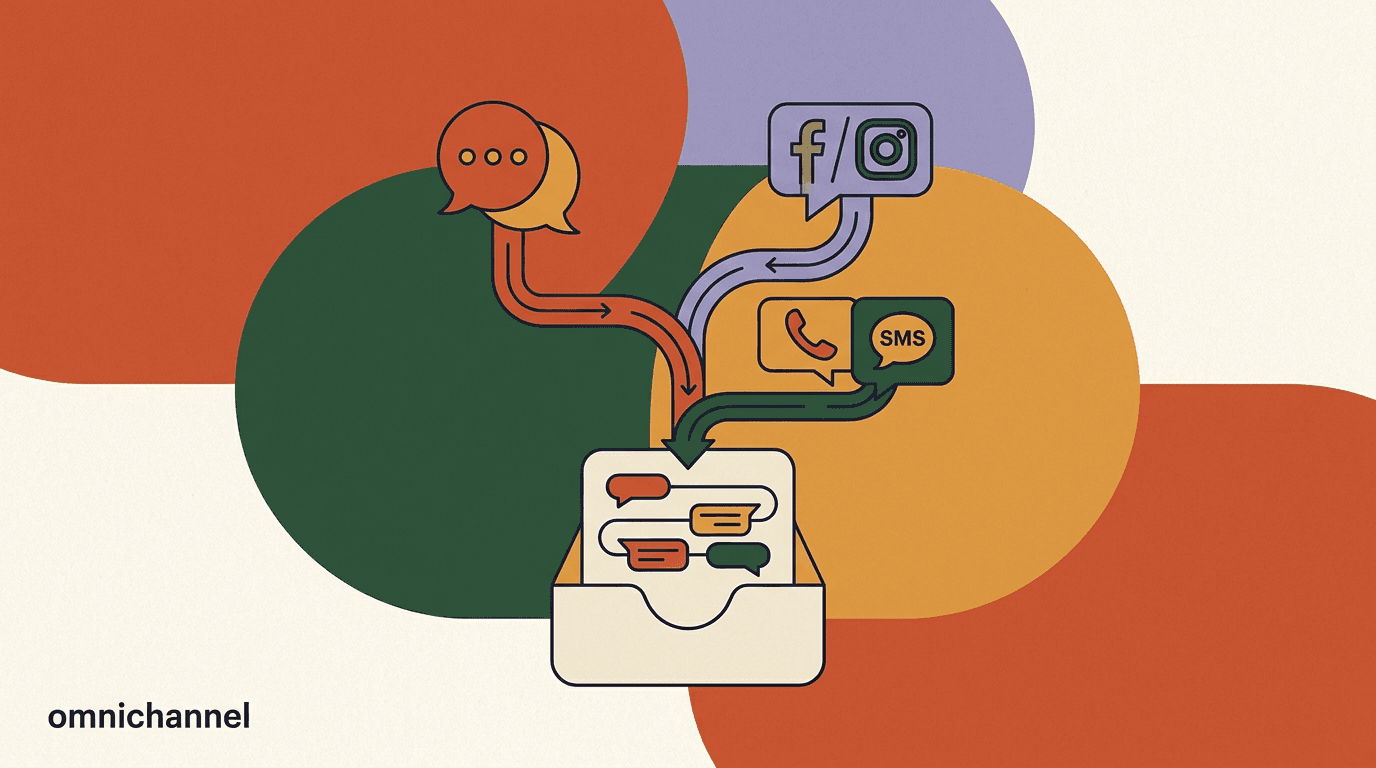
Omnichannel collapses those silos. The Monday message and the Thursday email are the same thread, attached to the same person, visible to whoever picks it up next, with the full history one scroll away. The agent does not ask the customer to repeat themselves because the agent can already see what happened. That continuity is the whole game, and it is exactly the part that gets quietly dropped when a multichannel tool slaps on the omnichannel label.
| Dimension | Multichannel | True omnichannel |
|---|---|---|
| Core idea | Be present on many channels | One conversation across channels |
| Customer record | Often duplicated per channel | One identity, one history |
| Conversation | Separate thread per channel | One continuous thread |
| Context handoff | Manual copy-paste or lost | Travels automatically |
| Agent experience | Switch tabs, re-ask questions | Full history in one place |
| Marketing metaphor | Many doors into the building | One room with many entrances |
A one-line gut check
Multichannel is many doors into the same building, each opening onto a different room. Omnichannel is one room that happens to have many doors. If your customer has to re-explain themselves after walking through a second door, you have a multichannel tool wearing an omnichannel label.
Why did 'omnichannel' become a buzzword?
Buzzwords are not born from malice. They are born from a real idea that proved hard to deliver and easy to claim. Omnichannel started as a difficult engineering and operational problem — unifying identity and context across systems that were never designed to talk to each other. Solving it properly is expensive and unglamorous. Claiming it is free.
Three forces pushed the word toward emptiness. First, the gap between claim and capability is invisible at the point of sale. A buyer comparing homepages cannot see whether context actually travels; they can only count the channel logos, so vendors compete on logo count. Second, the term carries a premium. Saying omnichannel signals modern and complete in a way that multichannel does not, so even honestly multichannel products reach for it. Third, nobody polices the definition. There is no certification, no standard, no referee. The word means whatever the loudest marketing says it means.
The result is predictable. The market optimizes for the claim, not the capability, because the claim is what gets rewarded at purchase time. The actual continuity — the thing customers feel and remember — only reveals itself months later, in the daily friction of switching tabs and re-asking questions. By then the contract is signed.
How the word drifts in practice
- What the homepage says
- Omnichannel inbox for all your channels
- What ships
- Six channel tabs, each with its own separate list of conversations
- What the customer feels
- Repeats their order number on every new channel
- What omnichannel should mean
- One thread, one identity, context that carries
What does fake omnichannel cost you in practice?
The drift would be harmless if it were only a naming quibble. It is not. When a tool promises omnichannel and delivers multichannel, the gap turns into a daily tax paid by your team and your customers. The cost is hidden because it is spread across thousands of small moments rather than landing as a single line item, but it is real and it compounds.
Start with the customer side. A person who has to re-explain their situation every time they switch channels learns, quickly, that this business does not remember them. That erodes trust in a way no marketing campaign can repair, because the company is contradicting its own promise in real time. They were told they would be recognized; they are treated as a stranger. The dissonance between the brand's claim and the lived experience is corrosive precisely because it happens at the most sensitive moment, when the customer is already reaching out for help.
Now the team side. Without carried context, every conversation that crosses a channel becomes a small investigation. Who is this person? Have we talked before? Where is that order number they mentioned? Agents spend their attention reconstructing history instead of solving problems, and that reconstruction is where errors creep in — a wrong order pulled up, a promise made twice, a refund missed. Multiply those minutes across a busy week and the lost time is substantial, but the lost accuracy is worse, because a confident wrong answer damages more than a slow right one.
There is a slower cost too, harder to see and harder to undo: the data never accumulates into a picture. When each channel keeps its own fragment, no one ever has the whole record of a customer relationship. Patterns that would be obvious in a unified history stay invisible. You cannot see that your best customers always start on Instagram and convert on WhatsApp, because your tools have never let those two halves meet. Fake omnichannel does not just slow you down in the moment; it quietly prevents you from ever learning from your own conversations.
- Customer trust erodes each time they have to repeat themselves on a new channel.
- Agents burn attention reconstructing history instead of resolving the issue.
- Reconstruction breeds errors: wrong orders, duplicated promises, missed follow-ups.
- Fragmented data never forms a full picture, so you cannot learn from your own conversations.
- The cost is invisible per incident and severe in aggregate — the worst kind of tax to budget for.
The tax is paid in trust, not just time
The minutes agents lose to context-hunting are recoverable. The trust a customer loses when a business forgets them mid-conversation is not. Fake omnichannel charges you on both, and the trust line is the one that does not show up on any invoice.
What does true omnichannel actually require?
If the count of channels is the wrong test, what is the right one? True omnichannel rests on a small number of hard requirements. None of them are about how many logos a tool can display. All of them are about whether a single customer stays a single customer as they move.
Here is the substance behind the word — the capabilities a tool needs before omnichannel describes it honestly.
- Unified identity: the same person is recognized as one customer across every channel, not re-created as a fresh contact each time they appear somewhere new.
- One continuous conversation: messages from different channels merge into a single thread in time order, so the history reads as one story rather than five fragments.
- Shared context: notes, tags, order history, and prior answers are attached to the person and visible everywhere, not trapped in the channel where they were created.
- Frictionless handoff: when a teammate or an automation takes over, they inherit the full context instantly, with no copy-paste and no 'can you remind me what this is about?'
- Consistent capability: the same automations, the same canned replies, the same routing work across channels, instead of each channel having its own half-built feature set.
Channel count is a vanity metric
A tool that supports twenty channels but keeps twenty separate conversation lists is less omnichannel than a tool that supports four channels with one shared thread and one identity. Counting logos measures reach. It does not measure continuity, and continuity is the whole definition.
Why is unified identity the hardest part?
Of all the requirements, unified identity is the one that separates serious tools from cosmetic ones, and it is worth understanding why it is genuinely hard. The problem is that the same human being shows up under different keys on different channels. On Instagram they are a username. On WhatsApp they are a phone number. On Telegram they are yet another handle. None of these identifiers natively know about the others. To treat them as one customer, a tool has to resolve those separate keys into a single person — and the platforms deliberately do not hand you the connective tissue to make that automatic.
This is why so many tools quietly skip it. Receiving messages from six channels is comparatively easy; each platform offers an API for that. Deciding that the Instagram username and the WhatsApp number belong to the same human is a modeling problem with no clean answer, and it requires the product to be built around a person-first data model rather than a channel-first one. A channel-first tool stores conversations under channels and bolts identity on as an afterthought, which is exactly why its contacts end up duplicated. A person-first tool stores conversations under people and attaches channels to them, which is what makes continuity possible at all.
The practical consequence for you as a buyer is that identity is the thing to probe hardest, because it is the thing most likely to be faked. A tool can show you a slick unified inbox that is really just a merged view of separate channel threads, with no underlying notion that two of those threads are the same person. The moment you test it with a single customer on two channels, the illusion breaks: two contacts, two histories, no link. That break is not a bug you can configure away. It is the architecture telling the truth about itself.
Channel-first vs. person-first data models
- Channel-first tool
- Stores conversations under channels; identity bolted on; contacts duplicate
- Person-first tool
- Stores conversations under people; channels attach to the person
- What the test reveals
- Two channels, same person: one record or two?
Why does a unified inbox matter more than a long channel list?
The unified inbox is where omnichannel either becomes real or stays a slogan. It is the surface where context actually lives. A long list of supported channels tells you a tool can receive messages from many places. A genuinely unified inbox tells you those messages land in one place, attached to one person, in one readable history. Only the second one changes how the work feels.
Think about the day-to-day reality of a small team handling customer messages. Without a unified inbox, every channel is a separate tab, a separate queue, a separate mental model. An agent finishes an Instagram conversation, switches to WhatsApp, and has no idea the same customer is also waiting there with a related question. The customer experiences this as a company that does not remember them. The team experiences it as constant context-switching, which is exhausting and error-prone.
With a unified inbox, the same agent sees both messages as one thread under one name. The context is right there. The reply is faster and more accurate because nobody is reconstructing history from scratch. This is the difference the word omnichannel was supposed to capture, and it is why a unified inbox is a better proxy for real omnichannel than any channel count could ever be.
Same customer, two inbox designs
- Channel-list inbox
- Instagram tab and WhatsApp tab show the customer as two unrelated conversations
- Unified inbox
- Both messages appear in one thread under one name, in time order
- Time to context
- Tab-switching and guesswork vs. a single scroll
- Customer feeling
- 'They don't remember me' vs. 'They picked up where we left off'
How do you evaluate a tool that claims omnichannel?
Because no one polices the word, the burden of definition falls on you, the buyer. The good news is that you do not need to take any homepage at its word. A short, deliberate test during a trial will tell you more than any feature list. The trick is to test for continuity, not for presence — to check whether context travels, not whether channels exist.
Run this exact sequence on any tool that calls itself omnichannel. It takes ten minutes and it cuts straight through the marketing.
- Message yourself on channel ASend a test message from one channel — say Instagram — and include a unique detail, like a fake order number. Reply to it inside the tool and add a note or a tag.
- Message yourself on channel B as the same personNow reach out from a different channel the same identity controls — WhatsApp or Telegram. Reference the earlier conversation as a customer naturally would.
- Check whether the tool connects the twoDoes the second message land in the same thread, under the same person, with the note and tag you added still visible? Or is it a brand-new, blank conversation with no memory of channel A?
- Test the handoffAssign the conversation to a teammate, or trigger an automation. Do they inherit the full history and context, or do they start cold?
- Score continuity, not channel countIgnore how many logos the homepage listed. Rate the tool on whether context carried through every step above. That score is its real omnichannel rating.
Trial the friction, not the feature list
Feature lists are written to win comparisons. Daily friction is what you actually live with. Spend your trial reproducing your real workflow across two channels and watch where context drops. That is the only test that predicts how the tool will feel in month three.
What questions should you ask a vendor?
If you cannot fully test a tool before buying, push the vendor with questions designed to separate continuity from channel count. Vague answers are themselves an answer. A tool built for real omnichannel can describe its identity and context model crisply, because that model is the heart of the product. A multichannel tool wearing the label will deflect toward its channel list.
These are the questions that get past the slogan.
- When the same customer messages on two channels, do those become one conversation or two? Ask them to show it, not describe it.
- Is there one customer record across channels, or one per channel? Duplicated records are a tell that identity is not unified.
- Do notes, tags, and history attach to the person or to the channel thread? Channel-scoped context is silo-shaped continuity.
- When a teammate picks up a conversation, what do they see? If the answer involves searching other tabs, handoff is not solved.
- Which capabilities differ by channel? Honest vendors will name the gaps; evasive ones will claim parity everywhere.
- Where does context not travel? Every real tool has limits — a vendor who admits theirs is more trustworthy than one who claims none.
Specific answers signal a real model
A vendor who can describe exactly how identity is resolved and where context lives has built for continuity. A vendor who answers every question by pointing at the channel list is selling multichannel. The shape of the answer tells you the shape of the product.
What are the common red flags in omnichannel marketing copy?
Once you know what to look for, the marketing copy itself becomes a useful signal. Vendors reveal a great deal in how they describe their product, often without meaning to. The language a tool reaches for tends to match the thing it actually built. A continuity-first product talks about customers, conversations, and context. A channel-first product talks about coverage, integrations, and how many platforms it touches. Neither vocabulary is dishonest on its own, but the emphasis is a tell.
Watch for copy that leads with a wall of channel logos and never explains what happens when the same person appears on two of them. That ordering is not an accident; it reflects where the product's strength lies and where the buyer's attention is being steered. Watch, too, for the word that promises an experience with no friction at all — the kind of total smoothness no real software delivers across systems it does not control. Sweeping, absolute claims are usually inversely correlated with the honesty of the limits underneath them. The tool that admits it does not cover everything is, paradoxically, the one more likely to deliver continuity where it does operate.
The strongest positive signal is specificity about the hard parts. A vendor that volunteers how it handles a customer messaging from two channels, what its automations can and cannot do per channel, and where its coverage stops is telling you it has thought about continuity seriously enough to know its own edges. Vagueness in those exact spots is the red flag. If the homepage is confident about reach and evasive about memory, you have learned which one the product is built for.
- Leading with a logo wall and never addressing the same-customer-on-two-channels case.
- Absolute promises of total smoothness with no stated limits anywhere.
- Channel-coverage language ('all your channels') crowding out customer-continuity language.
- Evasiveness on identity resolution and per-channel feature parity.
- No acknowledgment of which channels or capabilities the tool does not support.
Read for what the copy avoids
What a homepage refuses to discuss is as revealing as what it boasts about. If a tool is loud about channel count and silent about what happens when one customer crosses channels, it is telling you exactly where it is strong and where it is hollow.
Is 'every channel' even a realistic goal?
There is a quieter problem hiding inside the omnichannel promise: the implied claim of completeness. Omni means all. Taken literally, omnichannel would mean every channel a customer might ever use — social DMs, email, SMS, live chat, phone, in-app, the help center, and whatever launches next quarter. No tool actually does all of that well, and the ones that try tend to do many things shallowly rather than a few things deeply.
This is where honesty matters more than ambition. A tool that is excellent across a coherent set of channels — say, social messaging — and is upfront that it does not cover SMS or email is more useful than a tool that claims everything and delivers a thin layer over each. Coverage is not free; every channel a vendor genuinely supports is real engineering and real maintenance. Breadth and depth trade against each other, and pretending they do not is how you end up with shallow everything.
So the realistic version of the goal is not literally every channel. It is one continuous experience across the channels that matter most to your customers, with clear honesty about the edges. A focused tool that nails continuity within its scope beats a sprawling one that fakes continuity everywhere. The word omni oversells; the right question is whether the tool is truly continuous across the channels you actually use.
Two honesty postures
- Overclaiming tool
- 'Every channel, fully unified' — thin coverage, context drops at the edges
- Honest tool
- 'Deeply unified across these channels; we don't do X' — context holds within scope
- Which to trust
- The one that names its limits
What does 'good enough' omnichannel look like in practice?
Most teams do not need omnichannel across every surface a customer could theoretically use. They need it across the two or three channels where most of their conversations actually happen. For a creator or a small brand in 2025, that cluster is overwhelmingly social: Instagram and Facebook DMs, WhatsApp, Telegram, and increasingly TikTok and X. If those are unified — one thread, one identity, shared context — the customer experience already feels continuous in the moments that count.
This reframes the buying decision in a healthier way. Instead of chasing the longest channel list, you map where your customers actually message you, then look for genuine continuity across that specific set. A tool that delivers real omnichannel within your real channel mix will beat a broader tool that delivers fake omnichannel across channels you never use. Practical continuity in the right places outperforms theoretical completeness everywhere.
Good enough, in other words, is not a compromise. It is the correct target. The customer who messages you on Instagram and follows up on WhatsApp does not care that your tool lacks SMS. They care that you remembered them. Get that right across your core channels and you have delivered the substance of omnichannel, whatever the homepage chooses to call it.
Map your channels before you shop
List the channels where you actually receive customer messages, ranked by volume. Then evaluate tools only on whether context carries across that list. The exercise instantly demotes channel-count marketing and promotes the continuity that matters to your customers.
Does AI change what omnichannel should mean?
The rise of AI agents handling first-response messaging has raised the stakes on this definition, and it is worth being clear about why. An AI agent is only as good as the context it can see. Point an AI at a single channel's thread, with no memory that the same customer asked something related on a different channel yesterday, and it will answer confidently from half the picture. It will tell a returning customer to do something they already tried, or treat a known buyer as a brand-new lead. The shallow-context problem that annoys human agents becomes an outright failure mode for automated ones, because the AI cannot use judgment to sense that it is missing something.
This means AI raises the floor for what counts as acceptable omnichannel. In a human-only world, a fragmented setup is merely inefficient; a sharp agent can paper over gaps with intuition. In an AI-assisted world, fragmentation produces wrong answers at scale, instantly, to many customers at once. The unified context that omnichannel was always supposed to provide is now the precondition for automation that does not embarrass you. An AI agent on top of true omnichannel can pick up a conversation that started on Instagram and continue it on WhatsApp with full knowledge of what came before. An AI agent on top of fake omnichannel is a confident stranger every time the channel changes.
So the AI era does not change what omnichannel should mean — it makes the original meaning more important, not less. Continuity was always the point. Now it is also the thing standing between you and an automation that hallucinates context it does not have. When you evaluate a tool that pairs AI with an omnichannel claim, the test is the same as before, just more consequential: does the AI inherit the full cross-channel history, or only the current channel's slice?
AI is only as continuous as its inbox
An AI agent inherits whatever context the inbox provides. On a truly unified inbox it answers from the full customer history; on a fragmented one it answers confidently from a fragment. The omnichannel question and the AI-quality question are now the same question.
Where does KlyoChat sit on this spectrum?
Since we have spent this whole piece insisting on honesty, here is ours. KlyoChat is an AI-native unified inbox for social messaging. We bring Facebook, Instagram, Telegram, WhatsApp, TikTok, and X into one place, where a customer is one identity and their messages across those channels form one continuous conversation with shared context. By the definition we have argued for — continuity, not channel count — that is the omnichannel substance, delivered across the social channels where most creators and small brands actually talk to people.
And here is the limit, stated as plainly as the rest. KlyoChat does not do native SMS or email. So we are not omnichannel in the literal, every-channel sense, and we are not going to use the word as if we were. What we offer is true continuity across social DMs and WhatsApp — one inbox, one thread, one context — which is the cluster that matters most for our audience. If your strategy leans heavily on SMS or email, that is a real gap, and you should weigh it honestly. We would rather you know that now than discover it in month two.
We are also a newer, smaller product with a smaller community than the long-established players. We mention that for the same reason we mention the channel scope: the point of this article is to judge tools against an honest standard, and that standard applies to us too. KlyoChat Pro is $49/month, or $39/month billed yearly, and there is a 7-day free trial with no credit card — which means you can run the continuity test from earlier on our actual product rather than taking our word for any of this.
Hold us to the same test
Run the two-channel continuity check on KlyoChat during your trial. Message yourself on Instagram, follow up on WhatsApp, and watch whether it lands as one thread. If it does not, the word does not apply to us either — and you should hold every vendor, ours included, to exactly that bar.
KlyoChat against the omnichannel standard
- Continuity across social DMs
- One thread, one identity, shared context — yes
- Channels covered
- Facebook, Instagram, Telegram, WhatsApp, TikTok, X
- Honest limit
- No native SMS or email — not literally every channel
- Try it yourself
- 7-day free trial, no card; Pro $49/mo ($39 yearly)
How should you think about omnichannel going forward?
The practical takeaway is to treat omnichannel as a description of an experience, not a label on a box. The experience is continuity: a customer moves between channels and never has to start over, and your team always has the full picture. When you read the word on a homepage, mentally translate it into a question — does context travel here? — and then go find out.
Stop counting channels. Start testing continuity. A tool with four deeply unified channels serves your customers better than a tool with twelve disconnected ones, because the customer feels memory, not menus. The channel count is the number vendors want you to compare on precisely because it is the easy claim. The continuity is the number that predicts how the tool will actually feel, and it is the one you have to test for yourself.
And demand honesty about limits, including from us. A vendor who names the channels they do not cover and the places context does not travel is giving you the information you need to choose well. A vendor who claims smooth everything is selling the buzzword, not the substance. The omnichannel marketing reality is that the word has been emptied out — but the idea underneath it is still real, still valuable, and still worth holding tools to. Use the test, ask the questions, and let continuity, not logos, decide.
The whole article in one sentence
Omnichannel should mean one continuous conversation with one shared context across the channels your customers actually use — so judge every tool, including KlyoChat, by whether context travels, not by how many logos it lists.