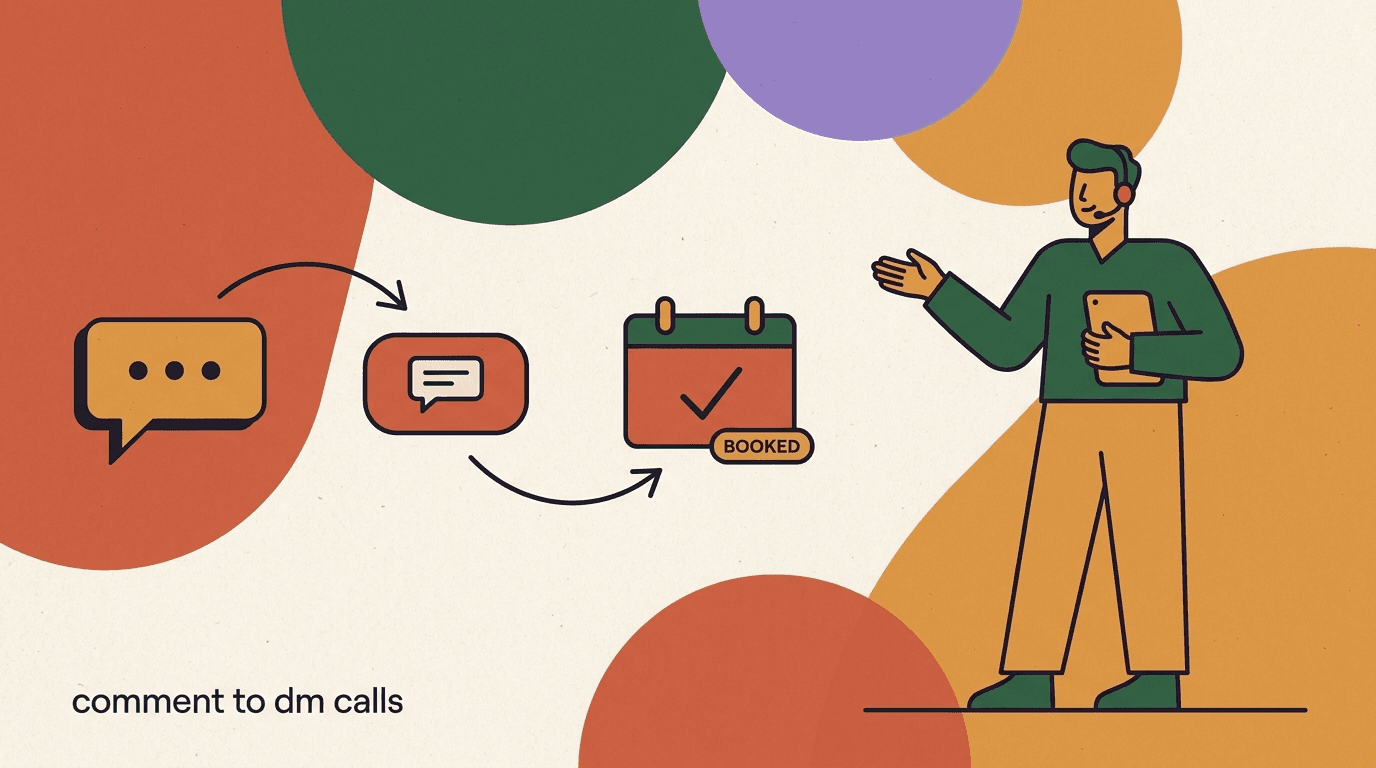
A comment to dm coaching flow is the shortest reliable path from an Instagram post to a booked discovery call. Someone watches your Reel, types a word you asked for, and within seconds your account opens a private conversation, asks a couple of questions to see if they are a fit, and sends them your booking link — all without you sitting in the inbox. For a coach, that is the difference between content that gets likes and content that fills your calendar.
Most coaches already get the comments. What they do not have is the bridge. A comment sits in public, gets buried under the next ten comments, and the person who was genuinely interested forgets about you by the time they scroll away. The flow we are going to build closes that gap. It catches the interest at the exact moment it is highest and moves it into a one-to-one space where a real conversation — and a booking — can happen.
This guide walks through one specific build: the single comment-to-call flow. Not a general funnel, and not a multi-day nurture sequence, but the focused path that takes a comment and ends with a call on your calendar. We will cover the trigger keyword, the opening DM, the qualifying questions, how to make the offer, the booking handoff, and the follow-up for people who go quiet. You will get sample copy you can adapt, two comparison tables, and the honest limits you need to respect so Meta does not throttle your account.
We build KlyoChat, an AI-native tool for exactly this kind of flow, so we have a point of view and we will say where the product fits near the end. Everything before that is platform-agnostic and works whether you build it in KlyoChat or anywhere else. There are no income promises here — a flow books calls, it does not guarantee that those calls become clients. That part is still your job.
What is a comment-to-DM flow for coaches, and why does it book calls?
A comment-to-DM flow is an automation that watches your posts for a specific word in the comments and, when someone types it, automatically opens a direct message with that person. For coaches, the DM is not the destination — it is the on-ramp. The destination is a booked call, and the DM exists to qualify the person and walk them to your calendar.
It books calls because of timing and friction. The moment someone comments is the moment they are most interested. If you make them go find your link in bio, open a separate calendar tool, and figure out whether they are even a fit for your program, most of them drop off. Each extra step loses people. The comment-to-DM flow collapses all of that into a single conversation that starts in the place they already are.
It also books calls because it is personal without being manual. A DM feels like a one-to-one message, not a broadcast. When your flow asks a real question and waits for a real answer, the prospect feels seen. That feeling is what moves a curious follower into a committed booking — and it is very hard to create at scale by hand.
- Catches interest at its peak, the second someone comments.
- Moves a public comment into a private, one-to-one conversation.
- Qualifies before the call, so you spend call time on real prospects.
- Runs every hour without you watching the inbox.
This is the single comment-to-call flow
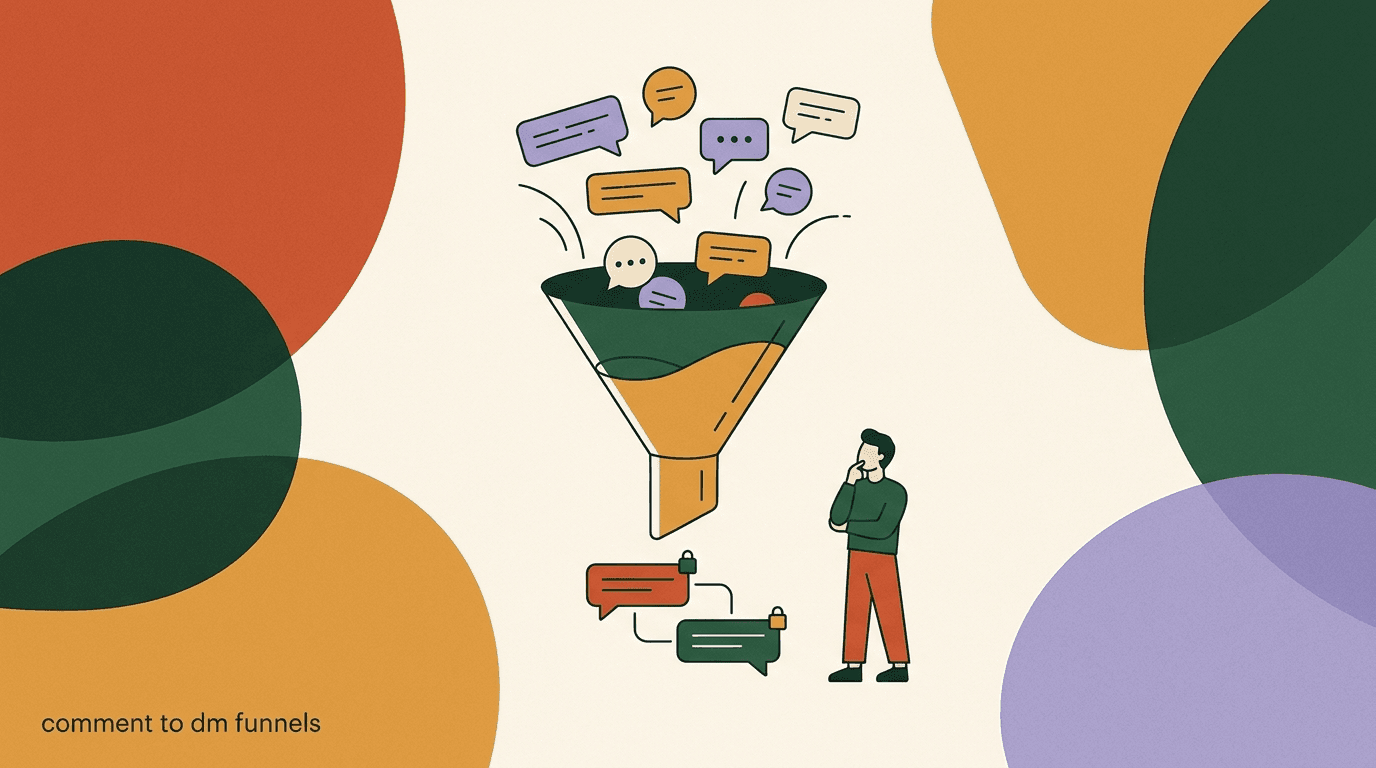
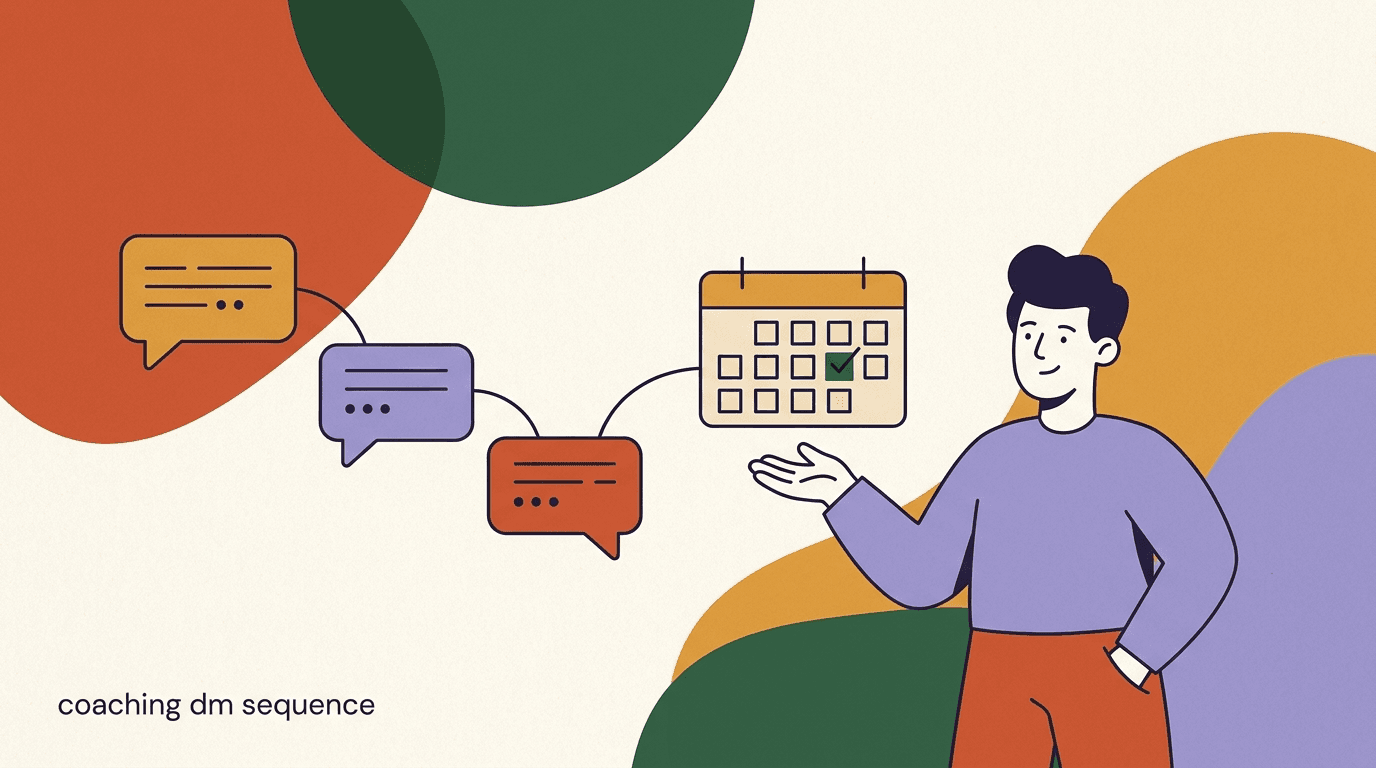
This guide is deliberately narrow. For a broader view of capturing leads across many post types, see our piece on comment-to-DM funnels. For what happens over the following days when someone is not ready to book yet, see our coaching DM sequence guide. This post is the one flow that gets a call on the calendar.
What do you need before you build the flow?
Before you touch any flow builder, get four things in order. Skipping these is the most common reason a comment-to-DM coaching flow underperforms — the automation works fine, but it points at nothing, or it points at the wrong people.
Take twenty minutes on this. A clear offer and a working booking link do more for your booked-call rate than any clever copy.
- A clear call offerDecide what the call is. A free discovery call? A paid strategy session? A fit assessment? Name it in one sentence the prospect can repeat. Vague offers get vague responses.
- A working booking linkUse any scheduler — Calendly, Cal.com, TidyCal, your own page. Test it on your phone. If the link is broken or slow, the flow dies at the last step.
- One or two qualifying criteriaKnow who the call is for. Budget range, stage of business, specific problem — pick the one or two filters that separate a real prospect from a tire-kicker.
- A post or Reel worth commenting onThe flow needs a trigger. Plan content where asking people to comment a word feels natural — a tip post, a results breakdown, a 'comment WORD and I'll send it' hook.
Write your offer sentence first
Before anything else, finish this sentence: 'This call is a [length] [free/paid] call where we [outcome] for [who it is for].' If you cannot finish it cleanly, the flow will feel fuzzy to prospects too. Clarity here pays off at every step downstream.
How do you choose the trigger keyword?
The trigger keyword is the word people type to start the flow. It is small but it matters: the wrong keyword either fails to fire or fires for people who did not mean to start anything. The goal is a word that is intentional, easy to spell, and unlikely to appear in normal conversation about your post.
Single words beat phrases. 'CALL' is better than 'I want a call', because you cannot rely on people typing an exact phrase. Most tools match on the keyword appearing anywhere in the comment, so a short, distinct word catches the most people with the fewest false triggers. Avoid common words like 'yes' or 'me' that show up in unrelated comments and will fire your flow at the wrong people.
Match the keyword to the offer so the comment doubles as a public signal. If your Reel is about a free audit, 'AUDIT' works. If it is a strategy call, 'STRATEGY' or 'CALL' works. When other people scroll the comments and see a string of 'CALL' replies, that social proof quietly pulls more of them in.
| Keyword type | Example | Verdict |
|---|---|---|
| Short, distinct, on-topic | CALL, AUDIT, READY | Best — intentional and easy to match |
| Common everyday word | YES, ME, INFO | Risky — fires on unrelated comments |
| Long phrase | I want a coaching call | Weak — hard to match exactly |
| Emoji only | A single emoji | Avoid — inconsistent matching across devices |
Say the keyword out loud in the content
In the Reel or caption, tell people exactly what to type: 'Comment the word CALL and I'll send you the details.' Spell it, show it on screen, and repeat it. The clearer the instruction, the higher the trigger rate. Do not make people guess.
What should the opening DM say?
The opening DM is the first private message your flow sends after someone comments. It has one job: confirm you heard them and earn the next reply. It is not the place to pitch the call yet. People who just commented a single word are warm but not committed; a hard sell in message one feels like a bait-and-switch.
Lead with acknowledgement and a tiny bit of value, then ask one easy question. The question matters because Meta's rules — and basic courtesy — reward two-way conversation. A DM that ends in a question invites a reply, which keeps the conversation inside the 24-hour window where you can keep messaging freely. A DM that ends in a link is a dead end if they do not click.
Keep it short and human. Two or three lines. Use their interest as the hook ('You commented on my post about X') and make the first question genuinely easy to answer — a yes/no or a quick pick. You are lowering the cost of the next reply, not raising it.
Do not open with the booking link
Dropping your calendar link in the first message converts far worse than earning one reply first. A cold link with no context reads as spammy and gets ignored. Lead with a question, get one reply, then offer the call once they have engaged. The order is the whole game.
Opening DM — sample copy
- Line 1
- Hey! Thanks for commenting on the Reel about getting your first 10 clients.
- Line 2
- I put together a quick way to map this out on a call — but first, quick question:
- Line 3
- Are you coaching full-time yet, or building it on the side right now?
How do you qualify the prospect inside the DM?
Qualifying is where a coaching comment-to-DM flow earns its keep. The point is to learn enough to know whether this person is a fit for your call before you offer it — and, just as importantly, to make the prospect articulate their own problem out loud, which raises their intent to book.
Ask two or three questions, no more. Each one should map to a real decision: is this person in your niche, do they have the problem you solve, and are they at a stage where your call makes sense. If you sell a premium program, one of your questions can gently surface readiness — not a blunt 'what's your budget', but something like 'are you looking to invest in coaching this quarter, or still researching?' that lets people self-select.
Use buttons or quick replies where the tool allows. Multiple-choice answers are easier to give than open text, they keep the conversation moving, and they give you clean data to branch on. If someone picks the answer that means 'not a fit yet', you can route them to your nurture sequence instead of the booking link — which is better for both of you.
- Question 1 — niche fit: confirm they are the kind of person you coach.
- Question 2 — problem fit: confirm they have the problem your call solves.
- Question 3 — readiness (optional): let them self-select on timing or investment.
- Use quick-reply buttons so answering takes a tap, not a paragraph.
| Qualifying question | Why you ask it | How to branch |
|---|---|---|
| What are you working on right now? | Confirms niche and problem fit | On-fit answer → continue; off-fit → soft exit |
| How long have you been coaching? | Reveals stage and readiness | Established → offer call; brand new → nurture |
| Ready to invest this quarter, or researching? | Surfaces buying intent gently | Ready → book now; researching → sequence |
Three questions is the ceiling, not the target
Every extra question loses a few people. If you can qualify with two, do it with two. The fastest-converting flows ask the minimum needed to know whether to offer the call. Treat each question as a cost and only spend it when the answer changes what you do next.
When and how do you offer the call?
Offer the call only after the prospect has answered your qualifying questions and the answers say they are a fit. Timing is everything. Offer too early and you are pitching a stranger; offer too late and the energy fades. The sweet spot is right after they have described their situation, because in that moment the call feels like the obvious next step rather than a sales move.
Frame the call around their answer, not your program. If they said they are stuck getting their first clients, the offer is 'a call to map out your path to your first 10 clients' — not 'a call to learn about my coaching package'. The call should feel like a continuation of the conversation you just had, aimed at their stated problem.
Make the offer a single, clear message with one action. State what the call is, how long it takes, what they will leave with, and then — and only then — the booking link. One offer, one link, one next step. If they hesitate, you can answer an objection, but do not stack three different asks into one message.
One offer, one link, one action
Resist the urge to add a freebie, a second link, and a PS to the offer message. The clearer the single next action, the more people take it. If they need more information, they will ask — and then you answer. Clutter in the offer message lowers the booking rate.
Call offer — sample copy
- Setup
- Got it — first clients is exactly what I help with.
- The offer
- Want to hop on a free 20-minute call? We'll map out a realistic plan to land your first 10.
- The link
- Grab a time that works here: [booking link]
How does the booking handoff work?
The booking handoff is the moment the conversation leaves your DM and lands on your calendar. It is the most fragile step because it depends on an external tool and on the prospect actually finishing the booking. Two things make or break it: the link must work flawlessly on mobile, and the flow should confirm the booking so the prospect feels held, not dropped.
Send the booking link in its own message, not buried in a paragraph, so it is tappable and obvious. After they book, if your tool can detect the confirmation — through a webhook, a tag, or a reply — send a short follow-up that confirms the time and sets expectations for the call. Even a simple 'You're booked for Tuesday at 2 — talk soon!' reduces no-shows because it makes the appointment feel real.
If your scheduler cannot talk back to your DM tool, build a lightweight version: ask the prospect to reply 'booked' once they have a time, and trigger the confirmation message off that. It is not perfect, but it keeps the loop closed and gives you a signal to follow up on the ones who never reply.
- Send the link cleanlyPut the booking link in its own message. Test it on a phone first — most prospects book from mobile.
- Confirm the bookingWhen the booking is detected (webhook, tag, or a 'booked' reply), send a short confirmation with the time and what to bring.
- Set the no-show guardrailSchedule a reminder before the call. A single reminder the day before measurably cuts no-shows.
A broken link wastes every step before it
You can run a perfect trigger, opener, and qualification, and lose the whole thing to a calendar link that 404s on mobile or shows no available times. Check your scheduler weekly: open the live link on a phone and confirm there are bookable slots in the next few days.
How do you follow up with people who go quiet?
Most people who start your flow will not finish it on the first pass. They get the opening DM, answer one question, get distracted, and never come back. Following up with these people is where a surprising share of your bookings actually come from — but you have to do it within the rules.
Inside the 24-hour window after a person's last message, you can send a follow-up freely. Use it. A single, gentle nudge — 'Still want me to send that call link?' — recovers people who simply got busy. Keep it light and low-pressure; you are reminding, not chasing.
Outside the 24-hour window, Meta restricts what you can send to approved message tags and limits promotional content. This is where a multi-day nurture sequence takes over rather than another sales nudge. The honest move is to route the quiet, not-yet-ready people into that longer nurture and keep the comment-to-call flow focused on the people who are ready now. We cover that handoff in our coaching DM sequence guide.
- One nudge inside 24 hours recovers people who just got busy.
- Keep the nudge short and low-pressure — a reminder, not a chase.
- Outside 24 hours, respect Meta's messaging window and tag rules.
- Route not-ready people to a nurture sequence instead of more sales nudges.
Respect the 24-hour window
Meta's messaging rules limit promotional messages outside a 24-hour window from the user's last interaction. Build your follow-up around that window — free nudges inside it, compliant tags or a nurture sequence outside it. Ignoring this risks message failures and, over time, account restrictions. The rules protect your account; work with them.
What does the whole flow look like end to end?
It helps to see the entire path in one place before you build it, because each step only makes sense in relation to the one before and after it. The flow is short by design — six moves from comment to confirmed call — and every move has a single job. If any one of them tries to do two jobs, the flow gets heavier and fewer people make it to the end.
Here is the full sequence as a prospect experiences it. They watch your Reel about landing first clients, they read the on-screen instruction to comment CALL, and they type it. Within seconds a DM lands acknowledging their comment and asking whether they coach full-time or on the side. They tap an answer. A second question surfaces their main blocker. They answer again. Now the flow knows they are a fit, so it offers a free twenty-minute call framed around their exact blocker and sends a clean booking link. They tap a time, and a confirmation message lands telling them when the call is and what to bring. The day before, a reminder fires. From their side it felt like a quick, friendly chat with a coach who got them. From your side, it ran while you slept.
Notice what is not in that sequence: no link in the first message, no five-question interrogation, no pitch about your program before they have said a word about themselves. The restraint is the design. Each thing you leave out is a place a prospect could have dropped, so a leaner flow books more calls than a fuller one almost every time.
| Step | What fires | What the prospect does |
|---|---|---|
| 1. Trigger | Comment keyword detected | Types CALL on the Reel |
| 2. Opener | Warm DM with one easy question | Replies to the question |
| 3. Qualify | Two or three quick-reply questions | Taps answers |
| 4. Offer | Call offer framed on their answer | Reads the offer |
| 5. Handoff | Booking link in its own message | Picks a time |
| 6. Confirm | Confirmation + day-before reminder | Shows up to the call |
Six moves, one job each
If you ever feel the flow getting complicated, come back to this six-step shape. Trigger, open, qualify, offer, hand off, confirm. Anything that does not serve one of those six moves is probably a distraction that is costing you bookings.
How do you tie the flow to content that actually triggers it?
A comment-to-DM coaching flow is only as good as the content that feeds it. The most carefully built flow books nothing if no one comments the keyword. So the flow and the content have to be designed together: the post earns the comment, and the flow converts it. Treating them as separate jobs is why so many coaches have a working flow that sits idle.
The content that triggers well shares a pattern. It promises something specific and valuable in exchange for a single comment — a resource, a breakdown, a call. The promise has to be worth typing a word for. 'Comment CALL and I'll help you map your first ten clients on a free call' works because the trade is clear and the value is concrete. 'Comment if you agree' does not, because there is nothing in it for the prospect.
Put the instruction everywhere the prospect looks: spoken in the Reel, written on screen, and repeated in the caption. People miss instructions constantly, so over-communicate. And keep the keyword consistent across the post so there is no ambiguity about exactly what to type. The clearer and more repeated the ask, the more comments your flow gets to work with.
- Lead the content with a specific, valuable promise tied to the comment.
- Make the trade obvious — what they get for typing one word.
- Repeat the keyword in the audio, on screen, and in the caption.
- Use content where asking for a comment feels natural, not forced.
The flow and the content are one system
Do not build the flow in isolation. Plan the post and the flow together so the promise in the content matches exactly what the flow delivers. When they line up, the comment-to-call rate climbs. When they drift apart, prospects feel a bait-and-switch and leave.
Content hook — weak vs. strong
- Weak hook
- Comment below if this resonates with you.
- Strong hook
- Comment CALL and I'll send you a free 20-min plan for your first 10 clients.
How do you write the copy so it sounds like you?
Automated does not have to mean robotic. The flows that book the most coaching calls read like the coach actually typed them. That means your voice, your phrasing, and the way you would genuinely talk to a new prospect in your DMs — not stiff corporate copy.
Write the whole flow as if it were one real conversation. Read it out loud start to finish. If any line is something you would never say to a person's face, rewrite it. Contractions, short sentences, and a warm opener go a long way. The goal is for a prospect to never be sure whether they are talking to you or your automation — and to not care, because it feels like you either way.
Personalize where you can. Reference the specific post they commented on. Use their first name if the tool pulls it. Mirror the language they used in their answers when you make the offer. Small touches like these are what separate a flow that converts from one that feels like a vending machine.
The read-aloud test
Before you publish, read every message in the flow out loud in order, as if you were speaking to one person. Anything that makes you cringe gets rewritten. This single test catches more conversion-killing copy than any framework.
Robotic vs. human copy
- Robotic
- Thank you for your interest. Please answer the following question to proceed.
- Human
- Hey, glad you commented! Quick q before I send the details —
How do you test and improve the flow?
Build it, then prove it works before you point real traffic at it. The most common failure is a flow that looks right in the builder but breaks in a real DM — a keyword that does not match, a button that goes nowhere, a link that is wrong. Testing takes ten minutes and saves you a week of silent failure.
Once it is live, improve it with numbers, not guesses. Track the conversion at each step: how many comment, how many reply to the opener, how many finish qualifying, how many click the link, how many actually book. The step where the biggest drop happens is the one to fix first. Usually it is one specific message, not the whole flow.
Change one thing at a time. Swap the opening DM and watch the reply rate. Reword the offer and watch the booking rate. If you change three things at once, you will never know which one moved the number. Small, isolated tweaks compound into a flow that books far more calls than the version you launched.
- Test from a second accountComment the keyword from a different account and walk the entire flow as a prospect would. Click every button and the final link.
- Track conversion per stepMeasure comment to reply, reply to qualified, qualified to link click, click to booking. Find the biggest drop-off.
- Fix the weakest stepRewrite the single message where most people leave. Re-measure. Then move to the next weakest step.
| Step | What a healthy flow looks like | If it's low, fix this |
|---|---|---|
| Comment → opener reply | Most people reply to the first DM | Make the opening question easier to answer |
| Reply → qualified | Most repliers finish your questions | Cut a question or use buttons |
| Qualified → link click | Most fits click the booking link | Sharpen the offer around their problem |
| Link click → booking | Most clickers pick a time | Fix the scheduler — slots, speed, mobile |
How do you know if the flow is actually working?
Bookings are the headline number, but they are also a lagging one. By the time your booked-call count tells you something is wrong, you have already lost a week of prospects. The way to manage a comment-to-DM coaching flow is to watch the leading numbers — the step-by-step conversions — and treat the booking count as the result they add up to.
There are really only a handful of numbers that matter. How many people comment the keyword tells you whether your content is doing its job. How many reply to the opener tells you whether your first message earns attention. How many finish qualifying tells you whether your questions are too many or too hard. How many click the link tells you whether your offer lands. And how many actually book tells you whether the scheduler and the offer match up. Each number isolates one part of the system, so a low number points straight at what to fix.
Set a rhythm. Glance at the leading numbers weekly and the booked-call total monthly. If a number dips, you usually know exactly which message to look at because each step maps to one message. This is far more useful than staring at a single conversion rate and guessing — and it is why analytics matter more than they sound for a flow this short.
| Metric | What it tells you | When to act |
|---|---|---|
| Keyword comments | Whether content drives the trigger | Low → fix the content hook |
| Opener reply rate | Whether the first DM earns attention | Low → soften the opening question |
| Qualify completion | Whether questions are too heavy | Low → cut a question, add buttons |
| Link click rate | Whether the offer lands | Low → tie the offer to their problem |
| Booking rate | Whether the scheduler matches up | Low → fix slots, speed, mobile |
Watch leading numbers, not just bookings
Bookings tell you what already happened. The per-step conversions tell you what is about to happen and exactly where to intervene. Check the leading numbers weekly so you fix problems while they are small, not after a dry month.
What are the common mistakes that kill bookings?
After watching a lot of these flows, the failures cluster into a short list of avoidable mistakes. None of them are about the technology — they are about judgment. Avoid these and your flow will outperform most coaches who set theirs up and never look again.
The biggest one is impatience: pitching the call before earning a reply. The second is over-qualifying — asking five questions and exhausting the prospect before the offer. The third is neglect — building the flow once and never checking that the link still works or the copy still fits the offer you sell today.
- Pitching the booking link in the first message instead of earning a reply.
- Asking too many qualifying questions and losing people before the offer.
- A booking link that is broken, slow, or shows no available times.
- Generic copy that reads like a form, not a coach.
- Ignoring Meta's 24-hour window and getting messages blocked.
- Building it once and never tracking or improving it.
Set-and-forget is the quiet killer
The flow that booked calls in January can quietly stop working by March — a renamed offer, a changed link, a new program. Put a recurring reminder to walk your own flow once a month. Ten minutes of maintenance protects your most important lead source.
How does KlyoChat help you build this flow?
Everything above works on any capable tool. We build KlyoChat to make this specific flow fast to set up and honest to run. It is an AI-native, mobile-first unified inbox that brings Facebook, Instagram, Telegram, WhatsApp, TikTok, and X into one place, with comment-to-DM, no-code flows, AI agents, and analytics included.
For a coaching comment-to-call flow, the relevant parts are the comment-to-DM trigger, the no-code flow builder for the opener-qualify-offer path, and the AI agents that can handle the qualifying conversation in your voice and walk a prospect to your booking link. Because the inbox is mobile-first, you can edit the flow and jump into a live conversation from your phone — useful when a high-value prospect wants to talk to a human before booking.
AI agents are included in the plans, not a separate add-on. An agent can answer follow-up questions, qualify against your criteria, and hand off to a human when the prospect asks something it should not guess at. Analytics show you the step-by-step conversion so you can fix the weakest message instead of guessing.
- 7-day free trial, no credit card — build the flow and test it before paying.
- AI agents included, so qualifying can run in your voice automatically.
- Honest limit: no native SMS or email — this flow lives on social DM.
- Honest limit: we are a newer, smaller community than the biggest incumbents.
- Respect Meta's rules and the 24-hour window — KlyoChat works within them, it does not get around them.
- No income guarantees: the flow books calls; turning calls into clients is still your work.
| Flow step | KlyoChat feature | Plan |
|---|---|---|
| Trigger on a comment | Comment-to-DM | All plans |
| Opener → qualify → offer | No-code flows | All plans |
| AI handles the conversation | Included AI agents | All plans (limits scale by tier) |
| Fix the weakest step | Built-in analytics | All plans |
| Reply from your phone | Mobile-first unified inbox | All plans |
What KlyoChat does not do
We do not offer native SMS or email, and we are newer than the largest players, with a smaller community. A comment-to-DM coaching flow is squarely in what KlyoChat is built for, but if your strategy depends on SMS or email in the same tool, factor that in. Start a trial at app.klyochat.com/signup or reach us via /contact with questions.
KlyoChat plans at a glance
- Basic
- $19/mo — small setups getting started with comment-to-DM
- Pro
- $49/mo ($39 billed yearly) — all channels and custom AI agents
- Business
- $129/mo — higher limits, more seats, API access
A comment to dm coaching flow is one of the highest-leverage things a coach can build: a single comment becomes a qualified, booked call, on repeat, without you living in the inbox. The pieces are simple — a clear trigger keyword, a warm opening DM, two or three qualifying questions, a sharp offer tied to the prospect's problem, a clean booking handoff, and a single follow-up inside the 24-hour window. The judgment is in earning the reply before you pitch, qualifying with the fewest questions, and maintaining the flow so it never quietly breaks.
Build this one flow first and get it converting before you complicate it. When you want to capture leads across more post types, read our comment-to-DM funnels guide; when you want to nurture the people who are interested but not ready to book, read our coaching DM sequence guide. Then, if you want a tool that makes this build fast and honest, start a free KlyoChat trial and walk your own flow end to end before you point real traffic at it.