A comment to dm funnel is the simple mechanic behind most of the 'comment WORD and I'll send it' posts you see on Instagram — and behind a surprising share of the leads creators and small brands actually close. Someone comments a keyword, an automation sends them a private message, and from there a short sequence qualifies them and points them at the next step. Done well, it converts attention into a conversation while the post is still warm.
Most guides stop at the mechanic: set a trigger, send a DM, done. This post is about the funnel — the part that decides whether those DMs turn into leads, signups, and sales, or just pile up unread. We will break down the five stages of a high-converting comment to dm funnel, walk through worked examples with sample copy for four common goals, give you benchmarks to aim for, and name the mistakes that quietly kill conversion.
Full disclosure: we build KlyoChat, an AI-native messaging platform with comment-to-DM funnels built in. Everything here works on any capable tool, and the examples are illustrative — sample copy and round-number benchmarks, not numbers from named customers. Where Meta's rules matter, we flag them, because a funnel that ignores the platform's policies does not stay live for long.
What exactly is a comment-to-DM funnel?
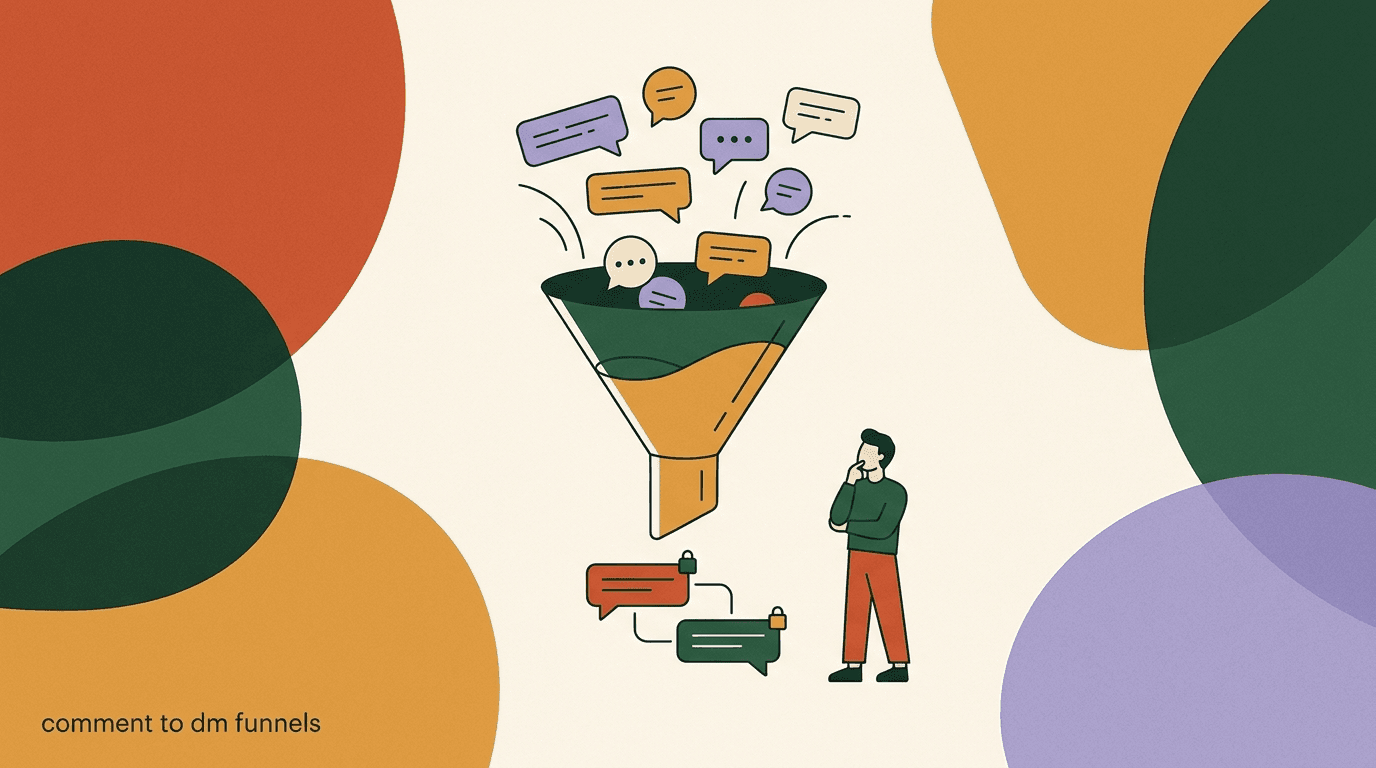
A comment to dm funnel is an automated path that starts with a public comment and ends in a private conversation with a goal attached. The trigger is a keyword you tell people to comment; the engine watches for it and, within the rules, opens a DM. From there, the funnel is just a short, deliberate sequence: confirm interest, ask one qualifying question, deliver the thing you promised, and follow up if they go quiet.
It works because it meets two different motivations at once. The public comment is low-friction and social — people will type a word they would never click a link for, and every comment feeds the post's reach. The private DM is high-intent and personal — it is one-to-one, it lands in a place people actually read, and it lets you carry a conversation that a caption never could. That split is the whole reason the format outperforms a plain 'link in bio' call to action: you collect the easy public signal and convert it in the high-intent private channel.
There is also a reach dividend that pure link-in-bio posts never get. Every comment is engagement, and engagement is one of the strongest signals the feed and Reels algorithms reward. A post that asks people to comment a keyword tends to gather comments faster than one that asks them to leave the app and click a link, which means the same content travels further — and a further-traveling post feeds more people into the top of the funnel. The mechanic compounds on itself.
The distinction worth holding onto: the comment is the trigger, but the funnel is everything after it. Plenty of accounts nail the trigger and still convert poorly because the DM that follows is a dead-end link drop. The accounts that convert treat the DM as the start of a relationship, not the end of a transaction. Think of the comment as the doorbell and the funnel as the conversation you have once you open the door — nobody buys anything on the doorstep.
Trigger vs funnel
The trigger is the easy 40 percent — pick a keyword, point an automation at it. The funnel is the 60 percent that decides outcomes: what the first DM says, what you ask, what you offer, and how you follow up. Spend your effort there.
What does the anatomy of a high-converting funnel look like?
Every comment to dm funnel that performs has the same five stages. You can run a stripped-down version with just the first three, but the qualify and follow-up stages are usually where the leads actually live. Here is the full skeleton.
It helps to think of these stages as a relay, not a checklist. Each one has a single job, and its only success metric is how many people it hands cleanly to the next stage. A funnel does not fail all at once — it fails at one specific handoff, and the whole point of naming the five stages is so you can tell which handoff is dropping the baton. When you look at your numbers later, you are really asking: which stage is losing more people than it should?
- Trigger and Auto-DM are non-negotiable — without them there is no funnel.
- Qualify is the stage most people skip, and it is usually the biggest lever on lead quality.
- Offer should change based on the qualify answer — a one-size DM converts worse than a branched one.
- Follow-up recovers the large share of people who open the first DM and then drift; it is the cheapest extra conversion you can add.
| Stage | Job | What 'good' looks like |
|---|---|---|
| 1. Trigger | Capture intent with a keyword in comments | One short, easy word; clear call to comment in caption and on-screen |
| 2. Auto-DM | Open the conversation and deliver value fast | Sends within seconds; warm, human, one clear next step |
| 3. Qualify | Learn who they are and what they want | One question, button options, no interrogation |
| 4. Offer | Point qualified people at the next step | Matched to their answer; one CTA, not three |
| 5. Follow-up | Re-engage people who went quiet | One nudge inside the 24-hour window; helpful, not nagging |
Why does the first auto-DM matter more than anything else?
If you only optimize one thing, optimize the first message. It is the moment the most people are paying attention and the moment most funnels lose them. A cold, robotic, link-only DM tells the reader they just got processed by a machine, and the drop-off is immediate. A warm, specific opener that delivers on the promise keeps them in the conversation.
The first DM has three jobs in about three sentences: acknowledge what they asked for, deliver it or set up the very next step, and make one clear ask. No menus, no walls of text, no three competing links. The reader commented one word; reward that with one clean path forward.
Timing is part of the message. A DM that arrives within seconds of the comment lands while the person is still on your post and still cares. A DM that arrives an hour later arrives to someone who has scrolled on. Speed is a feature, and automation is the only way to get it consistently — no human team can reply in seconds to a Reel that suddenly sends hundreds of comments, and the funnel's whole advantage evaporates if the first message is slow.
Voice matters as much as speed. Read your first DM aloud; if it sounds like a system notification, rewrite it until it sounds like you texting a friend who asked you for something. Contractions, a little warmth, and one clear question do more than any clever copywriting formula. People can feel the difference between a message written for them and a message blasted at them, and that feeling is what decides whether they reply.
Deliver first, ask second
Give people the thing they asked for in the first message, then ask your qualifying question. Asking for anything before you have delivered value reads as a bait-and-switch and tanks reply rates.
Weak first DM vs strong first DM
- Weak
- 'Here is your link: example.com/guide' — no warmth, no context, no next step, easy to ignore
- Strong
- 'Hey! Thanks for commenting — here is the 5-step guide I promised. Quick question so I send you the right next bit: are you just starting out or already running ads?'
How do you build the funnel step by step?
Here is the build order we recommend. It is deliberately small — a tight five-stage funnel beats an elaborate one almost every time, because every extra branch is another place to lose people.
- Pick one goal and one keywordDecide what a 'win' is for this funnel — a lead magnet download, a webinar signup, a booking. Choose one short keyword that is easy to spell and hard to typo. One goal per funnel keeps the copy focused.
- Write the first DM to deliver, then askThree sentences: thank them, deliver the promised thing (or the link to it), and ask one qualifying question with two or three button options. Keep it sounding like a person.
- Branch the offer on the qualify answerMap each button to a tailored next step. A beginner gets the starter resource; an advanced user gets the booking link or the paid offer. Two or three branches is plenty.
- Add a single follow-up inside the windowFor anyone who opens but does not reply, schedule one gentle nudge within Meta's 24-hour messaging window. One nudge, not a sequence — a second is the line between helpful and spammy.
- Test with the keyword yourself, then publishComment the keyword from a test account, walk every branch, confirm timing and links, then go live. Watch the first day's conversations and tighten the copy where people stall.
Match the caption to the funnel
The caption is part of the funnel. Tell people exactly what to comment, what they will get, and that it arrives by DM. Ambiguity in the caption shows up as low trigger rates no matter how good the automation is.
How do you pick a keyword and write a caption that triggers?
The trigger stage gets the least attention and is the easiest to fix. Two things drive it: the keyword you choose and the caption that asks for it. Get both right and your open rate at the top of the funnel rises before you touch a single message.
On the keyword: pick something short, easy to spell, and unlikely to appear in a normal comment by accident. One word beats a phrase. Avoid words people might type for other reasons — if you sell skincare and your keyword is 'SKIN', you will catch comments that were never meant for the funnel. A made-up or specific word ('GLOW', 'MEALS', 'LIVE') is cleaner than a generic one ('INFO', 'YES', 'ME'). Pick one keyword per funnel; juggling several in one post confuses people and muddies your data.
On the caption: be explicit. Tell people the exact word to comment, exactly what they will get, and that it arrives by DM. Ambiguity here is the most common reason a strong automation underperforms — people are not sure what to do, so they do nothing. Repeat the call to action on-screen in a Reel, not just in the caption, because most viewers never expand the caption.
Ask people to follow, too
On some setups the DM only sends reliably to accounts that meet the platform's interaction rules. Adding 'follow + comment WORD' to the caption both helps deliverability and grows your audience. Keep it honest — a follow for a genuinely useful resource is a fair trade.
Vague caption vs explicit caption
- Vague
- 'Want my free guide? Let me know below 👇' — no keyword, no mention of DM, unclear action
- Explicit
- 'Comment MEALS and I'll DM you the free 7-day prep guide — make sure your DMs are open!'
Worked example: a lead magnet funnel
The most common comment to dm funnel delivers a free resource — a guide, checklist, template, or swipe file — in exchange for a comment and, ideally, a qualifying answer. The goal is a qualified lead you can nurture, not just a download.
Here is the full flow for a hypothetical fitness coach offering a free meal-prep guide. The copy is illustrative; adapt the voice to your brand. Notice how the qualify question is not idle curiosity — the answer genuinely changes what the coach sends next, which is the test of a good qualifying question. If the answer would not change your response, do not ask it.
- The free thing is delivered in the very first message — no gate, no wait.
- One qualifying question splits the audience into two genuinely different needs.
- Each offer branch is a small, relevant next step, not a hard pitch.
- The follow-up is helpful and assumes good intent, not a guilt trip.
Lead magnet funnel — sample copy
- Caption CTA
- 'Comment MEALS and I'll DM you the free 7-day prep guide.'
- Trigger keyword
- MEALS
- First DM
- 'Thanks for commenting! Here is your free 7-day meal-prep guide [link]. Quick one so I can point you to the right next thing — are you cooking for just yourself or for a family?'
- Qualify buttons
- 'Just me' / 'Family'
- Offer (Just me)
- 'Perfect — the solo portions in the guide are dialed in for you. Want my single-serving grocery list too? Reply LIST.'
- Offer (Family)
- 'Got it — here is the family-scaling cheat sheet that pairs with the guide [link]. Want batch-cook ideas? Reply BATCH.'
- Follow-up (no reply)
- 'No rush! Did the guide come through okay? Happy to send the grocery list if it helps.'
Worked example: a webinar or live signup funnel
When the goal is registrations for a webinar, workshop, or live, the funnel changes shape slightly. The 'deliverable' is a registration link, and the qualify stage doubles as a way to set expectations and reduce no-shows. Reminders matter as much as the initial signup — for live events, getting the registration is only half the job; getting the person to actually show up is the other half, and the comment-to-DM channel is unusually good at the second part because it lands in a place people check.
Here is an illustrative flow for a marketing consultant promoting a free live training. The qualify answer here does double duty: it personalizes the event ('I'll include an Instagram example for you') and it gives the host a reason to send a same-day reminder that feels helpful rather than promotional.
Reminders must respect the 24-hour window
Meta's messaging policy lets you reply freely for 24 hours after a user's last message. A reminder sent inside that window is fine; one sent days later needs an approved message template and the right opt-in. Plan reminder timing around the window, not around your event schedule alone.
Webinar signup funnel — sample copy
- Caption CTA
- 'Comment LIVE for the link to Thursday's free training on DM funnels.'
- Trigger keyword
- LIVE
- First DM
- 'You're in! Here is your registration link for Thursday's training [link]. So I can tailor a few examples — what do you mostly run: Instagram, WhatsApp, or both?'
- Qualify buttons
- 'Instagram' / 'WhatsApp' / 'Both'
- Offer / confirmation
- 'Great — I'll make sure there's an Instagram example in there for you. You'll get a reminder before we go live so you don't miss it.'
- Reminder (within window)
- 'Quick heads up — the training starts in a few hours. Here's your link again [link]. See you there!'
Worked example: a product launch funnel
For a product drop or launch, the comment to dm funnel turns interest into a waitlist or an early-access purchase. The qualify stage sorts the ready-to-buy from the just-curious, so you can send a direct buy link to one group and nurture the other instead of burning the offer on people who are not ready. This split matters more for sales funnels than for any other type, because sending a hard buy link to someone who is only browsing trains them to ignore you, while sending a soft 'I'll notify you' to someone who is ready to buy loses a sale you already had.
An illustrative flow for a small skincare brand launching a new serum. Watch how the funnel never pressures the curious group and never under-serves the ready group — each gets exactly the energy that matches their intent.
- The qualify stage separates hot buyers from warm leads so each gets the right message.
- Scarcity is honest and specific (24-hour window, limited), not manufactured.
- The notify branch promises restraint, which makes people more willing to opt in.
Product launch funnel — sample copy
- Caption CTA
- 'Comment GLOW to get early access to the new serum before it sells out.'
- Trigger keyword
- GLOW
- First DM
- 'Thanks for the love! The new serum drops Friday. Want the early-access link the moment it's live, or should I add you to the waitlist for launch day?'
- Qualify buttons
- 'Early access' / 'Just notify me'
- Offer (Early access)
- 'Sending it now — here's your 24-hour early link with 10% off [link]. It's limited, so grab it while it's there.'
- Offer (Notify me)
- 'Done — you're on the launch list. I'll DM you Friday when it goes live, no spam in between.'
- Follow-up (early access, no buy)
- 'Just a nudge — your early-access window closes tonight. Here's the link again if you still want it [link].'
Worked example: a booking or consultation funnel
Service businesses — coaches, agencies, freelancers, local services — usually want a booked call, not a download. Here the funnel's job is to filter for fit before handing over a calendar link, so you spend call time on qualified prospects instead of tire-kickers. For a service business, calendar time is the scarcest resource, so a funnel that protects it is worth more than one that simply maximizes bookings. A calendar full of unqualified calls is a worse outcome than a half-full calendar of right-fit prospects.
An illustrative flow for a business coach booking discovery calls. Notice that the qualify question comes before the calendar link, not after — the order is deliberate, because once someone has a booking link in hand the friction to grab any slot drops, qualified or not.
Qualifying out is a feature
Sending the early-stage prospect a resource instead of a calendar link is not losing a lead — it is protecting your time and theirs. A booking funnel that qualifies out the wrong fit converts the right fit far better.
Booking funnel — sample copy
- Caption CTA
- 'Comment CALL if you want a free 15-minute strategy session this month.'
- Trigger keyword
- CALL
- First DM
- 'Happy to help! Before I send my calendar — what stage is your business at right now?'
- Qualify buttons
- 'Just starting' / 'Doing 10k+/mo' / 'Stuck and scaling'
- Offer (Doing 10k+ / Scaling)
- 'You're exactly who these sessions are built for. Here's my calendar — grab any slot [link] and we'll map your next move.'
- Offer (Just starting)
- 'Love the energy. The calls are better suited once you're up and running, so here's my free starter guide to get there first [link]. Reach back out when you're at it!'
Four goals, one structure. Notice that across the lead magnet, webinar, launch, and booking examples, the bones never changed — trigger, deliver, qualify, branch the offer, follow up. Only the deliverable and the qualifying question moved. That is the useful insight: once you have built one comment to dm funnel well, every other one is a variation on the same template, not a rebuild from scratch.
What happens to the lead after the funnel ends?
A comment to dm funnel captures and qualifies a lead, but the funnel ending is not the relationship ending. The person who downloaded your guide or joined your waitlist is now a known, opted-in contact — and what you do with them next determines whether the funnel was worth running. Treating the DM as a one-shot transaction wastes the hardest part, which was earning the conversation in the first place.
The clean, compliant way to keep the relationship going is broadcasts: opt-in messages you send to segments of your contacts later — a launch announcement, a new resource, a reminder. Because these go to people who explicitly engaged, and because you tag them by what they wanted during the qualify stage, you can send relevant messages instead of blasts. The qualify answers you collected become segments: 'solo cooks' versus 'family cooks', 'Instagram' versus 'WhatsApp', 'ready to buy' versus 'just curious'.
This is where the qualify stage pays off twice. The first time, it routes the immediate offer. The second time, weeks later, it tells you who to talk to about what. A funnel without a qualify stage gives you an undifferentiated list; a funnel with one gives you a segmented audience you can actually market to without spamming everyone the same message.
- Tag contacts by their qualify answer so you can segment later.
- Use broadcasts for opt-in follow-up campaigns, not cold blasts.
- Send relevant, segment-specific messages — relevance is what keeps opt-out rates low.
- Respect platform rules for messaging outside the 24-hour window: templates and proper opt-in.
The list is the real asset
The download or signup is the visible win, but the opted-in, tagged contact is the durable one. A single good comment-to-DM funnel can seed a segmented audience you market to for months — provided you keep messages relevant and compliant.
What benchmarks should you aim for?
It helps to have targets, but treat these as illustrative planning ranges, not guarantees. Performance varies enormously by audience, offer, niche, and how warm your traffic is. Use them to spot which stage is leaking, not to grade yourself against someone else's account.
The most useful way to read these is as a funnel: a healthy comment to dm funnel loses some people at every stage, and the question is whether any single stage is losing far more than its neighbors. That stage is where your next fix lives. Resist the urge to optimize everything at once — find the worst-performing stage, fix only that, and remeasure. Changing five things at once tells you nothing about which change helped.
One caution on reading early numbers: small samples lie. A funnel that has run on twenty comments has not told you anything statistically meaningful, no matter how good or bad the percentages look. Give a change at least a few dozen triggers before you judge it, and be especially wary of declaring a winner after a single viral post, where the audience may be unusually warm or unusually random compared to your norm.
| Stage metric | Illustrative range to aim for | If you're below it |
|---|---|---|
| Comment-to-DM open rate | 70-90% open the first DM | Your first DM is slow, generic, or filtered — speed it up and warm it up |
| First-DM reply rate | 30-50% reply to the qualifier | The question is too hard or too salesy — simplify to one easy choice |
| Qualify-to-offer rate | 50-70% reach the offer | Too many branches or too much friction — shorten the path |
| Offer click / action rate | 20-40% take the offered step | The offer doesn't match what they asked for — tighten the match |
| Follow-up recovery | 10-20% of quiet users re-engage | Follow-up is missing or sounds naggy — add one helpful nudge |
Benchmarks are diagnostic, not a scoreboard
These ranges are round-number illustrations to help you find leaks. Your own baseline after two weeks of live data is worth more than any external benchmark. Measure, then beat your own last number.
What mistakes quietly kill conversion?
Most underperforming comment to dm funnels are not broken — they are leaking in predictable, fixable ways. These are the patterns we see most often, in rough order of how much damage they do. The good news is that almost none of them require rebuilding the funnel; they are copy and timing fixes you can ship in an afternoon.
- Link-dump first DM: dropping a bare link with no warmth or question. It converts a fraction of what a delivered-then-asked opener does.
- Slow trigger: a DM that arrives minutes or hours late, after the person has scrolled on. Automation should fire in seconds.
- Skipping the qualify stage: sending everyone the same offer, so hot buyers and tire-kickers get identical treatment and both convert poorly.
- Too many branches: a maze of buttons and sub-menus that loses people who just wanted the thing. Keep it to two or three choices.
- No follow-up: leaving the large share of people who open but don't reply to drift away, when one nudge would recover a meaningful slice.
- Vague caption: not telling people the exact keyword or that the reply comes by DM, so the trigger rate stays low regardless of the automation.
- Ignoring the 24-hour window: trying to send promotional follow-ups days later without a template or opt-in, which breaks Meta's rules and risks the account.
The biggest killer is treating the DM as a delivery chute
If your funnel just dumps a link and ends, you have built a vending machine, not a funnel. The conversion lives in the conversation — qualify, match the offer, and follow up. That is the whole difference between a busy comments section and actual leads.
How do you stay compliant while running these at scale?
Comment-to-DM automation sits squarely inside Meta's platform rules, and staying on the right side of them is what keeps your account healthy. The rules are not obstacles — they map closely onto what good funnels do anyway, which is be helpful and not spammy.
Two principles cover most of it. First, the 24-hour messaging window: you can message someone freely for 24 hours after their last interaction with you. Outside that window, promotional messages need an approved message template and proper opt-in. Build your follow-ups and reminders around this window rather than fighting it. Second, no spam: do not blast unrelated content, do not message people who never engaged, and give people a clean way to stop.
The window has a practical consequence worth designing around: every reply from the user resets it. A funnel that asks a qualifying question and gets an answer has just bought another 24 hours of free messaging, which is one more reason the qualify stage earns its place. The interaction is not only collecting information — it is keeping the conversation legally open. Funnels that go quiet immediately after the first DM have a much shorter window to work with than funnels that get the user replying.
- Reply and follow up inside the 24-hour window; use approved templates and opt-in for anything later.
- Only message people who triggered your funnel — never scrape or cold-DM.
- Keep messages relevant to what the person asked for; one nudge, not a drip campaign.
- Honor opt-outs immediately and make stopping easy.
- Keep your keywords and offers honest — deliver exactly what the caption promised.
Compliance protects the asset you're building
Your Instagram account and your contact list are the assets. A funnel that bends Meta's rules to squeeze out a few more messages risks both. Build inside the window and inside the spam rules, and the funnel keeps earning for years instead of getting your reach throttled.
How does KlyoChat run comment-to-DM funnels?
We built KlyoChat partly because so many comment-to-DM tools stop at the trigger and leave the funnel to you. KlyoChat treats the whole five-stage funnel as the product: the keyword trigger, the warm first DM, the qualify branches, the matched offer, and the follow-up all live in one no-code builder, with timing that respects Meta's window by design.
It is also AI-native, which matters most at the qualify and follow-up stages. A custom AI agent — included, with its own knowledge base — can handle the open-ended replies a button menu can't, answer product questions in the DM, and decide which branch a fuzzy answer belongs in. That turns a rigid tree into something closer to a real conversation, across Instagram, Facebook, WhatsApp, Telegram, TikTok, and X from one mobile-first inbox.
The practical difference shows up the moment someone replies off-script. In a button-only funnel, a person who types 'actually I run a small gym, does this work for groups?' falls through the cracks — there is no button for that, so the funnel either ignores them or sends a generic catch-all. An AI agent reads the question, answers it from your knowledge base, and steers the conversation back toward the offer. Those off-script messages are often your most interested leads, because they cared enough to type a real question, which makes catching them disproportionately valuable.
- Comment-to-DM funnels, broadcasts, and a unified team inbox in one tool.
- Custom AI agents with knowledge bases are included, not a paid add-on.
- Every plan starts with a 7-day free trial — no credit card, no free-forever plan.
- Honest limit: KlyoChat does not do native SMS or email, and the community is newer and smaller than the biggest incumbents. If those matter to you, weigh them.
| Funnel need | What KlyoChat gives you |
|---|---|
| Trigger + first DM | Keyword triggers and instant auto-DM in a no-code builder |
| Qualify | Button branches plus an AI agent for free-text answers |
| Offer | Branched offers matched to the qualify answer |
| Follow-up | Scheduled nudges that respect the 24-hour window |
| Across channels | Same funnel logic on IG, FB, WhatsApp, Telegram, TikTok, X |
| Measure | Built-in analytics to find which stage leaks |
Try it on one funnel first
The fastest way to judge any tool is to build a single comment to dm funnel — one keyword, one offer — and watch it run for a day. KlyoChat's trial is built for exactly that: prove the funnel converts before you commit.
KlyoChat plans at a glance
- Basic
- $19/mo — entry tier, fewer channels and contacts
- Pro
- $49/mo ($39 yearly) — all channels, 10,000 contacts, custom AI agents
- Business
- $129/mo — higher seats and contacts, integrations
- Enterprise
- Custom — SSO/SAML, data residency, SLA
The takeaway: a comment to dm funnel is not the 'comment WORD' trick — it is the five-stage path that turns that comment into a qualified, followed-up conversation. The trigger and first DM get you in the door; the qualify, offer, and follow-up stages are where the leads and sales actually come from. Optimize the first message, branch the offer, add one nudge, and respect the 24-hour window.
If you remember one thing, make it this: the comment is cheap and the conversation is everything. Most accounts pour their energy into getting more comments and none into what happens after — which is exactly backwards, because the comments are already converting at a high rate and the conversation is where almost all the leakage is. Move your attention downstream, fix the worst-leaking stage first, and the same volume of comments will quietly produce more leads, signups, and sales without a single extra view.
If you want the broader picture, our Instagram DM automation guide covers the strategy end to end, the build-an-Instagram-DM-flow tutorial walks the exact setup click by click, and the course-creator DM automation piece shows the funnel applied to selling courses. Start with one funnel, measure where it leaks, and fix that stage first.