A coaching dm sequence is the difference between a content account that gets a lot of comments and a coaching business that gets a lot of clients. Most coaches already have the hard part working: people watch the videos, save the posts, and drop a keyword to get a freebie. Then nothing happens. The lead opts in, the resource gets sent, and the conversation dies in the inbox because no one designed what comes next.
This post lays out the part that comes next — a concrete five-day DM sequence built specifically for coaches who want to book discovery calls without manually messaging every follower. You will get the goal of each day, sample copy you can adapt, the timing between messages, and the branching logic for what to say when someone replies versus when they go quiet. The aim is a sequence that feels like a real conversation, respects the person on the other end, and ends with the right people on your calendar.
We build KlyoChat, an AI-native inbox and automation tool for creators and coaches, so we will show how an AI agent and a sequence engine run this on autopilot near the end. But the sequence itself is tool-agnostic. You can run the framework by hand, in another platform, or in KlyoChat — the structure is what books the call. This piece pairs with our broader pieces on the full Instagram revenue system and the AI sales qualifying agent that decides who is a fit; this one is the nurture-to-booking sequence those rely on.
Why do most coaching DMs never turn into booked calls?
The standard coaching funnel leaks at the same spot every time: the moment after the opt-in. Someone comments your keyword, the auto-DM fires with the lead magnet, and the system considers its job done. But sending a PDF is not nurturing a lead — it is handing them a reason to leave the conversation. They got what they came for, the thread goes cold, and three days later they have forgotten your name.
The second failure mode is the opposite: the coach who does follow up, but does it badly. One unbroken paragraph pitching the program, sent ten minutes after the freebie, with a calendar link and three fire emojis. It reads as a sales bot, it ignores whether the person is even a fit, and on Instagram it risks the kind of behavior Meta actively limits. People feel the difference between a conversation and a conveyor belt.
A real sequence solves both. It keeps the conversation alive after the opt-in with a reason to reply, it earns the right to make an offer before making one, and it qualifies softly so you are not pitching a thousand-dollar container to someone who wanted a free checklist. Spread over five days, with branching for engaged versus quiet leads, it does the follow-up a busy coach never has time to do by hand.
There is also a quieter cost to no sequence: every lead you do not nurture is a lead a competitor will. The follower who downloaded your meal plan is, that same week, downloading two other coaches' freebies. The one who follows up with a real conversation is the one who gets the call. You are not competing on content alone — you are competing on what happens after the content works. The sequence is that 'after'.
Nurture is not the same as broadcasting
A sequence that ignores how the lead responds is just a slow broadcast. The whole point of the five days below is that each message reacts to the last one. If someone replies on day two with strong intent, you do not make them wait until day four for the call offer — you move them forward.
What does the 5-day coaching DM sequence look like at a glance?
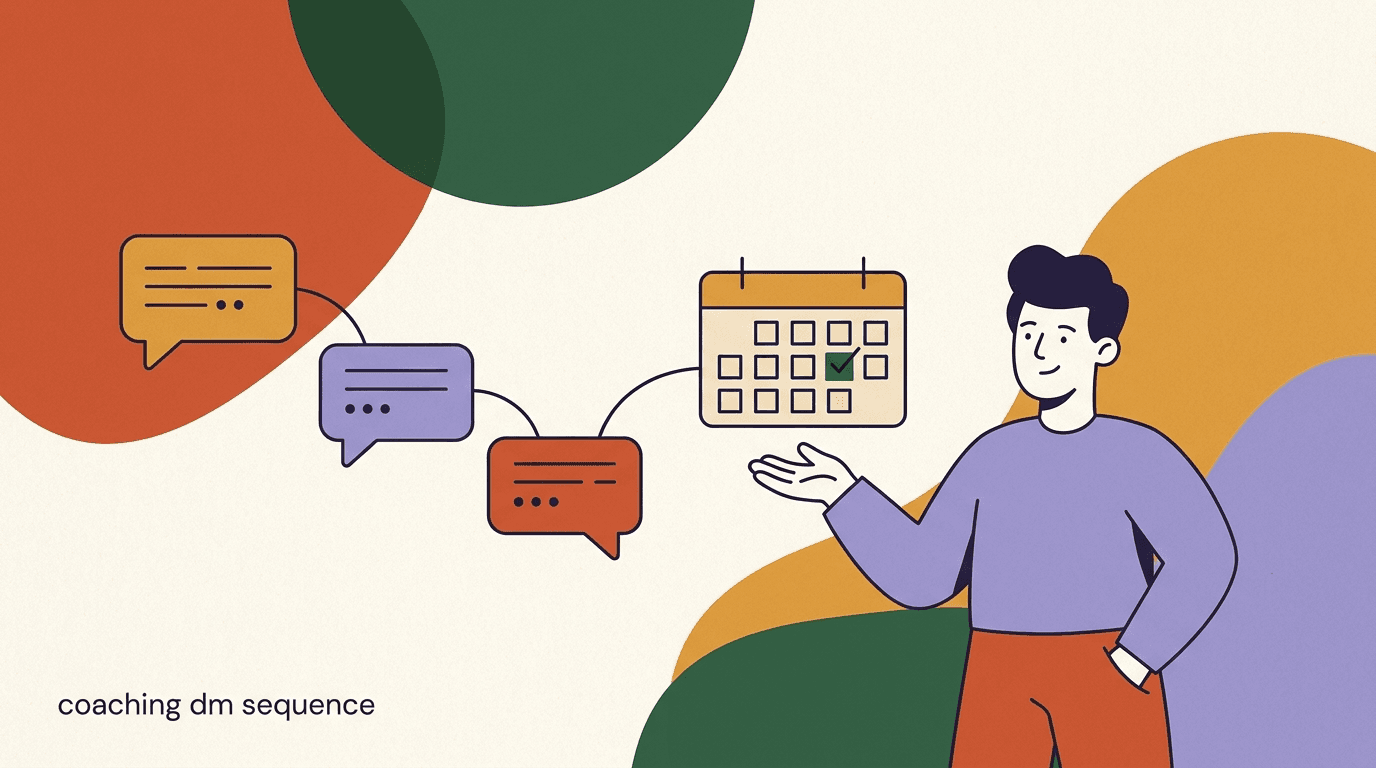
Before the day-by-day detail, here is the shape of the whole thing. Each day has one job, one primary message, and a clear branch depending on whether the lead replied to the previous message. The sequence assumes the lead has already opted in — they commented a keyword or sent a trigger word and received your lead magnet. Day one picks up from there.
The timing matters as much as the copy. Messages are spaced roughly a day apart, not minutes apart, because a coaching decision is considered, not impulsive. Crowding the inbox is the fastest way to get muted or reported.
| Day | Goal | Primary message | If they reply |
|---|---|---|---|
| Day 1 | Deliver value, open a loop | Lead magnet + one genuine question | Answer, reflect it back, ask a follow-up |
| Day 2 | Qualify softly | Ask about their situation or goal | Tag intent, branch to fit or not-yet |
| Day 3 | Build belief with proof | Short relevant story or case | Connect their goal to the outcome |
| Day 4 | Offer the call | Invite to a free discovery call + link | Send booking link, confirm, remind |
| Day 5 | Last chance, no pressure | Gentle nudge, then close the loop | Book or graceful exit to long-term nurture |
Respect the 24-hour messaging window
On Instagram and Facebook, you can only freely message a person within 24 hours of their last interaction. A sequence spaced a day apart must keep each step inside that window or use an approved message tag. Build the sequence so each message is triggered by, or quickly follows, the lead's own activity — do not assume you can DM someone cold on day five if they went silent on day one.
Day 1: How do you deliver the freebie and keep the conversation open?
Day one is where most sequences end and yours begins. The lead has opted in and expects their resource — so deliver it immediately and well. But the delivery message is not the end of the interaction; it is the start. Attach one genuine, easy-to-answer question that gives them a reason to reply. A reply on day one is the single best predictor of a booked call by day five, because it converts a passive download into an active conversation.
The question should be low-effort and specific to why they wanted the freebie. Avoid yes/no questions that die on arrival, and avoid the generic 'how can I help?' that signals a bot. Ask about their situation in a way that is genuinely useful for you to know and easy for them to answer in one line.
- Send the resource without frictionLead with the thing they asked for. Make the link obvious and the message short. No pitch, no preamble.
- Attach one specific questionAsk about their goal or situation in a way that takes one line to answer. This is the reply trigger for the rest of the sequence.
- Set the branchIf they reply, acknowledge their answer and ask one natural follow-up. If they go quiet, day two follows up gently rather than repeating the question.
One question, not three
Stacking questions feels like a form. Ask exactly one thing on day one. You will have the rest of the week to learn more, and a single easy question gets far more replies than a mini-interview.
Day 1 sample copy (fitness coach)
- Message
- Here's the 7-day meal plan you asked for — link below. Quick one so I can point you to the right next thing: are you mostly trying to lose fat, build muscle, or just feel less wrecked by 3pm?
- Link
- [meal plan]
- Why it works
- Delivers fast, then opens a loop with a one-tap-to-answer question tied to their goal
Day 2: How do you qualify a lead without sounding like a sales rep?
Day two has one job: find out whether this person is someone you can actually help, and how ready they are. This is qualification, but it should never feel like an intake form. The trick is to ask a question that is genuinely in service of the lead — something a good coach would ask anyway — that also happens to reveal fit and intent.
What you are listening for is the gap between where they are and where they want to be, plus any signal about urgency or past attempts. Someone who says 'I've tried three programs and nothing sticks' is telling you both their pain and their readiness. Tag that. Someone who says 'just curious, started last week' is early — they go into a slower, value-first track rather than a call offer in two days.
Branch your day two on the day one reply. If they answered day one, build on their answer with a more specific question. If they did not, day two is a lighter, no-pressure re-open — never a guilt trip about being ignored. A quiet lead has not rejected you; they have just been busy, and the message that assumes the best of them is the one that gets a reply two days later.
One more reason day two matters: it sets the depth of the rest of the week. A lead who tells you their real situation here gives you the raw material for a proof story on day three that actually lands, and an objection you can pre-empt on day five. Skip the qualification and every later message has to be generic. Do it well and the whole sequence personalizes itself off a single thoughtful exchange.
- Ask a diagnostic question that helps them think, not just one that helps you sell.
- Offer two or three options so they can answer with a tap instead of an essay.
- Listen for the gap, the urgency, and any past attempts — these are your qualification signals.
- Tag every reply by intent so the sequence can branch: ready-now, warming, or not-a-fit.
Disqualifying is a feature
If day two reveals someone is not a fit — wrong stage, wrong budget, wrong problem — that is a win, not a loss. Move them to a long-term content nurture instead of a call offer. Pitching a discovery call to the wrong person wastes your calendar and their trust.
Day 2 sample copy (business coach, lead replied on day 1)
- Context
- Day 1 reply: 'I want to get my first paying clients'
- Message
- Love that — first clients is the hardest and most exciting jump. Where are you stuck right now: getting in front of people, knowing what to offer, or actually closing the conversation?
- Why it works
- Reflects their goal, then gives three options that diagnose the real blocker and reveal how close they are
Day 3: How does a proof story build belief before the offer?
By day three the lead knows you are paying attention and you understand their problem. Now they need to believe that someone like them got the result they want. That is the job of the proof story — a short, specific account of a client (or your own journey) who started where this lead is and reached the outcome this lead wants.
Specificity is everything. 'I help people get results' persuades no one. 'A client came to me six months postpartum, exhausted, convinced she had no time — we built three 20-minute sessions a week around her schedule and she's now stronger than before the baby' paints a picture the lead can step into. Match the story to what you learned on day two: if they said their blocker is time, tell the time-poor client story, not the weight-loss-milestone story.
Keep it honest. Do not invent transformations or imply guaranteed outcomes. A true, modest story beats an inflated one — coaching buyers are skeptical of anything that sounds like a before-and-after ad. End the story with a soft bridge toward a conversation, but do not make the hard offer yet. That is tomorrow.
If you are early in your coaching career and short on client stories, use your own. The journey from where the lead is now to where you are today is itself proof, as long as you tell it honestly. 'I was exactly here three years ago' is often more persuasive than a polished client case, because the lead can see the path from their seat to yours. What you must not do is borrow someone else's results or imply a typical outcome you cannot back up.
No income or outcome guarantees
Use real, specific stories and never promise a result. Phrases like 'guaranteed', 'you will make X', or 'results in 30 days or your money back' create both trust problems and compliance risk. Honest proof outperforms hype with the kind of considered buyer who hires a coach.
Day 3 sample copy (career coach)
- Context
- Day 2 revealed: stuck, scared to negotiate, underpaid for two years
- Message
- This reminds me of someone I worked with last year — same spot, underpaid and dreading the conversation. We spent two weeks just on what to say and how to back it up. She asked for 18% and got 15. Not magic, just preparation. Curious whether the salary piece is the part you'd want to start with?
- Why it works
- Mirrors their exact fear, gives a real and modest number, then bridges toward a focused conversation
Day 4: How do you offer the discovery call so people actually book?
Day four is the offer. Everything before this earned the right to make it, which is why it can be direct and low-pressure at the same time. The lead has a problem you understand, has seen proof it is solvable, and has been in a real conversation with you for three days. Inviting them to a free discovery call is now the natural next step, not an interruption.
Frame the call as help, not a sales meeting. Name what it is for, how long it takes, and what they walk away with even if they never buy. Reduce the friction to a single tap: send the booking link directly in the DM. The more steps between the yes and the calendar, the more people you lose. Then handle the branch — confirm the booking when it happens, and have a gentle follow-up ready for those who say yes but do not click.
The word 'free' does a lot of work here, but so does the phrase 'no pitch unless you ask'. Coaching buyers brace for a high-pressure close on a 'strategy call'. Taking that fear off the table — explicitly promising you will not hard-sell — paradoxically raises booking rates, because the call stops feeling like a trap. You can still mention your program if the conversation goes there naturally; you just are not ambushing anyone. The honesty of that framing is also what makes the call itself easier to run.
- Make the offer explicitInvite them to a specific, time-boxed, free call. Vague offers ('let's chat sometime') do not convert.
- Drop the booking link in-threadSend the calendar link right in the DM. Every extra step — bio link, email, reply-to-schedule — loses people.
- Confirm and pre-frame on bookingAuto-send a confirmation and a one-line prep prompt so they arrive ready and the no-show rate drops.
- Catch the almost-bookersIf they react positively but do not book, day five follows up once. If they book, day five is replaced by a reminder.
Reduce no-shows with a pre-frame
A booked call is not a kept call. The confirmation message that asks them to bring one specific problem does two things: it raises commitment and it makes the call more useful. A short reminder the morning of, sent automatically, further cuts no-shows.
Day 4 sample copy (coaching call offer)
- Message
- Honestly, this is exactly the kind of thing I'd love to map out with you properly. Want to grab a free 20-minute call? I'll help you pick the one move that'll make the biggest difference, no pitch unless you ask. Here's my calendar:
- Link
- [booking link]
- On booking
- Auto-confirm + 'See you [day]! Come with the one thing you most want to solve and we'll start there.'
- Why it works
- Names the value, caps the time, removes the pressure, and books in one tap
Day 5: How do you send a last-chance nudge without being pushy?
Day five exists for the people who engaged but did not book — the ones who liked the idea on day four but got pulled away by life. This is a single, gentle nudge, not a barrage. The tone is 'no rush, just leaving the door open,' because pressure on a coaching buyer backfires. The goal is to make booking easy for the ready and to exit gracefully with everyone else.
The most effective day five does two things in one message: it removes a likely objection and it re-sends the link. Common objections are time ('the call is only 20 minutes'), cost ('the call itself is free and there's no obligation'), and timing ('even if now isn't right, the call can help you get clear'). Pick the one that fits what you learned earlier in the week. Then close the loop: if they do not respond, they move to your long-term content nurture, not a sixth message.
Notice what day five is not. It is not a fake-scarcity 'spots are running out' message, and it is not a guilt trip about not replying. Coaching is a trust business, and a manipulative final message poisons the relationship for the next three months when the lead might actually be ready. The strongest nudge you can send is a sincere one that genuinely leaves the door open. Counterintuitively, the people who do not book after a kind day five are far more likely to come back later than the people you pressured into ghosting you.
Know when to stop
After day five, stop the call-booking messages to non-responders. Continuing to push is how accounts get muted, reported, and rate-limited. A lead who is not ready now is not lost — they go into ongoing content nurture and may book in three months. Protect the relationship and your account.
Day 5 sample copy (last-chance nudge)
- Message
- No pressure at all — I know inboxes are chaos. If the timing's just off, totally fine and I'll keep sharing stuff that might help. But if part of you wants to get unstuck on this, the 20 minutes is free and there's zero obligation. Same link whenever you're ready:
- Link
- [booking link]
- If no reply
- Move to long-term nurture sequence; do not message again about the call
- Why it works
- Names the off-ramp first, dissolves the time and cost objection, then makes booking a one-tap option
How should you branch the sequence for repliers versus quiet leads?
The five days above describe the main path, but a real sequence is not a single line — it is a tree. The most important branch is reply versus no-reply, and it changes the pace, not just the words. Engaged leads should be allowed to move faster; quiet leads should be given space and lighter touches, never repetition or guilt.
Here is how the two tracks diverge across the week. Note that a strong reply early can collapse the timeline: if someone shows clear intent on day two, you can offer the call then rather than waiting for day four. The sequence serves the conversation, not the other way around.
- Let intent set the pace — a hot reply on day two can earn the call offer the same day.
- Never repeat the same question to a quiet lead; switch to giving value instead of asking.
- Tag every lead by track so reporting tells you where the sequence converts and where it leaks.
- Cap the no-reply track — silence after the soft offer means stop, not escalate.
| Day | Engaged track (replied) | Quiet track (no reply) |
|---|---|---|
| Day 1 | Acknowledge answer, ask a follow-up | Deliver freebie, ask the one question |
| Day 2 | Diagnose blocker, tag intent | Light re-open: 'did the plan land okay?' |
| Day 3 | Tailored proof story to their goal | One value tip, no ask |
| Day 4 | Direct call offer + link | Soft offer framed as 'if you ever want a hand' |
| Day 5 | Reminder if booked, nudge if not | Final value touch, then long-term nurture |
The branch is what makes it feel human
A sequence that sends the same five messages to everyone is a broadcast in disguise. Branching on whether someone replied — and how warmly — is what makes the inbox feel like a person rather than a machine, and it is the single biggest lever on booked-call rate.
How do you write coaching DM copy that does not sound automated?
The sequence structure books calls, but bad copy inside a good structure still reads as spam. A few writing habits keep the messages sounding like you, not a template. The overarching rule: write the way you would actually message a friend who asked for help — short sentences, real reactions, no marketing voice.
Personalization beyond the first name is what separates a conversation from a mail merge. Referencing what they said two days ago, matching the proof story to their stated goal, and reacting to their actual words all signal a human is present, even when an AI agent is doing the typing. The copy below contrasts the two on the same moment in the sequence.
Match your register to your audience, too. A coach for corporate executives writes differently than a coach for new mothers or for teenage athletes. The structure of the five days stays the same, but the vocabulary, the length, and even the emoji use should mirror how your specific people text. If your audience never uses exclamation points, neither should your sequence. The fastest way to sound automated is to write in a generic 'coach voice' that belongs to no one. Your messages should be unmistakably yours.
- Write short. One or two sentences per message beats a paragraph every time.
- Reference what they actually said — specificity is the tell of a real conversation.
- Cut the banned hype: no 'unlock your potential', no rows of fire emojis, no all-caps FREE.
- Match the proof story and the objection-handling to what you learned, not to a generic script.
- Ask before you pitch; on day four, 'want to' beats 'you should'.
Read it out loud
If a message sounds strange said aloud, it will read as a bot in the DM. The fastest copy edit is to read each line as if you were saying it to someone across a table. Anything that fails that test gets cut.
Day 4 offer: templated vs human
- Templated
- Hi {name}! I help coaches scale to 10k/mo. Book a FREE strategy call now to unlock your potential! [link]
- Human
- Honestly this is the kind of thing I'd rather just talk through — want a free 20-min call? I'll help you pick the one move that matters most. Here's my calendar: [link]
- Difference
- The human version reacts to the conversation, caps the time, and drops the hype
How does an AI agent run this sequence without being spammy?
Running this by hand works until you have more than a handful of leads a week, at which point the follow-up quietly stops happening — which is the original problem. Automation fixes the consistency, but only if it preserves the two things that make the sequence work: branching on real replies and sounding human. That is the difference between a dumb timed blast and an AI agent that holds a conversation.
A sequence engine handles the timing and the branches: it triggers day one on opt-in, schedules each step inside the messaging window, and routes the lead down the engaged or quiet track based on whether they replied. An AI agent handles the part a timer cannot — reading what the lead actually wrote, answering follow-up questions in your voice, tagging intent, and deciding when someone is ready for the call offer early. The two together run the framework above continuously, while the coach sleeps, without sending the same robotic message to everyone.
Done right, automation is less spammy than manual follow-up, not more. It never double-messages, it always respects the 24-hour window, it stops when a lead goes cold, and it hands off to a human the moment a conversation needs one. The lead experiences a responsive, attentive coach. The coach experiences a calendar that fills itself.
- Trigger on opt-inComment-to-DM or a keyword starts the sequence automatically, sending the freebie and the day one question.
- Let the agent read and replyAn AI agent interprets the lead's answer, responds in your voice, asks the day two diagnostic, and tags intent.
- Branch on the replyThe engine routes engaged leads to the faster track and quiet leads to the lighter one, always inside the window.
- Offer and book inside the chatWhen the lead is ready, the agent makes the call offer and drops the booking link, then confirms automatically.
- Hand off and know when to stopComplex or high-value conversations escalate to you; non-responders exit to long-term nurture after day five.
Automation has to follow the platform rules
Any tool you use for this must respect Meta's policies and the 24-hour window, avoid bulk unsolicited messaging, and give people a clean way out. A sequence that ignores those rules will get your account limited no matter how good the copy is. Build inside the rules, not around them.
How does KlyoChat run the 5-day coaching DM sequence?
We built KlyoChat to run exactly this kind of sequence, so here is the honest version of how it maps. KlyoChat is an AI-native, mobile-first unified inbox that pulls Facebook, Instagram, Telegram, WhatsApp, TikTok, and X into one place, with no-code automation, comment-to-DM, custom AI agents, and analytics included. For a coach, that means the whole sequence — trigger, branch, agent, booking — lives in one tool you can run from your phone.
The comment-to-DM feature triggers day one when someone comments your keyword. The flow builder schedules days two through five inside the messaging window and branches on whether the lead replied. A custom AI agent, trained on your coaching style and your offer, reads each reply, answers in your voice, qualifies softly, and makes the call offer when the lead is ready — then drops the booking link in the thread. The team inbox lets you or an assistant step in for the conversations that need a human, and analytics show you where the sequence converts and where it leaks.
Honest limits: KlyoChat does not do native SMS or email, so if your nurture depends on those channels you will need something alongside it. We are also a newer and smaller community than the largest incumbents, so there are fewer third-party templates floating around. And no tool can promise booked calls or income — the sequence and your offer do that work; we just run it reliably and within the platform rules.
| Sequence need | KlyoChat capability |
|---|---|
| Trigger on opt-in | Comment-to-DM and keyword triggers |
| Day-by-day timing and branching | No-code flow builder with reply-based branches |
| Human-sounding replies and qualification | Custom AI agents trained on your voice and offer (included) |
| Offer the call and book | Agent drops booking link in-thread; confirmations automated |
| Step in when needed | Mobile-first team inbox with human handoff |
| See what converts | Built-in analytics across every channel |
The sequence matters more than the tool
You can run this five-day framework by hand or in any capable platform. We think KlyoChat runs it well and cheaply for coaches, but the structure above is what books the call. Start with the sequence; pick the tool that runs it without breaking the platform rules. See /solutions/coaches and /features/flows for how it fits together.
KlyoChat plans for coaches
- Basic
- $19/mo — for a solo coach testing one or two channels
- Pro
- $49/mo ($39 billed yearly) — all channels, 10,000 contacts, custom AI agents
- Business
- $129/mo — for a coaching team with higher volume and more seats
- Trial
- 7-day free trial, no credit card, no free plan
How do you know if your coaching DM sequence is working?
A sequence you do not measure is a guess. Track a small set of numbers across the five days and you will see exactly where leads fall out, which tells you which day to rewrite. The point is not vanity metrics like total DMs sent; it is the conversion from one step to the next, because that is where you find the leak.
Watch four rates in particular, and read them as a funnel. If day one replies are low, your question is weak. If day two qualification stalls, your diagnostic is too heavy or too salesy. If day four offers do not convert, you have not earned belief — fix day three. The numbers point straight at the day that needs work.
- Measure step-to-step conversion, not raw volume — the leak is between two days, not in the total.
- Test one variable at a time: change the day one question, hold everything else, compare.
- Watch the no-show rate as closely as the booking rate; a booked call that no-shows is not a win.
- Review tagged intent monthly to see whether you are attracting fits or freebie-seekers.
| Metric | What it tells you | Fix if low |
|---|---|---|
| Day 1 reply rate | Is your opening question worth answering? | Make the question lighter and more specific |
| Qualification rate | Are people sharing their real situation? | Soften the day two diagnostic, give tap-options |
| Call offer acceptance | Did you earn the right to offer? | Strengthen the day three proof story |
| Show-up rate | Is the call pre-framed and reminded? | Add a confirmation prompt and a same-day reminder |
Fix the earliest leak first
If day one reply rate is low, nothing downstream can be measured fairly — too few people reach day four to judge the offer. Always repair the earliest leak in the funnel before touching later days.
The bottom line: a coaching DM sequence is a small, deliberate structure that does the follow-up a busy coach never gets to. Five days, one job per day — value, qualify, prove, offer, nudge — with branching for who replies and who goes quiet, and copy that sounds like a person. Run it by hand while volume is low, automate it with an AI agent and a sequence engine when it grows, and measure the step-to-step conversion so you know which day to fix.
If you want the wider picture, pair this with our breakdown of the full Instagram revenue system that this sequence plugs into, and the AI sales qualifying agent that decides who is genuinely a fit before the call offer. Then build the five days, keep them inside the platform rules, and let the right people book themselves onto your calendar.