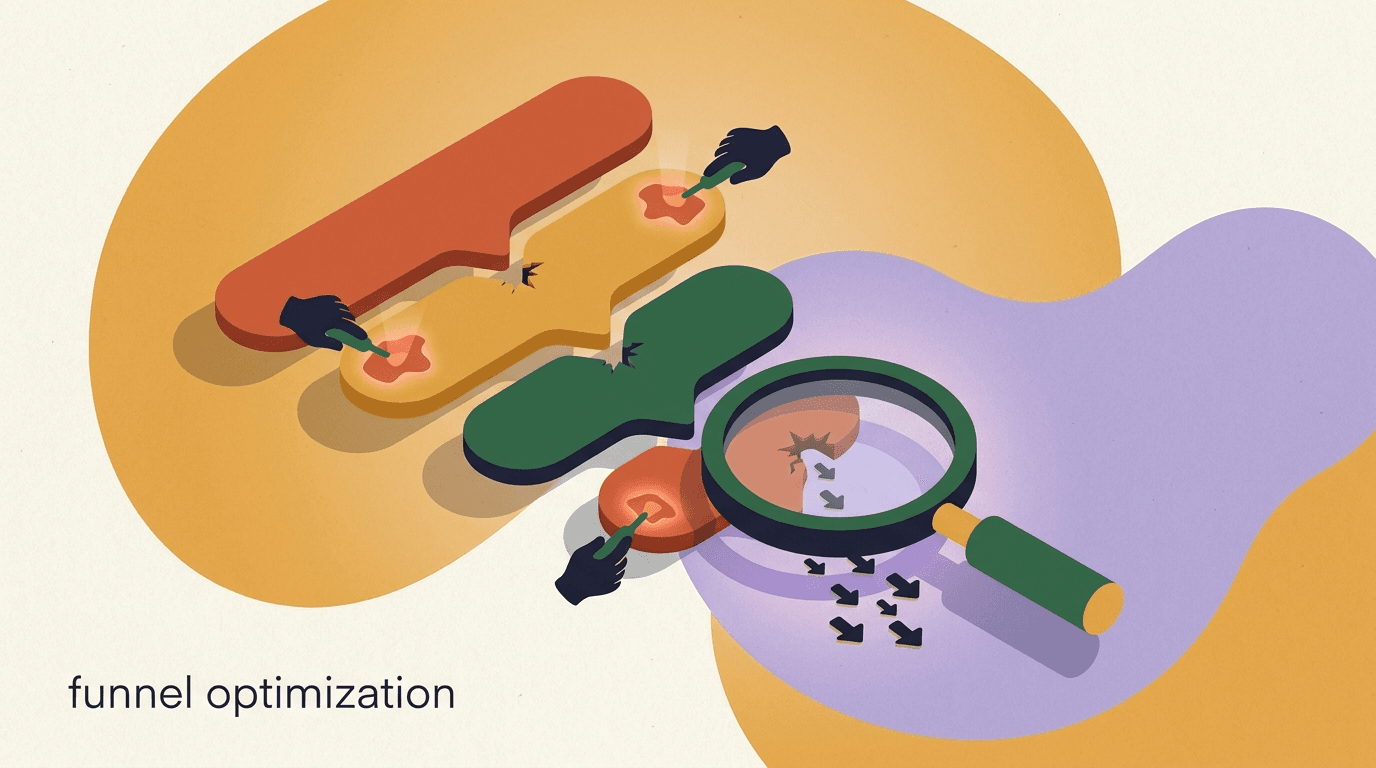
Chat funnel optimization is the work of finding where conversations stop converting and fixing those points one at a time. A chat or DM funnel feels different from a web funnel — there is no landing page to stare at, no obvious bounce rate, just a thread that either moves toward a sale or quietly goes cold. That makes the leaks harder to see, which is exactly why they go unfixed for months. The good news is that a chat funnel is still a funnel: it has stages, each stage has a conversion rate, and every drop between stages is a number you can measure and improve.
This guide is a practical playbook, not a theory lecture. We will map the stages of a typical DM funnel, show you how to read the drop-off between each one, walk through diagnosing the five places leaks usually hide, and lay out how to run small A/B tests that actually tell you something. The thread running through all of it is discipline: measure before you change anything, change one thing at a time, and let small tests beat big guesses.
Full disclosure before we start: we build KlyoChat, an AI-native platform for running and analyzing chat funnels. We have a point of view, and there is one section near the end where we explain how the product fits this workflow. Everything before that is tool-agnostic — the method works whether you run your funnel on KlyoChat, a competitor, or a spreadsheet and a lot of patience.
What is a chat funnel, and what does optimizing it actually mean?
A chat funnel is the sequence of steps a person passes through from the moment they enter a conversation with your business to the moment they buy — or don't. On Instagram it might start with a comment on a Reel that triggers a DM. On WhatsApp it might start with a click-to-chat ad. On Facebook Messenger it might start with a Send Message button. The channel changes; the shape does not. Someone enters, you say something, they respond or they don't, you qualify them, you make an offer, and you follow up. Each of those is a stage, and each stage loses people.
Optimizing the funnel means improving the rate at which people move from one stage to the next, without spending more to get them in the door. That distinction matters. You can always buy more conversations with more ad spend, but that hides the underlying problem. Chat conversion optimization is about getting more out of the conversations you already have. If 1,000 people enter your funnel and 20 buy, doubling your buyers by lifting conversion is far cheaper than doubling your traffic.
The reason chat funnels leak so badly is that most people never look at them stage by stage. They look at one number — replies, or sales — and that single number hides everything. A funnel with a great trigger and a terrible offer looks identical, from the top, to a funnel with a weak trigger and a great offer. Only when you break it into stages do the leaks become visible.
There is also a psychological trap unique to chat. Because each conversation feels personal, it is tempting to treat outcomes as one-off stories — this person was a tire-kicker, that one was just browsing. Stories are comforting and they are useless for optimization. The whole point of funnel thinking is to stop reasoning from individual anecdotes and start reasoning from rates across hundreds of conversations, where the patterns that anecdotes hide become obvious.
A funnel is a sequence of rates, not a single number
If you only track one metric — total sales, or total replies — you cannot tell a trigger problem from an offer problem. The whole value of funnel thinking is breaking the journey into stages so each leak has its own number you can attack.
How do you map the stages of your chat funnel?
Before you can fix a leak, you need a map. Mapping a chat funnel means writing down every distinct step a person passes through and deciding what counts as success at each one. Do this on paper or a whiteboard first; do not start in a tool. The goal is clarity, not configuration.
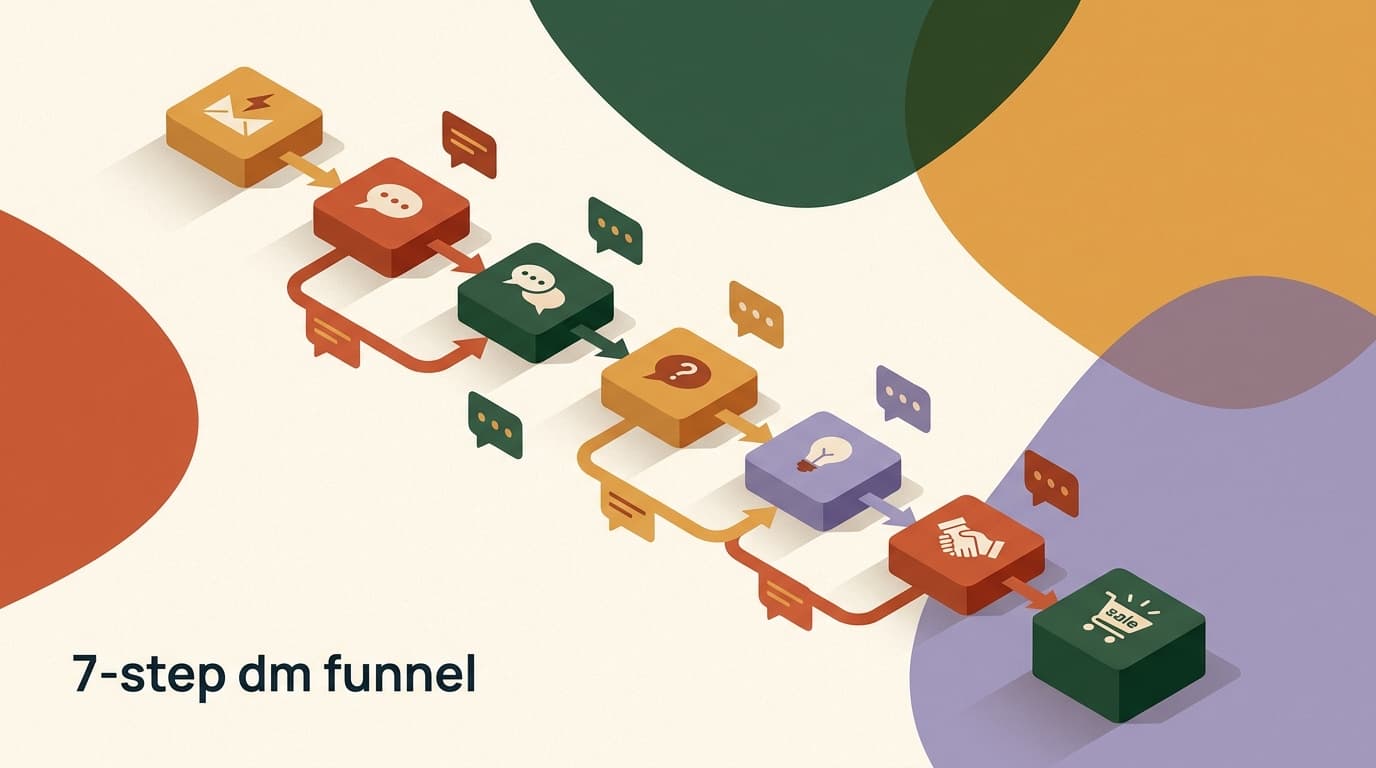
Most DM funnels collapse into five core stages, regardless of channel. The labels matter less than the act of separating them, because a combined number cannot be diagnosed.
- List every step from entry to saleWrite the literal sequence for your funnel: comment on Reel, auto-DM fires, they reply, you ask a qualifying question, they answer, you send the offer, they buy or go silent.
- Define success for each stepDecide what counts as 'advanced.' For the first message, success might be any reply. For the offer, success is a click or a yes. Write the definition down so it does not drift.
- Attach a number to each stepCount how many people reach each stage over a fixed window — say, the last 30 days. You now have a funnel with real volumes, not a vague mental model.
| Stage | What it is | The question it answers |
|---|---|---|
| Trigger | How the conversation starts (comment, ad, keyword, button) | Are people entering at all? |
| First message | Your opening reply and their first response | Do they engage after entering? |
| Qualification | You learn what they need; they reveal intent | Are these the right people? |
| Offer | You present the product, price, or next step | Do they say yes to the offer? |
| Follow-up | You re-engage people who went quiet | Do you recover the ones who stalled? |
A mapped 30-day DM funnel
- Trigger (entered funnel)
- 1,000 people
- First message (replied)
- 620 people
- Qualification (answered question)
- 310 people
- Offer (saw the offer)
- 180 people
- Sale (purchased)
- 36 people
How do you read drop-off and find the biggest leak?
Once your funnel has numbers, the next move is to turn raw counts into stage-to-stage conversion rates. The absolute counts tell you volume; the rates tell you where the funnel is broken. A stage that loses 80 percent of the people who reach it is a leak no matter how big the numbers look at the top.
Calculate the conversion from each stage to the next by dividing the count at the lower stage by the count at the stage above it. Then scan for the single worst drop. That is where your first effort goes. Counterintuitively, the biggest absolute loss is not always the most fixable — but it is always the first place to look.
- Find the worst stage-to-stage rate first — that is your primary leak, not the stage with the lowest raw count.
- Compare each rate to a sane benchmark or to your own past performance, not to a competitor's screenshot.
- Remember that early-stage leaks waste the most volume, because every later stage is starved by them.
| Transition | Math | Conversion rate |
|---|---|---|
| Trigger to first message | 620 / 1,000 | 62% |
| First message to qualification | 310 / 620 | 50% |
| Qualification to offer | 180 / 310 | 58% |
| Offer to sale | 36 / 180 | 20% |
| Overall (trigger to sale) | 36 / 1,000 | 3.6% |
Fix upstream leaks before downstream ones
An early leak poisons everything below it. If only 50 percent reach qualification, your offer stage will always look small even if the offer is excellent. Patch the highest leak in the funnel before optimizing anything beneath it.
Why measure before you change anything?
The single most common mistake in chat funnel optimization is changing things before you have a baseline. You rewrite the opening message because it 'feels weak,' you swap the offer because a competitor did, and a month later you have no idea whether anything improved — because you never recorded where you started. Without a baseline, optimization is just redecorating.
A baseline is the set of stage-to-stage rates measured over a defined window, before you touch anything. It is boring and it is the most important step. It gives you a reference point, it reveals which stage actually deserves attention, and it protects you from the trap of fixing the stage that annoys you instead of the stage that is losing money.
Give the baseline enough time and volume to mean something. A funnel that sees 30 conversations a week needs a longer window than one that sees 3,000 a day. The point is to capture normal variation, so that when you do make a change, you can tell a real lift from random noise.
No baseline, no conclusion
If you change your funnel without first recording the rates you started from, you can never prove the change helped. You will be guessing forever. Spend the first one to two weeks measuring and nothing else. It is the cheapest insurance you can buy.
Leak one: is your trigger bringing in the wrong people?
The trigger is how conversations start, and it sets the quality of everything downstream. A trigger that pulls in huge volume but the wrong audience will look great at the top and terrible at the bottom. A viral Reel that triggers thousands of DMs from people who will never buy is not a win; it is an expensive way to lower your conversion rates and inflate your contact list.
There are two distinct trigger problems, and they need opposite fixes. The first is low volume: not enough people are entering, so the funnel is starved. The second is low quality: plenty enter, but they are mismatched to your offer, so they leak out at qualification. Diagnose which one you have before you act, because the fixes pull in different directions.
- Low-volume trigger: make the call-to-action clearer, move it earlier in the content, or add a comment-to-DM keyword that is easy to type.
- Low-quality trigger: tighten the message so it pre-qualifies — say who the offer is for, so the wrong people self-select out before they enter.
- Mismatched channel: a trigger that works on TikTok may pull tire-kickers on Facebook. Read each channel's funnel separately.
Two trigger problems, opposite symptoms
- Low volume
- Few enter, but those who do convert well downstream — widen the top
- Low quality
- Many enter, almost none qualify — narrow and pre-qualify the trigger
Leak two: does your first message kill the conversation?
The first message is where most chat funnels bleed the worst, and it is the most fixable leak in the whole funnel. People enter with a flicker of interest, your opening reply lands, and either the conversation continues or it dies right there. A robotic, generic, or pushy first message ends threads that a warmer one would have kept alive.
Three things sink first messages. The first is delay: on social DMs, attention decays in minutes, and a reply that arrives an hour later talks to someone who has moved on. The second is tone: a message that reads like a form letter or a hard sell triggers an instant exit. The third is asking for too much too soon — leading with 'what's your budget' before you have given any reason to engage.
The fix is usually to make the opening feel like a human who read the context, acknowledge why they reached out, and ask one easy, low-commitment question that invites a reply. Speed matters as much as wording; a fast, decent message beats a slow, perfect one.
One more thing about openings: they should set the right expectation for what happens next. If your first message promises a quick answer and then drops the person into a long interrogation, the mismatch reads as a small betrayal and the conversation cools. The opening and the qualification stage have to feel like one continuous conversation, not a bait followed by a form. When you test first messages, read the qualification rate of each variant too, because a flashy opener that boosts replies but tanks qualification has only moved the leak one stage down.
Respect the platform's response window
Meta's platforms enforce a 24-hour window for free-form replies after a user's last message. If your first response is slow or your follow-up falls outside that window, you may be unable to reply at all without a paid template. Fast first messages are not just better for conversion — they keep you inside the rules.
Leak three: is your qualification doing real work?
Qualification is the stage where you learn who you are talking to and they reveal how serious they are. Done well, it sends genuine prospects toward your offer and gently filters out people who were never going to buy. Done badly, it does one of two harmful things: it interrogates good prospects until they leave, or it lets everyone through so your offer stage is clogged with people who waste your time.
The art of qualification is asking the fewest questions that still tell you what you need. Every question you add is a chance for someone to drop. So each question must earn its place by changing what you do next. If the answer would not change your offer or your routing, do not ask it.
Watch the qualification-to-offer rate closely. If it is high but your offer-to-sale rate is terrible, you are probably under-qualifying — sending unready people to the offer. If your qualification rate itself is low, you are probably over-qualifying — asking too much before you have earned it.
Over- vs under-qualification
- Over-qualifying
- Low qualification rate; good prospects abandon mid-interrogation
- Under-qualifying
- High qualification rate, low sale rate; offer stage full of wrong-fit people
- Balanced
- Enough questions to route well, few enough that serious buyers stay
Leak four: is your offer landing or stalling?
The offer is where you ask for the decision — the purchase, the booking, the next concrete step. By the time someone reaches it, they have already invested in the conversation, so a leak here is especially painful: you did the hard work of getting them this far and lost them at the moment of truth.
Offer leaks usually come from one of a few causes. The offer may be unclear — the person cannot tell what they get or what it costs. It may arrive at the wrong moment — too early, before trust is built, or too late, after momentum has faded. It may carry friction — a clunky checkout, a link that breaks on mobile, a payment method they do not use. Or the offer itself may simply not match what the conversation built toward.
Before you assume the offer needs rewriting, check the mechanics. A surprising share of offer-stage leaks are not persuasion problems at all; they are broken links, confusing prices, or a checkout that asks for an account before it asks for a card. Fix the plumbing before you touch the pitch.
- Clarity: state exactly what they get, the price, and the single next action — no ambiguity.
- Timing: present the offer when intent is high, right after a qualifying yes, not as a cold opener.
- Friction: test the actual purchase path on a phone; remove any step that is not strictly necessary.
- Fit: make sure the offer matches what the conversation promised — a mismatch reads as a bait-and-switch.
Check the plumbing before the pitch
When the offer stage leaks, people instinctively rewrite the copy. Often the real culprit is a broken checkout link, a price shown in the wrong currency, or a mobile flow that fails. Walk through your own purchase path end to end before you rewrite a single word.
Leak five: are you recovering people who go quiet?
Follow-up is the stage almost everyone neglects, and it is where a lot of recoverable revenue dies. Most conversations do not end with a clear no; they end with silence. The person got distracted, the offer arrived at a busy moment, they meant to reply and forgot. A single well-timed follow-up recovers a meaningful share of those — but only if you actually send one.
The reason follow-up gets skipped is that it is invisible. The leak does not show up as a rejection; it shows up as nothing. Threads just go cold, and without measurement you never see how many you are losing. Tracking a 'went quiet' segment and the rate at which follow-up recovers them turns this invisible leak into a number you can improve.
The discipline is to follow up without being a pest. One or two thoughtful nudges, spaced sensibly and inside the platform's messaging window, will recover the people who simply forgot. Beyond that you are mostly annoying the people who already decided no — and on Meta's platforms, you may be outside the 24-hour window and unable to send free-form messages at all.
- Define what counts as 'went quiet'Pick a threshold — for example, no reply for 24 hours after the offer. Anyone past it enters a follow-up segment you can track and message.
- Send one helpful nudge, not a guilt tripRe-open with value or a genuine question, not 'just following up.' Reference the specific thing they were interested in to show it is not a blast.
- Measure the recovery rateTrack how many quiet conversations the follow-up reactivates. That single number tells you whether follow-up is worth more investment or already maxed out.
How do you A/B test a chat funnel without fooling yourself?
Once you know which stage leaks worst, you test fixes. A/B testing a chat funnel means running two versions of a single element at the same time, splitting traffic between them, and comparing the stage conversion rate. The same-time part is essential. If you run version A this week and version B next week, any difference might be the day of the week, a holiday, or an ad that happened to bring better traffic — not your change.
The cardinal rule is to change one thing at a time. If you rewrite the first message and the offer in the same test, a lift tells you nothing about which one caused it. Isolate the variable. Test the opening line, or the qualifying question, or the offer wording — never two at once. It is slower, and it is the only way to learn anything you can trust.
Give the test enough volume before you call it. Two conversions out of ten on each side is noise; you could flip the result by moving a single person. Low-traffic funnels need patience here, and that is a real constraint — if you only get a handful of conversations a week, honest A/B testing is hard and you may have to rely on bigger, more obvious changes and longer windows instead of fine splits.
| Element to test | Version A | Version B |
|---|---|---|
| First message tone | Friendly and casual | Direct and concise |
| Qualifying question | Ask budget first | Ask need first |
| Offer framing | Lead with price | Lead with outcome |
| Follow-up timing | Nudge after 24 hours | Nudge after 4 hours |
Small samples lie
A few conversions per side is not a result, it is noise — one person flips it. If your funnel has low volume, run the test longer, test bolder changes, or accept that you cannot split-test fine details. Calling a winner too early is worse than not testing, because it gives false confidence.
What should you actually test first?
Not all tests are worth running. The best first tests are the ones at your worst-leaking stage that are cheap to change and likely to move the number. Resist the urge to test something just because it is easy; test where the leak is, even if the fix takes more thought.
A simple way to prioritize is to score each idea on two axes: how big the leak is at that stage, and how easy the change is to make. High-leak, low-effort changes go first. High-leak, high-effort changes go second. Low-leak changes wait, no matter how easy they are, because polishing a stage that already converts well is wasted motion.
- Start at the stage with the worst conversion rate, not the stage you find most annoying.
- Prefer changes you can fully reverse, so a losing test costs you nothing.
- Write down your hypothesis before the test: what you expect to happen and why. It keeps you honest when you read the result.
Prioritizing test ideas
- Worst leak + easy change
- Do this first — biggest return for least effort
- Worst leak + hard change
- Do this second — worth the effort because the leak is large
- Minor leak + easy change
- Defer — small upside even if it works
- Minor leak + hard change
- Skip for now — poor use of time
How do you iterate without breaking what works?
Optimization is not a one-time project; it is a loop. You measure, you find the worst leak, you test a fix, you keep the winner, and you go back to measuring — because once you patch the biggest leak, a different stage becomes the new biggest leak. The funnel never reaches a finished state, but the rate of improvement compounds.
The risk in iterating fast is regression: a change that lifts one stage while quietly hurting another. A more aggressive qualifying question might raise offer-stage conversion while shrinking the number who reach qualification at all — a net loss hidden behind a local win. This is why you watch the overall trigger-to-sale rate alongside the individual stage you are tuning. The end-to-end number is the referee.
Keep a simple change log: what you changed, when, and what happened to the rates. It sounds bureaucratic, but three months in it is the difference between a funnel you understand and a black box you are afraid to touch. When something dips, the log tells you what to roll back.
- Patch the biggest leakRun your prioritized test, keep the winner, and lock in the improvement at that stage.
- Re-measure the whole funnelConfirm the overall trigger-to-sale rate went up, not just the local stage. If the end-to-end number did not move, something downstream absorbed the gain.
- Find the new worst leak and repeatThe stage that now converts worst becomes your next target. The loop never ends; it just keeps lifting the floor.
Watch the end-to-end rate, always
A change can improve one stage while hurting another. The only number that cannot lie to you is the full trigger-to-sale conversion rate. If a 'winning' test does not move that, it did not really win — it just relocated the leak.
What metrics tell you the funnel is actually getting better?
It is easy to drown in metrics, so it helps to fix on a short list that genuinely reflects funnel health. The headline number is end-to-end conversion: how many of the people who enter eventually buy. Below it sit the stage-to-stage rates, which tell you where to act. Around those, a few supporting metrics give context — speed, recovery, and cost.
Response time deserves its own attention because it influences several stages at once. Faster first responses lift the first-message rate, keep you inside platform windows, and signal that a real business is on the other end. Recovery rate — the share of quiet conversations follow-up brings back — tells you whether your safety net is working. And cost per conversation, while not strictly a funnel rate, keeps you honest about whether better conversion is coming from real improvement or just more spend.
| Metric | What it tells you | Watch for |
|---|---|---|
| End-to-end conversion | Overall funnel health | The number that must go up over time |
| Stage-to-stage rates | Where the leaks are | The single worst transition |
| First response time | Speed and platform compliance | Slow replies bleeding the first-message stage |
| Recovery rate | How well follow-up works | Quiet conversations never re-engaged |
| Cost per conversation | Efficiency of the top | Rising cost masking weak conversion |
Pick a small dashboard and live with it
More metrics is not more insight. End-to-end conversion plus stage rates plus response time will carry most teams. Add a metric only when you have a specific decision it would change. A focused dashboard you check weekly beats a sprawling one you ignore.
How does KlyoChat help with chat funnel optimization?
Everything above works with any tool, including a spreadsheet. But the manual version is tedious: exporting conversations, counting stages by hand, and guessing at where threads went cold. We built KlyoChat partly to take that grind out of the loop, so optimizing a chat funnel is something you can actually keep doing rather than abandon after the first month.
KlyoChat is an AI-native unified inbox that brings Facebook, Instagram, Telegram, WhatsApp, TikTok, and X into one place. Its flows let you build the funnel — trigger, first message, qualification, offer, follow-up — without code, and edit any stage when a test points to a fix. Its analytics report on funnel performance, so the stage-to-stage rates this guide asks you to calculate by hand are shown for you, which makes finding the worst leak a matter of reading a screen rather than building a spreadsheet. AI agents can handle the first response in seconds across every channel, which directly attacks the first-message leak and keeps you inside the 24-hour window, and segments let you isolate the people who went quiet so follow-up is targeted rather than a blast.
Being honest about the limits: KlyoChat does not offer native SMS or email, so if your follow-up strategy leans on those channels you will need another tool alongside it. We are also a newer, smaller product with a smaller community than the incumbents, which means fewer third-party templates and tutorials. And like every platform, we are bound by Meta's 24-hour messaging window — no tool can opt out of that. If your funnel lives entirely on social DM and you want measurement and automation in one place, that is exactly the case we are built for.
- Flows build and edit every funnel stage without code, so a test result becomes a change in minutes.
- Analytics surface stage-to-stage conversion, turning leak-hunting into reading a chart.
- AI agents answer first across all channels, attacking the first-message leak and respecting the 24-hour window.
- Every plan includes a 7-day free trial with no credit card, so you can map your funnel before you pay.
- Honest limit: no native SMS or email, and a smaller community than older platforms.
The tool removes the grind, not the thinking
KlyoChat measures and automates the funnel, but it cannot decide which leak matters or what to test — that judgment is yours. What it removes is the manual counting that makes most teams quit optimizing after a month. The method in this guide still applies; the tool just makes it sustainable.
KlyoChat plans at a glance
- Basic
- $19/mo — entry plan for a small social DM funnel
- Pro
- $49/mo ($39 billed yearly) — all channels, funnel analytics, custom AI agents
- Business
- $129/mo — higher limits and team features for scaling operations
What are the most common chat funnel optimization mistakes?
After the method, it is worth naming the traps, because most failed optimization efforts fail the same handful of ways. Knowing them in advance is half the cure.
The deepest mistake underneath all of these is treating optimization as a feeling rather than a measurement. Once you commit to the discipline — baseline, one change, isolated test, end-to-end check — most of these mistakes simply cannot happen.
- Changing the funnel before measuring a baseline, so no improvement can ever be proven.
- Testing multiple changes at once, making it impossible to know what caused a result.
- Calling a winner on a tiny sample, where one person flips the outcome.
- Optimizing a downstream stage while an upstream leak starves it of volume.
- Buying more traffic to hide a conversion problem instead of fixing the leak.
- Skipping follow-up entirely and silently losing the people who merely went quiet.
- Ignoring response time, the one lever that quietly affects several stages at once.
Hunches feel faster but cost more
Acting on a strong hunch feels efficient and is usually the expensive path. A hunch that is wrong sends you rewriting the wrong stage for weeks. A small, honest test costs a little patience and saves you from confidently optimizing the thing that was never broken.
How long does chat funnel optimization take to pay off?
Set expectations honestly: this is not an overnight fix, and anyone promising one is selling something. The first cycle — baseline, diagnose, test, keep the winner — typically takes a few weeks, because the baseline alone needs enough volume and time to mean something. The payoff compounds after that, as each completed loop lifts the floor a little more.
The pace depends almost entirely on your conversation volume. A funnel that sees thousands of conversations a month can run clean A/B tests and reach conclusions in days. A funnel that sees dozens has to lean on longer windows and bolder changes, and must accept more uncertainty. Neither is wrong; the method adapts. What does not change is the order of operations: measure, find the worst leak, test one fix, verify the end-to-end number, repeat.
The teams that win at this are not the ones with the cleverest single trick. They are the ones who keep the loop running month after month, treating the funnel as something you tend rather than something you finish. Small, compounding improvements to a few stages add up to a conversion rate that quietly doubles over a year — without spending a dollar more to fill the top.
The bottom line on chat funnel optimization: a DM funnel is a sequence of stages, each with a conversion rate you can measure, and the work is finding the worst leak and fixing one stage at a time. Map the five stages — trigger, first message, qualification, offer, follow-up — read the stage-to-stage rates, diagnose the cause of the biggest drop, and test a single change against a baseline you recorded first. Then watch the end-to-end rate to make sure the local win is a real win, and start the loop again.
Do the boring parts and the rest follows: measure before you change, isolate one variable, give tests enough volume, and never trust a hunch over a number. For the automation side of this, see our guide to DM funnel automation; for the metrics that tell you it is working, our piece on chat marketing KPIs; and for the full journey from first message to purchase, our walkthrough of the chat-to-sale funnel.