Most advice about DM marketing stops at the idea. Reply to comments. Send a welcome message. Be helpful. All true, all useless when you sit down to actually build the thing. A DM funnel automation is not a vibe — it is a sequence of discrete steps, each with a trigger, a piece of copy, a branch for when people say yes and a branch for when they say no, and a number that tells you whether the step works.
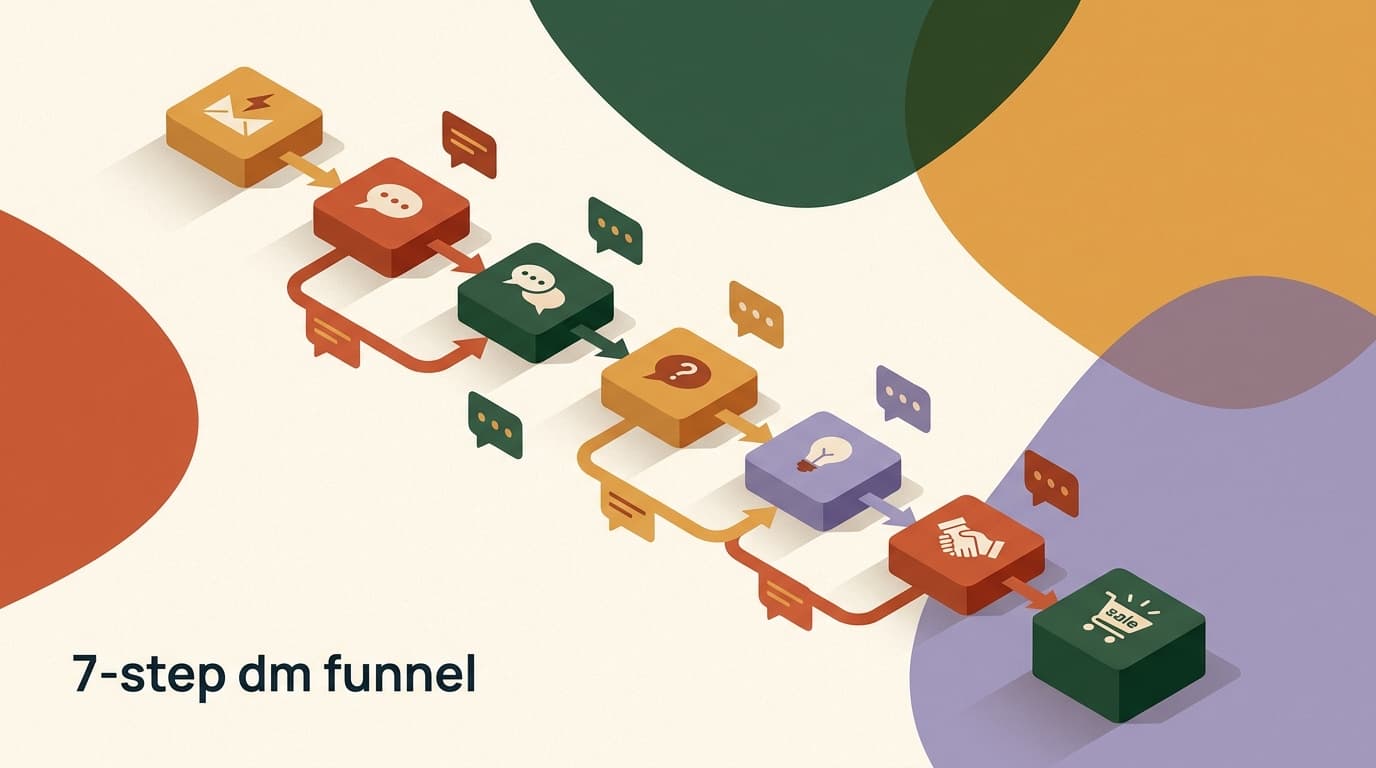
This guide is the build. We will walk through a concrete seven-step DM funnel you can set up this week, one section per step: the trigger that starts it, the welcome that earns the next reply, the qualify step that sorts buyers from browsers, the value step that creates a reason to trust you, the offer that asks for the sale, the objection step that handles the inevitable hesitations, and the follow-up that recovers the people who went quiet. For each one you get sample copy, the branching logic, where AI earns its place, and the single metric to watch.
Full disclosure: we build KlyoChat, an AI-native platform for exactly this kind of automation, so we have a point of view. But the seven steps are tool-agnostic. You can build them in most chat platforms. We will show the structure first, name the product only near the end, and flag the honest limits — including Meta's rules and the 24-hour messaging window that shape what any DM funnel can legally do.
What is a DM funnel and why automate it?
A DM funnel is a marketing funnel that lives inside direct messages instead of on a landing page or in an email sequence. The same logic applies — attract attention, qualify interest, build trust, make an offer, close — but it happens as a conversation, one message at a time, in the inbox where your audience already spends its day.
The reason to automate it is volume plus consistency. A single person can hold maybe a few dozen real DM conversations a day before quality collapses. A funnel can hold thousands at once, and every lead gets the same strong opening, the same qualifying questions, and the same timely follow-up — at 2pm or 2am, on the day they engage rather than the day you get around to your inbox. Automation does not replace the human conversation; it makes sure the human conversation starts well and never gets dropped.
The distinction worth holding onto: a DM funnel is not a blast. A broadcast pushes one message to a list. A funnel reacts to what each person does — it branches. Someone who clicks gets a different next message than someone who ignores you. That branching is the whole point, and it is what separates a real automated DM funnel from a glorified auto-reply.
- Conversation, not page: the funnel runs as a back-and-forth in the inbox.
- Reactive, not blasted: each step branches on what the person actually did.
- Always-on: it qualifies and follows up on the lead's schedule, not yours.
- Human-friendly: it warms leads so your team only joins the conversations worth their time.
A funnel is steps, not a single message
If your DM strategy is one welcome message and then silence, you do not have a funnel — you have an auto-reply. The value is in the sequence: each step earns the right to send the next, and each branch sends the right next message to the right person.
What are the 7 steps of an automated DM funnel?
Before we build each step in detail, here is the whole structure in one view. Think of it as the skeleton. The rest of this guide adds copy, branches, AI, and metrics to each bone.
Every step has a job, and every step hands off cleanly to the next. If a step does not move the person closer to a decision, it does not belong in the funnel.
| # | Step | Job of this step | Primary metric |
|---|---|---|---|
| 1 | Trigger | Start the funnel from a real signal of interest | Trigger-to-DM rate |
| 2 | Welcome | Earn the second reply; set the tone | Reply rate |
| 3 | Qualify | Sort buyers from browsers; tag intent | Qualification rate |
| 4 | Value | Give something useful before asking for anything | Value-engagement rate |
| 5 | Offer | Make a clear, single ask | Offer click / accept rate |
| 6 | Objection | Handle the reasons people stall | Objection-recovery rate |
| 7 | Follow-up | Recover the people who went quiet | Re-engagement rate |
Build it in order, but launch the first three first
You do not need all seven live on day one. Trigger, welcome, and qualify are the engine — ship those, watch the numbers for a week, then layer in value, offer, objection, and follow-up. A working three-step funnel beats a perfect seven-step funnel that never launches.
Step 1 — How does the trigger start the funnel?
The trigger is the signal that someone is interested enough to enter the funnel. It is the most important step to get right, because a funnel triggered by the wrong signal fills with the wrong people, and no clever copy downstream fixes a bad top of funnel.
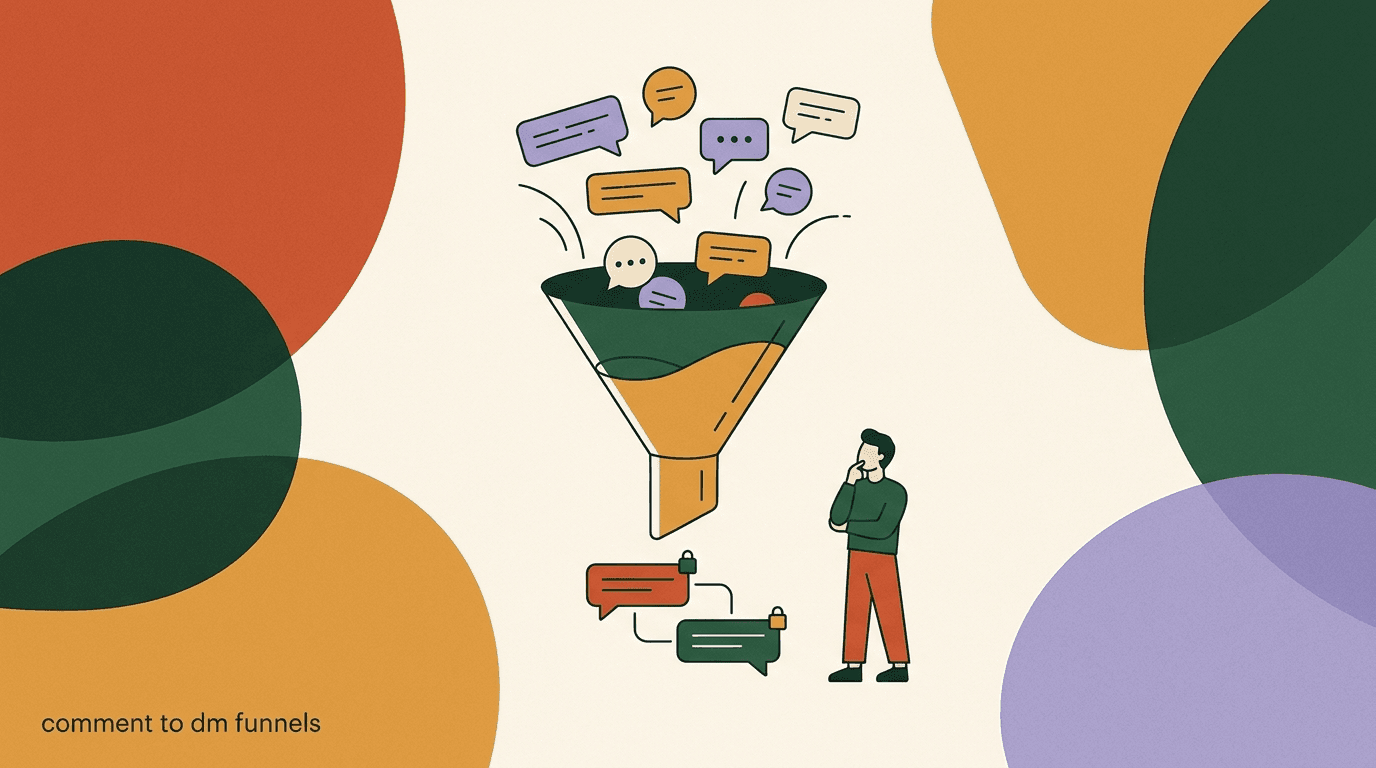
Good triggers are tied to a deliberate action. The strongest is a comment-to-DM: someone comments a keyword on your post or Reel, and the funnel opens a DM to them. Other solid triggers are a Story reply, a first DM from a new person, a keyword sent in chat, or a click on an ad that opens a conversation. The common thread is intent — the person did something, so the message they get next is welcome rather than intrusive.
The branching at this step is about routing. Different triggers can start different funnels. A comment of "PRICE" should start a buying-intent funnel; a generic "hi" should start a softer welcome funnel. Route by the signal so the rest of the steps can be sharper.
- Pick the action that signals intentComment keyword, Story reply, ad click, or first DM. Tie the trigger to something the person chose to do.
- Map each trigger to a funnel variantA pricing keyword starts a buying funnel; a content keyword starts a nurture funnel. Routing here keeps every later step relevant.
- Set the keyword and the public replyFor comment-to-DM, reply publicly so the thread looks alive, then move the real conversation to the DM.
Respect the platform's rules at the trigger
Comment-to-DM and first-contact messaging must follow Meta's policies and the 24-hour messaging window. You can reliably message someone after they message or interact with you; you cannot cold-DM strangers. Build triggers around genuine inbound actions, not scraped lists.
Sample trigger — comment-to-DM on a Reel
- Post caption
- Comment GUIDE and I will send you the 7-step DM funnel template.
- Public auto-reply
- Sent it to your DMs! Check your messages.
- Funnel opened
- Buying-intent funnel (keyword GUIDE)
Step 2 — What should the welcome message say?
The welcome is the first message the person reads inside the DM. Its only job is to earn the second reply. Not to sell, not to qualify, not to explain everything you do — just to get one more message back, because a conversation that gets a reply is a conversation that can go somewhere.
The pattern that works: confirm what they asked for, deliver it or promise it immediately, and end with a low-friction question or a tappable button. Friction is the enemy here. "Tell me about your business" is friction. "Want the free version or the paid one?" with two buttons is not.
Branching at the welcome step is usually a simple fork: they reply or they go quiet. If they reply, they move to qualify. If they go quiet for a set window, they enter the follow-up step later. Keep the fork clean and do not overthink the first message.
- Confirm and deliver: acknowledge the trigger, hand over what was promised.
- End with one easy action: a button or a yes/no question, never an essay.
- Set the tone: write like a helpful person, not a press release.
- Keep it inside the window: deliver the value while the conversation is still open.
Buttons beat open questions at the start
Early in a funnel, tappable buttons convert better than open-ended questions because they remove the effort of composing a reply. Save free-text questions for later steps, once the person is already engaged.
Sample welcome copy (with buttons)
- Message
- Here is the 7-step DM funnel template you asked for. Quick question so I send the right next thing:
- Button A
- I run ads and want more from them
- Button B
- I post organically and want to convert it
- Result
- Tapping a button branches into the matching qualify path
Step 3 — How does the qualify step sort buyers from browsers?
The qualify step decides who is worth the offer and who needs more nurturing. It asks one or two questions that reveal intent, budget, fit, or timing, and it tags the contact based on the answers so the rest of the funnel — and your team — knows who they are dealing with.
Keep it to the fewest questions that actually change what you do next. Two good questions beat five mediocre ones. A coaching business might ask about goal and timeline; a D2C brand might ask about use case and size; a service business might ask about budget band and urgency. The answers should map directly to a branch.
This is where branching does real work. A high-intent, good-fit answer routes straight toward the offer. A low-intent or poor-fit answer routes into the value step for more nurturing, or out of the funnel politely. Tag everything — those tags are what make your broadcasts and future funnels smart.
- Ask one or two intent questionsUse buttons or short free-text. Each question should change the branch the person takes next.
- Tag the contact on every answerTag intent (hot/warm/cold), fit, and topic. Tags drive routing now and segmentation later.
- Branch by answerHot and good-fit go toward the offer; warm goes to value; poor-fit gets a helpful exit, not a hard sell.
- Hand off the hot onesFor high-value leads, notify a human to join the live conversation instead of finishing on autopilot.
Qualifying is also disqualifying
A good qualify step is happy to route someone out. Sending a poor-fit lead a helpful resource and ending warmly protects your offer step from low-intent traffic and protects the lead from a pitch they did not want. Both sides win.
Sample qualify branch
- Question
- When are you looking to start? (This month / Next quarter / Just exploring)
- This month
- Tag hot, route to offer step
- Next quarter
- Tag warm, route to value step
- Just exploring
- Tag cold, send resource, exit to nurture
Step 4 — How does the value step build trust before the offer?
The value step gives the person something useful before you ask for anything. This is the step most automated funnels skip, and skipping it is why so many DM funnels feel like a vending machine that demands payment before showing the snack. Value earns the right to make an offer.
What counts as value depends on what you sell. It might be a short guide, a quick assessment, a relevant case example, a template, or a single genuinely helpful answer to the question implied by their qualify answers. The bar is simple: would this be worth receiving even if they never bought? If yes, send it. If it only makes sense as a setup for the pitch, it is not value.
Branching here keys off engagement. Did they open the link, reply to the resource, or react? Engaged contacts are ready for the offer. Unengaged contacts get one more touch or drop into follow-up. The value step is also the natural home for warm leads routed out of qualify — give them a reason to come back hot.
- Lead with usefulness: the resource should stand on its own.
- Match it to the qualify answer: relevance is what makes value feel personal.
- Track engagement: clicks and replies tell you who is ready to be asked.
- Use it to warm cold leads: this is where exploring becomes interested.
One strong asset beats a content firehose
You do not need a library at the value step. One genuinely helpful, well-matched asset does more than five generic ones. Pick the single thing your best customers say made them trust you, and lead with that.
Sample value message
- Message
- Based on what you said, this 2-minute breakdown will help most: [link]. It walks through the exact funnel for ad traffic.
- If they engage
- Route to offer step
- If silent 24h
- Route to follow-up step
Step 5 — How do you make the offer in a DM?
The offer step makes one clear ask. After a strong trigger, a welcome that earned a reply, a qualify step that confirmed intent, and a value step that built trust, the person is ready to be asked — and the worst thing you can do now is be vague or stack three asks into one message.
A good DM offer is specific and singular. One product, one link, one next action. Tell them exactly what to do and what happens when they do it. "Want me to send the checkout link?" is a clean ask. "You could book a call, or buy directly, or join the waitlist, or..." is a way to get no decision at all.
The branch off the offer is the most important fork in the funnel: accept, hesitate, or decline. Accept routes to fulfillment or a human. Hesitate routes to the objection step. Decline routes to a graceful follow-up later, not a guilt trip. Tag the outcome so you can measure the step honestly.
- Make one specific askOne product, one action, one link. Remove every choice that is not the choice you want them to make.
- Say what happens nextTell them exactly what the click or reply does — checkout, a call booking, a confirmation. Certainty reduces hesitation.
- Branch on the responseAccept to fulfillment or a human; hesitate to the objection step; decline to a softer follow-up.
- Tag the outcomeRecord accept/hesitate/decline so the offer step has a real conversion number, not a guess.
Do not promise outcomes you cannot guarantee
Tell people what your product does, not what results they will get. "You can be live in 10 minutes" is a fact about setup. "You will make $10k" is a claim you cannot back. Honest offers convert worse on the first read and far better over the life of the relationship.
Sample offer copy
- Message
- You are a great fit for the Starter plan. Want me to send your checkout link? It is set up so you can be live in about 10 minutes.
- Yes
- Send link, tag accepted, notify team
- Not sure
- Route to objection step
- No
- Tag declined, schedule soft follow-up
Step 6 — How does the objection step handle hesitation?
Most people who do not buy on the first ask are not saying no — they are saying not yet, because something is unresolved. The objection step exists to surface that something and answer it. It is the step that turns hesitation into a decision, in either direction.
The pattern: acknowledge the hesitation, ask what is holding them back, and have a prepared, honest response for each of the common objections. Price, timing, trust, fit, and "need to think about it" cover most of them. Each gets its own branch with a real answer — a comparison, a guarantee, a relevant example, or simply more information — not a pushier version of the same pitch.
This is the step where AI free-text handling matters most, because objections arrive as open language, not button taps. "I am not sure it works for my niche" needs an understanding reply, not a menu. We cover where AI fits across the funnel in its own section below, but the objection step is its clearest home.
| Objection | Branch response | Tone |
|---|---|---|
| Too expensive | Reframe around value or offer the lower tier | Helpful, not defensive |
| Bad timing | Offer to follow up on their timeline; tag the date | Patient |
| Not sure it fits | Send the closest relevant example, ask one question | Curious |
| Need to think | Answer the unspoken question; offer to send a summary | Low pressure |
An honest 'not a fit' is worth more than a forced yes
The objection step should be willing to talk someone out of buying when it is genuinely wrong for them. It costs one sale and earns a reputation that brings ten. People remember the brand that told them the truth in a DM.
Sample objection handling
- They say
- I am not sure it will work for my kind of business.
- Branch reply
- Fair question. What do you sell? I will tell you straight if it is a fit — and if it is not, I will say so.
- If a fit
- Send matching example, return to offer
- If not
- Say so honestly, exit warmly
Step 7 — How does the follow-up step recover quiet leads?
Most leads go quiet at some point — after the welcome, after the value asset, after the offer. The follow-up step recovers them. It is the highest-leverage step in the funnel because the people it reaches already raised their hand once; you are not finding new interest, you are reviving interest that already exists.
Effective follow-up is timed, limited, and varied. Timed: a sequence at sensible intervals, not a barrage. Limited: a small number of touches, then a clean exit so you are not the brand that messages forever. Varied: each follow-up brings a new angle — a reminder, a new piece of value, a question, a gentle last call — rather than repeating the same nudge.
The hard constraint here is the messaging window. On Meta platforms you generally have a 24-hour window to send free-form messages after the person's last interaction; outside it, you are limited to approved message types. Design your follow-up sequence to do its most important work inside the window, and respect the rules outside it. We would rather you recover fewer leads than risk your account.
- Wait, do not pounceGive a sensible gap after silence. A follow-up that lands too fast reads as desperate.
- Bring a new angle each timeReminder, then fresh value, then a question, then a last call. Never the same message twice.
- Cap the sequenceThree to four touches, then exit gracefully. Over-messaging burns the goodwill the funnel built.
- Respect the windowDo the heavy lifting inside the 24-hour window; use only compliant message types outside it.
The 24-hour window is not optional
Meta's messaging window limits free-form messages to roughly 24 hours after the contact's last interaction. Follow-ups that ignore it risk failed sends or account penalties. Build the sequence around the window — it is a constraint, not a suggestion.
Sample follow-up sequence (after a silent offer)
- Touch 1 (next day)
- Still want the checkout link? Happy to answer anything first.
- Touch 2 (+2 days)
- Sharing this quick example from someone in a similar spot: [link]
- Touch 3 (+3 days)
- Last nudge from me — want me to hold your spot or close this out?
- After touch 3
- Exit sequence, tag dormant, stop messaging
How do you connect the seven steps into one flow?
Built in isolation, the seven steps are just messages. The funnel is the wiring between them — the branches that decide, for each person, which step comes next. Getting the wiring right is the difference between a funnel that adapts and a funnel that funnels everyone into the same dead end.
Think of the connection in three layers. First, the happy path: trigger, welcome, qualify (hot), offer, accept. That is the route a perfect lead takes. Second, the recovery paths: every place someone can stall — silent after welcome, warm at qualify, hesitant at the offer — routes to value, objection, or follow-up and tries to bring them back to the happy path. Third, the exits: poor-fit leads and people who decline get routed out warmly, tagged for later, and stop receiving messages.
Tags are the connective tissue. Every branch should set a tag, because tags are how a later step knows what happened in an earlier one, how your team knows who to call, and how your next broadcast knows who to include. A funnel without tagging is a funnel that forgets everything the moment a message sends.
- Happy path: the clean route a high-intent lead takes from trigger to sale.
- Recovery paths: value, objection, and follow-up pull stalled leads back.
- Exits: poor-fit and declined leads leave warmly and stop getting messages.
- Tags everywhere: every branch records what happened so later steps and humans can act on it.
Draw it before you build it
Sketch the seven steps and every branch on paper or a whiteboard first. Most funnel mistakes are wiring mistakes — a branch that loops, a path with no exit, a hot lead that never reaches the offer. They are obvious on a diagram and invisible in a builder.
Where does AI actually help in a DM funnel?
AI is not magic dust you sprinkle on a funnel. It helps in specific places and gets in the way in others. The rule of thumb: automate the predictable with simple logic, use AI for the unpredictable, and reserve humans for the high-stakes. Buttons handle predictable choices. AI handles free-text. People handle the conversations that decide real money.
AI earns its place wherever the person types instead of taps. The qualify step when answers are open-ended. The objection step, where hesitations arrive as natural language. The follow-up step, where a reply needs an understanding response rather than a canned one. In each case, an AI agent trained on your product and FAQs can read intent, answer accurately, and either resolve the moment or route it to a human.
Where AI should not run unsupervised: the moment of the actual sale for high-value offers, anything involving a promise or a number you must stand behind, and any conversation where the person is upset. Set the AI to hand off to a human at those points. The strongest funnels use AI to do the 80% that is routine and free up humans for the 20% that is decisive.
| Step | AI's role | Human's role |
|---|---|---|
| Trigger / Welcome | None needed — logic and buttons | Set the copy |
| Qualify | Read free-text answers, tag intent | Review edge cases |
| Value | Recommend the right asset | Curate the assets |
| Offer | Assist; hand off high-value deals | Close big deals live |
| Objection | Answer common objections in natural language | Take over when stakes are high |
| Follow-up | Draft contextual replies | Approve tone for key accounts |
Train the AI on your real answers
An AI agent is only as good as what it knows. Point it at your actual FAQs, product docs, and the answers your best salesperson gives. Generic AI gives generic replies; a grounded agent answers like someone who works there.
How do you measure each step of the funnel?
A funnel you cannot measure is a funnel you cannot improve. The good news: each of the seven steps has one obvious number, and watching those seven numbers tells you exactly where leads leak out. You do not need a dashboard with forty metrics — you need seven, one per step, checked weekly.
Measure conversion between steps, not just totals. The question is never "how many sales" alone; it is "of the people who saw the offer, how many accepted, and of the people who hesitated, how many the objection step recovered." Step-to-step conversion shows you the single weakest link, and fixing the weakest link is almost always the highest-return change you can make.
Set a rough benchmark for each step, then beat your own baseline. Absolute benchmarks vary wildly by industry, audience, and offer, so the honest move is to measure your own funnel for two weeks, treat that as the line, and improve against it. We will not quote made-up conversion rates — your numbers are the only ones that matter.
- Instrument every stepMake sure each step records entries, exits, and the branch taken. You cannot measure what you do not log.
- Calculate step-to-step conversionFor each step, divide who advanced by who entered. The lowest ratio is your next project.
- Change one thing, then re-measureFix the weakest step, leave the rest alone, and watch for two weeks. One variable at a time keeps cause and effect clear.
| Step | Metric | What a low number tells you |
|---|---|---|
| Trigger | Trigger-to-DM rate | Your CTA or keyword is unclear |
| Welcome | Reply rate | First message is too salesy or too long |
| Qualify | Qualification completion | Too many questions, or questions feel intrusive |
| Value | Value engagement | The asset is not relevant or not compelling |
| Offer | Offer accept rate | Ask is vague, mistimed, or not trusted yet |
| Objection | Objection recovery | Responses are defensive or miss the real concern |
| Follow-up | Re-engagement rate | Timing is off or messages repeat themselves |
Fix the weakest link, not your favorite step
It is tempting to keep polishing the offer copy because it is fun. But if 70% of people never reply to the welcome, the offer is irrelevant. Always spend your effort on the earliest step with the worst conversion — that is where the leads actually leak.
What are the most common DM funnel automation mistakes?
Most failed DM funnels fail for the same handful of reasons, and all of them are avoidable. Knowing the common mistakes up front is cheaper than discovering them in your own numbers three weeks in.
The throughline is impatience — asking for the sale before earning it, skipping the value step, over-messaging the follow-up. A DM funnel is a relationship compressed into a sequence, and relationships do not respond well to being rushed.
- Selling in the welcome: the first message should earn a reply, not pitch. Pitching too early kills the funnel at step two.
- Skipping the value step: jumping from qualify straight to offer makes the funnel feel transactional and lowers accept rates.
- No branching: sending everyone the same next message wastes the one advantage DMs have over email blasts.
- Over-messaging in follow-up: more than a few well-spaced touches reads as spam and burns goodwill — and risks the platform's rules.
- Ignoring the 24-hour window: building follow-ups that cannot legally send is a silent failure you only notice when nothing converts.
- Not tagging: without tags, every step forgets what happened before it, and your team and broadcasts fly blind.
- Automating the close for big deals: letting a bot finish a high-value sale that needed a human costs real revenue.
Compliance mistakes are the expensive ones
Copy and timing mistakes cost you conversions. Compliance mistakes — cold-DMing, ignoring the messaging window, scraping contacts — can cost you the account the whole funnel runs on. Build inside Meta's rules from the first step, every time.
How do you build this DM funnel in KlyoChat?
Everything above is tool-agnostic — you can build the seven steps in most chat platforms. Here is how it maps to KlyoChat specifically, since that is the tool we make and the one we know in detail.
KlyoChat is an AI-native, mobile-first platform with a unified inbox across Facebook, Instagram, Telegram, WhatsApp, TikTok, and X. The trigger step uses comment-to-DM and keyword triggers. The welcome through follow-up steps are built in a no-code flow builder with branching and buttons, and you can start from templates rather than a blank canvas. The free-text steps — qualify, objection, follow-up — are handled by custom AI agents, which are included in the plan rather than sold as a separate add-on. Broadcasts let you re-engage tagged segments, and built-in analytics give you the per-step numbers the measurement section asks for.
Because the inbox spans six channels, the same seven-step funnel can run wherever your audience is, and a human can step in from their phone the moment the funnel hands off a hot lead. That mobile-first handoff is the part most desktop-only tools miss.
- Pricing is flat and bundled: Basic $19, Pro $49 ($39 billed yearly) with all channels, 10,000 contacts, and AI agents, Business $129.
- Every plan starts with a 7-day free trial — no credit card required.
- AI agents are included, not a separate per-step charge.
- Honest limits: KlyoChat has no native SMS or email, it is a newer tool with a smaller community than the incumbents, and like every platform it must respect Meta's rules and the 24-hour window. We make no income guarantees — a funnel is a tool, not a promise.
The funnel matters more than the tool
If you build the seven steps well, you will get results on whatever platform you choose. We think KlyoChat makes it faster and cheaper because AI agents and every channel are bundled in — but the structure is the asset. Steal the structure regardless of what you build it in.
Mapping the 7 steps to KlyoChat
- Trigger
- Comment-to-DM + keyword triggers
- Welcome → Offer
- No-code flow builder with branching, buttons, and templates
- Qualify / Objection / Follow-up
- Included custom AI agents for free-text replies
- Re-engagement
- Broadcasts to tagged segments
- Measurement
- Built-in analytics per step
How long does it take to set up an automated DM funnel?
A first working version takes far less time than people expect. The trigger, welcome, and qualify steps — the engine — can be live in an afternoon using templates. The value, offer, objection, and follow-up steps add another day or two once you write the copy and wire the branches.
The honest answer is that setup is the small part. The funnel that converts is the one you have measured and adjusted over a few weeks. Plan for a build day, a launch, and then a regular weekly habit of checking the seven metrics and fixing the weakest step. The funnel is never truly finished; it just gets steadily better.
Start narrow. One trigger, one offer, the seven steps. Get that converting before you add a second funnel for a second product. A single well-tuned funnel earns more than five half-built ones, and it teaches you the patterns that make the next funnel faster.
- Day 1: build the engineTrigger, welcome, qualify from templates. Launch it to real traffic and start logging.
- Days 2–3: add the restWrite and wire value, offer, objection, and follow-up. Connect the branches and exits.
- Weeks 1–4: measure and tuneCheck the seven metrics weekly, fix the weakest step, repeat. This is where the conversions are made.
Ship the three-step engine today
Do not wait until all seven steps are perfect. A live trigger-welcome-qualify funnel collecting real data this week beats a flawless seven-step plan that launches next month. The funnel teaches you what to build next.
A DM funnel automation is not one clever message — it is seven steps wired together: a trigger that starts on real intent, a welcome that earns the next reply, a qualify step that sorts buyers from browsers, a value step that builds trust, an offer that makes one clear ask, an objection step that handles hesitation honestly, and a follow-up that recovers the people who went quiet. Each step has its own copy, its own branches, and its own number.
Build it in order, launch the first three early, let AI handle the free-text moments while humans take the decisive ones, and measure each step so you always know where leads leak. Respect Meta's rules and the 24-hour window at every step. For the strategic case for DMs as a channel see our piece on the DM sales channel, for positioning read chat-to-sale, and for the top-of-funnel mechanics see comment-to-DM funnels — then build the seven steps and let them run.