Direct messages are where buying decisions actually happen now. People research in feeds, but they ask the real questions — price, fit, shipping, will this work for me — in a DM. That makes the inbox one of the highest-intent surfaces you own. It is also the easiest place to ruin your reputation, because the same channel that feels personal when used well feels invasive the moment you treat it like a megaphone.
This guide is about building DMs into a real, repeatable sales channel without becoming the thing everyone mutes. Not a list of cold-outreach templates that get you marked as spam. A philosophy plus a playbook: how to earn permission, lead with value, qualify honestly, make offers that feel like help rather than pressure, follow up without nagging, and use automation where it genuinely speeds things up instead of faking a relationship you have not earned.
We build KlyoChat, a unified inbox with automation and AI agents, so we have a stake in you using DMs well. We also have a stake in you not burning the channel, because a burned channel is a cancelled subscription. So this is honest. We will tell you where automation helps, where it quietly destroys trust, and how to tell the difference before your audience does it for you.
Why are DMs the highest-intent sales channel you have?
Think about the difference between a comment and a DM. A comment is public performance — people write them partly for the algorithm and partly for the audience. A DM is private. When someone moves from your post into your inbox, they have crossed a threshold: they want a one-to-one answer to a specific question. That single act filters out most of the noise. The people in your DMs are, on average, far closer to buying than the people scrolling your grid.
The intent is also fresher. A DM usually arrives seconds or minutes after the trigger — they watched the Reel, read the caption, saw the offer, and reached out while the interest was hot. Compared to email, where you are interrupting someone hours later in a crowded inbox, a DM lands inside an active moment of attention. The window is short, but it is wide open.
And DMs are two-way by nature. Email and ads push one direction; a DM expects a reply. That expectation is exactly what makes conversational selling work — you can ask a question, hear the real objection, and answer it before the person talks themselves out of the purchase. The catch is that everything that makes DMs powerful also makes them fragile. Intimacy cuts both ways.
Same lead, three channels
- Ad retargeting
- Shown a banner, ignored — one-way, low context, easy to scroll past
- Email follow-up
- Opened hours later in a full inbox, maybe skimmed, rarely replied to
- DM conversation
- Answered in the moment, objection surfaced and resolved, sale closed
What actually makes a DM feel spammy?
Spam is not defined by automation, and it is not defined by selling. Plenty of fully manual, heartfelt messages are spam, and plenty of automated replies are welcome. Spam is defined by one thing: a message sent without permission, without context, and without regard for whether the recipient wants it. If you understand that, you can sell hard and still be welcome.
The fastest way to feel spammy is to message strangers who never asked to hear from you. The second fastest is to lead with your pitch before you have given the person any reason to care. The third is to ignore the reply — to fire a template, get a real human response, and then send the next template anyway. Each of these breaks the implicit contract of the inbox: that a message is for me, about something I care about, from someone I have some relationship with.
Volume amplifies all of it. One unsolicited pitch is annoying. A hundred identical ones, copy-pasted, is a pattern the recipient recognizes instantly — and once they recognize the pattern, nothing you say lands, because they have already filed you under 'bot trying to sell me something.' The goal is to never trip that pattern-recognition in the first place.
| Behavior | Spammy version | Non-spammy version |
|---|---|---|
| Starting a conversation | Cold DM a stranger with a pitch | Reply to someone who engaged first |
| Opening line | Lead with the offer | Lead with their question or context |
| Volume | Identical message blasted to a list | Relevant message tied to a real trigger |
| Cadence | Daily follow-ups until they block you | A few spaced, value-led touches, then stop |
| Automation | Bot fakes being a person | Bot routes, qualifies, hands off honestly |
The block button is the only metric that matters here
If your DM strategy produces blocks, mutes, and reports, no clever copy will save it. Platforms read those signals and quietly throttle your reach. Optimize for not being blocked first; optimize for conversion second. The two are more aligned than they look.
How do you earn permission before you sell anything?
Permission is the whole game. The difference between a welcome DM and spam is almost entirely whether the person, in some form, raised their hand. So your first job is not to write better pitches — it is to build more ways for people to invite the conversation. When the recipient started it, even loosely, your message stops being an interruption and becomes a response.
There are many honest ways to earn that opening. The strongest is when someone takes a deliberate action that signals interest, and your DM is the natural continuation of that action. The weakest is anything that resembles you deciding, unilaterally, that a stranger needs to hear from you.
- Comment-to-DM: someone comments a keyword on your post, and you DM them what they asked for. They opted in by commenting.
- Reply-to-story: someone reacts or replies to a story, opening a thread on their terms.
- Bio and link prompts: 'DM us the word PRICING' invites the message explicitly.
- Ad click-to-message: a Click-to-Message ad where tapping the ad starts the DM — the tap is the consent.
- Inbound questions: someone messages you first. This is the cleanest permission there is — just answer well.
Make opting in the easy, obvious path
You will never run out of people to talk to if your content constantly offers a low-friction reason to DM you — a guide, a quote, an answer, a discount code. Permission-first is not a constraint on volume. Done right, it produces more conversations than cold outreach ever could, and every one of them is warm.
What does a value-led first message look like?
Once permission exists, the first message sets the tone for everything after it. The mistake almost everyone makes is treating the opening as a sales slot. It is not. It is a trust-building slot. The job of message one is to deliver the thing they came for, prove you are a real and helpful presence, and make the next reply feel natural — not to close.
Lead with what they asked for. If they commented 'GUIDE,' the first message is the guide, delivered cleanly, with maybe one warm line of context. If they asked about price, give a real answer or a real next step, not a deflection designed to extract their email first. Generosity up front is the cheapest trust you will ever buy, and it is exactly what spam never does — spam takes before it gives.
Keep it short, human, and specific to them. A first message that reads like it could have been sent to anyone reads like spam, because it was. A first message that references their exact comment, their question, or the post they engaged with reads like a person paying attention. That difference — generic versus specific — is the single biggest tell your audience uses to sort you into 'human' or 'bot.'
First message: pitch-led vs value-led
- Pitch-led
- 'Hey! Check out our premium plan, 20% off this week only, link here!' — sent before any rapport
- Value-led
- 'Here's the sizing guide you asked for. Quick q so I point you right — is this for running or everyday?'
How do you qualify without interrogating people?
Qualifying gets a bad reputation because most people do it badly — they fire a list of questions at someone who just wanted help, like a form with a pulse. Done well, qualifying does not feel like qualifying at all. It feels like a helpful person trying to give you the right answer, which requires knowing a little about your situation. The trick is to make every question obviously serve the customer, not your CRM.
Ask one question at a time, and make each one earn its place by leading to a more useful answer. 'Is this for you or a gift?' is fine because the recommendation genuinely changes. 'What's your budget and timeline and team size and current tools?' all at once is an interrogation, and it kills the warmth you just built. Pace it like a real conversation, because it is one.
Good qualification also protects the customer from a bad purchase, which is the most trust-building thing you can do. If your honest read is that they are not a fit — wrong size, wrong use case, too early — say so. Telling someone 'honestly, the cheaper option is right for you' or 'this isn't for you yet' costs you one sale and earns you a reputation that brings ten more. Spam never disqualifies anyone, because spam does not care if you are happy.
- Open with the question they already haveAnswer their actual query first. You earn the right to ask anything by being useful immediately.
- Ask one framing questionA single question whose answer changes your recommendation — use case, who it's for, the problem they're solving.
- Reflect their answer backShow you heard them: 'Got it, since it's for daily commuting, I'd point you to…' This is what separates a person from a script.
- Disqualify honestly when neededIf they're not a fit, say so. A redirected customer trusts you; a mis-sold one returns the product and warns their friends.
Notice the throughline so far: every step is about deserving the sale before asking for it. Permission, value, honest qualification — none of it is a trick. It is the opposite of a trick. The reason this works as a sales channel is precisely because it does not feel like one. Which brings us to the part everyone wants to rush: the offer.
When and how should you make the offer?
The offer is the easy part if you have done the rest. By the time you make it, you should already know what the person wants, why they want it, and what is standing between them and buying. The offer is just naming the obvious next step. If making the offer feels awkward or pushy, that is almost always a signal that you skipped a step earlier — you have not yet earned it, or you have not yet understood them.
Timing is everything. Make the offer when the person has signaled readiness — they have asked about price, asked how to start, expressed a clear need your product meets, or simply run out of questions and gone quiet in a satisfied way. Do not make it the moment they open the thread, and do not make it five times. One clear, well-timed offer beats a barrage every time.
Frame the offer as a recommendation, not a demand. 'Based on what you said, the Pro plan is the right fit — want me to send the signup link?' gives them an easy yes and an easy no. The easy no matters. An offer that traps someone, that makes 'no' feel embarrassing or hard, is a pressure tactic, and pressure is just spam wearing a suit. A soft offer respects that the decision is theirs.
| Signal | Ready to offer? | What to say |
|---|---|---|
| They asked the price | Yes | Give the price, then offer the next step |
| They asked 'how do I start?' | Yes | Send the link or walk them through it |
| They went quiet, satisfied | Soft offer | 'Want me to send the link, or any other questions?' |
| Still asking basic questions | Not yet | Keep answering; the offer can wait |
| They said 'not right now' | No — follow up later | Respect it, leave the door open, note the timing |
Always offer an easy exit with the offer
Pair every ask with a genuine out: 'no pressure either way' or 'happy to just answer questions.' Counterintuitively, making 'no' easy makes 'yes' more likely, because it removes the defensiveness that pressure creates. People buy from someone who clearly isn't trying to trap them.
How do you follow up without becoming a pest?
Most sales are not lost; they are forgotten. Someone gets genuinely interested, life interrupts, and the thread goes cold — not because they decided no, but because they got distracted. Follow-up exists to rescue those conversations. The problem is that the line between a helpful nudge and harassment is thin, and crossing it does lasting damage. So follow-up needs rules.
The first rule: every follow-up must add something. A new piece of information, an answer to a question they raised, a genuinely relevant update, a deadline that actually matters. 'Just checking in!' adds nothing and signals that you are following a script, not a relationship. 'You asked about the larger size — it's back in stock' adds value and gives an honest reason to message.
The second rule: space them out and cap them. A reasonable cadence is one follow-up a few days after the conversation stalls, maybe a second a week or so later if there is a real reason, and then you stop. Two or three value-led touches, then silence. If they are not ready, hammering them will not change that — it will only convert a maybe into a never. The door stays open longest when you stop knocking on it.
- Every follow-up carries new value — never a bare 'still interested?'
- Space touches days apart, not hours. Urgency you manufacture reads as desperation.
- Cap it at two or three. After that, leave the door open and walk away.
- Tie follow-ups to real triggers: back in stock, price change, a deadline that genuinely exists.
- When someone says 'not now,' honor it and note when 'now' might be — then reach out then, not before.
A fake deadline is a trust grenade
'Offer ends tonight!' that quietly resets every week trains people to ignore you and resent you. Manufactured urgency works once and poisons the well. If a deadline is real, use it; if it isn't, don't invent one. Your credibility is worth more than any single conversion.
Where does automation actually help in a DM sales channel?
Automation is not the enemy of a human DM channel. Used correctly, it is what makes a human channel scalable instead of a source of dropped messages and 2 a.m. anxiety. The principle is simple: automate the parts that are mechanical and identical for everyone, and keep the parts that require judgment, empathy, or a real decision firmly human. Automation should buy your team time to be human where it counts, not replace the humanity.
The clearest wins are at the edges of the conversation. The instant first reply so nobody waits twenty minutes and loses interest. The delivery of the exact thing someone asked for via comment-to-DM. Routing the right conversation to the right person. Tagging and organizing so nothing falls through. Reminders to follow up. None of these fake a relationship; they remove the friction that lets warm leads go cold.
The danger zone is anywhere automation pretends to be a person making a real connection. A bot that mimics intimacy, invents enthusiasm it cannot feel, or carries an emotional conversation it cannot understand will eventually say something tone-deaf, and the customer will feel deceived. The damage from feeling deceived is far worse than the damage from a slightly slower human reply. Automate the plumbing, not the relationship.
| Task | Automate it? | Why |
|---|---|---|
| Instant first reply | Yes | Speed matters; nobody resents a fast acknowledgment |
| Delivering a requested guide or code | Yes | It's exactly what they asked for |
| Routing to the right teammate | Yes | Invisible to the customer, saves everyone time |
| Basic FAQ answers | Yes, with an easy human handoff | Fast and accurate, as long as escape is one tap away |
| Handling an objection or emotion | No | Needs judgment; a bot here erodes trust |
| Closing a high-stakes sale | No | The moment that most deserves a real person |
We build automation — and we'll tell you its limits
KlyoChat is an automation and AI product, so take this as honest self-interest: automation that oversteps gets your account muted and your tool blamed. The version of automation that lasts is the one that augments genuine conversation. We'd rather you automate less and keep the channel than automate everything and lose it.
Where does AI help, and where does it quietly hurt trust?
AI agents have changed what is possible in DMs. A good AI agent, trained on your real knowledge base, can answer the majority of routine questions instantly, accurately, around the clock, in the customer's language. For first response, FAQ handling, and qualifying triage, that is a genuine upgrade over a slow human or an unanswered message. The customer gets help faster, and your team gets to focus on the conversations that need them.
AI hurts when it is asked to do something it cannot honestly do: feel, judge, or pretend. An AI that invents a personal story, claims an emotion, or insists it is human is lying, and people are getting very good at detecting the uncanny flatness of a bot trying to be a buddy. The moment a customer realizes the warm rapport was synthetic, every prior message gets retroactively reread as manipulation. You do not just lose the moment; you lose the history.
The safe and effective posture is transparent, bounded AI. Let the AI be helpful and fast without pretending to be a person who cares about you. Make handoff to a human easy and obvious. Do not have the AI claim feelings or fabricate facts. And keep humans on the conversations where stakes, emotion, or complexity are high. Used this way, AI extends your reach without spending the trust you have built — which is the only way to use it that survives contact with real customers.
- AI helps: instant accurate answers, FAQs, qualification, after-hours coverage, language coverage.
- AI hurts: faked emotion, invented facts, claiming to be human, carrying high-stakes or sensitive talks alone.
- Always make 'talk to a human' a visible, one-tap option.
- Train the AI on real knowledge so it doesn't improvise wrong answers.
- Set escalation rules: pricing edge cases, complaints, and emotion go to a person.
AI reply: trust-eroding vs trust-keeping
- Trust-eroding
- 'OMG I totally love this product too, it changed my life!!' — a bot faking a feeling it can't have
- Trust-keeping
- 'Happy to help! Here's the answer. Want me to connect you with someone on the team for the details?'
How do you handle objections in a DM without getting defensive?
Objections are not rejections. When someone says 'it's too expensive' or 'I'm not sure it'll work for me,' they are not closing the door — they are telling you exactly what is standing between them and a yes. An objection is a gift, because it is specific. The worst thing you can do is treat it as an attack and get defensive, or worse, paper over it with a counter-pitch that ignores the actual concern. The customer notices when you talk past them, and it confirms their suspicion that you only want the sale.
The move that works is to acknowledge the objection honestly before you address it. 'Totally fair — it's a real investment' validates the concern and signals you are listening rather than steamrolling. Then you can address it with substance: reframe the price against the value, point to the specific feature that solves their doubt, or offer a lower-commitment way in like a trial. The acknowledgment is what makes the answer land. Skip it and your response sounds like a rehearsed rebuttal; include it and it sounds like a person helping.
Some objections are genuine deal-breakers, and the honest thing is to say so. If your product truly does not do the thing they need, telling them 'honestly, we don't do that well — here's what might' costs you a sale you were never going to keep and earns you a reputation that brings referrals. Trying to argue someone past a real limitation only produces a refund, a bad review, and a story they tell their friends. Honest objection handling is the same restraint as honest qualification, applied later in the conversation.
| Objection | Defensive (bad) | Honest (good) |
|---|---|---|
| Too expensive | 'It's actually a great deal' | 'Fair — here's the value it pays back, and a cheaper way to start' |
| Not sure it fits me | 'It works for everyone' | 'Let's check — what's the use case? I'll tell you straight' |
| Need to think about it | 'The deal ends tonight' | 'Of course. Anything specific I can clear up to help you decide?' |
| Bad past experience | 'That won't happen here' | 'I get the hesitation — here's exactly how we handle that' |
Acknowledge first, answer second
The single highest-leverage habit in DM selling is validating the concern before you respond to it. 'That's a fair point' costs you nothing and changes everything — it turns a debate into a collaboration. People let their guard down for someone who clearly heard them.
What tone and voice keep DMs feeling human?
Tone is what your audience uses, more than anything else, to decide whether they are talking to a person or a machine pretending to be one. The good news is that human tone is not complicated — it is just specific, brief, and a little imperfect. The bad news is that most sales writing is the opposite: generic, long, and polished to the point of sounding synthetic. If your DMs read like a brochure, they will be treated like one, which is to say, ignored.
Write the way you would actually talk to one person who asked you a question. Use their name when it is natural, reference the exact thing they said, and answer the real question rather than the question you wish they had asked. Keep messages short — a DM is a conversation, not an email, and a wall of text signals a script. Match their energy: if they are casual, be casual; if they are precise and businesslike, mirror that. The goal is to sound like the same brand every time without sounding like the same template every time.
Avoid the tells that scream automation: over-the-top enthusiasm, stacked exclamation points, hollow phrases like 'I hope this message finds you well,' and emoji used as decoration rather than expression. None of these are forbidden, but used reflexively they form the exact pattern people associate with bulk outreach. The most trustworthy tone is calm, specific, and slightly understated — it sounds like someone who is confident enough not to oversell.
- Short messages, one idea each — a DM is a chat, not an essay.
- Reference the specific thing they said; generic equals spam.
- Match their energy and formality instead of forcing your own.
- Drop the corporate filler and the manufactured enthusiasm.
- Sound like the same person every time without sounding like the same template every time.
Tone: synthetic vs human
- Synthetic
- 'Hello valued customer!! We are SO excited to assist you today!! 🎉 How may we help?!'
- Human
- 'Hey — got your question about sizing. Quick answer below, and ask if anything's unclear.'
Which metrics tell you the channel is healthy, not just busy?
Activity is not the same as health. You can run thousands of DMs a week and be quietly destroying your channel, or run a few dozen and be building something durable. The numbers that matter are the ones that tell you about quality and trust, not volume. If you only watch how many conversations you start, you will optimize for the wrong thing and mistake a busy channel for a working one.
Track the funnel metrics that show where conversations succeed or stall. Reply rate and reply speed tell you whether you are responsive enough to keep interest alive. Qualified-conversation rate — what fraction of openers turn into someone genuinely worth talking to — tells you whether your permission triggers are attracting the right people or just anyone. Offer-to-close rate tells you whether your timing and framing are right. Watched together, these point precisely at which step to fix.
But the most important number is the one most people never look at: the rate at which people block, mute, or report you. That single metric is the difference between a channel you are building and one you are burning. A rising close rate paired with a rising block rate is not success — it is a fire you have not noticed yet, because the platform notices it first and throttles your reach in response. Watch the trust signal as closely as the revenue signal, because the trust signal predicts whether the revenue signal will still exist next quarter.
| Metric | What it tells you | Watch for |
|---|---|---|
| Reply rate & speed | How responsive you are | Slow replies let warm leads cool |
| Qualified-conversation rate | Whether triggers attract the right people | Lots of openers, few real fits |
| Offer-to-close rate | Whether timing and framing work | Offers landing too early or too hard |
| Block / mute / report rate | Whether you're burning trust | Any upward trend — fix immediately |
A rising close rate can hide a dying channel
If conversions climb while blocks and mutes climb too, you're spending trust faster than you're earning it. Platforms read those signals and throttle your reach, so the revenue you're celebrating today is borrowed against next quarter. Track the trust metric as seriously as the money metric.
How do you build this into a repeatable channel, not a scramble?
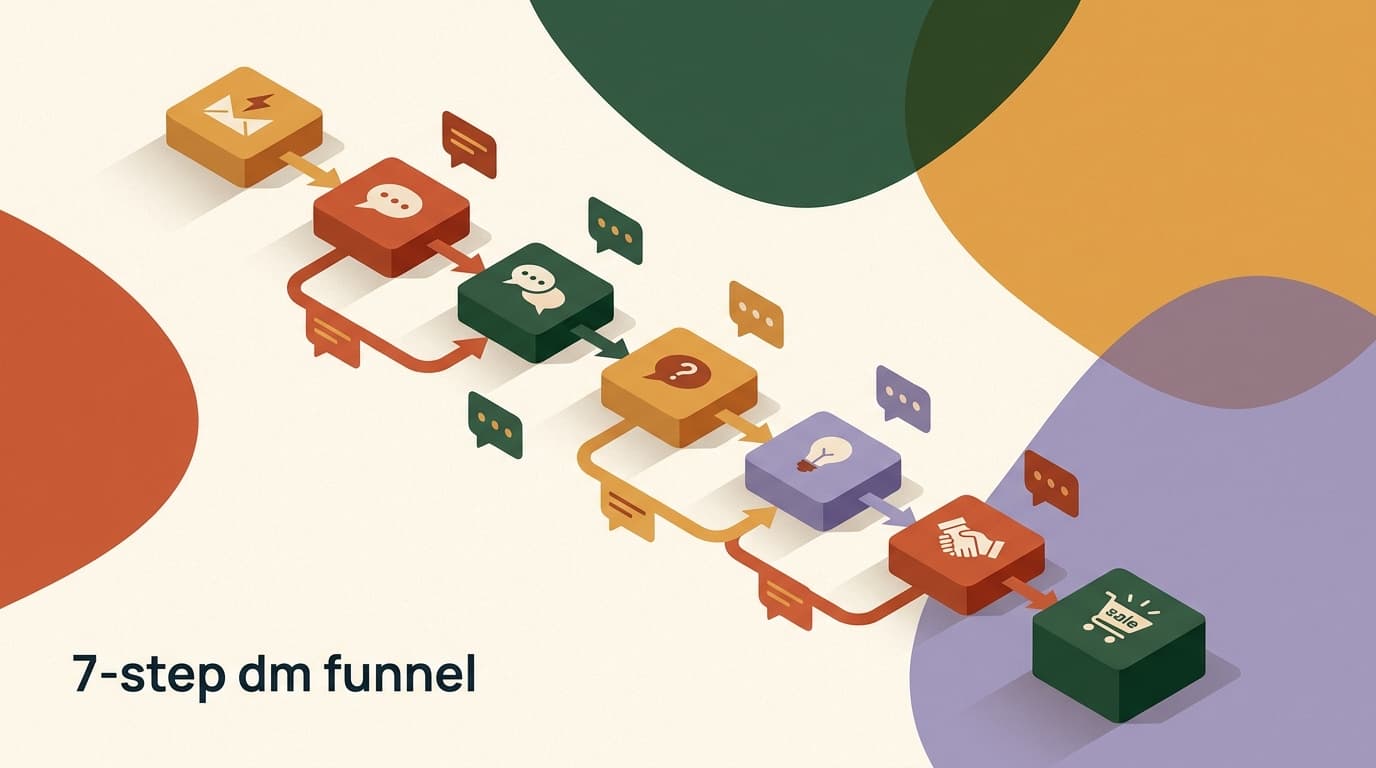
A sales channel is not a one-off campaign; it is a system you can run every week and improve over time. The difference between people who 'tried selling in DMs and it didn't work' and people who built a durable channel is almost always structure. Random acts of DM-ing produce random results. A defined motion — trigger, first message, qualify, offer, follow up, measure — produces a flywheel you can tune.
Start by mapping the conversation you want to happen, end to end, before you automate any of it. Know your permission triggers, your value-led opener, your one or two qualifying questions, the signal you wait for before offering, your follow-up rules, and how you hand off to a human. Write it down. Only once the human version works should you automate the mechanical parts of it — automating a broken conversation just breaks it faster.
Then measure the things that tell you whether the channel is healthy, not just whether it is busy. Reply rate and speed tell you about responsiveness. Qualified-conversation rate tells you about targeting. Offer-to-close rate tells you about your pitch and timing. And the quiet one — block, mute, and report rate — tells you whether you are building the channel or burning it. Watch that last one like a hawk.
- Map the conversation manually firstRun the full motion by hand until it converts. Don't automate anything you haven't proven works as a human.
- Set up permission-based triggersComment-to-DM, story replies, click-to-message ads, bio prompts. Every conversation should start with a raised hand.
- Automate only the mechanical edgesInstant first reply, requested-content delivery, routing, tagging, follow-up reminders. Keep judgment human.
- Add an AI agent for first response and FAQsBounded and transparent, with one-tap human handoff. It buys your team time for the conversations that matter.
- Measure health, then iterateTrack reply speed, qualified rate, close rate — and block/mute/report rate. Tune the motion every week.
Prove it by hand before you scale it
The cheapest way to find out whether your DM motion sells is to do twenty of them yourself, manually, this week. You'll learn the real objections, the right questions, and the moment to offer — knowledge no template gives you. Then automate what you proved, not what you guessed.
What rules and ethics keep your channel (and account) alive?
Beyond taste, there are hard rules. The platforms — Meta especially, across Instagram, Facebook, and WhatsApp — have explicit policies about messaging, and breaking them does not earn you a warning so much as a quiet throttle or a sudden ban. WhatsApp in particular runs on opt-in: you generally need a person to have messaged you or explicitly consented before you message them, and marketing messages have their own rules and Meta-billed fees. Treat these as non-negotiable, because the platform does.
The ethics and the rules point the same direction, which is convenient. Respect opt-in. Honor opt-out instantly and completely — if someone says stop, you stop, everywhere. Do not buy lists or scrape contacts. Do not deceive people about who or what they are talking to. Keep your data handling clean and your promises real. The same restraint that keeps you compliant is the restraint that keeps you welcome, and the restraint that keeps your account from disappearing overnight.
There is a longer-term ethic too: protect the channel for everyone. Every spammer makes every legitimate message slightly less trusted, and platforms respond to abuse by tightening rules for all of us. By selling in DMs the honest way, you are not just protecting your own reputation — you are keeping the channel viable. The inbox is a commons, and commons survive only when most people use them with restraint.
- Respect platform messaging policies — especially Meta's opt-in and WhatsApp's consent and fee rules.
- Honor opt-out instantly and across every channel. 'Stop' means stop.
- No bought lists, no scraping, no messaging people who never engaged.
- Be transparent about automation and AI; never claim a bot is human.
- Handle data responsibly and keep every promise you make in a DM.
Compliance is a feature, not a cost
Teams that treat opt-in and opt-out as annoying overhead are the teams that get throttled and banned. Teams that build consent into the motion get higher engagement and a durable channel. The rules exist because they describe what people actually tolerate — work with them, not around them.
How does KlyoChat help you sell in DMs the right way?
Everything above is platform-agnostic — you can run an honest DM sales channel with a notebook and discipline. But once you are doing it across several platforms and any real volume, you need one place to see every conversation and tools that automate the mechanical parts without overstepping. That is the gap we built KlyoChat to fill, and we built it specifically around the augment-don't-replace philosophy this whole guide describes.
KlyoChat is an AI-native, mobile-first unified inbox that brings Facebook, Instagram, Telegram, WhatsApp, TikTok, and X into a single thread view, so a DM channel is something you can actually run from your phone. Comment-to-DM turns public engagement into permission-based conversations. No-code flows handle the instant first reply, deliver what people asked for, and route to the right teammate. AI agents — included in your plan, trained on your knowledge base — cover first response and FAQs with an easy handoff to a human. A shared team inbox keeps everyone aligned, and analytics show you what is converting and what is being ignored.
We will be straight about the limits, because that is the whole point of this post. KlyoChat does not do native SMS or email — if those are core to your sales motion, you will need them elsewhere. We are a newer, smaller community than the biggest incumbents, so you will find fewer third-party templates floating around. And our automation is built to augment genuine conversation, not to help you blast strangers — if spray-and-pray DM outreach is your plan, we are the wrong tool, on purpose.
- One inbox for Facebook, Instagram, Telegram, WhatsApp, TikTok, and X — run the channel from your phone.
- Comment-to-DM turns public interest into permission-based conversations.
- Flows automate instant replies, content delivery, and routing — the mechanical edges, not the relationship.
- AI agents for first response and FAQs are included, with one-tap human handoff.
- Honest limits: no native SMS or email, a smaller community, and automation built to augment — not spam.
The tool reflects the philosophy
We deliberately did not build features for cold-blasting strangers, because that motion burns the channel and, eventually, churns the customer. KlyoChat is for people who want to sell in DMs the way that lasts: permission-first, value-led, human where it counts, automated where it doesn't.
KlyoChat plans at a glance
- Basic
- $19/mo — get started with core inbox and automation
- Pro
- $49/mo ($39 billed yearly) — all channels, 10,000 contacts, AI agents included
- Business
- $129/mo — higher limits and team scale
- Free trial
- 7 days, no credit card — test the full product, not a slice
The bottom line on building a DM sales channel without being spammy: the channel works because it is personal, and it stops working the instant you treat it like a broadcast list. Earn permission, lead with value, qualify honestly, offer at the right moment with an easy exit, follow up with restraint, and let automation and AI handle the mechanical edges while humans keep the relationship. Do that, and DMs become the highest-converting, most durable sales channel you have.
Start small and prove it by hand. Run twenty real conversations this week, end to end, and watch where they convert and where they stall. Then automate only what you proved, measure your block rate as closely as your close rate, and grow from there. For the conversational-marketing foundations see our pillar guide, for turning this into a structured flow see our DM funnel automation breakdown, and for the full path from first message to purchase see our chat-to-sale funnel walkthrough.