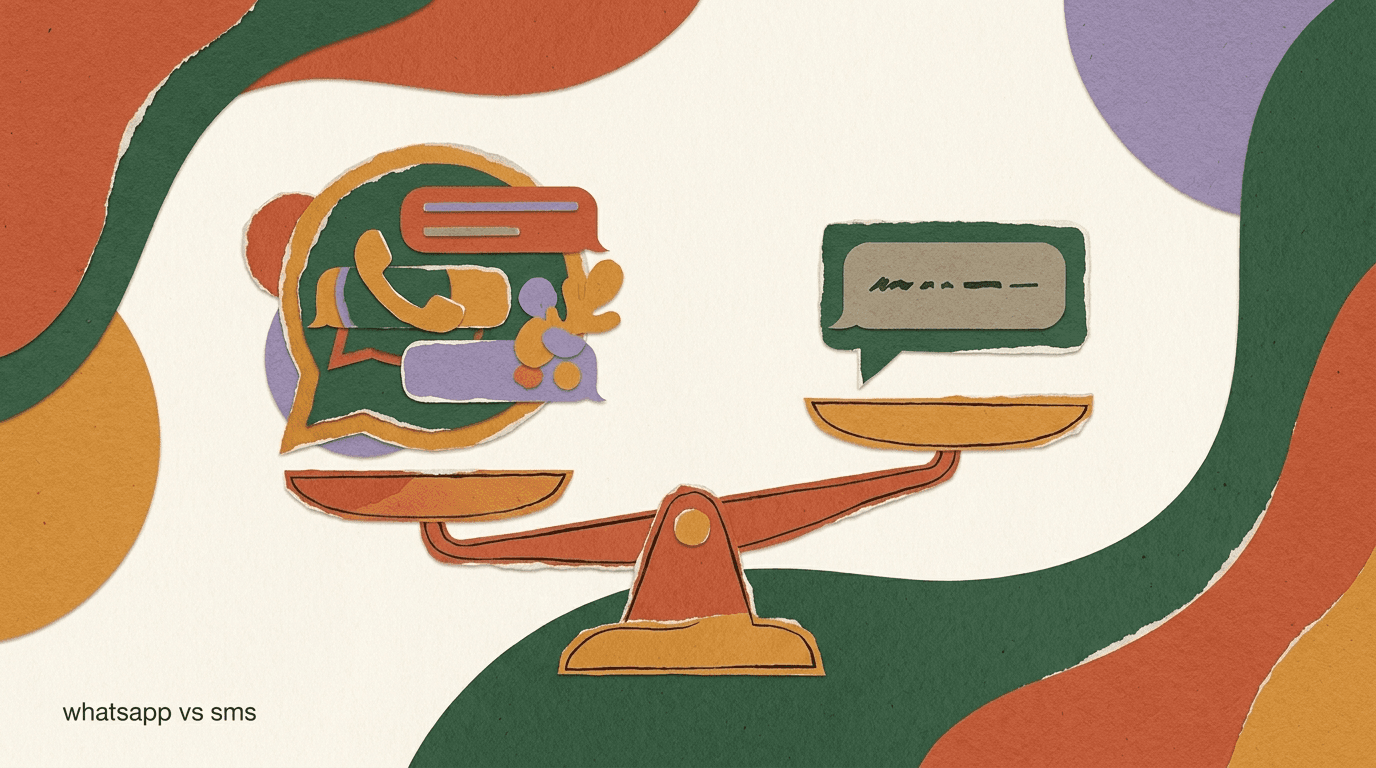
The WhatsApp vs SMS question comes up the moment a business gets serious about messaging customers directly. Both put a message on someone's phone, both feel instant, and both have decades or near-decades of trust behind them. But they are very different channels underneath — different reach, different economics, different capabilities, and different rules. Picking one because it is trendy, or because a competitor uses it, is how teams end up paying for the wrong tool or, worse, missing the audience they were trying to reach.
This is an honest, balanced comparison. We will look at where each channel is dominant by region, what rich media and interactivity actually buy you, how deliverability differs, the two very different cost models (Meta's per-conversation pricing versus per-SMS rates), how opt-in works on each, and the specific use cases where one clearly beats the other. The short version is that this is rarely an either/or decision for a mature operation. The longer version, with the reasoning, is below.
Full disclosure up front: we build KlyoChat, a unified inbox for WhatsApp and social DMs. We do not offer native SMS, and we will say so plainly in the sections where SMS is the better fit. Our goal here is to help you choose correctly, not to talk you out of a channel we happen not to sell. Where SMS wins, we will tell you to pair a dedicated SMS provider.
What is the real difference between WhatsApp and SMS?
SMS is a carrier protocol. It rides on the mobile network itself, the same plumbing that has delivered text messages since the 1990s. It needs no app, no internet connection, and no account — if a device can receive calls, it can receive an SMS. That universality is its defining strength. Its defining limit is that it is plain: 160 characters per segment, no native buttons, no read receipts a business can rely on, and rich media only through MMS, which is inconsistent and often more expensive.
WhatsApp is an app that runs over the internet. It is owned by Meta, requires the recipient to have the app installed and an account, and works through the WhatsApp Business Platform (often called the WhatsApp Business API) for any serious sending. In exchange for those requirements, it offers a far richer experience: images, video, documents, voice notes, location, interactive buttons, list menus, and genuine two-way conversation with delivery and read indicators.
So the core trade is universality versus richness. SMS reaches essentially every phone but says little. WhatsApp says a great deal but only reaches people who use it. Everything else in this comparison flows from that single distinction, and it is why the right answer so often depends on what you are sending and to whom.
| Dimension | SMS | |
|---|---|---|
| Network | Carrier / mobile network | Internet (app + account required) |
| Device requirement | Any phone | Smartphone with WhatsApp installed |
| Message length | 160 chars per segment | Long-form supported |
| Rich media | MMS only, inconsistent | Images, video, docs, voice, location |
| Interactivity | None native | Buttons, lists, quick replies |
| Two-way conversation | Possible but clunky | Native and expected |
Different tools, not rivals
It helps to stop thinking of WhatsApp and SMS as competitors and start thinking of them as instruments. A guitar and a piano are both for music; you pick by the song. WhatsApp and SMS are both for reaching a phone; you pick by the message.
Which channel has more reach, and does it depend on region?
Reach is the first thing most teams ask about, and the honest answer is that it depends heavily on geography. SMS has near-universal reach everywhere because it does not require an app — anyone with an active number can receive it. That makes SMS the most reliable way to reach an unknown or mixed audience, especially in markets where smartphone penetration or messaging-app habits vary.
WhatsApp's reach is enormous but uneven. In large parts of Latin America, India, Southeast Asia, the Middle East, Africa, and much of Europe, WhatsApp is the default way people communicate — businesses included. In those regions, asking a customer to talk over WhatsApp feels natural, and ignoring it means ignoring the channel people actually live in. In the United States, by contrast, WhatsApp adoption is real but far lower; SMS and iMessage dominate everyday texting, so a US-only campaign built solely on WhatsApp will under-reach.
The practical takeaway is that you should map your audience before you map your channel. A business serving Brazil, Mexico, India, or the UAE will likely find WhatsApp is where the conversation already happens. A business serving primarily the US may find SMS reaches more people more reliably, with WhatsApp as a supplement for the segment that prefers it. There is no global winner here — there is only your customer base.
Let the data, not the trend, pick the channel
Before committing, check where your customers actually are. Pull country breakdowns from your analytics or CRM. If most of your audience sits in WhatsApp-dominant markets, lead with WhatsApp. If they are US-heavy, lead with SMS. Trends are regional; budgets should follow your map, not headlines.
Reach by audience, illustrative
- D2C brand selling in Brazil and Mexico
- WhatsApp is the primary channel customers expect
- Local service business in the US
- SMS reaches the widest audience reliably
- Global SaaS with mixed user base
- Both — WhatsApp for engaged regions, SMS for fallback
What does rich media and interactivity actually buy you?
This is where WhatsApp pulls clearly ahead. A WhatsApp message can carry a product image, a short video demo, a PDF invoice, a voice note, a pinned location, and tappable buttons that let the recipient choose an option without typing a word. That turns a message from an announcement into an interaction. A customer can browse a small catalog, confirm an order, reschedule an appointment, or pick a support topic, all inside the thread.
SMS, by design, cannot do most of this. You get text and a link. A well-written SMS with a smart link can still drive action — and the constraint can even be a virtue, because it forces clarity — but the experience ends at the carrier and continues in a browser. There is no in-thread choosing, no inline media you can count on, no buttons. MMS exists for images, but support and pricing are inconsistent enough that most businesses treat SMS as text-plus-link and leave it there.
The richness matters most when the goal is conversation or guided action: support, sales, onboarding, recovery flows where you want the customer to do something specific. It matters least when the goal is a single, urgent, unmissable fact — a code, an alert, a reminder. For those, the plainness of SMS is not a weakness; it is exactly the point.
There is a subtler benefit to WhatsApp's richness that is easy to overlook: persistence and context. A WhatsApp thread is a continuous record both you and the customer can scroll back through, so a conversation that started with a sales question last month and continues with a support issue today sits in one place. The agent — human or AI — has the full history at a glance. SMS threads exist on the device but are far harder for a business to treat as a coherent, searchable conversation, which is why SMS tends to be used for discrete sends rather than relationships. When you are trying to build a relationship over time, that continuity is worth a lot, and it is something the plainness of SMS simply does not provide.
Be careful, though, not to over-romanticize richness. More capability also means more ways to annoy people. A WhatsApp thread that fills with promotional images, buttons, and follow-ups can feel intrusive in a way a single SMS never does, because it lands in the same app a customer uses to talk to family. The richer the channel, the more discipline it demands. Used well, WhatsApp's media and interactivity raise conversion and satisfaction; used carelessly, they raise block rates and tank your quality rating faster than SMS ever would.
- WhatsApp interactive elements (buttons, list menus, quick replies) cut friction by letting customers tap instead of type.
- Media-rich messages suit catalogs, demos, receipts, tickets, and visual confirmations.
- Two-way threading makes WhatsApp a real support and sales channel, not just a broadcast pipe.
- SMS richness tops out at text plus a link — clean and universal, but limited.
- For pure one-way alerts, SMS's simplicity is an advantage, not a shortfall.
How does deliverability compare between WhatsApp and SMS?
Deliverability is more subtle than open rates, and we will avoid quoting specific percentages because real figures vary widely by country, carrier, sender reputation, and message type. Qualitatively, both channels are strong, but they fail in different ways. SMS delivery depends on carrier routing and number reputation. Most messages arrive quickly, but carrier filtering, especially for promotional traffic to certain countries, can silently drop or delay messages, and you do not always get reliable feedback on what happened.
WhatsApp delivery depends on the recipient being online and on Meta's policies. WhatsApp gives you clearer delivery and read signals — the familiar checkmarks — which is genuinely useful for knowing a message landed and was seen. The flip side is that WhatsApp enforces quality ratings and messaging limits. Send messages people mark as spam or block, and Meta can throttle your number or lower your messaging tier, which constrains how many people you can reach proactively.
In plain terms: SMS is more of a 'fire and trust the network' channel, while WhatsApp gives you more visibility but holds you to higher behavioral standards. Neither is strictly more deliverable; they are deliverable under different conditions. For a time-critical message you absolutely must land, many teams favor SMS precisely because it does not depend on an app being installed or open. For an engagement message where you want to confirm it was read, WhatsApp's signals are valuable.
It is also worth separating delivery from attention. A message can be delivered and still ignored, and here the two channels behave differently. SMS arrives in the native messaging app where most people still check texts, so a transactional SMS tends to get glanced at quickly even if no one replies. WhatsApp arrives in an app people open many times a day, which is good for attention, but a business message competes with personal chats for that attention and can be muted or archived without a trace. The right mental model is that SMS optimizes for being seen at least once, while WhatsApp optimizes for being part of an ongoing conversation. Both can fail quietly, and the only honest way to know your real numbers is to measure them on your own audience rather than trusting a generic statistic.
Sender reputation is the thread that runs through both. On SMS, a number or short code that generates spam complaints gets filtered more aggressively by carriers over time, sometimes without clear warning. On WhatsApp, Meta makes the consequence explicit through quality ratings and tiered messaging limits, so the feedback loop is visible but the penalty for abuse is just as real. In both cases the lever you control is the same: message people who genuinely opted in, send content they expect, and give them an easy way out. Deliverability is less a property of the channel than a property of how you behave on it.
We avoid exact open-rate claims on purpose
You will see eye-catching open-rate statistics for both channels online. Real performance depends on your country, list quality, message category, and sender reputation. Treat any single headline number with suspicion and test on your own audience before you build a forecast around it.
How do the cost models differ — per-conversation vs per-SMS?
The economics are where WhatsApp and SMS diverge most, and confusing the two billing models is a common budgeting mistake. SMS is billed per message segment. Every 160 characters is a segment, so a long SMS counts as two or three, and you pay per segment per recipient. Rates vary enormously by destination country — domestic messages in one market can be cheap, while messages to certain international numbers cost many times more. The model is simple to grasp but can add up fast at high volume or across borders.
WhatsApp, through the Business Platform, is billed by Meta per conversation rather than per message. A conversation is a 24-hour window, and within that window you can exchange multiple messages at no extra per-message charge. Pricing depends on the conversation category — broadly, marketing conversations cost more than utility or authentication conversations, and rates vary by country. Meta periodically adjusts this structure, so the exact numbers must be checked on Meta's current pricing, not memorized.
The result is that the cheaper channel depends entirely on your pattern. For a single, short, one-way blast to a domestic list, SMS can be very economical per send. For an ongoing two-way conversation where you would otherwise send many SMS segments back and forth, WhatsApp's per-conversation window can be cheaper because the whole exchange is bundled. Model your actual usage — number of recipients, messages per interaction, countries, and message categories — rather than comparing a single per-unit rate.
| Cost factor | SMS | WhatsApp (Business Platform) |
|---|---|---|
| Billing unit | Per 160-char segment, per recipient | Per 24-hour conversation |
| Multi-message exchange | Each segment billed | Bundled inside the window |
| Category pricing | Usually flat per segment | Marketing > utility/auth, by country |
| International cost | Highly variable, can be steep | Varies by country, set by Meta |
| Best economics for | Short one-way blasts | Ongoing two-way conversations |
Verify current rates with the source
Both SMS rates and Meta's WhatsApp conversation pricing change over time and differ by country. Always confirm live numbers with your SMS provider and Meta's official WhatsApp pricing page before you commit a budget. The structures above are durable; the exact figures are not.
Which channel is cheaper for marketing at scale?
Marketing is the use case where the cost question gets sharpest, because volume is high and margins matter. For a large promotional blast — one message, one link, no expected reply — SMS often has the edge on raw cost per recipient in domestic markets, especially where SMS rates are low. You pay once, the message lands on every phone, and you are done. WhatsApp marketing conversations carry Meta's marketing-category rate, which is typically its most expensive tier.
But raw cost per send is the wrong lens if engagement differs. WhatsApp marketing messages can carry images, buttons, and a real conversation, which tends to drive higher interaction and lets you recover the customer into a two-way thread you can monetize further within the same conversation window. If a WhatsApp campaign converts meaningfully better, a higher per-conversation cost can still produce a lower cost per outcome. The honest answer is that cheaper-per-send and cheaper-per-result are not the same number, and the second one is the one that should drive the decision.
There is also a reach multiplier baked into cost. A cheap SMS that reaches a region where everyone uses SMS is efficient. A cheap SMS to a WhatsApp-first audience that ignores promotional texts is expensive waste. Cost efficiency is reach times relevance times conversion, divided by spend — not just the per-unit rate on the invoice.
One more cost wrinkle catches teams that scale internationally: the two channels are expensive in different places. SMS to certain countries carries steep per-segment rates and unpredictable carrier surcharges, so an international SMS campaign can cost far more than the same campaign run domestically. WhatsApp's conversation pricing also varies by country, but because it bundles a whole exchange into one billed window, a conversation-heavy international flow can come out ahead of the equivalent in SMS segments. If your audience is global, do not assume one channel is uniformly cheaper — price each major market separately, because the cheaper channel can flip from one country to the next.
Cost-per-outcome thinking, illustrative
- SMS blast, US domestic, link only
- Low cost per send, broad reach, modest interaction
- WhatsApp campaign, LATAM, media + buttons
- Higher cost per conversation, often higher conversion
- Wrong-channel send
- Any per-unit saving is lost to an audience that ignores it
How does opt-in and consent work on each channel?
Consent rules are non-negotiable on both channels, but they are stricter and more actively enforced on WhatsApp. For SMS, you generally need explicit opt-in, a clear description of what you will send, and an easy way to stop (the universal STOP keyword in many markets). Regulations like TCPA in the US and equivalents elsewhere carry real penalties, so SMS consent is a legal matter, not a nicety. Carriers also police promotional SMS and can block traffic that looks like spam.
WhatsApp layers Meta's own policies on top of local law. You must collect opt-in before messaging a user proactively, and Meta is explicit that the opt-in must be clear about it being for WhatsApp specifically. Proactive (business-initiated) messages outside the 24-hour customer service window must use pre-approved message templates, and Meta reviews those templates. Send unwanted messages and users will block or report you, which directly hurts your quality rating and messaging limits. WhatsApp effectively turns consent and relevance into a delivery requirement, not just a compliance one.
The practical implication is that WhatsApp rewards permission-based, relevant messaging and punishes blasting harder than SMS does. If your strategy is high-volume promotional pushes to loosely consented lists, SMS is more forgiving operationally, though still legally bound. If your strategy is engaged, opted-in conversations, WhatsApp's stricter regime works in your favor by keeping the channel clean.
- SMS: explicit opt-in, clear disclosure, easy STOP, plus carrier filtering of spammy traffic.
- WhatsApp: opt-in must reference WhatsApp specifically; Meta enforces it actively.
- WhatsApp proactive messages need pre-approved templates outside the 24-hour service window.
- WhatsApp quality ratings mean blocks and spam reports throttle your reach.
- Both are bound by local law (TCPA, GDPR, and regional equivalents) — treat consent as legal, not optional.
Consent protects you and your channel
Beyond avoiding fines, clean opt-in keeps your SMS sender reputation healthy and your WhatsApp quality rating high. On both channels, the cheapest way to lose deliverability is to message people who did not ask for it. Build consent capture into every signup point.
When does SMS clearly win?
SMS is the right choice more often than WhatsApp evangelists admit, and being honest about that is part of choosing well. The clearest case is anything time-critical and one-way that must land regardless of whether someone has an app installed or open. One-time passwords and two-factor codes are the textbook example: they need to arrive in seconds on any device, the recipient may not have WhatsApp, and the message is a single number with no conversation around it. SMS is purpose-built for this, and many security flows depend on it.
SMS also wins for critical alerts — appointment reminders, delivery notifications, fraud warnings, outage notices, and emergency messages — where universal reach beats richness. If even a small fraction of recipients lack WhatsApp, a critical alert sent only over WhatsApp will miss them, which for safety or security messages is unacceptable. And in SMS-dominant markets like the US, SMS is simply where more people are reachable for everyday transactional texts.
Finally, SMS wins when you need the lowest-friction channel for an unknown audience. You do not have to ask whether they use a particular app; you just need a valid number and consent. For first-touch verification, abandoned-cart nudges to a mixed list, or any message where you cannot assume app adoption, SMS is the safe default.
Honest note: pair an SMS tool where SMS fits
KlyoChat does not offer native SMS. If OTPs, critical alerts, or US-heavy transactional texts are core to your operation, pair a dedicated SMS provider (such as a CPaaS or SMS marketing platform) for that traffic. Use the right tool for each job rather than forcing one channel to do everything.
Where SMS is the better tool
- OTP / 2FA codes
- Must land instantly on any device — SMS
- Critical safety / fraud alerts
- Universal reach beats rich media — SMS
- US-heavy transactional reminders
- More reachable audience — SMS
- Unknown audience, no app assumption
- Lowest friction — SMS
When does WhatsApp clearly win?
WhatsApp is the stronger choice whenever the goal is conversation, relationship, or guided action — and especially in markets where it is the default messaging app. Customer support is the flagship case: a customer can send a photo of a damaged product, get a typed reply, tap a button to start a return, and receive a tracking link, all in one threaded conversation that both sides can scroll back through. SMS cannot match that experience, and email is too slow for it.
WhatsApp also wins for sales and commerce in its dominant regions. Catalogs, product images, interactive buttons, and the ability to answer questions in real time turn the channel into a storefront and a sales associate at once. Re-engagement flows — cart recovery, post-purchase follow-up, re-orders — benefit from the same richness, and the per-conversation billing model suits the back-and-forth those flows involve. For onboarding and education, the ability to send a short video or a step-by-step guided message outperforms a plain text link.
And WhatsApp wins for brand presence in WhatsApp-first cultures. In countries where customers expect to message a business the way they message a friend, having a real WhatsApp presence is not a nice-to-have; it is table stakes. Being absent from the channel where your audience already lives is a bigger cost than any per-conversation fee.
- Two-way support with media, threading, and read receipts.
- Conversational sales and catalog browsing in WhatsApp-dominant regions.
- Re-engagement and recovery flows that benefit from the 24-hour conversation window.
- Onboarding and education with video, documents, and guided steps.
- Brand presence in markets where WhatsApp is the default way to reach a business.
Can you use WhatsApp and SMS together, and how?
For most businesses past a certain size, the right answer is not WhatsApp or SMS but WhatsApp and SMS, each assigned to the jobs it does best. The two channels complement each other cleanly: WhatsApp carries the rich, two-way, relationship-building traffic, and SMS carries the universal, time-critical, one-way traffic and acts as a fallback when WhatsApp is not available for a given recipient.
A common pattern is channel fallback. You attempt to reach an engaged customer on WhatsApp, where the experience is better and, for two-way exchanges, often cheaper. If the customer is not on WhatsApp, or a message is undelivered, or it is a critical alert that must not depend on an app, you fall back to SMS. That way no message is lost to the gaps in either channel, and each message rides the channel that fits its urgency and content.
Another pattern is content-based routing. OTPs, fraud alerts, and bare reminders default to SMS. Support, sales, onboarding, and recovery default to WhatsApp. The decision is made by message type, not by a single house preference. The result is lower cost per outcome and broader effective reach than either channel achieves alone.
- Map each message type to a channelList your message categories — OTP, alerts, support, sales, recovery — and assign each to WhatsApp or SMS by urgency, richness, and audience.
- Set WhatsApp as the default for conversationRoute support, sales, onboarding, and re-engagement to WhatsApp where the audience uses it, taking advantage of rich media and the conversation window.
- Set SMS as the default for critical one-way trafficRoute OTPs, fraud and safety alerts, and bare reminders to SMS so they land on any device, instantly, without app dependency.
- Add a fallback ruleIf a recipient is not on WhatsApp or a message goes undelivered, fall back to SMS so no critical message is lost.
- Measure cost per outcome, not per sendTrack conversion and resolution by channel, not just delivery, and rebalance routing toward whichever channel produces the cheaper result per job.
Two tools, one strategy
Running both channels usually means running two tools — a WhatsApp and social-DM platform plus a dedicated SMS provider — connected so routing and fallback work smoothly. That is normal and healthy. Forcing a single vendor to do everything often means doing one of the channels poorly.
What about email, RCS, and the wider messaging mix?
WhatsApp and SMS do not exist in a vacuum. Email remains the workhorse for long-form content, receipts, newsletters, and anything that benefits from a permanent, searchable record — it is cheap, universal, and asynchronous, but slower and easier to ignore than a phone notification. Many teams use email for depth and detail, SMS for urgency, and WhatsApp for conversation, with each channel covering the others' blind spots.
RCS (Rich Communication Services) is the carrier industry's answer to WhatsApp-style richness over the SMS rails, bringing buttons, media, and read receipts to the native messaging app on supported devices. It is worth watching, but adoption and business-messaging availability remain uneven across devices and regions, so most businesses still treat SMS as the reliable carrier-level channel and WhatsApp as the rich app-level channel. RCS may reshape this comparison over time; today it is a complement, not a replacement.
Social DM channels — Instagram, Facebook Messenger, Telegram, TikTok, and X — round out the picture, especially for brands whose audiences discover and engage with them on social platforms. The broader point is that channel strategy in 2026 is a portfolio, not a single bet. WhatsApp vs SMS is the most important pairing for direct, phone-based messaging, but the strongest operations layer it into a wider mix matched to where each customer actually is.
Think portfolio, not silver bullet
No single channel wins every job. Match email to depth, SMS to urgency, WhatsApp to conversation, and social DM to where your audience already engages. The teams that win are the ones that route each message to the channel that fits it, then measure results honestly.
How does AI change the WhatsApp vs SMS calculation?
AI agents have quietly shifted the balance in this comparison, and it is worth understanding how. The economics of a two-way channel used to be dominated by labor: every conversation needed a human, so the richer, more conversational channel was also the more expensive one to staff. AI agents change that. When an AI can handle first response, qualify a lead, answer a common question, or guide a return entirely inside the thread, the cost of running a conversational channel drops sharply, and the channel's richness turns from a staffing burden into an asset.
This favors WhatsApp more than SMS, because WhatsApp is built for the kind of multi-turn, media-rich exchange an AI agent handles well. An AI can read an image a customer sends, present buttons to narrow down an issue, and carry context across the conversation window — all things SMS cannot natively do. On SMS, an AI is still useful, but it is working through a narrow text pipe, and the per-segment billing means a chatty AI exchange can quietly run up costs. So AI tends to make WhatsApp's conversational strengths cheaper to exploit while leaving SMS's plainness roughly where it was.
None of this removes SMS's core advantages. An AI agent cannot make SMS deliver an OTP to someone without a phone any less reliably than before, and it cannot turn a critical one-way alert into something that benefits from conversation. What AI does is widen the set of jobs where WhatsApp is the economical choice, because the conversations that used to be too costly to staff at scale are now affordable. If you are deciding today, factor in that the conversational channel is cheaper to operate than it was a few years ago, which strengthens the case for WhatsApp wherever conversation adds value.
AI lowers the cost of the conversational channel
If your reason for leaning toward SMS was that conversations are expensive to staff, revisit it. AI agents handle first response and routine exchanges inside WhatsApp threads at a fraction of the old labor cost, which makes the richer channel viable for jobs that used to be too costly to run conversationally.
How does KlyoChat fit into a WhatsApp vs SMS strategy?
We built KlyoChat for the WhatsApp and social-DM side of this picture, and we want to be precise about what that does and does not cover. KlyoChat is an AI-native unified inbox that brings Facebook, Instagram, Telegram, WhatsApp, TikTok, and X into one place, with no-code automation, comment-to-DM funnels, broadcasts, and custom AI agents on top. WhatsApp is fully included — Meta's per-conversation fees still apply, as they do on any platform — and AI agents are included in every plan rather than sold as a separate add-on.
Here is the honest limit, stated plainly: KlyoChat does not do native SMS, and it does not do native email. If your strategy needs OTPs, critical one-way alerts, or US-heavy transactional texts — the cases where SMS clearly wins — you should pair a dedicated SMS provider for that traffic and let KlyoChat handle the rich, conversational, WhatsApp-and-social side. We would rather you build the right stack than oversell ours. We are also a newer, smaller community than the largest incumbents, which is a fair trade-off to weigh.
Where KlyoChat earns its place is the conversation layer: unifying WhatsApp with your social DMs, automating first response with AI agents trained on your knowledge base, and running comment-to-DM and broadcast campaigns across the channels your audience already uses. If WhatsApp and social are central to how you reach customers, that is exactly the job KlyoChat is built for — and pairing an SMS tool alongside it covers the rest.
- Unified inbox for WhatsApp, Facebook, Instagram, Telegram, TikTok, and X.
- AI agents included on every plan — not a separate add-on.
- WhatsApp included; Meta's per-conversation fees apply, as on any platform.
- Honest limit: no native SMS or email — pair dedicated tools where those win.
- 7-day free trial, no card; pricing from $19 (Basic) to $129 (Business).
| Job | Best channel | KlyoChat covers it? |
|---|---|---|
| WhatsApp support & sales | Yes — included (Meta fees apply) | |
| Instagram / Facebook / Telegram / TikTok / X DMs | Social DM | Yes — unified inbox |
| AI first response across channels | WhatsApp + social | Yes — AI agents included |
| OTP / 2FA codes | SMS | No — pair an SMS tool |
| Critical one-way alerts | SMS | No — pair an SMS tool |
| Long-form email / receipts | No — use a dedicated email tool |
Use KlyoChat for the conversation layer
KlyoChat is the right fit for the WhatsApp and social-DM side of your messaging mix. For the SMS side — OTPs, critical alerts, US transactional texts — pair a dedicated SMS provider. Two focused tools, routed by message type, beat one tool stretched thin.
KlyoChat plans at a glance
- Basic
- $19/mo — small teams getting started on WhatsApp + social DM
- Pro
- $49/mo ($39 billed yearly) — all channels, custom AI agents
- Business
- $129/mo — higher volume, more seats, advanced needs
- Trial
- 7-day free trial, no credit card required
How do you decide between WhatsApp and SMS for your business?
The decision comes down to four questions, answered honestly about your own situation rather than about what is fashionable. Work through them in order and the right channel — or the right mix — usually becomes obvious. None of this requires a vendor's help; it requires looking clearly at your audience and your message types.
Most teams that run this exercise end up with a split: WhatsApp for engagement and conversation, SMS for codes and critical alerts, with fallback rules connecting them. That is not a failure to choose — it is the correct, mature answer for a business with varied messaging needs across a real audience.
- Where is your audience?If they are in WhatsApp-dominant regions, lead with WhatsApp. If they are US-heavy or mixed, lean on SMS for reach and add WhatsApp for the engaged segment.
- What is the message?Conversation, media, or guided action points to WhatsApp. A single urgent fact like an OTP or alert points to SMS.
- How does the cost model fit your pattern?Short one-way blasts favor SMS economics; ongoing two-way exchanges often favor WhatsApp's per-conversation window. Model your real usage.
- Can you run both?If your needs span both, route by message type and add fallback. Pair a WhatsApp/social tool like KlyoChat with a dedicated SMS provider.
The answer is usually 'both, routed well'
If you take one thing away: stop hunting for the single winning channel. Assign each channel the jobs it does best, connect them with fallback, and measure cost per outcome. That beats an all-in bet on either WhatsApp or SMS for almost every business with a real, varied audience.
The bottom line on WhatsApp vs SMS in 2026: this is not a contest with one winner. SMS is the universal, no-app, time-critical channel — unbeatable for OTPs, alerts, and reaching mixed or US-heavy audiences. WhatsApp is the rich, two-way, relationship channel — dominant in much of the world and the better tool for support, conversational sales, and re-engagement. They fail in different ways, they bill in different ways, and they shine on different jobs.
Decide by audience and message type, model the cost on your real usage rather than a headline rate, and respect the consent rules on both channels because that is what keeps either one deliverable. For most serious operations the right answer is to run both, routed by message type with fallback between them. KlyoChat covers the WhatsApp and social-DM side of that strategy; where SMS wins, pair a dedicated SMS tool and let each channel do what it does best.