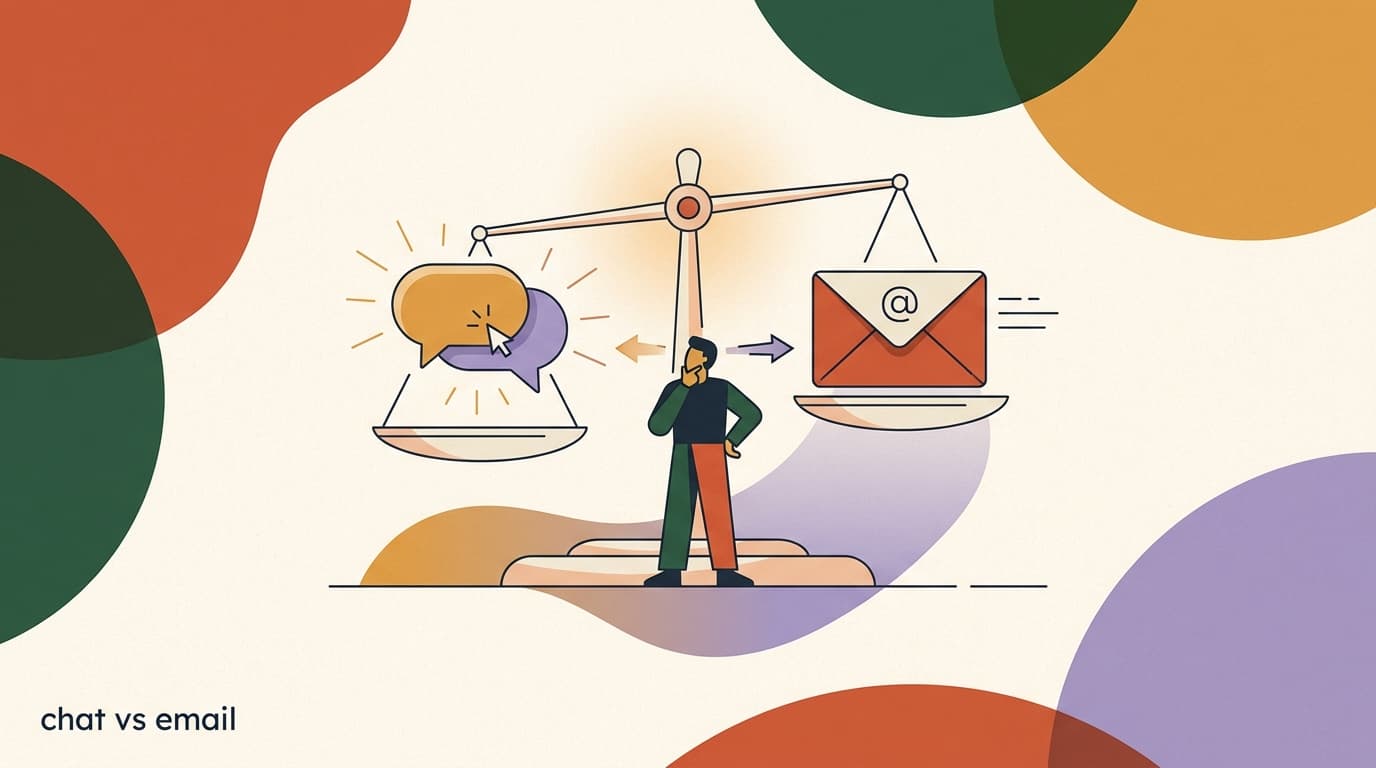
The chat vs email marketing question usually gets framed as a fight, with one side declaring email dead and the other insisting DMs are a fad. Both framings are wrong. Chat marketing and email marketing are different instruments that do different jobs, and the honest answer to which converts better in 2026 is: it depends on the job, and most growing teams end up using both.
This guide is a genuine head-to-head. We will compare open rates and response rates, cost structures, deliverability, who actually owns the list, and the specific situations where each channel clearly wins. We will not pretend chat replaces email, and we will not pretend email is finished. Each has a shape it fits.
One disclosure up front: we build KlyoChat, a chat and DM platform. That means we have a stake in the chat side of this conversation, and it also means we have a clear limitation to be honest about — KlyoChat does not do native email. So when we say most teams need both, we are not selling you a single tool that does everything. We are telling you to pair a chat platform with a dedicated email tool, and we will say exactly why throughout.
What is chat marketing, and what is email marketing?
Before comparing them, it helps to define them precisely, because both terms get stretched.
Email marketing is the practice of sending messages to an audience's email inboxes — newsletters, promotions, product announcements, drip sequences, transactional receipts, and long-form nurture. The list is an asset you own: you hold the addresses, you export them, and no single platform can revoke your access to your own contacts. Delivery flows through the open email protocol, mediated by inbox providers and spam filters.
Chat marketing is the practice of reaching people inside messaging surfaces — WhatsApp, Instagram DMs, Facebook Messenger, Telegram, TikTok messages, and similar. Messages arrive as notifications on the phone, often read within minutes. The conversation is two-way by default, and automation lives inside flows triggered by keywords, comments, ads, or buttons. The relationship runs on platforms you do not own, under rules those platforms set.
That last difference — owned protocol versus borrowed platform — drives most of the trade-offs in this article. Keep it in mind.
It is also worth noting how the two evolved, because it explains their personalities. Email grew up as a formal, document-like medium: it has subject lines, sign-offs, attachments, and an expectation that a message can be long and considered. Chat grew up as a casual, real-time medium: short messages, fast replies, emoji, and an expectation of immediacy. When you market on each channel, you inherit those personalities. People who get a 1,200-word essay in a WhatsApp thread feel the mismatch instantly, just as people who get a one-line 'u still want this?' in a formal email feel it the other way. The channel sets the tone before you write a word.
These personalities are not flaws to fix; they are the reason each channel fits different jobs. The rest of this article is mostly an exploration of where each personality is an asset and where it is a liability.
Same goal, two channels
- Goal
- Recover an abandoned cart
- A sequence of 2-3 emails over 24-48 hours with product images and a discount
- Chat
- A WhatsApp message within minutes, conversational, often a single reply away from checkout
Which has better open rates: chat or email?
Open rate is where chat marketing's reputation comes from, and the directional story is real even if the exact numbers floating around the internet are not always trustworthy.
Messaging app notifications tend to get opened at a far higher rate than marketing emails. A WhatsApp message or an Instagram DM lands as a phone notification that people are conditioned to check quickly, and the read rates reported across the industry are dramatically higher than typical email open rates. Marketing email open rates, by contrast, generally sit in the low-to-mid double digits depending on industry, list quality, and how you measure.
We are deliberately keeping this qualitative. Precise open-rate percentages get quoted with false confidence, and Apple's Mail Privacy Protection has made email open rates unreliable to measure in the first place — many opens are now machine-prefetched rather than human. So treat the comparison as directional: chat notifications are read more reliably and faster than emails, often within minutes rather than hours or days.
But open rate is the most overrated metric in this entire debate. An opened message that goes nowhere is worth less than a slower-read email that drives a purchase. Open rate measures attention, not outcome. Which is why the next two metrics matter more.
There is also a deeper reason chat gets read fast: the medium itself is high-priority in people's lives. Most people keep notifications on for messaging apps because that is where their friends and family are. Email notifications, by contrast, are often muted or batched, because email is where work, receipts, and marketing pile up. So a chat message borrows the urgency of personal communication, while a marketing email sits in a stack that people deliberately set aside to process later — if at all.
That borrowed urgency is a privilege, and it is fragile. The moment chat marketing starts to feel like the email stack — frequent, promotional, ignorable — people mute it or opt out, and the open-rate advantage collapses. Email's lower open rate is partly the scar tissue of decades of overuse. Chat has not earned that scar tissue yet, which is exactly why it should be used sparingly enough to keep it.
Be skeptical of exact open-rate stats
You will see specific percentages quoted as fact for both channels. Most trace back to a single vendor blog and get copied without verification, and email open rates in particular are distorted by privacy prefetching. Trust the direction — chat is read faster and more reliably — not the decimal point.
What about response rates and conversational conversion?
This is chat marketing's real advantage, and it is bigger than open rate. Chat is two-way. When someone reads your message, replying is one tap away inside the same thread, so a meaningful share of recipients actually respond. Email replies, by contrast, are rare — most marketing email is built to be read, clicked, and never answered.
That two-way nature changes what conversion looks like. In chat you can answer a question, handle an objection, and close in the same conversation. A prospect asks about sizing, your AI agent or a teammate replies in seconds, and the sale happens without the person ever leaving the thread. There is no landing page bounce, no form abandonment, no waiting for the next email in the sequence.
Email conversion typically runs through a funnel with more steps and more leakage: open, click, land on a page, fill a form or add to cart, check out. Each hop loses people. Chat compresses those hops into a dialogue. For fast, objection-driven, lower-consideration purchases, that compression is where chat earns its keep.
The caveat: conversational conversion needs someone — or something — to actually converse. A chat 'campaign' that blasts a one-way message and ignores replies throws away the channel's only real edge. The whole point is the conversation.
This is where the channel's economics and its staffing collide. Email scales without humans — you write the sequence once and it runs forever. Chat, done well, generates replies, and replies need answers. For a small team, a successful chat campaign can mean a flood of inbound messages that nobody has time to handle, which sours the experience faster than no campaign at all. The historical answer was to hire support staff or accept slow replies; the modern answer is automation and AI agents that can hold the first part of the conversation, qualify intent, and escalate to a human only when it matters. Without one of those, chat's response-rate advantage becomes an operational burden rather than a conversion engine.
There is a quality dimension too. Email conversion is impersonal by design — the same message goes to thousands, and personalization is mostly tokens like a first name. Chat conversion can be genuinely personal, because the reply you send can respond to what this specific person just said. That personal quality is part of why chat converts the moments it is suited to: people are more likely to buy from a conversation that feels like it is actually about them than from a broadcast that obviously is not.
Conversion path comparison
- Email path
- Open -> click -> landing page -> form/cart -> checkout (4+ hops, leakage at each)
- Chat path
- Read -> reply -> answer -> checkout link (conversation, fewer hops)
Which is cheaper to run: chat or email?
Cost is where email quietly wins on raw economics, and it is worth being honest about that.
Email's marginal cost per message is close to zero. Once you have an email service provider, sending to 10,000 people costs roughly the same as sending to 1,000 — you pay for list size and features, not per email in any way you feel. That makes email extraordinarily cheap for high-volume, recurring sends like a weekly newsletter.
Chat is more expensive per message, especially WhatsApp. WhatsApp's Business Platform charges per conversation through Meta, with rates that vary by country and message category — marketing messages cost more than utility messages. Instagram and Messenger have their own platform rules and messaging windows. So a large broadcast over chat carries a real, metered cost that a comparable email broadcast does not.
The trade-off is value per message. A chat message that gets read in minutes and converts in a conversation can be worth far more than its cost, even at a higher per-message price. The mistake is using an expensive channel for a cheap job — blasting a routine newsletter over WhatsApp when email would do the same reach for a fraction of the price.
It helps to think in terms of cost per outcome rather than cost per message. A 1-cent email that converts at a low rate and a higher-cost chat message that converts at a much higher rate can land at very different cost-per-sale figures, and the chat message can easily win on that basis for the right job — even though it is far more expensive to send. The reverse is true for a newsletter: the per-message cost gap is so large that email wins on cost per outcome by a wide margin, because the outcome there is long-term relationship value spread across cheap, frequent touches.
Do not forget the platform subscription on both sides, either. Email service providers charge a monthly fee that usually scales with list size and feature tier. Chat platforms charge their own subscription on top of the per-conversation fees Meta collects. So a fair cost comparison has three layers on the chat side — platform subscription, plus Meta's conversation fees, plus your own staffing or automation cost to handle replies — versus two on the email side: the provider fee and the near-zero marginal send cost. When people say chat is more expensive, this stacking is what they mean, and it is real. It is justified only when the outcomes justify it.
| Cost factor | Chat (esp. WhatsApp) | |
|---|---|---|
| Per-message cost | Near zero | Metered per conversation (Meta fees) |
| High-volume sends | Very cheap | Costs scale with volume |
| Platform subscription | ESP monthly fee | Chat platform monthly fee |
| Best economics for | Newsletters, recurring nurture | Timely, high-intent, conversational sends |
Match channel cost to message value
Use email's near-zero marginal cost for high-frequency, low-urgency content. Reserve chat's higher per-message cost for moments where speed and a reply genuinely change the outcome — cart recovery, restock alerts, time-sensitive offers, hot-lead follow-up.
How do deliverability and reach compare?
Deliverability is a quiet but decisive factor, and the two channels fail in different ways.
Email deliverability is a craft. Between spam filters, sender reputation, authentication (SPF, DKIM, DMARC), and aggressive promotions tabs, a meaningful fraction of marketing email never reaches the primary inbox — and you often cannot tell which. Good senders invest real effort in list hygiene, warm-up, and content to stay out of spam. When it goes wrong, you keep paying to send messages nobody sees.
Chat has higher delivery reliability in the sense that a message accepted by the platform reaches the device — there is no spam folder swallowing it. But chat has a harder ceiling on reach: you can only message people who have opted in and, on most platforms, only within specific messaging windows or via approved templates. There is no equivalent of buying or appending an email list. Reach is gated by explicit, recent permission.
So email trades deliverability uncertainty for near-unlimited reach to anyone whose address you hold; chat trades reach constraints for near-certain delivery to anyone who has opted in. Neither is strictly better — they are different bargains.
There is a subtle consequence for measurement. Because email deliverability is uncertain and opens are now partly machine-generated, you often cannot tell whether a flat campaign failed because the content was weak or because half of it never reached a human. Chat removes that ambiguity: if a message was accepted by the platform, it reached the device, so a weak result is almost always a content or targeting problem, not a delivery problem. That clarity makes chat easier to optimize honestly — you are testing the message, not fighting an invisible filter.
On the other hand, chat's reach constraints are stricter and less forgiving than most people expect. Each platform has its own rules about when you may message someone and what you may say. Many require that the user message you first, or that you reply within a set window, or that any proactive message outside that window use a pre-approved template. WhatsApp in particular distinguishes sharply between utility messages people expect and marketing messages that need explicit opt-in. Break those rules and you do not just lose reach — you risk the account itself. Email has nothing as punishing as account suspension for sending the wrong kind of message; the worst case there is the spam folder. So chat's high delivery certainty comes bundled with higher compliance stakes.
- Email risk: spam filters and privacy tabs hide an unknown share of sends.
- Email strength: you can reach any address you legitimately hold, at scale.
- Chat risk: you can only reach opted-in users, within platform windows or approved templates.
- Chat strength: accepted messages reach the device — no spam folder.
- Chat stakes: violating platform messaging rules can restrict or suspend the account, not just hurt deliverability.
Who actually owns the list — and why it matters most
This is the single most important strategic difference, and it is the strongest argument for keeping email no matter how good chat gets.
Your email list is yours. You can export every address, move providers in a weekend, and nobody can switch off your access to your own audience. If your email vendor raises prices or shuts down, your relationships survive the migration. Email is the closest thing to owned audience that marketing has.
A chat audience lives on a platform you do not control. Your WhatsApp opt-ins, your Instagram followers, your Messenger contacts — they exist under Meta's, Telegram's, or TikTok's rules. Policies change, accounts get restricted, messaging windows tighten, and you cannot simply export a chat audience and rebuild it elsewhere. You are renting reach to people whose contact you do not fully own.
The practical implication is a hedge: use chat for its speed and conversion, but use email to capture and own the relationship so you are not wholly dependent on a platform's goodwill. A smart funnel often uses chat to engage and then invites the person onto an owned channel — email and chat working together rather than competing.
Owned audience is risk management
Building your entire audience inside one social platform is a single point of failure. If the rules change or an account is restricted, you lose access. An owned email list is your insurance policy. This alone is a reason not to abandon email for chat.
How do consent and compliance differ between chat and email?
Consent rules shape what you can do on each channel, and they are not symmetric. Getting this wrong is expensive in both — fines on the email side, account loss on the chat side — so it deserves its own look.
Email consent is mature and well-understood. Regulations like GDPR and CAN-SPAM set expectations: you generally need a lawful basis to email someone, every marketing email must offer a clear unsubscribe, and you must honor opt-outs promptly. The rules are strict, but they are stable, documented, and broadly the same across providers. A competent email program builds consent and unsubscribe handling in from the start, and once it does, the compliance surface is predictable.
Chat consent is layered and stricter at the point of contact. On top of the same privacy regulations, each platform imposes its own opt-in requirements and messaging policies, and those tend to be more demanding than email's. WhatsApp wants explicit opt-in for marketing and separates message categories with different rules and costs. Instagram and Messenger restrict proactive messaging to windows opened by user action. The practical effect is that you cannot lawfully or reliably message a cold chat audience the way you might email a list you have a lawful basis for — chat is opt-in-first, almost without exception.
There is also a consequence-asymmetry worth internalizing. Mishandle email consent and you face regulatory penalties and reputation damage, but your tooling keeps working. Mishandle chat consent and the platform can throttle, restrict, or ban your account, cutting off the audience entirely and overnight. That is a sharper, faster failure mode, and it is a strong argument for treating chat opt-ins as carefully as you treat your most valuable assets.
- Email: stable, documented rules (GDPR, CAN-SPAM); unsubscribe is mandatory; failure means penalties, not loss of tooling.
- Chat: platform opt-in rules stack on top of privacy law and are stricter; marketing usually needs explicit opt-in.
- Chat failure mode is harsher — account restriction or ban, not just a spam folder.
- Both: keep clean records of how and when each contact opted in.
Treat chat opt-ins as fragile and precious
Because a chat audience can be cut off by a single account action, protect it more carefully than an email list. Only message people who clearly opted in, respect messaging windows and template rules, and never import a chat audience you did not earn. The downside is not a fine — it is losing the channel.
Where does chat marketing clearly win?
Chat is the right tool when speed, conversation, and high intent matter more than reach or long-form depth. These are the jobs it does best.
- Abandoned cart recovery — a timely chat message often beats a 24-hour email sequence.
- Hot-lead follow-up — replying in seconds while interest is fresh.
- Comment-to-DM funnels — turning social engagement into private conversations at scale.
- Order updates and restock alerts — utility messages people genuinely want now.
- Objection handling and qualification — back-and-forth that closes in the thread.
- Post-ad conversations — Click-to-WhatsApp ads that open a dialogue instead of a form.
The pattern: speed plus dialogue
Chat wins wherever the value of the message decays fast and a reply changes the outcome. If the job benefits from a human-feeling, immediate, two-way exchange, chat is the channel.
Where does email marketing clearly win?
Email is the right tool when depth, ownership, reach, and frequency matter. Chat cannot replace these, and pretending otherwise would be dishonest.
- Long-form content — newsletters, guides, and storytelling that need room to breathe.
- Recurring, high-frequency sends — a weekly newsletter is cheap and expected in email, intrusive in chat.
- Owned-list nurture — building a relationship on an audience you fully control.
- Broad reach — messaging everyone whose address you hold, not just recent opt-ins.
- Compliance-heavy or formal communications — receipts, statements, policy notices where a written, archivable record matters.
- Cold-to-warm nurture over weeks or months, where chat's messaging windows make sustained contact awkward.
Email's depth is not a weakness chat fixes
Some jobs need length, permanence, and an owned channel. A 1,200-word newsletter, a monthly digest, or a formal notice belongs in email. Trying to force these into chat annoys people and burns opt-ins.
Chat vs email marketing: the balanced comparison
Here is the honest side-by-side. Notice that neither column is all green — each channel wins different rows, which is exactly the point.
| Dimension | Chat marketing | Email marketing |
|---|---|---|
| Open / read rate | Higher, read within minutes | Lower, distorted by privacy |
| Response rate | High — two-way by default | Low — rarely answered |
| Conversion path | Compressed, conversational | Multi-step funnel |
| Cost per message | Metered, higher (esp. WhatsApp) | Near zero |
| High-volume sends | Expensive at scale | Very cheap |
| Deliverability | Near-certain to device | Uncertain — spam/promo filters |
| Reach ceiling | Opted-in users only | Anyone whose address you hold |
| List ownership | Platform-controlled | Fully owned by you |
| Long-form content | Poor fit | Excellent fit |
| Best for | Speed, dialogue, high intent | Depth, nurture, ownership |
Read the table as a division of labor
Do not pick the column with more wins. Pick chat for the rows where it wins and email for the rows where it wins. The right strategy uses both channels for the jobs each is built for.
How should you measure success on each channel?
Because the two channels do different jobs, judging them by the same scorecard guarantees a wrong conclusion. If you grade email by response rate, it will look broken; if you grade chat by reach, it will look small. The fix is to measure each by the outcome it is actually responsible for.
For email, the metrics that matter are the ones suited to slow, owned-list nurture: list growth and retention, revenue per subscriber over time, click-through on the calls to action that matter, and unsubscribe rate as a health signal. Open rate is worth watching only as a rough trend, given how privacy distortion has hollowed it out. The real question email answers is whether your owned audience is growing in size and value over months, not whether any single send spiked.
For chat, the metrics that matter are the ones suited to fast, conversational conversion: response rate, time to first reply, conversation-to-conversion rate, and cost per conversation against revenue per conversation. Reach is a weak metric here because chat is opt-in-gated by design — a small, engaged, recently opted-in audience is the goal, not a large one. The real question chat answers is whether conversations are turning into outcomes at a cost that makes sense.
When you run both, add one cross-channel metric: how effectively chat feeds your owned email list and how effectively email drives people back into chat for time-sensitive moments. That handoff is where the combined strategy either compounds or leaks, and it is invisible if you only look at each channel in isolation.
| Question you are answering | Email metrics | Chat metrics |
|---|---|---|
| Is the audience healthy? | List growth, unsubscribe rate | Opt-in rate, opt-out rate |
| Is engagement working? | Click-through, trend in opens | Response rate, time to first reply |
| Is it converting? | Revenue per subscriber over time | Conversation-to-conversion rate |
| Is it efficient? | Cost per outcome (very low) | Cost per conversation vs revenue |
Wrong metric, wrong verdict
Most 'email is dead' and 'chat doesn't scale' takes come from measuring one channel by the other's scorecard. Grade each by the job it does, and both turn out to be working — at different things.
So which converts better in 2026?
If you force a single answer: chat converts better per message for fast, high-intent, conversational moments, and email converts better in aggregate for owned-list nurture, long-form persuasion, and high-frequency reach. They are not measuring the same kind of conversion.
A weekly newsletter does not convert like an abandoned-cart WhatsApp message, and it is not supposed to. The newsletter builds a relationship over months that eventually converts; the cart message converts a specific intent in minutes. Comparing their conversion rates head-to-head is comparing a marathon split to a sprint time.
The teams getting the best results in 2026 stopped asking which channel wins and started asking which channel for which job. They use chat to engage fast and capture high-intent moments, and email to nurture, deliver depth, and own the relationship. The two reinforce each other: chat brings people in quickly, email keeps them over time, and each picks up where the other is weak.
A combined funnel in practice
- Top
- Ad or social post drives a comment-to-DM or Click-to-WhatsApp conversation
- Engage
- Chat qualifies, answers questions, and converts the ready-to-buy
- Capture
- Invite the contact onto your owned email list
- Nurture
- Email delivers long-form value over weeks and re-engages over time
How do you decide which channel for a given campaign?
When you are planning a specific send, a short decision process keeps you from defaulting to the wrong channel out of habit.
- Ask how time-sensitive the message isIf value decays in hours — cart recovery, restock, flash offer, hot lead — lean chat. If it is evergreen or recurring, lean email.
- Ask whether a reply changes the outcomeIf the conversion benefits from back-and-forth (objections, qualification, questions), chat earns its cost. If it is one-way information, email is cheaper.
- Ask how broad the reach needs to beTo reach everyone you have ever collected, use email. To reach recent opt-ins with permission, chat fits.
- Ask how long the content isAnything past a few short paragraphs belongs in email. Chat is for tight, scannable, conversational messages.
- Check the cost against the valueIf it is a high-frequency, low-urgency send, email's near-zero cost wins. If it is a high-value, time-critical moment, chat's per-message cost is justified.
Default to email for volume, chat for moments
A useful rule of thumb: if you are about to message a large list with non-urgent content, it is probably an email. If you are reacting to a specific, time-sensitive, high-intent signal, it is probably a chat.
Why run both — and how the channels feed each other
The strongest setups do not choose. They build a loop where chat and email hand off to each other, each covering the other's weakness.
Chat is excellent at the front of the funnel: a comment-to-DM flow or a Click-to-WhatsApp ad captures attention fast and converts the people who are ready now. But because the chat audience lives on a platform you do not own, you want to convert those relationships into an owned channel. So you invite engaged chat contacts onto your email list, where you can nurture them indefinitely regardless of platform changes.
Email, in turn, can re-activate dormant contacts and point them back into chat for time-sensitive moments. A newsletter that mentions a limited restock can drive replies into WhatsApp; an email sequence can include a Click-to-WhatsApp option for people who want to talk rather than read. The handoff runs both directions.
This is why the practical recommendation is not 'replace email with chat.' It is 'add chat alongside email,' with each channel doing the jobs it is built for and feeding the other.
If you are starting from one channel and want to add the other, you do not need a big-bang rollout. A simple sequence gets the loop running without overwhelming a small team.
- Pick the channel you are missingIf you have email, add a chat platform for the fast jobs. If you have chat, add an email tool to own the relationship. Do not rip out what works.
- Add one capture point from chat to emailInside your highest-value chat flow, add a single invitation to join the email list. This is the handoff that turns borrowed reach into owned audience.
- Add one path from email back to chatIn your email, include a Click-to-WhatsApp option or a prompt to reply in DMs for time-sensitive offers, so the loop runs both directions.
- Assign jobs deliberatelyRoute cart recovery, hot-lead follow-up, and restocks to chat; route newsletters, long-form nurture, and broad reach to email. Write the rule down so habit does not override it.
- Measure the handoff, not just each channelTrack how many chat contacts join email and how much email drives back into chat. That cross-channel number tells you whether the loop is compounding.
The honest recommendation
If you only have one channel today, do not rip it out. If you have email, add a chat platform for speed and dialogue. If you have chat, add an email tool to own the relationship. The goal is two complementary channels, not a replacement.
What are the most common mistakes teams make with each channel?
Most channel failures are not strategy failures — they are execution mistakes that come from misunderstanding the channel's personality. Here are the ones we see most, on both sides, so you can avoid them.
The biggest chat mistake is treating it like email: broadcasting frequent, one-way, promotional messages to a large list. This burns the open-rate advantage, drives opt-outs, and on a per-message-priced channel, costs real money to annoy people. Chat punishes overuse faster and harder than email does, because the medium is personal and the cost is metered.
The biggest email mistake is the opposite: treating it like chat by sending thin, promotional, one-line blasts with no depth. Email's strength is room to nurture and persuade; a stream of 'SALE ENDS SOON' subject lines wastes that strength and trains people to ignore you. Email rewards substance and a consistent cadence, not frequency for its own sake.
Across both channels, the deepest mistake is owning your audience in the wrong place — building your entire reachable audience on a platform you do not control, with no owned email list as a fallback. If the platform's rules shift, you have no way to reach the people you spent years gathering.
- Chat mistake: high-frequency, one-way blasts that read like spam and burn opt-ins.
- Chat mistake: generating replies you have no capacity — human or AI — to answer.
- Email mistake: thin, chat-style blasts that waste email's room for depth.
- Email mistake: neglecting list hygiene and deliverability until the inbox stops trusting you.
- Both: relying on a borrowed platform with no owned list as a hedge.
- Both: judging the channel by the wrong metric and concluding it failed.
Most 'this channel doesn't work' verdicts are execution problems
Before concluding a channel is wrong for you, check that you used it for its actual job, at its natural cadence, with the metric that fits it. Chat used like email, or email used like chat, fails predictably — and the channel takes the blame for the misuse.
A worked example: how a small brand uses both together
To make this concrete, walk through a single small D2C brand running both channels for a product launch and the routine months around it. The point is to show the handoff, not to prescribe exact numbers.
In the launch week, the brand runs a Click-to-WhatsApp ad. People who tap land in a chat conversation where an AI agent answers questions about the product, handles the common objection about shipping time, and sends a checkout link to anyone ready to buy. This is chat doing what it is best at: capturing high-intent attention fast and converting it in a dialogue, while interest is hot. The brand does not send a single launch email to this group yet — they are mid-conversation, and an email would be a step backward.
As those conversations wrap up, the brand invites engaged contacts to join its email list for early access to future drops and a behind-the-scenes newsletter. Now the relationship moves onto a channel the brand owns. Over the following weeks, email carries the depth: a story about how the product was made, a guide to using it, a customer spotlight. None of that belongs in a WhatsApp thread, and email's near-zero cost makes the cadence sustainable.
Two months later, a popular item restocks. The brand sends a short, timely chat message to the segment that asked about it — utility-flavored, expected, welcome — and simultaneously mentions it in the weekly email for broader reach. The chat message converts the people who wanted it now; the email re-activates people who had drifted. Each channel did the half it is built for, and the owned email list means the brand is not wholly dependent on any platform for the relationship.
The brand's channel split over time
- Launch week
- Chat (Click-to-WhatsApp) captures and converts high intent fast
- Handoff
- Engaged chat contacts invited onto the owned email list
- Weeks after
- Email carries long-form nurture at near-zero cost
- Restock
- Chat for the people who wanted it now; email for broad re-activation
Where KlyoChat fits — and the email gap we won't hide
We build KlyoChat for the chat side of this strategy, and we want to be precise about what that means for you. KlyoChat is an AI-native, mobile-first unified inbox that brings Facebook, Instagram, Telegram, WhatsApp, TikTok, and X into one place. It does no-code automation, comment-to-DM funnels, broadcasts with dynamic segments, custom AI agents, a team inbox, and analytics. It is built to do the jobs in the 'where chat wins' section well.
Here is the limitation we will not bury: KlyoChat does not do native email. It is a chat and DM platform, not an all-in-one marketing suite. If your strategy needs email — and based on everything above, it almost certainly should — you will run a dedicated email tool alongside KlyoChat. We would rather tell you that plainly than pretend chat replaces your newsletter. It does not.
We are also a newer, smaller community than the long-established email and chat incumbents. For some teams that is a reason to wait; for others, the AI-native approach and unified inbox are worth being early. We would rather you decide with the full picture.
So the honest pitch is narrow: if you want the chat half of a chat-plus-email strategy done well — fast, AI-assisted, across every major messaging channel — KlyoChat is built for exactly that. Pair it with whatever email tool you already trust.
- Included: unified inbox across six channels, AI agents, comment-to-DM, broadcasts, team inbox, analytics.
- Honest limit: no native email and no native SMS — pair KlyoChat with a dedicated email tool.
- AI agents are included in the plan, not a separate add-on.
- 7-day free trial, no card, so you test the full chat side before committing.
| Plan | Price | What you get |
|---|---|---|
| Pro | $49/mo ($39 yearly) | All channels, 10,000 contacts, custom AI agents, broadcasts |
| Business | $129/mo | Higher limits, more seats, advanced needs |
| Free trial | $0 for 7 days | Full product, no credit card required |
Do not use KlyoChat as an email replacement
If someone tells you a chat platform makes email obsolete, be skeptical — including of us if we ever implied it. KlyoChat handles chat. Keep your email tool for newsletters, long-form nurture, and your owned list. The two run side by side.
The bottom line on chat vs email marketing in 2026: it is not a contest with one winner. Chat wins on immediacy, open and response rates, and conversational conversion. Email wins on cost at volume, long-form depth, broad reach, and — most importantly — list ownership. The teams that win use both, each for the jobs it is built for, with the two channels feeding each other.
If you are building out the chat half, KlyoChat covers every major messaging channel with AI agents and automation included — and we will keep being honest that you should pair it with a dedicated email tool rather than expecting it to replace one. For more on the chat side, see our guides on conversational marketing, WhatsApp abandoned cart recovery, and Instagram DM automation.