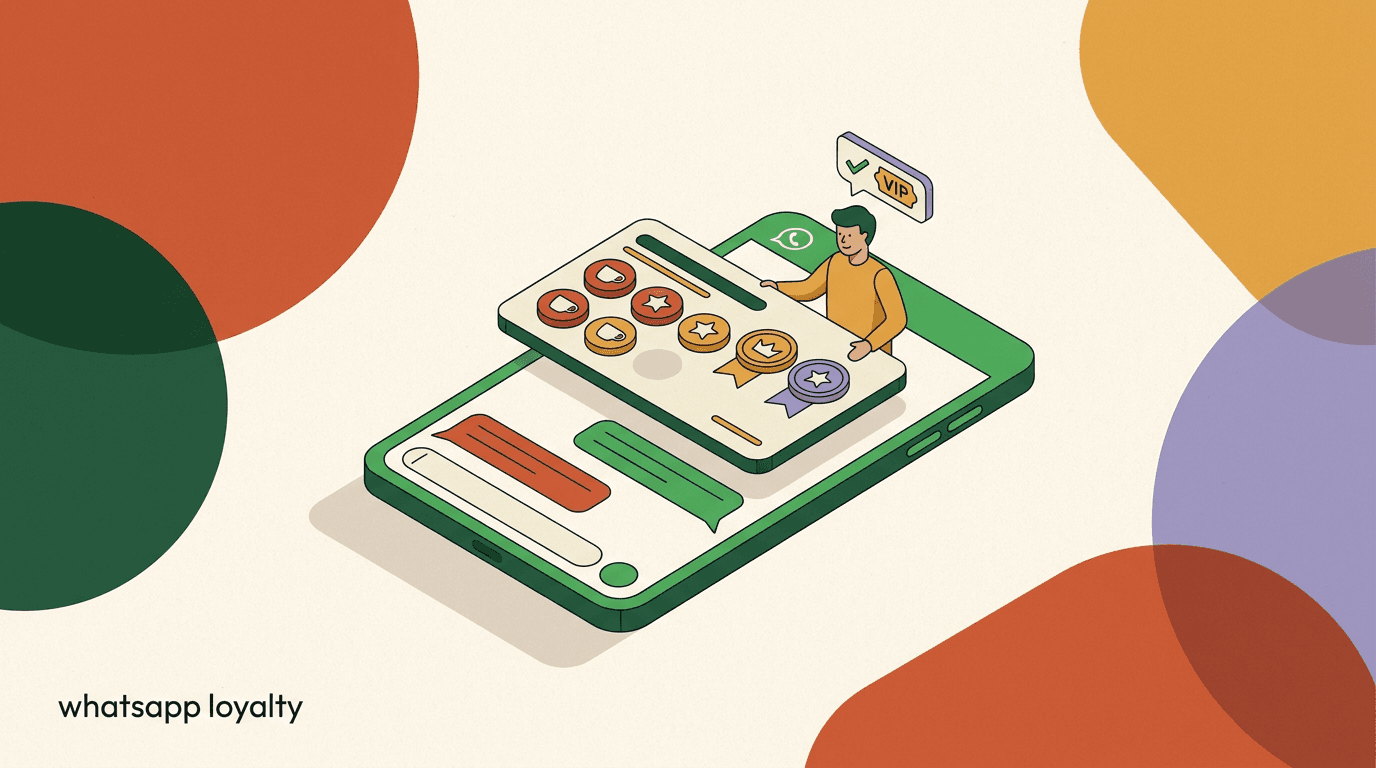
A WhatsApp loyalty programme puts your rewards, tiers, and VIP perks inside the one app your customers open dozens of times a day. Instead of a points balance buried in an account page nobody visits, the reward lands as a message — read within minutes, replied to in seconds. For a D2C brand fighting to keep repeat buyers, that difference in attention is the whole game. Loyalty only works when members actually see it, and WhatsApp is where they are looking.
This guide is the full setup. We will cover enrollment and opt-in the compliant way, how to track points and tiers when WhatsApp itself has no points field, the reward triggers that bring people back, exclusive drops for your VIP segment, and how to measure whether any of it moves retention. We will also be honest about the seams: WhatsApp and a messaging platform handle the relationship, the segments, and the sends, but a true points-and-redemption engine usually lives in a separate tool you connect.
Full disclosure: we build KlyoChat, an AI-native inbox and automation platform that handles the WhatsApp side of exactly this kind of programme. So we have a point of view, and we will say plainly where KlyoChat fits and where you will want a dedicated loyalty engine alongside it. No inflated claims, no pretending one tool does everything.
Why run a loyalty programme inside WhatsApp at all?
Most loyalty programmes fail quietly. The customer signs up at checkout, earns points they never check, and forgets the programme exists until an email lands in a tab they will never open. The mechanics are fine; the channel is dead. Loyalty is a relationship, and relationships need a channel people actually attend to.
WhatsApp inverts that. It is not a marketing inbox people triage once a week — it is the thread where they talk to family and friends, and messages there get read. When a points milestone, a tier upgrade, or an early-access drop arrives as a WhatsApp message, it competes for attention with personal conversations and usually wins. That is the entire reason to move loyalty into the channel: not novelty, but attention.
There is a second reason: conversation. A loyalty email is a broadcast a customer cannot answer. A WhatsApp message is a door. A member can reply 'how many points do I have?' or 'is the VIP drop still live?' and get an answer — from automation or a human — in the same thread. That two-way quality turns a passive programme into an active one, and active members spend more.
A third reason is trust. The WhatsApp thread is persistent — every reward, every drop, every milestone the member ever received sits there in one scrollable history they can revisit at any time. There is no forgotten password to a loyalty portal, no app to reinstall, no account page that times out. The programme lives where the member already is, and that continuity quietly builds the sense that the brand is reliable. Loyalty, in the end, is just trust that compounds, and a channel the member never loses access to is fertile ground for it.
Channel is the variable most programmes ignore
Brands obsess over points ratios and reward catalogues, then deliver it all through a channel nobody checks. Before you tune the economics, fix the channel. A modest programme on WhatsApp beats a generous one buried in email nobody opens.
What does a WhatsApp loyalty programme actually need?
Before the setup steps, it helps to see the moving parts. A loyalty programme on WhatsApp is not one feature — it is four jobs working together. Some live in WhatsApp and your messaging platform; one usually lives in a connected tool. Knowing which is which keeps your expectations honest and your stack sensible.
- Enrollment and opt-in: the front door, and the part you must get right legally.
- Membership and tier tracking: simple to do with tags and fields for basic tiers.
- Points and redemption: the part WhatsApp and a messaging inbox do not natively compute.
- Reward delivery: the part WhatsApp does better than any other channel.
| Job | What it does | Where it usually lives |
|---|---|---|
| Enrollment & opt-in | Get members in with explicit WhatsApp consent | WhatsApp + messaging platform |
| Membership & tier tracking | Know who is a member and what tier they are in | Tags / custom fields, or a loyalty engine |
| Points & redemption logic | Calculate balances, redeem rewards, expire points | A dedicated loyalty / points engine |
| Reward delivery & drops | Send milestones, perks, VIP early access | Broadcasts + automation on WhatsApp |
Decide your ambition before your tools
A tier-based VIP programme (Silver / Gold / Platinum by spend) needs only tags and fields. A points-per-dollar programme with redemption needs a points engine connected to WhatsApp. Pick the model first; the tooling follows from it.
How do you get members to opt in the right way?
WhatsApp is consent-first by design, and that is a feature for loyalty, not a hurdle. You cannot message someone on WhatsApp without their opt-in, and template messages plus Meta's per-conversation fees apply. The upside is that everyone in your programme genuinely chose to be there, which is exactly the audience a loyalty programme wants.
Opt-in needs to be explicit and logged. A pre-ticked box or a buried checkbox will not do — the member has to take a clear action that says 'yes, message me on WhatsApp about rewards.' Capture that action and store the timestamp and source, because that record is your proof of consent if anyone ever asks.
- Offer a clear reason to joinLead with the perk, not the programme. 'Join on WhatsApp and get 15% off your next order plus early access to drops' beats 'sign up for our loyalty programme.'
- Use a low-friction entry pointA click-to-WhatsApp link or button on your site, at checkout, on packaging (QR code), and in your link-in-bio. The member taps, lands in chat, and confirms.
- Confirm consent inside the chatFirst message restates what they signed up for and how often you will message. A simple reply or button press logs explicit opt-in.
- Tag the member and record the sourceOn confirmation, tag them as a loyalty member, set their join date, and store where they came from. This is your audit trail and your segmentation seed.
- Send the promised perk immediatelyDeliver the welcome reward in the same conversation. Instant payoff sets the tone and proves the programme is real.
Opt-in is a record, not a vibe
Store the consent action, timestamp, and source for every member. WhatsApp and data-protection rules both expect verifiable opt-in. Treat the consent log as part of the programme, not paperwork you bolt on later.
A clean opt-in confirmation message
- Trigger
- Member taps the click-to-WhatsApp join link
- Message
- Welcome to the VIP list. Reply YES to get 15% off now and early access to every drop.
- On reply YES
- Tag loyalty_member, set joined_date, send the discount code
How do you track points and tiers when WhatsApp has no points field?
Here is the honest core of the whole article. WhatsApp is a messaging channel. Your inbox platform stores contacts, tags, and custom fields. Neither one is a points calculator — they do not compute 'spend $1, earn 1 point' or 'redeem 500 points for a reward.' For that math you need a points engine. So how do you run tiers and rewards without one? It depends on which model you choose.
The good news is that the most engaging loyalty models — tier-based VIP programmes — need very little computation. A tier is just a label that changes when a customer crosses a spend or order threshold. That is something tags and custom fields handle comfortably, especially when your store data feeds in.
- Tiers map cleanly to custom fields: a 'tier' field set to Silver, Gold, or Platinum.
- Thresholds can be driven by store data — total spend or order count from Shopify or WooCommerce.
- Segments let you message a whole tier at once: 'all Gold members, here is your perk.'
- True points balances with redemption belong in a points engine you connect, not in WhatsApp.
| Loyalty model | What you track | Engine needed? |
|---|---|---|
| Tier by spend (Silver/Gold/Platinum) | A tier tag or field per member | No — tags/fields suffice |
| Punch card (buy 5, get 1) | A simple counter field | Light — a counter, sometimes manual |
| Points per dollar + redemption | Running balance, redemptions, expiry | Yes — a dedicated points engine |
| VIP / early-access list | A single membership segment | No — a tag is enough |
Do not fake a points engine with tags
You can label tiers with tags and fields all day. You cannot reliably run a live points balance with expiry and redemption that way — it gets brittle fast. If your model is points-per-dollar, connect a real loyalty engine and use WhatsApp to deliver what it calculates.
How do reward triggers bring members back?
A reward sitting in an account balance does nothing. A reward that arrives as a message at the right moment changes behaviour. The art of a WhatsApp loyalty programme is choosing the triggers — the moments where a timely message turns a dormant member into a repeat buyer.
Triggers fall into two buckets: milestone triggers (the member did something worth celebrating) and lifecycle triggers (time or inactivity calls for a nudge). The best programmes mix both, so members hear from you when they earn something and when they are drifting away.
- Tier upgrade: 'You just reached Gold — here is your new perk' is one of the highest-engagement messages you can send.
- Milestone reached: hit the spend or order threshold and a reward fires automatically.
- Birthday or anniversary: a dated field triggers a perk on the member's day or their join anniversary.
- Inactivity nudge: no purchase in 60–90 days triggers a win-back offer to a still-opted-in member.
- Post-purchase points note: after an order, confirm what they earned and how close they are to the next tier.
Celebrate earning, not just spending
Members get plenty of 'buy now' messages. The ones that build loyalty say 'look what you earned.' Lead with the reward they unlocked, and the next purchase follows on its own.
A tier-upgrade trigger that drives a repeat order
- Condition
- Member's total spend crosses the Gold threshold
- Action
- Set tier field to Gold, send congratulations message
- Message
- You are officially Gold. Enjoy free shipping on every order and first dibs on drops.
- Result
- A reason to order again, delivered in the channel they read
What makes VIP drops and exclusive access work on WhatsApp?
Exclusivity is the most under-used lever in loyalty. Discounts train customers to wait for the next discount. Access — early access to a drop, a members-only product, a private sale — rewards loyalty without eroding margin, and WhatsApp is the perfect channel for it because the message lands before the public ever sees the launch.
A VIP drop on WhatsApp is simple: you have a segment of your highest-tier members, and you broadcast the early-access link to them a set time before the general release. The scarcity is real, the channel is fast, and the member feels genuinely ahead of the crowd. That feeling is what retains people.
- Build the VIP segmentFilter to your top tier — Platinum members, or anyone above a spend threshold, all opted in to WhatsApp.
- Prepare the early-access offerA real head start: a private link, a 24-hour window, or a quantity reserved for VIPs only. The exclusivity must be true.
- Broadcast to the segment with a templateSend the early-access message to the VIP segment. Keep it short — the perk and the link, nothing else.
- Handle replies in the same threadVIPs will ask questions. Let automation answer the common ones and route the rest to a human, so the white-glove feel holds.
- Follow up once, then open to allA single 'last few hours of early access' reminder, then the public launch. Do not over-message the VIP list.
Access beats discounts for margin
Early access and members-only products reward loyalty without conditioning customers to wait for a sale. When you can choose, give VIPs access rather than a deeper discount — it protects margin and feels more premium.
A VIP early-access drop message
- Segment
- Platinum tier, opted in, ~400 members
- Send time
- 24 hours before public launch
- Message
- VIP early access: the new drop is live for you only. Shop before everyone else here.
- Why it works
- Real scarcity in a channel read within minutes
How do you message a loyalty programme without annoying members?
WhatsApp is intimate, and that cuts both ways. The same proximity that makes a reward message powerful makes an unwanted message intrusive. Over-message your loyalty list and they will opt out — and a WhatsApp opt-out is hard to win back. Cadence discipline is not optional; it is what keeps the channel valuable.
The rule of thumb: every loyalty message should carry value the member can feel — a reward, an access pass, a milestone, an answer. If a message is really a generic promotion dressed as loyalty, it does not belong on this list. Keep the promotional firehose on other channels and reserve WhatsApp for messages that earn their place.
- Cap frequency: most loyalty lists do well with a few messages a month, not a few a week.
- Segment hard: a Gold-tier perk should not go to Silver members, and vice versa.
- Make every send actionable: a reward, a drop, a milestone — never filler.
- Honor opt-outs instantly and make leaving easy; a clean list is a healthy list.
- Watch your Meta template categories — marketing templates cost more and carry stricter rules than utility ones.
A WhatsApp opt-out is expensive
Losing an email subscriber is recoverable; losing a WhatsApp loyalty member usually is not. Treat every send as borrowing attention from a personal channel. When in doubt, send less.
How do you measure whether the loyalty programme is working?
A loyalty programme that you cannot measure is a cost centre with good intentions. The point is retention — getting members to buy again, more often, for longer — so measure that directly rather than vanity metrics like list size. A 10,000-member list that never reorders is worse than a 1,000-member list that does.
Track a small set of numbers and watch them over time. You do not need a data team; you need consistency. Compare members against non-members and watch the gap, because that gap is the programme's actual contribution.
- Compare members vs non-members on repeat rate — that delta is the programme's value.
- Watch opt-out rate as your cadence canary; a rising number means you are messaging too much.
- Track reward-message engagement (replies, link taps) to see which triggers actually work.
- Tie VIP drops to revenue from the segment, not just opens, so exclusivity earns its keep.
| Metric | What it tells you | Good signal |
|---|---|---|
| Repeat purchase rate (members) | Whether the programme drives reorders | Higher than non-members |
| Time between orders | Whether members buy more often | Shorter than non-members |
| Tier progression rate | Whether members climb tiers | Steady upward movement |
| Opt-out / churn rate | Whether cadence is sustainable | Low and stable |
One number to start with
If you track only one thing, track repeat purchase rate for members versus everyone else. If members do not reorder more, no amount of clever tiering matters — fix the rewards before you scale the programme.
How do you design the tier structure itself?
The tiers are the spine of a non-points programme, so they deserve real thought. Too few tiers and there is nothing to climb toward; too many and progress feels impossible. Most D2C brands land on three tiers, sometimes four, because three gives members a clear ladder — entry, mid, top — without diluting the prestige of reaching the summit. The names matter too: members should feel something when they read their tier, which is why metals, gemstones, and status words outperform 'Level 1, Level 2, Level 3.'
Set the thresholds against your real purchase data, not a guess. Look at your distribution of customer lifetime spend and place the entry tier where most repeat buyers already sit, the mid tier where your better customers cluster, and the top tier where only your genuine best land. The point of the top tier is scarcity — if a third of your list is Platinum, Platinum means nothing. Aim for a top tier that is a small, proud minority.
Each tier needs a benefit that is visibly better than the one below it. Escalating perks are what make the climb worth it: a welcome discount at entry, free shipping at the mid tier, early access and a personal touch at the top. The jump between tiers should feel like a meaningful upgrade, because that gap is the motivation to spend more.
- Three tiers suit most D2C brands; add a fourth only if your spend distribution is genuinely wide.
- Name tiers so the label carries status — members should feel the upgrade.
- Anchor thresholds to your actual lifetime-spend distribution, not round numbers.
- Keep the top tier a proud minority; ubiquity kills its appeal.
- Make each tier's perk visibly better than the one below, so the climb is worth it.
| Tier | Example threshold | Signature perk |
|---|---|---|
| Silver (entry) | First purchase / opt-in | Welcome discount, points note |
| Gold (mid) | Crosses mid spend band | Free shipping, birthday reward |
| Platinum (top) | Top spend band, small minority | Early access, members-only products, human concierge |
Design downgrade rules before launch
Decide up front whether tiers are earned for life, reset annually, or based on a rolling spend window. Rolling windows keep members active but can feel punishing if a loyal customer drops a tier — so communicate the rule clearly and warn members before any downgrade.
How does AI change a WhatsApp loyalty programme?
A loyalty programme on WhatsApp invites questions, and questions at scale are where most teams drown. Members ask the same things over and over: what tier am I, how do I move up, is the drop still live, how do I redeem this code, when does my perk expire. Answer them by hand and a growing programme becomes a support burden; ignore them and members feel the programme is a one-way broadcast. This is the gap AI agents fill.
An AI agent trained on your programme rules can hold the routine side of the conversation in the same WhatsApp thread the member is already in. It can explain tiers, surface the next milestone, restate a member's perks, and confirm whether a drop is active — instantly, at any hour, in the member's language. The member feels attended to; your team only sees the conversations that genuinely need a human, like a redemption gone wrong or a VIP with a special request.
The honest boundary is the same one that runs through this whole guide: an AI agent can read and explain a member's tier and perks, but it does not invent the points math. If a member asks 'how many points do I have,' the agent answers accurately only if that balance exists in a field or a connected engine it can read. AI makes the programme feel responsive; it does not replace the system that holds the numbers.
- AI agents handle the repetitive loyalty FAQ — tiers, milestones, perks, drop status — around the clock.
- Routing keeps humans for what matters: redemptions, complaints, and VIP requests.
- Agents work in the member's language and in the same thread, so nothing feels handed off.
- Accuracy depends on the data: an agent can only quote a balance that lives in a field or connected engine.
AI agents are included in KlyoChat plans
Every KlyoChat plan includes AI agents — there is no separate AI add-on. Point an agent at your programme rules and member fields, and it can field the loyalty FAQ on WhatsApp without adding headcount. It quotes only what it can read, so connect your data for accurate answers.
An AI agent answering a member in-thread
- Member asks
- what tier am I and how do I get to the next one?
- Agent reads
- tier field = Gold, spend-to-Platinum field
- Agent replies
- You are Gold. Spend a little more and you unlock Platinum early access.
- Human needed?
- No — routine, answered instantly
What are the common mistakes that kill WhatsApp loyalty programmes?
Most failed loyalty programmes do not fail because the idea was wrong. They fail on execution, and the failures repeat across brands. Knowing the common traps ahead of time is cheaper than learning them from a churning member list. Here are the ones we see most often, and how to avoid each.
The pattern underneath nearly all of them is the same: treating WhatsApp like an email list. Email tolerates volume and forgives a weak offer because the cost of ignoring it is near zero. WhatsApp does not. Every mistake below is a version of forgetting that you are a guest in a personal channel.
- Over-messaging: blasting the loyalty list weekly until members opt out. Fix: cap frequency and make every send valuable.
- Faking points with tags: trying to run live balances and redemption on fields alone until it breaks. Fix: connect a real engine for points models.
- Rewarding spend only: never celebrating what members earned, only pushing the next purchase. Fix: lead with milestones and access.
- No segmentation: sending every perk to every member, so tiers feel meaningless. Fix: segment hard by tier.
- Ignoring the consent log: launching without verifiable opt-in records. Fix: log the action, timestamp, and source from day one.
- Discount addiction: training members to wait for the next sale. Fix: favour access and exclusivity over deeper discounts.
The slow death is over-messaging
The most common programme killer is not a dramatic failure — it is a steady drip of one-too-many messages that quietly erodes your opt-in list. By the time you notice the churn, the members are gone and a WhatsApp opt-out rarely comes back. Protect cadence above almost everything.
How do you handle redemption and fulfilment when a member claims a reward?
Earning a reward is the easy half; redeeming it cleanly is where programmes either feel premium or fall apart. A member who unlocks a perk and then cannot figure out how to use it — or hits a broken code, or waits days for a reply — learns that the programme is decoration. The redemption moment is a service moment, and on WhatsApp it happens in a live conversation, which is both the opportunity and the risk.
Keep redemption inside the thread wherever you can. A discount perk is best delivered as a code or a pre-applied link the member taps without leaving WhatsApp. A members-only product is a direct link to the product. When a redemption needs a human — a special request, a high-value VIP, an exception — route it to a person fast, because a slow reply on a reward feels worse than no reward at all.
- Confirm the reward is validWhen a member claims, check the perk applies to their current tier and has not expired. Automation can verify this against their fields before issuing anything.
- Deliver in-threadSend the code, link, or access pass directly in the WhatsApp conversation. The fewer steps and tabs, the higher the redemption rate.
- Handle exceptions with a humanRoute anything non-standard — a VIP request, a code that failed, a fulfilment question — to a teammate quickly so the premium feel holds.
- Record the redemptionLog that the reward was used so it cannot be claimed twice and so your metrics capture real redemption, not just issuance.
Measure redemption, not just issuance
A reward issued and never redeemed is a promise the member did not feel. Track redemption rate separately from how many rewards you sent. A low redemption rate usually means the reward was hard to use, not that members did not want it.
What does a complete WhatsApp loyalty stack look like?
Putting it together, a working programme is rarely a single product. It is a small stack where each tool does one job well: your store is the source of truth for spend, a loyalty engine (if you run points) does the math, and your WhatsApp platform handles consent, segmentation, and delivery. The seams matter less than getting each job to the right tool.
For a tier-and-access programme, the stack is light — your store plus a WhatsApp platform with tags, fields, and broadcasts. For a full points-and-redemption programme, you add a dedicated loyalty engine and connect it so balances and rewards flow into WhatsApp. Start light; add the engine only when your model truly needs it.
Build the minimum that earns retention
Most brands over-build loyalty before proving it works. A tier-and-access programme on WhatsApp with no points engine at all can lift retention meaningfully. Prove that, then graduate to points if the numbers justify the added tool.
Two stacks, two ambition levels
- Tier / VIP programme
- Store + WhatsApp platform (tags, fields, segments, broadcasts)
- Points / redemption programme
- Store + loyalty engine + WhatsApp platform for delivery
- The constant
- WhatsApp is always the delivery and relationship layer
Where does KlyoChat fit in a WhatsApp loyalty programme?
We build KlyoChat, so here is the honest placement. KlyoChat is an AI-native unified inbox that connects WhatsApp alongside Instagram, Facebook, Telegram, TikTok, and X. For a loyalty programme it handles the relationship and the messaging layer: capturing opt-in, tagging members, storing tiers in custom fields, segmenting by tier, and broadcasting rewards and VIP drops. AI agents can answer 'how many points do I have?' or 'is the drop still live?' in the same thread, around the clock.
What KlyoChat is not: a points-and-redemption engine. We do not calculate points-per-dollar balances, expiry, or redemptions natively. If your model is tier-and-access, KlyoChat covers it end to end with tags, fields, segments, and broadcasts. If your model is full points, you run a dedicated loyalty engine for the math and connect it to KlyoChat — on the Business plan via API and webhooks, plus native Shopify and WooCommerce — so balances and tier changes flow in and the rewards flow out over WhatsApp.
- Pricing is flat and bundled: Basic $19, Pro $49 ($39 billed yearly), Business $129 — AI agents included.
- Every plan starts with a 7-day free trial, no credit card.
- Honest limits: KlyoChat has no native SMS or email, is not a points engine, and WhatsApp template plus Meta per-conversation fees apply on any platform.
- We are a newer, smaller community than the largest incumbents — so support is direct, but the marketplace is younger.
| Loyalty job | KlyoChat does this | Notes |
|---|---|---|
| Opt-in capture & consent log | Yes | Tags, custom fields, source tracking |
| Tier tracking & segmentation | Yes | Custom fields + segments, fed by store data |
| Reward & VIP drop delivery | Yes | Broadcasts + automation on WhatsApp |
| Points balance & redemption math | No — connect an engine | API/webhooks on Business; Shopify/Woo native |
The handoff, stated plainly
KlyoChat owns consent, tiers, segments, and WhatsApp delivery. A points engine owns balances and redemption. Connect them on the Business plan and WhatsApp becomes the place members experience a programme calculated elsewhere. That is the realistic architecture — not one box that does everything.
A realistic KlyoChat-based programme
- Model
- Tier by spend (Silver / Gold / Platinum) + VIP early access
- Tracking
- Tier custom field, fed by Shopify order data
- Delivery
- Tier-upgrade triggers and VIP drop broadcasts over WhatsApp
- Engine needed
- None — tags, fields, and broadcasts cover it
How do you launch a WhatsApp loyalty programme in your first week?
You do not need the perfect programme to start. You need a single tier or VIP list, a clean opt-in, and one reward trigger that fires reliably. Launch small, prove it lifts repeat purchases, then expand. Here is a sequence that gets a real programme live fast.
- Pick one model and one rewardStart with a VIP / early-access list or a single spend tier. One clear perk. Resist the urge to launch a points economy on day one.
- Set up opt-in and the consent logAdd a click-to-WhatsApp join point on your site and checkout, confirm consent in-chat, and tag members with a join date.
- Connect your store for tier dataFeed spend or order data from Shopify or WooCommerce so tier fields update without manual work.
- Build one trigger and one dropWire a tier-upgrade or milestone trigger, and schedule one VIP early-access broadcast to test the exclusivity lever.
- Measure and iterateAfter a few weeks, compare member repeat rate to non-members. If the gap is real, add a tier or a points engine. If not, fix the reward first.
Ship the smallest programme that can prove itself
A one-tier VIP list with a single reliable reward trigger will teach you more in a month than a fully-specced points economy you spend a quarter building. Launch, measure, then scale the parts that work.
The bottom line on a WhatsApp loyalty programme: the channel is the advantage. Rewards, tiers, and VIP access delivered as messages get read and acted on in a way email never matches, and that attention is what actually retains customers. Get opt-in right, track tiers with tags and fields, fire rewards on real triggers, run true early-access drops, and measure repeat purchase rate above everything else.
Be honest about the architecture. WhatsApp and a platform like KlyoChat own consent, segmentation, and delivery; a points engine owns balances and redemption if your model needs one. Start with a tier-and-access programme that needs no engine at all, prove it lifts retention, and add complexity only when the numbers earn it. For the messages around it, see our post-purchase WhatsApp sequence and win-back guides, and our Shopify integration walkthrough for the store connection.