Voice AI agents have moved from demo reels to real phone lines in 2026, and the honest question is no longer whether they work but where they work well enough to trust. A voice AI agent listens to a caller, transcribes speech in real time, decides what to say, and speaks back — all fast enough to feel like a conversation rather than a walkie-talkie exchange. When the task is narrow and the audio is clean, that loop now holds up. When the task is messy, emotional, or spans several steps, it still strains.
This piece is a landscape, not a sales pitch. We will map where voice AI agents genuinely help against where text and chat remain the better tool, and we will do it with the trade-offs in plain view: latency, accuracy, cost, and the failure modes that do not show up in a vendor demo. The goal is to leave you able to decide, for one specific job, whether voice or text is the right channel.
One disclosure up front, because it shapes how you should read us. We build KlyoChat, and KlyoChat is a text and chat platform — social DM plus WhatsApp. We do not offer voice agents. That means this is educational ground, not a walkthrough of a feature we sell. We have no incentive to oversell voice, and we will be equally plain about where text falls short. Treat this as a map drawn by people who work next door to the territory, not inside it.
What exactly is a voice AI agent, and how does it differ from a text agent?
A voice AI agent is software that holds a spoken conversation. It takes audio in, works out what was said and what the caller wants, decides on a response, and produces audio out. The common shorthand for the underlying idea is conversational AI, and if you want the neutral background there is a solid overview of conversational AI on Wikipedia that avoids any single vendor's framing.
A text AI agent does the same reasoning but skips the audio on both ends. The customer types, the agent reads text directly, thinks, and writes back. Because there is no speech to convert, a text agent has fewer moving parts and fewer places to go wrong. That single difference — audio in and out versus text in and out — cascades into almost every trade-off in this article. Voice adds two extra processing stages, a strict timing budget, and a whole class of errors that text agents never encounter.
It helps to separate the reasoning core from the channel. Modern agents, voice or text, usually share the same kind of language model at the center. What differs is the wrapper. A text agent wraps the model in a message queue and a chat interface. A voice agent wraps the same model in a speech-recognition front end and a speech-synthesis back end, then wires the whole thing to a phone network or an app microphone. The intelligence can be identical; the plumbing is not.
This is why comparing voice and text is less about which is smarter and more about which channel fits the job. A voice agent is not a text agent that learned to talk. It is a text agent carrying extra equipment — equipment that is worth its weight for some tasks and pure overhead for others.
Voice and text often share a brain
In most 2026 stacks the language model reasoning behind a voice agent and a text agent is the same. The differences you feel as a customer come from the speech layers wrapped around that shared core, not from one being fundamentally more capable than the other.
Why is 2026 a turning point for voice AI agents?
For years, voice automation meant the rigid phone tree — press one for billing, press two for support — and the equally frustrating early voicebot that only understood a fixed script. What changed is that the two hardest parts of the pipeline, understanding natural speech and producing natural speech, both crossed a usability threshold at roughly the same time.
On the input side, general-purpose speech recognition has become good enough that a caller can talk normally, with contractions, filler words, and a bit of background noise, and still be understood most of the time. On the output side, synthesized voices stopped sounding like a train-station announcer. The combination means a caller can now forget, for stretches, that they are talking to software — until the agent hits something outside its lane.
The other shift is latency. A conversation only feels natural if the reply comes back within the rhythm of human turn-taking, which is well under a second of silence before it starts to feel broken. Streaming architectures — where transcription, reasoning, and speech generation overlap rather than run one after another — got fast enough in this window to keep most exchanges inside that budget. That is the quiet engineering story behind the demos that suddenly feel alive.
None of this makes voice universally ready. It makes voice ready for a growing set of specific jobs, and it moves the frontier every few months. The honest 2026 position is not that voice AI agents have arrived across the board, but that the set of tasks where they are the right call has grown large enough to take seriously — and small enough that you still have to choose carefully.
What actually improved
- Then (phone trees)
- Fixed menus, keypad input, no real understanding of natural speech
- Early voicebots
- Scripted paths, brittle recognition, robotic playback, awkward pauses
- 2026 voice AI agents
- Natural speech in and out, streaming pipeline, sub-second turns on narrow tasks
How does the voice AI pipeline actually work?
To judge where voice AI agents break, it helps to see the assembly line. A spoken turn passes through several stages, and each one adds both time and a chance of error. Understanding the stages is the difference between blaming the whole system when only one link is weak.
The pipeline is usually described in four moves. Audio comes in and becomes text. Text becomes an interpreted intent and a decision. The decision becomes a response in words. The words become audio again. In a streaming design these overlap, but conceptually they run in order, and the total time the caller waits is the sum of what each stage cannot overlap away.
- Speech to text (recognition)The caller's audio is transcribed in real time. This is where accents, noise, and crosstalk do their damage. The neutral primer on speech recognition covers why this stage is hard.
- Understanding and reasoningThe transcribed text goes to the language model, which works out intent, pulls any needed data, and decides on a reply. This is the stage voice shares with text agents.
- Response generationThe agent composes what to say, ideally short and speakable, because long paragraphs that read fine on screen sound exhausting out loud.
- Text to speech (synthesis)The reply is turned back into audio. The background on text-to-speech explains why natural prosody and timing are the hard part, not just pronunciation.
Errors compound down the pipeline
A mistake early in the chain poisons everything after it. If recognition mishears a product name, the reasoning stage answers the wrong question confidently, and the speech stage delivers that wrong answer in a pleasant voice. Text agents skip the two speech stages entirely, which removes a whole category of compounding error.
What does latency really mean for a voice AI agent?
Latency is the single trait that separates a voice agent that feels human from one that feels broken, and it is far less forgiving than in text. When you send a chat message, a two or three second wait for a reply is normal and barely noticed. On a phone call, two seconds of silence after you stop talking feels like the line dropped. People start to say hello, are you there.
The reason is human turn-taking. In natural conversation, the gap between one person finishing and the other starting is astonishingly short — a fraction of a second. Voice agents have to respect that rhythm or the illusion collapses. The whole four-stage pipeline, plus network time, has to fit inside a budget that leaves the caller feeling heard rather than kept waiting.
This is why voice engineering obsesses over streaming. Instead of waiting for the caller to finish, transcribing the whole thing, then reasoning, then generating all the audio before playing any of it, a streaming pipeline starts transcribing while the caller is still talking, starts reasoning on partial input, and starts speaking the first words of a reply before the last words are composed. The overlap is what buys the sub-second feel. It also makes the system more complex and more expensive to run, which matters for the cost section below.
Text agents live in a different world. Because there is no turn-taking rhythm to honor, a text agent can take a beat to think, call a database, check three sources, and compose a careful answer, and the customer waits patiently because that is how messaging already works. The latency budget for text is measured in seconds; for voice it is measured in hundreds of milliseconds. That gap alone rules voice out of some tasks and rules it in for others.
| Channel | Comfortable response window | What a slow reply feels like |
|---|---|---|
| Voice call | Under ~1 second of silence | A dropped line or a confused agent |
| Live chat | A few seconds | Slightly slow, still acceptable |
| Async DM or WhatsApp | Seconds to minutes | Completely normal |
If the task needs thinking time, text is kinder
Any job that requires the agent to look things up, reason across several records, or wait on a slow system is a poor fit for voice, because the silence while it works reads as failure. In text, that same pause is invisible. Match the channel to how much thinking the task demands.
How accurate is speech recognition in real conditions?
Vendor demos are recorded in quiet rooms by people with clear diction speaking a language the system was tuned for. Real phone calls are not like that. They happen in cars, in kitchens with a television on, on speakerphone in a warehouse, and from callers with accents, colds, and a habit of trailing off. Speech recognition accuracy is not one number; it is a range that swings hard with conditions.
The variables that hurt recognition are predictable, which is good news because you can test for them before you deploy. Background noise degrades accuracy. Strong or underrepresented accents degrade it. Domain-specific vocabulary — product names, drug names, part numbers — is a frequent failure point because the words are rare and easy to confuse. Crosstalk, where the caller and agent speak at once, confuses the boundary detection that streaming relies on.
The practical consequence is that a voice agent's real accuracy is the accuracy on your actual callers, not the headline figure. A system that transcribes a clear American English speaker at very high accuracy might drop noticeably on a regional accent, a noisy line, or a caller rattling off an order number. This is not a reason to avoid voice; it is a reason to measure recognition on a representative sample of your own calls before you trust it with anything consequential.
There is also an asymmetry worth naming. A text agent reads exactly what the customer typed, typos and all, but it never mishears. Autocorrect aside, the input is the ground truth. A voice agent is always working from a best guess at what was said. That best guess is usually right, and getting righter, but the residual error rate is why high-stakes fields — a shipping address, a payment amount, a medication — are the riskiest things to capture by voice and the safest to capture by text or a confirmed keypad entry.
- Background noise, accents, and rare vocabulary are the main accuracy killers.
- Real accuracy is the accuracy on your callers, not the demo number.
- Text never mishears — the typed input is the ground truth.
- High-stakes fields (addresses, amounts, medical terms) are the riskiest to capture by voice.
- Always test recognition on a representative sample before trusting it.
Confirm anything that matters
For any detail where a mistake is costly — an address, an order quantity, a payment — a well-built voice agent reads the value back and asks the caller to confirm, or falls back to keypad entry. Silent capture of a mis-heard number is the failure that turns a helpful agent into an expensive one.
What does a voice AI agent cost compared to text?
Voice is more expensive to run than text, and the reasons are structural rather than a matter of any one vendor's pricing. It is worth understanding the cost shape even though exact figures move constantly, because the shape tells you where voice earns its keep and where it burns money.
Start with the extra stages. A text turn costs, roughly, the price of the language model reasoning. A voice turn costs that same reasoning plus real-time speech recognition plus speech synthesis, and often plus telephony minutes to carry the call. You are paying for three or four services where text pays for one. Streaming, which is what makes voice feel natural, also tends to cost more than batch processing because it holds resources open for the length of the call.
Then there is the shape of the workload. Text is naturally asynchronous and bursty in a forgiving way. One agent process can juggle many slow text conversations at once, because most of the time it is waiting for a human to type. Voice is synchronous and continuous. A call occupies the pipeline for its full duration whether the caller is talking or thinking. That lower concurrency per unit of infrastructure is part of why voice minutes cost what they do.
The honest way to think about cost is per resolved outcome, not per message. A voice call that resolves an order-status question in forty seconds may be cheaper than a ten-message text thread that drags across a day of a support agent's attention — or it may be far more expensive if the call wanders. Voice tends to win on cost where calls are short, high-volume, and repetitive, and lose where they are long, rare, or complex. Text tends to win on cost almost everywhere the interaction can be async.
| Cost factor | Voice AI agent | Text AI agent |
|---|---|---|
| Processing stages billed | Recognition + reasoning + synthesis (+ telephony) | Reasoning only |
| Concurrency per resource | Low — one call holds the pipeline | High — many slow chats share a process |
| Best cost fit | Short, high-volume, repetitive calls | Async, bursty, or complex conversations |
| Worst cost fit | Long, rare, or wandering calls | Rarely a poor cost fit |
Measure cost per resolution, not per minute
A voice agent that ends a call in thirty seconds can beat a long text thread on total cost, and a voice call that meanders can lose to it badly. The unit that matters is cost per resolved outcome. Price the whole interaction, not the per-minute or per-message rate in isolation.
Where do voice AI agents genuinely shine in 2026?
Voice earns its place when the phone is where the customer already is and the task is narrow enough to finish before anything goes wrong. The strongest fit is inbound phone support for high-volume, repetitive questions — the calls that a human team handles hundreds of times a day and finds draining precisely because they are so routine.
Order and delivery status is the flagship example. A caller wants to know where their package is. The agent authenticates them, looks up the order, and reads back the status. The exchange is short, the vocabulary is contained, and the caller gets an answer faster than waiting in a queue for a human to do the same lookup. Appointment booking, rescheduling, and reminders follow the same pattern: bounded choices, clear confirmations, quick resolution.
Triage and routing is another sweet spot, and arguably the safest one. Here the voice agent does not try to resolve the issue at all. It understands why the caller is calling, gathers a few details, and hands off to the right human or system with context attached. This plays to voice's strength — natural spoken understanding — while sidestepping its weakness, because nothing high-stakes is being decided or captured without a human check.
After-hours coverage rounds out the list. A voice agent that handles the simple third of calls at two in the morning, and takes a clean message on the rest, turns a closed line into a partial service without staffing a night shift. The pattern across all of these is the same: narrow scope, short duration, clear success criteria, and a graceful handoff when the caller steps outside the lane.
- Order, delivery, and account status lookups — short and repetitive.
- Appointment booking, rescheduling, and reminders — bounded choices.
- Triage and routing — understand, gather context, hand off to a human.
- After-hours coverage — resolve the simple calls, capture the rest cleanly.
- High-volume inbound where the phone is already the customer's channel.
A voice task that fits well
- Caller
- Where is my order? The number is on my email.
- Agent
- Reads back the order number to confirm, then the current status
- Outcome
- Resolved in under a minute, no human needed, clean handoff if the caller asks for more
Where does text still clearly win?
For a large share of customer interactions, text is not the fallback — it is the better channel on the merits. The clearest case is anything asynchronous. Most people would rather send a message and get on with their day than sit on a call. Social DMs and WhatsApp threads let the customer reply when it suits them, and let the agent take the time it needs to get the answer right without any silence reading as failure.
Text also wins wherever a record matters. A chat thread is its own transcript. The customer can scroll back, copy a tracking link, re-read the return policy, or forward the confirmation. Voice is ephemeral by default; the moment it is spoken it is gone unless you record and transcribe it, which adds cost and privacy weight. For anything the customer might need to reference later, text delivers a paper trail for free.
Complex, multi-step, or information-dense tasks favor text as well. Comparing three plans, walking through a numbered troubleshooting sequence, sharing a link, or showing an image — these are natural in a chat window and clumsy out loud. Nobody wants a URL or a list of specifications read to them digit by digit. When the answer has structure, text carries the structure and voice flattens it.
And text scales in a way voice cannot easily match. One system can hold thousands of slow, overlapping text conversations at once because most are idle at any moment. That is why messaging is where high-volume, always-on automation tends to live. If you want a fuller treatment of when an automated agent beats a human queue and when it does not, our piece on AI agent vs live chat works through the trade-offs, and the broader AI agents vs chatbots comparison covers how much genuine reasoning sits behind the label.
- Asynchronous conversations where the customer replies on their own schedule.
- Anything that needs a record — links, confirmations, transcripts, references.
- Complex or information-dense answers with structure, lists, or images.
- Very high concurrency, where many idle conversations share one system.
- Sensitive details that are safer typed and confirmed than mis-heard.
Async is a feature, not a limitation
The fact that text does not demand an instant reply is exactly why it scales and why customers often prefer it. A channel that lets both sides take their time removes the pressure that makes voice unforgiving. For many businesses, most support simply does not need to happen in real time.
Voice AI agents vs text: how do they compare side by side?
Pulling the threads together, here is the comparison in one view. Read it as a set of tendencies rather than absolutes — a specific implementation can beat these generalizations — but the shape holds across most 2026 deployments.
| Dimension | Voice AI agents | Text AI agents |
|---|---|---|
| Response timing | Must reply in under a second or it feels broken | Seconds to minutes are fine |
| Input accuracy | Best guess at speech; degrades with noise and accents | Exact typed input; never mishears |
| Cost to run | Higher — extra speech stages and low concurrency | Lower — reasoning only, high concurrency |
| Record of the interaction | Ephemeral unless recorded and transcribed | Self-documenting transcript by default |
| Complex or structured answers | Awkward — links and lists read poorly aloud | Natural — structure, links, images all fit |
| Emotional or urgent moments | Strong — tone and immediacy help | Weaker — tone is harder to read in text |
| Scale and concurrency | Limited — one call per pipeline | High — many idle chats per system |
| Best-fit tasks | Short, repetitive phone calls; triage; after-hours | Async support; complex tasks; high volume |
Neither is the winner — the task is
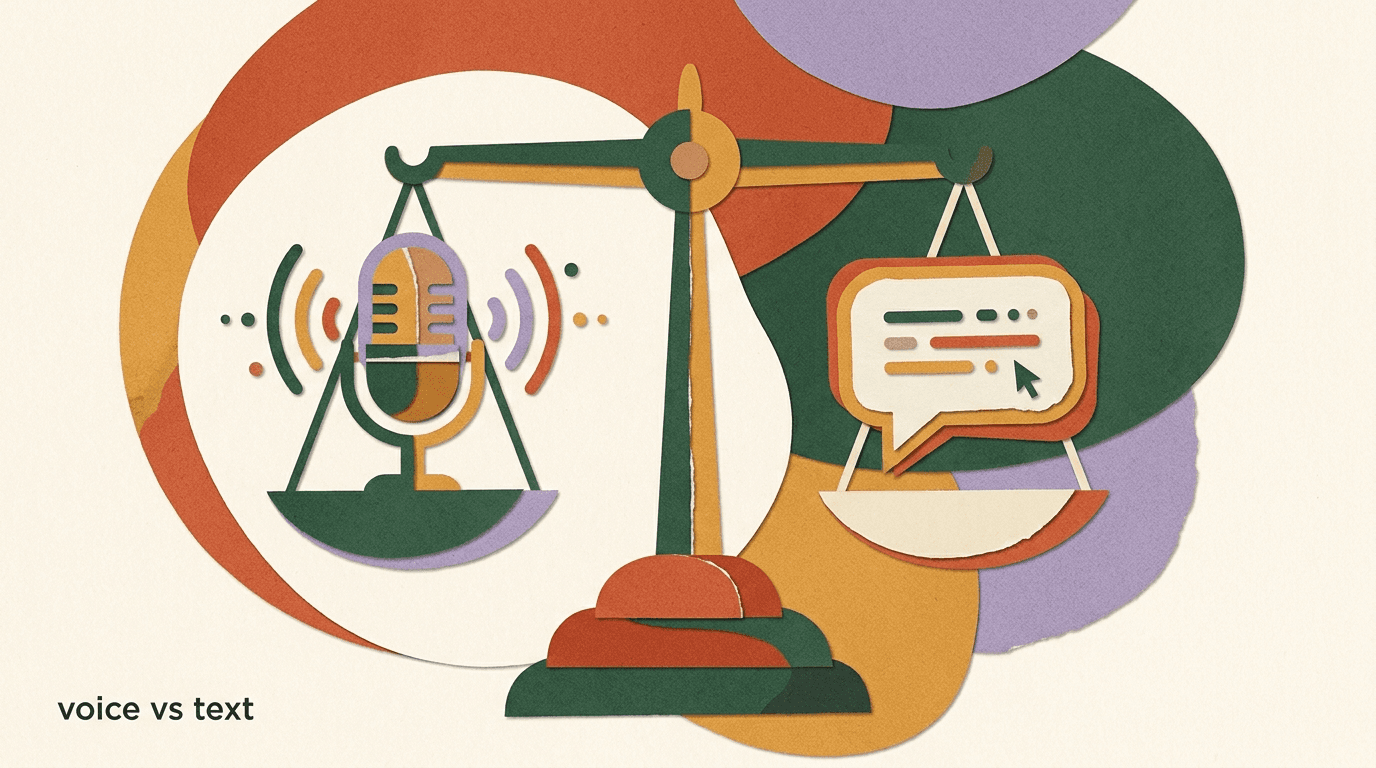
There is no row where one channel wins every case. Voice takes timing-sensitive spoken moments; text takes async, structured, and high-volume work. The useful question is never voice or text in the abstract, but voice or text for this specific job with these specific customers.
How do you decide between voice and text for a given job?
Rather than choosing a channel and forcing tasks into it, work the other way: take one job, run it through a short set of questions, and let the answers point to voice, text, or a mix. This takes a few minutes per task and prevents the common mistake of deploying voice because it demos well and then discovering it fits a third of your volume at best.
- Where is the customer already?If they naturally reach for the phone, voice removes friction. If they live in DMs and WhatsApp, forcing a call adds it. Meet them on their channel, not yours.
- How long and how bounded is the task?Short, repetitive, clearly-scoped tasks suit voice. Long, open-ended, or multi-step tasks suit text, where thinking time is invisible.
- Does the task need a record?If the customer will need to reference a link, confirmation, or transcript later, text hands it over for free. Voice needs extra machinery to do the same.
- How costly is a mis-heard detail?If a wrong address or amount is expensive, prefer text or force explicit confirmation. Low-stakes lookups tolerate voice's residual error rate.
- What is the fallback when it fails?Decide the handoff before you launch. A voice agent that cannot escalate cleanly to a human, or a text agent with no route out, fails harder than one that knows its limits.
Many businesses need both, split by job
The realistic 2026 answer for a lot of teams is not voice or text but both — voice for the inbound phone tasks that suit it, text for async and complex support — with a clean handoff between them. Design the split deliberately instead of defaulting the whole operation to one channel.
What are the failure modes worth planning around?
Every channel fails; the question is whether it fails gracefully. Voice AI agents have a characteristic set of failure modes, and naming them is the first step to designing around them. None of these are reasons to avoid voice outright, but ignoring them is how a promising pilot turns into a wall of one-star reviews.
The first is the confident wrong answer born of a mis-heard input. Because recognition errors happen silently, the agent can answer the wrong question in a reassuring tone, and the caller only discovers the mistake later. The defense is confirmation on anything that matters and a low threshold for handing off when the agent is unsure.
The second is the latency stumble. When the pipeline lags — a slow database call, a noisy line forcing re-recognition — the silence reads as a dropped call and the caller talks over the agent, which then compounds the confusion. The third is the trapped caller: an agent with no clear escape route that keeps the customer looping when they plainly need a human. This is the failure that generates the most anger, and it is entirely preventable with a well-signposted path to a person.
The fourth is the accent and noise cliff, where the agent works beautifully for the callers it was tested on and poorly for a segment it was not. Because that segment is invisible in a clean demo, it only surfaces in production, often as a quietly worse experience for a specific group of customers. Testing on a representative sample of real callers is the only reliable way to catch it before they do.
- Confident wrong answers from silently mis-heard input — confirm what matters.
- Latency stumbles that read as a dropped call — budget time and stream.
- Trapped callers with no route to a human — always signpost an escape.
- Accent and noise cliffs invisible in demos — test on real callers.
- Over-scoping — asking voice to do the complex tasks text handles better.
The unforgivable failure is no way out
Customers forgive an agent that says it cannot help and connects them to a person. They do not forgive one that loops them endlessly with no escape. Whatever else you get wrong, build a clean, obvious path to a human before you launch a voice line.
How do you pilot a voice AI agent responsibly?
If a voice task passes the fit test, the way to deploy it is narrow and measured, not broad and hopeful. A responsible pilot starts with the smallest useful slice, measures the right things, and expands only when the numbers earn it. The same discipline applies to text agents, and our overview of AI customer support automation walks through it for messaging; the voice version simply adds the speech-specific checks.
- Pick one narrow taskStart with a single, bounded, high-volume call type — order status, say — not your whole phone line. A small surface is easy to measure and easy to roll back.
- Test recognition on real callersBefore launch, run a representative sample of your actual callers through the recognition stage, including the accents and noisy lines you serve. Fix or confirm around the weak spots.
- Set a hard latency budgetDecide the maximum acceptable silence before a reply and measure against it under real load, not just in testing. If the task cannot meet it, it may belong in text.
- Build the human handoff firstWire the escape route before the happy path. The agent should escalate on low confidence, on explicit request, and after a set number of failed turns, with context passed along.
- Measure resolution, not deflectionTrack how many callers actually got what they needed, not just how many avoided a human. A call deflected but unresolved is a cost, not a saving.
- Expand only when the numbers holdAdd a second task or a second call type only after the first proves out on resolution, satisfaction, and cost per outcome. Growth should follow evidence.
Deflection is a vanity metric
A high deflection rate looks good and can hide a bad experience if the deflected callers left unresolved and frustrated. Resolution rate and post-call satisfaction are the numbers that tell you whether the agent is helping or just keeping people away from the help they needed.
What is realistic for voice AI agents in 2026, and what still is not?
The balanced read is that voice AI agents in 2026 are production-ready for a defined and growing set of tasks, and not yet ready to be the whole front door for most businesses. What is realistic today is narrow, high-volume, low-stakes phone work with clean audio and a clear handoff: status lookups, booking, reminders, triage, after-hours coverage. In those lanes, voice is not a science project; it is a working tool that a lot of teams already run.
What is not realistic is the fully autonomous voice agent that handles any call, of any complexity, from any caller, with no human behind it. Complex problem-solving, emotionally charged conversations, sensitive data capture without confirmation, and calls that wander across many topics still expose the seams. The technology is improving quickly, but honesty means saying that the frontier is a moving line, not a finished capability.
It is also worth resisting two opposite errors. One is dismissing voice because early phone trees were bad; the tools have genuinely moved on, and writing them off means missing real savings on routine calls. The other is believing the demo reel and deploying voice everywhere; that ends in trapped callers and a worse experience than the queue it replaced. The useful stance sits between them — specific optimism, backed by measurement.
For most businesses, then, 2026 voice AI is a scalpel, not a sledgehammer. Use it on the calls it clearly fits, keep text for the async and complex majority, and keep humans in the loop for the hard and the high-stakes. That is not a hedge; it is the arrangement that actually works right now, and it is the one we would choose ourselves if we were building on voice, which brings us to where we do and do not play.
The realistic 2026 line
- Ready now
- Narrow, high-volume, low-stakes phone tasks with clean audio and a handoff
- Not yet
- Fully autonomous handling of complex, emotional, or sensitive calls with no human
- Best practice
- Voice for the calls it fits, text for the rest, humans on the hard cases
Where does KlyoChat fit in all this?
Here is the honest place to put ourselves on this map: KlyoChat does not offer voice AI agents. We are a text and chat platform. Our AI agents handle written conversations across social DMs and WhatsApp — an AI-native unified inbox for the channels where a lot of customers now prefer to reach a business in the first place. If your need is a phone line answered by a spoken agent, we are not the tool, and we would rather tell you that plainly than stretch our product to fit your search.
Where we do fit is the large and, in our view, underrated other half of this article: the async, structured, high-volume text side. KlyoChat's AI agents answer questions, qualify leads, and resolve routine requests in Instagram, Facebook, WhatsApp, and other messaging channels, with a clean handoff to a human when a conversation needs one. That is the text-wins column from the comparison table, and it is where we have chosen to be genuinely good rather than broadly adequate. You can see how the agents work on our AI agents page.
It is worth being upfront about our limits too, in the same spirit as the rest of this piece. Beyond having no voice agents, KlyoChat does not do native SMS or email, and we are a newer, smaller platform with a younger community than the incumbents. If your strategy depends on voice, SMS, or a vast third-party marketplace, weigh that honestly. If it centers on doing social DM and WhatsApp automation well, that is exactly the job we built for.
The pricing follows the same no-surprises intent as this article: a flat plan rather than metered add-ons, with Pro at 49 dollars a month, or 39 a month billed yearly, and a 7-day free trial that needs no credit card. The full breakdown lives on our pricing page. None of that is a voice pitch — it is simply where we sit on the map, so you can place us accurately alongside the rest of the landscape.
We build for text, and we will say so
KlyoChat is a social DM and WhatsApp platform with AI agents for text conversations. We do not offer voice agents, native SMS, or email. If voice is your need, this article is a map to help you choose well elsewhere. If text is your need, that is the ground we know.
The short version of the 2026 landscape is that voice AI agents are ready where the job is narrow and the audio is clean, and text remains the better channel for the async, structured, high-volume majority of customer conversations. Latency, accuracy, and cost are the three trade-offs that decide which side of that line any given task falls on, and the failure modes — mis-heard inputs, latency stumbles, trapped callers — are predictable enough to design around when you go in with your eyes open.
The mistake to avoid in either direction is treating this as a fashion rather than a fit question. Voice is not a sledgehammer to swing at every call, and text is not a relic that voice will soon replace. They are two channels with different strengths, and the teams that do best in 2026 are the ones that match each job to the channel that actually suits it — voice for the short spoken tasks, text for the rest, humans on the hard cases. If you are weighing where automated agents help at all, our comparisons on AI agents vs chatbots and AI agent vs live chat are good next reads, and the practical AI customer support automation guide covers the text side in depth.