The phrase ai agent vs live chat sounds like a fork in the road — pick automation or pick people, software or staff, cheap or good. That framing is wrong, and it leads teams to make expensive mistakes in both directions. Some over-automate, push every customer through a bot, and quietly bleed trust. Others refuse to automate anything, staff a live chat queue around the clock, and pay for humans to answer the same shipping question four hundred times a week. Neither extreme is the answer.
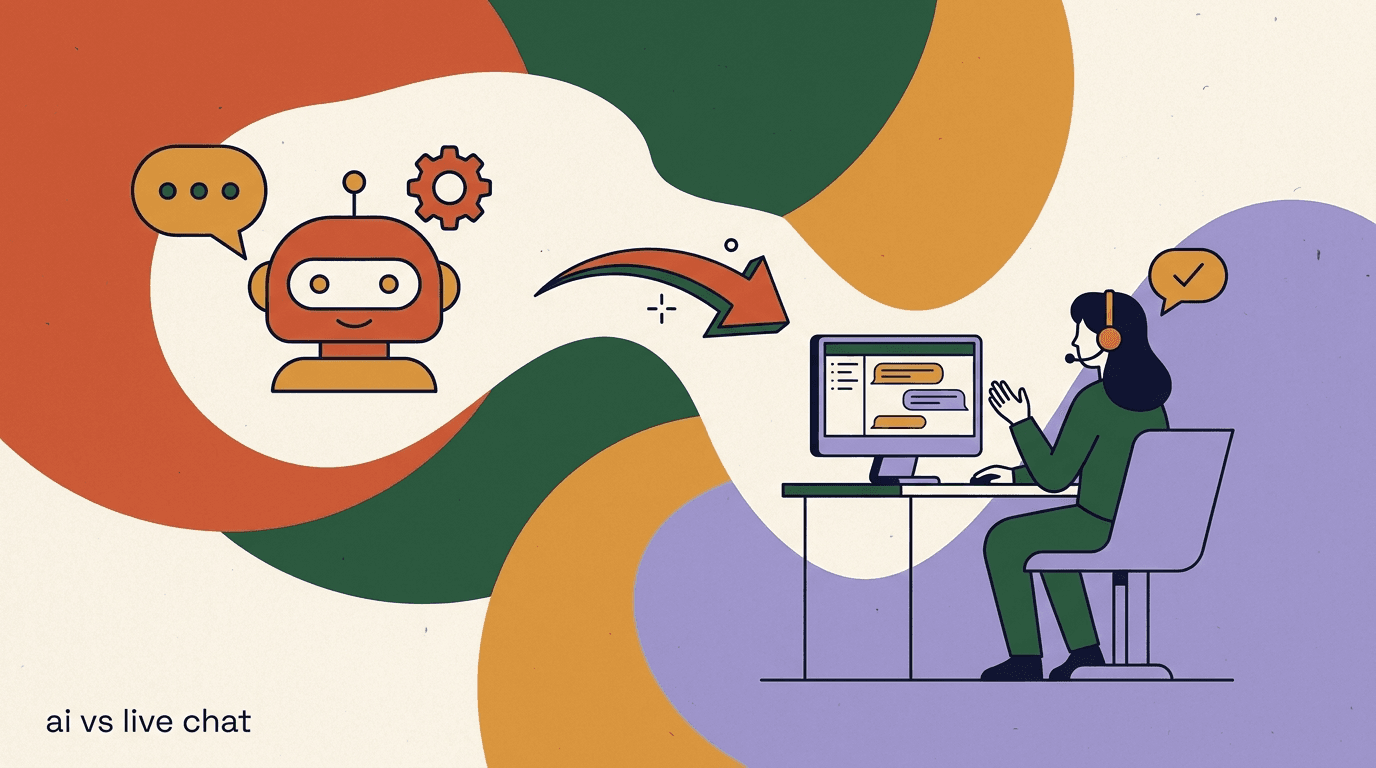
An AI agent and human live chat are tools with different strengths. An AI agent is fast, tireless, consistent, and cheap per conversation, but it has limits on judgment, empathy, and accountability. Human live chat is the opposite: slower and more expensive per conversation, but capable of nuance, reassurance, negotiation, and ownership of a messy problem. The skill is knowing which conversations belong to which — and building a system where the handoff between them is invisible to the customer.
This guide gives you a decision framework, side-by-side comparisons, and concrete scenarios so you can decide, conversation by conversation, when to use an AI agent, when to use human live chat, and how to combine them. We will be honest about where each one fails, because a recommendation that pretends AI can replace your whole support team is not a recommendation worth trusting. Full disclosure: we build KlyoChat, which runs AI agents and human live chat in one inbox, so we have a view. We will keep the advice useful whether or not you ever use our product.
What is the actual difference between an AI agent and live chat?
Before deciding when to use each, it helps to be precise about what each one is — because the terms get used loosely and the distinction matters for the rest of this guide.
An AI agent is software that reads an incoming message, understands intent, and generates a reply on its own. A good one is trained on your knowledge base — your help docs, policies, product details — and can answer questions, look things up, and take simple actions without a person in the loop. It is not a fixed decision tree. It interprets natural language and responds in natural language.
Human live chat is exactly what it sounds like: a real person on your team typing replies in real time from a shared inbox. The customer is talking to someone who can exercise judgment, make exceptions, apologize sincerely, and own a problem until it is solved.
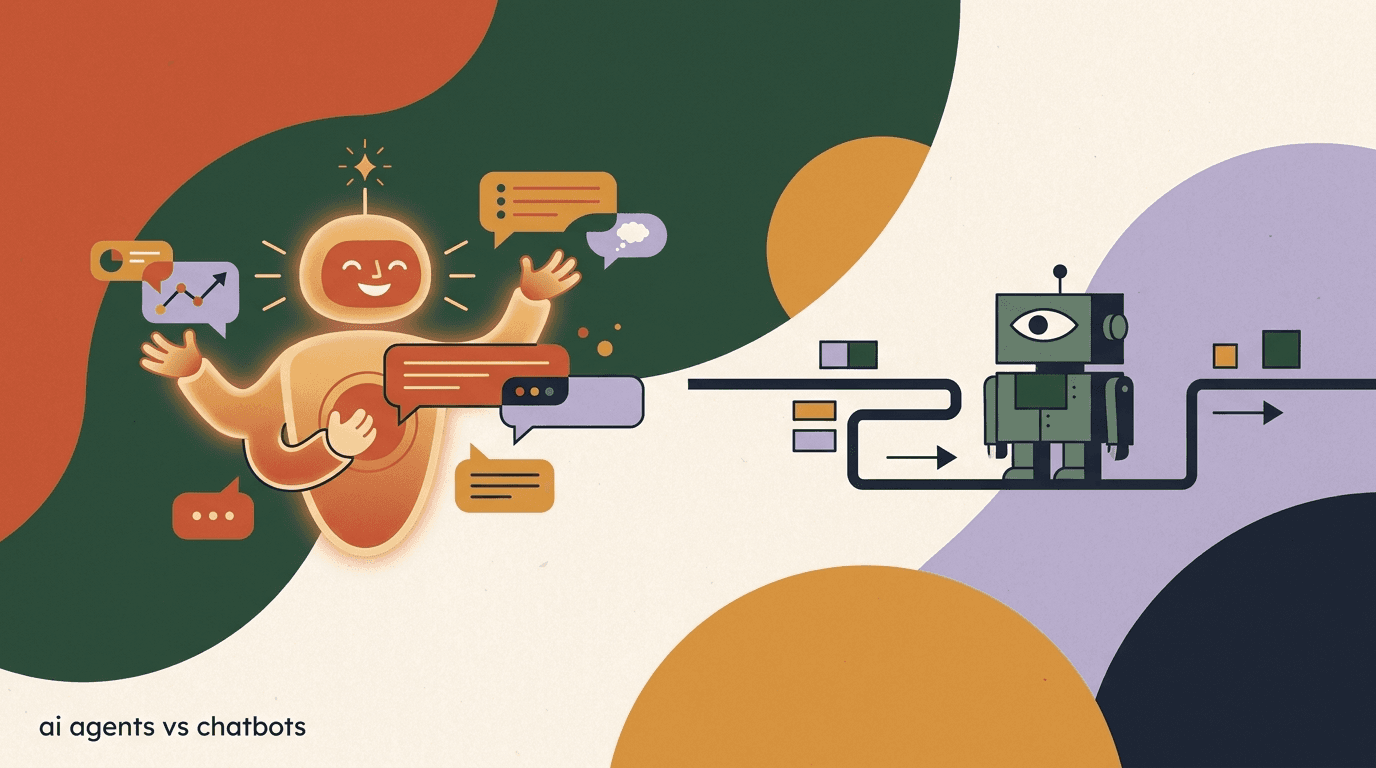
There is a third thing people confuse with both: the old-fashioned rule-based chatbot — the press-1-for-billing menu that breaks the moment a customer phrases something unexpectedly. That is a separate comparison, which we cover in our piece on AI agents vs chatbots. This guide is specifically about modern AI automation versus human-staffed live chat, and how to blend them.
| Dimension | AI agent | Human live chat |
|---|---|---|
| Speed | Instant, 24/7 | Limited by staffing and queue |
| Cost per conversation | Very low at volume | High — it is paid labor |
| Handles complexity | Good for known questions | Strong on novel and messy cases |
| Empathy and trust | Adequate, can feel scripted | Genuine, situational |
| Consistency | Identical every time | Varies by person and mood |
| Accountability | Cannot truly own a failure | Can take ownership and follow up |
This is not the same as AI agents vs chatbots
If you are trying to decide between a smart AI agent and a rule-based menu bot, that is a different question about automation quality. This guide compares automation as a category against human-staffed live chat, and shows how to use both together.
When should you use an AI agent instead of a human?
An AI agent earns its place wherever the work is high-volume, repetitive, and answerable from information you already have. These are the conversations that drain a human team's time and morale without using any of their actual skill. Handing them to an agent is not cutting corners — it is freeing your people for work only they can do.
The clearest signal is repetition. If your team answers the same handful of questions over and over — where is my order, what are your hours, how do I reset my password, do you ship to my country — that is automation's home turf. The answer does not change, the customer wants it instantly, and a person typing it for the thousandth time adds no value a well-trained agent cannot.
- High-frequency, low-variation questions: shipping status, hours, returns policy, pricing, basic how-to.
- After-hours and weekend coverage, when no human is online to respond.
- First response on every conversation, so no one waits in silence while the queue clears.
- Qualification and triage — gathering order numbers, emails, and context before a human steps in.
- Spikes you cannot staff for: a viral post, a product launch, a flash sale flooding the inbox at once.
- Multilingual first contact, where an agent can respond in the customer's language immediately.
Automate the answer you have already written down
A simple test: if the answer lives in your help docs or a saved reply, an AI agent should handle it. If answering requires judgment that is not written down anywhere, that is a sign it belongs with a human.
A conversation an AI agent should own
- Customer
- Hi, has my order shipped yet? Order #4821.
- Best handler
- AI agent — looks up the order, replies instantly with tracking
- Why
- Known question, known answer, no judgment required, customer wants it now
When should a human handle the conversation instead?
Just as clearly, some conversations should never be left to an AI agent alone. The common thread is that they require something software does not have: real judgment, genuine empathy, the authority to make an exception, or accountability for an outcome. When the cost of getting it wrong is high — a lost customer, a refund dispute, an upset person, a complex edge case — a human should be in the seat.
Sensitivity is the first flag. A customer who is angry, grieving, confused, or in a vulnerable situation needs a person, full stop. An AI agent can be polite, but it cannot read the room the way a human can, and a slightly-off automated reply to an emotional message reads as cold or careless. The reputational downside is not worth the saved minutes.
- Emotional or sensitive situations: complaints, cancellations, anything where someone is upset.
- High-value conversations: enterprise deals, big accounts, anything where the revenue justifies a person.
- Complex or novel problems that are not covered by your documentation.
- Anything requiring an exception, a judgment call, or authority to bend a policy.
- Negotiation: pricing pushback, refund disputes, retention conversations.
- Cases where being wrong is costly — legal, medical, financial, or safety-related questions.
Do not over-automate the moments that matter
The fastest way to make customers distrust your automation is to trap an upset person in a loop with an AI agent that will not escalate. The conversations where a human matters most are exactly the ones where a bad automated experience does the most damage.
A conversation a human should own
- Customer
- This is the third time my order arrived broken. I want a refund and I am done.
- Best handler
- Human agent — apologizes, owns it, makes it right
- Why
- Emotional, high churn risk, needs authority and genuine accountability
Why does the hybrid model usually win?
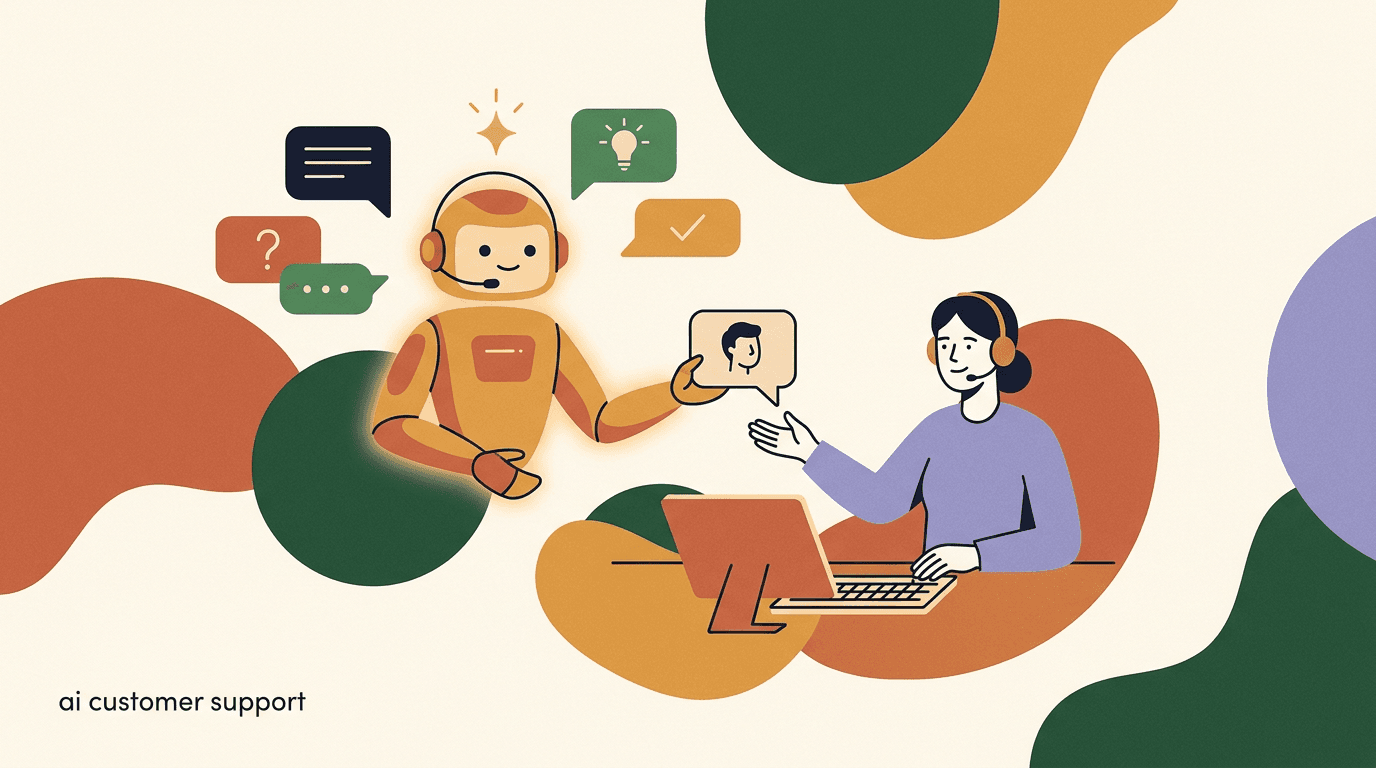
Once you accept that some conversations belong to an AI agent and others belong to a human, the question answers itself: you need both, working together, in one system. This is the hybrid support model — AI first, human handoff when needed — and for most teams it beats either pure approach on every dimension that matters.
Pure automation fails because it eventually meets a conversation it should not handle, and if there is no human to catch it, the customer is stuck. Pure human staffing fails because it is expensive and slow, and it cannot scale to instant 24/7 coverage without enormous headcount. The hybrid model takes the strengths of each and uses the other to cover its weaknesses.
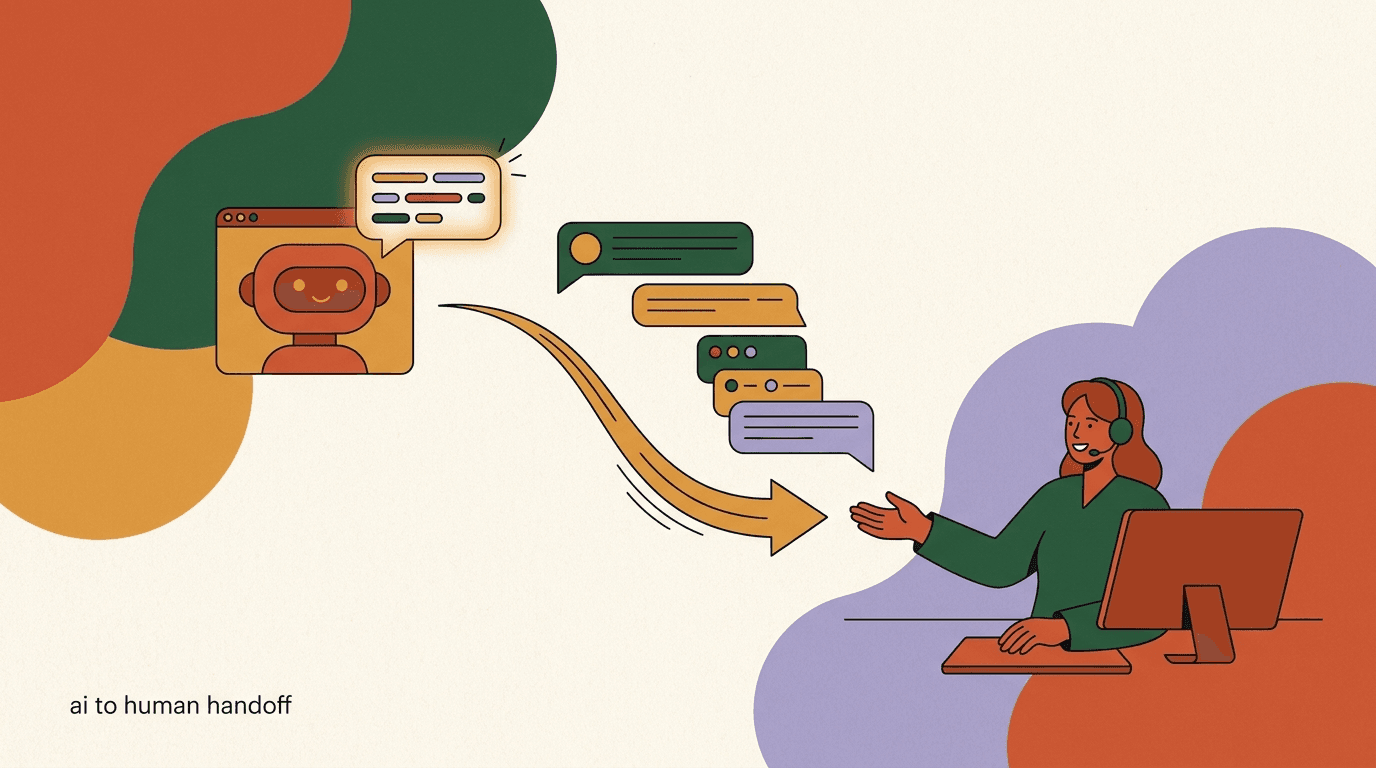
In practice, the AI agent answers first on every conversation. It resolves the large share of questions that are simple and repetitive, instantly and at any hour. When it hits something it should not handle — detected by topic, by sentiment, or because the customer asks for a person — it hands the conversation to a human with the full context already gathered. The customer never repeats themselves, and the human starts where the agent left off.
The split is usually 80/20, not 100/0
For most support inboxes, a large majority of conversations are repetitive and automatable, while a meaningful minority genuinely need a human. The hybrid model lets each side do what it is good at instead of forcing one tool to do everything.
Three models, same 1,000 conversations a week
- Pure human live chat
- All 1,000 wait in a queue; high cost, slow at peak, no after-hours
- Pure AI automation
- Fast and cheap, but the hard 15% get stuck with no escape
- Hybrid (AI first + handoff)
- AI clears the easy 85% instantly; humans focus on the 15% that need them
How do you decide, conversation by conversation? A decision framework
A model is only useful if you can apply it in the moment. Here is a simple framework you can encode into your routing logic — and into your team's instincts — to decide who should handle any given conversation.
Run each conversation through these questions in order. The first one that points to a human wins; if none do, the AI agent handles it. This keeps the default toward automation for efficiency while protecting the conversations that truly need a person.
- Is the customer upset or in a sensitive situation?If sentiment is negative or the topic is emotionally charged, route to a human. Empathy is non-negotiable here.
- Is this a high-value account or deal?If the revenue or relationship justifies a person, give them one. Big accounts notice when they are sent to a bot.
- Does the answer require judgment or an exception?If resolving it means bending a policy or making a call that is not written down, a human decides.
- Is the question covered by your knowledge base?If the answer exists in your docs or saved replies, the AI agent can handle it instantly.
- Did the customer ask for a human?Always honor this immediately. Forcing someone to keep talking to AI after they ask for a person destroys trust.
| Signal | Route to AI agent | Route to human |
|---|---|---|
| Repetitive FAQ | Yes | No |
| Negative sentiment detected | No | Yes |
| Outside business hours | Yes (first response) | When available |
| High-value or enterprise account | Triage only | Yes |
| Needs a policy exception | No | Yes |
| Customer explicitly asks for a person | No | Yes, immediately |
What does good routing logic actually look like?
Routing is the machinery that makes the hybrid model work. Get it right and customers never feel the seam between AI and human. Get it wrong and you either escalate everything (defeating the point of automation) or escalate nothing (trapping people with a bot).
Good routing combines a few signals rather than relying on one. Topic detection catches conversations about cancellations or billing disputes that should go straight to a person. Sentiment analysis catches frustration even when the topic looks routine. Explicit requests — talk to a human, agent please — are honored instantly. And confidence matters: if the AI agent is unsure of its answer, it should hand off rather than guess.
- Topic-based rules: certain subjects (refund disputes, cancellations, legal questions) always reach a human.
- Sentiment triggers: detected frustration or distress escalates the conversation automatically.
- Explicit-request handling: asking for a person routes to one immediately, no friction.
- Confidence thresholds: if the agent is not sure, it hands off instead of guessing.
- Business-hours awareness: AI covers first response at all times; humans pick up complex cases when online.
- Account-tier rules: VIP or enterprise contacts get a human faster.
Escalation should carry context, not reset it
The single biggest difference between a good handoff and a bad one is whether the customer has to repeat themselves. When the AI agent passes a conversation to a human, the human should see the full thread and any details already gathered — order number, account, the issue — so they continue smoothly rather than starting over.
How much does each approach really cost?
Cost is where the ai agent vs live chat debate gets concrete, because the economics genuinely differ. Human live chat is labor: every conversation costs a fraction of someone's salaried time, and scaling to handle more volume or longer hours means hiring more people. AI automation has a largely fixed cost — a subscription — and the marginal cost of one more conversation is close to zero.
But the honest comparison is not AI-cheap versus human-expensive. It is the total cost of resolving every conversation at the quality your customers expect. Pure automation looks cheapest on a spreadsheet until you count the customers lost to a bad bot experience. Pure human staffing looks high-quality until you count the customers lost to slow responses and no after-hours coverage. The hybrid model usually produces the best cost-to-quality ratio: automation absorbs the cheap, high-volume work so your paid humans spend their time only where it changes the outcome.
| Factor | Pure human live chat | Hybrid (AI + human) |
|---|---|---|
| Cost of routine questions | Full labor cost each | Near zero (AI handles them) |
| After-hours coverage | Expensive or absent | AI covers, humans pick up later |
| Scaling to volume spikes | Hire or fall behind | AI absorbs the spike instantly |
| Cost of complex cases | Appropriate use of people | Same — humans still handle these |
| Customer wait time | Grows with queue | Instant first response, human for hard cases |
Measure resolution cost, not response cost
The number that matters is the fully-loaded cost to actually resolve a conversation well — including the customers you keep or lose based on the experience. Automation that loses customers is not cheap, and human staffing that resolves everything perfectly but slowly is not free either.
What about speed and availability?
Speed is the dimension where AI has an unambiguous edge, and it is worth being clear about why it matters. Customers in chat expect a response in seconds, not hours. A human team, however good, is bounded by how many people are online and how long the queue is. At peak, or overnight, or during a launch, that queue grows and people wait — and waiting customers abandon.
An AI agent removes the wait entirely for the conversations it can handle. Every customer gets an instant first response, at three in the afternoon or three in the morning. For the routine majority, that instant reply is also the resolution. For the rest, the agent has at least acknowledged them, gathered context, and set expectations before a human takes over — which makes the eventual human response feel faster even when it is not instant.
This is the after-hours argument in particular. Most small teams cannot staff live chat around the clock, so without automation, every message outside business hours sits unanswered until morning. An AI agent turns those dead hours into resolved conversations, and flags the ones that need a person for the team to handle when they are back online.
Same customer, 11pm message
- Pure human live chat
- No reply until morning; customer may have bought elsewhere by then
- Hybrid
- AI answers instantly; if it needs a human, it is queued with full context for the morning
Where does AI fall short, honestly?
Any guide that tells you AI can replace your support team is selling something. It cannot, and pretending otherwise sets you up to disappoint customers at the worst moments. Being clear-eyed about the limits is what lets you deploy automation confidently where it works.
AI agents struggle with genuine novelty — problems that are not in their training and do not resemble anything they have seen. They cannot truly own a failure; an apology from a bot does not carry the weight of a person taking responsibility. They can be confidently wrong, stating an incorrect answer with the same fluency as a correct one, which is dangerous for high-stakes questions. And they lack the situational empathy to handle a person who is grieving, furious, or frightened in a way that actually lands.
- Novel problems with no precedent in the knowledge base.
- True accountability — owning a mistake and following up until it is resolved.
- Reading subtle emotional context and responding with real warmth.
- High-stakes accuracy where a confident wrong answer causes real harm.
- Judgment calls and exceptions that require weighing a specific situation.
Confident and wrong is worse than slow and right
An AI agent's biggest risk is not that it fails to answer — it is that it answers incorrectly with total confidence. For questions where being wrong is costly, keep a human in the loop and treat the agent as a draft, not a final word.
Where does human-only live chat fall short?
The case against pure automation is well-rehearsed, but pure human staffing has its own failure modes that are easy to ignore if you romanticize the human touch. Real customers, more often than support leaders like to admit, would rather get an instant correct answer from an agent than wait twenty minutes for a human to tell them the same thing.
Human-only live chat does not scale gracefully. It is bounded by headcount, so volume spikes create queues, and round-the-clock coverage requires staffing you may not be able to afford. It is inconsistent — answers vary by who is online, their mood, and their tenure. It is expensive for work that uses none of a person's actual skill. And it burns people out: nothing drains a support agent faster than typing the same answer to the same question hundreds of times a day, which is exactly the work an AI agent should take off their plate.
- Does not scale without hiring; spikes become long queues.
- After-hours coverage is expensive or simply absent.
- Inconsistent answers across people and shifts.
- Expensive labor spent on questions that need no human judgment.
- Agent burnout from endless repetition of the same answers.
Automating the boring work is good for your humans
Giving repetitive questions to an AI agent is not just a cost decision. It protects your team from the grind that causes turnover and lets them spend their energy on the conversations that are interesting, difficult, and genuinely human.
How do you roll out a hybrid model without breaking trust?
Moving to a hybrid model is not a switch you flip — it is a rollout you tune. Done carelessly, you can over-escalate and waste your automation, or under-escalate and trap customers. Done deliberately, you build confidence in the system before you lean on it.
Start conservative. Let the AI agent handle a narrow set of clearly safe questions, escalate liberally, and watch what happens. As you see where it succeeds and where it stumbles, expand its scope and tighten your routing. The goal is to learn from real conversations rather than guessing at the right split up front.
- Map your conversation typesList the questions your team actually gets and sort them into clearly-automatable, clearly-human, and gray-area.
- Automate the safe majority firstPoint the AI agent at your knowledge base and let it handle the clearly-automatable questions only.
- Set escalation triggersDefine the topics, sentiment, and explicit requests that always route to a human, and make handoff carry full context.
- Watch the handoffsReview escalated conversations weekly. If the agent is escalating things it could handle, expand its scope; if it is handling things it should not, tighten it.
- Expand scope as confidence growsGradually move gray-area questions into automation as you trust the agent, while keeping the human safety net in place.
Always keep the exit door visible
No matter how good your AI agent gets, make talk to a human an obvious, always-available option. The presence of an easy escape hatch is what makes customers comfortable using the automation in the first place.
Scenario one: how does a D2C brand handle a launch?
Abstract frameworks land better with concrete examples, so consider a direct-to-consumer brand on launch day. The marketing worked, traffic spiked, and the inbox is suddenly flooded — hundreds of people asking where their order is, whether a size runs small, and how returns work, all at the same time. A human-only team would drown; the queue would stretch to hours and some of those messages would never get answered before the customer gave up.
In the hybrid model, the AI agent absorbs that wave instantly. Shipping status, sizing guidance, and returns policy are exactly the high-frequency, documented questions automation is built for, so every customer gets an immediate, accurate answer no matter how many arrive at once. The two humans on the team are not buried under that volume — they are free to spend the day on the conversations that actually need them: the customer whose order arrived damaged and is upset, and the unexpected wholesale inquiry that could become a real account.
The key point is that the AI agent did not replace the humans. It changed what they spent launch day doing. Instead of typing the same shipping answer two hundred times, they handled the two conversations where their judgment changed the outcome — saving a frustrated customer and chasing a B2B lead.
Scenario A — a D2C brand during a launch
- Situation
- Launch day floods the inbox: hundreds of where-is-my-order and sizing questions at once
- AI agent
- Answers shipping, sizing, and returns instantly for everyone, around the clock
- Human
- Handles the damaged-item complaints and the wholesale inquiry that came in
- Outcome
- No queue, no missed sales, team focused on the cases that need them
Scenario two: how does a small SaaS team cover the globe?
Now take a different shape of business: a small SaaS company with a two-person support team and customers spread across every time zone. The problem here is not a one-day spike — it is the constant trickle of questions arriving at three in the morning local time, when no one is awake to answer. Without automation, those overnight customers wait until the team logs on, by which point some have churned, downgraded, or filed an angry ticket.
The AI agent turns those dead hours into resolved conversations. Password resets, billing FAQs, and how-to questions — the bulk of an inbound SaaS queue — get answered around the clock, in the customer's language, instantly. The two humans wake up to a far shorter list: not a backlog of password resets, but the genuinely hard cases that the agent correctly escalated, like a detailed integration bug report and a cancellation that is worth trying to save.
Again, the humans are not removed from the loop — they are pointed at the work that uses their skill. The agent handled the volume that would have woken them or lost them customers, and flagged the two conversations where a person actually needed to think. That is the hybrid model doing exactly what it is supposed to do for a team too small to staff 24/7.
Scenario B — a small SaaS support team
- Situation
- Two-person team covering global customers across time zones
- AI agent
- Resolves password resets, billing FAQs, and how-to questions 24/7
- Human
- Takes the integration bug report and the cancellation save conversation
- Outcome
- Overnight customers get answers; the team is not woken up for FAQs
What metrics tell you the balance is right?
Once the hybrid model is running, you need a way to know whether your split between AI and human is healthy or quietly going wrong. The danger is running on vibes — feeling like automation is helping while customers silently grow frustrated, or escalating so much that the agent is barely earning its keep. A few metrics keep you honest.
Watch the automated resolution rate: the share of conversations the AI agent closes without a human. If it is very low, your routing is too cautious or the agent is under-trained; if it is suspiciously high, check that you are not jamming people who needed a person into automation. Watch escalation accuracy: of the conversations that reached a human, how many genuinely needed one. And above all, watch satisfaction split by path — if customers who went through the AI agent are markedly less happy than those who reached a human for the same kind of question, your automation is overreaching.
- Automated resolution rate: share of conversations the agent closes alone — too low means timid routing, too high means over-automation.
- Escalation rate and accuracy: how often the agent hands off, and whether those handoffs were warranted.
- First response time: should be near-instant on every conversation once AI answers first.
- Satisfaction by path: compare ratings for AI-resolved versus human-resolved conversations of the same type.
- Re-open rate: conversations the agent marked resolved that the customer had to reopen — a sign it answered wrong.
A high automation rate is not automatically good
If your AI agent resolves a huge share of conversations but satisfaction on that path is poor and re-opens are climbing, the automation is not working — it is just deflecting people who needed help. Read resolution rate alongside satisfaction, never on its own.
How do AI agents and live chat fit different industries?
The right balance between an AI agent and human live chat is not the same for every business, because the stakes of a wrong answer differ enormously by industry. A clothing brand and a financial service should not automate to the same depth, and pretending otherwise is how teams get into trouble.
Where the questions are routine and the cost of an occasional imperfect answer is low — retail, e-commerce, creators, most consumer apps — you can lean heavily on automation and reserve humans for complaints and high-value cases. Where answers carry real consequences — healthcare, finance, legal, anything safety-related — the balance shifts: the AI agent is best used to triage, gather information, and answer only clearly safe questions, while humans handle anything where a confident wrong answer could harm someone.
| Industry | Lean on AI for | Keep humans for |
|---|---|---|
| E-commerce / retail | Order status, sizing, returns, hours | Complaints, damaged goods, wholesale |
| SaaS / software | Password resets, billing FAQ, how-to | Bug reports, integrations, churn saves |
| Healthcare / finance | Triage, info gathering, safe FAQs | Anything with real consequences |
| Creators / media | FAQs, links, scheduling, basic info | Brand deals, sensitive DMs |
Higher stakes mean a wider human safety net
The riskier the domain, the more conservative your automation should be. In healthcare, finance, or legal contexts, use the AI agent to triage and gather context, but route the substance to a qualified person — a confidently wrong automated answer is far costlier there.
What are the most common mistakes teams make?
Most failures with the ai agent vs live chat decision are not failures of technology — they are failures of how the tools are deployed. The same handful of mistakes come up again and again, and all of them are avoidable once you know to look for them.
The two biggest are mirror images: over-automating and under-automating. Over-automating means pushing every conversation through the AI agent with no easy escape, which traps the people who needed a human and teaches customers to distrust the bot. Under-automating means refusing to let the agent handle even obviously routine questions, which wastes the investment and keeps your team buried in repetition. Both come from treating the choice as all-or-nothing instead of conversation-by-conversation.
- Over-automating: no visible path to a human, trapping customers who needed one.
- Under-automating: making the agent escalate everything, so it adds no real value.
- Losing context on handoff: forcing customers to repeat themselves to the human who takes over.
- Hiding the escape hatch: making talk to a human hard to find, which breeds resentment.
- Set-and-forget: deploying the agent and never reviewing its conversations or tightening routing.
- Pretending it is fully human: dressing up the agent so customers feel deceived when it cannot help.
Be honest that an AI agent is an AI agent
Customers generally do not mind talking to an AI agent for routine questions — what they mind is being deceived about it or trapped by it. Being upfront that they are talking to an assistant, and offering an easy path to a person, earns more trust than pretending the bot is human.
How does KlyoChat handle AI agents and live chat together?
Everything above is the strategy. The reason we built KlyoChat is that the strategy is hard to run if your AI agent and your human live chat live in two different tools — because then the handoff is a copy-paste, the context is lost, and the customer repeats themselves. KlyoChat puts both in one place.
KlyoChat is an AI-native unified inbox. Custom AI agents, trained on your knowledge base, answer first across Facebook, Instagram, WhatsApp, Telegram, TikTok, and X. When a conversation needs a person — by topic, by sentiment, or because the customer asks — a human on your team takes over live in the same thread, with the full history and context already there. There is no separate handoff tool and no lost context. Routing and handoff are built in, and your whole team works the same inbox.
In other words, KlyoChat is built for exactly the hybrid model this guide recommends: AI first, human handoff when it matters, both in one conversation. That is the point of an AI-native inbox rather than a bot bolted onto a help desk.
- AI agents and human live takeover in the same thread — no context lost on handoff.
- Routing and escalation by topic, sentiment, and explicit request, built in.
- One team inbox across Facebook, Instagram, WhatsApp, Telegram, TikTok, and X.
- 7-day free trial, no credit card — test the full hybrid model, not a demo slice.
Honest limits, because the whole guide is honest
KlyoChat is not a full replacement for human support — and we would not recommend treating any AI agent that way. Keep humans for complex and sensitive cases. We also do not offer native SMS or email, and as a newer product our community is smaller than the largest incumbents. If those matter to you, weigh them before you switch.
KlyoChat plans at a glance
- Basic
- $19/mo — small teams getting started with AI agents plus live chat
- Pro
- $49/mo ($39 billed yearly) — all channels, custom AI agents, team inbox
- Business
- $129/mo — higher limits, more seats, advanced needs
- Trial
- 7-day free trial, no credit card required
So which should you choose — AI agent or live chat?
The honest answer to ai agent vs live chat is: both, in the right proportion, working together. Use an AI agent for the high-volume, repetitive, after-hours work that drains a human team and uses none of their skill. Keep humans for the complex, sensitive, and high-value conversations where judgment, empathy, and accountability decide the outcome. Then connect them with routing and context-carrying handoff so the customer never feels the seam.
If you take one thing from this guide, let it be this: do not choose between automation and people. Choose a system that lets each do what it is best at. Automate the boring questions to protect your team and answer customers instantly, and reserve your humans for the moments that actually need a human. That is the hybrid model, and for most teams it beats either pure approach on cost, speed, and trust at the same time. To go deeper on the handoff itself, see our guide on AI agent human handoff, and if you are still untangling the underlying definitions, start with AI agents vs chatbots.