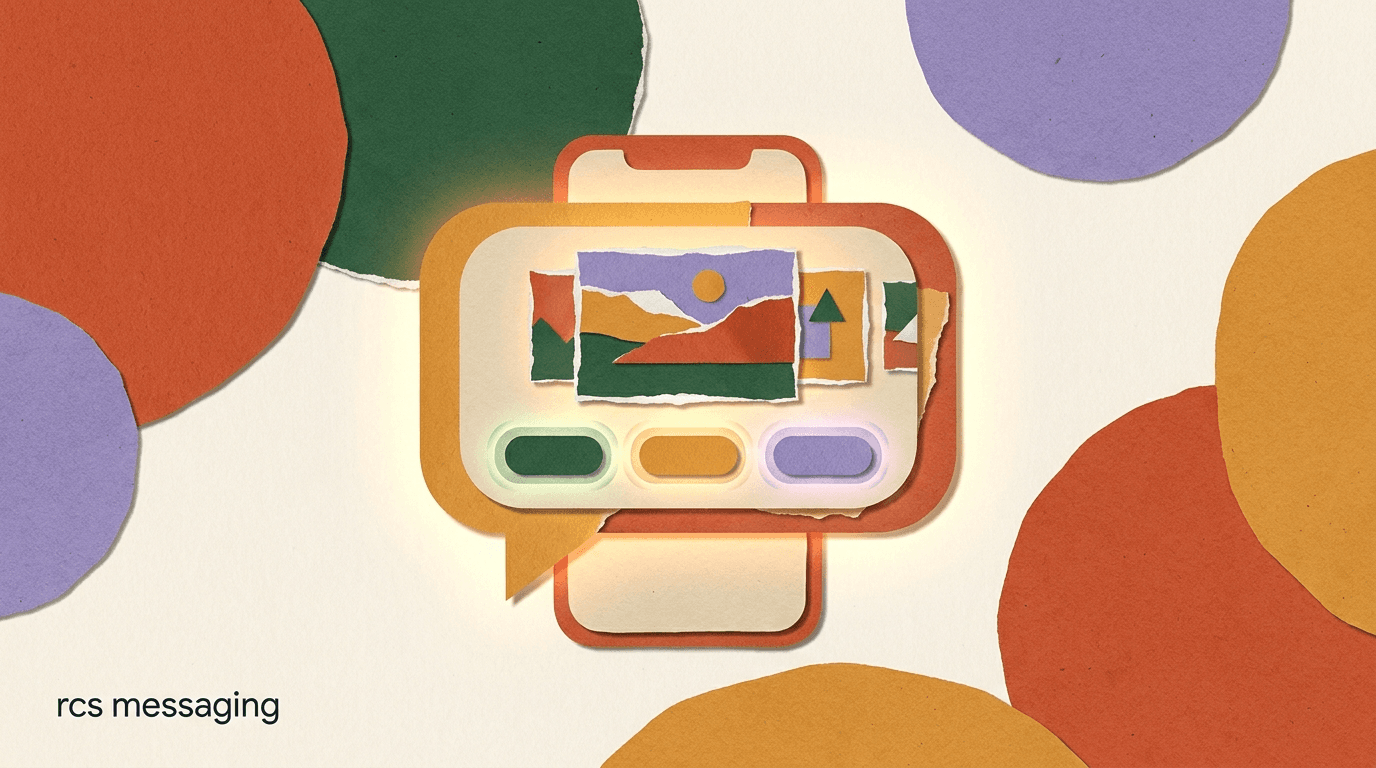
RCS business messaging is the topic a lot of marketing and support teams keep circling back to in 2026, and for good reason. Rich Communication Services — RCS for short — promises to do for the plain text message what the smartphone did for the phone: keep the familiar surface, replace everything underneath. Instead of 160 characters of gray text, you get branded senders, verified badges, images and carousels, suggested replies, typing indicators, and read receipts, all inside the phone's default messaging app. No download, no separate login.
That is the promise. The reality in 2026 is more nuanced, and this piece is about the gap between the two. We will explain what RCS actually is, how it differs from SMS and from WhatsApp, where adoption genuinely stands across carriers and regions, what the opportunity looks like for brands, and where the caveats are real enough that you should not bet a whole channel strategy on it yet.
One disclosure up front: we build KlyoChat, an AI-native inbox for social DM and WhatsApp. We do not offer RCS today. That is exactly why we can write about it plainly — we are not selling you an RCS product, so we have no reason to oversell the channel. We think it is worth watching closely and piloting deliberately, and we will tell you honestly where the cautions are.
A quick note on how to read this article. It is part explainer and part opinion. The explainer parts — what RCS is, how it differs from SMS and WhatsApp, how verification works — are as factual as we can make them. The opinion parts — whether you should invest now, how to size a pilot, where the channel sits in 2026 — are our considered view, informed by watching the messaging landscape closely but not infallible. Where a claim is a moving target, such as carrier coverage or pricing, we say so and tell you to verify rather than trust a number that could be out of date by the time you read it.
What is RCS, and why is it suddenly everywhere?
RCS stands for Rich Communication Services. It is a messaging standard developed by the GSMA, the industry body that represents mobile operators worldwide, intended as the successor to SMS and MMS. Where SMS is a decades-old protocol limited to short plain-text bursts, RCS is designed to behave like a modern messaging app: rich media, interactive buttons, group features, delivery and read status, and higher-resolution images and video.
The reason it feels like RCS is suddenly everywhere in 2026 is not that the standard is new — it is years old. What changed is reach. For a long time RCS was effectively an Android story, available where carriers and Google's Messages app supported it. The pivotal shift was Apple adding RCS support to iPhone, which closed the largest gap in the addressable audience. Once both major mobile ecosystems could send and receive RCS, the channel crossed from a niche Android feature toward something a brand could plausibly plan around.
It helps to separate two things that often get blurred. There is person-to-person RCS, which is what replaces the green-or-blue bubble texting experience between friends. And there is RCS Business Messaging — RBM — which is the commercial layer: verified brand senders, rich templated messages, and the conversational surface businesses actually buy. When this article talks about RCS business messaging, it means RBM, the brand-facing version.
There is also a technical detail worth knowing without getting lost in it. RCS rides on the operator's data connection or Wi-Fi rather than the legacy SMS signaling channel, which is what allows the richer payloads. The capability is negotiated between the sending and receiving clients, so a message is only delivered as RCS when both ends support it; otherwise it degrades. This is why you cannot simply declare your audience reachable by RCS — reachability is determined per recipient, in the moment, by what their device, app, and carrier support. It is a small point with large planning consequences, and it is the root of most of the coverage nuance in this article.
The momentum also has a business logic behind it, not just a technical one. Carriers and ecosystem owners have a clear incentive to upgrade the default messaging experience: a richer, branded, interactive channel is more valuable to advertisers and brands than plain SMS, and it keeps the native messaging app relevant against the gravitational pull of standalone chat apps. That alignment of incentives is part of why RCS has gone from a long-stalled standard to something with real forward motion in a relatively short window.
Standards move slowly, support moves unevenly
RCS is a single standard on paper, but in practice support depends on the carrier, the region, the device, and the messaging app. Before you plan a campaign, confirm coverage for your specific audience and market rather than assuming the standard equals universal availability.
How is RCS different from plain old SMS?
If you already run SMS campaigns, the easiest way to understand RCS is as SMS with the lights turned on. The delivery happens in the same native app your customers already use for texting, so there is nothing to install. But the message itself can do far more, and crucially, the sender can be a verified brand rather than an anonymous number.
That verified-brand piece is more important than it sounds. A large share of SMS distrust comes from not knowing who is texting you — a random short code or a long number with no name and no logo. RCS business messaging replaces that with a branded sender: your company name, your logo, often a verified checkmark, and a consistent identity. For open rates and for trust, that shift matters.
The other major difference is interactivity. SMS can carry a link and hope for a tap. RCS can carry suggested reply chips, action buttons, image carousels, and forms — so a customer can pick a time, confirm an order, or browse products without leaving the thread. It turns a one-way blast into something closer to a conversation.
Then there is feedback. SMS gives the sender almost nothing back: you fire a message into the void and infer engagement from downstream behavior like a click or a purchase. RCS supports delivery and read receipts and, depending on the implementation, signals about how recipients interacted with rich elements. For a marketing team that has spent years guessing whether SMS landed, even basic delivery and read confirmation is a meaningful upgrade in operational visibility. It changes how you can run a campaign — you can see what is happening rather than only what happened afterward.
It is worth being precise about what does not change, too, because that is part of the appeal. The customer does not install anything. They do not create an account or accept a new app's permissions. They do not learn a new interface. The conversation appears in the same thread list as their texts from family and the dentist. That continuity is RCS's quiet advantage over app-based channels: the friction of adoption is borne by the brand and the carrier, not by the customer. For audiences who will not download yet another app, that matters more than any single rich feature.
- Branding: RCS shows a verified brand name and logo; SMS shows a number or short code.
- Media: RCS carries high-resolution images, video, and carousels; SMS is text plus a link.
- Interactivity: RCS offers suggested replies and action buttons; SMS relies on links.
- Status: RCS supports delivery and read receipts and typing indicators; SMS generally does not.
- Fallback: when RCS is unavailable, messages typically fall back to SMS, so coverage gaps degrade gracefully rather than failing outright.
The fallback to SMS is a feature, not a footnote
Because RCS gracefully falls back to SMS when a recipient or carrier does not support it, you can adopt RCS without abandoning anyone. The catch is that you should design both versions of the message deliberately — do not assume the rich version always lands.
How does RCS compare to WhatsApp and SMS side by side?
Most teams evaluating RCS are not choosing in a vacuum. They are already running SMS, and many are running WhatsApp through the Business Platform. So the practical question is not whether RCS is good in the abstract — it is how RCS stacks up against the two channels you probably already use. Here is a direct comparison across the dimensions that actually drive a channel decision.
| Dimension | SMS | RCS business messaging | WhatsApp Business |
|---|---|---|---|
| Where it lives | Native messaging app | Native messaging app | Separate WhatsApp app |
| Install required | No | No | Yes (customer must have WhatsApp) |
| Rich media & buttons | Very limited | Yes — images, carousels, replies | Yes — images, buttons, lists |
| Verified brand identity | No | Yes — verified sender | Yes — verified business profile |
| Global reach | Near-universal | Growing, uneven by region/carrier | Very large, strongest outside US |
| Pricing model | Per message | Carrier/aggregator pricing, evolving | Per-conversation Meta fees |
No single channel wins on every row
SMS still wins on raw reach. WhatsApp wins where it is already the default messenger, especially outside the US. RCS wins on a no-install rich experience in the native app — where it is supported. The honest answer in 2026 is that these are complementary, not interchangeable.
Where does RCS adoption actually stand in 2026?
This is the section where it is most tempting to quote a confident statistic, and where we are going to resist that. Adoption figures for RCS get cited loosely and they vary wildly depending on whether someone is counting devices, active users, carriers, or markets. Rather than hand you a number that may be stale or regionally meaningless, here is the qualitative shape of where things stand, with the strong recommendation that you verify for your own market.
Directionally, adoption is real and trending up. The addition of iPhone support meaningfully expanded the potential reach because it removed the single largest excluded audience. Major carriers in several large markets support RCS, and Google's Messages app has been the default RCS client on a large portion of Android devices for some time.
But the unevenness is the headline, not a footnote. Carrier support varies by country and sometimes by carrier within a country. Device and OS version matter. The maturity of RCS Business Messaging — the verified-sender, brand-facing layer — lags behind person-to-person RCS in many places, because the commercial tooling, aggregator relationships, and brand verification processes are still being built out. So a market can have plenty of consumer RCS traffic while still being thin on the business side.
There is a regional dimension that is easy to miss if you only look at your home market. In some countries, the messaging habits of the population are already dominated by an app like WhatsApp, and the native SMS thread is a backwater used mostly for one-time codes. In those markets, even excellent RCS support may not change behavior much, because the audience simply does not live in the native messaging app. In other countries — the United States being the clearest example — there is no single dominant chat app, the native messaging app is where a huge amount of conversation happens, and RCS therefore has far more room to matter for brands. The point is that the value of RCS to your business is a function of both technical coverage and your customers' existing habits, and those two things vary independently by region.
A practical way to hold all this in your head: think of RCS reachability as a funnel, not a flag. Start with your total audience, narrow to those on supporting devices, narrow again to supporting carriers in supporting regions, narrow again to those whose messaging app has RCS enabled, and what remains is your true addressable RCS audience for a given send. The rest fall back to SMS. In a strong market that funnel may retain a large majority; in a weak one it may retain very little. You cannot know which without checking, and you should not assume the optimistic end.
- iPhone support removed the biggest reach gap, but rollout details vary by region and carrier.
- Android, via Google Messages, has carried RCS as a default for a while in many markets.
- Carrier support is patchy — strong in some countries, partial or absent in others.
- The business layer (RBM) is generally less mature than consumer RCS.
- Verify coverage for your specific audience and country before committing budget.
Do not plan around a global adoption number
RCS coverage is a regional and carrier-level question, not a single global percentage. A figure that is true in one country can be wildly wrong in another. Always check current support for the exact markets and carriers your customers use before you forecast reach.
What can a brand actually do with RCS business messaging?
Stripped of hype, the use cases for RCS business messaging map closely to what teams already do over SMS and WhatsApp — just with a richer surface. The value is not a new category of communication; it is a better-looking, more interactive, more trustworthy version of the messages you already send.
The clearest wins are in transactional and post-purchase moments, where the message is expected and the rich format genuinely helps. A shipping update with a live map, an order confirmation with a product image, an appointment reminder with a one-tap reschedule button — these are concrete improvements over a plain text line and a link.
- Order confirmations and shipping updates with images and tracking actions.
- Appointment reminders with one-tap confirm, reschedule, or cancel buttons.
- Customer support handoffs with quick-reply chips that route the conversation.
- Product discovery carousels for browse-and-buy moments, where supported.
- Verified promotional messages where a branded sender lifts trust and open rates.
Same shipping update, two formats
- SMS version
- Your order has shipped. Track it: https://example.co/x9f2 (anonymous number, link only)
- RCS version
- Branded sender + verified badge, product photo, live tracking button, and a quick-reply chip to contact support
What does RCS mean for customer support, not just marketing?
Most of the RCS conversation is framed around marketing, but the support side may be where the channel earns its keep first. Support messaging is, by nature, expected and welcome — a customer who is waiting on an order or troubleshooting a product wants to hear from you. That removes the consent and fatigue concerns that hang over promotional messaging and lets the rich format do useful work without irritating anyone.
Consider what RCS adds to a support thread. A customer asks where their order is; instead of a link to a tracking page, they get a live status with a map and an estimated time, right in the thread. A customer reports a problem; instead of a phone tree, they get quick-reply chips that route them to the right queue, and an agent picks up in the same thread with full context. The interaction stays in one place, branded and verified, with the customer never leaving the app they already had open.
The operational benefit is that rich, structured replies can deflect a meaningful share of contacts that would otherwise become phone calls or emails. A one-tap reschedule button resolves an appointment change without a human. A carousel of common solutions handles a tier-zero question. None of this is unique to RCS — WhatsApp and even well-built SMS flows do versions of it — but RCS does it inside the native messaging app, which is the lowest-friction surface available for customers who do not use a chat app.
- Support messages are expected, sidestepping the consent and fatigue issues of promotion.
- Rich status updates and quick replies can deflect calls and emails to a cheaper channel.
- Verified branding reassures customers that a support message is genuinely from you.
- Read receipts give agents visibility into whether a customer has seen a critical update.
Start RCS on the support side if consent worries you
If permission and message fatigue make you nervous about RCS marketing, begin with transactional and support messages, which customers expect and welcome. You get the rich-format benefits with far less risk of annoying anyone.
How does RCS handle consent, opt-in, and compliance?
Any channel that reaches a customer's phone carries compliance weight, and RCS is no exception. The arrival of richer, more brand-like messaging does not relax the rules that govern messaging consent — if anything, the expectation of professionalism rises with the polish of the format. Treating RCS as a license to message more freely than you would over SMS is a mistake that invites both regulatory trouble and customer backlash.
The practical guidance is to carry your existing messaging discipline straight into RCS. Collect clear opt-in, keep records of consent, honor opt-out promptly, respect quiet hours and frequency limits, and keep promotional and transactional messaging appropriately separated. The verified-sender model actually raises the stakes here: because your brand identity is front and center, a compliance failure or a flood of unwanted messages is attached unmistakably to you, with no anonymous number to hide behind.
Regulations differ by country, and messaging rules in particular are a patchwork. What is permissible in one market may be restricted in another, and the categories of message — promotional versus utility versus authentication — often carry different obligations. As with coverage and pricing, the honest instruction is to verify the rules for your specific markets rather than assume a single global standard, and to involve whoever owns compliance at your company before you launch rather than after.
Verified identity means accountability
With a verified brand sender, every message is unmistakably yours. That is great for trust and unforgiving for mistakes — there is no anonymous number to absorb a compliance lapse. Carry your strictest messaging-consent practices into RCS from day one.
Where does AI fit into RCS conversations?
RCS is an interactive channel, and interactive channels invite a question every team is asking in 2026: where does automation and AI come in? The rich, two-way nature of RCS means customers can and will reply, ask follow-ups, and expect answers. That is a feature, but it is also a staffing problem if every inbound reply needs a human. This is the same pressure that has pushed AI into every other conversational channel, and RCS will not be exempt.
The sensible pattern mirrors what already works on WhatsApp and social DM: let automation handle the structured, predictable parts — confirmations, status lookups, routing, frequently asked questions — and hand off to a human when the conversation needs judgment. An AI agent grounded in your knowledge base can field a large share of first responses instantly, around the clock, and escalate the rest. The rich format helps here too, because an AI can present options as buttons or carousels rather than forcing the customer to type.
We are honest that KlyoChat does not bring this to RCS today, since we do not support the channel. But the broader lesson holds regardless of vendor: as you add a new conversational surface, plan for the volume of replies it will generate before you turn it on, not after the inbox fills up. A rich channel that invites conversation but cannot answer fast undermines the very trust the verified-sender model is meant to build.
Automation plus human handoff
- Automated
- Order status, delivery ETA, reschedule, FAQ, routing chips
- Human
- Refund disputes, complex troubleshooting, anything needing judgment
Why does the verified-sender piece matter so much?
It is worth dwelling on brand verification, because it is arguably the most underrated part of RCS business messaging and the part that most directly addresses why SMS marketing underperforms its potential. The fundamental weakness of SMS as a brand channel is anonymity. A message from a string of digits asks the recipient to trust an entity they cannot see. In an era of relentless smishing — SMS phishing — that trust is in short supply.
RCS business messaging flips the default. A verified sender carries the brand name, the logo, and frequently a verification indicator, presented consistently inside the native app. The recipient knows who is messaging before they read a word. That does two things at once: it lifts engagement for legitimate brands, and it raises the bar for impersonation, because a verified identity is harder to fake than a spoofed number.
None of this is magic, and verification is a process you have to go through, not a checkbox. But for any brand whose SMS performance is dragged down by recipient suspicion, the verified-sender model is the single most compelling reason to take RCS seriously.
There is a second-order effect worth naming. As verified RCS messaging becomes more common, customer expectations recalibrate. A branded, verified message starts to feel normal, and an anonymous number starts to feel suspect by contrast. Over time this can change how people triage their messages: the verified thread gets attention, the unverified one gets ignored or reported. For brands that establish a trusted RCS presence early, that shift works in their favor. For brands that stay on anonymous SMS while competitors move, it quietly erodes their reach. This is a slow dynamic, not an overnight one, but it is part of why the verified-sender model is strategically interesting rather than merely cosmetic.
Verification cuts both ways
A verified brand sender helps customers trust your messages and makes impersonation harder. But verification is a gated process with requirements you must meet, and standards differ by provider and region. Budget time for it rather than expecting instant approval.
What are the real caveats brands should weigh?
Enthusiasm for RCS is easy to find. A clear-eyed list of its current limitations is harder, so here is one. None of these are reasons to ignore RCS. They are reasons to pilot it carefully rather than betting the channel on it in 2026.
The biggest caveat is the one we keep returning to: coverage is uneven. If a meaningful slice of your audience cannot receive RCS, your rich messages fall back to SMS, and you are effectively running two channels with two designs. That is workable, but it is more complex than a single-format SMS program.
- Uneven coverage: support depends on carrier, country, device, and app, so reach is not uniform.
- Maturing business tooling: RBM platforms, verification, and analytics are still developing in many regions.
- Evolving pricing: commercial pricing models are less settled than SMS or WhatsApp, so cost forecasting is harder.
- Dual-format overhead: you must design both the rich version and the SMS fallback.
- Measurement gaps: attribution and reporting for RCS are less standardized than for established channels.
Pilot before you replatform
The mistake to avoid is treating RCS as a finished replacement for SMS in 2026. It is a strong, fast-improving channel with real coverage gaps. Run a measured pilot on a use case where the rich format clearly helps, and expand as coverage and tooling mature.
How much does RCS business messaging cost?
Cost is one of the harder questions to answer cleanly, and we are not going to pretend otherwise. Unlike SMS, which has a well-established per-message economy, and WhatsApp, which has Meta's published per-conversation fee structure, RCS business messaging pricing is still settling. It typically flows through carriers and messaging aggregators, and the models vary by region and provider.
What we can say usefully is how to think about it rather than a specific rate. Price the channel against the value of the richer format and the verified identity, not just against the per-message cost of SMS. A more expensive message that converts meaningfully better can still be cheaper per outcome. But you have to measure that, which loops back to the measurement caveat above.
It also helps to think about cost in terms of the whole program, not the individual send. RCS carries setup and operational costs beyond the per-message rate: the verification process, the work of designing rich templates and their SMS fallbacks, the tooling or platform fees to send through an aggregator, and the staffing or automation to handle the replies an interactive channel generates. None of these are prohibitive, but they mean the true cost of an RCS program in its first months is front-loaded. Budget for the ramp, not just the run rate, and judge the channel after it has had time to settle rather than on the first invoice.
| Channel | Pricing shape | Maturity of pricing |
|---|---|---|
| SMS | Per message, per country | Well established |
| WhatsApp Business | Per conversation (Meta fees) | Established, published |
| RCS business messaging | Carrier/aggregator, varies | Still settling in 2026 |
Measure cost per outcome, not cost per message
Because RCS can lift engagement, the right comparison is cost per conversion or cost per resolved support ticket — not cost per send. Set up that measurement before the pilot so you can judge RCS on the metric that matters.
What does getting verified for RCS involve?
Because the verified-sender model is so central to RCS's value, it is worth understanding what verification actually requires before you assume it is a quick formality. The details differ by provider and region, but the general shape is consistent: you are proving to the ecosystem that your brand is who it claims to be, and that takes documentation and review time.
Treat verification as a project with a lead time, not a same-day switch. Starting it early is the single most common piece of advice from teams who have launched RCS, precisely because the wait is the part that surprises people. Here is the typical sequence at a high level.
- Choose a provider or aggregatorSelect an RCS Business Messaging provider that supports your target markets and carriers, since coverage and verification routes differ between them.
- Prepare your brand assets and detailsAssemble your verified business information, logo, brand colors, sender name, and the kinds of messages you intend to send.
- Submit for brand verificationProvide the documentation the provider and ecosystem require to confirm your identity, then allow time for review — this is rarely instant.
- Configure your sender and templatesOnce approved, set up your branded sender profile and build the rich message templates you will use, each with an SMS fallback.
- Test end to end before launchSend to real devices across the carriers and OS versions in your audience to confirm both the rich version and the fallback render correctly.
Start verification before you build campaigns
The verification review is the part most likely to stall a launch. Begin it at the very start of your RCS project so it runs in parallel with template design rather than blocking it at the end.
How do you run a sensible RCS pilot in 2026?
If RCS is a channel to watch and pilot rather than fully adopt, then the practical question is how to pilot it well. The goal of a pilot is to learn whether RCS moves a metric you care about, on an audience you can actually reach, without over-investing before you have evidence. Here is a sequence that keeps the bet small and the learning real.
- Verify coverage for your audience firstBefore anything else, confirm what share of your actual customer base — by country and carrier — can receive RCS. If it is too thin, wait or pick a different market.
- Pick one high-value, expected use caseStart where the rich format obviously helps and the message is welcome — shipping updates or appointment reminders, not cold promotions.
- Design the RCS message and its SMS fallbackBuild both versions deliberately. The fallback should still work as a standalone SMS for recipients who cannot receive RCS.
- Complete brand verification earlyStart the verified-sender process at the beginning, since approval timelines vary and the verified badge is much of the value.
- Measure cost per outcome against your current channelCompare the RCS cohort to a matched SMS cohort on conversions or resolutions, not opens alone, and let that decide whether to expand.
A realistic first pilot
- Use case
- Shipping updates for a single market
- Audience
- Customers on carriers confirmed to support RCS
- Success metric
- Tracking-link taps and support deflection vs SMS control
Will RCS replace SMS or WhatsApp?
The framing of RCS as a replacement is where a lot of the confused expectations come from, so it is worth answering directly. In the long run, RCS is the natural successor to SMS — that is literally what the standard was designed to be, and the direction of travel points that way. But long run is doing heavy lifting in that sentence, and 2026 is not the long run.
For now, the honest picture is coexistence. SMS will remain the universal fallback for years precisely because it works everywhere. WhatsApp will remain dominant in the many markets where it is the default messenger, and a brand presence there is independent of RCS. RCS is the upgrade layer that makes the native messaging app richer where it is supported — additive to your mix, not a clean swap.
So the useful question is not whether RCS replaces your other channels this year. It is where RCS gives you a better outcome than the alternative for a specific use case and audience, and whether that set of cases is large enough to justify the operational overhead. For a growing number of teams the answer is becoming yes for narrow, high-value cases — and still no for everything.
Successor in theory, complement in practice
RCS is positioned as the successor to SMS, and over time that is the likely destination. In 2026 it behaves as a complement: an upgrade where supported, with SMS as the universal floor and WhatsApp dominant in its strongholds.
How should RCS fit into your existing channel mix?
Assuming you decide RCS earns a place, the next question is architectural: how does it slot in next to the channels you already run? The wrong mental model is a ladder where each new channel replaces the last. The right one is a portfolio, where each channel has a job it does best and you route messages to the channel that fits the message, the market, and the moment.
A reasonable default allocation looks something like this. SMS remains the universal floor — the channel you can always reach someone on, and the fallback when richer options are unavailable. WhatsApp owns the markets and audiences where it is the default messenger, and the conversations that benefit from its established two-way, app-based experience. RCS takes the native-app rich messaging in markets where coverage is strong and the audience lives in the default messaging thread, especially for transactional and support moments where the rich format clearly helps. Social DM handles the conversations that begin where your audience discovers you — Instagram, TikTok, and the rest.
The unifying discipline across all of this is the inbox. The more channels you add, the more important it becomes to see and answer them coherently rather than logging into five tools and losing context between them. Whatever mix you land on, invest in the layer that brings conversations together and lets you respond consistently. That is true whether or not RCS is in your stack today, and it is the part of the problem that does not change no matter which channels rise or fall.
- SMS: universal reach and the fallback floor for everything else.
- WhatsApp: dominant in its strongholds and for app-based two-way chat.
- RCS: native-app rich messaging where coverage and habits support it.
- Social DM: conversations that start where your audience discovers you.
- Across all of them: one inbox so context and response quality do not fragment.
Route by fit, not by fashion
Do not adopt RCS because it is the new thing and route everything to it. Match each message to the channel that serves it best for that audience and market. RCS earns specific jobs, not your whole program.
Where does KlyoChat fit into all this?
Here is the honest part, since we run a messaging product. KlyoChat does not offer RCS today. We are an AI-native unified inbox focused on social DM and WhatsApp — Facebook, Instagram, Telegram, WhatsApp, TikTok, and X — with no-code automation, comment-to-DM funnels, and custom AI agents on top. RCS and native SMS are not in the product right now.
We are writing about RCS because we think it matters for how brands will message customers, and because we would rather give you a straight read on a channel we do not sell than pretend everything fits inside our product. If your near-term need is automating and unifying the social and WhatsApp conversations you already get — with AI handling first response across every connected channel — that is the problem KlyoChat is built for. If your near-term need is specifically RCS, you will want a provider focused on RBM, and we would point you there without hesitation.
Where the worlds meet is the inbox philosophy: customers message brands across more surfaces every year, and the work is unifying those conversations and answering them fast and consistently. RCS, when you adopt it, is one more surface to fold into that picture. KlyoChat's job is to make the surfaces it does support — social DM and WhatsApp — coherent in one place, on a flat plan (Pro is $49/month, $39 billed yearly), with a 7-day free trial and no credit card.
We do not do RCS — and we will say so
KlyoChat focuses on social DM and WhatsApp, not RCS or native SMS. We are a newer, smaller community than the largest incumbents. If RCS is your priority, use a dedicated RBM provider; if unifying social and WhatsApp with AI is, that is us.
The bottom line on RCS business messaging in 2026: it is the most interesting thing happening to the humble text message in a long time, and it is genuinely worth your attention. Branded, verified, interactive threads inside the native app — with a graceful SMS fallback — address real weaknesses in SMS marketing, especially the trust gap. The addition of iPhone support was the moment the channel became plannable rather than Android-only.
But measured beats breathless. Coverage is uneven by carrier and region, the business tooling and pricing are still maturing, and you will run RCS and SMS in parallel for some time. Treat it as a channel to watch and pilot on a high-value use case, verify coverage for your specific audience, complete brand verification early, and judge it on cost per outcome. For more on how messaging channels stack up, see our comparisons of WhatsApp versus SMS and our outlook on the future of DM marketing.