Podcast DM growth is the quiet advantage most shows never turn on. You pour hours into recording, editing, and posting clips, and then you hope people remember to search for the episode later. They rarely do. A direct message closes that gap: when a listener comments the word you asked for, the link lands in their inbox in seconds, and a one-to-one conversation begins where a public post used to trail off.
This guide is about growing and engaging a podcast audience through DMs on Instagram and the other places your show lives. We will cover comment-to-DM for episode resources, opt-in alerts for new episodes, running listener questions through your inbox, using DMs for guest outreach, and turning casual listeners into email subscribers and a real community. Every section includes sample copy you can adapt today.
We build KlyoChat, so we have a stake in this. We have kept the tactics tool-agnostic and flagged the honest limits — the platform rules, the opt-in requirements, and the things a DM tool simply cannot do for you. The goal is a strategy that works whether or not you ever touch our product.
Why do DMs work so well for growing a podcast audience?
Podcasts have a discovery problem that social platforms do not solve on their own. A great clip can rack up views and still send almost no one to the actual episode, because the path from a public post to a play button is full of friction. The viewer has to remember your show name, leave the app, open a podcast player, search, and press play. Most people drop off at step one. DMs remove nearly all of that by delivering the link directly to the person who raised their hand.
There is also a relationship dimension that matters more for podcasts than for almost any other format. Listeners feel like they know hosts — the voice in their ears on a commute or a run builds a parasocial bond that a caption never will. A DM meets that feeling in the right channel. When someone comments and gets a reply that sounds like you, it reinforces the intimacy the show already created. That is fuel for retention, not just a one-time click.
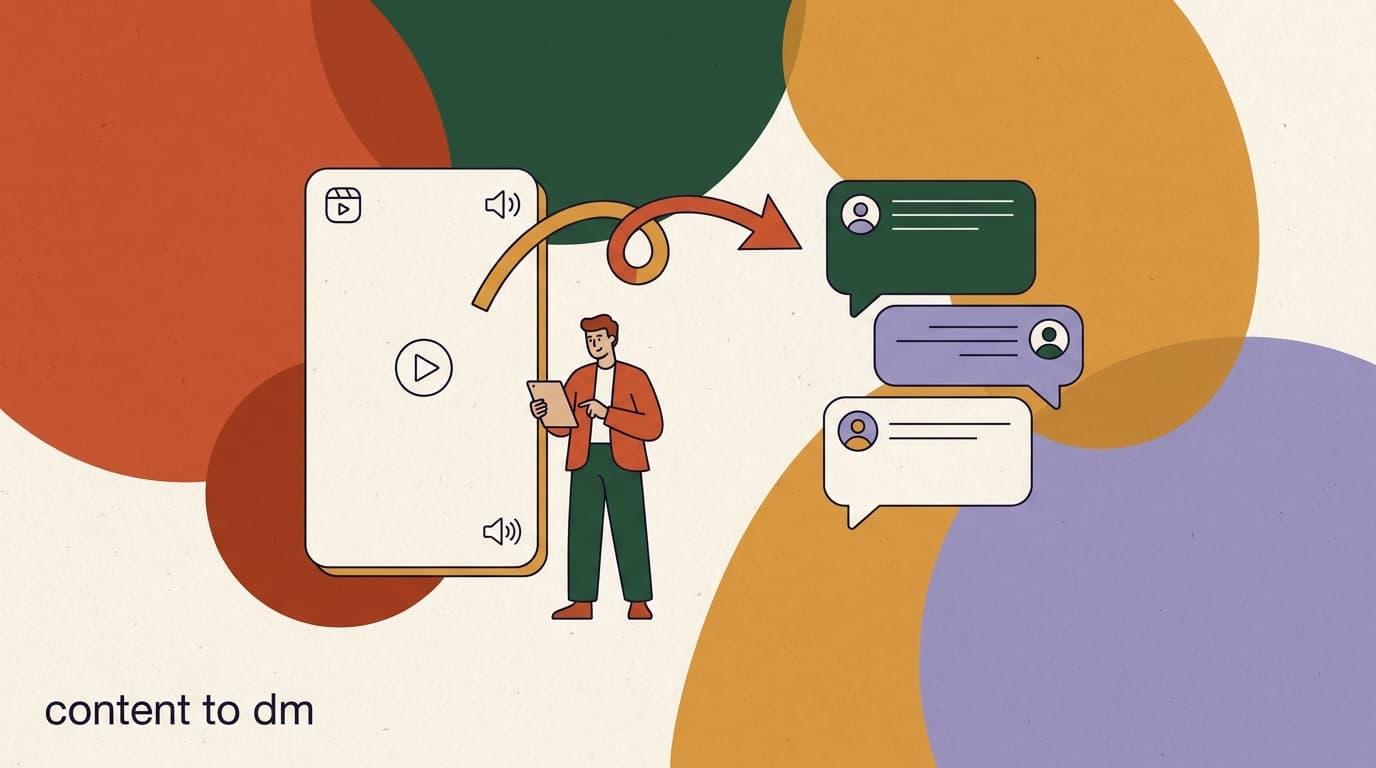
DMs are also where opt-in lives. A follow can be silent and forgettable, but a listener who agrees to episode alerts in their inbox has told you they want to hear from you. That permission is the difference between shouting into a feed and tapping a person on the shoulder when the thing they asked for is ready. For a deeper look at the mechanics of moving people from public content into private conversation, our content-to-DM strategy guide breaks the funnel down step by step.
A DM is permission, not a megaphone
The whole value of a podcast DM strategy is that the person on the other end asked to be there. Treat every inbox conversation as a privilege you can lose, not a channel you own. That mindset keeps your list engaged and keeps you on the right side of platform rules.
What is comment-to-DM, and how does it deliver episode resources?
Comment-to-DM is the workhorse of podcast promotion automation. You post a clip, a quote card, or a full episode announcement, and you invite people to comment a specific word — something like EPISODE, LISTEN, or the guest's name. When they do, an automation detects the keyword and sends them a direct message with the link, the show notes, or whatever resource you promised. The public comment stays visible, which nudges the algorithm, and the private DM does the actual work of getting them to press play.
This solves the discovery problem head-on. Instead of a caption that says 'link in bio' and hopes for the best, you create a tiny transaction: one word from them, one link from you. It feels fair, it feels fast, and it works because you are giving people exactly what they signed up for at the exact moment they want it. The keyword also becomes a signal of intent — someone who typed LISTEN is far warmer than someone who scrolled past.
For podcasters specifically, the resource you deliver can be much richer than a single link. You can bundle the audio link, a timestamped highlight, a guest's handle to follow, and an invitation to a listener community into one tidy message. That turns a single clip into a small onboarding sequence, all triggered by one comment. You can build these flows in a no-code editor — KlyoChat's flow builder is one option, but the pattern is the same on any capable tool.
- Pick one memorable keyword per episodeUse a single, easy word listeners can spell without thinking — PLAY, EP42, or a guest's first name. Put it in the caption and say it out loud in the clip.
- Write the reply as a real messageLead with a thank-you, deliver the link, and add one small extra — a highlight timestamp or a follow suggestion. Make it sound like you, not a receipt.
- Add a soft opt-in ask at the endClose the DM by inviting them to reply YES for future episode alerts. That single line turns a one-time click into a subscriber you can reach again.
Comment-to-DM reply for a new episode
- Trigger
- Comment contains LISTEN on the episode announcement post
- Opening line
- Thanks for the comment — here is the full episode with [guest].
- Link
- Direct link to the episode plus a 30-second highlight timestamp
- Opt-in close
- Want a heads-up when new episodes drop? Reply YES and I will DM you each week.
How do you set up new-episode alerts without annoying anyone?
Episode alerts in DMs are one of the highest-return plays available to a podcaster, and also the easiest to get wrong. Done well, they are a weekly tap on the shoulder that reliably drives your most loyal listeners to press play on day one. Done badly, they are spam that gets you muted, reported, or worse. The dividing line is opt-in. You may only send episode alerts to people who have explicitly agreed to receive them, and you should make leaving as easy as joining.
The mechanics are simple. Somewhere in your funnel — the end of a comment-to-DM reply, a story link, a pinned comment — you ask people to opt in for alerts. When they say yes, you tag them as a subscriber. Then, each time an episode goes live, you send a broadcast to that tagged group with the link. Because everyone on the list asked to be there, engagement stays high and complaints stay near zero.
There is a platform constraint you cannot design around, and it is important to understand it honestly. On Instagram and Messenger, Meta enforces a 24-hour messaging window: outside of 24 hours since a person's last message to you, you can only send certain approved message types, and promotional blasts are restricted. That means your new-episode broadcast works cleanly for people who have interacted recently, and gets more limited the longer someone has been quiet. We cover how to work within this in the limits section below, but the short version is: alerts are powerful and they are governed by rules you must respect.
| Alert element | Good practice | Why it matters |
|---|---|---|
| Consent | Explicit opt-in reply before any alert | Required by platform rules and basic respect |
| Frequency | One alert per new episode, predictable cadence | Predictability builds trust and cuts mutes |
| Opt-out | One-word reply like STOP removes them instantly | Easy exit keeps your list clean and compliant |
| Timing | Send within the 24-hour window when possible | Meta restricts promotional sends outside it |
Never buy, scrape, or auto-add people to alerts
Only send episode alerts to listeners who explicitly opted in. Adding people without consent breaks platform policy, tanks your engagement, and risks your account. A small opted-in list beats a large unwilling one every single time.
How do you run listener Q&A through DMs?
One of the most underused podcast DM plays is turning your inbox into an ongoing question box. Podcasts thrive on listener questions — they give you content, they make listeners feel heard, and they surface the exact topics your audience cares about. Instead of asking people to email or fill out a form, invite them to DM their questions directly. The barrier is almost zero, and the conversations you get back are gold for future episodes.
The simplest version is a story or post that says 'DM me your question for next week's episode.' An automation can acknowledge each incoming question, tag it, and drop it into a list you review before recording. You get a steady stream of prompts, and every person who submitted one now has a reason to listen — they want to hear if you answered them. When you do answer on air, DM them a clip of that moment. That single gesture turns a casual listener into an evangelist.
You can go further and segment questions by theme using tags, so a mailbag episode practically assembles itself. The AI in a modern inbox can even draft a first acknowledgment so no question sits unread, while you keep full control over what actually gets answered on the show. The point is not to automate the human part away — it is to make sure no listener who reached out feels ignored, because an ignored listener rarely reaches out twice.
- Ask for questions in stories, episode outros, and pinned comments, not just once.
- Acknowledge every submission automatically so no one feels ignored.
- Tag questions by topic so mailbag or theme episodes assemble themselves.
- DM a clip to anyone whose question you answer on air — it drives shares.
- Keep a saved list of the best questions as evergreen episode fuel.
Listener Q&A acknowledgment DM
- Trigger
- Listener sends a question after the 'ask me anything' story
- Acknowledgment
- Got it — thank you. I am saving this for an upcoming mailbag episode.
- Follow-up promise
- If I answer it on the show, I will DM you the clip so you do not miss it.
How do you use DMs for guest outreach and booking?
Growing a podcast is not only about reaching listeners — it is about landing guests who bring their own audiences. DMs are quietly one of the best channels for guest outreach, because they are personal, they skip crowded inboxes, and they let you show genuine familiarity with someone's work. A cold email to a busy creator often dies unopened. A warm, specific DM that references their actual work stands a far better chance.
The craft here is personalization at a scale you can sustain. You do not want to blast identical pitches — that is how you get ignored and reported. But you can build a repeatable structure: a sincere opening that proves you know their work, a one-line pitch of your show and its audience, a clear and low-friction ask, and a couple of concrete date options. Keep a template for the bones of the message and rewrite the personal parts by hand every time. The template saves you the boilerplate; the human touch closes the booking.
Once a guest says yes, the DM thread becomes your logistics channel: recording links, prep docs, and reminders can all live in one place. And after the episode airs, the same thread is where you send them their clips and share numbers, which makes them far more likely to promote the episode to their own followers. That promotion loop is often where the real audience growth comes from, so treat the post-record DM as seriously as the pitch.
- Open with proof you know their workReference a specific thing they made or said. Generic flattery reads as a mass pitch and gets ignored.
- Pitch the show in one lineSay what the show is, who listens, and why this person fits. Keep it to a sentence or two.
- Make the ask tinyOffer two date options and a format. The easier you make saying yes, the more yeses you get.
- Turn the yes into a promotion loopAfter recording, DM them clips and numbers so sharing with their audience is frictionless for them.
Templates for structure, hands for the pitch
Save the skeleton of a good outreach DM so you never rewrite the logistics. But always write the personal opener by hand. The moment guest outreach feels mass-produced, your reply rate collapses.
How do you turn listeners into email subscribers and a community?
Here is the strategic truth every serious podcaster eventually learns: you do not own your audience on a social platform. An algorithm change, a suspended account, or a shift in reach can cut you off from the people you spent years building. The channels you do own are email and, to a lesser degree, a community space you control. DMs are the bridge from rented reach to owned audience, and moving people across that bridge is one of the highest-leverage things you can do.
The play is to capture an email address inside the DM conversation. Someone comments for an episode, you deliver it, and then you offer something worth an email — a bonus episode, a resource guide, an early-access feed, or entry to a listener community. When they say yes, you collect their email right there in the thread. Here is the honest part: KlyoChat can capture that email into a custom field, but it does not send newsletters. There is no native email tool. You capture the address in the DM and then hand it to your email platform — the tool you already use to send broadcasts — where the actual newsletter lives. We are clear about that boundary because pretending otherwise would set you up to fail.
Community is the other half of ownership. A DM invitation to a listener group — wherever you host it — converts far better than a passive link because it arrives in a personal channel at a moment of interest. Our newsletter growth through Instagram DMs guide goes deep on the email side, and our community-building through DMs playbook covers turning listeners into an active group. For podcasters aiming to build an owned audience, KlyoChat's creator tools are designed around exactly this hand-off.
| Channel | Who owns it | What DMs do here |
|---|---|---|
| Social follow | The platform | Entry point; capture intent via comment-to-DM |
| DM list | Shared with platform | Direct reach for alerts and Q&A, within rules |
| You | Capture address in DM, send from your email tool | |
| Community | You | Invite via DM; convert listeners into members |
Honest limit: KlyoChat captures emails, it does not send them
You can collect email addresses inside a DM using custom fields, but KlyoChat has no native newsletter feature. Export or sync those addresses to your existing email platform and send the actual emails from there. The DM is the capture point, not the send engine.
What sample copy actually works in podcast DMs?
Good DM copy for a podcast sounds like the host, respects the listener's time, and always makes the next step obvious. Bad DM copy sounds like a form letter, buries the link, or asks for too much at once. Below are patterns you can adapt. The exact words matter less than the structure: acknowledge, deliver, invite. Every message should thank the person, give them what they came for, and offer one clear next action.
Notice how each example keeps a warm, spoken tone. Podcasts are an intimate medium, and your DMs should match. Avoid corporate phrasing, avoid stacking three asks into one message, and avoid making people hunt for the link. When in doubt, read the message out loud — if it does not sound like something you would say into a microphone, rewrite it.
- Lead with a thank-you — it sets a human tone from the first line.
- Deliver the promised thing before you ask for anything back.
- Make one ask per message; stacked asks kill response rates.
- Always include a plain-language way to opt out of alerts.
- Read it aloud; if it does not sound like your show, rewrite it.
| Situation | Sample DM copy |
|---|---|
| Episode link delivery | Thanks for commenting. Here is this week's episode with [guest] — the part about [topic] starts around 12 minutes in. Enjoy. |
| Alert opt-in ask | Glad you liked it. Want me to DM you when a new episode drops? Reply YES and I will send it every week. Reply STOP anytime to leave. |
| Question box acknowledgment | Great question — thank you. I am saving it for a mailbag episode, and I will DM you the clip if I answer it on air. |
| Email capture offer | I put together a bonus resource for this episode. Drop your best email and I will send it over plus the occasional behind-the-scenes note. |
Write copy the way you talk on the mic
Your listeners chose your voice on purpose. DM copy that sounds like a marketing email breaks the spell. Keep it conversational, specific, and short — the same qualities that make your episodes work.
Which podcast DM funnels should you prioritize first?
It is tempting to build everything at once — alerts, Q&A, guest outreach, email capture, community invites — and end up with a tangle of half-finished flows. Resist that. The shows that grow through DMs start with one funnel, get it working, and only then add the next. Sequencing matters because each funnel feeds the ones that follow: comment-to-DM builds the audience, opt-in alerts retain it, and email capture makes it durable.
For most podcasters, the right order is clear. Start with comment-to-DM for episode links, because it is the funnel that turns your existing content into conversations and it delivers a visible result fast. Once that is running, add opt-in episode alerts so the audience you are capturing hears about every new episode. Third, layer in email capture to move your most engaged listeners into a channel you own. Q&A and guest outreach can slot in whenever they fit your workflow, since they run in parallel rather than depending on the others.
This staged approach also keeps your analytics readable. When you launch one funnel at a time, you can actually see what each one does — how many comments convert to DMs, how many DMs convert to opt-ins, how many opt-ins convert to email. Launch everything simultaneously and you learn nothing, because you cannot tell which change moved which number. Discipline in sequencing is what turns a pile of automations into a system you understand.
Suggested build order for a podcast
- Phase 1
- Comment-to-DM episode links — turns clips into direct conversations
- Phase 2
- Opt-in episode alerts — retains the audience you just captured
- Phase 3
- Email capture in DM — moves loyal listeners to an owned channel
- Ongoing
- Q&A and guest outreach run in parallel whenever they fit
How do you measure whether DM growth is working?
A podcast DM strategy is only worth running if you can tell it is working, and the metrics that matter are not vanity numbers. Comment counts feel good but do not pay the rent. What you actually want to track is the flow from public interest to owned audience: how many people comment your keyword, how many receive and open the DM, how many opt in for alerts, and how many hand over an email. Each of those is a conversion step you can improve.
Set up a simple funnel view and watch the drop-off between stages. If lots of people comment but few open the DM, your opening line may be weak or your keyword confusing. If people open but few opt in, your alert offer may not feel worth it. If they opt in but rarely click the episode link, your alert copy or timing needs work. The beauty of DM funnels is that every stage is measurable, so you are never guessing about where you are losing people.
Tie it back to the outcome that matters for a podcast: plays and, ideally, day-one plays from your alert list. A healthy DM system should show a meaningful chunk of your early episode plays coming from people you reached directly. If you are capturing emails, watch how that owned list grows month over month, because that is the asset that survives any single platform. Numbers in hand, you can decide where a tool earns its keep — compare what you need against KlyoChat's plans rather than paying for capacity you will not use.
| Funnel stage | Metric to watch | Fix if it is low |
|---|---|---|
| Public interest | Keyword comments per post | Clearer call to action in caption and clip |
| DM open | Open rate of the delivered DM | Stronger opening line, simpler keyword |
| Opt-in | Percent who reply YES to alerts | Make the alert offer feel more worth it |
| Owned audience | Emails captured per month | Offer a better lead magnet for the email |
Track the hand-raise-to-play journey
The single most useful podcast DM metric is how many of your early plays trace back to a direct message. If your alert list reliably drives day-one plays, the whole system is earning its place. If it does not, tighten the opt-in offer and the alert copy before adding more funnels.
What are the honest limits and rules you must respect?
No guide is complete without the constraints, and DM growth has real ones. Ignoring them does not just risk poor results — it risks your account. The two rules that govern everything are consent and the messaging window, and both come from the platforms themselves, not from any tool. Understanding them is what separates sustainable growth from a strategy that gets you flagged.
First, opt-in is not optional. You may only send episode alerts, promotions, or repeated messages to people who have explicitly agreed to hear from you. This is spelled out in the platform policies, and it is enforced. Meta's own guidance for businesses covers what you can and cannot send, and it is worth reading directly rather than trusting secondhand summaries — start with Instagram's Help Center and Meta's business resources. Second, the 24-hour window: outside of 24 hours since a user's last message to you, Instagram and Messenger restrict what you can send, and promotional broadcasts are limited. Your alerts land cleanly for recently active people and get more constrained the longer someone has been silent. Design your cadence around that reality instead of fighting it.
There are also things a DM tool simply does not do, and being upfront about them saves you disappointment. A DM automation is not a podcast host — it will not store or distribute your audio; you still need a hosting platform for that. It does not send email, so newsletters run on your existing email tool. And, at least for KlyoChat, there is no native SMS channel, so text-message alerts are outside its scope. Knowing the edges of the tool lets you build a stack that actually covers everything, rather than discovering a gap after you have committed.
- Consent first: only message people who explicitly opted in.
- The 24-hour window limits promotional sends to recently active users.
- A DM tool is not a podcast host — you still need audio hosting.
- No native email: capture in the DM, send from your email platform.
- No native SMS in KlyoChat — text alerts are out of scope.
Rules protect your reach as much as your listeners
Opt-in and the messaging window can feel like friction, but they are what keep your account healthy and your engagement high. A list built on consent stays deliverable. A list built by ignoring the rules gets throttled or banned. Respecting the constraints is a growth strategy, not a tax on one.
How do you avoid the mistakes that get podcasters ignored?
Most failed DM strategies fail for the same handful of reasons, and all of them are avoidable. The first is over-sending. A podcaster gets excited, sends alerts for every clip and every micro-update, and trains the audience to mute them. One alert per new episode is plenty. Save the extra energy for a monthly behind-the-scenes note that people actually look forward to, not a daily drip they learn to ignore.
The second mistake is making it about you instead of the listener. DMs that read like press releases — all announcements, no acknowledgment — perform badly because they break the intimacy that made someone comment in the first place. Every message should give before it asks. Deliver the episode, answer the question, share the clip, and only then invite the next step. The third mistake is neglecting the human layer: automating so aggressively that real replies go unanswered. Automation should handle the predictable openings so you have time for the conversations that need a person. When a longtime listener sends a heartfelt message, an automated receipt is worse than silence.
The last common mistake is skipping the owned-audience step entirely. Shows that live only on social reach are one algorithm change away from a cliff. If you are capturing attention in DMs but never moving people to email or a community you control, you are building on rented land. The fix is to make email capture a standing part of your funnel from early on, so your owned list grows alongside your social following instead of lagging years behind it.
The fastest way to lose a DM audience is to over-send
Every extra, low-value message trains people to mute or block you. Protect the channel by sending less than you think you should, and making each message worth opening. Scarcity keeps your open rates high.
Common mistake vs. better move
- Alert for every clip
- Better: one alert per new episode, plus a monthly bonus note
- DMs that only announce
- Better: give first — deliver, answer, share — then invite
- Fully automated inbox
- Better: automate openings, answer real messages yourself
- Social reach only
- Better: capture emails in DMs to build an owned list
What does a repeatable weekly DM routine look like?
The strategies above only compound if they become a habit, and the shows that grow through DMs treat it as a weekly routine rather than a one-off launch. A podcast has a natural rhythm — record, edit, publish, promote — and your DM work slots into that rhythm at predictable points. The aim is a checklist you can run in under an hour a week, most of it automated, so it survives busy weeks and travel and the inevitable stretches when motivation dips.
Anchor the routine to your publish day. When a new episode goes live, your comment-to-DM flow is already armed on the announcement post, and your broadcast to the opt-in list goes out within the messaging window while listeners are most active. Midweek, you post a clip with the same keyword to keep the funnel filling, and you spend a few minutes answering real questions in the inbox that the automation flagged for you. Once a week, you review which questions to save for a mailbag and send a personal note or two to your most engaged listeners.
Keeping the cadence steady is what turns scattered effort into a system. Because most of the mechanical work — link delivery, acknowledgments, alert sends — runs on its own, the human hour you spend goes to the things automation should never touch: real replies, guest conversations, and the judgment calls about what to say on air. That division of labor is the whole point. Automate the predictable, protect time for the personal, and let the routine run week after week.
| Day | DM action | Automated or manual |
|---|---|---|
| Publish day | Comment-to-DM live; alert broadcast to opt-in list | Mostly automated |
| Publish day | Answer real replies flagged from the inbox | Manual |
| Midweek | Post a clip with the same keyword to refill the funnel | Automated delivery |
| Midweek | Send one or two personal notes to top listeners | Manual |
| Weekly | Review saved questions and plan a mailbag | Manual |
Anchor the routine to your publish day
Tie every DM action to the rhythm you already have — record, publish, promote. When the routine attaches to a day you never miss, it survives busy weeks. The automation carries the mechanical load so your weekly hour goes to the conversations that need a human.
How does KlyoChat fit into a podcast DM strategy?
If you have read this far, you have the strategy. The remaining question is which tool runs it, and this is where we describe how KlyoChat fits — honestly, including what it does not do. KlyoChat is an AI-native, mobile-first inbox that unifies Instagram, Facebook, Telegram, WhatsApp, TikTok, and X into one place, with comment-to-DM, broadcasts, and custom AI agents built in. For a podcaster, that means the comment-to-DM episode funnel, the opt-in alert broadcasts, and the Q&A inbox all live in a single app you can run from your phone between recordings.
The pieces map cleanly onto the plays in this guide. Comment-to-DM delivers your episode links. Broadcasts send opt-in episode alerts to your tagged subscriber list, within the platform's rules. Custom AI agents can handle first-response — acknowledging questions, sending the right link, tagging by topic — so no listener message sits unread while you are away from the app. And custom fields capture email addresses inside the DM, ready to hand to the email platform you already use. You can build every one of these in the no-code flow builder without touching code.
Now the honest limits, because they decide whether we are right for you. KlyoChat is not a podcast host — your audio still lives on your hosting platform. It has no native email, so it captures addresses but your newsletter sends from your existing email tool. It has no native SMS. And it is a newer product with a smaller community than the largest incumbents, so if you rely on a vast third-party template marketplace, factor that in. Pricing is flat and bundled: Basic is $19/month, Pro is $49 ($39 billed yearly), and Business is $129, each with a 7-day free trial and no credit card required. If your core need is Instagram-plus-DM automation with AI and a clean mobile inbox, that math tends to work well for a podcast; if you need SMS or a native newsletter in the same tool, you will be stitching in another product regardless.
| Podcast need | KlyoChat feature | Honest note |
|---|---|---|
| Deliver episode links | Comment-to-DM flows | Included on paid plans |
| New-episode alerts | Broadcasts to opt-in list | Subject to the 24-hour window |
| First-response Q&A | Custom AI agents | Automates openings; you handle real replies |
| Build an email list | Custom fields capture emails | No native email; send from your tool |
| Run it from your phone | Mobile-first unified inbox | Newer product, smaller community |
Try it against your real funnel, not a demo
The 7-day trial needs no credit card, so build your actual comment-to-DM and alert flows and watch them run on a live episode. That tells you more than any feature list. If SMS or native email is core to your plan, factor in that KlyoChat does neither.
Podcast DM growth is not a hack — it is a disciplined way to close the gap between the content you already make and the listeners who want it. Comment-to-DM turns clips into conversations. Opt-in alerts bring your most loyal listeners back on day one. A DM question box gives you content and makes people feel heard. Guest outreach lands the collaborations that grow your reach. And email capture moves your best listeners onto an owned channel that survives any platform change.
Start with one funnel, respect the opt-in and the 24-hour window, give before you ask, and always move people toward an audience you own. If you want a single mobile inbox to run it — comment-to-DM, alerts, AI first-response, and email capture in one place — KlyoChat's creator tools are built for exactly this, with a flat price and a free trial so you can test it on a real episode. Wherever you build it, the strategy is the same: meet listeners in the channel where they already feel close to you, and give them a reason to keep coming back.