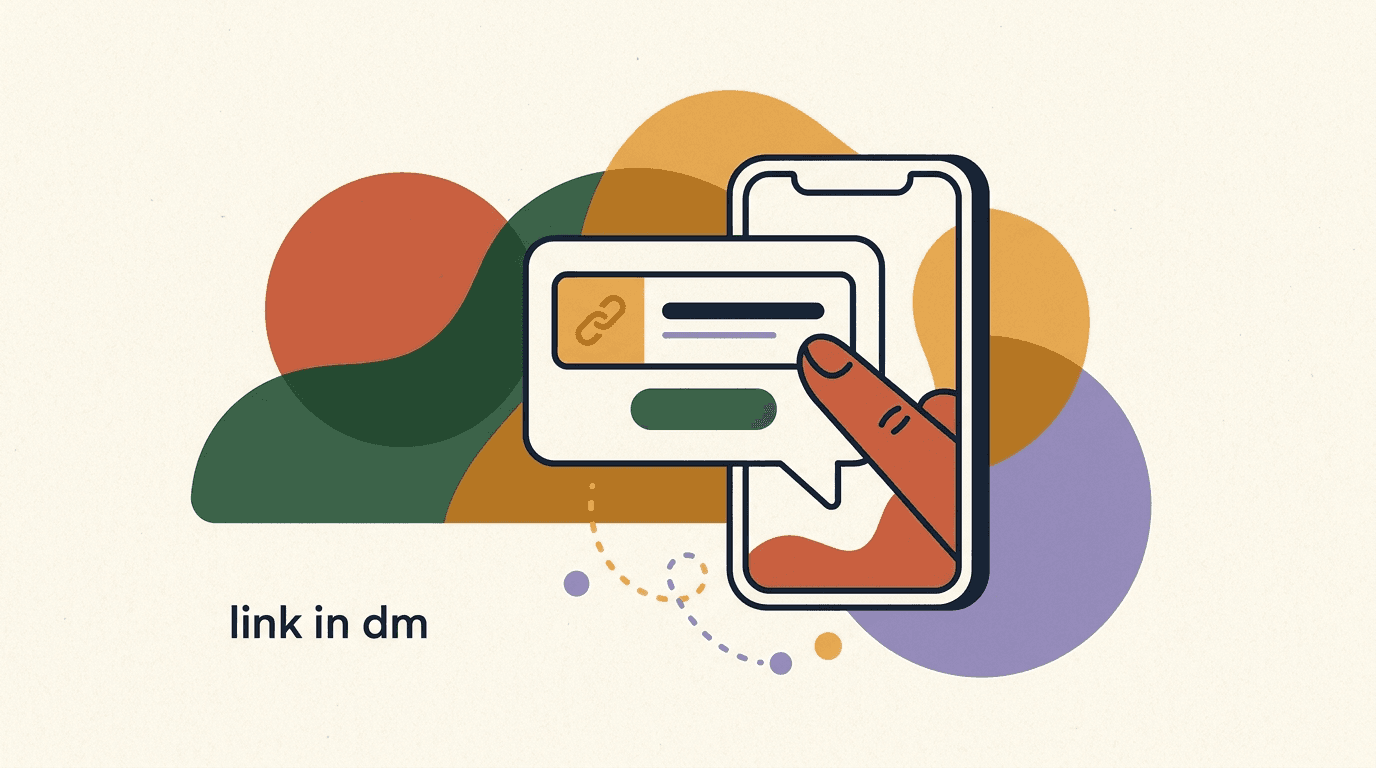
An Instagram link in DM is, in 2026, the most reliable way to turn attention into a click. The reason is simple and a little unglamorous: when a link arrives in a direct message, it shows up at the exact moment someone asked for it, addressed to them, inside a private one-to-one thread they opened on purpose. That context does most of the persuasion work that a link-in-bio can never do. The bio link sits at a fixed address, waiting for someone to leave the post, remember it exists, tap your profile, find the right button, and follow through. The DM link skips all of that.
This guide is about doing it well rather than just doing it. Anyone can paste a URL into a message. The teams that consistently drive clicks from Instagram do something more deliberate: they earn the link with a useful reply first, send one clear link instead of three, time it to land while interest is hot, track which links actually get tapped, and stay firmly inside Meta's rules so their reach and their account survive the campaign. Those are the moving parts we will work through.
Full disclosure before we start: we build KlyoChat, an AI-native inbox and automation tool that, among other things, delivers links and assets straight into Instagram DMs from comments. So we have a point of view and a product in this space. We have written this so it stands on its own whether or not you ever use our tool — the strategy is the strategy, and most of it you can run by hand. Where KlyoChat genuinely helps, we will say so plainly near the end, and we will be honest about what it does not do.
Why does a link in the DM beat the link in bio?
Link-in-bio became the default because Instagram historically did not let you put clickable links in captions. So creators trained their audiences with the phrase everyone now ignores: link in bio. It works, sort of. But it leaks clicks at every step, and each step is a place a motivated person quietly gives up.
Think about the journey a caption link asks for. Someone reads your post, feels a spark of interest, has to remember to act on it, taps through to your profile, scans for the bio link, possibly lands on a link hub with eight other options, finds the right one, and only then arrives where you wanted them. Every hop sheds people. The spark cools with each tap. By the time they reach the destination, a large share of the original interest has evaporated.
A DM link collapses that journey. The person expressed interest — they commented, replied to a story, or messaged you — and the link comes back to them directly, in the place they are already looking, with a sentence of context wrapped around it. There is no profile detour, no link hub to scan, no remembering. The path from interest to click is one tap inside a conversation they are already having.
There is also a psychological difference that is easy to underrate. A bio link is impersonal infrastructure — it is the same for everyone, it has no idea who is tapping it, and it never speaks to the specific reason you cared. A DM link is the opposite. It can reference the exact post that drew you in, the exact question you asked, the exact thing you said you wanted. That sense of being spoken to as an individual, rather than processed as traffic, is part of why the click feels natural rather than transactional. People click links from people far more readily than they click links from menus.
And there is a discovery-versus-intent split worth naming clearly, because it reframes the whole debate. Link-in-bio is a discovery tool: it serves the person who arrives at your profile cold, with no prior prompt, browsing. The DM link is an intent tool: it serves the person who already raised their hand. Those are two different jobs, and trying to make one mechanism do both is where a lot of click loss hides. The bio link is fine at the job it is good at. It is just the wrong tool for warm, high-intent traffic, which is precisely the traffic worth the most.
| Step | Link in bio | Link in DM |
|---|---|---|
| Where the link lives | Fixed spot on your profile | Inside the conversation |
| Effort to reach it | Leave post, tap profile, scan | Read the message, one tap |
| Context around it | Generic, same for everyone | Tailored to what they asked |
| Timing | Whenever they remember | While interest is hot |
| Choice overload | Often a hub of many links | One clear link |
Bio link and DM link are not rivals
Keep your link in bio for passive discovery — people who land on your profile cold. Use the DM link for active intent — people who raised their hand. The DM is where the warm clicks live, so put your effort there.
Is putting a link in an Instagram DM even allowed?
Yes — sending a link in a direct message is normal, supported behavior. Instagram lets people share URLs in DMs, and the platform shows a link preview in the thread. The thing you have to respect is not whether links are allowed but how and when you message people, because that is governed by Meta's messaging rules and, for automation, by the platform's policies.
Two rules matter most. The first is consent and relevance: you should be replying to people who initiated contact or who clearly opted in — by commenting on a post that promised a DM, replying to a story, or messaging you first. Cold-DMing strangers with links is the fastest way to get flagged, restricted, or reported. The second is the 24-hour standard messaging window. Once someone messages your business, you have a 24-hour window in which to respond with standard messages, including links. Outside that window, the kinds of messages you can send are limited and the rules are stricter.
If you automate any of this — and most teams eventually do — you also have to use approved tools and the official API rather than scripts that pretend to be a person tapping the app. Unofficial automation is against Instagram's terms and routinely gets accounts banned. Stay on the supported path and the link-in-DM play is durable; cut corners and it is a matter of time before something breaks.
It also helps to understand why these rules exist, because once the logic clicks you stop fighting it. Meta's incentive is to keep DMs feeling like a place people want to be — a space for real conversations, not a dumping ground for unsolicited offers. The 24-hour window, the consent expectation, and the restrictions on automation all push toward the same outcome: messages people actually want, sent by entities they actually engaged with. When you build your link strategy to align with that incentive rather than against it, the platform is effectively on your side. The teams that get punished are the ones trying to extract reach the platform is specifically designed to protect.
One more practical note on the link itself. Instagram may treat links from brand-new accounts, or accounts with little history, more cautiously than links from established ones. This is not a reason to panic, but it is a reason to warm up an account with genuine activity before you lean hard on link delivery, and a reason not to switch domains or shorteners constantly in a way that looks evasive. Consistency reads as trustworthy; erratic behavior reads as something to scrutinize.
Respect the 24-hour window
After a user messages your account, the standard messaging window is 24 hours. Deliver your link and your value inside that window. If you need to reach people later, that moves into different, more restricted message types — plan your funnel so the link lands while the window is open.
What makes a link-in-DM message actually get clicked?
A link by itself is not persuasive. People do not click links; they click on the promise of what is on the other side, delivered by someone who has just been useful to them. The messages that convert share a recognizable shape, and once you see it you cannot unsee it.
First, they lead with value, not the link. The opening line answers the question the person actually had or delivers the thing they asked for, before any URL appears. Second, they give context for the link — a short sentence that says what it is and what to do with it, so the click feels safe and obvious. Third, they offer exactly one link. A single, unmissable next step beats a menu every time. Fourth, they sound like a person, not a billboard. The tone matches a real conversation, because that is what a DM is.
Underneath those four traits is a quieter principle: the message respects the reader's attention. A DM is an intimate space. People grant brands access to it conditionally, and they revoke that access the instant it feels exploited. A message that opens with a hard sell, or that is transparently a template with a name slotted in, signals that you see the person as a conversion event rather than a human. The messages that get clicked do the opposite — they spend their first sentence giving rather than taking. That small inversion, value before ask, is the difference between a DM that earns a tap and one that earns a mute.
It is also worth being deliberate about the call to action that surrounds the link. A naked URL with no instruction leaves the reader to guess what happens if they tap it, and guessing is friction. A single clear line — what it is, and what to do with it — removes that hesitation. You are not writing ad copy; you are removing the last small reason someone might not click. The most effective link DMs read almost boringly clear: here is the thing, this is what it does, tap to get it. Clarity converts; cleverness usually does not.
- Value first: answer or deliver before the link appears.
- Context wrap: one sentence on what the link is and why to tap it.
- One link only: a single next step, never a menu of three.
- Human tone: write like a reply, not an ad.
- Clear ask: tell them what happens after they tap.
The link is the reward, not the message
Treat the link as the payoff for a useful reply. If you stripped the URL out, the message should still feel helpful. When the message is only a link, it reads as a drop, and drops get ignored or reported.
What does a good link DM look like? (two examples)
Abstract advice is easy to nod at and hard to use, so here are two concrete messages. The first is a value-first reply to someone who commented asking for a resource. The second is a story-reply follow-up. Notice in both that the link arrives after the value, wrapped in one line of context, and that there is exactly one of them.
Example 1 — comment asked for the free guide
- Opening
- Hey! Thanks for the comment — happy to send this over.
- Value
- The guide walks through the 3 setups I mentioned in the Reel, with the templates included.
- Context + link
- Here is the download — it opens straight to the templates: example.com/guide
- Ask
- Have a look and tell me which setup you want to try first.
The second example is for a warmer moment — someone replied to your story with a question. The link still comes last, and the message still works as a helpful reply even if you imagine the URL removed.
Read your DM out loud before you send it at scale
If it sounds like something a helpful human would actually type, it will perform. If it sounds like a press release, rewrite it. This thirty-second test catches most of the messages that quietly tank click rates.
Example 2 — story reply asking how pricing works
- Opening
- Good question — short version: it is a flat monthly plan, no per-message fees from us.
- Value
- Most people on your kind of setup land on the middle tier; it covers all the channels.
- Context + link
- Full breakdown with the numbers is here: example.com/pricing
- Ask
- Want me to point you to the right tier for your volume?
When should the link land for the most clicks?
Timing is the lever most people ignore, and it may be the highest-leverage one. Interest is perishable. The gap between someone raising their hand and your link arriving is the single biggest predictor of whether they click. A link that lands in seconds, while the post is still on their screen and the curiosity is fresh, gets clicked far more often than the same link sent two hours later when they have scrolled on with their day.
This is why so many teams move from answering comments manually to automating the first touch. Not because automation is fancy, but because a human cannot reply in three seconds at 11pm to the forty-first person who commented the keyword. The first reply does not have to be the whole conversation — it just has to deliver the link fast, while the moment is alive, and a real person can follow up afterward.
There is also a daily-rhythm layer. Your link DMs should fire whenever interest happens, which usually tracks when your content goes out and when your audience is online. The point is not to pick a clever hour; it is to never make a warm lead wait. Speed of first response beats time-of-day optimization in almost every test we have seen.
Same lead, two response speeds
- Reply in seconds
- Post still on screen, curiosity hot — high click-through
- Reply in 2+ hours
- Moved on, context gone — most of the interest is lost
How many links should one DM contain?
One. The answer is almost always one, and the reason is the same reason link-in-bio hubs underperform: choice is friction. Every additional option forces a decision, and a person deciding between three links is a person more likely to decide on none. A single, obvious next step removes the deliberation entirely.
There are narrow exceptions. If someone explicitly asks for two different things, sending two clearly labeled links is fine — you are matching their request, not padding the message. But the default, the thing you should do unless you have a specific reason not to, is one link per message tied to one clear action. If you genuinely have multiple things to share, send them across a short sequence of messages rather than stacking them into one wall of URLs.
- Default to one link and one action per message.
- Two labeled links only when the person asked for two things.
- Never stack a menu of links and hope they pick.
- If you must share several, sequence them, do not pile them.
A link menu is a decision tax
Every extra link you add lowers the odds of any single one being clicked. The DM's whole advantage over link-in-bio is removing choice overload. Stuffing the DM with options throws that advantage away.
How do you track whether your link DMs are working?
If you cannot see which links get tapped, you are guessing, and guessing is how good campaigns quietly rot. Tracking turns the link-in-DM play from a vibe into a system you can improve. There are two layers worth setting up, and neither is complicated.
The first layer is the link itself. Use trackable URLs — UTM parameters or a short-link service — so your analytics can tell you that a given click came from an Instagram DM rather than your bio or an ad. This is the difference between knowing DMs drive clicks and proving it. The second layer is conversation-level analytics: how many people received the link, how many tapped it, and how that varies by which message copy or which post triggered the DM. That is where you find out that example A out-clicks example B, and you double down.
| Metric | What it tells you | How to act on it |
|---|---|---|
| Link click rate | Did the message earn the tap | Rewrite low performers, scale winners |
| Time to first reply | Are you catching warm leads | Automate the first touch if slow |
| Source attribution (UTM) | DM vs bio vs ad clicks | Shift effort to what actually drives clicks |
| Reply rate after link | Did the link start a conversation | Add a question after the link |
Tag your links so the click is traceable
A UTM-tagged or branded short link costs nothing and turns every DM click into data you can attribute. Without it, you will never know whether the DM, the bio, or the ad earned the conversion — and you will optimize blind.
What are the pitfalls that make link DMs backfire?
The link-in-DM play is powerful, which means it is also easy to overdo until it works against you. Most failures fall into a few buckets, and all of them are avoidable once you know to watch for them.
The first and biggest is looking spammy. Identical, link-only messages blasted to people who did not ask for them is the textbook pattern Instagram penalizes — it leads to reports, restrictions, and in bad cases bans. The fix is the value-first structure from earlier: reply to people who opted in, lead with usefulness, and vary your copy enough that it reads as human. The second pitfall is reach anxiety — a worry that linking in DMs hurts your account. Sending a link inside a one-to-one thread to someone who messaged you is normal; what hurts you is mass unsolicited messaging, not the existence of a link.
The third is ignoring the window. If your funnel relies on messaging people long after they went cold, you will run into Meta's restrictions on messages outside the 24-hour window and wonder why delivery falls apart. Design the funnel to deliver the link while the window is open. The fourth is the broken or wrong link — nothing kills trust faster than a 404 from a brand that just promised you something. Test every link before it goes live and again after any site change.
- Spam pattern: identical link-only blasts to people who did not opt in.
- Reach myth: a contextual link to a warm lead does not tank your reach — mass unsolicited DMs do.
- Window neglect: relying on messages sent after the 24-hour window closes.
- Dead links: untested URLs, 404s, and stale destinations.
- Over-automation: no human follow-up, so warm leads stall after the link.
Automation amplifies whatever you point it at
Automating a respectful, value-first link reply scales a good behavior. Automating a cold, link-only blast scales the exact pattern that gets accounts restricted. The tool is neutral — the message and the audience are what keep you safe.
Where should the link send people — and does the destination matter?
A perfect DM that points at a bad destination still loses. The click is only half the job; the page on the other side has to honor the promise the message made. The most common self-inflicted wound here is a mismatch — the DM promises a quick template and the link opens a sprawling homepage where the template is buried three scrolls down. The person tapped expecting one thing and got a scavenger hunt, and the trust you built in the message evaporates on arrival.
The fix is to match the destination to the promise as tightly as possible. If the DM offered a guide, link straight to the guide, not to the blog that contains it. If it offered a discount, link to the page where the discount is obviously applied, not to the store's front door. Mobile matters enormously here, because virtually all of this traffic is on a phone — a destination that loads slowly, demands a sign-up before showing value, or renders badly on mobile will undo a great message. Treat the landing experience as part of the DM, not a separate concern.
There is also a question of how many destinations you maintain. It is tempting to point every DM at one catch-all page to keep life simple. Resist it. The whole advantage of the DM link is specificity, and a generic destination throws that away just as surely as a generic message would. A handful of focused, fast, mobile-friendly destinations — one per offer — will out-convert a single do-everything page every time.
- Match the destination to the exact promise the DM made.
- Link to the specific page, not the homepage that contains it.
- Assume mobile: fast load, value visible before any sign-up wall.
- Prefer focused, per-offer destinations over one catch-all page.
A click you waste is harder to win back
The hardest part is earning the tap. Squandering it on a slow, mismatched, or buried destination is the most expensive mistake in the funnel, because that person already did the thing you wanted and you lost them anyway.
How do you write link DMs that do not all sound the same?
Scale and sincerity pull in opposite directions, and the tension shows up most in copy. The instant you start delivering the same link to hundreds of people, the temptation is to write one message and fire it verbatim every time. That is exactly the pattern — identical, repetitive text — that reads as automated and trips spam signals. So the craft is to be consistent in structure while varying enough in surface that each message feels like it was written for the person reading it.
A practical way to do this is to write a few variants of each part — two or three openings, two or three context lines, two or three closing questions — and let them mix. The structure stays disciplined (value, context, one link, ask) but no two recipients get a word-for-word clone. You can also genuinely personalize the cheap, high-impact details: reference the specific post they engaged with, or the keyword they used. Those small specifics do more for perceived authenticity than any amount of clever phrasing.
The deeper point is that variation is not just spam avoidance — it is how you learn. Different openings and different framings perform differently, and if every message is identical you can never find out which words earn more taps. Treating copy as something to test, rather than something to set once, is what separates a funnel that slowly improves from one that plateaus on day one and quietly decays as the novelty wears off.
- Write the skeleton onceLock the structure — value, context, one link, follow-up question — so every message is disciplined.
- Draft a few variants per partTwo or three openings, context lines, and closers so messages mix rather than repeat verbatim.
- Personalize the cheap specificsReference the actual post or keyword. Small real details beat generic flattery for authenticity.
- Compare the variantsTrack which combinations earn more taps, retire the weak ones, and keep iterating.
Variation is a feature, not just safety
Mixing your copy keeps you out of the repetitive-message spam pattern and, just as importantly, generates the comparisons you need to improve. Identical messages are both riskier and dumber — they never teach you anything.
What if someone does not click the link right away?
Not everyone taps the moment the link lands, and that is normal — people get distracted, they save it for later, they hesitate. The instinct to immediately re-send the link or pile on more messages is the wrong one; it reads as pushy and burns goodwill. But there is a right way to follow up, and it lives inside the same constraints as everything else: stay inside the 24-hour window, and keep adding value rather than just repeating the ask.
A good follow-up, sent while the window is still open, does something for the person rather than nagging them. It might answer the obvious next question, add a relevant tip, or simply check whether they had a chance to look — phrased as a genuine offer to help, not a guilt trip. If the window closes and they still have not engaged, that is where the funnel ends for most casual campaigns; chasing people with the restricted message types available outside the window is rarely worth it and easy to get wrong. Better to let the next piece of content re-engage them naturally.
The honest framing is that not every lead converts, and trying to force the ones who go quiet usually costs more in trust than it returns in clicks. A respectful single follow-up inside the window, then a graceful stop, will serve you better over time than an aggressive sequence that trains your audience to dread your DMs. Patience is a conversion strategy too.
A graceful stop protects the next campaign
The audience you do not annoy today is the audience that opens your DM tomorrow. Restraint after a non-click is an investment in every future message you send to that person.
Follow-up done right vs wrong
- Wrong (pushy)
- Re-sending the same link with did you see this an hour later, then again
- Right (value)
- One helpful note inside the window: Quick tip on using it — and here if you need it again
How do you build a repeatable link-in-DM funnel? (steps)
Putting the pieces together, here is a funnel you can stand up and reuse. It works manually for low volume and benefits from automation as you grow, but the logic is the same either way: earn the intent, deliver the link in context, track the click, follow up like a human.
- Create the promptMake a post, Reel, or story that promises something specific in the DM — a guide, a discount, a breakdown — and asks people to comment a keyword or reply.
- Capture the intentWatch for the comment, story reply, or DM that signals they want it. This is the opt-in that makes your link reply welcome rather than spammy.
- Deliver value plus one link fastSend a value-first reply with a single trackable link, ideally within seconds and always inside the 24-hour window.
- Track the clickUse UTM-tagged or short links so you can attribute the click to the DM and compare message variants.
- Follow up as a humanAsk a question after the link to start a real conversation. The link is the start of the relationship, not the end of it.
Start manual, automate the bottleneck
Run this by hand until the volume hurts. The first thing to automate is almost always the fast first reply, because speed is where clicks are won or lost. Keep the human follow-up human as long as you can.
Should you automate link delivery, or send by hand?
Both are valid, and the honest answer is that it depends on volume. At a trickle — a handful of interested people a week — sending links by hand is fine and arguably better, because the personal touch is real and the maintenance is zero. The problem is that the link-in-DM play tends to work, and working creates volume. A Reel that lands or an ad that converts can produce more comment-keyword opt-ins in an hour than a person can answer in a day.
That is the moment automation earns its keep. Not to remove the human, but to guarantee the one thing humans cannot do at scale: deliver the right link to the right person in seconds, every time, inside the window, with the click tracked. The human then steps in for the follow-up, where judgment and warmth matter and speed does not. The mistake is treating it as all-or-nothing. The right setup is automated first touch, human conversation.
It helps to separate the two jobs in your head. The first touch is mechanical: a known trigger (a keyword, a story reply) should produce a known, value-first link reply, fast and reliably. There is no judgment to apply and no upside to a human doing it slower. The conversation that follows is the opposite — it is where someone asks a real question, raises an objection, or signals they are ready to buy, and that is exactly where a human's attention pays off. Automating the first and protecting the second is how you scale clicks without turning your inbox into a robotic wall that people can feel.
| Situation | Send by hand | Automate |
|---|---|---|
| A few opt-ins a week | Good fit | Overkill |
| Spiky, viral-driven volume | Falls behind | Good fit |
| Need fast first reply | Hard to guarantee | Reliable |
| Personal, complex conversation | Good fit | Hand off to human |
How does KlyoChat help with links in Instagram DMs?
This is the part where we talk about our own tool, so take it with the appropriate grain of salt — though everything above stands whether you use us or not. We built KlyoChat as an AI-native unified inbox that brings Facebook, Instagram, Telegram, WhatsApp, TikTok, and X into one place, with automation layered on top. The specific job this article is about — getting a link into an Instagram DM well — is one of the things it is built to do.
The most directly relevant feature is comment-to-DM: when someone comments a keyword on your post, KlyoChat can automatically send them a DM that delivers your link or asset in seconds, inside the 24-hour window, using the value-first copy you set up. Flows let you design the full sequence — the reply, the link, the follow-up question — without code. And because every link delivery runs through the system, you get analytics on clicks, so you can see which post and which message copy actually drive taps rather than guessing. That is the manual funnel from earlier, automated at the first-touch bottleneck where speed wins clicks.
We owe you the honest limits too. KlyoChat does not do native SMS or email, so if your link strategy depends on those channels, you will need something else for them. We respect Meta's rules and the 24-hour window by design, which means we will not help you do the cold-blast spam that gets accounts banned — that is a feature, but it is also a constraint if that was your plan. And we are a newer, smaller community than the largest incumbents, so the template marketplace and the sheer volume of third-party tutorials are thinner. If those things matter more to you than AI-native automation and flat pricing, that is a fair reason to look elsewhere.
- Comment-to-DM delivers links and assets automatically, in seconds.
- No-code flows design the value-first reply, link, and follow-up.
- Click analytics show which posts and messages drive taps.
- Honest limits: no native SMS or email; rules-respecting by design; smaller community.
You do not need a tool to start
Everything in this guide works by hand. A tool like KlyoChat matters when volume outgrows your ability to reply fast — which is exactly when the link-in-DM play starts paying off. Start manual, and automate the moment speed becomes the bottleneck.
KlyoChat pricing at a glance
- Basic
- $19/mo — entry tier for small setups
- Pro
- $49/mo ($39 billed yearly) — all channels, comment-to-DM, AI agents
- Business
- $129/mo — higher volume, more seats and contacts
- Trial
- 7-day free trial, no credit card
What should you measure to know if it is working?
Before you scale anything, decide what success looks like, or you will mistake activity for results. The link-in-DM play has a clean set of numbers, and you do not need all of them on day one — start with click rate and response speed, and add the rest as you grow.
Click rate tells you whether the message earned the tap; it is the headline number and the one to optimize copy against. Time to first reply tells you whether you are catching warm leads or letting them cool — if it is creeping up, that is your automation signal. Source attribution, via tagged links, tells you the DM is doing the work rather than your bio or ads stealing the credit. And reply rate after the link tells you whether the link started a relationship or ended the conversation. Watched together, these four turn a tactic into a system you can compound.
- Click rate — does the message earn the tap.
- Time to first reply — are warm leads caught fast.
- Source attribution — is the DM the real driver.
- Reply rate after link — did it start a conversation.
Pick one metric to improve this month
Do not try to move everything at once. Choose the weakest number, change one thing — copy, speed, or the link itself — and measure. Compounding small, isolated improvements beats overhauling the whole funnel and learning nothing from it.
The bottom line: an Instagram link in DM wins because it puts the link where the interest already is — in a private thread, in context, at the moment someone asked. That structural advantage is real, but it is not automatic. You earn it with value-first copy, protect it with one clear link, multiply it with speed, prove it with tracking, and keep it durable by respecting Meta's rules and the 24-hour window.
Start by hand, write messages that would help even without the URL, and only reach for automation when volume makes fast first replies impossible to do yourself. When you get there, KlyoChat's comment-to-DM, flows, and click analytics handle that first-touch bottleneck — and for the deeper plays, see our pieces on Instagram lead-magnet DMs, comment-to-DM funnels, and the full Instagram DM automation guide.