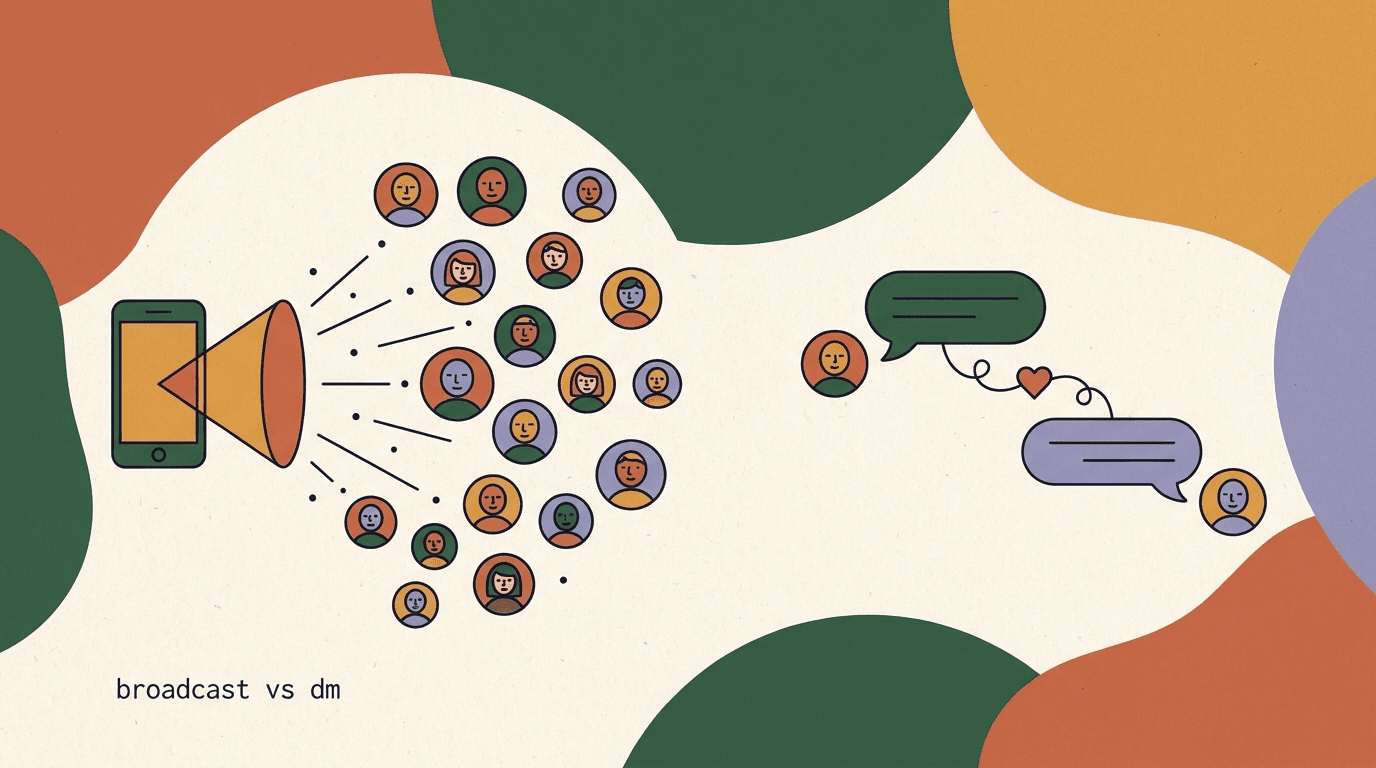
The Instagram broadcast vs DM question trips up a lot of creators and brands because the two tools look similar from the outside — both live inside Instagram messaging, both let you reach people through chat — but they solve opposite problems. Broadcast channels are a one-to-many announcement format: you write once, and every follower who joined the channel sees it. DM automation is one-to-one: a conversation that reacts to what each person does, answers their question, qualifies them, and moves them toward a purchase or a signup.
Confusing the two leads to predictable mistakes. Brands blast a broadcast hoping for conversions and wonder why nobody buys. Creators try to hand-run DM conversations at the scale of a broadcast and burn out. The right framing is not which one is better — it is which job you are trying to do right now, and how the two work together when you stop treating them as competitors.
This guide is a decision framework, not a single tutorial. We will define each tool precisely, compare them head to head on reach, conversion, control, and cost, walk through the situations where each one clearly wins, show you how to chain them into one funnel, and give you setup steps for both. Full disclosure: we build KlyoChat, a tool that does both broadcasts and DM automation, so we have a point of view — but the strategy here applies whatever software you use, and we have kept the platform pitch to one honest section near the end.
If you remember nothing else, remember this: broadcasts are how you reach people, and DM automation is how you convert them. Almost every confused strategy we see comes from asking one tool to do the other's job. By the end of this guide you will know, for any given message you want to send, which tool fits — and how to make the two work as a single system rather than two disconnected tactics.
What is an Instagram broadcast channel, exactly?
An Instagram broadcast channel is a public, one-to-many messaging feature. A creator or brand creates a channel, followers opt in to join it, and from then on the owner can send messages — text, images, polls, voice notes, links — that land in the inbox of every member at once. It behaves like a private feed delivered through the messaging surface rather than the main grid.
The defining characteristic is direction. Communication flows one way. Members can react with emoji and vote in polls, but they cannot reply with a normal message that reaches you the way a DM does. That constraint is the whole point: a broadcast channel is built for announcing, not for conversing. It is the closest thing Instagram has to an email newsletter living inside the app.
Because it is opt-in, the audience is self-selected and warm — people who join your channel have already told you they want more from you than the algorithm shows them. That makes the channel a high-attention surface. But it is still a megaphone, and a megaphone cannot ask a follower what size they wear or whether they have used your product before.
- One-to-many: one message reaches every member at once.
- Opt-in: followers choose to join, so the audience is warm.
- One-directional: members react and vote, but cannot hold a conversation.
- Best for announcements, drops, behind-the-scenes, and timely updates.
Broadcast channels are not the same as broadcast sends
Instagram's native broadcast channel is a feature followers join. Separately, automation tools offer broadcast sends — pushing a message to a segment of people who already DM'd you. They overlap in spirit but differ in mechanics and rules. We cover both senses of broadcast in this guide and flag which one we mean.
What is Instagram DM automation, exactly?
Instagram DM automation is software that sends, receives, and reacts to direct messages on your behalf, one conversation at a time. Instead of broadcasting the same thing to everyone, it responds to what each individual person does: a comment on a Reel, a keyword in a DM, a click on a story link, a reply to a previous message. Each person gets a path that fits their behavior.
The defining characteristic here is also direction — but the opposite one. DM automation is two-way and conditional. It asks a question, waits for the answer, and branches based on the response. Someone who says they are a first-time buyer gets a different message than a returning customer. Someone who asks about shipping gets shipping info; someone who asks about sizing gets sizing help. It is a conversation, scaled.
This is what makes DM automation a conversion tool rather than a reach tool. Conversion happens in the back-and-forth: qualifying the lead, handling the objection, sending the link at the right moment, capturing the email. A broadcast cannot do any of that because it cannot listen. DM automation is built entirely around listening and reacting.
- One-to-one: each person gets a path based on their own behavior.
- Two-way and conditional: it asks, waits, and branches on the reply.
- Triggered: comments, keywords, story replies, and clicks all start flows.
- Best for qualifying, answering, converting, and capturing contact details.
Same goal, two mechanics
- Broadcast channel
- New product is live — here is the link (everyone gets the identical message)
- DM automation
- Comment LINK and I will DM it → are you shopping for yourself or a gift? → here is the right collection
Instagram broadcast vs DM: the core comparison
The fastest way to internalize the difference is to put the two side by side on the dimensions that actually drive a decision: who they reach, how they communicate, what they are good at, and what they cost you in effort and money. The table below is the heart of this guide.
Read it as a tendency, not a law. A clever broadcast can nudge a sale, and a DM flow can deliver an announcement. But the grain of each tool runs in one direction, and you get the best results when you work with the grain rather than against it.
| Dimension | Broadcast channels | DM automation |
|---|---|---|
| Direction | One-to-many | One-to-one |
| Communication | One-way announcement | Two-way conversation |
| Primary job | Reach and awareness | Conversion and qualification |
| Audience | Opted-in channel members | Anyone who triggers a flow |
| Personalization | Same message to all | Branches on each reply |
| Best content | Drops, news, BTS, polls | Offers, FAQs, lead capture |
| Effort to run | Low — write once | Low once built, more to design |
| Captures data | Limited (poll votes, reactions) | Rich (answers, tags, contact info) |
The one-line rule
Use broadcasts to reach people and DMs to convert them. If your goal is to make a lot of people aware of something, broadcast. If your goal is to move a person from interested to bought, automate the DM. Most teams need both, in that order.
Which one drives more reach?
Reach is the broadcast channel's home turf. Because every member receives every message and the format sits in the high-attention messaging inbox rather than competing with the algorithmic feed, a broadcast reliably puts your message in front of your warmest audience without paying for distribution. There is no ranking system deciding who sees it — if they joined, they get it.
DM automation, by contrast, reaches people one trigger at a time. Its reach is bounded by how many people take the triggering action — comment a keyword, reply to a story, click a button. That can be a large number when a Reel goes viral and thousands comment your keyword, but it is fundamentally pull, not push. You cannot proactively start a DM with someone who has not first opted into a conversation, because Instagram's rules require an interaction to open the window.
So if the question is purely about putting one message in front of the most warm people with the least effort, the broadcast channel wins. It is the push channel. DM automation only reaches people who raised their hand, which is exactly why the people it does reach convert better.
You cannot cold-DM at scale, and you should not try
Instagram's policies and the 24-hour messaging window exist to stop spam. DM automation only works with people who have interacted with you first. Any tool promising mass unsolicited DMs is a fast route to a restricted or banned account. Respect the rules — they protect your reach.
Which one drives more conversion?
Conversion belongs to DM automation. Selling is rarely a single message; it is a sequence of small commitments — confirming interest, answering the objection, choosing the variant, clicking the link. Each of those steps needs a response from the buyer, and only a two-way tool can read the response and act on it. The DM is where the actual decision gets made.
A broadcast channel can announce a sale, but it cannot tell whether a given member is ready to buy, what they are unsure about, or which product fits them. It fires the same message at the ready, the curious, and the indifferent alike. That is fine for awareness and terrible for the last mile of a purchase, where personalization is the difference between a click and a scroll-past.
There is also the data point. Conversion improves over time when you learn from each interaction, and DM automation captures rich signals — which question someone asked, which branch they took, whether they left an email. A broadcast captures poll votes and emoji reactions, which are interesting but thin. The conversational thread is where the qualifying information lives.
Why the conversation converts
- Broadcast: 20% off today
- Reaches everyone, persuades the few already decided
- DM: what is holding you back?
- Surfaces the objection, answers it, then sends the offer — converts the undecided
When should you use a broadcast channel?
Reach for a broadcast channel whenever you have something to tell your whole warm audience that does not require a reply from them. The value is timely, low-friction distribution to people who have already opted in. If the message would work as a newsletter or a story you wish more people saw, it probably belongs in a broadcast.
- Product drops, restocks, and launch-day announcements.
- Time-sensitive news: an event, a livestream going live, a deadline.
- Behind-the-scenes content and updates that deepen the relationship.
- Polls and quick reactions to gauge interest before you build something.
- Content roundups — your latest video, post, or article in one place.
Treat your channel like a newsletter, not a feed
Broadcast members opted in for signal, not noise. A cadence of a few high-value messages a week beats daily filler. The fastest way to lose channel members is to broadcast so often that opening it stops feeling worth it.
When should you use DM automation?
Reach for DM automation whenever the outcome depends on a back-and-forth — when you need to qualify someone, answer a specific question, deliver something tailored, or move an individual toward a purchase. If the right next message depends on what the person says or does, you need the two-way tool.
- Comment-to-DM funnels: someone comments a keyword on a Reel and gets the link in their DMs.
- Lead qualification: a few questions that route hot leads to a human and cold ones to nurture.
- FAQ handling: shipping, sizing, pricing, and returns answered instantly, around the clock.
- Lead capture: collecting an email or phone number in exchange for a resource.
- Re-engagement: a flow that reopens a stalled conversation within the messaging window.
The 24-hour window shapes DM strategy
Instagram lets you message someone freely for 24 hours after their last interaction. After that, your options narrow. Good DM automation does its real work inside that window — answer fast, deliver value, and capture a durable contact (like an email) before the window closes.
How do you combine broadcasts and DM automation?
The biggest mistake in the whole Instagram broadcast vs DM debate is treating it as either/or. The strongest play is to chain them: use the broadcast for reach at the top, then hand off to DM automation for conversion at the bottom. The broadcast creates the moment; the DM closes it.
Here is the pattern. You broadcast an announcement to your channel — a drop, an offer, a new piece of content. The broadcast itself cannot converse, so you give it a single job: drive an action that opens a DM. Ask members to reply to a linked post, comment a keyword on the accompanying Reel, or tap through to a flow. The instant they act, DM automation takes over and runs the personalized conversation that actually converts.
This solves both tools' weaknesses at once. The broadcast's inability to converse stops mattering because it is only a launcher. The DM's limited reach stops mattering because the broadcast just sent a wave of warm people into it. Reach and conversion stop competing and start compounding.
- Broadcast the momentSend a clear, single-purpose announcement to your channel — the drop is live, the offer is open, the new video is up.
- Point to a DM triggerTell members exactly what to do to get more: comment a keyword on the Reel, reply to the linked post, or tap the link.
- Let automation take the conversationThe moment they act, a DM flow greets them, qualifies them, answers questions, and sends the right link.
- Capture a durable contactInside the 24-hour window, collect an email or tag so you can reach them even when the window closes.
- Re-broadcast and re-triggerUse what the DM learned to segment, then broadcast follow-ups and reopen conversations with relevant offers.
The chained funnel in action
- Step 1 — Broadcast
- New collection just dropped. Comment FIT on today's Reel for your size guide.
- Step 2 — DM trigger
- Follower comments FIT on the Reel
- Step 3 — DM flow
- Auto-DM: what are you shopping for? → tailored size guide + link
- Step 4 — Capture
- Want restock alerts? Drop your email — converts reach into an owned contact
Reach plus conversion: a worked example
Numbers make the chaining logic concrete, so here is an illustrative example — not a benchmark, just arithmetic to show how the two tools stack. Imagine a creator with a broadcast channel of 5,000 opted-in members launching a new digital product.
If they only broadcast, they reach 5,000 warm people with one announcement and convert whoever was already decided. If they only run DM automation off a Reel, they reach however many people comment the keyword — say a few hundred — but convert them at a much higher rate because each gets a tailored conversation. Neither alone is the full picture.
Chained, the broadcast pushes all 5,000 toward the Reel and the keyword. A slice of them comment, enter the DM flow, get qualified and answered, and convert at the high DM rate — while the flow also captures emails so the next launch starts from an even warmer base. The broadcast supplied the volume; the DM supplied the conversion; together they beat either path run in isolation.
| Approach | What it optimizes | Typical weakness |
|---|---|---|
| Broadcast only | Reach to warm audience | Converts only the already-decided |
| DM automation only | High conversion per person | Reach limited to who triggers it |
| Broadcast → DM (chained) | Reach and conversion together | Requires building both, once |
These figures are illustrative
We use round numbers to show the mechanics, not to promise results. Your reach, comment rate, and conversion will depend on your audience, offer, and content. Treat the example as a model for how the pieces fit, then measure your own funnel.
How do reach and conversion differ in cost and effort?
Beyond reach and conversion, the two tools differ in what they cost you — not just in money, but in the more precious currency of attention and time. Understanding the cost profile of each helps you decide where to invest first and how to budget your week.
A broadcast channel is cheap to run once it exists. The marginal cost of one more message is close to zero: you write it once and the platform delivers it to everyone. The investment is front-loaded into building the membership and finding a content rhythm that keeps people from muting you. There are no per-message fees on native channels, and the time cost per send is small. The risk is not cost but attrition — broadcast badly and members leave, which quietly erodes the asset you spent weeks building.
DM automation has a different shape. The build is heavier — you are designing branching conversations, writing copy for each path, and thinking through edge cases — but once built, a good flow runs indefinitely and handles volume that would be impossible by hand. The ongoing cost is mostly maintenance: updating the flow when your offer changes and watching for conversations the bot cannot handle. Where money enters, it is usually the automation tool's subscription rather than per-message charges, though messaging on channels like WhatsApp carries Meta's own per-conversation fees that apply on any platform.
The practical takeaway: broadcasts are low-build, low-run, attrition-sensitive. DM automation is higher-build, low-run, maintenance-sensitive. Neither is expensive once established, which is another argument for running both rather than agonizing over choosing one.
| Cost factor | Broadcast channels | DM automation |
|---|---|---|
| Build effort | Low — set up and invite | Higher — design the flow |
| Per-message run cost | Effectively zero | Effectively zero (tool subscription) |
| Ongoing risk | Member attrition from over-sending | Flows going stale or unhandled cases |
| Main money cost | None on native channels | Automation subscription |
Front-load the build, then let it run
Both tools reward up-front investment and then cost little to operate. Spend the effort building a strong channel membership and a few high-value DM flows, and the day-to-day running cost of both stays low while the results compound.
What about control, data, and ownership?
Reach and conversion are the headline differences, but there is a quieter one that matters more over time: how much you own and learn from each tool. Marketers who think about the long game weigh this heavily, because an audience you can reach and understand is worth far more than one you can only shout at.
Broadcast channels give you a reliable line to a warm audience, but the data they return is thin. You see who reacted with an emoji and how a poll split, and that is roughly it. You do not learn what an individual member wants, what objection is holding them back, or how to reach them off-platform. The channel is rented attention — valuable, but tied to the platform and limited in what it tells you about the people in it.
DM automation, because it is a conversation, returns rich, structured data. Every branch a person takes is a signal: their intent, their question, their stage in the buying journey. Better still, a DM flow can capture a durable, owned contact — an email or a phone number — which converts rented platform attention into an audience you can reach even if the platform changes its rules tomorrow. That ownership is the strategic prize hiding inside DM automation, and it is the single biggest reason to put conversion flows in front of your broadcast reach.
So when you weigh the tools, do not stop at reach versus conversion. Think also about learning and ownership. The broadcast keeps a warm audience close; the DM turns that closeness into knowledge and owned contacts. Together they build an audience asset rather than a series of one-off sends.
- Broadcasts return thin data: reactions and poll votes, little about individuals.
- DM automation returns rich data: intent, questions, and stage, per person.
- DM flows can capture owned contacts (email, phone) — rented attention becomes owned.
- Owned contacts survive platform changes; channel membership does not transfer.
The goal is an owned audience
Platform reach is borrowed — algorithms and policies change. The durable win is converting that reach into contacts you own. DM automation is the bridge: it turns a warm broadcast member into a known, reachable contact you can serve for years.
How do you measure each one?
You cannot improve what you do not measure, and the two tools call for different scoreboards. Tracking the wrong metric is how teams conclude a tool is failing when it is simply being judged by the other tool's standard — a broadcast graded on conversions, or a DM flow graded on raw reach.
For broadcast channels, the metrics that matter are reach-shaped: how many members you have and how fast it is growing, how many opened or reacted to a given message, how polls split, and how many members you lose after each send. That last one — attrition per broadcast — is the early warning that you are over-sending. A healthy channel grows steadily and loses few members when you post.
For DM automation, the metrics are conversion-shaped: how many people enter a flow, how many complete it versus drop off at each step, how many reach the conversion action, and how many durable contacts you capture. Step-level drop-off is the gold here — it tells you exactly which message in the conversation is losing people, so you can fix the one line that is costing you sales rather than rebuilding the whole flow.
When you chain the two, add one more measure: the handoff rate — what share of broadcast recipients actually trigger the DM flow you pointed them to. A low handoff rate usually means the broadcast's call to action was unclear or the friction to act was too high. Watching that single number tells you whether your reach is actually feeding your conversion engine.
| Metric type | Broadcast channels | DM automation |
|---|---|---|
| Audience | Members and growth rate | Flow entries (triggers) |
| Engagement | Opens, reactions, poll splits | Step completion vs drop-off |
| Outcome | Attrition per send | Conversions and contacts captured |
| Chained funnel | — | Handoff rate from broadcast to DM |
Grade each tool by its own job
Judge a broadcast by reach and retention, not sales. Judge a DM flow by completion and conversion, not raw audience. The handoff rate is the one number that tells you whether the two are working as a single funnel.
How do you set up an Instagram broadcast channel?
Native broadcast channels are created inside Instagram itself, and the option appears for eligible accounts in the messaging area. The setup is deliberately simple because the value is in the cadence and content, not the configuration. Here is the shape of it.
- Create the channelFrom your Instagram inbox, choose to create a broadcast channel, name it clearly, and write a short description of what members will get.
- Invite your followers inAnnounce the channel in a post, story, and Reel. Tell people exactly what they will receive so the right audience joins.
- Plan a content cadenceDecide what belongs in the channel — drops, BTS, polls — and how often. Aim for high-signal, not high-frequency.
- Use polls to listenSince members cannot reply freely, polls and emoji reactions are your feedback loop. Use them to gauge interest before launches.
- Always include a next stepEnd broadcasts with a clear action — comment a keyword, tap a link — so the channel can hand off to a DM flow when you want conversion.
Seed the channel before you rely on it
A new channel with twelve members is not a reach tool yet. Spend a couple of weeks promoting it across your posts and stories before you tie a launch to it, so the broadcast actually reaches a meaningful warm audience.
How do you set up Instagram DM automation?
DM automation requires a tool connected to your Instagram professional account through the official API. Once connected, you build flows that listen for triggers and respond. The mechanics are similar across reputable tools; what follows is the general path, and it is the same flow we use inside KlyoChat.
- Connect your account via the official APIUse a tool that authenticates through Instagram's approved API — not a tool that logs in as you, which risks your account.
- Pick a triggerChoose what starts the flow: a comment keyword on a Reel or post, a story reply, a DM keyword, or a button tap.
- Design the conversationWrite the opening message, the qualifying questions, and the branches. Keep it short and send the value fast.
- Add the conversion stepPlace the link, offer, or lead-capture at the point where the person has signaled they are ready — not in the first message.
- Respect the window and hand offDo the real work inside the 24-hour window, capture a durable contact, and route anything the bot cannot handle to a human inbox.
Avoid tools that log in as you
Any DM automation that asks for your Instagram password and acts as your account, rather than connecting through the official API, puts you at risk of suspension. Reputable automation always uses the approved API. This is non-negotiable for account safety.
What mistakes should you avoid with each?
Most of the disappointment with both tools comes from a handful of avoidable errors. Knowing them in advance is half the battle, so here is a short field guide to the failure modes on each side.
- Broadcast mistake: over-sending. Too many low-value messages and members mute or leave the channel.
- Broadcast mistake: expecting conversation. The channel cannot reply; build the conversion into a linked DM flow instead.
- Broadcast mistake: no call to action. A broadcast that does not point anywhere is awareness with nowhere to go.
- DM mistake: front-loading the link. Sending the offer in message one, before any qualification, reads as spam and converts poorly.
- DM mistake: ignoring the window. Building flows that assume you can message anytime; the 24-hour limit will break them.
- DM mistake: no human handoff. A bot that cannot escalate a complex question frustrates exactly the high-intent buyers you want.
Compliance is a growth strategy
Respecting Meta's rules and the 24-hour window is not just risk management — it keeps your account healthy and your reach intact. The accounts that last are the ones that treat policy as a constraint to design within, not an obstacle to route around.
Which tool fits your business type?
The abstract rule — broadcasts for reach, DMs for conversion — lands differently depending on what you sell and how you grow. A creator monetizing attention has different bottlenecks than a product brand chasing orders or a service business booking calls. Mapping the tools onto your business type makes the choice concrete.
For creators and personal brands, the broadcast channel is often the natural anchor. Your audience follows you for you, so an opt-in channel of your most engaged fans is a powerful, low-effort way to keep them close between posts. DM automation then converts that closeness into outcomes — a comment-to-DM flow that delivers your latest product, course, or link to anyone who asks. The pattern is community first, conversion on demand.
For product and e-commerce brands, the weight usually tips toward DM automation, because the buying decision needs personalization — size, variant, fit, shipping. The broadcast becomes the launch megaphone for drops and restocks, but the DM is where the cart gets filled. These brands also benefit most from capturing owned contacts in the DM, since repeat purchase is the whole game and an owned list de-risks the next launch.
For service and local businesses, DM automation as a qualification and booking tool is often the highest-value build. A flow that asks two or three questions and routes a qualified prospect to a booking link or a human does work that would otherwise eat hours of manual replies. The broadcast channel plays a supporting role: announcing availability, sharing results, and keeping past clients warm for repeat work and referrals.
| Business type | Anchor tool | Supporting tool |
|---|---|---|
| Creator / personal brand | Broadcast channel (community) | DM automation for on-demand links |
| Product / e-commerce | DM automation (conversion) | Broadcast for drops and restocks |
| Service / local | DM automation (qualify and book) | Broadcast for availability and proof |
Start with your bottleneck, not your business type
These are tendencies, not rules. Whatever your category, build first for the constraint you feel most — too little reach, or too few conversions — then add the other tool and chain them. The business type just tells you which one to expect to lean on.
Three businesses, same toolkit
- Creator
- Broadcast a new video → DM flow delivers the linked resource to anyone who comments
- E-commerce
- Broadcast a restock → DM flow handles size and ships the link
- Service
- Broadcast openings → DM flow qualifies and routes to a booking
How does KlyoChat handle broadcasts and DMs together?
Since the strongest play is chaining reach and conversion, it helps to run both in one place rather than stitching together a broadcast tool and a separate DM tool. That is the gap we built KlyoChat to close — and to be upfront, this is the part where we talk about our own product, so weigh it accordingly.
KlyoChat is an AI-native, mobile-first unified inbox that connects Facebook, Instagram, Telegram, WhatsApp, TikTok, and X. On the DM side, you build comment-to-DM funnels and conversational flows with included AI agents that handle first response across channels. On the broadcast side, you send broadcasts to dynamic segments — so the people a DM flow qualified and tagged can be the exact audience your next broadcast reaches. The handoff between reach and conversion happens inside one system, with analytics across both.
We are honest about the limits. KlyoChat has no native SMS or email, so if those channels are central to you, factor that in. We are also a newer, smaller community than the largest incumbents — you trade the biggest template marketplace for AI that is built in rather than bolted on and pricing that does not gate features behind add-ons. If that trade fits, the trial is the fastest way to judge it.
- Both tools, one inbox: broadcasts and DM automation in the same place.
- Dynamic segments mean a DM flow's tags can target your next broadcast.
- AI agents are included in the plan, not a separate line item.
- Honest limit: no native SMS or email, and a smaller community than incumbents.
| Job | What KlyoChat gives you |
|---|---|
| One-to-many reach | Broadcasts to dynamic segments across channels |
| One-to-one conversion | Comment-to-DM funnels and conversational flows |
| First response | AI agents included, not a separate add-on |
| Reach + convert in one place | Unified inbox so DM tags feed broadcast segments |
| Measurement | Analytics across both broadcasts and DM flows |
Always verify current pricing
Plans and limits change over time. The figures above reflect our pricing at the time of writing — confirm the current numbers on our pricing page before you budget, and use the free trial to test the broadcast-to-DM chain on your own audience.
KlyoChat plans at a glance
- Basic
- $19/mo — entry plan for getting started with DM and broadcast
- Pro
- $49/mo ($39 yearly) — all channels, 10,000 contacts, AI agents
- Business
- $129/mo — higher limits for teams running at scale
- Trial
- 7-day free trial, no credit card required
So which should you choose?
The honest answer to Instagram broadcast vs DM is that the question is slightly wrong. They are not rivals; they are two halves of one funnel. Broadcast channels are your push surface — the way you reach a warm, opted-in audience with a single message and no algorithmic gatekeeping. DM automation is your conversion surface — the way you turn an individual's interest into a qualified, answered, captured, converted customer.
If you only have time to build one first, build the one that matches your bottleneck. If you have reach but few sales, build the DM automation that converts the attention you already get. If you have engaged buyers but struggle to reach them with news, build the broadcast channel. And as soon as both exist, chain them: broadcast to create the moment, automate the DM to close it, and let the data from each conversation make the next broadcast smarter.
Reach without conversion is noise; conversion without reach is a secret. Use broadcasts to reach, DMs to convert, and run them together. For the deeper mechanics, see our Instagram DM automation guide, our walkthrough of comment-to-DM funnels, and our piece on Reels comment automation — and look at the broadcasts and inbox features to see how the chain works in one place.