Gym membership automation is the difference between a prospect who books a free trial at 11pm and one who scrolls past your reply two days later. A studio lives on a steady flow of first visits, and most of those first visits now start as a comment under a post, a question in Instagram DMs, or a WhatsApp message asking about class times. If a person has to wait for the front desk to open before they hear back, you have already lost a chunk of them to the gym down the road that answered in thirty seconds.
This is a vertical playbook for gyms and studios — the business, not the solo personal trainer. It is written for the owner or manager who runs a physical location with memberships, class schedules, and a front desk, and who wants the messaging side of the operation to capture leads, book trials and tours, and nudge members without anyone watching the inbox all day. If you are a solo coach selling programs over DM, our fitness coach DM funnel guide fits you better; if you want the general mechanics of a fitness chatbot, start with our fitness chatbot setup guide. This piece is about the studio.
Full disclosure before we go further: we build KlyoChat, an AI-native messaging platform, so we have a stake in this topic. We have tried to keep the playbook tool-agnostic — the flows and sample copy work whether you use us or a competitor — and we have flagged honestly where automation helps and where it does not. We make no claims about fitness results, weight loss, or health outcomes anywhere in this guide. Automation books visits and answers questions; what happens in the gym is your job, not the bot's.
Why do gyms and studios need messaging automation at all?
A gym is an appointment business wearing the clothes of a retail one. People do not buy a membership the way they buy a coffee. They lurk, they ask one question, they think about it for a week, they ask a friend, and then — if you stayed in front of them — they come in for a trial. The whole game is staying responsive across that slow decision without burning a staff member's entire day on it.
The volume is also lumpy in a way that breaks manual handling. A single Reel that performs well can drop fifty comments and a dozen DMs in an afternoon, almost always outside staffed hours. Your front desk is busy checking members in during peak times — exactly when prospects are also most active — so the messages that matter most arrive when you are least able to answer them. Automation does not replace the human warmth of a good front desk; it covers the gaps the front desk physically cannot.
There is a second, quieter reason: retention. The cheapest member to sign is the one who never left. Most gyms have a leaky bucket of people who stopped coming, froze a membership, or let it lapse, and almost none of them get a single proactive message. A small amount of automation aimed at lapsed and at-risk members often returns more than any new-lead campaign, because the relationship already exists.
It is worth being honest about why this gap exists. Front-desk staff are not lazy; they are simply overloaded. A person checking in members, cleaning equipment, taking calls, and answering walk-in questions cannot also reliably monitor three social channels and a WhatsApp number for new inquiries, then remember to follow up with everyone who booked a trial, then proactively message every member who has gone quiet. The work is not hard, but the volume and the timing make it impossible to do by hand without dropping pieces. Automation is the only realistic way to make sure none of those pieces fall through, and it does it without adding a salary to the payroll.
Automation is a front-desk extension, not a replacement
The goal is not to remove humans from your gym. It is to make sure no prospect waits hours for a basic answer, and no booked trial gets forgotten. Keep a clear handoff to a real person for anything the bot cannot confidently handle — pricing negotiations, complaints, injuries, or medical questions.
What can a gym chatbot actually do, and where are its limits?
It helps to be precise about the job before building anything. A gym chatbot is good at a narrow set of repetitive, high-volume tasks: answering the same questions, qualifying a lead, and booking a first visit. It is bad — and should not be trusted — with anything involving money it cannot verify, health advice, or judgment calls about a specific person's body. Knowing the line keeps you from overbuilding and overpromising.
Here is an honest split of what to automate and what to keep human. The pattern across the whole table is the same: automate the things that are identical for every prospect, and route the things that depend on a specific human's situation to a specific human.
| Task | Automate it? | Why |
|---|---|---|
| Answer hours, location, parking, class times | Yes | Identical for everyone, asked constantly |
| Qualify a lead (goal, schedule, experience) | Yes | A few structured questions, no judgment needed |
| Book a free trial or tour slot | Yes | Calendar logic, no negotiation |
| Send class-booking links and reminders | Yes | Scheduling, repetitive, time-sensitive |
| Win-back and retention nudges | Yes (with care) | Proactive outreach scales well, keep it human-toned |
| Quote custom or discounted pricing | Partly | Publish standard prices, hand off any negotiation |
| Take payment and process membership | No | Use your gym-management or billing system, not a chat bot |
| Give fitness, diet, or injury advice | No | Health judgment belongs to qualified staff, never a bot |
Never let a bot give health or injury advice
If a prospect mentions an injury, a medical condition, pregnancy, or asks for a training or diet plan, the bot's only correct move is to hand off to a qualified human and stop. Do not let automation imply medical guidance, and do not promise any specific fitness or weight result. This is both an ethical line and a liability one.
What is the core set of flows every studio should build first?
You do not need twenty automations. You need three or four that cover the moments where money is won or lost: the first inquiry, the trial offer, the booking, and the lapsed member. Build these, get them working, and only then add refinements. Trying to map every edge case before launch is the most common way studios stall and never ship anything.
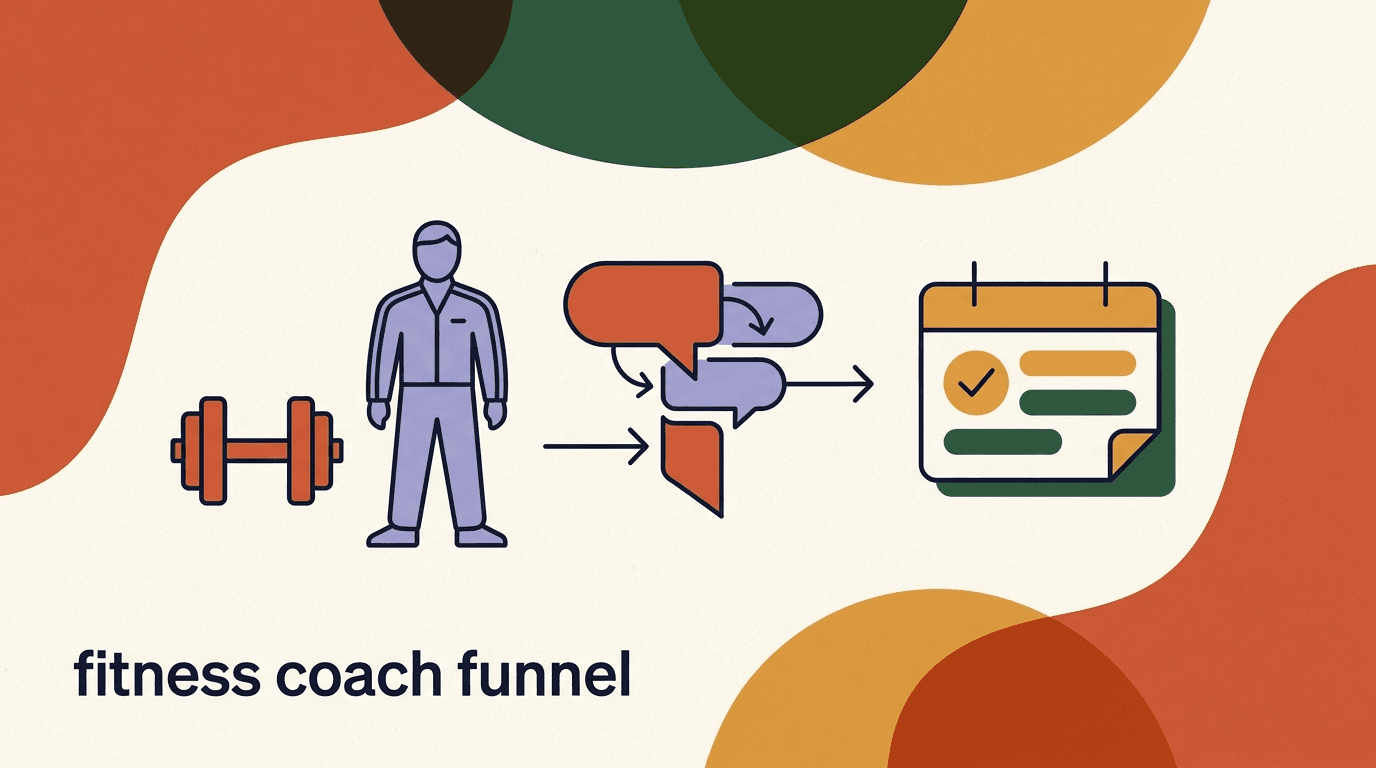
Think of the flows as a funnel that mirrors the real customer journey. A stranger comments or messages, gets qualified and offered a trial, books a first visit, gets reminded so they actually show, and — if they ever drift away — gets a warm nudge to return. Each stage is a flow.
- Lead capture and qualification: turn a comment or cold DM into a named lead with a goal and a schedule.
- Trial and tour booking: offer a free trial or facility tour and book the slot.
- Class-booking assistant: surface the schedule, send booking links, and remind before class.
- Membership sign-up handoff: when a qualified lead is ready, pass them cleanly to your gym software or a human closer.
- Win-back and retention: re-engage members who lapsed, froze, or stopped showing up.
Ship one flow, then the next
Launch the trial-booking flow alone for a week before adding anything. It is the highest-value automation in a gym, and getting one flow genuinely good teaches you more than launching five mediocre ones at once. Resist the urge to build the whole system before going live.
How do you turn comments and DMs into qualified gym leads?
The top of the funnel for most studios is social. Someone watches a class clip, comments a single word, or slides into the DMs asking what your day passes cost. The job of the lead-capture flow is to catch every one of those, move the conversation into a private channel, and collect just enough information to know whether this person is worth a trial offer — without interrogating them.
The mechanic that does the heavy lifting here is comment-to-DM: a public comment with a keyword triggers an automatic private message. It works because it meets people where they already are and feels like a reply, not a broadcast. Keep the public-facing ask simple — one word — and do the real qualification in the DM where it is private.
Qualification deserves a word of restraint, because it is where studios overreach. The temptation is to collect everything up front — age, full goals, injury history, budget, preferred trainer — so the front desk has a complete picture before the person ever visits. Resist it. Every question you add between the prospect saying hello and you offering a trial is a place they can drop off, and the marginal information is rarely worth the lost lead. Collect the minimum needed to make a sensible trial offer, and gather the rest in person, on the trial, when the relationship is warmer and the person is already committed enough to have shown up. The bot's job at this stage is momentum, not a complete database record.
- Post with a clear comment triggerEnd a Reel or post with one instruction: comment a single keyword like TRIAL or START. One word converts far better than a sentence.
- Auto-reply in the DM, not the commentsWhen the keyword fires, send a friendly private message that thanks them and asks the first qualifying question. Keep the public thread clean.
- Ask two or three qualifying questionsGoal, weekly availability, and experience level are enough. Avoid long forms; every extra question loses people.
- Tag and route the leadBased on answers, tag the contact (e.g. beginner, evenings, strength) so the right offer and the right staff member follow up.
- Offer the trial immediatelyDo not wait. A qualified lead who just told you their goal is at peak intent. Offer the trial slot in the same conversation.
Sample comment-to-DM qualification
- Public comment
- User comments: TRIAL
- Auto DM (1)
- Hey! Thanks for the interest. Quick question so I point you the right way — what's your main goal right now: general fitness, strength, or classes?
- Auto DM (2)
- Got it. And which days usually work — weekday mornings, evenings, or weekends?
- Auto DM (3)
- Perfect. Want me to grab you a free trial slot this week? I can book it right here.
How should the free-trial flow be structured?
The free trial is the single most important conversion event in a studio. Everything upstream exists to produce a booked trial, and everything downstream depends on the person actually showing up. So the trial flow has two distinct jobs: book the slot, and protect the slot with reminders so the no-show rate stays low.
Keep the booking step short. Once a lead has said yes to a trial, the worst thing you can do is make them fill out a long form or wait for a callback. Offer two or three concrete time options, confirm in one tap, capture the details your front desk needs, and then get out of the way. The momentum of a yes is fragile.
- Confirm intent and offer specific slotsDo not ask when works for you. Offer two or three real options — Tuesday 6pm, Thursday 7am, Saturday 10am — so the choice is fast.
- Capture the essentials onlyName, phone or email, and the chosen slot. Anything else can be collected at the front desk on arrival.
- Send an immediate confirmationConfirm the booking in the chat right away with the time, address, and what to bring. Certainty reduces second-guessing.
- Send a reminder before the visitA nudge the day before and a few hours before the trial cuts no-shows. Keep it warm and include the address again.
- Follow up after the trialA same-day message after the trial — how did it go, ready to join? — catches people at the peak of their post-workout goodwill.
Reminders are where the ROI hides
Most studios obsess over getting more trial bookings and ignore no-shows. A simple two-message reminder sequence often does more for trial-to-show rate than any amount of extra ad spend. Build the reminders before you scale the bookings.
Sample trial confirmation and reminder copy
- Confirmation
- You're booked for a free trial this Thursday at 7am. We're at 14 Mill Street — parking out front. Just bring water and trainers. See you then!
- Reminder (day before)
- Quick reminder: your free trial is tomorrow at 7am at 14 Mill Street. Reply RESCHEDULE if you need a different time.
- Post-trial follow-up
- Great having you in today! How did the session feel? If you're ready to keep going, I can set you up with a membership — want the details?
How does a class-booking bot work for studios with schedules?
Boutique studios and class-based gyms have an extra layer: a rotating schedule that members and trial-goers need to navigate. A class-booking bot answers what classes are on, when, and with whom, then routes the person to wherever bookings actually happen — usually your scheduling or gym-management app. The bot is the front door to the schedule, not the schedule itself.
Be clear about the boundary here, because it is the most common place studios overbuild. A messaging bot is excellent at answering schedule questions and sending the right booking link with a reminder. It is not a replacement for a real class-management system that tracks capacity, waitlists, and check-ins. Use the bot to reduce the same three schedule questions you answer a hundred times a week, and hand the actual reservation to the system built for it.
- Answer recurring schedule questions instantly: what's on tonight, do you have a beginner class, when's the early session.
- Send the correct booking link based on the class the person asked about.
- Remind booked attendees before class to reduce empty spots.
- Capture interest in full or waitlisted classes and notify when space opens — handed to your scheduling system.
- Do not try to manage capacity or payments in chat; that belongs in your class-management software.
The bot links to bookings; it does not own them
Keep your single source of truth for class capacity in your scheduling or gym-management system. The chatbot's job is to answer questions and route people there fast, not to duplicate the booking database. Duplicating it is how double-bookings happen.
When and how should the bot hand off a membership sign-up?
This is the most important limit to respect in the whole playbook: a chatbot should not be your billing system. When a qualified, warmed-up lead is ready to actually join — to put a card down and start a membership — the automation's job is to make that handoff clean and fast, not to process the payment itself. Memberships involve contracts, recurring billing, freeze terms, and cancellation rules that belong in dedicated gym-management software, not a chat flow.
The handoff can take two shapes depending on how you sell. Some studios close memberships in person at the front desk, in which case the bot's job is to book the closing visit. Others sell online through their gym software, in which case the bot sends the right sign-up link at the right moment. Either way, the bot recognizes the buying signal, confirms the person is ready, and passes them to the human or the system that completes the sale.
- Detect the buying signalPhrases like how do I join, what are your prices, or I'm ready signal intent. Tag the contact as sales-ready.
- Confirm the plan fitQuickly confirm which membership matches their goal and schedule based on what they told you earlier. Keep it to one message.
- Choose the right handoffIf you close in person, book the sign-up visit. If you sell online, send the secure sign-up link from your gym software.
- Notify a humanAlert your sales or front-desk staff in the team inbox that a hot lead is ready, with their tags and history attached.
- Confirm completion outside the chatLet your gym-management system handle the contract and billing, then have the bot send a warm welcome once membership is confirmed.
A chatbot is not a billing or membership system
Do not try to take payment, store card details, or manage contracts inside a messaging tool. KlyoChat included — we are not a gym-management or billing platform. Hand membership billing to software built and compliant for it, and use the bot to get the lead there.
How do you win back lapsed and frozen members?
The most overlooked automation in any gym is the one aimed at people who already paid you. Members lapse for ordinary reasons — a busy season, a holiday, a move, a loss of momentum — and most never hear from the gym again. A win-back sequence is a small, warm series of messages that reminds a former member you are there and gives them an easy reason to come back. It is usually the highest-return automation a studio can run, because the relationship and the trust already exist.
Tone is everything here. A win-back message that reads like a billing reminder or a guilt trip backfires. The good ones sound like a friendly check-in from a human who noticed you have not been around. They acknowledge that life happens, make returning low-stakes, and never shame. Broadcasts are the right mechanism — a scheduled message to a segment of lapsed contacts — but the writing has to feel one-to-one.
Timing matters as much as tone. The window for a win-back is wider than most studios assume, but it is not infinite. A message a week after someone lapses can feel pushy, as if you were watching their account. A message two or three weeks out, once the immediate reason for leaving has cooled, tends to land better — long enough that the person has missed the routine, short enough that they have not fully replaced it with something else. For frozen members, the natural moment is just before or at the end of the freeze period, framed as a helpful heads-up rather than a sales push. Test a couple of timings with small segments and let the response rates tell you what your particular members respond to.
- Segment first: lapsed (membership ended), frozen (paused), and ghosting (paying but not attending) need different messages.
- Lead with warmth, not billing: we miss you and we noticed it's been a while beat your membership status reminders.
- Make returning easy: offer a no-pressure come-back session or a short re-onboarding chat.
- Keep it short: two or three messages over a couple of weeks, not a relentless drip.
- Always give an exit: respect anyone who replies that they are done, and stop messaging them.
Segment before you send
A frozen member who paused on purpose needs a different message than someone whose membership lapsed by accident. Sending the same generic win-back to everyone is the fastest way to annoy your best prospects. Tag and segment, then write to each group.
Sample win-back broadcast for lapsed members
- Message 1
- Hey — we noticed it's been a while since we saw you at the studio. No pressure at all, just wanted to check in. How have you been?
- Message 2 (if engaged)
- Life gets busy, we get it. If you ever fancy easing back in, I'd be happy to book you a low-key come-back session whenever suits.
- Message 3 (gentle close)
- The door's always open if you want to pick things up again. Just reply here and I'll sort it out. Take care!
What retention nudges keep current members coming back?
Win-back catches people after they leave. Retention nudges keep them from leaving in the first place, and they are easier and cheaper than re-acquisition. The pattern that predicts churn in almost every gym is simple: attendance drops off before a cancellation does. A member who came three times a week and is suddenly at zero for two weeks is telling you something. A gentle, well-timed nudge at that moment is one of the highest-leverage messages you can send.
Retention automation should feel like care, not surveillance. The trick is to celebrate and encourage rather than monitor and chase. Milestone messages, check-ins after a gap, and the occasional bit of useful information all keep the relationship warm. None of this should make claims about results — it is about belonging and habit, which are what actually keep people renewing.
- Onboarding nudges: in the first two weeks, a new member is most likely to quit; check in early and often.
- Attendance gap nudges: if someone hasn't visited in a set window, send a warm, no-guilt check-in.
- Milestone messages: celebrate a member's tenth visit, six-month mark, or class streak — recognition builds loyalty.
- Renewal reminders: a friendly heads-up before a renewal date, handled in chat, reduces awkward lapses.
- Feedback asks: a simple how's it going message surfaces problems before they become cancellations.
Retention nudges are about belonging, not results
Keep every retention message focused on habit, community, and care. Do not tie nudges to weight, body composition, or any performance outcome — that is both off-limits as a claim and counterproductive for the members most at risk of quitting. People stay for belonging, not metrics.
How do you keep automation feeling human, not robotic?
The fastest way to lose a prospect is for them to feel processed by a machine. Gym buyers are choosing a place they will spend hours of their week, often somewhere they feel vulnerable. If the first interaction is cold, scripted, and obviously automated, you have set the wrong tone before they walk in. The whole point of automating the routine parts is to free up genuine human attention for the moments that need it.
Most of this comes down to writing and to knowing when to step back. Use the prospect's name, match the casual tone of social DMs, keep messages short, and never send a wall of text. Crucially, build an obvious off-ramp to a real person at every stage. The best automated experiences are the ones where the handoff to a human is so smooth the prospect never quite knows where the bot ended and the staff began.
- Write like a friendly front-desk person, not a corporate FAQ — short, warm, casual.
- Always offer a way to reach a human: reply HELP or I'll get a coach to call you.
- Hand off on any sensitive topic immediately: injuries, complaints, refunds, medical questions.
- Don't over-automate the close; a hot lead often wants to talk to a person, so let them.
- Review real conversations weekly and fix the lines where people drop off or get confused.
Read your own transcripts
The single best way to improve a gym chatbot is to read fifteen real conversations a week. You will see exactly where people get stuck, what questions you didn't anticipate, and which lines sound robotic. Fix those, and the flow gets noticeably better fast.
What metrics tell you the automation is actually working?
It is easy to feel busy with automation and have no idea whether it is making money. A studio should track a short list of numbers that map directly to the funnel, so you can see where it leaks and fix the right thing. Vanity metrics — total messages sent, contacts collected — are noise. The numbers that matter are the ones tied to a booked trial, a show-up, and a sign-up.
Here is a focused dashboard. The point of measuring each stage separately is diagnostic: if trials are booking but no one shows, fix reminders; if people show but don't join, fix the trial experience or the handoff. Without stage-by-stage numbers you are guessing.
| Metric | What it tells you | If it's low, fix |
|---|---|---|
| Inquiry-to-DM rate | How many comments become real conversations | Your comment-trigger and opening DM |
| DM-to-trial-booked rate | How well you qualify and offer the trial | Qualification length and the trial offer timing |
| Trial show-up rate | Whether booked people actually arrive | Reminder sequence before the visit |
| Trial-to-member rate | Whether the visit converts to a sign-up | Post-trial follow-up and the sign-up handoff |
| Win-back response rate | Whether lapsed members re-engage | Segmentation and the warmth of the copy |
Measure stages, not totals
A single conversion number hides where the funnel breaks. Track each stage separately — book, show, join — so you can point automation effort at the leak instead of guessing. Most studios are surprised by which stage is actually losing them members.
What mistakes do gyms make when automating, and how do you avoid them?
Most failed gym automations fail for the same handful of reasons, and all of them are avoidable. The errors cluster around two themes: trying to automate things that should stay human, and building so much before launch that nothing ever ships. Knowing the common traps lets you sidestep them before they cost you leads.
Below is the short list we see most often. Read it before you build, not after, because every one of these is far cheaper to avoid than to unwind once it is live and shaping how prospects experience your studio.
- Automating the close: hot leads often want a human; forcing them through a bot to sign up loses sales.
- Letting the bot quote custom prices or discounts: publish standard rates, hand off negotiation.
- Skipping reminders: booking trials without reminding people guarantees a high no-show rate.
- Robotic tone: long, formal, obviously-templated messages kill the warmth a gym needs.
- No human off-ramp: a prospect who can't reach a person when they need one feels trapped.
- Over-building before launch: shipping three solid flows beats designing twenty perfect ones forever.
- Treating the bot as a billing system: keep membership payment and contracts in real gym software.
The most expensive mistake is over-automation
Gyms sell trust and belonging. Automate the repetitive front-desk work, but keep a human in the loop for the close, for sensitive topics, and for anyone who asks for one. A prospect who feels handled by a machine at the wrong moment rarely comes back.
How does KlyoChat fit a gym or studio's automation stack?
If you have read this far, you have the playbook regardless of which tool you use — the flows above work anywhere. Here is the honest case for where KlyoChat fits, and where it does not. We built KlyoChat as an AI-native unified inbox: Facebook, Instagram, WhatsApp, Telegram, TikTok, and X all land in one place, with AI agents that can qualify a lead, book a trial, and send reminders, plus comment-to-DM, broadcasts for win-back, and a shared team inbox so your front desk and sales staff work from the same screen.
For a gym, that maps cleanly onto the five core flows. AI agents handle the round-the-clock qualification and trial booking; comment-to-DM turns your Reels into booked visits; broadcasts run the win-back and retention nudges to segmented lists; and the team inbox is where a human picks up the close and anything sensitive. It is a middle-of-funnel tool: it captures and books, then hands off.
- What it does well: unified inbox across social and WhatsApp, AI qualification and booking, comment-to-DM, broadcasts, team inbox.
- Honest limit: KlyoChat is not a gym-management or billing system — hand membership billing and contracts to dedicated software.
- Honest limit: no native SMS or email, so trial reminders and win-back run through the chat channels you connect, not text or inbox.
- Honest limit: WhatsApp carries Meta's per-conversation fees on any platform, ours included — budget for those separately.
- Honest limit: we are a newer, smaller community than the largest incumbents, so the template marketplace is smaller.
Where KlyoChat stops and your gym software starts
Use KlyoChat to capture leads, book trials and tours, and run retention and win-back across messaging. Use your gym-management platform for memberships, billing, contracts, and class capacity. The clean handoff between the two is the whole design — neither tool should try to be the other.
KlyoChat plans at a glance
- Basic
- $19/mo — for a small studio testing one or two channels
- Pro
- $49/mo ($39 billed yearly) — all channels, custom AI agents, the common choice for a growing gym
- Business
- $129/mo — multi-location or higher-volume studios with bigger teams
- Trial
- 7-day free trial, no credit card required
How do you roll this out without disrupting the front desk?
A sensible rollout is gradual. You do not flip every flow on at once and hope. You start with the single highest-value automation, prove it works with real prospects, fold your staff in so they trust the handoffs, and then expand. The aim is for the front desk to feel the automation as relief, not as a thing they have to babysit.
Here is a four-week sequence that most studios can run alongside normal operations. The dates are a guide, not a rule — move faster if a flow is solid, slower if you are still tuning the copy. What matters is the order: capture and book first, then reminders, then retention.
- Week one: launch the trial-booking flowConnect your busiest channel, build comment-to-DM plus the trial flow, and route bookings to the front desk. Watch transcripts daily.
- Week two: add reminders and follow-upLayer in the day-before reminder and the post-trial follow-up. This is where show-up and conversion rates jump.
- Week three: connect remaining channels and the team inboxBring WhatsApp and other social channels into one inbox so staff work from a single screen, with clear human handoff rules.
- Week four: turn on win-back and retentionSegment lapsed and at-risk members, write warm copy, and run your first win-back broadcast to a small group before scaling it.
Bring staff in early
Automation that the front desk doesn't trust gets quietly ignored. Show staff exactly when the bot hands off to them and what information they'll receive. When they see it saving them work and feeding them warm leads, they become its best advocates.
Gym membership automation is not about removing the human touch that makes a studio worth joining. It is about making sure the routine, high-volume, around-the-clock messaging work gets done so your people can spend their attention where it counts — on the trial that just walked in and the member who needs a real conversation. Start with three flows: capture and qualify, book the trial with reminders, and win back lapsed members. Add the rest only once those are genuinely good.
Respect the limits and the system works for you: a bot books visits and answers questions; a gym-management platform handles billing and contracts; and a human handles the close, the complaints, and anything touching health. If you want the broader mechanics, our fitness chatbot setup guide goes wider; if you are a solo coach rather than a studio, the fitness coach DM funnel guide fits you; and if you run an appointment business adjacent to fitness, the salon booking chatbot guide shows the same pattern in another vertical. Build the trial flow first, read your transcripts, and let the numbers tell you what to fix next.