A fitness coach DM funnel is the simplest way to turn the content you already post into booked consultations, and most coaches are leaving it half-built. You film the workout, you write the caption, you get comments and saves — and then the trail goes cold. The people most interested in working with you raise their hand in your comments or your DMs, and without a clear path forward, they scroll on. The funnel is what catches that intent and walks it, one message at a time, toward a conversation where you can actually help.
This is a creator-strategy playbook written specifically for fitness and online coaches: personal trainers, nutrition coaches, hybrid online programs, and anyone who sells coaching off the back of social content. It is not a generic five-day sequence and it is not an operations manual for booking studio sessions. It is the path that fits how coaches sell — content earns attention, a hook moves people to DMs, a few honest qualifying questions sort fit from curiosity, and the right offer gets matched to the right person before you ever ask them to book.
We build KlyoChat, so we have a stake in this. We will show you the funnel as a method first — something you can run by hand if you want — and then where automation genuinely helps. No income promises, no body-transformation claims, no pretending a chatbot replaces coaching. Just the structure, the copy, and the math of why DMs convert better than a link in bio.
Why does a DM funnel work better than a link in bio for coaches?
The link in bio is a cliff. Someone watches your content, feels a flicker of motivation, and your only call to action sends them out of the app, onto a landing page, into a form, and through a checkout — all in one leap, while the motivation drains by the second. Most people do not make the jump. They were interested, not committed, and the gap between those two states is exactly where a funnel should live.
A DM funnel replaces the cliff with stairs. Instead of asking for a purchase, you ask for a comment. Instead of a form, you ask a question. Each step is small enough that saying yes feels natural, and each yes builds a little momentum toward the next. By the time you mention a consult, the person has already told you their goal, their level, and roughly what they are looking for. You are not pitching a stranger — you are continuing a conversation.
There is also a trust dimension that matters more in fitness than in almost any other category. People are handing you their body, their habits, and often their insecurities. A real exchange in the DMs — where you answer a question honestly before you ever sell — does more to earn that trust than any landing page. The funnel is not a trick to extract a sale. It is a structured way to have the conversation a good coach would have anyway, at a scale you could not manage purely by hand.
Consider the difference in friction from the prospect's side. The link in bio asks someone to switch contexts entirely: leave the feed they are enjoying, load a separate page, read marketing copy written for everyone instead of for them, and then decide — alone, with no one to ask — whether to spend money. The DM, by contrast, keeps them in the app they already trust, in a thread that feels personal, talking to a human who is responding to what they specifically said. Lower friction is not a minor optimization here; it is the whole reason the funnel exists.
Finally, the DM funnel produces something a landing page never can: information. Every reply teaches you about your audience — the goals they actually have, the objections they actually raise, the words they actually use. Over a few weeks of running it, you end up understanding your prospective clients better than any analytics dashboard could tell you, and that understanding flows back into better content, better offers, and better calls. The funnel is a sales path and a research instrument at the same time.
The funnel is a conversation, not a conveyor belt
If your DM funnel ever feels like you are processing people, it is built wrong. The goal is to make a real conversation repeatable, not to make it robotic. Every step should sound like something you would actually say to someone who asked for your help.
What does a fitness coach DM funnel actually look like end to end?
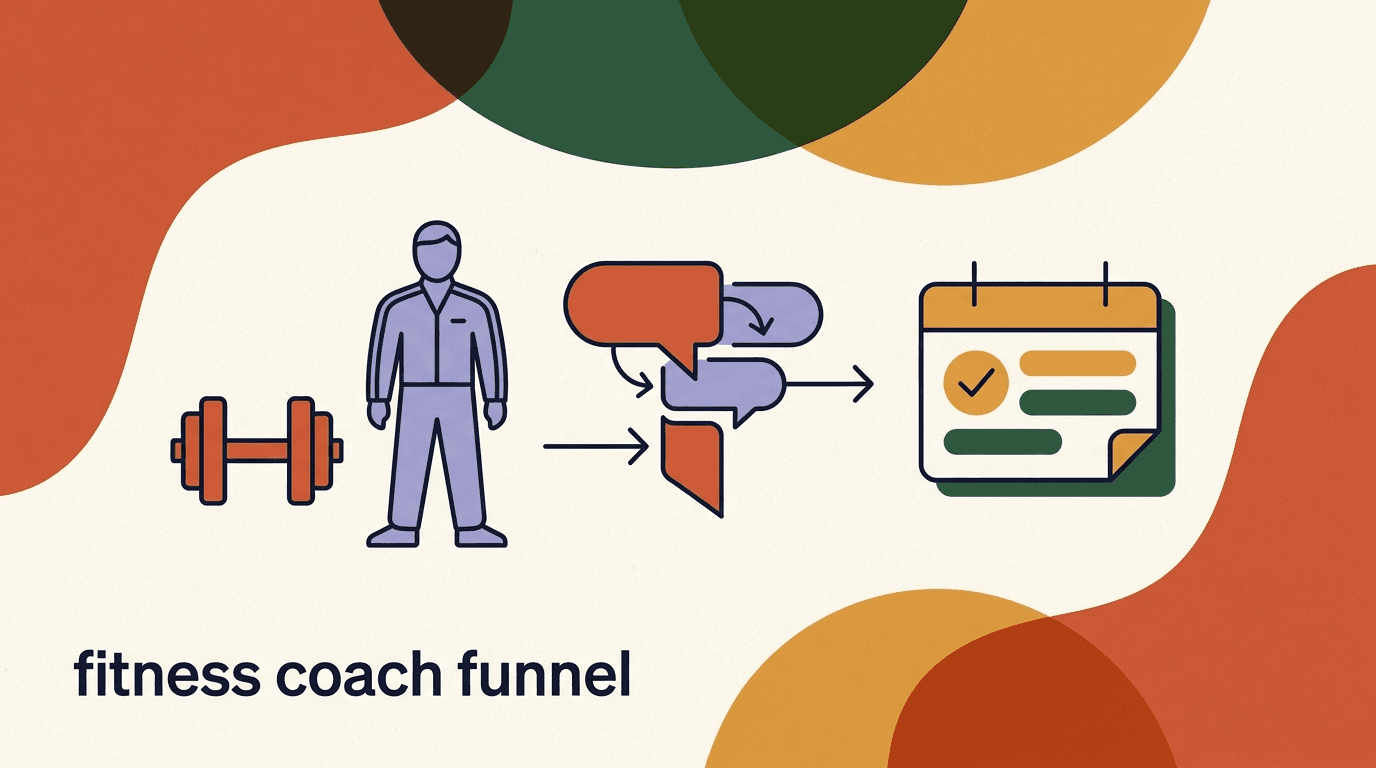
Before we go step by step, it helps to see the whole shape at once. A complete fitness coaching funnel has six stages, and each one has a single job. When a stage tries to do two jobs — say, qualifying and selling at the same time — conversion drops, because you are asking for commitment before you have earned it. Keep each stage to its one job and the whole thing flows.
Here is the path from a piece of content to a booked consult, with the job of each stage and the signal you are looking for before you move on.
- Each stage moves people one step closer, never two.
- Qualifying comes before offering, always — fit first, pitch second.
- The consult is the conversion event, not the sale. The sale happens on the call.
- Follow-up recovers the majority of people who go quiet, and most coaches skip it.
| Stage | Job | Move-on signal |
|---|---|---|
| Content hook | Earn attention and prompt a comment | Someone comments the keyword or replies |
| Comment-to-DM | Move the conversation into private messages | They open the DM and respond |
| Qualify | Learn goal, level, budget, timeline | You understand their situation and fit |
| Share offer | Match the right program to their answers | They engage with the program details |
| Book consult | Get a call or assessment on the calendar | A confirmed booking |
| Follow up | Re-engage people who stalled | They reply or rebook |
How do you build a content hook that earns the right comments?
The funnel starts with content, but not just any content. A hook for a DM funnel is a piece of content built to provoke a specific, low-friction action: a comment with a keyword. The classic format is the value-tease — you show a slice of something genuinely useful, then offer the full version in exchange for a comment. A coach might post three exercises for a stronger lower back and say the full eight-move routine is available to anyone who comments a single word.
The keyword matters more than people think. It should be short, easy to spell, and tied to the content so the intent is unmistakable. Someone who comments PROGRAM under a video about your training method is telling you something different from someone who just likes the post. The comment is a filter and a signal at once: it sorts the curious from the casual, and it gives you permission to open a DM.
Resist the urge to make the hook about you. The content that drives the most qualified comments is almost never the highlight reel of your own physique or your client wins. It is the content that solves a small, specific problem the viewer has right now — how to fix a form issue, how to structure a week, what to do when motivation dips. Solve the small problem in public, and the people who want the big problem solved will raise their hands.
Think about who you want to comment, then build the hook to attract exactly them and gently repel everyone else. A hook aimed at busy professionals who train at home will use different language and a different promise than one aimed at gym regulars chasing a strength number. Specificity is what makes a hook a filter. The broader and more generic the promise, the more low-intent comments you collect — and low-intent comments waste the rest of your funnel, because you spend your DM energy on people who were never going to be a fit.
There is a rhythm to making this sustainable, too. You do not need a viral post to run a funnel; you need a steady cadence of useful, hook-shaped content so there is always something new pulling comments. One reliable value-tease a week, each tied to its own keyword, gives the funnel a constant top-of-funnel supply without forcing you to chase virality. Consistency at the hook stage matters more than the occasional breakout, because the funnel only works when fresh people keep entering it.
One keyword per piece of content
Do not ask for two different keywords in one post, and do not reuse a generic keyword across unrelated content. A specific keyword tied to specific content tells you exactly what the person wants, which makes the next message in the funnel write itself.
Sample hook caption with a keyword call to action
- Hook line
- Most home workouts skip the one muscle group that actually changes how you look in a shirt.
- Value tease
- Here are 3 moves. The full 8-move routine plus a weekly split is something I will send over.
- Comment CTA
- Comment ROUTINE and I will DM it to you.
- Keyword
- ROUTINE — short, on-theme, easy to spell
How does comment-to-DM move someone from public to private?
The comment is a hand raised in public; the DM is where the conversation becomes personal. Comment-to-DM is the bridge, and it is the step most coaches either skip or fumble. Doing it by hand means watching your comments, spotting the keyword, and opening a DM for each person — which works at small scale and collapses the moment a post does well. This is the first place automation earns its keep, because the same trigger that overwhelms you by hand runs with no manual effort at any volume when it is built into a flow.
However you do it, the first DM should do three things and nothing more: acknowledge what they asked for, deliver on the promise, and open the door to the next step. Acknowledge so they know this is a real follow-up and not spam. Deliver so you build trust by keeping your word before you ask for anything. Open the door with a light question that invites a reply, because a DM that ends in a period is a dead end, while one that ends in a question keeps the conversation alive.
Tone is everything here. The DM should sound like you, not like a system. Match the voice of your content — if your videos are warm and a bit funny, the DM should be too. The fastest way to kill a fitness coaching funnel is a first DM that reads like a press release. People can feel the difference between a coach reaching out and a machine processing them, and in a space built on trust, that feeling decides whether they reply.
Respect the platform rules
Comment-to-DM only works inside the messaging rules of each platform, and those rules change. Meta governs how and when you can message people on Instagram and Facebook, including windows for proactive messages. Build your funnel to respect those windows rather than around them — getting flagged costs you far more than any single lead.
Sample first DM after a comment-to-DM trigger
- Acknowledge
- Hey! Saw you commented ROUTINE on the lower-back video.
- Deliver
- Here is the full 8-move routine and a simple weekly split: [link].
- Open the door
- Quick one so I can point you right — are you training mostly at home or in a gym?
- Result
- Delivers value first, then asks one easy question
What qualifying questions sort serious prospects from browsers?
Qualifying is the heart of a fitness coach DM funnel, and it is where coaching funnels differ most from generic ones. You are not just trying to gauge interest — you are gathering the exact information you need to recommend the right program and to walk into a consult already knowing who you are talking to. Four dimensions cover almost everything that matters: goal, level, budget, and timeline. Ask them conversationally, one or two at a time, never as a wall of questions that feels like a form.
Goal tells you what they are actually trying to achieve, in their words, which is often different from what your content assumes. Level tells you where they are starting and how much hand-holding they will need. Budget, asked gently, tells you which of your offers is even relevant — there is no point pitching premium one-to-one coaching to someone looking for a self-guided plan, and no point underselling someone ready to invest. Timeline tells you urgency: a wedding in eight weeks is a very different conversation from a vague someday.
The art is in the sequencing. Lead with goal, because it is the question people most want to answer — everyone likes talking about what they are working toward. Level follows naturally. Budget and timeline come later, once there is rapport, and they can be folded into the conversation rather than fired off as interrogation. A good qualifying flow feels like a coach taking an interest, because that is exactly what it is.
Pay attention to how you ask about budget, because it is the question that makes coaches most nervous and the one they most often skip. The trick is to never ask for a number directly. Instead, ask about the kind of support someone wants — self-guided versus hands-on — and let the answer point you to the right price tier without anyone having to say a figure out loud. Framing budget as a question about how much help they want is honest, comfortable, and far more accurate than asking what they can afford.
It also helps to react genuinely to each answer before moving on. If someone says their goal is to feel strong again after an injury, the worst thing you can do is reply with the next scripted question as if you had not read it. Acknowledge it — that is a great goal, and a careful one — then continue. These small reactions are what separate a qualifying conversation from a survey, and they are exactly the kind of human touch that should survive even when the rest of the flow is automated. People can tell when they have been heard, and being heard is most of what they came for.
| Dimension | What you ask | What it tells you |
|---|---|---|
| Goal | What are you mainly working toward right now? | The outcome to anchor everything else to |
| Level | How long have you been training consistently? | Starting point and support needed |
| Budget | Are you looking for a self-guided plan or hands-on coaching? | Which offer is relevant |
| Timeline | Is there a date or event you are working toward? | Urgency and pacing |
Two questions at a time, maximum
Dumping all four questions into one message reads like a form and kills the conversation. Ask one or two, let them answer, react to what they say, then ask the next. The back-and-forth is what makes it feel human, and the answers are richer because of it.
How do you share your offer without sounding like a pitch?
By the time you share an offer, you should know enough to recommend, not pitch. That distinction is the whole game. A pitch leads with the product — here is my program, here is the price, here is the buy button. A recommendation leads with the person — based on what you told me about your goal and your timeline, here is the path I would put you on. The information you gathered while qualifying is what lets you do the second thing instead of the first.
Match the offer to the answers. Someone who said they train at home, have a few months of experience, and want a self-guided plan should hear about your self-guided program, not your premium coaching tier. Someone with a hard deadline who said they want hands-on help is exactly who your one-to-one offer is for. Recommending the wrong tier — too much or too little — breaks trust and lowers conversion, because it signals you were not really listening.
Keep the offer message focused on the outcome and the fit, and treat price as a detail rather than the headline. You are not hiding the price; you are framing it inside the value. And crucially, the offer message should not try to close. Its job is to get agreement that this is the right direction and to move toward the consult, where the actual decision happens. Trying to close in the DM, before the call, is asking for commitment a step too early.
If you offer more than one program, resist the temptation to lay out a full menu in the DM. A menu shifts the work of deciding onto the prospect, and people who are unsure tend to choose nothing. Your qualifying answers already told you which option fits; lead with that one. You can always mention that there is a lighter or heavier option if it turns out the fit is different, but anchoring on a single confident recommendation is far more useful to someone than a comparison table they did not ask for.
Watch for the difference between a buying signal and a polite reply. When someone responds to your offer with a specific question — about the check-ins, the timeline, what happens after the first month — that is interest, and the right move is to answer briefly and steer toward the consult where you can go deeper. When someone replies with a flat that sounds good, you have agreement but not momentum, and you should move to booking immediately before the moment passes. Reading these signals is a skill, and it is one of the places where staying personally involved in the conversation pays off.
Sample offer message matched to qualifying answers
- Reflect back
- So you are training at home, about 6 months in, and want a structured plan you can run yourself.
- Recommend
- The self-guided program is built exactly for that — progressive plan, video library, monthly check-ins.
- Move to consult
- Easiest next step is a quick 15-minute call so I can tailor the first month. Want me to send times?
- Note
- Recommends a fit, then steps toward the consult — no hard close
What is the best way to book the consult from a DM?
The consult is the conversion event your whole funnel is built around. Not the sale — the conversation. For most coaching businesses, the sale happens on a call or in an assessment, where you can answer objections, build rapport, and tailor the offer in real time. So the job of the DM is narrow and clear: get a real, confirmed booking on the calendar with as little friction as possible.
Friction is the enemy at this stage. Every extra step between yes and booked loses people. The smoothest path is to offer specific times right in the DM and let them pick, or to send a single booking link that opens to your availability. Avoid the back-and-forth of does Tuesday work, well actually, how about Thursday — it is where momentum goes to die. Offer concrete options and confirm fast.
Set expectations for the call so they show up. A booked consult that no-shows is worse than no booking, because you held the slot. Tell them how long it will be, what you will cover, and what they will walk away with even if they do not sign up. A consult framed as a free session of genuine value gets honored; one framed as a sales call gets ghosted. And the moment it is booked, confirm it warmly so the commitment feels real.
- Offer specific times or one linkGive two or three concrete slots in the DM, or a single booking link. Never make them ask what is available.
- Confirm immediatelyThe moment they pick, confirm the time and add a warm line so the booking feels personal, not transactional.
- Set the agendaTell them the length, what you will cover, and the value they get on the call regardless of whether they sign up.
- Send a reminder before the callA short reminder the day before and an hour before cuts no-shows. Keep it friendly and easy to reschedule.
Booked is not the finish line — showing up is
Track booked-to-attended, not just bookings. If people book and do not show, the problem is usually framing or reminders, not your funnel's top end. Fix the reminder and the agenda before you touch anything earlier in the path.
How do you follow up with people who go quiet?
Most coaches build the first five stages and stop, which means they leave most of their results on the table. People go quiet for ordinary reasons — they got busy, they meant to reply, life happened. Silence is rarely a hard no; it is usually a not right now. Follow-up is how you separate the two, and it is consistently the highest-return, lowest-effort part of a fitness coaching funnel.
The key is to follow up with a reason, not a reminder. Bumping someone with just checking in adds nothing and can feel needy. Following up with a new piece of value — a tip related to the goal they mentioned, an answer to a worry they raised, a relevant client story told honestly without claiming guaranteed results — re-opens the conversation on a positive note. You are giving, not nagging, and that changes how the message lands.
Timing and limits matter. Space follow-ups out, vary the angle, and know when to stop. A good rhythm is a value-led nudge a couple of days after they go quiet, a second one with a different angle a few days later, and then a graceful exit that leaves the door open without pressure. Following up forever does not help; following up two or three times with genuine value recovers a meaningful share of stalled conversations without ever feeling pushy.
- Lead every follow-up with value, never with a bare reminder.
- Vary the angle each time — a tip, then an answer to a likely objection, then a soft door-open.
- Reference what they told you while qualifying so it feels personal, not bulk.
- Cap it at two or three touches, then leave the door open and move on.
Sample value-led follow-up after a stall
- Reference their goal
- Hey — still thinking about that home-training goal you mentioned?
- Lead with value
- Quick tip while it is on my mind: anchoring your sessions to the same two days a week beats relying on motivation.
- Soft door-open
- If you want, that 15-minute call still stands — no pressure either way.
- Note
- Gives something useful before re-asking
How do you keep the funnel honest and on the right side of the rules?
A coaching funnel touches two sensitive areas at once: people's health and the platform rules you operate under. Get either wrong and the funnel that was meant to grow your business can damage it instead. The good news is that staying honest is also what makes the funnel convert better over time, because trust compounds and burned trust does not come back.
On health, the rule is simple: do not promise outcomes you cannot guarantee, and do not make medical claims you are not qualified to make. No guaranteed results, no specific weight or body promises, no claims to treat conditions. Speak to your method, your structure, and the work you do together — not to a finish line you cannot control. This is not just ethics; vague promises attract the wrong clients and specific honest framing attracts the right ones.
On platform rules, respect the messaging windows and policies of each network. Meta sets the terms for proactive and automated messaging on Instagram and Facebook, and those terms shift. Build your comment-to-DM and follow-up logic to work inside the allowed windows, keep your messaging relevant to what the person asked for, and avoid anything that looks like unsolicited bulk contact. A funnel that respects the rules runs for years; one that games them runs until it gets flagged.
No income or health guarantees, ever
Do not promise specific results, weight loss, or income — to your prospects or in your own marketing. Beyond being against most platform and advertising rules, guarantees you cannot keep are the fastest way to lose the trust your whole funnel runs on. Sell the process, not a promise.
What metrics tell you whether the funnel is working?
You cannot improve what you do not measure, and a DM funnel gives you clean numbers at every stage. The point of tracking is not a dashboard for its own sake — it is to find the one stage where people drop off most, fix that, and then find the next one. Funnels improve at their weakest link, so the metric that matters most is wherever the biggest leak is right now.
Track each handoff as a conversion rate, not just a raw count. Comments per post tells you whether your hooks land. Comment-to-DM-reply tells you whether your first message earns a response. Qualified-to-offer tells you whether your questions are sorting well. Offer-to-booked and booked-to-attended tell you whether your consult step is tight. When one number is far lower than the rest, that is your project for the week.
Be patient with the data and ruthless about one change at a time. If you rewrite your hook, your first DM, and your offer message all at once and bookings move, you learn nothing about which change did it. Adjust one stage, give it enough volume to read, then move on. A funnel tuned this way gets quietly better every month, and the compounding is what separates coaches who book consistently from coaches who book in bursts.
| Metric | What it measures | If it is low, fix |
|---|---|---|
| Comments per post | Whether your hook provokes action | The hook and keyword CTA |
| DM reply rate | Whether your first message earns a response | First DM tone and the question you end on |
| Qualify completion | Whether people answer your questions | Question count and pacing |
| Offer-to-booked | Whether your offer fits and your booking is frictionless | Offer match and booking friction |
| Booked-to-attended | Whether people show up | Reminders and call framing |
When should a coach run this by hand versus automate it?
Run it by hand first. Before you automate anything, run the whole funnel manually for a couple of weeks — watch your comments, open the DMs yourself, ask the questions live, book the calls. This is not busywork; it is how you find the copy that actually works in your voice and the questions that actually surface the right information. Automating a funnel you have not validated by hand just scales something that does not convert.
Automate the parts that break under volume, in order. The first thing that breaks is comment-to-DM — the moment a post does well, you cannot catch every keyword by hand, and people who waited too long for a reply lose interest. Next is the first DM and the delivery of whatever you promised, because that should be instant. Then the qualifying flow and the follow-up sequence, which are repetitive by nature and easy to forget when you are busy coaching.
Keep yourself in the loop where judgment matters. The consult conversation and the actual offer recommendation are where a human coach is irreplaceable, and they should usually stay human or at least human-reviewed. The right setup is not full automation or none — it is automation handling the repetitive top of the funnel so your attention is free for the conversations where it counts. That balance is what lets a solo coach run a funnel that would otherwise need a team.
- Validate the funnel by hand before automating anything.
- Automate comment-to-DM first — it is what breaks when content performs.
- Automate first DM, delivery, qualifying, and follow-up next, in that order.
- Keep the consult and the offer recommendation human or human-reviewed.
Automation should free your attention, not replace your judgment
The goal is not to remove yourself from the funnel. It is to remove yourself from the repetitive parts so you have more attention for the conversations that decide whether someone becomes a client.
How does KlyoChat help you run a fitness coach DM funnel?
We build KlyoChat, so here is the honest version of where it fits. KlyoChat is an AI-native, mobile-first unified inbox that brings your social messages into one place, with comment-to-DM, no-code flows, AI agents, and analytics built in. For a fitness coach DM funnel, that maps onto exactly the stages we just walked through — and because the inbox is mobile-first, you can manage real conversations from your phone between sessions instead of being tied to a desk.
Comment-to-DM triggers handle the bridge from public to private automatically, so a post that performs does not leave qualified commenters waiting. No-code flows let you build the first DM, delivery, and qualifying sequence without writing code, in your own voice. AI agents can handle the repetitive qualifying back-and-forth and help book consults, while you stay in the loop for the offer recommendation and the call itself. The analytics give you the stage-by-stage conversion rates you need to find and fix your weakest link.
Now the limits, plainly. KlyoChat has no native SMS or email, so if your follow-up strategy leans on texting or email sequences, you will need another tool for those channels. We are a newer and smaller platform with a smaller community than the longest-established players, so there are fewer third-party templates and tutorials floating around. And we hold the line on the rules in this post: KlyoChat helps you respect Meta's messaging policies, and it does not make income or fitness-results guarantees on your behalf — the honesty of your funnel is still yours to own.
- AI agents are included for qualifying and booking — not a separate add-on.
- Mobile-first inbox means you can run the funnel from your phone between clients.
- Honest limit: no native SMS or email; pair another tool if you need those.
- Honest limit: newer, smaller community than the oldest platforms.
| Funnel stage | How KlyoChat helps | Where you stay involved |
|---|---|---|
| Comment-to-DM | Automatic trigger from comment keyword to DM | Writing the keyword and first message |
| First DM and delivery | Flow sends acknowledgment and your promised value instantly | The voice and the value you deliver |
| Qualify | AI agent or flow asks goal, level, budget, timeline | Reviewing answers, judging fit |
| Book consult | AI agent helps surface times and confirm | The recommendation and the call |
| Follow up | Flow sends value-led, paced follow-ups | Approving the angle and the cap |
KlyoChat plans for coaches
- Basic
- $19/mo — get a single funnel running on a couple of channels
- Pro
- $49/mo ($39 billed yearly) — all channels, custom AI agents for qualifying and booking
- Business
- $129/mo — for coaching teams with more seats and higher volume
- Trial
- 7-day free trial, no credit card required
The bottom line: a fitness coach DM funnel is just a good coaching conversation made repeatable — a hook that earns the right comment, a bridge into the DMs, honest qualifying by goal, level, budget, and timeline, an offer matched to the answers, a frictionless consult booking, and follow-up that leads with value. Run it by hand until the copy works in your voice, then automate the repetitive top of the funnel so your attention goes to the conversations that close.
Keep it honest — no guaranteed results, no health claims, and full respect for each platform's messaging rules — and the trust it builds will compound. For the operational booking-and-ops side see our fitness chatbot setup guide, for a generic day-by-day cadence see our coaching DM sequence, and for the bigger picture of turning a following into revenue see our Instagram revenue system. Then go build the funnel that catches the intent your content is already creating.