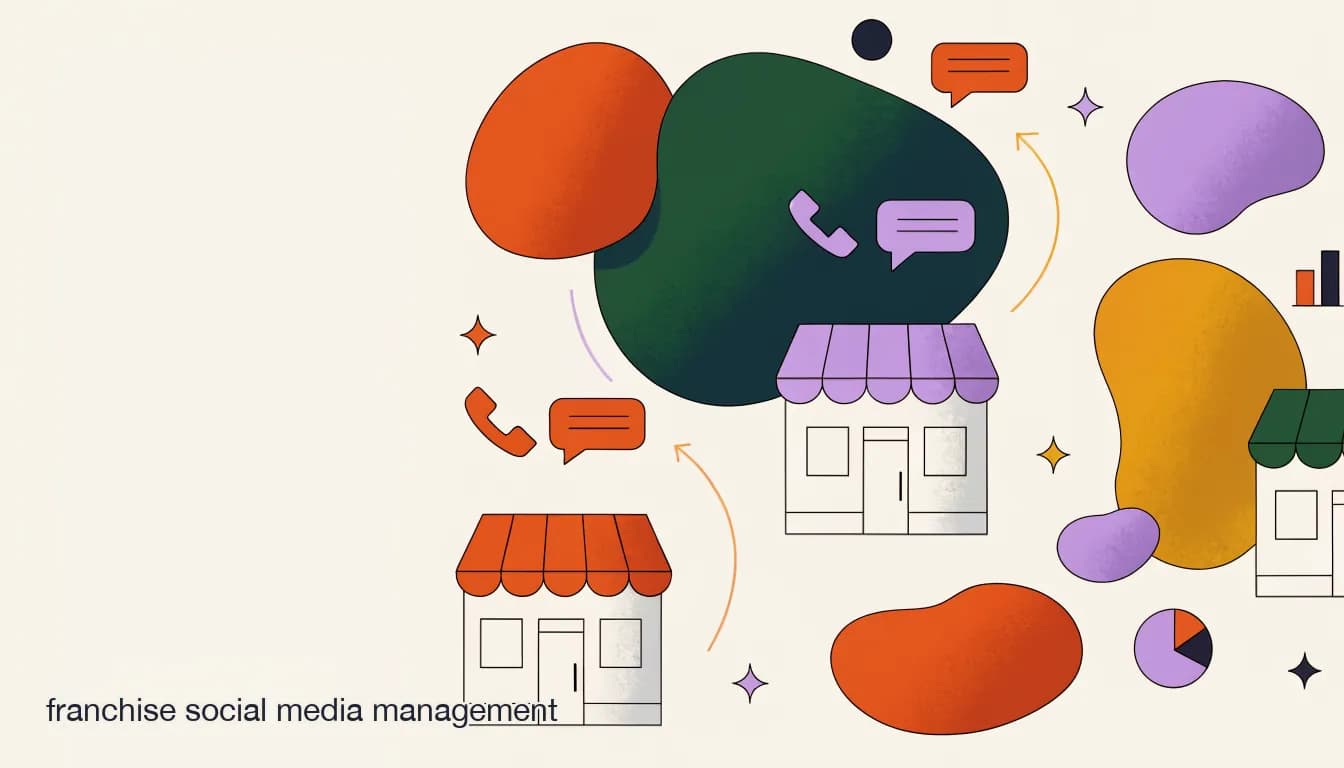
Franchise social media management looks manageable with one or two locations. One person owns the Instagram and Facebook accounts, answers DMs personally, and knows every regular customer by name. Add a third location and the model quietly stops working — not because anyone got lazy, but because the informal system that worked for two storefronts has no way to scale to three, ten, or fifty.
The symptoms show up gradually. A regional manager notices one location's Instagram replies take four hours while another answers in ten minutes. A corporate marketing team posts a promo, and half the locations never mention it in their DM conversations because the local page owner didn't see the memo. A customer messages the wrong location's Facebook page asking about a franchise two towns over, and nobody forwards it. None of this is a single dramatic failure — it's a slow leak of leads, consistency, and brand trust across every channel the franchise touches.
This post covers why the breakdown happens structurally, not just anecdotally, what it actually costs a franchise group in practice, and what changes when a franchise moves from per-location logins to a shared system built for exactly this problem.
Why does adding a third location change everything?
Two locations can coordinate with a phone call. Three or more locations need a process, because informal coordination has a hard ceiling — somewhere between two and four people or teams, ad hoc coordination stops scaling and needs to become a system. This isn't specific to social media; it's a pattern that shows up in any operational function once headcount or location count crosses a small threshold.
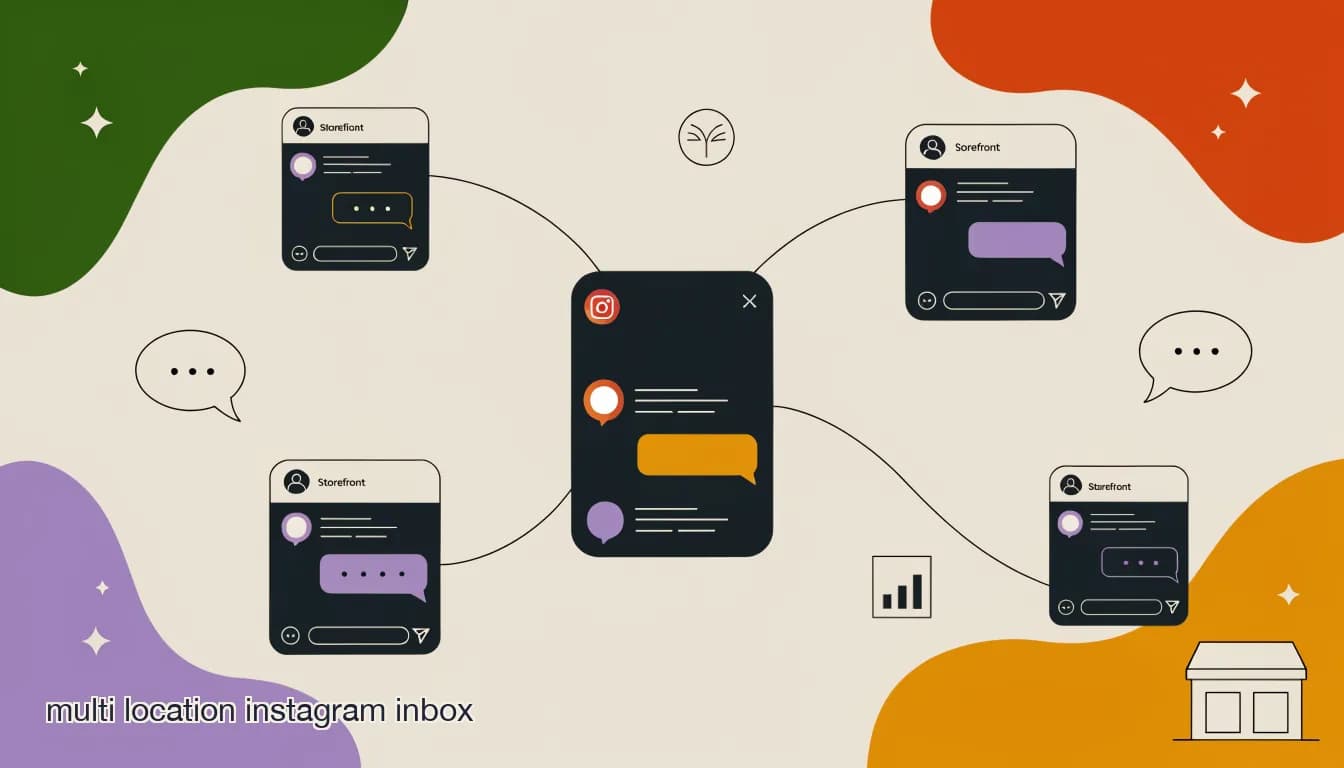
At three-plus locations, each with its own Instagram and Facebook page, you get three separate inboxes, three separate response-time habits, and three separate interpretations of 'how we talk to customers.' Nobody at corporate can see all three at once unless they log into each page individually, which nobody actually does consistently — checking three Instagram accounts by hand every morning is the kind of task that gets skipped the first time something more urgent comes up, and then becomes a habit of skipping.
The math gets worse, not better, as locations are added. With two locations there's one relationship to manage (Location A and Location B coordinating). With ten locations there are, in principle, forty-five possible pairwise relationships if anyone tried to coordinate peer-to-peer, which nobody does — instead, coordination collapses entirely and each location operates as an island. That's the real mechanism behind the breakdown: it isn't that franchise operators get worse at social media as they grow, it's that the coordination model that worked at small scale has no equivalent at larger scale unless someone deliberately builds one.
| Locations | Typical coordination model | What breaks |
|---|---|---|
| 1 | Owner-operator personally replies | Nothing — works fine |
| 2 | Two owners text each other as needed | Still mostly holds |
| 3-5 | Informal group chat, no shared visibility | Response times diverge, tone drifts |
| 6-15 | Regional manager tries to spot-check locations | Spot-checks miss most problems; reactive firefighting |
| 16+ | No single person can track all inboxes | Leads lost, brand voice fragments, no reporting |
This is an operations problem wearing a marketing costume
Franchise groups often file 'inconsistent social media' under marketing and try to fix it with a style guide or a training video. The actual failure is operational — no shared system, no shared visibility — and a style guide doesn't fix a visibility problem any more than a memo fixes a broken reporting pipeline.
What does inconsistent brand voice actually cost a franchise?
Brand consistency isn't a marketing nicety for a franchise — it's the entire value proposition of the franchise model. A customer who has a great DM experience at one location and a curt, slow one at another location doesn't conclude 'that one franchisee is having a bad week.' They conclude the brand itself is unreliable, and that impression follows them to every other location they might visit, including ones they haven't tried yet.
Maria, regional ops director at a 14-location fitness franchise, put it plainly in a call with our team: 'Corporate spends real money making sure the gym floor looks the same in every location. Nobody was doing that for the DMs, and DMs are where half our trial memberships start now.' That's a useful way to think about the cost: franchise groups already invest heavily in visual and operational consistency — signage, uniforms, menu presentation, equipment layout — but the messaging layer, which is often the very first touchpoint a prospective customer has with the brand, gets none of that same rigor.
The cost shows up in a few concrete ways. First, directly lost leads: a slow or generic DM response loses the customer to a competitor before the conversation even starts. Second, brand equity erosion: a customer who has one bad experience generalizes it to the whole chain, which means a single underperforming location can quietly undermine marketing spend at every other location. Third, franchisee friction: when one location's poor DM handling becomes visible to corporate (usually via a complaint, rarely via proactive monitoring), it creates a difficult conversation with that franchisee that could have been avoided with earlier, quieter visibility.
Where do franchise social DMs actually go missing?
In our conversations with franchise operators, the same failure points come up repeatedly, and none of them require a bad employee — just a system with no shared visibility. It's worth walking through each one because the fix looks different depending on which failure mode is actually happening at your locations.
- A DM lands on a location page after hours and sits unanswered until someone happens to open the app the next day, by which point the customer has often already messaged a competitor.
- A customer messages the wrong location's page (common when locations are geographically close, or when a customer finds an old page via search) and nobody forwards it to the correct storefront.
- A corporate promo goes out, but a location's page owner never sees the brief and answers customer questions about it incorrectly, creating a confusing or embarrassing exchange.
- A location's social manager quits or changes roles, and DMs to that page go unanswered for days or weeks until someone notices — often only when a customer complains through a different channel.
- Nobody at corporate can pull a simple report of which locations are answering fast and which aren't, so underperformance is invisible until it shows up in revenue, by which point it's already cost several months of leads.
- A location's staff member replies off-brand — too casual, too curt, or factually wrong about a policy — and there's no review layer catching it before the customer sees it.
Is it worth centralizing franchise social media at 3 locations, or should we wait?
The honest answer: earlier than most franchise groups think. The cost of centralizing isn't the trigger — the cost of not centralizing compounds quietly with every location you add, because each new location multiplies the number of disconnected inboxes without adding any shared oversight.
A useful test: if a regional manager cannot answer 'which of our locations is slowest to respond to DMs this week' without calling each store manager individually, the informal system has already broken down, whether or not anyone has noticed the lost leads yet. Waiting for the problem to become visible in revenue numbers means waiting for months of accumulated damage that a simple shared-inbox setup would have caught immediately.
There's also a practical growth argument: franchise groups that centralize early build the habit and the process while it's still small and low-stakes. Trying to retrofit a shared system across thirty locations, each with its own entrenched habits and its own franchisee pushback, is a much harder project than building it in at location four or five, when the habits haven't calcified yet.
The question that reveals the breakdown
- 2 locations
- "Just ask Dave, he handles both pages" — still works
- 5 locations
- No single answer exists — nobody can see all five inboxes at once
What's the difference between managing 3 locations and managing 30?
At three locations, the problems described above are mostly annoyances — a slow response here, a missed promo there. At thirty locations, the same unmanaged pattern becomes a structural liability that shows up in franchisee relations, in brand audits, and in the franchise's ability to sell new territories, because prospective franchisees will notice if the brand's digital presence looks inconsistent from one existing location to the next.
The scale also changes what 'good' oversight looks like. At three locations, a regional manager can plausibly eyeball each page once a week. At thirty, that's not a job for a person anymore — it requires a system that surfaces exceptions (a location whose response time has spiked, a location with unanswered DMs older than 24 hours) rather than requiring someone to manually review every conversation across every location.
| Scale | Oversight that's realistic | What corporate actually needs |
|---|---|---|
| 3-5 locations | Manual spot-checks, informal check-ins | A shared inbox to remove the manual step |
| 6-15 locations | Manual oversight is already failing quietly | Assignment + basic per-location reporting |
| 16-50 locations | Manual oversight is not possible | Exception-based alerts, standardized AI first response |
| 50+ locations | Requires dedicated ops tooling | Full analytics dashboard, role-based access per region |
How should staffing responsibility change as location count grows?
Small franchise groups often assume the fix for social media inconsistency is hiring a dedicated social media manager once they hit a certain size. That can help, but it doesn't solve the structural problem on its own — a single social media manager covering fifteen locations' DMs personally just becomes the new single point of failure, and now every location's response quality depends entirely on one person's bandwidth and shift schedule.
The more durable model splits responsibility: local staff at each location handle their own conversations (because they know local context — inventory, promotions, community events — better than anyone at corporate), while a shared system and a consistent AI-assisted first response layer ensure that no conversation goes fully unanswered regardless of whether local staff are online at that moment. Corporate's role shifts from 'answering DMs' to 'monitoring whether DMs are being answered well,' which is a fundamentally more scalable job.
- Keep conversation ownership localLocal staff answer their own location's DMs — they have the context corporate doesn't.
- Add a consistent AI-assisted first response layerEvery location gets the same baseline response quality, even outside staffed hours.
- Give corporate exception-based visibilityRegional managers see flagged issues — slow locations, unanswered threads — not every message.
- Rotate a light-touch QA reviewPeriodically sample conversations across locations to catch tone or policy drift early.
What metrics should corporate actually track across locations?
Most franchise groups either track nothing at the location level (relying on anecdote and complaints) or try to track everything, which produces a report nobody reads. A small, well-chosen set of metrics, reviewed consistently, beats a large dashboard reviewed rarely.
- First-response time per location — the single clearest early-warning signal of a location falling behind.
- Percentage of conversations answered within a defined target window (e.g. under 15 minutes during business hours).
- Volume of DMs per location, to distinguish a genuinely slow location from a genuinely overloaded one.
- Conversations left unanswered past 24 hours — should be close to zero and is a strong red flag when it isn't.
- A rotating sample of conversation transcripts reviewed for tone and accuracy, not just speed.
Track trends, not single snapshots
A single bad week at one location isn't necessarily a systemic problem — staff illness, a busy local event, or a platform outage can all cause a temporary spike. Look for locations that are consistently below the network average over several weeks before treating it as a real issue.
What does the transition from per-location chaos to a shared system actually look like?
Franchise groups often delay centralizing because they imagine it as a disruptive, all-at-once migration. In practice it's closer to a phased rollout, and franchise groups that treat it that way have a much easier time than the ones that try to flip every location over on the same day.
- Pilot with 2-3 locationsPick a mix of a strong-performing and a struggling location to see how the shared system handles both.
- Connect channels via standard OAuthEach location's Instagram, Facebook, and WhatsApp connects individually — no passwords shared, no accounts merged.
- Set a single brand voice and escalation standardWrite it down once, apply it everywhere, rather than leaving tone to individual interpretation.
- Turn on assignment and location taggingConversations route automatically to the right local team, so nothing crosses wires between nearby locations.
- Review the pilot's response-time data after 2-3 weeksConfirm the shared system is actually improving consistency before rolling out further.
- Roll out to the rest of the network in batchesOnboard remaining locations in groups rather than all at once, so support capacity keeps pace.
What mistakes do franchise groups make when they try to centralize?
The most common mistake is over-correcting: centralizing not just visibility but the actual conversation ownership, routing every location's DMs to one corporate team. That team doesn't know Location B is out of a specific item this week or that Location C has a local promotion running, so customers get generic or wrong answers — a different failure mode, but still a failure. The right target is shared visibility with local ownership, not full corporate takeover of every conversation.
A second common mistake is rolling out a new shared tool without also settling the brand voice question first. If every location is suddenly visible in one dashboard but there's still no agreed standard for tone, escalation, or which claims staff are allowed to make about pricing or promotions, centralizing the tooling just makes the inconsistency more visible without fixing it. The tooling and the standard need to launch together.
A third mistake is treating the rollout as purely a corporate mandate with no franchisee buy-in. Franchisees who feel their local ownership is being taken away tend to resist, drag their feet on adoption, or quietly keep using their old workflow alongside the new one. Explaining the local-ownership-plus-shared-visibility model clearly, and showing franchisees the response-time data that motivated the change, tends to get much better voluntary adoption.
Don't centralize tooling before agreeing on the standard
A shared inbox without a shared brand-voice standard just makes existing inconsistency more visible, not less. Settle the tone, escalation rules, and what staff can and can't promise customers before or alongside the rollout, not after.
How does KlyoChat approach franchise social media management?
We build KlyoChat, and this is the exact problem our multi-tenant structure is designed around: every location's social inbox under one roof — consistent AI agents, assignment, and per-location analytics. Instead of each location running its own disconnected Instagram and Facebook logins, a franchise group connects every location into one shared inbox, assigns conversations to the right local team, and gives regional managers a single view across all of it.
Each location keeps its own public-facing Instagram, Facebook, and WhatsApp presence — nothing about local ownership changes — while the conversation layer behind those accounts becomes visible and consistent for the first time. An AI agent trained on a shared brand knowledge base handles baseline first response so no location goes fully unanswered outside staffed hours, and per-location analytics let a regional manager spot a struggling location in a weekly glance instead of a quarterly surprise.
This isn't a claim that social media management gets effortless at scale — staffing, training, and local relationships still matter — but it's a structural fix for the specific breakdown described above: no shared visibility, no consistent voice, no way to route a DM to the right storefront. Franchise groups on KlyoChat typically start with Pro, which includes AI agents and all supported channels in the plan.
None of this requires a franchise group to give up local ownership of its social presence or its franchisee relationships. The change is narrower and more mechanical than it sounds: give corporate shared visibility into response time and conversation quality, keep local staff answering local conversations, and add a consistent baseline response so no location's customers are left waiting simply because nobody happened to be logged in. That's a small structural change with an outsized effect on how consistent the brand actually feels to a customer messaging any one of its storefronts.