A multi location Instagram inbox is the tool a franchise group needs the moment it has more locations than one person can watch. Instagram is usually the highest-volume DM channel for franchise businesses — customers ask about hours, availability, pricing, and promotions there before they'll call — and each location typically runs its own Instagram account for local discoverability and geo-tagged content. That's the right setup for the public-facing page. It's the wrong setup for how the DMs behind it get managed.
The mistake franchise groups make is assuming that because each location needs its own Instagram account, each location also needs its own completely disconnected inbox with no shared visibility. Those are separate decisions. A location can keep full ownership of its public Instagram presence — its posts, its local voice, its community — while still routing its DMs through a shared inbox that gives corporate oversight and consistent response quality across the network.
This post covers how to structure that split correctly: what stays local, what gets centralized, and where the common setup mistakes are.
Should every franchise location have its own Instagram account?
Generally yes. A separate account per location supports local discoverability (customers searching for the nearest storefront), location-tagged posts, and a community feel that a single brand-wide account can't replicate at scale. Trying to run twenty locations off one shared Instagram account usually backfires — followers in one city get flooded with content about a location they'll never visit.
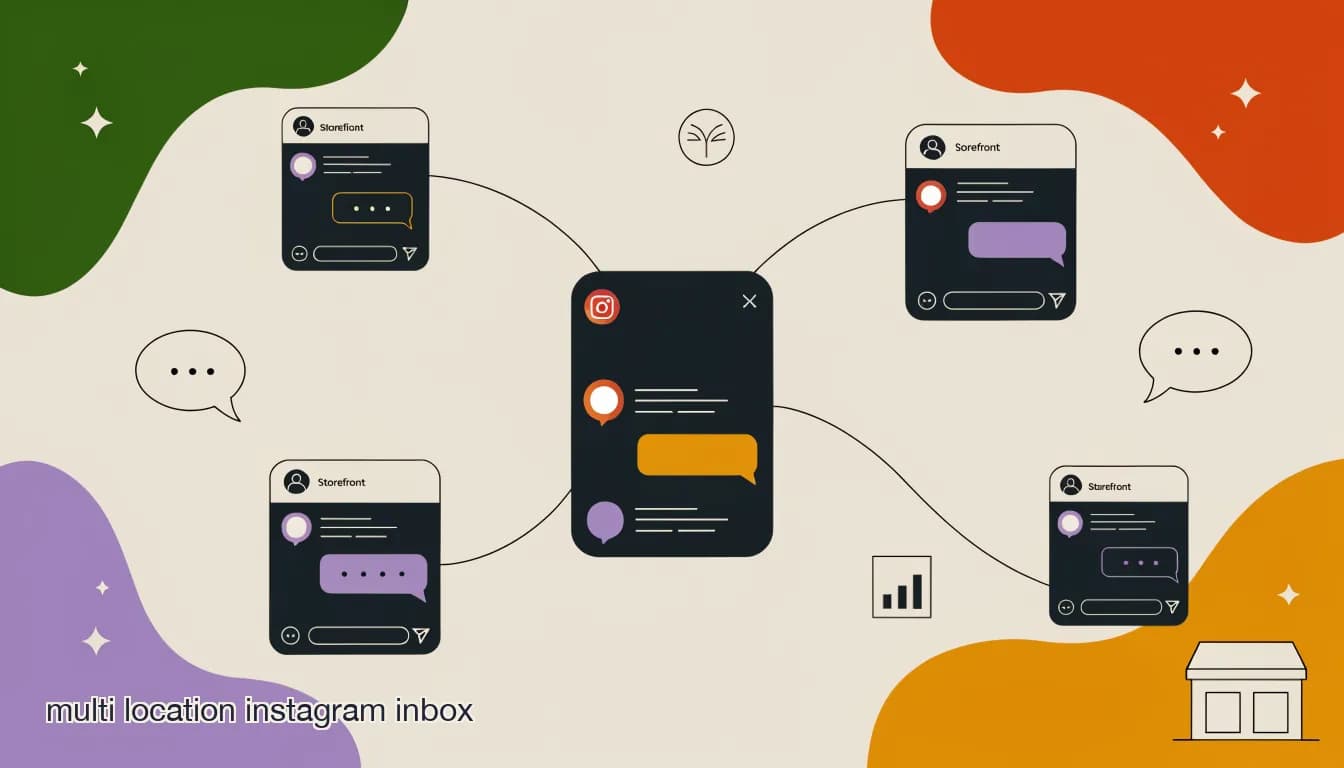
What doesn't need to be separate is the DM management behind those accounts. Instagram supports connecting multiple business accounts into a shared inbox tool, which is the structural fix: local public presence, centralized conversation management.
What should stay local vs. what should be centralized?
Getting this split right is the core design decision for a multi location Instagram inbox. Get it wrong in either direction and you either lose local relevance or lose brand consistency.
| Element | Keep local | Centralize |
|---|---|---|
| Instagram account & posts | Yes — local voice, local content | — |
| Who answers a location's DMs | Yes — local staff know local context | — |
| Brand voice / tone standard | — | Yes — one standard, applied everywhere |
| Response time visibility | — | Yes — corporate needs to see all locations |
| First-response AI knowledge base | Local facts (hours, address, promos) | Brand facts (policies, FAQ, tone) |
| Escalation rules | — | Yes — consistent across the network |
Local ownership and shared visibility are not in conflict
Franchise operators sometimes worry that centralizing DM management means taking control away from local teams. Done right, it's the opposite: local staff still own the conversation, corporate just gets a window into whether it's happening well.
How do you connect multiple Instagram accounts to one inbox?
Each location's Instagram Business account connects individually via standard OAuth to the shared inbox platform — this is a few clicks per location, not a technical migration. Once connected, conversations from every location flow into one view, tagged by which location they came from, without merging the underlying Instagram accounts or followers.
- Confirm each location runs an Instagram Business (not personal) accountBusiness accounts are required for third-party inbox connections.
- Connect each location's account via OAuthA few clicks per location; no need to share passwords across the organization.
- Set up location taggingEach incoming DM is automatically tagged to its source location so nothing gets mixed up.
- Assign local staff to their location's conversationsStaff only see and handle DMs for their own location, even inside a shared platform.
- Give regional managers cross-location visibilityOne dashboard view across every location's response time and volume.
What's the biggest risk in setting this up wrong?
The most common failure mode is a franchise group centralizing everything, including who answers each conversation — routing all DMs to one corporate team with no local context. That backfires because a corporate agent doesn't know Location B is out of a specific product this week, or that Location C has a local promotion running. Customers get generic, sometimes wrong, answers.
The opposite failure — no centralization at all — is the more common starting point and the one this whole series addresses: complete fragmentation, no shared visibility, and brand voice drift.
Two ways to get it wrong
- Over-centralized
- One corporate team answers all locations' DMs, misses local context, gives generic answers
- Under-centralized
- Every location manages DMs in total isolation, no shared visibility, response times diverge
How does KlyoChat structure a multi-location Instagram inbox?
We build KlyoChat around exactly this local-ownership-plus-shared-visibility split. Every location's Instagram account connects independently, conversations are automatically tagged and routed to the right local team through assignment, and an AI agent handles consistent first response using a shared brand knowledge base with location-specific facts layered on top — details we cover in depth in our post on franchise chatbot brand consistency.
The result matches the positioning we build KlyoChat around: every location's social inbox under one roof — consistent AI agents, assignment, and per-location analytics — without forcing locations to give up their own Instagram presence.