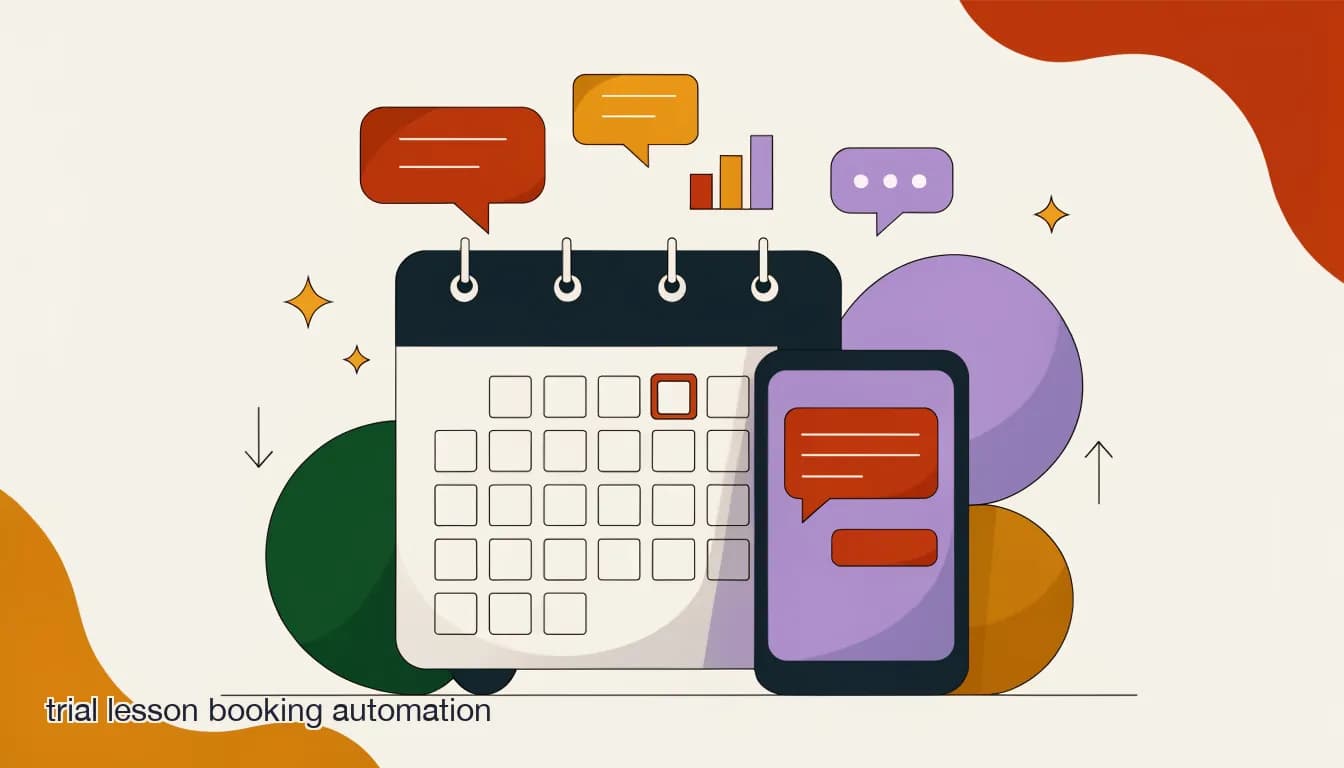
Trial lesson booking automation matters because the trial or placement assessment is the single highest-leverage appointment in an education provider's entire funnel — it is the moment a prospective student experiences your teaching firsthand, and it is also the appointment most likely to get missed. A student who no-shows a trial rarely reaches back out on their own to reschedule; the interest that brought them that far quietly evaporates.
The fix is not more willpower from staff remembering to send reminders — it is a repeatable, automated workflow that runs the same way every time: booking, confirmation, a reminder sequence, and an immediate recovery message if the student does not show. Get that workflow right and the payoff shows up directly in your trial-to-enrollment conversion rate.
This applies whether the appointment is a language placement test, a driving lesson trial, a tutoring diagnostic, or a first coaching session for a course platform — the underlying mechanics of booking, reminding, and recovering a missed slot are largely the same across sub-verticals, even though the content of the assessment itself differs completely.
Why do trial lessons and placement assessments need their own automated workflow?
A trial or assessment is different from a regular booked session in ways that matter for automation design. The student has no existing relationship with your center yet, so there is no sunk cost keeping them engaged if they forget — unlike a paying, enrolled student who has already committed money and time. That makes a trial booking inherently more fragile, and it means the reminder and recovery sequence needs to work harder than it would for a returning student's regular lesson.
A trial slot is also more expensive to waste than a regular slot, because it represents a lost enrollment opportunity, not just a lost hour of billable time. A missed regular session can often be rebooked easily by an existing, invested family; a missed trial often means the prospective student never enrolls at all.
There is also a staffing cost specific to trials that regular sessions do not carry in the same way: a trial or assessment is frequently run by a senior instructor or the provider's owner, precisely because a strong first impression matters most at this stage. Wasting that person's time on an empty slot is a more expensive loss than a missed regular session covered by a junior instructor, which is another reason the recovery workflow deserves extra care.
A trial no-show is a lost lead, not just a lost hour
Treat a missed trial or assessment with more urgency than a missed regular session — the automated recovery message should go out within the hour, not the next business day, because the odds of winning back the student drop sharply the longer the gap, and every additional hour of silence makes the eventual re-contact feel more awkward for everyone involved.
What does the full trial and assessment booking workflow look like?
Breaking the workflow into stages clarifies exactly where automation should run without staff involvement and where the actual teaching or assessment still needs a real instructor.
| Stage | Trigger | Automated action | Human still needed for |
|---|---|---|---|
| Slot offer | Prospective student requests a trial or assessment | Show real-time available slots matching the student's level and preferences | Nothing yet |
| Confirmation | Slot selected | Send confirmation with what to expect, what to bring | Nothing |
| Reminders | 48h, 24h, and same-day before the appointment | Send reminder sequence with a one-tap reschedule option | Nothing |
| No-show recovery | Appointment marked missed | Send same-hour rebooking message | Deciding when to stop trying after repeated no-shows |
| Post-trial follow-up | Trial or assessment completed | Send enrollment offer with pricing and next steps | Answering non-standard pricing questions |
How much do automated reminders actually reduce no-shows?
Automated reminder sequences sent via SMS, WhatsApp, or DM before a session are commonly cited as cutting no-show rates by roughly 30–50%, and some platforms report reductions as high as 66% when reminders are combined with a deposit or payment-on-booking requirement. The exact figure varies by vertical and audience, but the direction is consistent across every source: a reminder sequence that reaches the student close to the appointment time meaningfully changes whether they show up.
The specific timing matters. A single reminder sent a week in advance is easy to forget by the time the appointment arrives. A layered sequence — 48 hours out, 24 hours out, and a same-day nudge for trial or first-time students specifically — catches the student at multiple points where a single reminder would miss.
- A 48-hour reminder catches students who need to adjust their week's plans.
- A 24-hour reminder is the one most families actually act on to confirm or reschedule.
- A same-day, same-hour nudge for first-time trial students specifically catches the group most likely to forget, since they have no established routine with your center yet.
What should the reminder message actually say?
A reminder that reads like an automated calendar notification gets the same passive ignoring that a robocall gets. A reminder that reads like a person confirming a plan — naming the instructor, the subject or skill being assessed, and the exact time — gets acknowledged, and that acknowledgment itself is a strong predictor the appointment will happen.
The reminder should also make rescheduling frictionless. A student who wants to reschedule but finds no easy way to do so sometimes just no-shows instead of going through the trouble of calling to reschedule — a one-tap 'reply RESCHEDULE' option captures that intent instead of losing it entirely.
Make rescheduling as easy as booking
If cancelling or rescheduling requires a phone call while booking only required a DM, you have created an asymmetry that pushes hesitant students toward silently no-showing instead of rescheduling. Keep both actions equally frictionless.
Two reminder messages, same trial
- Generic calendar reminder
- "Reminder: Appointment scheduled for tomorrow at 4:00 PM."
- Well-designed automated reminder
- "Hey! Just confirming your trial with Ms. Chen tomorrow at 4pm for the beginner Spanish class. Need to reschedule? Just reply here."
What happens the moment a student no-shows?
The response in the first hour after a missed trial matters more than almost any other message in the sequence. A same-hour, no-pressure rebooking message — acknowledging the miss without guilt-tripping, and offering a new slot directly — recovers students that a next-day or next-week message will not, because the awkwardness of forgetting is still fresh and the student is more receptive to simply fixing it immediately.
Waiting even a day changes the psychology of the recovery message from 'let's just get this rescheduled' to 'are you still interested at all,' which is a much harder conversation to have and a much lower-converting message to send.
- Send a same-hour rebooking messageNo guilt, no lecture — just a direct, easy offer to grab a new slot, phrased as routine rather than a big deal.
- Offer two or three specific alternative timesSpecific options convert better than an open-ended 'let us know when works' — remove the decision friction.
- If there is no response within 24 hours, send one follow-upA single, low-pressure second attempt, then stop — repeated messaging past this point tends to annoy rather than convert.
Deposits and payment requirements deserve a brief note here, because they are the other major lever alongside reminders. Requiring even a small deposit or full payment to hold a trial slot filters out students who were never seriously committed and gives the ones who do pay a concrete reason to show up. Not every education provider wants to charge for a trial — some see it as a pure marketing cost — but for providers who do charge, pairing that requirement with the reminder sequence above compounds the no-show reduction beyond what reminders alone achieve.
How do you handle the post-trial follow-up to actually convert enrollment?
The hours immediately after a completed trial or assessment are the highest-intent moment in the entire relationship — the student has just experienced your teaching firsthand and formed a real opinion, positive or negative, about whether to continue. A same-day follow-up that references something specific from the session (the instructor's name, the topic covered, the level assessed) converts meaningfully better than a delayed, generic message sent a day or two later once the moment has cooled.
The follow-up should remove friction rather than add it: confirm the recommended next class or schedule, state pricing clearly without making the student ask, and provide a direct way to book and pay in the same conversation.
| Follow-up timing | Typical conversion impact |
|---|---|
| Same day (within hours) | Highest — student's experience is fresh and momentum is still high |
| Next day | Meaningfully lower — some momentum lost overnight |
| 2+ days later | Lowest — daily life has usually taken over the decision-making window |
Do not let the post-trial follow-up wait for a coordinator's free moment
If the follow-up depends on a staff member remembering to send it whenever they get a chance, it will inevitably slip during busy weeks — exactly when volume, and the cost of a missed follow-up, is highest. Automate the trigger so it fires the same day regardless of how busy the front desk is.
What is a realistic rollout plan for this automation?
Providers that try to automate the entire trial and assessment lifecycle in one go often end up with a reminder sequence that has not been tested against a real booking, or a no-show recovery message that reads awkwardly the first time it fires. A staged rollout gets each piece working and trusted before adding the next layer, and it means you can measure the impact of reminders separately from the impact of the recovery flow.
Start with reminders, since they touch existing bookings and carry the least operational risk. Add the no-show recovery message next, since its payoff is immediate and easy to see against the weeks before it existed. Slot-offer automation and the post-trial enrollment follow-up come last, because they depend on your schedule and pricing data being current and accurate.
- Week 1 — turn on the reminder sequence48-hour, 24-hour, and same-day reminders for every booked trial or assessment. Compare no-show rate to the prior month.
- Week 2 — add same-hour no-show recoveryTrigger a rebooking message the moment an appointment is marked missed, with two or three specific alternative slots offered.
- Week 3 — automate slot offers on new inquiriesShow real-time available trial or assessment slots directly in the conversation once a prospective student expresses interest.
- Week 4 — automate the same-day post-trial follow-upTrigger a pricing-and-next-steps message within hours of every completed trial or assessment.
Measure trial-to-enrollment conversion before and after
No-show rate is the easiest number to track, but trial-to-enrollment conversion is the number that actually matters financially. Track both — a lower no-show rate that does not move enrollment conversion means the post-trial follow-up, not the reminder sequence, is where the real leak is.
What mistakes do education providers make with trial and assessment booking automation?
The most common mistake is treating every no-show the same way. A first-time trial student who no-shows because they simply forgot is a very different situation from an existing student who has missed three sessions in a row — the same generic recovery message sent to both misses an opportunity to tailor the tone and, for repeat no-shows, to have a real conversation about whether the schedule or format is actually working for that family.
A second common mistake is over-automating the actual assessment or trial content itself while under-automating the logistics around it. Providers sometimes spend significant effort building an elaborate placement test but leave the booking, reminders, and follow-up manual — which is backwards, since the logistics are what determine whether a student ever reaches the assessment content in the first place.
- Do not send the same generic no-show recovery message to a first-time trial student and a repeat no-show — the second case deserves a different, more personal conversation.
- Prioritize automating the booking, reminder, and follow-up logistics before investing heavily in the assessment content itself — logistics determine whether students ever reach the content.
- Keep the recovery message tone light and pressure-free on the first attempt; a guilt-inducing tone tends to push hesitant students away rather than back toward rebooking.
How does KlyoChat support trial lesson and assessment booking automation?
KlyoChat's no-code automation builds the full sequence described above — slot offers, confirmations, layered reminders, same-hour no-show recovery, and post-trial follow-up — across Facebook, Instagram, Telegram, WhatsApp, TikTok, and X, all from one inbox. Broadcasts with dynamic segments let you message just the students with an upcoming trial this week, rather than manually tracking who needs a reminder.
A KlyoChat AI agent, trained on your class levels, schedule, and pricing, can offer available slots directly in a conversation and hand off to a coordinator for anything requiring judgment, like a scheduling conflict across siblings or a request for an unusual assessment time.
A trial no-show, before and after automation
- No automated recovery
- The slot sits empty; the student is never re-contacted and is assumed lost
- Same-hour KlyoChat recovery message
- A quick rebooking offer wins the student back before the moment's momentum fades