Most D2C brands lose sales in the gap between a question and an answer. Someone is on the product page at 11pm, unsure whether the medium will fit, whether it ships to their country, or whether they can return it if it does not work out. They send a message. Nothing comes back until the morning — and by morning they have moved on, or bought from a competitor who replied while you were asleep.
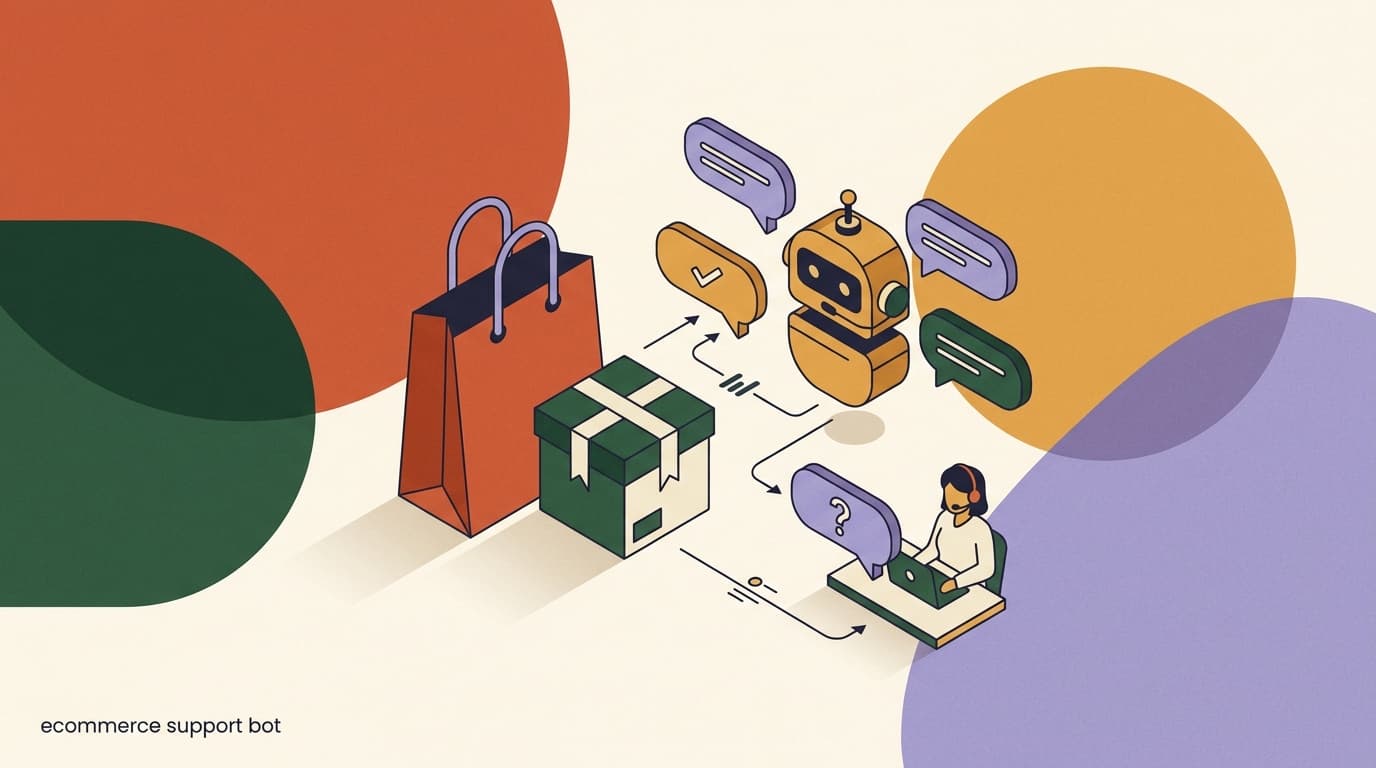
An ecommerce AI support agent closes that gap. It is an always-on assistant that reads your store data and policies, answers the routine questions a shopper has before they buy, and hands the genuinely tricky ones to a human. It does not replace your support team; it covers the hours, channels, and volume your team cannot, and it frees them for the conversations that actually need a person.
This is the business case for putting one in place, written by the team that builds KlyoChat. We will be specific about what an AI support rep should answer, what it must escalate, how to ground it so it does not guess, and how to think about the return on investment without inventing numbers. We will also be honest about the limits, because an AI agent pointed at bad data or trusted with the wrong cases does more harm than good.
What is an ecommerce AI support agent, really?
An ecommerce AI support agent is a conversational assistant that handles customer questions on your behalf, around the clock, using your own store and policy information as its source of truth. It lives where your customers already message you — Instagram, WhatsApp, Facebook Messenger, Telegram, TikTok, and the rest — and it responds in seconds rather than hours.
The word that matters is grounded. A useful support agent is not a generic chatbot that improvises answers. It draws on a knowledge base you control: shipping policy, return window, sizing charts, product details, FAQs, and order data where it is connected. When a shopper asks a question, the agent answers from that material, and when the question falls outside it, the agent escalates instead of guessing.
It is worth separating this from two things it is often confused with. It is not a website chat widget bolted onto your storefront — though it can work alongside one. And it is not a scripted flow that only handles the exact phrasing you anticipated. A modern AI agent understands intent, so it answers the same question whether the shopper types 'when will it arrive', 'how long is delivery', or 'do you ship fast'.
Agent vs chatbot vs flow
A flow follows a fixed script and breaks on phrasing it did not expect. A basic chatbot answers FAQs but tends to improvise when unsure. An AI agent understands intent, answers from a grounded knowledge base, and escalates what it cannot safely handle. For ecommerce support, the third is what you want.
Why does a D2C brand need 24/7 support coverage?
Shopping does not keep office hours. A meaningful share of ecommerce browsing and buying happens in the evening, late at night, and on weekends — precisely the windows when most small support teams are offline. If your reply time is measured against business hours, then for more than half of every week your effective reply time is 'tomorrow'.
Then there is geography. The moment you sell internationally, your customers are spread across time zones. A shopper in another country is wide awake and ready to buy while your team sleeps. Without always-on coverage, you are effectively closed for business to anyone whose daytime is your night.
An always-on AI support agent removes the clock from the equation. It answers the first message in seconds regardless of when it arrives, holds the conversation, and either resolves it or captures enough context that a human can finish the job in the morning. The customer never hits silence. That continuity — never leaving a buyer hanging — is the whole point of always-on support.
The same Friday-night question, two outcomes
- Without an AI agent
- Shopper asks at 10:40pm if the jacket runs small. No reply until Monday. They buy elsewhere over the weekend.
- With a 24/7 AI agent
- Agent answers in seconds with the sizing chart, suggests sizing up, and the order goes through that night.
What should an AI support rep answer on its own?
The fastest win is letting the agent own the high-volume, low-risk questions — the ones your team answers dozens of times a day with the same information. These are routine, factual, and grounded in data you already have, which makes them ideal for automation.
As a rule of thumb, a well-fed agent can resolve the bulk of pre-sale and order-status questions without a human. The exact share depends on your catalog and how clean your data is, but most brands find a large majority of inbound messages fall into a handful of repeatable categories.
- Shipping questions: delivery times, costs, countries you ship to, tracking.
- Sizing and fit: size charts, measurements, fabric, fit guidance.
- Product details: materials, ingredients, compatibility, what is in stock.
- Order status: where is my order, when will it arrive, has it shipped.
- Returns and exchanges: the window, the process, what qualifies.
- Store basics: payment methods, discount codes, opening hours, contact options.
Start with your top ten questions
Pull the last few hundred support messages and tally the most common questions. The top ten almost always cover the majority of volume. Feed those answers to the agent first and you capture most of the value in the first afternoon — before you fine-tune anything.
What should it escalate to a human?
An honest AI support agent knows what it should not handle. The cases that need a person are the ones where a wrong answer is costly, the emotion is high, or the situation is outside the policies the agent was given. Trying to automate these is where brands get burned — and where a careless setup damages trust.
The right design is not 'AI or human'. It is AI first, human for the exceptions, with a clean handoff that carries the full conversation so the customer never has to repeat themselves.
- Refunds, chargebacks, and anything touching money beyond stated policy.
- Damaged, wrong, or missing items that need judgment and goodwill.
- Angry or distressed customers — a human should own the recovery.
- Complex or unusual requests the knowledge base does not cover.
- Anything legal, safety-related, or involving sensitive personal data.
- Wholesale, partnership, press, or high-value account inquiries.
Never let an AI agent guess on money or harm
If a request involves a refund outside policy, a safety issue, or a clearly upset customer, the agent should hand off — not improvise. A confident wrong answer on a sensitive case costs far more than the few seconds saved. Build the escalation rules before you turn the agent on.
How do you ground an AI agent in your store and policy data?
An AI support agent is only as good as what it knows. Grounding is the work of giving it accurate, current, and well-organized information so it answers from facts rather than guesses. This is the single biggest factor in whether the agent helps or hurts.
Grounding has two layers. The first is static knowledge — your policies, FAQs, product information, and brand voice — which you load into a knowledge base. The second is live data — order status, tracking, inventory — which comes from connecting the agent to your store platform so it can look up specifics in real time.
- Write down your policies clearlyShipping, returns, exchanges, warranty, and refund rules in plain language. Vague policies produce vague answers, so tighten them first.
- Build a knowledge base from real questionsTurn your most common support messages into clean question-and-answer entries. Use the exact wording customers use, not internal jargon.
- Add product and sizing informationMaterials, dimensions, fit guidance, compatibility, ingredients — whatever buyers ask before purchasing. Keep it in one source you can update.
- Connect your store for live lookupsLink Shopify or WooCommerce so the agent can answer order-status and tracking questions with real data instead of generic responses.
- Set the escalation rules and toneDefine which topics hand off to a human and how the agent should sound — warm, concise, on-brand. Then test before going live.
Garbage in, confident garbage out
An AI agent will state an outdated return window or a wrong shipping time just as confidently as a correct one if that is what its data says. Schedule a recurring review of the knowledge base so policy changes reach the agent the same day they take effect.
What does slow support actually cost you?
The cost of an ecommerce AI support agent is easy to see — it is a line on your software bill. The cost of not having one is harder to see, because it shows up as sales that quietly never happened. That makes it easy to underestimate, and it is usually the larger number.
Think about where slow or absent replies leak revenue. A pre-sale question that goes unanswered is an abandoned cart. A shipping question with no reply is a shopper who buys from a faster competitor. An after-hours order-status request with no response is a customer whose trust erodes a little. None of these show up as a refund, so they are invisible — but they are real.
| Where slow replies leak money | What it looks like |
|---|---|
| Pre-sale questions unanswered | Abandoned carts — the buyer needed one fact and never got it |
| After-hours messages ignored | Lost sales to competitors who replied first |
| Slow order-status answers | Eroded trust, more 'where is my order' follow-ups, worse reviews |
| Return questions left hanging | Frustration that turns into chargebacks and negative word of mouth |
| Repetitive tickets on the team | Burnout and slower responses to the cases that actually need a person |
We will not invent a revenue figure for you
Plenty of articles quote a precise percentage of sales lost to slow replies. We will not, because the honest answer is that it depends on your traffic, margin, and category. The right move is to measure it on your own data: track your reply times and your after-hours inbound volume, then estimate the carts that question gap is costing you.
How do you frame the ROI of an AI support agent?
The return on an AI support agent comes from three places, and it helps to weigh each one separately rather than reaching for a single headline number. Two of them are about money, and one is about your team's sanity — which eventually becomes money too.
First, recovered sales: questions answered in time that would otherwise have ended in an abandoned cart. Second, saved time: hours your team no longer spends answering the same routine questions, redirected to higher-value work. Third, retained customers: faster, more consistent support that keeps buyers coming back and protects your reviews.
- Recovered revenue: pre-sale questions answered before the buyer leaves.
- Labor saved: routine tickets handled by the agent instead of a person.
- Faster resolution: seconds to first response instead of hours.
- Coverage gained: nights, weekends, and other time zones, with no extra headcount.
- Better team focus: humans spend their time on the cases that need judgment.
How to size it on your own numbers
- Step 1
- Count after-hours and weekend inbound messages over a typical month
- Step 2
- Estimate how many are pre-sale questions that influence a purchase
- Step 3
- Apply your average order value and conversion rate to that group
- Step 4
- Compare the recoverable revenue to the monthly cost of the agent
Does an AI agent replace your support team?
No — and any vendor who tells you it does is overselling. An AI support agent is a force multiplier for your team, not a substitute for it. The goal is to remove the repetitive volume so the people you employ can do the work that actually requires people.
Picture the division of labor. The agent takes the first message every time, resolves the routine questions on its own, and escalates the rest with full context. Your team arrives to a queue that is already triaged — sensitive and complex cases only, each one carrying the conversation history so nobody starts cold. The agent handles breadth; your team handles depth.
This matters for morale as much as economics. Support staff burn out answering the same shipping question for the hundredth time. Hand that to the agent and the human role becomes more interesting and more valuable — solving real problems, recovering upset customers, and building relationships. You usually need the same team, doing better work, covering far more volume.
Measure deflection and handoff quality together
A high deflection rate looks great until you realize the agent is closing conversations it should have escalated. Track both: what share the agent resolves, and how clean the handoffs are. A healthy setup deflects the routine and escalates the sensitive — not the other way around.
How does an AI agent work across multiple channels?
D2C customers do not pick one channel and stay there. They DM you on Instagram, message your WhatsApp, comment on a TikTok, and reply to a Facebook ad — often the same person across several of them. If your AI support agent only covers one channel, you have automated a sliver of the problem.
The version that works treats every channel as one stream. The same agent, with the same knowledge base and the same escalation rules, answers consistently no matter where the message lands. A shipping answer is identical on WhatsApp and Instagram, because it comes from one source of truth. And when a human steps in, they do it from a single inbox rather than juggling six apps.
| Channel | Typical use | What the agent handles |
|---|---|---|
| DMs from ads, posts, and stories | Pre-sale questions, sizing, product details | |
| Order updates and direct support | Order status, shipping, returns | |
| Facebook Messenger | Page messages and ad replies | FAQs, availability, store basics |
| TikTok | Comments and DMs from viral content | Quick product and shipping answers at volume |
| Telegram | Community and direct support | FAQs and order help |
One inbox beats six tabs
The real efficiency is not just the AI — it is unifying the channels. When every conversation, automated or human, lives in one inbox, your team stops switching apps and nothing falls through the cracks. The agent answers everywhere; the humans manage everything from one place.
How do you roll out an AI support agent without breaking trust?
The way to lose with AI support is to flip it on for everything overnight and hope. The way to win is a staged rollout: start narrow, watch closely, and widen the agent's responsibility only as it earns trust. This protects your customers and gives you clean data on what works.
A careful rollout also gives your team confidence. They see the agent handle the easy cases well before it is trusted with anything sensitive, and they help shape the escalation rules along the way. Here is a sequence that works for most brands.
- Start with FAQs onlyLet the agent answer your top shipping, sizing, and return questions. Keep everything else routed to a human while you watch.
- Review transcripts daily for the first weekRead what the agent said. Fix wrong or vague answers at the source — in the knowledge base — not with one-off patches.
- Add order-status lookupsConnect your store and let the agent answer 'where is my order' with live data. This is high-volume and high-value.
- Tighten the escalation rulesBased on real conversations, refine exactly what hands off to a human and make sure the context travels with it.
- Expand coverage and keep auditingWiden the topics the agent owns, then set a recurring review so policy changes and new products keep its knowledge current.
Be upfront that it is an assistant
Customers respond better when they know they are talking to an assistant that can fetch a human. A simple, honest framing — fast answers now, a person if you need one — sets the right expectation and makes the handoff feel like a feature, not a failure.
How does an AI support agent help recover abandoned carts?
Cart abandonment is rarely about price alone. A large slice of it is hesitation — a shopper who wanted to buy but had one unanswered question standing in the way. They were not sure the size would fit, not sure it would arrive in time, not sure they could send it back if it did not work out. That single doubt is enough to make them close the tab, and most of them never return.
An AI support agent is well placed to catch these moments because the questions are predictable and grounded in data you already have. When a shopper asks the agent whether something runs small, or whether it ships in time for an occasion, or what the return policy is, the agent answers instantly with the exact fact that was blocking the purchase. The doubt clears and the order goes through. That is recovery happening in real time, at the moment of intent, rather than a discount email chasing the customer two days later.
The agent also extends this to proactive recovery when you pair it with messaging. A shopper who started a conversation and drifted off can get a gentle, on-brand nudge — an answer to the question they were circling, or a reminder that the item is still waiting. The point is not to badger; it is to remove the friction that caused the hesitation in the first place, while the buyer still cares.
Answer the objection, do not just discount it
The reflex for abandoned carts is to throw a coupon at the problem. Often the buyer did not need a discount — they needed a fact. An AI agent that resolves the real objection recovers the sale without eroding your margin, and it does it at the exact moment the buyer is deciding.
Two shoppers, one unanswered question
- Shopper A — no agent
- Asks if the boots are true to size at 9pm, gets silence, abandons the cart, never returns
- Shopper B — with agent
- Asks the same question, gets the sizing chart and fit guidance in seconds, completes checkout that evening
What makes a good knowledge base for an ecommerce agent?
Since grounding is the difference between an agent that helps and one that hurts, it is worth being specific about what good source material looks like. A strong knowledge base is not a dump of every document you own — it is a curated, current, and clearly written set of answers organized the way customers actually ask.
The most common mistake is feeding the agent internal documents written for staff: policy PDFs full of caveats, spreadsheets of SKUs, onboarding wikis. The agent will technically have the information, but it will struggle to surface the right piece in a conversational answer. Write for the customer instead — short, direct entries in the language buyers use.
- Plain-language policies: shipping, returns, exchanges, warranty, refunds — no internal jargon.
- Real questions and answers: built from your actual support history, in the customer's wording.
- Sizing and fit guidance: charts, measurements, and the advice your team gives by hand today.
- Product specifics: materials, ingredients, dimensions, compatibility, care instructions.
- Edge cases worth covering: international shipping nuances, pre-orders, restocks, gift options.
- Tone and brand voice notes: how the agent should sound, what it should never promise.
| Weak source material | Strong source material |
|---|---|
| A 12-page returns policy PDF written for staff | A short 'How do returns work?' entry in plain language |
| A spreadsheet of every SKU and attribute | Fit and material guidance for the products people ask about |
| An internal wiki with outdated sections | A reviewed FAQ updated the day policies change |
| Marketing copy full of vague claims | Specific, verifiable facts the agent can state safely |
Review on a schedule, not when something breaks
Knowledge bases rot. A shipping carrier changes, a return window shortens, a product is reformulated — and the agent keeps confidently citing the old fact. Put a recurring review on the calendar so the knowledge base stays in sync with reality rather than drifting until a customer catches the error.
How does an AI agent handle order-status questions?
Where is my order is the single most common message many ecommerce brands receive after a sale, and it is almost entirely automatable — but only if the agent can see real data. An agent answering from a static knowledge base can explain your general shipping timeline; it cannot tell a specific customer where their specific package is. That requires a live connection to your store.
When the agent is connected to Shopify or WooCommerce, the flow becomes simple. The customer asks about their order, the agent identifies the order, looks up its current status and tracking, and responds with the real answer — shipped, in transit, out for delivery, or delayed. No human touches it, and the customer gets a precise reply at any hour instead of a generic 'orders usually take three to five days'.
This category is worth singling out because it is both high-volume and high-anxiety. A customer asking where their order is has already paid; a slow or vague reply turns a satisfied buyer into a worried one, and worried buyers leave bad reviews and open chargebacks. Handling these instantly, accurately, and around the clock protects the relationship after the sale, which is where repeat revenue comes from.
- Connect your store platformLink Shopify or WooCommerce so the agent can read order and fulfillment data directly rather than guessing.
- Let the agent identify the orderIt matches the customer to their order from the conversation context or by asking for an order number or email.
- Return the real statusShipped, in transit, out for delivery, or delayed — with tracking where available, in seconds, at any hour.
- Escalate the exceptionsLost, stuck, or clearly late packages that need goodwill or investigation hand off to a human with full context.
Live data turns a guess into an answer
There is a real difference between 'orders usually arrive in three to five days' and 'your order shipped yesterday and is out for delivery today'. The first is a hedge; the second is service. A store connection is what moves the agent from the first to the second on order-status questions.
Will an AI agent sound like my brand?
A common worry is that automating support means handing your customers to something robotic that flattens your brand voice. It is a fair concern — a curt, generic agent can do real damage to a brand built on personality. But tone is something you control, and a well-configured agent can sound distinctly like you rather than like a help-desk macro.
Voice comes from two places. The first is instruction: you tell the agent how to sound — warm and playful, calm and precise, whatever fits your brand — and what it should never say. The second is the source material: when the knowledge base is written in your voice, the agent answers in your voice, because it is drawing on phrasing you chose. Feed it bland corporate copy and you get bland answers; feed it material that sounds like your brand and the agent inherits that.
There is also a quieter benefit. A consistent agent never has an off day, never gets short with a difficult customer, and never forgets a policy. Your best support person on their best day is the ceiling; the agent holds that standard on every message, at 3am, on the hundredth identical question. Consistency, done well, reads as professionalism.
Test the tone before you trust the facts
Before going live, run a dozen real questions through the agent and read the answers out loud. If they sound like a stranger wrote them, fix the voice instructions and the source phrasing first. Customers forgive a slightly slow human; they remember a cold, robotic brand.
Same question, brand voice dialed in
- Generic agent
- 'Our return window is 30 days from delivery. Refer to policy for details.'
- On-brand agent
- 'Good news — you have got a full 30 days to send it back, no fuss. Want me to start a return for you?'
Is an AI support agent worth it for a small store?
There is a belief that AI support is something only big brands with huge ticket volumes need. The opposite is often true: a small store feels the cost of slow replies more acutely, because every lost sale is a larger share of the total, and a solo founder cannot personally answer DMs at midnight while also running the business.
For a small team, the agent is not about deflecting thousands of tickets — it is about not being the bottleneck. When you are the founder, the marketer, the packer, and the support rep, the messages pile up while you do everything else, and replies slip from minutes to days. An always-on agent answers the routine questions the moment they arrive, so you stop losing the late-night and weekend sales you were never going to catch in time anyway.
The honest caveat is that the agent still needs good data and a human for the hard cases — and on a small team, that human is you. But the trade is favorable: you spend an afternoon setting up a knowledge base once, and in return the agent absorbs the repetitive volume forever, leaving you the handful of conversations that genuinely need your attention.
- Small stores feel slow replies harder — each lost sale is a bigger share of revenue.
- A solo founder cannot staff nights and weekends; the agent can.
- Setup is a one-time afternoon, not an ongoing cost in hours.
- The agent absorbs repetitive questions so the founder handles only the exceptions.
- Pricing that includes AI agents keeps it affordable at small scale.
The bottleneck is usually time, not volume
Small stores rarely drown in ticket volume — they drown in the fact that one person cannot be available all the time. An always-on agent solves the availability problem directly, which is exactly the problem a small team has and a large team can throw headcount at.
What metrics tell you the agent is working?
Once the agent is live, a few numbers tell you whether it is genuinely helping or quietly causing problems. Watch them weekly at first, then monthly once things settle. The goal is to confirm the agent is deflecting the right things and escalating the right things.
Resist judging it on deflection rate alone. A high resolution rate paired with rising complaints means the agent is closing conversations it should escalate. The healthy picture is high deflection on routine topics, clean handoffs on sensitive ones, and stable or improving satisfaction.
- First-response time: should drop to seconds across every channel.
- Deflection rate: the share of conversations the agent resolves without a human.
- Escalation accuracy: are the right cases reaching humans, and only those?
- Handoff quality: does the human receive full context, or does the customer repeat themselves?
- Customer satisfaction: track it qualitatively at first — are replies on social and DMs more positive?
- After-hours coverage: how many messages the agent now handles outside business hours.
Watch for confidently wrong answers
The failure mode to hunt for is the agent answering incorrectly with full confidence — a stale shipping time, a wrong return window. You catch these by reading transcripts, not by watching dashboards. Make transcript review a standing habit, not a one-time setup task.
How does KlyoChat handle ecommerce AI support?
We built KlyoChat to be exactly this kind of always-on support layer for D2C brands. It is an AI-native, mobile-first unified inbox that brings Facebook, Instagram, Telegram, WhatsApp, TikTok, and X into one place — so the AI agent and your team work from a single stream rather than a pile of apps.
The core is custom AI agents with knowledge bases, included in your plan rather than sold as a separate add-on. You point an agent at your policies, FAQs, and product information, set the tone and the escalation rules, and it answers shoppers 24/7 across every connected channel. When a case is sensitive or outside its knowledge, it hands off to a human in the team inbox with the full conversation attached. On the Business plan, Shopify and WooCommerce connect so the agent can answer order-status questions with live data.
- AI agents with knowledge bases are included — there is no separate AI fee.
- One mobile-first inbox for every channel, so handoffs are clean and nothing is missed.
- Agents answer 24/7 and escalate the sensitive cases to your team with context.
- Shopify and WooCommerce on Business connect live order data to the agent.
- 7-day free trial, no credit card — test the full product before you decide.
| Plan | Price | What you get for support |
|---|---|---|
| Basic | $19/mo | Unified inbox, AI agents, core channels — for a small store getting started |
| Pro | $49/mo ($39 yearly) | All channels, 10,000 contacts, custom AI agents, 5,000 AI replies/mo |
| Business | $129/mo | 25,000 AI replies/mo, Shopify and WooCommerce for live order data |
Where KlyoChat is honest about its limits
KlyoChat does not do native SMS or email, and it is not a website chat-widget tool — it focuses on social and messaging channels. We are a newer, smaller community than the incumbents. And the agent only performs as well as the data you give it, with human handoff for sensitive cases. If those constraints fit your brand, the always-on social support is hard to beat for the price.
How is this different from a basic support chatbot?
If you have read our piece on the ecommerce support chatbot, you will notice the angle here is different. That guide is about support operations and the ticket workflow — how a chatbot fits into your team's queue and process. This one is about the business case for always-on coverage: why a 24/7 AI support agent earns its place, what it should and should not do, and how to size the return.
The distinction matters when you are deciding. A chatbot is a tool in your support stack. An always-on AI support agent is a strategic choice about coverage — it is how you stay open to buyers in every time zone, at every hour, without hiring around the clock. Most brands end up wanting both framings: the ops view for how it runs day to day, and the always-on view for why it is worth doing at all.
Two ways to look at the same agent
- Support-ops view
- How the agent fits the ticket queue, deflection, and team workflow
- Always-on view (this guide)
- Why 24/7 coverage recovers sales and protects trust across time zones
The case for an ecommerce AI support agent comes down to one thing: shoppers ask questions on their schedule, not yours, and the brand that answers first usually wins the sale. An always-on agent answers the routine majority in seconds, escalates the sensitive cases to your team with context, and covers the nights, weekends, and time zones you cannot staff. The cost is a software line; the cost of going without is sales that quietly never happened.
Get the foundation right — clean policies, a real knowledge base, clear escalation rules, and a staged rollout — and the agent earns trust fast. For the day-to-day operations view, see our guide to the ecommerce support chatbot; for the broader playbook, read our piece on AI customer support automation; and if you sell on Shopify and run WhatsApp, our Shopify WhatsApp integration guide shows how live order data plugs in.