A dm drip campaign is the difference between a lead who messaged you once and forgot you exist, and a customer who bought because the right message arrived on the right day. Most teams capture a cold contact — a comment-to-DM trigger, a quiz, a giveaway — and then do nothing useful with it. They blast a discount, get ignored, and write the channel off. The drip is the missing middle: a planned, timed nurture sequence that walks someone from curiosity to confidence to purchase, one message at a time, inside the inbox they already check every day.
This guide is the practical build. We will map the cold-to-customer journey, set a message cadence with real spacing, explain why value has to come before the offer, show how to branch on engagement so engaged and quiet leads get different treatment, and work through the constraint that defines DM nurture: Meta's 24-hour window and the template rules that go with it. There are sample drip messages you can adapt, tables you can copy, and an honest measurement section so you know whether the thing is working.
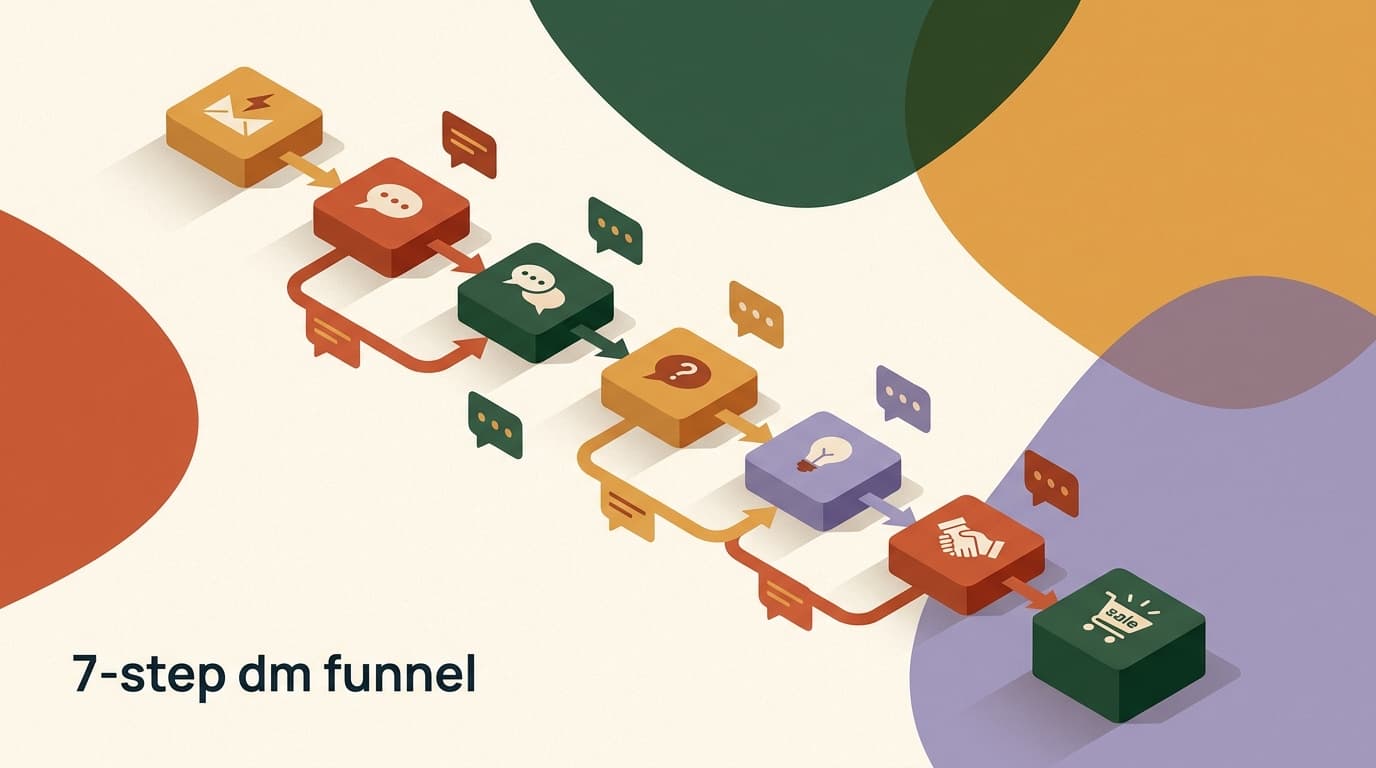
Full disclosure: we build KlyoChat, a tool for exactly this kind of automation, so we have a point of view. We have kept the platform talk to one clearly marked section near the end. Everything else is channel-agnostic and applies whether you run your drip on Instagram, Facebook Messenger, WhatsApp, or Telegram. If you want the broader seven-step funnel view, our dm funnel automation guide covers that; this piece is specifically about the timed nurture angle.
What is a DM drip campaign, and how is it different from a funnel?
A drip campaign is a sequence of messages sent on a schedule, triggered by an action and spaced over time. A dm drip campaign runs that sequence inside a direct-message channel instead of email. Someone opts in — they comment a keyword, click an ad, finish a quiz — and the sequence starts dripping messages to them over the following hours and days, each one designed to move them a small step closer to buying.
People mix up drips and funnels, so it helps to be precise. A funnel is the whole journey and its stages: awareness, interest, consideration, decision. A drip is one mechanism inside that journey — the timed message track that carries a lead through the consideration and decision stages. You can have a funnel without a drip (a single landing page and a checkout) and a drip without a full funnel (a standalone nurture track). The most reliable setups use both: a funnel defines the stages, and a drip does the patient work of moving people between them.
The other defining trait of a DM drip is that it is conversational. Email drips are broadcasts dressed up as letters. A dm drip campaign lives in a two-way channel, which means every message can invite a reply, and every reply changes what happens next. That is the source of its power and its main constraint, and the rest of this guide is about using the first while respecting the second.
| Concept | What it is | Scope |
|---|---|---|
| Funnel | The full journey and its stages | Strategy / structure |
| Drip campaign | A timed message track inside the journey | Mechanism / cadence |
| Broadcast | A one-time message to a segment | Single send |
| DM drip | A conversational drip in a chat channel | Timed + two-way |
Drip and funnel are partners, not rivals
Do not choose between a funnel and a drip. Map your funnel stages first, then build a drip that carries leads from one stage to the next. The funnel tells you what to say; the drip decides when to say it.
Why nurture in the DM instead of email?
The honest answer is that you should usually do both, but DM has structural advantages that make it the better place to nurture leads who first met you on social. The contact arrived on a social platform; keeping the conversation there removes the friction of asking for an email and waiting for an inbox they may never open. Open rates in a chat channel are far higher than email simply because the message lands as a notification in an app people actively use, not in a promotions tab they triage once a week.
DM is also faster to feel personal. A reply in chat reads like a message from a person, and people answer it. That two-way quality is exactly what nurture needs — you are not just broadcasting, you are learning. Every reply tells you where the lead is in their thinking, and a good drip uses that information to branch. Email can do versions of this with click tracking, but the signal in a DM is richer because it is literal: the person types what they want.
There is a real trade-off, and we will not pretend otherwise. Email has no per-message window restriction; you can mail a contact on day thirty as easily as day one. DM channels, especially on Meta platforms, restrict free-form messaging to a 24-hour window after the last user interaction, and reaching someone outside that window requires an approved template. That constraint shapes every cadence decision in this guide, so we tackle it head-on in its own section rather than burying it.
- Higher open and reply rates than email, because the message is a notification in an active app.
- Conversational by default — replies become routing signals you can branch on.
- Lower opt-in friction when the lead already came from social.
- The trade-off: the 24-hour window limits free-form sends and forces templates outside it.
How do you map the cold-to-customer journey?
Before you write a single message, map the journey. A drip that does not know where a lead is cannot move them anywhere. Think in stages, and for each stage name the lead's mindset, the one job your message has, and the signal that tells you they are ready to advance. Most cold-to-customer journeys have four stages, and you can usually fit a strong drip to them.
The point of the map is to stop you from selling too early. A cold lead who just opted in is not ready for a discount code; they are ready for a reason to care. Each stage earns the right to the next. When you map mindset and job per stage, the messages almost write themselves, and the cadence becomes obvious because you can see how much time each mental shift realistically takes.
| Stage | Lead mindset | Message job | Ready-to-advance signal |
|---|---|---|---|
| Cold / new | Curious but unsure who you are | Deliver the promised value, set expectations | Opens, replies, consumes the lead magnet |
| Warming | Interested, evaluating | Teach, build trust, handle early doubt | Asks a question, clicks a link, replies positively |
| Hot | Considering a purchase | Show proof, address objections, make the offer | Asks about price, terms, or how to buy |
| Customer | Bought, deciding to stay | Onboard, deliver a win, set up the next step | Completes setup, uses the product, replies happy |
Write the signal before the message
For each stage, define the observable signal that means a lead is ready to advance — a reply, a click, a keyword. Build your branches off those signals. A drip that advances on a real signal converts far better than one that advances on a timer alone.
How long should a DM drip campaign be, and how should you space it?
There is no universal length, but there are reliable principles. A nurture drip for a low-cost product can be short — three to five messages over a few days. A higher-consideration purchase needs more touches over a longer window, because trust takes longer to build and the decision is heavier. The mistake almost everyone makes is going too fast: firing five messages in two days, exhausting the contact, and getting muted. Spacing is not dead time; it is the time the lead spends thinking, which is the whole point of nurture.
Cadence also has to respect the rhythm of the channel and the 24-hour window. Inside the window you can send naturally as part of a back-and-forth. Once the window closes, your next scheduled touch has to be a template send or wait for the lead to re-engage. Practically, this means your early messages — which arrive while the lead is fresh and likely to reply — can be closer together, and your later messages should be spaced wider and built as templates where the platform requires it.
A good default rhythm for a mid-consideration product looks like this: an immediate value delivery, a follow-up the next day, a teaching message two days later, a proof message a few days after that, the offer around a week in, and a final nudge a few days after the offer. Treat it as a starting skeleton, not a law. Watch reply and progression rates and tighten or loosen from there.
| Day | Message | Goal | In-window or template |
|---|---|---|---|
| Day 0 | Deliver the promised value | Honor the opt-in, set expectations | In-window |
| Day 1 | Quick check-in / one useful tip | Re-engage, invite a reply | In-window if they replied; else template |
| Day 3 | Teach: the core idea | Build authority, reframe the problem | Template likely |
| Day 6 | Proof: result or testimonial | Reduce risk, build belief | Template likely |
| Day 8 | The offer | Ask for the sale with a reason now | Template likely |
| Day 11 | Last nudge / objection answer | Recover the undecided | Template likely |
Going too fast is the most common drip-killer
Five messages in 48 hours feels productive and reads as spam. People mute, block, or report, and your channel quality score drops. Space messages to match how long the mental shift actually takes — usually a day or more between substantive touches.
Why does value have to come before the offer?
A cold lead owes you nothing. They opted in for a specific reason — the checklist, the discount, the answer to a question — and the fastest way to lose them is to ignore that reason and pitch. Value before offer is not a feel-good principle; it is a sequencing rule that makes the offer land. Each useful message you send earns a little trust and a little attention. By the time the offer arrives, you have built enough goodwill that the ask feels reasonable instead of pushy.
Value also does the persuasion work that a pitch cannot. When you teach a lead something true and useful, you demonstrate competence without claiming it, and you reframe the problem in a way that makes your product the obvious answer. A proof message — a real result, a customer's words — lowers risk. By the time you ask for the sale, the lead has already concluded most of the argument on their own. The offer message just removes the last bit of friction.
A useful ratio to hold in your head is roughly three value touches for every ask. The exact number flexes with price and audience, but the direction is fixed: most of your drip is giving, and a small, well-placed part is asking. Teams that invert this — mostly asking, occasionally giving — get the open rates of a spam folder and wonder why DM does not work for them.
- Deliver exactly what the opt-in promised, first, with no strings.
- Teach something true and useful before you teach why your product helps.
- Use proof — a result, a testimonial — to lower risk before the ask.
- Hold a rough 3:1 value-to-offer ratio across the sequence.
Value-first vs offer-first opening
- Offer-first (weak)
- Day 0: 'Thanks for signing up! Use CODE20 for 20% off today only.'
- Value-first (strong)
- Day 0: 'Here is the checklist you asked for. One tip: start with step 3 — it is the one most people skip and it saves the most time.'
What should the first message actually say?
The first message sets the tone for the entire drip, and it has one job: deliver the value you promised, instantly and completely. If someone commented a keyword to get a guide, the first message hands over the guide. No upsell, no friction, no 'reply YES to confirm' unless the platform requires the double opt-in. The faster and cleaner the delivery, the more credibility you bank for everything that follows.
Two things make a first message work beyond the delivery itself. First, set expectations: tell the lead, briefly, what they will hear from you and roughly how often, so the next message is welcome rather than a surprise. Second, plant a low-effort reply hook — a simple question they can answer in a tap or a few words. A reply inside the first 24 hours keeps you in the window and gives you a branching signal for message two. The hook should be genuinely easy; 'what are you working on?' beats 'tell me your biggest challenge with X' for a stranger.
- Deliver the promised value immediatelyHand over the guide, code, or answer in the first message. Lead with what they came for, before anything else.
- Set a light expectationOne sentence on what is coming: 'I will send you two more tips this week.' This makes the next messages welcome.
- Plant an easy reply hookAsk one low-effort question. A reply keeps you in the 24-hour window and gives you a signal to branch on.
Sample first message (Day 0)
- Delivery
- Here is your free 7-day meal-prep guide — grab it here: [link]
- Expectation
- Over the next week I will send you two short tips to make it stick.
- Reply hook
- Quick one: are you prepping for one person or a family? (helps me send the right tip)
How do you branch a drip on engagement?
A drip that sends every lead the same six messages regardless of behavior is a glorified broadcast. The whole advantage of doing this in a two-way channel is that you can read engagement and route accordingly. Branching means your engaged leads — the ones replying and clicking — move faster and get more direct, while your quiet leads get a gentler track designed to re-spark interest rather than push an offer they are not ready for.
The simplest useful branch splits on a single signal after an early message: did they reply or not. Repliers go down a warmer path with quicker follow-ups and an earlier offer, because they have shown intent. Non-repliers go down a re-engagement path: a different angle, a new piece of value, a softer question, and a longer leash before any ask. You can branch further on specific replies — someone who asks about price jumps straight to the offer; someone who raises an objection gets the message that handles it — but start with the reply / no-reply split and add nuance once it runs.
Branching is also how you keep the 24-hour window working for you. Every reply resets the window and lets you continue the conversation freely. So a branch that rewards replies with relevant, well-timed follow-ups is not just better nurture — it literally buys you more in-window sends. Design your hooks to earn replies, then design your branches to make those replies worth giving.
- Pick the branching signalStart simple: replied vs did not reply to the Day 0 or Day 1 message. Add reply-content branches later.
- Build the engaged pathFor repliers, move faster: a quicker proof message and an earlier offer, since they have shown intent.
- Build the re-engagement pathFor non-repliers, change the angle: new value, a softer question, a longer gap before any ask.
- Add reply-content branchesRoute price questions to the offer, objections to the objection-handler, support questions to a human or agent.
Replies are free window time
Every user reply resets Meta's 24-hour window. A drip that earns replies through good hooks and smart branching keeps itself in-window, which means more natural messages and fewer template sends. Branching pays for itself twice.
How does the 24-hour window change your drip?
This is the constraint that separates DM nurture from email nurture, and it is the one teams most often get wrong. On Meta platforms — Instagram and Facebook Messenger — you can send free-form messages to a contact only within 24 hours of their last interaction with you. Outside that window, you cannot send arbitrary promotional messages; you can only send pre-approved message templates that fit allowed categories, or wait for the contact to message you again. WhatsApp has its own version of this with template messages and conversation categories. The exact rules vary by platform and change over time, so verify the current policy for your channel before you build.
What this means for a drip is concrete. Your early messages — Day 0 and often Day 1 — usually land inside the window, because the lead just opted in. Your later messages almost always fall outside it. So a realistic drip is a hybrid: in-window conversational messages while the lead is fresh, and template-based sends for the scheduled touches that come days later. If you design your whole drip as if you can free-form message on Day 8, it will silently fail to deliver, and you will not know why your later steps get no engagement.
The practical workflow is to identify, for each step, whether it will land in-window or out, and build accordingly. In-window steps can be casual and reactive. Out-of-window steps must be templates that comply with platform policy — and the cleanest templates are ones that invite the lead back into a conversation, because once they reply, the window reopens and you are free again. This is why re-engagement and value framing matter so much outside the window: a template that earns a reply converts a restricted contact back into an open one.
| Situation | What you can send | Best move |
|---|---|---|
| Within 24h of last user message | Free-form messages | Converse naturally, deliver value, ask |
| Outside 24h, no recent reply | Approved templates only | Send a compliant template that invites a reply |
| Contact replies to a template | Window reopens, free-form again | Continue the drip naturally |
| Contact never re-engages | Limited / template-only | Slow the cadence; do not keep firing templates |
Respect opt-in and the window — do not spam
The 24-hour window and template rules exist to protect users, and platforms enforce them. Only message people who opted in, keep template sends relevant and infrequent, and stop messaging contacts who go quiet. Aggressive out-of-window pushing risks your account, not just your conversion rate.
What does a full sample drip look like?
Putting it together, here is a complete sample dm drip campaign for a mid-priced digital product, written so you can adapt the wording. It assumes a value-first structure, a reply-based branch after Day 1, and a hybrid of in-window and template sends. Read it as a pattern, not a script — swap in your own product, proof, and voice.
Notice how each message has exactly one job, how the offer does not appear until trust is built, and how the later messages are framed to invite a reply so the window reopens. The non-reply branch is not shown in full, but it would mirror this with softer asks, a fresh angle on Day 3, and a longer gap before the offer.
One job per message
Every message above does exactly one thing: deliver, re-engage, teach, prove, offer, recover. When a message tries to do two jobs, it does neither well. If you cannot name the single job of a message, cut it.
Sample drip — engaged path
- Day 0 (in-window)
- Here is the template pack you asked for: [link]. I will send a couple of short tips this week. Quick q — what are you using it for first?
- Day 1 (in-window)
- Most people open the pack and freeze on the first blank one. Start with template 4 — it is the easiest win and it builds momentum. Did template 4 make sense?
- Day 3 (template)
- The reason most setups stall is trying to customize everything at once. Here is the 3-step order that actually works: [link].
- Day 6 (template)
- Sam ran this exact order and shipped in a weekend — here is what changed for them: [link]. Want the version with the done-for-you flows?
- Day 8 (template)
- If you want the full toolkit — every flow, pre-built — it is open now with a launch price: [link]. Happy to answer anything first.
- Day 11 (template)
- Last note on this — the launch price closes Friday. Any question holding you back? Reply and I will sort it.
How do you write a re-engagement branch that recovers quiet leads?
Most of your opted-in leads will not reply to the first hook, and that is normal. The re-engagement branch exists for them, and it is where a lot of recoverable revenue hides. The instinct to keep pushing the offer harder is wrong; a lead who went quiet did not ignore you because they needed a louder pitch. They went quiet because the message did not connect. The fix is a different angle, not more volume.
A good re-engagement branch resets and tries again. Lead with a new piece of value unrelated to the first hook — a different tip, a different problem, a different format. Lower the ask: instead of a question that requires thought, offer a binary, tap-to-answer option. And because these leads are usually out of the window, your re-engagement messages will often be templates, so they must be framed as helpful and reply-inviting rather than promotional. The goal of the branch is not to sell; it is to earn one reply, reopen the window, and rejoin the main nurture.
- Change the angle — a new value piece, not a louder version of the old one.
- Lower the ask to a binary, tap-to-answer question.
- Frame out-of-window messages as helpful, reply-inviting templates.
- Aim to earn one reply, reopen the window, and merge back into the main drip.
- If a lead stays silent across the whole branch, slow down and stop — pruning protects your channel quality.
Re-engagement template (quiet lead)
- New angle
- Different tip than last time: the single setting that fixes 80% of the issues people hit on day one is buried in the menu — here it is: [link].
- Binary ask
- Was that the thing tripping you up, or is it something else? (A) that was it (B) something else
How do you measure a DM drip campaign?
Email-trained marketers reach for open rate first, and in DM that is the least useful number you have. Notifications inflate opens, and an open tells you nothing about progress. The metrics that matter in a dm nurture sequence are about movement: are leads replying, are they advancing through stages, and are they buying. Measure the drip as a pipeline, not a newsletter.
Track reply rate per message — it tells you which hooks actually land and where the conversation dies. Track stage progression — the percentage of leads who move from warming to hot — because that is the real job of nurture. Track offer conversion from leads who reached the offer message, separately from overall conversion, so you can tell whether the problem is the offer or the nurture leading up to it. And watch your negative signals: mute, block, and report rates. A rising block rate is the channel telling you your cadence is too aggressive, and no conversion number is worth a damaged account.
Use these numbers to find the single biggest leak and fix that one thing. If reply rate craters at Day 3, your teaching message is weak or mistimed. If leads reach the offer but do not convert, the offer or the proof before it is the problem, not the nurture. If they never reach the offer, your spacing or your value is failing earlier. Optimize one stage at a time; changing the whole drip at once teaches you nothing.
| Metric | What it tells you | Why it beats open rate |
|---|---|---|
| Reply rate per message | Which hooks land and where conversation dies | Replies are real engagement; opens are noise |
| Stage progression rate | Whether nurture is actually moving people | Measures the drip's core job, not vanity |
| Offer conversion (of those who reach it) | Whether the offer / proof works | Isolates the offer from the nurture |
| Mute / block / report rate | Whether cadence is too aggressive | Protects account health, not just numbers |
Fix the biggest leak first
Find the single stage where the most leads drop, change only that, and re-measure. Rebuilding the whole drip at once gives you no clean signal about what helped. Nurture optimization is a series of single-variable fixes.
How does retargeting fit with a DM drip?
A drip and a retargeting program are complementary, and the strongest setups connect them. The drip handles leads who are actively in your sequence; retargeting handles the ones who fell out — who stopped replying, who reached the offer and did not buy, who went cold in the re-engagement branch. Instead of writing those contacts off, you move them into a retargeting motion: a paid ad audience, a later broadcast, or a fresh re-entry trigger that brings them back into a DM conversation.
The clean handoff is this: when a lead exhausts the drip without converting, they exit into a retargeting segment rather than a dead-letter list. From there a periodic, relevant broadcast — a new offer, a new piece of value, a seasonal hook — can re-spark them, and any reply drops them back into a live conversation and a fresh nurture track. This keeps your hard-won contacts working without spamming them inside the original drip. We go deep on this in our dm retargeting guide; for the purposes of the drip, the rule is simple: design an exit, not a dead end.
- Leads who exhaust the drip without buying should exit into a retargeting segment, not a void.
- Use periodic, relevant broadcasts to re-spark cold segments rather than re-running the same drip.
- Any reply to a retargeting touch drops the lead back into a live conversation and fresh nurture.
- Keep retargeting infrequent and valuable — frequency is what damages a channel.
Design an exit, not a dead end
Every drip should define what happens to a lead who finishes without buying. The best answer is a graceful handoff to a slower retargeting cadence, so the contact stays valuable instead of becoming list clutter.
What are the most common DM drip mistakes?
Most failed drips fail for a handful of repeatable reasons, and knowing them in advance saves you a quarter of wasted sends. The biggest is selling too early — pitching before any value lands, which trains the lead to ignore you. The second is going too fast, cramming messages into a couple of days until the contact mutes you. The third is ignoring the 24-hour window, designing later steps as free-form messages that never deliver.
The subtler mistakes are about structure. A drip with no branch treats your hottest and coldest leads identically, wasting intent and irritating the uninterested. A drip with no exit keeps firing at people who will never buy, dragging down your channel quality. And a drip measured by opens instead of replies and progression hides its own problems behind a flattering number. Each of these is fixable, and most teams have several at once.
- Selling before delivering value — the fastest way to get muted.
- Cadence too tight — five messages in two days reads as spam.
- Designing out-of-window steps as free-form messages that never send.
- No engagement branch — hot and cold leads get identical treatment.
- No exit — the drip keeps pushing leads who will never convert.
- Measuring opens instead of replies, progression, and conversion.
Honest limit: a drip cannot fix a bad offer
Nurture amplifies a good offer; it cannot rescue a weak one. If leads reach a well-built offer message and consistently do not buy, the problem is the offer, the price, or the proof — not the drip. Fix that before adding more messages.
How KlyoChat helps you build a DM drip campaign
This is the one section where we talk about our own tool, so take it as such. We built KlyoChat to make exactly the kind of timed, branching nurture this guide describes practical to run without code. It is an AI-native unified inbox that brings Facebook, Instagram, WhatsApp, Telegram, and more into one place, with no-code automation and sequences, custom AI agents, broadcasts, and analytics on top. For a dm drip campaign specifically, three things matter.
First, the no-code flow builder lets you lay out the whole drip — timed steps, delays, and engagement branches — visually, so the journey map you drew earlier becomes the actual automation. Second, KlyoChat understands the difference between in-window and template sends, which is the part of DM nurture most tools handle badly; you can design steps knowing which will land in-window and which need a compliant template. Third, AI agents can handle replies inside the window — answering questions, qualifying, routing to a human — so your branches respond to real conversation, not just timers. Broadcasts cover the retargeting handoff for leads who exit the drip.
We will be honest about the limits, because that is the only useful kind of pitch. KlyoChat has no native SMS or email, so if your nurture strategy depends on those channels you will need something alongside it. We are a newer and smaller product than the biggest incumbents, with a smaller community and template library. And no tool exempts you from the rules: you still have to respect opt-in and Meta's 24-hour window, and you still should not spam — KlyoChat makes compliant nurture easier, it does not make aggressive nurture safe.
- No-code flow builder for timed steps, delays, and engagement branches.
- In-window vs template awareness built in, so later steps actually deliver.
- AI agents handle in-window replies — qualify, answer, route — feeding your branches.
- Broadcasts handle the retargeting handoff for leads who exit the drip.
- Honest limits: no native SMS or email; newer and smaller than incumbents; window and opt-in rules still apply.
Build the drip, then test it on real leads
The fastest way to learn whether your map and cadence work is to ship a small version and watch the reply and progression numbers. KlyoChat's 7-day trial is enough to wire up a first drip and see real signal before you commit a budget.
KlyoChat plans at a glance
- Basic
- $19/mo — small teams getting started with one or two channels
- Pro
- $49/mo ($39 billed yearly) — all channels, custom AI agents, the sweet spot for serious nurture
- Business
- $129/mo — higher volume, more seats, more AI replies
- Trial
- 7-day free trial, no credit card required
The bottom line: a dm drip campaign turns a pile of cold opt-ins into a steady flow of customers by doing the patient work most teams skip. Map the cold-to-customer journey, space your messages to match how long each mental shift actually takes, lead with value and earn the offer, branch on engagement so hot and quiet leads get different treatment, and design every step around the 24-hour window instead of pretending it does not exist.
Measure replies and progression rather than opens, fix one leak at a time, and give leads who finish without buying a graceful exit into retargeting. If you want the wider structure around the drip, see our dm funnel automation guide; for the recovery motion that catches everyone who falls out, see our dm retargeting guide. Build the smallest version that proves the idea, watch the numbers, and grow it from there.