The choice between conversational AI vs rule-based bots is one of the first real decisions you make when you start automating customer messages, and it is easy to get wrong because the marketing around it is loud. One camp says rule-based bots are obsolete relics. The other says AI is unpredictable and unsafe. Both are overstating things. The honest answer is that they are different tools built for different jobs, and the right pick depends entirely on what you are trying to automate.
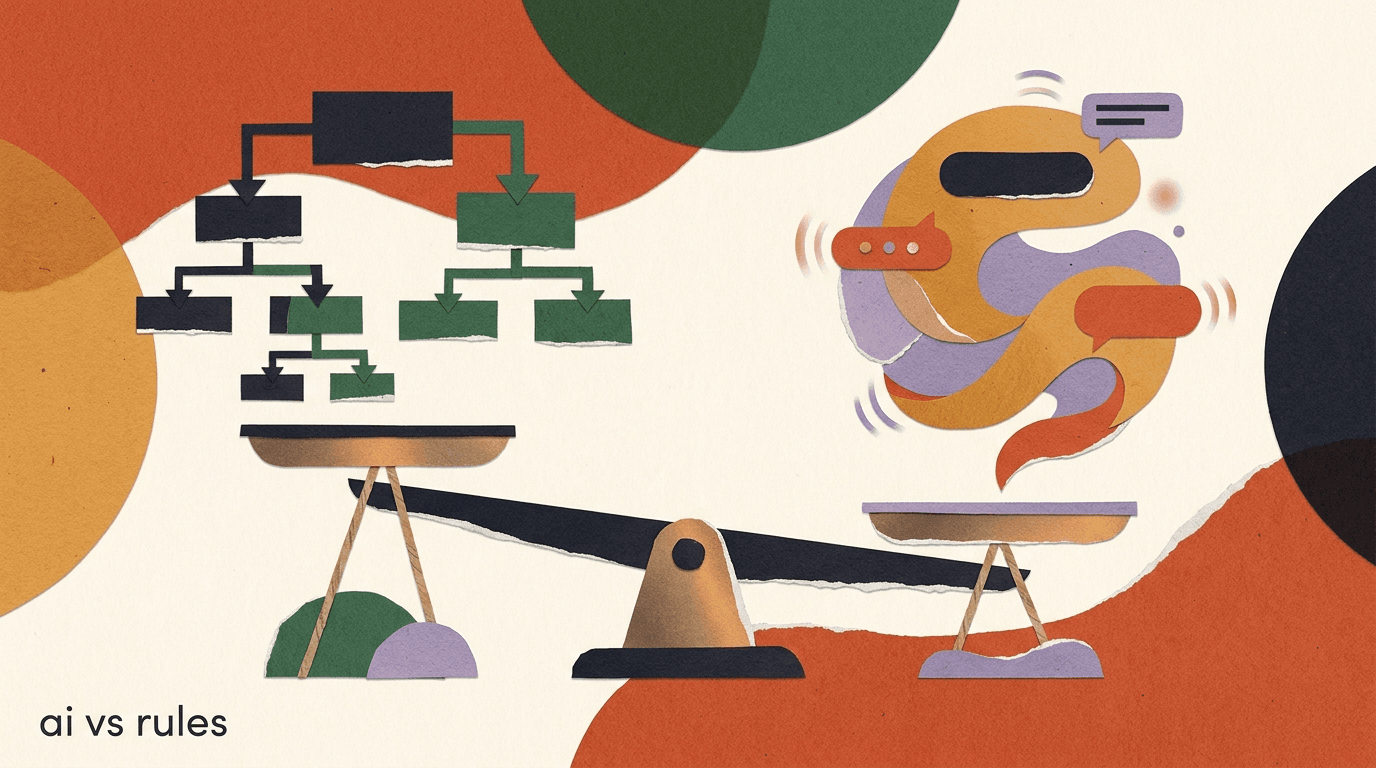
A rule-based chatbot follows a script you build by hand — a decision tree of buttons, keywords, and conditions. It does exactly what you told it to and nothing else. A conversational AI bot, by contrast, uses natural language processing (an NLP chatbot, in the common phrasing) or a large language model to interpret what a person actually typed, then generate a response. One is a flowchart. The other is closer to a reasoning engine with a knowledge base behind it.
This guide walks through how each one works under the hood, the real strengths and weaknesses of both, what they cost to run and maintain, and — the part most articles skip — when a rule-based bot is genuinely the better choice. We build KlyoChat, which supports both no-code rule-based flows and conversational AI agents, so we have a stake here. We have tried to keep the comparison honest rather than steering you toward AI for its own sake, because plenty of jobs are better served by a simple decision tree.
What is a rule-based chatbot, and how does it actually work?
A rule-based chatbot is automation built from explicit rules: if the user does X, the bot does Y. You design it as a decision tree — a branching map of questions, buttons, keyword triggers, and conditions. When a message comes in, the bot matches it against your rules and follows the branch you defined. There is no interpretation and no guessing. If the input does not match a rule, the bot either falls back to a default response or hands off to a human.
The mental model that helps most people is a phone menu. "Press 1 for sales, press 2 for support." A rule-based bot is that menu rendered as chat: buttons and keywords instead of keypad digits. You can make it far richer than a phone tree — branching deep, carrying variables, calling APIs, tagging contacts — but the core property holds. Every path through the conversation was drawn by a human in advance.
Because every branch is explicit, a rule-based bot is completely deterministic. Given the same input, it produces the same output every single time. That predictability is the whole point. You know exactly what it will say because you wrote exactly what it will say. For some use cases that certainty is worth more than any amount of conversational flair.
- Built from explicit if-then rules and keyword triggers.
- Structured as a decision tree the user navigates with buttons or set phrases.
- Fully deterministic — identical input always produces identical output.
- Cannot handle anything outside the paths you drew; off-script input hits a fallback.
- No knowledge base or model required — the logic is the content.
A simple rule-based branch
- Trigger
- User taps the button "Track my order"
- Rule
- Ask for order number, then call the lookup API
- Condition
- If order found, show status; if not, offer human handoff
- Result
- Same outcome every time — no interpretation involved
What is conversational AI, and how is it different?
Conversational AI is automation that understands free-form language and generates a response, rather than matching against a fixed script. Under the hood it uses natural language processing, and in modern tools it is usually powered by a large language model. Instead of waiting for the user to tap the right button, it reads whatever they typed — typos, slang, half-formed questions, multiple questions at once — works out the intent, and replies in natural language.
The practical difference is that a conversational AI bot does not need you to anticipate every phrasing. A rule-based bot only understands "track my order" if you added that exact keyword. A conversational AI bot understands "hey where's my stuff", "the package hasn't shown up", and "is my order shipped yet?" without any of them being predefined, because it is interpreting meaning rather than matching strings.
This is also where the term NLP chatbot comes from. NLP — natural language processing — is the technology that lets software parse and interpret human language. Older NLP bots used intent classification: you trained the bot on example phrases for each intent, and it picked the closest match. Today's LLM-based conversational AI goes further, generating original responses and reasoning across a conversation rather than just classifying it into a bucket. The trade-off is that this flexibility introduces variability — the same question can get slightly different (though usually equivalent) answers — and the bot needs a knowledge base to ground its answers in your facts rather than its training data.
- Uses NLP or an LLM to interpret free-form text, not fixed keywords.
- Understands many phrasings of the same intent without you listing them.
- Generates responses rather than reading from a pre-written script.
- Needs a knowledge base to stay accurate about your specific business.
- Is probabilistic, not deterministic — answers can vary slightly run to run.
"AI" is not one thing
Intent-classification NLP bots and modern LLM agents are both "conversational AI," but they behave differently. Classification bots route to canned replies; LLM agents generate replies. When a vendor says "AI chatbot," ask which one they mean — the maintenance burden and the failure modes are not the same.
Conversational AI vs rule-based: the side-by-side comparison
Here is the core comparison in one place. The headline framing — conversational AI vs rule-based — really resolves into a set of trade-offs along a handful of dimensions: flexibility, predictability, setup effort, maintenance, cost, and how each one fails. Neither column is "better" in the abstract. They are better at different things.
| Dimension | Rule-based bot | Conversational AI |
|---|---|---|
| How it understands input | Keywords, buttons, exact conditions | NLP / LLM interpretation of free text |
| Predictability | Fully deterministic | Probabilistic — answers can vary |
| Handles unexpected questions | No — falls back or breaks | Yes — reasons about novel input |
| Setup effort | Build every branch by hand | Write a knowledge base, set guardrails |
| Ongoing maintenance | Update flows when anything changes | Curate knowledge base, monitor outputs |
| Failure mode | Dead ends and "I didn't understand" | Wrong or invented answers if ungrounded |
| Best for | Strict, repeatable, compliance-bound flows | Open-ended Q&A and messy real-world phrasing |
Read the table by your use case, not by the totals
Do not count which column has more wins. Find the row that matters most for your specific job and weight it heavily. If predictability is non-negotiable, the rule-based column wins outright no matter what the other rows say.
What are the strengths and weaknesses of rule-based bots?
Rule-based bots get dismissed as outdated, which is unfair. They have real, durable advantages that no amount of AI changes. Their defining strength is control: you know precisely what the bot will say in every situation because you authored every situation. For anything where a wrong answer carries real cost — pricing, legal terms, medical or financial steps, account actions — that control is the feature, not a limitation.
They are also cheap and transparent. A decision-tree bot needs no model, no knowledge base, and no per-message AI cost. When it does something you do not like, you can open the flow and see exactly which branch fired, then fix it in seconds. There is no prompt to tune and no behavior to coax. The logic is right there in front of you.
The weaknesses are the mirror image. A rule-based bot is rigid. It only handles inputs you anticipated, so real users — who never phrase things the way you expected — hit dead ends constantly. The richer you make the tree to cover more cases, the more complex and brittle it becomes; large decision trees are genuinely hard to maintain. And every time your business changes, you have to go update the flows by hand. The bot does not learn. It knows exactly what you last told it, no more.
- Strength: total control and predictability — no surprises.
- Strength: cheap to run, no AI cost per message, fully transparent logic.
- Strength: easy to audit — you can see which branch fired and why.
- Weakness: rigid — only handles paths you anticipated in advance.
- Weakness: brittle at scale — big trees get hard to maintain.
- Weakness: no learning — every change is manual flow editing.
Determinism is a compliance feature
In regulated contexts, the fact that a rule-based bot can only say approved, pre-written things is exactly what auditors want. A bot that generates novel text is much harder to certify. If you operate under compliance constraints, do not treat rule-based as the legacy option — it may be the only defensible one.
What are the strengths and weaknesses of conversational AI?
Conversational AI's strength is the thing rule-based bots lack: it handles the messy, unpredictable, real-world way people actually write. It does not need you to predict every phrasing, it can answer questions you never explicitly built for, and it can hold a coherent multi-turn conversation rather than marching someone through a menu. For open-ended support and pre-sales questions — where the range of what people ask is effectively infinite — this is a large advantage. One well-grounded AI agent can cover ground that would take hundreds of decision-tree branches to approximate.
It also scales differently. Adding a new topic to a rule-based bot means building a new branch. Adding a new topic to a conversational AI agent often means adding a paragraph to its knowledge base. The marginal cost of coverage is much lower, which is why AI shines as the surface area of questions grows.
The weaknesses are real and you should not gloss over them. Conversational AI is probabilistic, so it does not give the bit-for-bit repeatability some workflows require. Without a solid knowledge base it can produce confident wrong answers — the failure mode is not a dead end, it is a plausible-sounding mistake, which is arguably more dangerous. It needs oversight: someone has to review what it is saying, especially early on. And it carries a per-message cost that a static decision tree does not. AI is powerful, but it is not free and it is not fire-and-forget.
- Strength: handles free-form, unanticipated questions and typos.
- Strength: natural multi-turn conversation, not a rigid menu.
- Strength: low marginal cost to add coverage — expand the knowledge base.
- Weakness: probabilistic — not bit-for-bit repeatable.
- Weakness: can give confident wrong answers if the knowledge base is thin.
- Weakness: needs oversight and carries a per-message cost.
An ungrounded AI bot is worse than no bot
The single most common conversational AI mistake is launching an agent with no real knowledge base and hoping it figures things out. It will improvise, and some of what it improvises will be wrong. Ground it in your actual policies, prices, and docs before it touches a customer — and keep a human in the loop while you build trust.
Quick bridge: so which one is 'smarter'?
It is tempting to call conversational AI the smarter option, but that framing misleads. A rule-based bot is not trying to be smart — it is trying to be correct and predictable. A conversational AI bot is flexible, which looks like intelligence, but flexibility is exactly what you do not want in a flow that must run the same way every time. The useful question is not which is smarter. It is which behavior your specific task needs: certainty or adaptability.
How much does each one cost to build and run?
Cost splits into two parts: the effort to build it and the cost to run it. Rule-based and conversational AI have nearly opposite cost shapes, and understanding that shape matters more than any single price.
Rule-based bots are front-loaded on build effort and near-zero on runtime cost. You spend the time mapping out every branch, but once it is live there is no per-message AI charge — it is just your platform subscription. The hidden cost is maintenance: every business change means going back into the flows. A bot that covers a lot of cases is a lot of flow to keep current.
Conversational AI is lighter on initial build but carries an ongoing runtime cost and an oversight cost. You write a knowledge base and set guardrails instead of drawing hundreds of branches, which is often faster to stand up. But you pay per AI message (or per a bundled allowance), and someone has to monitor output quality. The trade is real: you swap heavy build-and-maintain labor for a per-message cost plus oversight time.
| Cost factor | Rule-based bot | Conversational AI |
|---|---|---|
| Initial build | High — draw every branch by hand | Moderate — write knowledge base + guardrails |
| Per-message runtime cost | None beyond your subscription | Per AI reply or a bundled allowance |
| Maintenance labor | Ongoing flow edits for every change | Curate knowledge base; lighter per change |
| Oversight cost | Minimal — it only does what you set | Real — monitor outputs for accuracy |
| Scales cheaply with topics? | No — each topic is more branches | Yes — add knowledge, not branches |
Cheap to run is not the same as cheap to own
Rule-based bots have no per-message AI cost, which makes them look cheaper — and for a small, stable flow they are. But a sprawling decision tree that someone has to maintain forever has a real labor cost that does not show up on an invoice. Count the maintenance, not just the subscription.
When is a rule-based bot actually the better choice?
This is the part most AI-era content refuses to say plainly, so we will: for a lot of jobs, a rule-based bot is the right answer, and reaching for AI would make things worse. Rules win whenever the value of the automation is in doing the exact same thing every time.
Think about flows where there is precisely one correct path: collecting a structured set of fields, qualifying a lead with fixed questions, booking a slot, returning an order status, or walking someone through a compliance-bound sequence where the wording cannot vary. In all of these, the flexibility of AI is a liability. You do not want the bot to get creative with a refund policy or to phrase a legal disclosure a new way each time. You want it to follow the script. That is what rules do, and they do it for free, transparently, and forever.
Rule-based is also the better choice when you cannot or do not want to maintain a knowledge base, when you have zero tolerance for a wrong answer, or when the interaction is genuinely simple — a menu with five options does not need a language model behind it. Adding AI to a problem that a decision tree solves cleanly just adds cost, variability, and an oversight burden for no benefit.
- Strict, deterministic flows: one correct path, no room for variation.
- Compliance- or legally-sensitive wording that must not change.
- Structured data collection — forms, qualification, booking.
- Simple menu-style interactions that do not need language understanding.
- Cases where you have no knowledge base and no appetite to build one.
- Anywhere a wrong answer is unacceptable and a dead end is preferable.
Where rules clearly beat AI
- Task
- Collect name, order number, and reason for return
- Rule-based
- Three fixed prompts, validated, stored — identical every time
- Conversational AI
- Overkill; risks free-form drift on a structured task
- Verdict
- Use the decision tree
When is conversational AI the better choice?
The flip side: conversational AI is the better choice whenever the range of what people might ask is too wide to script. Customer support is the classic example. People ask about shipping, returns, sizing, compatibility, account issues, and a thousand edge cases, in endless phrasings. Trying to capture that with a decision tree produces a sprawling, frustrating maze that still misses most real questions. A grounded AI agent handles the long tail naturally.
AI also wins for pre-sales and discovery conversations, where you want the bot to understand a vague need and ask sensible follow-ups rather than force the person down a fixed funnel. It wins when phrasing varies wildly, when conversations are genuinely multi-turn, and when you would rather expand a knowledge base than rebuild flows every time your catalog or policies change.
The honest caveat: AI is the better choice here only if you do the work to ground it. An AI agent pointed at a real knowledge base, with guardrails and human handoff for the hard cases, is excellent at this. An AI agent with no knowledge base is a liability. The technology earns its place when it is set up properly, not by default.
- Open-ended customer support with a wide, unpredictable question range.
- Pre-sales and discovery where you want to understand a fuzzy need.
- Highly varied phrasing you could never enumerate as keywords.
- Multi-turn conversations that need context, not a fixed menu.
- Fast-changing catalogs or policies — update knowledge, not flows.
Start AI narrow, then widen
Do not switch on an AI agent for everything at once. Point it at one well-documented topic — say, shipping and returns — let it prove itself with human oversight, then expand its scope. A narrow, accurate agent builds trust; a broad, shaky one destroys it.
Can you combine both? The hybrid approach
Here is the resolution to the whole conversational AI vs rule-based debate: in practice, the strongest setups are not one or the other. They are hybrids that use rules where determinism matters and AI where flexibility matters. The two are complementary, and treating it as a binary choice leaves value on the table.
A hybrid bot uses a rule-based flow as the backbone and calls in conversational AI at the points where free-form understanding helps. The structured parts — collecting an order number, booking a slot, running a fixed qualification sequence, executing an account action — stay as deterministic rules. The open-ended parts — answering a question that does not fit a button, interpreting a vague opening message, handling the long tail of support — get routed to an AI agent. The bot picks the right tool for each moment instead of forcing everything through one model.
This gives you the best of both: the control and predictability of rules where you need a guaranteed outcome, and the adaptability of AI where you cannot script the input. It is also how most mature deployments actually look once teams get past the hype and build for real traffic. The question stops being "AI or rules?" and becomes "which parts of this flow want which?"
- Map your flow and split itGo through the conversation and mark each step as deterministic (one correct path) or open-ended (unpredictable input). That split is your design.
- Build the deterministic spine with rulesUse a decision-tree flow for the structured steps — data collection, booking, qualification, account actions — so they run identically every time.
- Route open-ended moments to an AI agentWhere the input is free-form or off-script, hand the turn to a grounded conversational AI agent instead of a fallback message.
- Set guardrails and human handoffGive the AI a knowledge base, constrain its scope, and route low-confidence or sensitive cases to a human. The rules and the human are the safety net.
- Monitor, then rebalanceWatch where each side struggles. Convert frequently-missed AI questions into rules if they stabilize; hand brittle, over-grown rule branches to the AI.
A hybrid support bot in one conversation
- Opening message
- AI interprets "my thing never came" as an order issue
- Data collection
- Rules take over: ask for order number, validate it
- Status lookup
- Rules call the API and return the deterministic status
- Follow-up question
- AI handles "can I change the address?" in free text
- Edge case
- Rules + handoff escalate a refund dispute to a human
How do you decide for your own use case?
You do not need a grand strategy. You need to answer a few specific questions about the job in front of you, and the right tool falls out of the answers. Run your flow through this short decision framework before you build anything.
- Is there exactly one correct path?If the interaction has a single right sequence and no room for variation, lean rule-based. If the input is open-ended, lean AI.
- What does a wrong answer cost?If a wrong or reworded answer carries real risk — legal, financial, compliance — favor the determinism of rules. If the worst case is a slightly-off reply, AI is fine.
- Can you maintain a knowledge base?Conversational AI is only as good as what grounds it. If you cannot or will not maintain a knowledge base, rules are the safer bet.
- How wide is the range of questions?A handful of predictable options? Rules. An effectively infinite long tail of phrasings? AI, or a hybrid.
- Where do the two halves meet?Most real flows have both kinds of step. Map them, then build a hybrid: rules for the deterministic spine, AI for the open-ended turns.
Default to rules for the spine, AI for the edges
A reliable rule of thumb: make the backbone of any critical flow deterministic, and use conversational AI for the unpredictable edges around it. You get guaranteed outcomes where they matter and flexibility where you cannot script the input.
How does a knowledge base change the conversational AI side?
If there is one factor that decides whether conversational AI works for you, it is the knowledge base. People talk about AI bots as if the model is the product, but in practice the model is a commodity and the knowledge base is the differentiator. A capable model pointed at thin, stale, or contradictory information will produce thin, stale, or contradictory answers — confidently. The same model pointed at clean, current, well-structured information becomes genuinely useful. The quality of the output tracks the quality of what you feed it far more than it tracks which model is underneath.
This is also the dimension where conversational AI quietly resembles rule-based work. With rules, you encode your business logic as branches; with a knowledge base, you encode your business facts as documents. Both are upfront authoring effort, and both need maintenance when the business changes. The difference is the shape of the artifact: a tree of branches versus a body of text. Many teams find the text easier to keep current than a sprawling flow, because writing a paragraph about a new policy is simpler than re-wiring a decision tree to account for it.
The practical implication is that you should budget for knowledge-base work the way you would budget for flow-building. It is not a one-time upload. It is a living document that someone owns, reviews, and updates as products, prices, and policies move. An AI agent is only as honest as its knowledge base is current, and a neglected knowledge base degrades silently — the agent keeps answering, it just starts answering wrong.
- The knowledge base, not the model, is the main driver of AI answer quality.
- A great model on thin information still produces confident wrong answers.
- A knowledge base is upfront authoring effort, like building rule branches.
- It needs an owner and ongoing updates as the business changes.
- Neglect degrades it silently — the agent keeps answering, just incorrectly.
Treat the knowledge base as a product, not a file
Assign an owner, set a review cadence, and update it whenever a price, policy, or product changes. The most reliable conversational AI deployments are the ones where someone treats the knowledge base as a living asset rather than a one-time import.
Same model, two knowledge bases
- Thin knowledge base
- Agent guesses on returns policy — sometimes wrong, always confident
- Curated knowledge base
- Agent quotes the actual policy, current and correct
- Takeaway
- Invest in the knowledge base before blaming the model
How do the two approaches handle scale and growth?
Scale is where the difference between rule-based and conversational AI stops being abstract and starts showing up in your workload. The two scale along different axes, and which axis you are growing on should influence your choice.
Rule-based bots scale poorly with the variety of questions but perfectly with volume. A decision tree handles ten thousand people clicking the same five buttons exactly as well as it handles ten — there is no per-message thinking, so traffic volume is free. What it does not handle well is variety: every genuinely new kind of question means a new branch, and the tree grows linearly with the number of distinct paths you support. Past a certain size that tree becomes a maintenance liability, and the more you add, the more brittle it gets.
Conversational AI is the reverse. It scales beautifully with variety — a single grounded agent can absorb an enormous range of questions by reading the same knowledge base — but every message carries a runtime cost, so it scales with volume in a way that shows up on your bill. Doubling your traffic roughly doubles your AI message consumption. The two approaches therefore have mirror-image scaling economics: rules are cheap at high volume and expensive at high variety; AI is cheap at high variety and metered at high volume.
For a growing business, this usually argues for a hybrid yet again. Push your highest-volume, most-repetitive interactions onto deterministic rules so they cost nothing per message, and reserve conversational AI for the high-variety long tail where its strength lives. That way you are not paying a per-message AI cost for the thousandth identical "track my order" tap, and you are not maintaining a thousand-branch tree to approximate open-ended support.
| Growth dimension | Rule-based bot | Conversational AI |
|---|---|---|
| More message volume, same questions | Free — no per-message cost | Metered — cost scales with volume |
| More variety of questions | Expensive — a branch per new path | Cheap — expand the knowledge base |
| More channels | Rebuild or adapt flows per channel | One agent serves all channels |
| Faster business change | Manual flow edits each time | Update knowledge base, lighter touch |
Match the tool to your growth axis
If you are growing in volume on a small set of repeatable interactions, lean on rules. If you are growing in the variety of questions you field, lean on conversational AI. Most fast-growing teams do both at once — which is the case for a hybrid.
A short bridge: what about analytics and improvement?
One last difference worth naming before the common pitfalls: the two approaches give you different feedback loops. A rule-based bot tells you where people drop off and which branches go unused, so you improve it by pruning and re-wiring. A conversational AI bot tells you which questions it struggled with and where it handed off, so you improve it by patching the knowledge base. Both improve — they just hand you different evidence and ask for different fixes. Knowing which loop you are signing up for helps you staff and maintain the bot you actually chose.
What are the common mistakes with each approach?
Both approaches fail in predictable ways, and the failures usually come from misusing the tool rather than from the tool itself. Knowing the common mistakes up front saves you from the most expensive ones.
The classic rule-based mistake is trying to scale a decision tree into something it was never meant to be. Teams keep adding branches to cover more cases until the flow is an unmaintainable thicket that still misses real questions and frustrates users with dead ends. At that point, you have built a bad imitation of AI out of rules — and you should have used AI for the open-ended part.
The classic conversational AI mistakes are the opposite: launching with a thin or missing knowledge base, giving the agent unlimited scope, and skipping oversight. An ungrounded agent improvises wrong answers confidently, an over-scoped agent gets asked things it has no business answering, and an unmonitored agent drifts without anyone noticing. None of these are flaws in AI — they are flaws in deployment.
- Rule-based: growing a decision tree until it is brittle and unmaintainable.
- Rule-based: leaving fallback dead ends with no human handoff.
- Conversational AI: launching with no real knowledge base.
- Conversational AI: unlimited scope instead of a defined remit.
- Conversational AI: no monitoring, no handoff, no guardrails.
- Both: forcing one tool to do a job the other is built for.
The biggest mistake is treating it as either/or
Most failed bot projects picked one approach and forced the whole flow through it. The fix is almost always to stop choosing sides and build a hybrid — rules where you need certainty, AI where you need flexibility, and a human where it is genuinely hard.
How does KlyoChat handle conversational AI and rule-based together?
We built KlyoChat to support both approaches in one place, because — as this whole guide argues — the realistic answer for most teams is a hybrid, not a side. KlyoChat is an AI-native unified inbox that brings your channels into one view, and on top of it you can run no-code rule-based flows, conversational AI agents, or any mix of the two.
The no-code flow builder is your rule-based layer: build deterministic decision trees for the structured work — comment-to-DM funnels, qualification sequences, data collection, fixed paths that must run the same way every time. The AI agents are your conversational layer: point an agent at a knowledge base and it handles the open-ended questions in natural language across every connected channel. When the AI hits something sensitive or low-confidence, human handoff routes it to a person. You decide which part of each flow is rules, which is AI, and where the human steps in.
We will be straight about the limits, because the point of this article is honesty. The AI agents need a knowledge base and ongoing oversight to be reliable — that work is on you, not magic the platform does for you. The rule-based flows need maintenance as your business changes, like every decision-tree bot. KlyoChat has no native SMS or email, so if those channels are core to your strategy, factor that in. And we are a newer, smaller product than the long-established players, with a smaller community and template library to match. If those trade-offs are dealbreakers, a more established tool may suit you better — but if you want rules and conversational AI working together in one inbox, that is exactly what we built.
- No-code flows for the deterministic, rule-based parts of a conversation.
- Conversational AI agents, grounded in a knowledge base, for open-ended turns.
- Human handoff for sensitive, low-confidence, or genuinely hard cases.
- One unified inbox across your connected social and messaging channels.
- Honest limits: AI needs a knowledge base and oversight; flows need maintenance; no native SMS or email; newer and smaller than incumbents.
| Layer | What it is | Best for |
|---|---|---|
| No-code flows | Rule-based decision trees | Structured, deterministic, repeatable steps |
| AI agents | Conversational AI on a knowledge base | Open-ended questions and messy phrasing |
| Human handoff | Route to a real person | Sensitive, low-confidence, or complex cases |
Try the hybrid before you commit to a camp
If you are still torn between conversational AI vs rule-based, the cheapest way to decide is to build one of each on the same flow and watch real conversations. KlyoChat's 7-day trial needs no card, so you can test both layers against your actual traffic before choosing how to split them.
KlyoChat plans at a glance
- Basic
- $19/mo — entry plan with flows and an AI agent to start
- Pro
- $49/mo ($39 billed yearly) — all channels and custom AI agents
- Business
- $129/mo — higher limits for larger teams and volume
- Trial
- 7-day free trial, no credit card required
The bottom line on conversational AI vs rule-based: stop treating it as a winner-take-all choice. Rule-based bots give you control, predictability, and near-zero runtime cost, and they remain the right answer for strict, deterministic, compliance-bound flows. Conversational AI gives you flexibility and natural-language understanding, and it is the right answer for open-ended questions and messy real-world phrasing — provided you ground it in a knowledge base and keep a human in the loop.
The setups that actually work in production are hybrids: a deterministic rule-based spine for the steps that must be exact, conversational AI for the unpredictable turns, and human handoff for the genuinely hard cases. Map your flow, decide which parts want which tool, and build accordingly. If you want both approaches in one inbox to test that split against real traffic, that is what we built KlyoChat to do — and the related guides on AI agents versus chatbots and conversational marketing go deeper on the pieces.