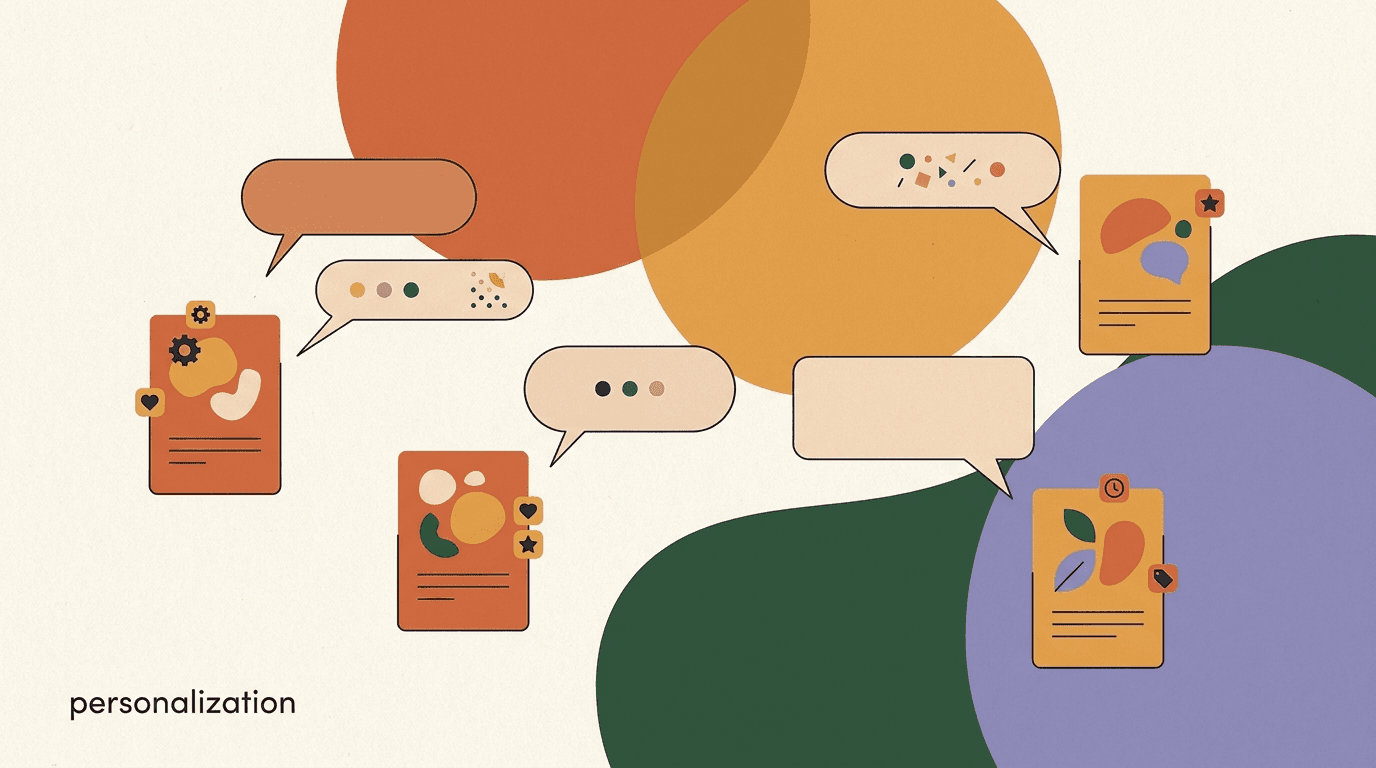
Chat personalization usually starts and ends with one tired trick: dropping a {{first_name}} token into the opening line of a message. It feels personal for about half a second, until the reader realizes the rest of the message is identical to what every other contact received. Worse, when the token breaks — and it always eventually breaks — you get the dreaded "Hi {{first_name}}" or "Hey there ," and the illusion collapses entirely. Real personalization is not a token. It is the practice of changing what you say, how you say it, and when you say it based on what you genuinely know about the person on the other end of the conversation.
This guide is about that deeper practice. We will move past the cosmetic and into the structural: tags that record who someone is, custom fields that store what they told you, behavioral signals that reveal what they want, and purchase history that tells you where they are in their relationship with you. We will cover how to branch a flow on that data, how to time a message to intent rather than to your calendar, and where AI fits in to adapt wording at a scale you could never write by hand.
We build KlyoChat, an AI-native chat platform, so we have a stake in this — and we will be honest about that throughout, including where the approach has limits and where you should be cautious. The most important caution comes first: everything below depends on having permission to message someone and a defensible reason to use their data. Personalization done without consent is not clever marketing. It is surveillance with a friendly font. We will keep returning to that line.
What does chat personalization actually mean beyond the first name?
At its core, chat personalization is the alignment of a message with a specific person's context. The first-name token is the most superficial layer of that — it personalizes the salutation and nothing else. Genuine personalization changes the substance: the offer, the example, the tone, the channel, and the moment. A message that says "Hi Sarah" and then pitches a product Sarah already bought is less personalized, in any meaningful sense, than a message that omits her name but recommends the accessory that pairs with her last purchase.
The mental shift is from decoration to relevance. Decoration is sprinkling known facts onto a generic message. Relevance is letting known facts determine which message gets sent at all. The first is a token; the second is a decision. Everything in this guide is about making more of your messaging the second kind.
It helps to think in layers. The shallowest layer is identity tokens — name, city, the obvious merge fields. Above that sits attribute-based personalization, where tags and custom fields route people into different content. Higher still is behavioral personalization, where what someone did changes what they see next. And at the top is contextual, real-time personalization, where the message adapts to the moment and the conversation itself. Most teams live in the bottom layer and assume the top layer requires a data science team. It does not.
Personalization is relevance, not decoration
If your idea of personalization is adding more known facts to the same message, you are decorating. If it is changing which message a person receives based on what you know, you are personalizing. The whole of this guide lives on the second side of that line.
What are the levels of chat personalization, from token to true 1:1?
It is easier to plan a personalization strategy when you can see it as a ladder. Each rung requires more data, more setup, and more discipline than the one below — but each also delivers more relevance. You do not need to climb to the top to win. Most teams see the biggest jump simply moving from level one to level three.
Here is the ladder we use when we help teams think this through. Match your ambition to the data you actually have and the consent you actually hold, not to the most advanced rung you can imagine.
- Level 1 is table stakes — do it, but do not mistake it for a strategy.
- Level 2 is where most of the easy wins are; segment-based chat takes hours, not weeks.
- Level 3 needs you to capture behavior, which means instrumenting your funnel.
- Level 4 needs AI to scale the wording, because no human writes 10,000 truly distinct messages.
| Level | What changes | Data it needs | Example |
|---|---|---|---|
| 1. Token | The salutation only | A name field | "Hi Sarah" on an otherwise identical message |
| 2. Segment | Which message a group gets | Tags / attributes | VIP customers get an early-access note; new leads get a welcome |
| 3. Behavioral | Content based on actions | Event / activity data | Cart abandoners get a nudge; browsers get a guide |
| 4. Contextual 1:1 | Wording, offer, and timing per person | Behavior + AI + real-time signals | An AI reply that references the exact product asked about, sent when they are active |
Climb one rung at a time
Teams that try to jump straight to AI-driven 1:1 personalization usually stall, because they skipped the data foundation underneath. Get tags and custom fields clean first. Behavioral and contextual personalization are only as good as the attributes feeding them.
How do tags power segment-based chat?
Tags are the workhorse of personalized messaging, and they are the most underused tool in most accounts. A tag is a simple label attached to a contact — "vip", "trial", "interested-in-pricing", "attended-webinar", "cold" — and the power comes not from any single tag but from how you combine them. A contact tagged both "vip" and "renewal-due" is a different person, strategically, from one tagged "trial" and "never-logged-in". Each combination implies a different message.
Tags get applied in three ways: manually by your team during a conversation, automatically by a flow when someone takes an action, and by an AI agent that infers intent from what a person says. The automatic and AI-driven routes are what let segment-based chat scale. When someone clicks a button that says "I'm interested in the enterprise plan," a flow can tag them "enterprise-interest" instantly, and every future message can branch on that fact without anyone lifting a finger.
The discipline that separates good tagging from a mess is a naming convention. Decide on a structure — prefixes for source ("src-ad", "src-organic"), for status ("status-trial", "status-customer"), for interest ("int-pricing", "int-feature-x") — and document it. An account with 200 ad-hoc tags nobody understands is worse than an account with 20 tags everyone trusts. Tags are only useful if they mean the same thing to everyone and to your automations.
Same broadcast, three tag-driven variants
- Tag: status-trial
- "Your trial ends in 3 days — here's the one feature most teams say sealed it."
- Tag: status-customer
- "You've been with us 6 months. Here's a power-user tip you may have missed."
- Tag: status-customer + int-feature-x
- "Feature X just shipped the update you asked about. Want a 2-minute walkthrough?"
What role do custom fields play in dm personalization?
If tags answer "what category is this person in," custom fields answer "what specific thing do I know about them." A custom field stores a value: company size, plan type, preferred product category, the date of their last order, the name of their account manager, the size they wear, the city they ship to. Where a tag is a yes-or-no flag, a field holds detail — and detail is what makes dm personalization feel like it was written for one person.
The trick with custom fields is to capture them naturally inside the conversation rather than demanding them up front. A flow can ask "What are you mostly looking to do with this?" offer three buttons, and store the answer in a field. Later messages reference that stored answer directly. The contact never filled out a form; they had a short chat, and the system remembered. That memory, surfaced at the right moment, is the difference between a message that feels robotic and one that feels attentive.
Custom fields also let you do dynamic chat content — inserting a stored value into a message so it reflects reality. "Your usual size, medium, is back in stock" works only if you captured and stored "medium" earlier. The merge token is the same mechanic as {{first_name}}, but pointed at a field that actually carries weight. That is the whole upgrade: stop merging trivia, start merging the things that change a decision.
Capture fields in the flow of conversation
The best custom-field data is collected as a byproduct of a helpful exchange, not a form. Ask one useful question, store the answer, and use it later. People answer a single relevant question far more readily than they fill out a profile.
How does behavioral data change what you send?
Behavior is the most honest signal you have, because it is what people do rather than what they say. Someone can tell you they are "just browsing," but if they have viewed the same product page four times this week, opened your last three messages, and clicked the pricing link, their behavior is telling you something their words are not. Behavioral personalization listens to actions and lets them shape the next message.
In a chat context, the behaviors worth tracking are concrete and conversational: which buttons someone clicked, which links they opened, whether they replied, how recently they were active, where they dropped out of a flow, and what they purchased. Each of these is an event you can trigger on. A contact who clicked "see pricing" but never replied is a warm lead who hesitated — a perfect candidate for a single, low-pressure follow-up that addresses the most common pricing objection.
The reason behavioral personalization outperforms attribute-based personalization is timing and intent. Tags and fields describe a person in general; behavior describes them right now. A "vip" tag tells you someone is important, but a fresh cart-abandonment event tells you they were about to buy and stopped — and that is the moment a well-judged message earns its keep. Behavior turns personalization from a static profile into a live conversation.
Two contacts, same product, different message
- Behavior: viewed once, left
- Educational nudge — "Here's how three customers use this. No rush."
- Behavior: added to cart, abandoned
- Gentle close — "You left this in your cart. Want me to hold it or answer a question?"
How does purchase history sharpen personalized messaging?
Purchase history is the richest, most actionable data you can personalize on, because money is the clearest statement of preference a person ever makes. What someone bought, when, how often, how much they spent, and what they bought it alongside — all of it points toward what to say next. A first-time buyer needs reassurance and onboarding. A repeat buyer needs to feel recognized. A lapsed buyer needs a reason to come back. These are three different conversations, and purchase history tells you which one to have.
The most reliable plays are well-worn for a reason. Post-purchase, you can check in and recommend the natural companion product. After a typical reorder interval, you can remind someone before they run out. After a period of silence from a former regular, you can reach out with genuine acknowledgment rather than a generic blast. Each of these is personalized not by inserting a name but by being aware of where the person sits in their buying rhythm.
Connecting purchase history to chat usually means integrating your store. KlyoChat connects to Shopify and WooCommerce on the Business plan, which lets order data flow into the inbox so messages can reference real purchases. Be honest with yourself about the setup cost here — this is the most powerful layer and also the one that requires the most plumbing. If your store is not connected, start with tags and behavior and add purchase history when you are ready to wire it up.
| Customer state | Signal from purchase history | Personalized move |
|---|---|---|
| First-time buyer | One order, recent | Onboarding + how-to-get-value message |
| Repeat buyer | Multiple orders, steady | Recognition + cross-sell the companion item |
| Due for reorder | Past typical reorder interval | Pre-empt the run-out with a one-tap reorder |
| Lapsed | No order in a long while | Honest re-engagement, not a guilt trip |
Where does AI fit in 1:1 personalization?
Tags, fields, behavior, and purchase history get you to relevant segments and well-timed triggers. But there is a ceiling to template-based personalization: you can write maybe a dozen variants of a message by hand before it becomes unmanageable, and even a dozen variants is not truly 1:1. This is where AI changes the economics. An AI agent can read the actual content of what a person wrote and respond to that specific thing, in natural language, at any volume.
In practice this means an AI agent can take the same underlying data — the tags, the fields, the last purchase — and compose a reply that references the exact product someone asked about, in the tone of the conversation so far, rather than picking from a fixed set of templates. Someone asks "does this come in a larger size for a taller person?" and the agent answers that question, mentions the relevant size, and notes the field it stored about their last order, all in one coherent message. No template tree could anticipate every phrasing; the AI does not need to.
KlyoChat's AI agents draw on a knowledge base you provide and adapt their replies to each conversation. The honest framing is that AI is the wording engine, not the strategy. It scales the how of personalization — turning structured data into natural, specific language — but you still decide the what and the why. And it is not infallible: AI can misread intent, so the highest-stakes messages still deserve a human in the loop. Use AI to handle the volume of first responses and routine personalization, and reserve human judgment for the moments that carry real weight.
AI scales the wording, not the judgment
Treat AI as the engine that turns your data into specific, natural language at scale — not as the decider of strategy. It is excellent at first responses and routine personalization, and it should hand off to a human when stakes are high or intent is ambiguous.
How do you branch a flow on what you know about someone?
A flow is where personalization stops being a plan and becomes a mechanism. Branching means the flow checks a piece of data — a tag, a field, a behavior — and sends the person down a different path depending on the answer. Done well, a single flow can deliver dozens of distinct experiences from one piece of setup, because each contact only ever sees the branch that matches them.
The structure to aim for is a check, then a split, then tailored content on each side. Check whether the contact is tagged "customer." If yes, branch to a loyalty message; if no, branch to a conversion message. Within the customer branch, check the plan field and split again. Each split should correspond to a real difference in what the person needs, not a difference you can technically detect but that does not matter. Branching on noise just multiplies your maintenance for no gain.
KlyoChat's flow builder branches on tags, custom fields, and behavior with no code, which is what makes this practical for a small team. Here is a simple, reliable structure to start from. Build it once, and it personalizes every contact who enters it from then on.
- Open with a question that captures intentOffer two or three buttons that map to real paths. Store the choice in a custom field so the rest of the flow — and future messages — can use it.
- Branch on what you already know firstBefore asking anything, check existing tags and fields. A known customer should never be treated like a cold lead just because they entered a new flow.
- Split into tailored content per branchEach branch carries a message written for that specific situation — different offer, example, and tone. Keep branches to the differences that matter.
- Tag the outcome for laterWhen someone completes a branch, apply a tag that records what happened. That tag personalizes the next flow they enter and keeps your data compounding.
- Hand off to a human or AI for the long tailNo branch covers every case. Route anything unmatched to an AI agent or a person rather than dead-ending the conversation.
How do you time outreach to intent instead of the calendar?
Most messaging is timed to the sender's convenience: the Tuesday newsletter, the end-of-month promo, the campaign that ships when the campaign is ready. Personalized timing flips this to the recipient's reality. The best moment to message someone is when their behavior says they are receptive — right after they engaged, when they are active, at the point in their cycle when the message is genuinely useful — not when your editorial calendar happens to land.
Intent-based timing relies on the same behavioral signals as content personalization. Someone who just opened your last message is warm right now; a follow-up lands far better in the next hour than in next week's batch. A reorder reminder is useful a few days before the typical run-out date and useless a month after. A re-engagement message to a lapsed contact works best framed around their absence, not around a holiday they have no reason to associate with you.
Two practical guardrails keep timing on the right side of helpful. First, respect quiet hours and the recipient's time zone — a perfectly relevant message at 3 a.m. is still a bad message. Second, cap frequency hard. Personalization can tempt you to message more often because you always have a relevant reason, but relevance is not a license for volume. The fastest way to make someone mute you is to be relevant too often.
Relevance is not a license for frequency
Behavioral personalization gives you a reason to message someone almost every day. Resist it. Cap frequency, honor quiet hours and time zones, and remember that the right to be in someone's DMs is easy to lose and hard to win back.
How do you personalize without being creepy?
There is a line between attentive and unsettling, and personalization can cross it fast. The principle that keeps you on the right side is simple: use data the person would expect you to have, for a purpose that helps them. Referencing a product they explicitly asked about feels attentive. Referencing something they never told you — pieced together from data they did not knowingly share — feels like being watched. The same fact can be welcome or alarming depending entirely on how you came to know it.
A few concrete tests help. Would the person be comfortable if you explained, out loud, how you knew the thing you just referenced? If the explanation is "you told me last week," you are fine. If it is "we tracked you across the web," you are not. Does the personalization serve them or just you? A reorder reminder serves them; resurfacing a private detail to manufacture urgency serves only you. When in doubt, under-personalize. A slightly generic message that respects boundaries beats a hyper-specific one that violates them.
There is also a transparency dividend. People are far more comfortable with personalization when they understand it is happening and have some control over it. Letting someone set preferences, choose what they hear about, and opt down rather than only opt out builds the kind of trust that makes personalization welcome instead of suspicious. The goal is a relationship where the person is glad you remember them, not unnerved that you do.
Consent and privacy law come first — this is not legal advice
Personalization depends on having permission to message someone and a lawful basis to use their data. Regulations like GDPR and similar laws around the world set real obligations: consent, transparency, data minimization, and the right to be forgotten. We are not lawyers and this is not legal advice — get qualified counsel for your jurisdiction. The simplest rule of thumb: if you could not comfortably tell the person exactly what data you hold and why, do not use it.
What are the most common chat personalization mistakes?
Most personalization failures are not failures of ambition — they are failures of restraint and hygiene. The teams that get this wrong rarely do too little; they do too much, too eagerly, on data they should not have leaned on. Knowing the common traps in advance is the cheapest way to avoid them, because every one of these mistakes is easier to prevent than to recover from once a contact has decided you are annoying or untrustworthy.
The first and most frequent mistake is over-relying on the broken token. A message built entirely around {{first_name}} will eventually render "Hi ," to the contacts whose names you never captured, and that single broken merge undoes the impression of care you were trying to create. Always write a fallback and, better yet, write messages that read well even with no name at all. The name should be a bonus, never the load-bearing element.
The second is personalizing on stale or wrong data, which is worse than not personalizing at all. Telling a customer their "usual size, medium" when they switched to large months ago is not attentive — it is a sign you are not actually paying attention, just replaying old records. The third is confusing the ability to detect something with permission to mention it. Just because your tooling can surface a fact does not mean referencing it will feel anything other than invasive. And the fourth is volume: treating every behavioral signal as a reason to send another message, until your relevance becomes noise and the person mutes the channel entirely.
- Leaning on the name token with no fallback, so broken merges expose the trick.
- Personalizing on stale data — referencing a preference or fact that is no longer true.
- Mentioning data the person did not knowingly share, which reads as surveillance.
- Treating every signal as a reason to message, until relevance becomes spam.
- Building elaborate branches on differences that do not actually change what to say.
Wrong personalization is worse than none
A generic message is forgettable; a confidently wrong personalized message — wrong name, wrong size, wrong assumption — actively erodes trust. Before you scale personalization, make sure the data underneath is current and correct. Speed without accuracy is a liability here.
How do you scale personalization without losing the human touch?
There is a tension at the heart of personalization at scale: the whole point is to make each message feel one-to-one, yet the only way to do it across thousands of contacts is automation, which is the opposite of personal attention. The resolution is not to pick a side but to design the handoff between automation and humans deliberately, so machines handle the volume and people handle the moments that genuinely need a person.
A useful way to divide the work is by stakes and ambiguity. Low-stakes, unambiguous interactions — a welcome message, a reorder reminder, a routine FAQ answer — are perfect for automation and AI, because the right response is clear and the cost of a small imperfection is low. High-stakes or ambiguous interactions — a frustrated customer, a complex objection, a big purchase decision, anything where intent is unclear — should route to a human. The art is building flows and AI agents that recognize their own limits and hand off cleanly rather than bluffing through a conversation they should have escalated.
Keeping the human touch also means letting your automation sound like your brand and your people, not like a system. The wording AI produces should match the voice your team actually uses, the tone should fit the channel, and the message should never pretend to be a live human when it is not. People are remarkably forgiving of automation that is honest about being automation and genuinely helpful; they are unforgiving of automation that impersonates a person and then fails to deliver. Scale the routine, protect the meaningful, and be transparent about which is which.
- Automate the routine and unambiguousLet flows and AI handle welcomes, reminders, and common questions where the right answer is clear and a small imperfection costs little.
- Route the high-stakes to a humanFrustration, complex objections, big decisions, and unclear intent belong with a person. Build explicit handoff triggers into your flows.
- Match automation to your real voiceTune AI wording and templates so they sound like your team and channel. Generic, off-brand automation reads as impersonal no matter how relevant.
- Be honest about what is automatedDo not let automation impersonate a live human. People forgive helpful automation that is upfront; they resent automation that pretends and then fails.
What does a personalization data foundation look like?
Everything above rests on data, and data that is messy, inconsistent, or stale produces personalization that is worse than none — a confidently wrong message lands harder than a generic one. Before you build clever flows, it is worth investing in the foundation: a clean, consistent, well-governed set of tags, fields, and events that you and your automations can trust.
A solid foundation has a few characteristics. It is consistent: tags follow a documented naming convention and fields hold values in a predictable format. It is current: data decays, so you have a way to refresh or expire stale attributes rather than personalizing on year-old facts. It is minimal: you collect what you will actually use, not everything you could grab, both because minimal data is easier to keep clean and because it is the right posture for privacy. And it is auditable: you know where each piece of data came from and on what basis you hold it.
The unglamorous truth is that the teams with the best personalization are not the ones with the fanciest AI — they are the ones with the cleanest data. A unified inbox helps here because it keeps a single profile per contact across channels, so a person's tags, fields, and history travel with them whether they message you on Instagram today and WhatsApp next week. Fragmented data across disconnected tools is the most common reason personalization quietly fails.
- Consistent: documented naming conventions for tags and a predictable format for fields.
- Current: a process to refresh or expire stale attributes so you never personalize on dead data.
- Minimal: collect only what you will use, which is both cleaner and the right privacy posture.
- Auditable: know the source and lawful basis of every attribute you hold.
- Unified: one profile per person across channels, so context follows them everywhere.
How do you measure whether personalization is working?
Personalization is not free — it costs setup time, maintenance, and complexity — so it has to earn its place. The way to know it is working is to compare personalized messaging against a sensible baseline and watch the metrics that reflect genuine relevance rather than vanity. The headline question is always the same: did tailoring the message change behavior in the direction you wanted?
Reply rate and reply quality are the most telling chat metrics, because conversation is the medium. A personalized message that earns more genuine replies is working; one that earns more unsubscribes is not, no matter how clever it felt. Beyond replies, watch conversion on the specific action each message was designed to drive, and watch the negative signals just as closely — mutes, blocks, and opt-outs are personalization telling you it went too far. The point is balance: relevance up, annoyance down.
The most rigorous approach is to hold out a control. Send the personalized version to most of a segment and a generic version to a small holdout, then compare. This is the only way to know whether the lift came from personalization or from something else entirely. It takes discipline to keep a holdout when you believe in the personalized version, but without one you are guessing. Measure honestly, and be willing to retire personalization that does not pay for itself.
| Metric | What it tells you | Watch for |
|---|---|---|
| Reply rate | Whether the message earned a real conversation | A drop means the message felt off, not just unread |
| Conversion on intended action | Whether tailoring moved the needle | Compare against a generic holdout to isolate the effect |
| Opt-out / mute / block rate | Whether you crossed the creepy or frequency line | A rise is a warning, even if conversion looks fine |
| Time-to-first-reply | Whether timing matched intent | Faster replies suggest you hit a receptive moment |
How does KlyoChat support chat personalization?
We built KlyoChat as an AI-native unified inbox precisely because fragmented data is the enemy of good personalization. Facebook, Instagram, Telegram, WhatsApp, TikTok, and X messages land in one place, and each contact carries a single profile — their tags, custom fields, and history — across every channel. That unified profile is the foundation the rest of this guide depends on: you cannot personalize well if a person's context is scattered across five disconnected tools.
On top of that inbox, the pieces line up with the levels of personalization above. Tags and segments handle attribute-based personalized messaging. Custom fields capture and store the specifics that make dm personalization feel attentive. The no-code flow builder branches on tags, fields, and behavior so one flow delivers many tailored experiences. And AI agents, working from a knowledge base you provide, adapt their replies to each conversation — the wording engine for contextual, near-1:1 personalization. The Business plan connects Shopify and WooCommerce so purchase history can flow in and inform messages.
We will be straight about the limits, because choosing the wrong tool helps no one. KlyoChat does not offer native SMS or email — if those channels are central to your personalization strategy, you will need them elsewhere or alongside. We are also a newer, smaller platform with a smaller community than the incumbents, so there are fewer third-party templates and tutorials floating around. And like everyone, we cannot make personalization compliant for you; consent and lawful basis are your responsibility. If your needs are social DM plus WhatsApp, with AI doing the heavy lifting on wording, that is exactly what we are built for. Plans start at Basic ($19/mo), Pro ($49/mo, or $39 billed yearly), and Business ($129/mo), and every plan starts with a 7-day free trial — no credit card.
- Unified inbox keeps one personalization profile per contact across every channel.
- Tags, custom fields, and segments drive attribute-based personalized messaging.
- No-code flows branch on data so one build serves many tailored paths.
- AI agents adapt wording per conversation from your knowledge base.
- Honest limits: no native SMS or email, and a smaller community than legacy tools.
KlyoChat plans for personalization, at a glance
- Basic — $19/mo
- Tags, custom fields, segments, and one AI agent — enough to run levels 1-2 well
- Pro — $49/mo ($39 yearly)
- Custom AI agents and all channels for contextual personalization across DMs
- Business — $129/mo
- Shopify and WooCommerce connection so purchase history powers your messaging
Chat personalization that matters has almost nothing to do with first-name tokens and almost everything to do with relevance: changing what you say, how you say it, and when you say it based on what you genuinely know and have permission to use. Climb the ladder one rung at a time — tags and segments first, then behavior and purchase history, then AI to scale the wording — and keep your data clean enough to trust at each step.
Above all, stay on the helpful side of the line. The goal is a person who is glad you remember them, not one who feels watched. Respect consent, honor frequency limits, measure against an honest baseline, and be willing to under-personalize when in doubt. Do that, and personalization stops being a gimmick and becomes the reason people actually want to hear from you. For where this fits into the bigger picture, see our guides on conversational marketing, the KPIs that prove it is working, and how to structure a DM drip campaign.