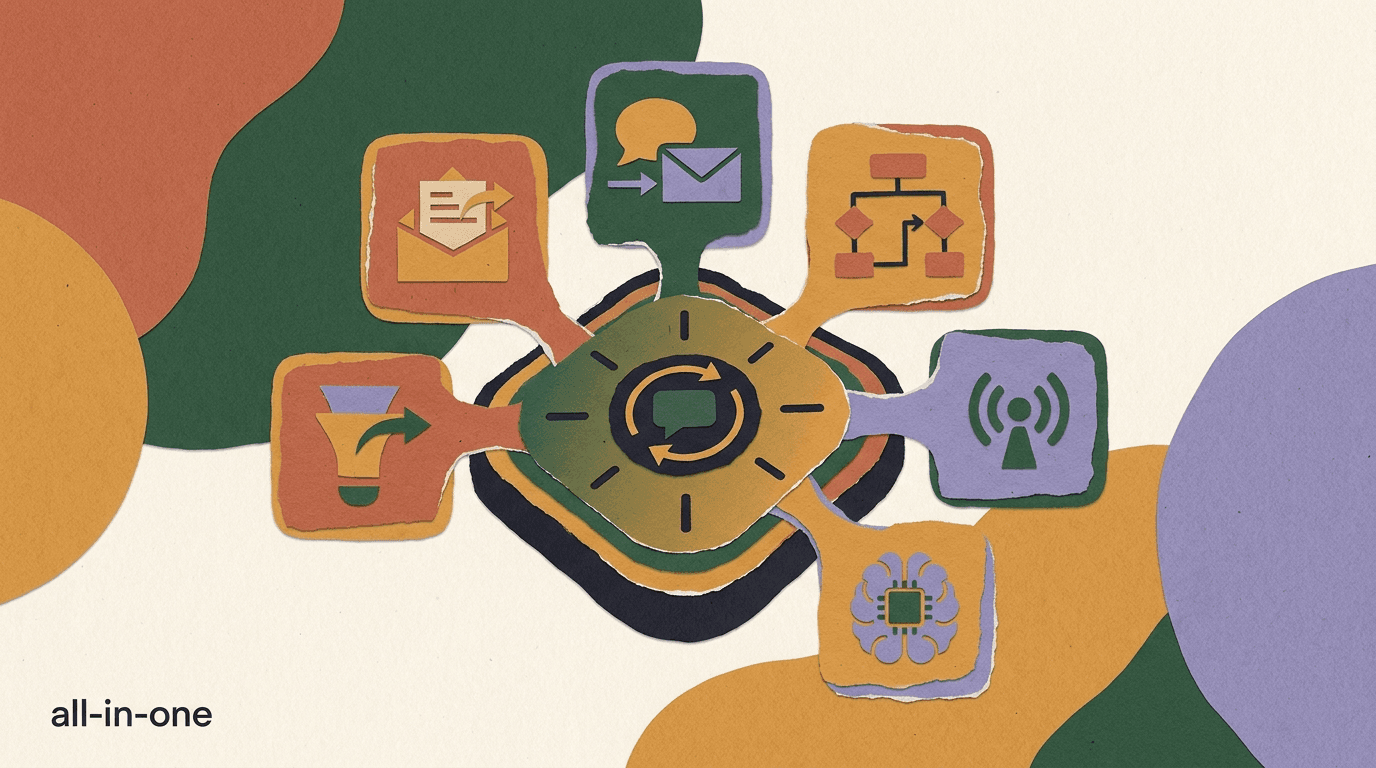
An all-in-one chat marketing platform promises to do the job that used to take four or five separate tools: catch a comment on a Reel, turn it into a direct message, qualify the person with a short flow, hand a hard question to a human, follow up with a broadcast a week later, and show you which of those steps actually made money. That is a lot to ask of one product, and the category is crowded with tools that claim to do everything and quietly do only two things well.
This guide is a buyer's map, not a sales pitch. We will define what an all-in-one chat marketing platform should include, weigh the honest trade-offs of buying one product versus stitching together point tools, and give you a repeatable way to evaluate any vendor — including the parts they would rather you not test on a demo. We build KlyoChat, so we have a point of view, but the framework here works no matter which conversational marketing platform you end up choosing.
The short version: consolidation is genuinely useful when your channels share data, your team shares one inbox, and your reporting lives in one place. It stops being useful the moment a single vendor becomes a weak link in a channel you depend on. The skill is knowing which functions you truly need bundled and which you are better off keeping specialized. That is the whole decision, and the rest of this piece is about making it well.
What is an all-in-one chat marketing platform?
An all-in-one chat marketing platform is software that manages your automated and human conversations across messaging channels — Instagram, Facebook Messenger, WhatsApp, Telegram, TikTok, and increasingly X — from a single account. Instead of one app for Instagram DMs, another for WhatsApp campaigns, and a spreadsheet to track it all, you run acquisition, automation, support, and follow-up in one place. The term overlaps with what people call a conversational marketing platform, dm marketing software, or an all in one messaging platform; the labels differ, the job is the same.
The category grew out of a simple shift in buyer behavior. People stopped treating a brand's inbox as a last resort and started using it as the front door. They ask about sizing before they add to cart, they reply to a Story instead of clicking a link, and they expect an answer in minutes, not the next business day. That behavior has a name — conversational commerce — and it turned the humble DM into a revenue channel that needs real tooling.
So an all-in-one chat marketing platform sits at the intersection of three older categories: social media management, marketing automation, and helpdesk software. It borrows the scheduling and listening instincts of the first, the flows and segmentation of the second, and the shared-inbox, assignment, and SLA thinking of the third. When it works, those three stop being separate jobs. When it does not, you have bought a tool that is mediocre at all three instead of good at one.
Chat marketing is not the same as chatbots
A chatbot is one feature. A chat marketing platform is the whole operation around it — acquisition, routing, human handoff, broadcasts, and measurement. If a vendor sells you a bot builder and calls it a platform, you will feel the gap the first time a customer needs a real person.
Why did chat marketing tools consolidate into single platforms?
Ten years ago, running DMs at any scale meant a drawer full of point tools: a bot builder here, a link-in-bio tool there, a separate broadcast service, and a support desk that never talked to any of them. Each did its narrow job, but the customer did not live inside one tool — they moved from a comment to a DM to a support ticket to a follow-up campaign, and every boundary between tools was a place where context got dropped and someone had to copy-paste.
Consolidation happened because the cost of those boundaries got too high. When a customer messages you on Instagram, mentions an order they placed on WhatsApp, and expects the agent to already know both, a stack of disconnected tools makes that impossible. A single platform with shared contact records, shared tags, and a shared inbox makes it ordinary. The value of all-in-one is not that it has more features — it is that the features share a memory.
There is also a plainer commercial reason: buying one platform is usually cheaper and easier to administer than five subscriptions with five logins, five bills, and five integration points that break on their own schedule. Procurement likes one vendor. IT likes one security review. The person who actually runs the inbox likes one screen. Those forces pushed the market toward suites — which is good when the suite is strong across the board and a trap when it is strong in one place and thin everywhere else.
The same customer, two setups
- Point-tool stack
- Comment tool captures the lead, a separate bot replies, support desk has no history, follow-up tool re-asks for their email
- All-in-one platform
- Comment, DM, support thread, and follow-up all read from one contact record — the agent sees everything
What should an all-in-one chat marketing platform include?
Before you compare vendors, agree on the checklist. Marketing pages are designed to make every product look complete, so the way to cut through them is to hold each one against a fixed list of capabilities and ask, for each, whether it is present, deep, and connected to the rest. Below is the capability set we consider table stakes for a serious all-in-one chat marketing platform, plus a blunt note on whether missing it should end the conversation.
Read the last column carefully. Not every gap is fatal. A platform can lack native SMS and still be the right tool for a business that lives on Instagram and WhatsApp. But some gaps — a broken unified inbox, no human handoff, no analytics — mean you are buying a demo, not a platform.
- Present is not the same as deep — a checkbox feature can still be unusable at volume.
- Connected matters more than complete — features that do not share contact data recreate the stack you were trying to leave.
- Score each capability as missing, shallow, or strong. Two strong-but-narrow tools often beat one that is shallow everywhere.
| Capability | What it does | Deal-breaker if missing? |
|---|---|---|
| Unified inbox | Every channel's conversations in one screen, with assignment and human handoff | Yes — this is the core of the category |
| Comment-to-DM | Turns public comments into private conversations and captured leads | Usually — it is the top acquisition play on social |
| No-code flows | Visual automation for welcomes, qualification, and FAQs without a developer | Yes — you should not need engineering to change a reply |
| Broadcasts | One-to-many messages to segments, respecting each channel's rules | Often — it is how you re-engage a list you already own |
| AI agents | Models that draft or send first replies from your knowledge base | Increasingly yes — manual-only does not scale |
| Analytics | Conversion, response time, and revenue attribution per flow and channel | Yes — without it you are guessing |
| Multi-channel | Real support for the channels your audience actually uses | Depends — only the channels you need matter |
What does a unified inbox actually do for you?
The unified inbox is the spine of any all-in-one chat marketing platform, and it is the feature most likely to look fine in a demo and fall apart in daily use. Its job is to put every conversation — Instagram, WhatsApp, Telegram, Facebook, TikTok, X — into one queue that a team can work together, with assignment, internal notes, tags, and a clean handoff from automation to a human being. When it works, an agent never has to ask which app a message came from; they just work the queue.
The details that separate a real inbox from a glorified message list are unglamorous. Can two agents work it without colliding on the same conversation? Does a bot-to-human handoff carry the full history, or does the human start blind? Can you tag, snooze, and reassign quickly with a keyboard? Are internal notes actually private? Does search find a conversation from three weeks ago by phone number or order ID? These are the things you will do hundreds of times a day, and small friction compounds into real cost.
A good inbox also respects that automation and humans are not enemies. The best setups let a flow or an AI agent handle the predictable ninety percent and route the tricky ten percent to a person with context attached. The unified inbox is where that handoff either feels natural or feels like a dropped call — so test it with a genuinely awkward conversation, not the tidy scripted one the sales engineer will show you.
Test the inbox with two people at once
Most inbox weaknesses only show up under concurrency. During a trial, have two teammates work the same queue for twenty minutes. If they step on each other, lose notes, or cannot tell who is handling what, that pain scales with every hire you make.
Why is comment-to-DM the feature people underrate?
Comment-to-DM is the single most effective acquisition play native to social platforms, and it is often buried three tabs deep in a feature list. The mechanic is simple: someone comments a keyword on your post or Reel, and the platform automatically sends them a direct message — a link, a code, a short qualifying question. It converts public, low-intent engagement into a private, one-to-one conversation you own, and it does it at the exact moment the person is paying attention.
It works because it rides the algorithm instead of fighting it. Comments boost a post's reach, so a comment-to-DM prompt encourages the exact engagement the platform rewards, which lifts the post, which drives more comments. You are not buying attention; you are converting attention you already earned. For creators and D2C brands, a single well-placed Reel with a comment-to-DM trigger can capture more qualified leads in a day than a month of link-in-bio traffic.
The reason people underrate it is that it looks like a gimmick until they see the numbers. It is also where platform rules bite hardest — Instagram and Facebook have specific policies about automated messaging windows and what you can send, so the feature has to be built to respect them. Instagram publishes its own guidance in its help center, and any platform worth buying will keep its comment-to-DM automation inside those lines rather than risking your account to chase a slightly faster reply.
Comment-to-DM in practice
- Post
- A Reel says: comment GUIDE and I will send it to you
- Trigger
- Platform detects the keyword and opens a DM automatically
- Capture
- The DM delivers the guide and asks one qualifying question
- Result
- A public comment becomes an owned contact you can follow up with
Flows or broadcasts — when do you use each?
Flows and broadcasts are the two workhorses of chat marketing, and confusing them is a common and expensive mistake. A flow is reactive: it responds to something a person does — a comment, a keyword, a first message, a button tap — and walks them through a branching path. A broadcast is proactive: you send a message to a segment of people you have already earned permission to contact. One meets people where they are; the other reaches out to people you already know.
Flows are where automation earns its keep on the front line. A welcome flow greets a first-time messager and sets expectations. A qualification flow asks two or three questions and tags the contact so the right person or offer reaches them. An FAQ flow deflects the questions your team answers fifty times a day. Good flow builders are visual, no-code, and forgiving — you should be able to change a reply without filing a ticket, and you should be able to see, at a glance, where people drop off.
Broadcasts are where you monetize the list those flows built. A product drop, a restock, a limited offer, an event reminder — these go to a segment, not to everyone, and they respect each channel's rules about what you can send and when. WhatsApp in particular has strict, well-documented rules around template messages and messaging windows, laid out in the WhatsApp Business Platform documentation; a platform that lets you broadcast without accounting for those rules is setting you up for blocked messages or a suspended number. Used together, flows fill the list and broadcasts activate it — which is the heart of good conversational marketing.
- Use a flow when the person acts first — a comment, a keyword, a first DM, a button.
- Use a broadcast when you act first — a launch, a restock, a reminder, a reactivation.
- Segment broadcasts by tags your flows set, so the right message reaches the right people.
- Respect channel rules — WhatsApp templates and messaging windows are not optional.
Do you actually need AI agents built into the platform?
A year ago, AI in chat marketing meant a bolt-on that drafted a reply you still had to approve. Today, an AI agent can hold the first exchange on its own — read a customer's question, pull an answer from a knowledge base you control, respond in your voice, and escalate to a human when it is out of its depth. The question is no longer whether AI helps; it is whether it should be native to your platform or a separate service you wire in.
The case for native is that AI agents live or die on context. An agent that can see the full conversation history, the contact's tags, and which channel they are on gives materially better answers than one that receives a stripped-down message over an API and answers in a vacuum. When the AI shares the same contact record as your flows and your inbox, its handoff to a human is clean and its answers are grounded. When it is a separate tool, you are back to gluing systems together and hoping context survives the trip.
The honest caution is that AI quality varies enormously, and a bad agent is worse than no agent — it answers confidently and wrongly, and it does it at scale. So the feature to test is not whether the AI exists but how well you can constrain it: can you scope it to your knowledge base, set the tone, decide when it must hand off, and review what it said? We covered where this is heading in our look at the state of conversational AI; the practical takeaway for a buyer is that a built-in agent you can govern beats a powerful one you cannot.
A confident wrong answer is the real AI risk
The failure mode that hurts is not the AI going quiet — it is the AI inventing a return policy or a price. Before you trust an agent with live conversations, test it on the questions where a wrong answer costs you money, and confirm you can force a human handoff on those topics.
What analytics separate a real platform from a toy?
Analytics is the capability buyers skip on a demo and regret in month three. A chat marketing platform without real reporting is a machine that does work you cannot measure, which means you cannot improve it and you cannot defend its budget. The bar is not a dashboard of vanity metrics; it is the ability to answer three questions: which flows convert, how fast we respond, and what all of this is actually worth in revenue.
Conversion analytics should tell you where people enter a flow, where they drop off, and where they convert, per step. That is how you find the one question in a qualification flow that is scaring people away, or the broadcast segment that outperforms the rest three to one. Response-time analytics should show first-response and resolution times by channel and by agent, because in chat, speed is conversion — a reply in two minutes and a reply in two hours are different businesses.
Revenue attribution is the hard one and the one that matters most. A serious platform connects conversations to outcomes — an order placed, a booking made, a code redeemed — so you can say a flow drove a specific amount, not merely that it sent a lot of messages. If a vendor cannot show you revenue per flow or per channel, treat their platform as a cost center you are running on faith. You can compare how different tools handle this on a comparison page, but the real test is loading your own data and seeing whether the numbers help you decide anything.
Ask what you cannot measure
Every analytics tool has a blind spot. On a trial, ask the vendor directly what their reporting cannot tell you. An honest answer teaches you more about the product than any dashboard tour, and a vendor who claims no blind spots is the one to worry about.
How many channels do you really need?
Multi-channel is the headline feature of every all in one messaging platform, and it is also the one most likely to lure you into paying for reach you will never use. The right number of channels is not all of them — it is the set your audience actually messages you on, plus at most one you have a concrete plan to grow into. A platform that supports twelve channels you do not use is not more valuable than one that supports the four you do.
That said, the modern default is broader than it was. A brand serious about chat commerce typically needs Instagram and WhatsApp at minimum, Facebook Messenger for an older or more Western audience, and Telegram or TikTok depending on geography and demographic. X has re-emerged as a support and conversation channel for certain audiences. The point of a unified platform is that adding a channel should be a connection step, not a new tool and a new login — so the value is in the ease of expansion, not the raw count.
The trap to avoid is the mirror image: buying a single-channel tool because it is cheap today, then paying the migration tax when your audience moves. Audiences drift between platforms faster than they used to. A tool that unifies channels gives you optionality — when TikTok becomes your best acquisition channel next year, you connect it rather than re-platform. Weigh channel breadth as insurance, not as a feature you have to fully use on day one.
Two businesses, two channel maps
- Beauty D2C brand
- Instagram plus WhatsApp does ninety percent of the work; Facebook mops up an older segment
- SaaS with a global community
- Telegram and X carry support; Instagram is mostly top-of-funnel
All-in-one platform or a stack of point tools?
This is the real decision, and there is no universal right answer — there is only the answer for your team, your channels, and your appetite for administration. An all-in-one chat marketing platform trades some depth in any single function for shared data, one bill, and one screen. A stack of best-in-class point tools trades that simplicity for the deepest possible tool in each category, at the cost of gluing them together and keeping the glue from cracking.
The honest framing is that all-in-one wins on total cost of ownership and speed, while point tools win on ceiling. If your operation is straightforward and your team is small, the overhead of integrating five specialized tools will cost you more than the marginal depth they offer. If you have one function so specialized and so central that no suite can match it — a bespoke helpdesk, a sophisticated CDP — then keeping that specialized and letting a platform handle the rest is the smarter build.
The table below is the comparison we would hand a friend who asked. Notice that most rows do not have a clean winner — they have a trade-off you have to price for your own situation. The mistake is treating all-in-one versus point tools as an identity choice rather than a math problem. Run the math on your real workload, not on a vendor's idea of an average customer.
| Dimension | All-in-one platform | Stack of point tools |
|---|---|---|
| Depth per function | Good enough for most, rarely the deepest | Best-in-class where you choose it |
| Shared context | Native — one contact record everywhere | Manual — you integrate and hope it holds |
| Total cost | One subscription, easier to forecast | Several bills plus integration and upkeep time |
| Setup speed | Days — connect channels and go | Weeks — wire tools together and test the seams |
| Failure risk | One vendor is a single point of failure | One tool breaking rarely takes down the rest |
| Admin overhead | One login, one security review | Many logins, many reviews, many renewals |
| Best fit | Small-to-mid teams wanting speed and clarity | Teams with one deep, non-negotiable specialty |
What are the honest limits of any single platform?
No all-in-one chat marketing platform is genuinely all of anything, and a vendor who implies otherwise is the one to distrust. The word all-in-one describes an ambition, not a physical law. Every suite makes choices about where to be deep and where to be adequate, and the useful skill is reading those choices before you buy rather than discovering them in production.
The most common real limit is channel scope. Many chat-first platforms are excellent on social messaging — Instagram, WhatsApp, Telegram, TikTok — and offer no native SMS or email. That is a deliberate focus, not a bug, but it matters enormously if your strategy leans on those channels, because you will still need a dedicated email or SMS tool alongside. Another common limit is that a chat marketing platform is not a full CRM, a full e-commerce backend, or a full helpdesk; it talks to those systems, but it does not replace them, and expecting it to leads to disappointment.
The other honest limits are commercial and human. Newer or smaller platforms have thinner communities, fewer templates, and fewer third-party experts to hire than the incumbents — real friction when you are stuck at 11pm. And any platform that touches WhatsApp inherits Meta's per-conversation fees, which the platform does not control and cannot waive. None of these are reasons to avoid a focused tool; they are reasons to pair it deliberately with the specialized systems it was never meant to be.
Pair, do not force
The strongest setups treat a chat marketing platform as the conversational layer and connect it to the email tool, the CRM, and the store that already do their jobs well. Trying to make one tool be all of them is how good stacks turn brittle.
How do you evaluate a chat marketing platform, step by step?
Evaluation goes wrong when you start from feature lists instead of from your own workflow. The reliable method is to define the two or three conversations that drive most of your outcomes, then test each candidate platform against exactly those — nothing more. A tool that nails your real work and lacks a feature you will never use is a better buy than one that checks every box and fumbles the conversation you have a thousand times a week.
Here is the sequence we would run, in order. It takes a focused afternoon per platform and it surfaces the problems that a polished demo is designed to hide.
- Map your real channels and conversations firstList the channels your audience actually uses and the two or three conversations that matter most — the acquisition play, the qualifier, the top support question. This is your test script.
- Score the capability checklist honestlyRun each candidate against the checklist earlier in this guide and mark every item missing, shallow, or strong. Ignore features you will never use — they are not free if they add clutter.
- Build your top flow in each toolDo not watch the vendor build it. Build your own comment-to-DM or welcome flow yourself in a trial. How long it takes and how it feels is the truest signal you will get.
- Stress the unified inbox with two peopleHave two teammates work the same queue and force a bot-to-human handoff on an awkward conversation. Watch whether context survives and whether they collide.
- Load real data into the analyticsPush a small amount of your own traffic through and see whether the reporting helps you decide anything. If it only shows message counts, it is a dashboard, not analytics.
- Price the fully-loaded, twelve-month costAdd the plan, any AI or channel add-ons, and platform fees like WhatsApp at next year's scale. Compare fully-loaded totals, never base price to base price.
Check who owns your data and how you leave
Before you commit, confirm you can export your contacts and conversation history in a usable format, and read how the vendor handles data on cancellation. A platform you cannot leave is a platform that has stopped competing for your business.
What should you actually test during a free trial?
A free trial is not a tour; it is a rehearsal. The goal is to reproduce a slice of your real operation and see where it strains, because the failures that matter never appear in the guided demo. Treat the trial as if you had already switched — run genuine traffic through it, let a real teammate work it, and pay attention to the small frictions, because those are what you will feel every single day once the honeymoon ends.
Use the trial to answer questions you cannot answer from a pricing page. These five tests, run in order, will tell you more than a week of reading reviews.
- Trial with your worst conversation, not your best — the edge cases are where tools break.
- Have the person who will actually run the inbox do the testing, not the person who signs the contract.
- Write down every small friction; five small frictions become one big reason you churn.
- Ship one live comment-to-DMPut a real trigger on a real post and watch a real person go from comment to captured contact. This exercises acquisition, automation, and the inbox in one shot.
- Break the AI on purposeAsk the AI agent the questions where a wrong answer costs money. Confirm it stays inside your knowledge base and hands off cleanly instead of inventing an answer.
- Send a segmented broadcastBroadcast to a small tagged segment on your most rule-bound channel — usually WhatsApp. See whether the platform enforces the channel's rules or lets you break them.
- Do a messy human handoffForce a conversation from bot to human mid-thread and check that the agent inherits the full history. A blind handoff is a bad customer experience at scale.
- Read your own numbersOpen the analytics after a few days of real activity and try to make one decision from it. If you cannot, the reporting is decorative.
What does a smart buyer's shortlist look like?
Once you have run the tests, the shortlist tends to sort itself by fit rather than by feature count. The most useful thing we can do is show you how different buyers weight the same capabilities differently, because the right all-in-one chat marketing platform for a solo creator is rarely the right one for a fifteen-person support team. Your job is to recognize which of these you are before you read another review.
Below are three honest buyer profiles and what actually tips their decision. Notice that price, channel scope, and AI governance move to the front for different reasons in each. There is no platform that wins all three columns, which is exactly why you evaluate against your own workflow instead of against a leaderboard.
Three buyers, three priorities
- Solo creator
- Comment-to-DM plus a flat, predictable price beats depth they will never use
- Growing D2C brand
- Instagram and WhatsApp done well, revenue attribution, and AI they can govern
- Mid-size support team
- A strong multi-agent inbox with assignment and SLAs outweighs marketing bells
How much should an all-in-one chat marketing platform cost?
Pricing in this category is where clarity goes to die, because vendors have learned that a low headline number sells and the real cost hides in contacts, add-ons, and per-message fees. The number to anchor on is never the sticker; it is the fully-loaded, twelve-month cost of the setup you will actually run, at the scale you expect to reach. Two platforms with identical headline prices can differ by a factor of three once AI and channel fees are added.
The two pricing models that dominate are contact-based tiers and flat plans, and the difference matters more than most buyers realize. Contact-based pricing charges you more as your audience grows, which sounds fair until you notice it means your bill rises fastest exactly when a campaign works. Flat pricing bundles a generous contact ceiling into a fixed price, so a viral month does not become a surprise invoice. We argued the case for the flat model in detail in our piece on why flat pricing wins; the short version is that predictability is worth real money to anyone whose growth is spiky.
Whatever the model, watch for three costs that rarely make the headline: an AI add-on charged on top of the base plan, channel gating that forces you up a tier to unlock WhatsApp, and Meta's per-conversation WhatsApp fees, which every platform passes through because none of them control it. Model those into your estimate from day one. You can see how any given vendor structures this on its pricing page, but only your own projected numbers will tell you what you will really pay.
Compare fully-loaded, not base to base
The most common budgeting error is comparing one platform's base plan to another's base plan. Compare the real setup: your projected contacts, plus AI, plus every channel you need, plus pass-through fees. That is the only apples-to-apples number, and it is often nothing like the headline.
Where does KlyoChat fit — and where it does not?
We build KlyoChat as an AI-native all-in-one chat marketing platform, so here is our honest place in this picture, limits included. KlyoChat unifies Facebook, Instagram, Telegram, WhatsApp, TikTok, and X into a single inbox, then layers comment-to-DM, no-code flows, broadcasts, custom AI agents, and analytics on top. The AI agents are included in the plan rather than sold as a separate add-on, and pricing is flat, so going from five thousand to ten thousand contacts does not move your bill.
The design bet behind KlyoChat is that most teams do not need the deepest possible version of every function — they need the common functions done well and sharing one memory. The AI agent sees the same contact record as the flows and the inbox, the comment-to-DM capture flows straight into the same queue, and the analytics tie conversations back to outcomes. For a creator or a growing D2C brand whose center of gravity is social messaging plus WhatsApp, that consolidation is the whole value.
Now the honest limits, because you should hear them from us before a competitor tells you. KlyoChat does not do native SMS or email — if those channels are core to your strategy, you will pair KlyoChat with a dedicated tool for them, and that is the right build, not a workaround. It is not a full CRM, e-commerce backend, or helpdesk suite; it is the conversational layer that connects to those. We are a newer platform with a smaller community than the largest incumbents, so there are fewer third-party templates and experts today. And WhatsApp's Meta per-conversation fees apply on KlyoChat exactly as they do everywhere, because Meta charges them, not us.
| What you need | How KlyoChat handles it |
|---|---|
| Unified inbox across social + WhatsApp | Included — FB, IG, Telegram, WhatsApp, TikTok, X in one screen |
| Comment-to-DM acquisition | Included, built to respect platform messaging rules |
| No-code flows and broadcasts | Included on every plan |
| AI agents on your knowledge base | Included — not a separate add-on |
| Native SMS or email | Not offered — pair with a dedicated tool |
| Full CRM / e-commerce / helpdesk | Not offered — connects to systems that do this |
Trial it against your real workflow
The only way to know if KlyoChat fits is to run your top flow and one live comment-to-DM through it during the 7-day trial. If native SMS or email is core to you, factor that gap in honestly before you decide.
KlyoChat plans at a glance
- Basic
- $19/mo — small teams getting started on a couple of channels
- Pro
- $49/mo ($39 billed yearly) — all channels, custom AI agents, 10,000 contacts
- Business
- $129/mo — larger teams, more seats and contacts, API and store integrations
- Trial
- 7-day free trial, no credit card — test the full product, not a limited slice
The bottom line: an all-in-one chat marketing platform is worth buying when your channels share data, your team shares one inbox, and your reporting lives in one place — and it stops being worth it the moment a single vendor becomes the weak link in a channel you cannot afford to lose. The category's real value is shared memory, not feature count, so evaluate against the two or three conversations that drive your revenue rather than against a marketing checklist.
Do the work in the right order. Map your channels, score the capabilities honestly, build your top flow yourself in a trial, stress the inbox with two people, load your own data into the analytics, and price the fully-loaded twelve-month cost before you sign anything. If you want to go deeper, our guides on conversational marketing, why flat pricing wins, and the state of conversational AI each pick up a thread this guide only had room to introduce. Choose the platform that does your real work well, pair it deliberately with the specialists it was never meant to replace, and revisit the decision when your channels or your scale change.