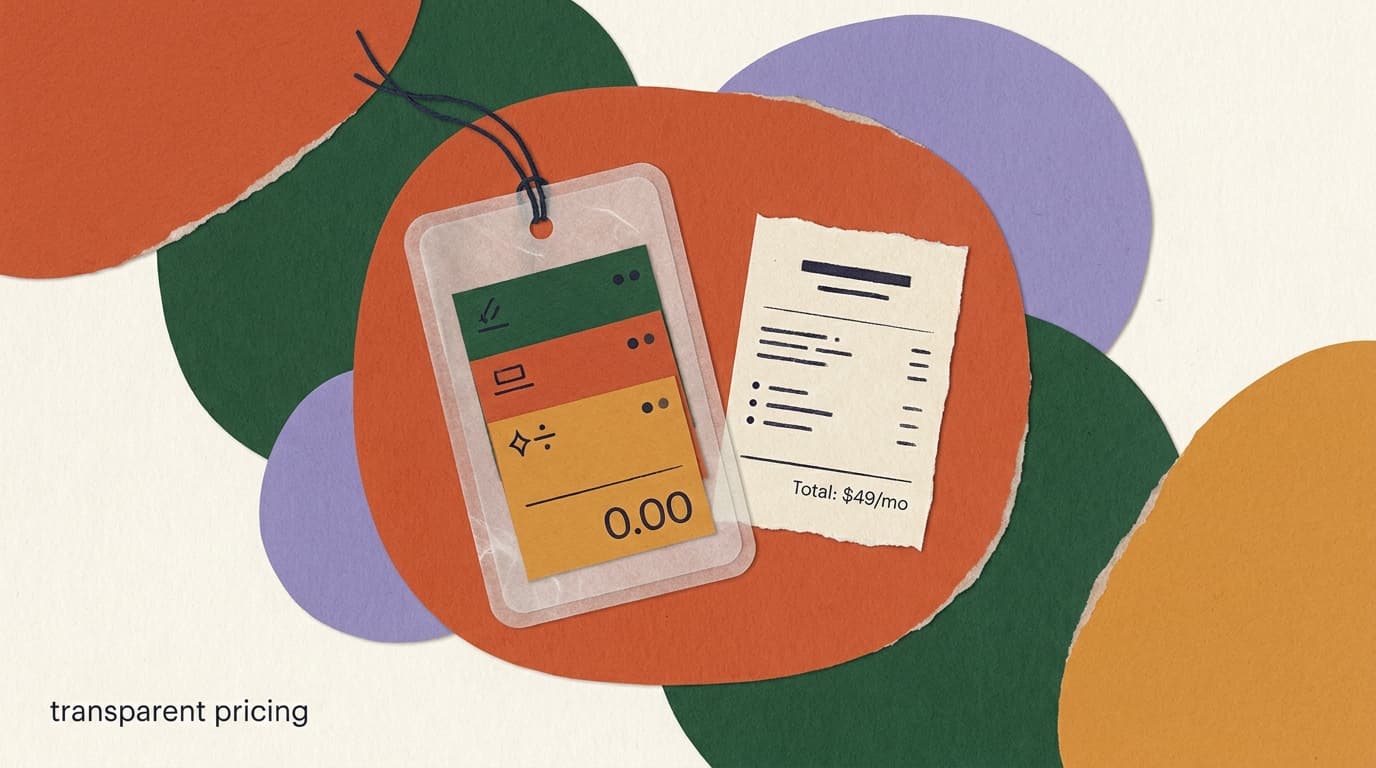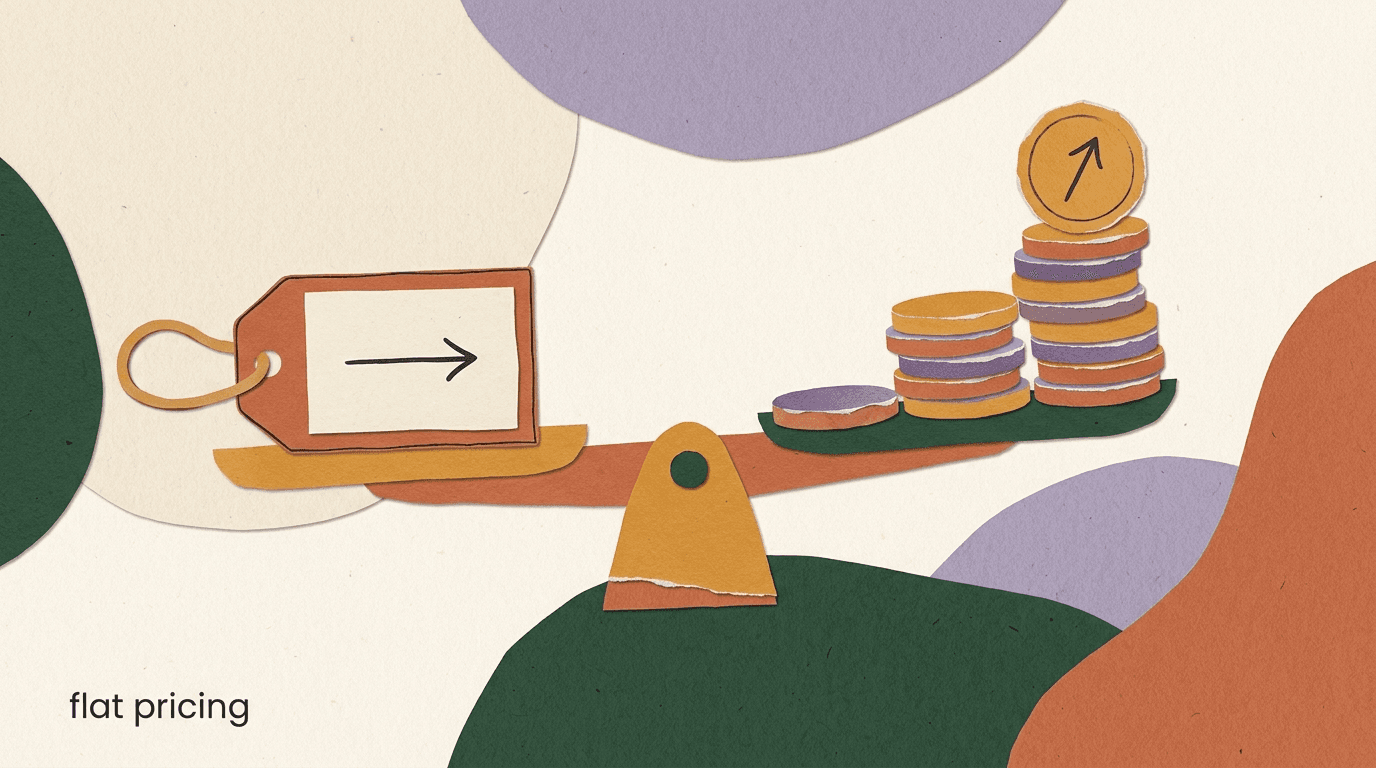
The choice between flat pricing vs per-contact billing decides whether your software bill is a number you set or a number that happens to you. Under a flat-rate plan, you pick a tier, pay one price, and that price holds whether your audience is two thousand people or twelve thousand. Under per-contact billing, the meter runs on the size of your audience, so every new follower who messages you, every lead a campaign captures, every comment-to-DM that fires on a strong post nudges your invoice upward. Same product, same value delivered, higher cost — because you grew. For a creator or a small team, that difference is not academic. It is the gap between a budget you can plan around and one you cannot.
This is an opinion piece, and the opinion is that flat, predictable pricing beats audience-based metering for most creators and small teams. But it is a fair opinion, not a slogan. Per-contact and usage-based models exist for real reasons, they are genuinely the right call for some buyers, and pretending otherwise would make the argument weaker, not stronger. So we will make the case for flat pricing, name the cases where metering is actually fairer, and give you a way to decide for your own situation rather than ours.
We build KlyoChat, which uses flat pricing, so we have a stake in this and a bias to declare. We have tried to keep the analysis honest: where we use our own model as the example, we include our real limits next to our real strengths, and we never invent a competitor's numbers. The aim is a framework you can take to any vendor — including us — and use to find the model that actually fits how you grow.
What is the difference between flat pricing and per-contact billing?
Flat pricing means you pay a fixed amount for a tier, and that amount does not change as you use the product more, up to the ceiling of the tier. A flat plan might include ten thousand contacts; whether you are using one thousand or nine thousand of them, the price is identical. The tier defines a generous envelope, and you live inside it for one steady number.
Per-contact billing — a form of usage-based or audience-based pricing — ties your cost to the number of contacts you hold. Cross a threshold and you move to a higher tier or pay a per-unit rate. The defining feature is that the metered unit, contacts, only ever accumulates. People opt in; they rarely opt out. So the meter ratchets upward over time even when you are not actively doing more, and it jumps sharply in any month where a campaign or a piece of content performs.
The crucial distinction is direction and control. Flat pricing decouples your bill from your audience size, so growth is free until you outgrow a whole tier. Per-contact billing couples your bill to your audience size, so growth is continuously billable. Everything else in this debate flows from that single structural fact.
The unit is the whole argument
Flat versus per-contact is really a question about which unit you are billed on. Flat bills you on a tier you choose. Per-contact bills you on an audience that grows on its own. The first you control; the second mostly controls you.
Why does per-contact billing punish you for growing?
Per-contact billing has a structural flaw that its defenders rarely address head-on: it charges you more precisely when you succeed, and the extra charge is not matched by extra value from the tool. A contact who messaged you once and a contact who messaged you a hundred times count the same toward your tier, but they deliver wildly different value to your business. The platform does almost nothing extra to hold a dormant contact, yet that dormant contact still pushes you toward the next price band.
Think about where contacts come from. The best marketing you do — the Reel that takes off, the ad that converts, the comment-to-DM funnel that captures every interested person — is exactly the marketing that adds contacts fastest. Under per-contact pricing, a great month and a higher bill arrive together. You executed perfectly, the audience responded, and the reward is an invoice increase. The pricing model turns your wins into expenses.
This is what we mean by a success tax. It is not a fee for using more of the product; it is a fee for being more successful at the thing the product is supposed to help you do. A steady business can absorb it. A creator whose growth is lumpy and unpredictable cannot easily plan around it, because the tax lands hardest in the months that are otherwise the best news they have had all year.
A viral month under two models (illustrative)
- Per-contact billing
- A Reel pops, 4,000 new contacts opt in overnight, you cross a tier and your bill jumps
- Flat-rate plan
- The same 4,000 contacts arrive, and your bill does not move because you are still inside your tier
Why is predictable pricing worth paying for?
Predictability has a value that is easy to underrate when you are staring at two headline numbers. A bill you can forecast is a bill you can plan a business around. You can set a marketing budget, model your margins, and decide whether to push growth this quarter without first solving a puzzle about what that growth will do to your software costs. Flat pricing gives you that certainty as a built-in feature; per-contact billing takes it away as a structural side effect.
The hidden cost of an unpredictable bill is the mental overhead it creates. On a per-contact plan, every decision about reach carries a small pricing question attached. Should you run the campaign that might add eight thousand contacts? Should you keep the dormant ones or prune them to stay under a threshold? That is cognitive load spent managing your tool instead of growing your business, and it compounds month over month.
There is also a planning asymmetry. With flat pricing, the worst-case bill is the one you already signed up for — you know the number before anything happens. With per-contact billing, the worst-case bill is whatever your best month produces, which is unknowable in advance. Trading a slightly higher fixed number for the removal of that uncertainty is, for most small teams, an obviously good deal.
It is worth being concrete about who feels this most. A solo creator does not have a finance team to model contact growth against tier thresholds; the bill is whatever the invoice says, and a surprise lands directly on the person least equipped to absorb it. A small agency managing a handful of clients has the opposite problem at scale: it has to forecast costs for each account it runs, and per-contact billing makes every one of those forecasts a moving target. Flat pricing gives both of them the same gift — a number they can write down in advance and trust.
Price the certainty, not just the dollars
When you compare a flat plan to a metered one, the flat plan is buying you a forecastable bill on top of the features. That certainty has real value — it makes budgeting possible. Factor it in instead of comparing headline numbers as if they were the whole story.
Isn't usage-based pricing supposed to be fairer?
Yes — and this is where an honest argument has to slow down. Usage-based pricing is built on a genuinely fair idea: pay for what you use, so a small user pays little and a heavy user pays more, and nobody subsidizes anybody. When the model works as intended, it is hard to argue against. The trouble is not the principle; it is whether the principle is being applied to the right unit.
Usage-based pricing is fair when the metered unit tracks the cost or value of what you consume. Paying per API call is fair, because each call genuinely costs the vendor compute. Paying for storage you actually use is fair, because the bytes cost money to hold. In those cases the meter and the value move together, and a heavy user really should pay more because they really do consume more.
Per-contact billing fails this test in a specific way. The unit, a contact, does not track ongoing cost or ongoing value. A contact who went dormant a year ago costs the platform essentially nothing to keep, yet still counts toward your tier and still raises your bill. The meter has come unbound from value. You are not paying for what you use; you are paying for the size of an audience that may be largely inactive. That is the difference between fair usage-based pricing and a success tax wearing its clothes.
We are not anti-metering
Usage-based pricing is the most honest model available for some products, especially infrastructure where cost truly scales with consumption. The critique here is narrow: per-contact billing meters a unit that grows with your success rather than your consumption, which is where it stops being fair.
When does usage-based or per-contact pricing actually make sense?
It would be lazy to claim flat always wins. There are real situations where a metered model, including per-contact, is the better deal, and a fair argument names them clearly so you can check whether you are one of them.
The clearest case is a genuinely small, stable audience. If you hold a few hundred contacts and have no intention of growing fast, a per-contact plan priced at the bottom of its scale can cost less than a flat plan whose ceiling you will never come close to using. Why pay for ten thousand contacts of headroom you do not need? For a tiny operation, metering can be the cheaper, more honest choice.
- Small, stable audiences: if you will stay under a few hundred or low thousands of contacts indefinitely, a metered plan may be cheaper than a flat tier built for scale.
- Truly variable consumption: when the unit you pay for tracks real cost — compute, storage, messages actually sent — metering charges you fairly for what you consume.
- Seasonal or shrinking usage: a good metered model lets your bill fall when your usage falls, which a flat tier does not.
- Experimentation phases: when you do not yet know your scale, paying only for what you use avoids committing to a tier you might not fill.
Where metering can be the better deal (illustrative)
- Tiny stable list (300 contacts, no growth plans)
- A bottom-tier metered plan may undercut a flat plan built for 10,000 contacts
- Growing creator (3,000 contacts, scaling fast)
- Flat pricing wins as soon as growth would cross metered thresholds
How does per-contact billing compare to flat pricing at scale?
The two models look closest at the smallest scale and diverge as you grow. At a few hundred contacts, a metered plan and an entry flat plan can be within a few dollars of each other. The gap opens as your audience climbs, because one number is rising and the other is not. By the time a creator reaches the low tens of thousands of contacts, the divergence is usually the whole reason they started shopping for an alternative.
The table below illustrates the shape of the divergence rather than any specific vendor's prices. The point is the trajectory: per-contact billing climbs with audience size, while flat pricing steps up only when you outgrow an entire tier, then holds flat again. Always verify real numbers on each vendor's own pricing page, because tiers and rates change.
| Audience size | Per-contact billing (trajectory) | Flat-rate plan (trajectory) |
|---|---|---|
| ~1,000 contacts | Low — near an entry tier | Entry flat tier |
| ~5,000 contacts | Rising — likely a tier jump | Same flat tier, unchanged |
| ~10,000 contacts | Higher — another band crossed | Same flat tier, unchanged |
| ~25,000 contacts | Higher still, climbing | Step up one flat tier, then steady |
| ~50,000 contacts | Often a multiple of the entry price | One higher flat tier, still predictable |
Verify every number on the vendor's own page
The trajectories above are illustrative shapes, not quoted prices. Per-contact rates, flat tiers, and contact ceilings all change over time and vary by vendor. Before you budget, confirm the current figures for any tool — ours included — on its official pricing page.
How do you estimate your real cost under each model?
Rather than trusting a headline, spend ten minutes building the only number that matters: your fully-loaded cost twelve months out, under each model you are considering. The exercise is the same regardless of which way you lean, and it turns a vague feeling about price into a figure you can defend.
- Project your contact count for next yearDo not price today's list — price where it will be in twelve months given your growth plans. A single viral month can double it, so be honest about your ambitions.
- Price the metered option at that projected countMap your projected contacts to the metered vendor's current tier or per-unit rate, then add any required add-ons and pass-through fees. That total, not the entry price, is the metered cost.
- Confirm the flat tier's ceiling covers your projectionFind the flat plan whose contact ceiling sits comfortably above your twelve-month projection. If your projection breaches it, price the next tier up so the comparison is real.
- Add the costs neither model can bundleWhatsApp's Meta conversation fees and any AI-reply or usage allowances apply on top of both. Add them to each side so you are comparing like with like.
- Compare the two fully-loaded totalsPut the metered total next to the flat total at next year's scale. The gap — plus the value you place on predictability — is your decision.
Price the year, not the month
On any model whose cost can rise with audience size, today's bill is the least relevant number. The gap between this month and next year is exactly where the success tax lives. Project forward before you commit a budget.
What does the success tax actually cost a creator over a year?
The single-month view understates the problem, because per-contact billing compounds. Each tier you cross becomes your new floor; you rarely cross back down, since contacts do not leave on their own. So a year of normal growth ratchets your baseline upward step by step, and the bill you end the year with is the bill you carry into the next one.
Consider a creator who starts a year at a comfortable contact count and runs a few successful campaigns. Under per-contact billing, each campaign that lands adds contacts, and a couple of them push across tier thresholds that stick. Under flat pricing, the same campaigns add the same contacts, but the bill holds steady until — and only until — the audience genuinely outgrows the whole tier, which for many creators does not happen within a single year.
The deeper cost is behavioral. When growth is billable, some teams start to ration it. They hesitate before the campaign that might cross a threshold, they leave a growth tool switched off, they prune contacts not for list health but to manage cost. That is the success tax doing its quietest damage: not the dollars on the invoice, but the growth that never happened because the pricing model made it feel expensive.
There is a ratchet effect worth naming explicitly. Because contacts rarely leave on their own, a tier you cross in March is almost never a tier you fall back out of in April. So the per-contact bill behaves like a one-way valve: it steps up easily and steps down almost never. Over a year of even modest success, that valve does its work quietly, and the baseline you are paying by December bears little resemblance to the comfortable number you signed up for in January. Flat pricing has no such valve inside a tier — the only way your bill rises is if you genuinely outgrow the whole envelope, which is an infrequent and predictable event rather than a monthly drift.
A year of growth, compounding (illustrative)
- Per-contact billing
- Three good campaigns cross three thresholds; each becomes a sticky new floor and the year-end baseline is far above where it started
- Flat-rate plan
- The same three campaigns add the same contacts; the bill holds at one tier all year
Does flat pricing have downsides too?
It would undercut the whole argument to pretend flat pricing is free of trade-offs. It is not, and naming its costs is the only way to make the case credibly. Flat pricing is the right model for most creators, but it is not the right model for everyone, and the reasons are worth being precise about.
The first cost is the one any bundle carries: a light user subsidizes a heavy one. If you hold a few hundred contacts on a flat plan built for ten thousand, you are paying for headroom you do not use, and a metered plan would charge you less. Flat pricing trades perfect per-user fairness for predictability — that is the deal, and if you are a very light user, the deal may not favor you.
The second cost is the tier ceiling. Flat pricing is only flat inside its envelope. Outgrow the tier and you step up to the next one, which is a real increase even if it is a predictable, infrequent one. A well-designed flat plan sets ceilings generous enough that ordinary growth stays inside them, but if a vendor sets stingy ceilings, flat pricing quietly becomes metered pricing in disguise. The third cost is simply that there is no automatic refund for under-use: a flat plan does not get cheaper in a slow month the way a metered plan can.
- Light users subsidize heavy ones — if your usage is tiny, you may pay for headroom you never touch.
- Tier ceilings are real — flat pricing is only flat until you outgrow the envelope, then you step up.
- No discount for a slow month — your bill does not fall when your usage temporarily dips.
- Stingy ceilings can fake it — a flat plan with tight limits is metered pricing wearing a flat label.
Flat pricing is a trade, not a free lunch
You give up some per-user fairness and accept tier ceilings in exchange for a forecastable bill. For creators and small teams with growth, that is usually a good trade. For a very light, stable user, it may not be — and an honest vendor will tell you so.
How do you tell honest flat pricing from flat pricing in name only?
Not every plan that calls itself flat actually behaves that way. The label is easy to claim; the behavior is what matters. A genuine flat plan holds its price across the growth a normal customer will experience. A flat plan in name only sets such tight allowances that ordinary success breaches them within months, at which point you are paying overages and the flatness was a marketing word.
The way to check is to look past the label at the ceilings and the allowances. Are the included contacts generous relative to where you expect to be in a year? Is the headline feature included, or is it an add-on that quietly converts the flat price into a base price? Are there overage charges, and if so, are they a smooth curve or a cliff? A flat plan worth the name answers these in your favor.
- Check the contact ceiling against your 12-month projectionProject where your audience will be in a year, then confirm the flat tier's ceiling sits comfortably above it. If ordinary growth would breach the ceiling, the plan is flat in name only.
- Confirm the feature you came for is includedIf the AI, the channel, or the automation you actually need is sold as an add-on, the flat price is really a base price. Add the add-on before you judge anything.
- Read the overage behaviorAsk what happens above the included allowance. A smooth per-unit charge is tolerable; a jump to the next tier is a cliff. Either way, a flat plan that meters above a low ceiling is metering in disguise.
- Verify the price holds as you grow inside the tierThe whole promise of flat pricing is that success does not raise the bill inside the envelope. Confirm in writing that going from, say, 3,000 to 8,000 contacts changes nothing.
A tight ceiling turns flat into metered
Flat pricing only delivers its benefit if the ceiling is generous enough to absorb normal growth. A flat-labeled plan with a low contact cap and steep overages gives you the worst of both models. Judge the ceiling, not the label.
How should a creator decide between flat and per-contact billing?
The decision is not about which model is morally superior; it is about which one fits how you grow. The deciding variable is your growth trajectory. If your audience is growing, or you intend to push it, flat pricing protects you from the success tax and gives you a budget you can plan. If your audience is genuinely tiny and stable, a metered plan at the bottom of its scale may simply cost less.
Run the comparison the right way: not headline to headline, but fully-loaded total to fully-loaded total at where you will realistically be in twelve months. For the metered option, that means projecting your contact count forward and pricing the tier you will actually land on, plus any add-ons and pass-through fees. For the flat option, it means confirming your projection fits inside the tier's ceiling. Then the two numbers mean something.
- Growing or spiky audience: flat pricing almost always wins on both cost and predictability.
- Tiny, stable audience: a bottom-tier metered plan may genuinely be cheaper — do the math.
- Always price next year, not this month, on any model whose cost can rise with audience size.
- Compare fully-loaded totals, including add-ons and pass-through fees, never base-to-base headlines.
| Your situation | Likely better model | Why |
|---|---|---|
| Audience growing fast or unpredictably | Flat pricing | Removes the success tax; bill stays forecastable through spikes |
| Small, stable list with no growth plans | Per-contact / metered | You pay only for the little you use, below a flat tier's price |
| Running a giveaway or big push soon | Flat pricing | A successful campaign will not trigger a tier jump |
| Unsure of your future scale | Flat pricing | Predictable worst case beats an unknowable one |
| Usage that genuinely tracks cost (calls, storage) | Metered | The unit reflects real consumption, so metering is fair |
Let your growth plan pick the model
If you are betting on growth, you are betting against per-contact billing — every win raises that bill. If you are deliberately staying small and steady, metering can reward you. Match the pricing model to the trajectory you actually expect, not the one that looks cheapest today.
How does KlyoChat handle this, honestly?
We will use our own model as the worked example, held to the same scrutiny we have asked you to apply elsewhere. KlyoChat is an AI-native unified inbox, and it uses flat pricing, not per-contact billing. Contacts are bundled into each tier, AI agents are included rather than sold as a separate add-on, and the price holds as you grow inside the tier ceiling. Going from 3,000 to 9,000 contacts on the same plan does not change your bill.
Here are the real numbers, published on our pricing page rather than dressed up. There is a 7-day free trial with no credit card, because we would rather you test the full product than a limited slice. AI replies come with an allowance per tier, with top-ups available if you exceed it — which is the one place our model does meter, and we would rather name it than hide it.
- Flat pricing: growing within your tier ceiling does not raise the price.
- AI agents are included — there is no separate AI add-on to discover on a later invoice.
- Contacts are bundled into each tier rather than metered contact by contact.
- AI replies have a per-tier allowance with optional top-ups, which is where our model does meter — named openly.
Where KlyoChat is not the cheaper choice
We do not offer native SMS or email, so if those channels are core to your strategy, a broader tool may serve you better. We are also newer, with a smaller community than the incumbents. Both are real trade-offs to weigh, not footnotes — and if you are a very light user, a metered tool might cost you less.
KlyoChat flat plans at a glance
- Basic
- $19/mo — entry plan, core channels and automation, AI agent included
- Pro
- $49/mo ($39 billed yearly) — all channels, generous contacts, AI agents included, larger AI-reply allowance
- Business
- $129/mo — higher contact and AI-reply allowances for growing teams
- Trial
- 7-day free trial, no credit card — test the full product, not a limited tier
Where does even KlyoChat's flat pricing have a cost it cannot bundle?
Naming this is the test of whether any of the above is sincere. WhatsApp carries Meta's per-conversation fees. Those fees are charged by Meta, vary by country and message category, and apply on top of the subscription on any platform that supports WhatsApp — including ours. We cannot bundle them into a flat price because they are not ours to bundle; they are a genuine third-party pass-through.
There is also the AI-reply allowance. Flat pricing covers the seats, channels, contacts, and AI agents, but AI replies are metered against a per-tier allowance with top-ups beyond it. We chose generous allowances so most teams never touch the ceiling, but we would rather state plainly that this is the one place our model meters than let you discover it later. Honest flat pricing is not the absence of every variable cost; it is naming the few that exist instead of hiding them. Verify Meta's current WhatsApp rates for your region, and verify any vendor's pricing on its own page before you plan a budget.
Two costs we name on purpose
WhatsApp's Meta conversation fees are unavoidable on every platform, and KlyoChat meters AI replies against a per-tier allowance with top-ups. Both sit outside the flat subscription, so we put them in plain sight rather than in a footnote. Confirm the live WhatsApp rate for your region before budgeting.
What questions should you ask before choosing a pricing model?
If a pricing page leaves the model unclear, do not guess — ask, and treat the quality of the answer as data about how the vendor will behave at renewal. A vendor who answers plainly and in writing is showing you something good; one who deflects a question that has a number is showing you something too.
Ask these by email, so the answers are in writing and you can hold them to the reply.
- Is this plan flat, or does my bill rise as my contacts or audience grow?
- What is the included contact ceiling, and what happens when I cross it — a smooth charge or a tier jump?
- Is the feature I actually need included in this plan, or is it a separate add-on?
- Are there third-party or pass-through fees, like WhatsApp's Meta charges, that apply on top?
- If my audience shrinks, does my bill go down, or only up?
- What is my fully-loaded monthly cost at my projected scale twelve months from now?
How a vendor answers is the answer
A clear, written, numerical reply is a good sign about every future interaction. Vagueness, or a push to a sales call for a question that has a number, tells you what renewal day will feel like. Judge the response as carefully as the price.
Why does flat pricing make for a healthier relationship with your tool?
Beyond the dollars, the two models shape how you relate to the software you depend on. Per-contact billing puts you and the tool into a low-grade conflict: every growth decision has a cost attached, so part of your attention is always spent managing the meter rather than using the product. The pricing model and your goals are quietly misaligned, because the tool earns more when your costs rise.
Flat pricing removes that friction. Inside your tier, there is no penalty for using the product fully — switch on every channel, run every campaign, capture every lead, because none of it moves the bill. The pricing model and your goals point the same way: the vendor wants you to succeed, and your success does not cost you extra. That alignment is worth something that does not show up on either headline.
It also changes renewal. A flat bill that never surprised you makes renewal a non-event; there is nothing to dispute, nothing to audit, no moment where a good month produces a bad invoice and sends you shopping. The stickiness that comes from predictability is the durable kind, built on a relationship that never put you and the tool on opposite sides. That, in the end, is the strongest argument for flat pricing — not that it is always the cheapest, but that it stops your software from charging you for doing well.
Notice, too, what flat pricing does to the conversation inside a team. On a metered plan, the question of whether to flip on a new channel or chase a bigger audience eventually becomes a budget conversation, and budget conversations slow things down and create internal friction. On a flat plan, those questions stay where they belong — in marketing strategy — because the cost answer is already settled. The tool stops being a line item that has to be defended every quarter and becomes simply infrastructure you use without thinking about the meter. For a small team, removing that recurring negotiation is worth more than the few dollars of difference at the headline.
How does flat pricing change the way you experiment?
One of the least-discussed effects of a pricing model is what it does to experimentation, and this is where flat pricing quietly pays for itself. Growth is mostly the product of trying things — a new comment-to-DM funnel, a giveaway, a fresh ad angle, a broadcast to a segment you have not messaged before. Most experiments fail or do little, and a few succeed unexpectedly. The trouble with per-contact billing is that the experiments most worth running are precisely the ones that, if they work, add the most contacts and therefore cost the most. The model taxes the upside of every test.
That tax distorts behavior in a way that is hard to notice from the inside. You start unconsciously favoring small, safe experiments over big, ambitious ones, because the ambitious ones carry a cost risk attached to their success. You run the giveaway to five hundred people instead of fifty thousand. You hold back the broadcast that might bring a wave of new contacts. None of these are dramatic decisions, but in aggregate they shrink the surface area of your growth, and you never see the line on a chart for the experiments you declined to run.
Flat pricing removes the tax on the upside. Inside your tier, a wildly successful experiment costs exactly what a failed one does: nothing extra. That symmetry frees you to swing for bigger outcomes, because the downside of a test is only the time you spent on it, never a bigger bill if it lands. For a creator or small team whose growth depends on finding the few things that work, that freedom to test at full scale without a cost penalty is one of the most valuable and least visible benefits flat pricing provides.
Run the big experiment, not the safe one
Per-contact billing quietly nudges you toward small tests because a successful big one raises your bill. Flat pricing removes that penalty, so the only cost of an experiment is your time. If you are on a flat plan, use that freedom — test at full scale.
The case comes down to a single structural fact: flat pricing decouples your bill from your audience, and per-contact billing couples them. For creators and small teams that intend to grow, that coupling is a success tax — it charges you more in exactly the months you did best, and it makes budgeting a guessing game tied to which post goes viral. Flat pricing trades a little per-user fairness for a bill you can forecast and a model that does not punish your wins. For most people reading this, that is the better trade.
But the argument is meant to be fair, not absolute. If your audience is genuinely tiny and stable, a metered plan may cost you less, and usage-based pricing is honest whenever the unit tracks real cost. So do the work: project your scale a year out, compare fully-loaded totals rather than headlines, and let your growth plan pick the model. If you want to see flat pricing in practice, our pricing page lists every plan with AI included and the two costs we cannot bundle named plainly — and our breakdown of the real cost of ManyChat at scale applies the same lens to an audience-based incumbent.