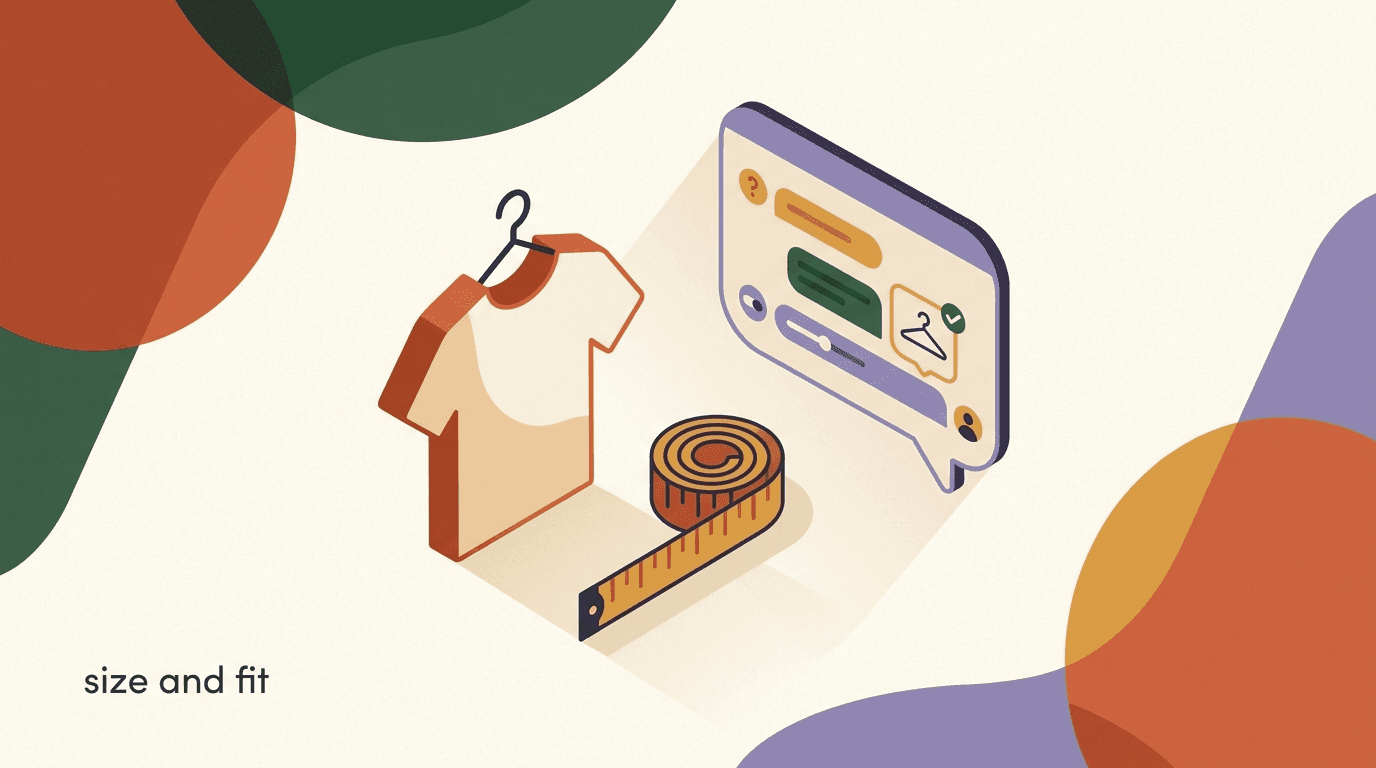
A size fit chatbot is a short, guided conversation that helps a fashion shopper pick the right size before they buy. Instead of leaving someone to squint at a static size chart, the bot asks a handful of fit questions — usual size, height and weight, how they like a garment to sit — and returns a specific recommendation like size M, drawn from your own product measurements. For apparel D2C brands, this is one of the few automations that touches conversion and returns at the same time: shoppers who are confident about size are more likely to check out, and more likely to keep what arrives.
This guide is a practical walkthrough, not a pitch. We will cover the fit questions worth asking, how to turn answers into a size recommendation, how to hand off cleanly to checkout, and how to measure whether the thing is actually working. We will also be honest about the limits, because a size fit chatbot is not magic. Its recommendations are only ever as good as the size and fit data behind them, it reduces size-related returns rather than eliminating them, and it is an advisor — not a checkout. Get those expectations right and it becomes a genuinely useful part of the storefront. Get them wrong and it becomes another widget nobody trusts.
We build KlyoChat, so we have a stake in this, and we will show you how it maps to our product near the end. Everything before that is vendor-neutral and applies whether you build the bot yourself, use a dedicated fit-finder app, or run it through a chat platform.
What is a size and fit advisor chatbot, exactly?
At its simplest, a size and fit advisor is a decision aid. A shopper arrives on a product page, is unsure whether they are a small or a medium in your cut, and the bot walks them through a few questions to land on an answer. The conversation can live in a chat widget, a messaging channel like WhatsApp or Instagram DM, or a lightweight quiz embedded on the page. The channel matters less than the logic underneath it.
It helps to separate three things that often get bundled together. A size chart is static reference data — a table of measurements the shopper has to interpret themselves. A fit finder or fit quiz is an interactive flow that collects inputs and outputs a size. A size fit chatbot is the conversational version of that quiz, able to ask follow-up questions, explain its reasoning, and handle the messy edge cases a rigid form cannot. The line between a fit quiz and a chatbot is blurry, and for most brands the practical build sits somewhere in between: a structured flow with a little conversational flexibility around the edges.
The job to be done is narrow and worth stating plainly. The bot exists to reduce the uncertainty that stops a confident purchase and to cut the returns that come from ordering the wrong size. It is not there to be a stylist, a support agent, or a replacement for good product photography. When a size advisor tries to do everything, it does the one thing it is good at badly. Keep the scope tight.
Advisor, not oracle
Frame the bot to shoppers as a recommendation, not a guarantee. A line like 'Based on what you told me, I would suggest size M' sets the right expectation. It invites the shopper to use judgement, which is exactly what you want, and it protects you when a recommendation is imperfect — which, on real bodies and real garments, it sometimes will be.
Why do fashion D2C brands get so many size-related returns?
Returns are the tax fashion pays for selling clothes people cannot try on. A large share of apparel returns come down to fit and size — the item arrived and it was too tight, too loose, too long, or simply not what the shopper pictured. Understanding why size returns happen is the first step to designing a bot that actually prevents them, rather than one that just adds a step before checkout.
The root cause is that sizing is not standardised in any way a shopper can rely on. A US 8 at one label is a US 10 at another, and vanity sizing has drifted the numbers over decades, so the label on the garment tells you very little about the body it will fit. Different countries run different systems entirely, and the same nominal size can vary between a brand's own product lines. Because clothing size systems vary so widely across regions and eras, a shopper who is a confident medium in their wardrobe genuinely does not know what they are in your cut. That is not carelessness on their part. It is a structural problem the industry created.
On top of the sizing chaos sit human factors. Shoppers guess. They order two sizes intending to return one — bracketing — which guarantees a return before the parcel even ships. They misjudge how a fabric will behave, whether a knit will cling or drape, whether a waistband will give. And they carry a mental model of their size from a brand they bought years ago, which may bear no relation to yours. A size fit chatbot attacks the first problem directly, by translating what the shopper knows about themselves into what your specific garment will do, and it chips at the second by making a single confident recommendation more attractive than ordering two sizes to test.
- Non-standard sizing: the same label size differs across brands, product lines, and countries.
- Vanity sizing: the numbers on the tag have drifted and no longer map to fixed measurements.
- Bracketing: shoppers order multiple sizes on purpose, planning to send some back.
- Fabric surprises: knits, stretch, and drape behave in ways a flat photo does not convey.
- Stale self-image: people shop their size from a different brand and a different year.
What fit questions should the chatbot actually ask?
The quality of a size recommendation is set almost entirely by the questions you ask and the data you can match them against. Ask too little and the bot is guessing; ask too much and shoppers abandon the quiz before they reach the answer. The craft is choosing the smallest set of questions that meaningfully narrows the size, and ordering them so the flow feels quick.
Start with the single most predictive input you have, which for most casual apparel is the shopper's usual size in a comparable garment. If someone tells you they are normally a medium in a relaxed-fit t-shirt, you already have a strong anchor, and every question after that is a refinement. For fitted or structured items — denim, tailoring, swimwear, bras — usual size is weaker, and body measurements or specific dimensions carry more weight. Match the question set to the category rather than running one generic quiz across the whole catalogue.
Below is a starting set of questions with the reasoning for each. Treat it as a menu, not a script: pick the four or five that matter for the garment in front of the shopper, and drop the rest.
| Question | Why it helps | When to skip it |
|---|---|---|
| What size do you usually wear in this kind of item? | The strongest single anchor for casual and relaxed fits | Rarely — keep it for almost every category |
| Height and weight | Lets you map to a fit model when usual size is unknown | If shoppers resist sharing; make it optional |
| How do you like this to fit — snug, regular, or relaxed? | Captures preference so two people at one size get different advice | For items with only one intended fit |
| Which body area do you size around? | Waist, bust, shoulders, or hips — flags where fit breaks first | For simple, forgiving silhouettes |
| Any brand you fit well, and your size there? | A cross-brand reference point to calibrate against | If you have no comparison data for that brand |
Order questions from easy to personal
Open with the low-friction question almost everyone will answer — usual size — and place height, weight, or measurements later, framed as optional and tied to a clear payoff ('this sharpens the recommendation'). People who have already invested three taps in the quiz are far more likely to share a body measurement than someone hit with it on question one.
How does the bot turn answers into a size recommendation?
Collecting answers is the easy half. The recommendation logic is where a fit finder earns its keep, and it does not require machine learning to be useful. Most effective size recommendation bots run on a rules layer sitting on top of a clean measurements table, with any AI used to interpret fuzzy natural-language replies rather than to make the size decision itself.
The backbone is a garment measurements table: for each product and size, the actual dimensions — chest, waist, length, inseam, sleeve — ideally as flat measurements you can verify with a tape. The shopper's inputs get mapped onto that table. If they give a usual size and a fit preference, you shift up or down from their anchor: a relaxed preference at a borderline point nudges to the larger size, a snug preference to the smaller. If they give body measurements, you match them to the size whose garment dimensions clear their body measurement by your intended ease — the deliberate gap between body and cloth that defines how a piece is meant to sit.
Where the answers conflict or fall between sizes, the bot should say so rather than forcing false precision. A recommendation of 'size M, though you are close to the boundary with L — go L if you prefer room through the chest' is more honest and more useful than a bare 'M'. This is also where a light AI layer helps: when a shopper types something unstructured like 'I have broad shoulders but a narrow waist', a model can extract the relevant signal and route it into the rules, instead of the flow breaking on an unexpected answer.
- Anchor on the strongest inputUsual size for casual fits, body measurements for structured items. This sets the starting size before any adjustment.
- Adjust for fit preferenceShift up or down from the anchor based on snug, regular, or relaxed. Only move a size when the shopper is near a boundary.
- Cross-check against garment measurementsConfirm the candidate size's real dimensions clear the shopper's body measurements by your intended ease.
- Resolve conflicts transparentlyWhen inputs disagree or fall between sizes, present the trade-off in plain language instead of hiding it behind one number.
- Return a size with a short reasonGive the size and a one-line why, so the shopper can sanity-check it against their own judgement.
Garbage in, garbage out
The recommendation is only ever as good as your measurements table. If your size chart is a marketing approximation rather than real flat measurements, the bot will confidently recommend the wrong size — which is worse than no bot at all, because it carries the authority of a personalised answer. Fix the data before you build the flow.
What does a good fit conversation look like?
Abstractions only go so far, so here is a concrete example. Imagine a shopper on a product page for a relaxed-fit cotton t-shirt, unsure between S and M. The exchange below shows a clean flow: one anchor question, one preference question, one optional refinement, and a recommendation with a reason and a clear next step. Notice how short it is — four exchanges to a confident answer.
Fit conversation: relaxed-fit t-shirt
- Bot
- Happy to help you size this one. What size do you usually wear in a relaxed t-shirt?
- Shopper
- Usually a medium, but sometimes it comes out too baggy
- Bot
- Got it. Do you like this style snug, regular, or relaxed on you?
- Shopper
- Regular. Not clingy, not a tent
- Bot
- One optional thing that sharpens it: mind sharing your height and weight?
- Shopper
- 5 foot 10, around 165 pounds
- Bot
- Thanks. Our medium runs a touch generous, so for a regular feel I would suggest size M and size down to S only if you want it closer to the body.
- Bot
- Want me to add the medium to your cart so you can check out?
How do you handle between-sizes shoppers and fit preferences?
The single-answer cases are easy. The interesting work is in the between-sizes shopper, because that is exactly the person most likely to return an item — and most likely to bracket and order both. A size fit chatbot that handles this well can turn a two-size hedge into a single confident purchase, which is where a lot of the return reduction actually comes from.
The principle is to make the trade-off explicit and then let the shopper decide, rather than pretending there is one correct size. When someone lands on a boundary, tell them what each choice means in terms they can feel: size down for a closer fit that may pull across the shoulders, size up for room that may look loose at the waist. You are not dodging the recommendation; you are giving them the information a good in-store assistant would. The example below shows a preference-driven exchange for a pair of slim-fit jeans, where usual size alone is a weak anchor and the conversation has to work harder.
Log the between-sizes answers
Every time a shopper reveals where they size around — thighs, shoulders, bust — that is gold for your product and merchandising teams. Aggregated, these answers tell you which garments run tight where, feeding both better size charts and better next-run patterns. The chatbot is a data-collection instrument as much as a sales aid.
Fit conversation: slim-fit jeans, between sizes
- Bot
- Denim sizing is tricky, so a couple of questions. What waist size do you normally buy?
- Shopper
- Depends. 32 in some brands, 33 in others
- Bot
- Understood. Do you size around your waist or your thighs — where does denim usually feel tight first?
- Shopper
- Thighs, definitely. Waist is fine, thighs are always snug
- Bot
- That is the key detail. This is a slim cut, so on a 32 the thigh may feel tight for you.
- Bot
- I would suggest the 33 for comfort through the thigh; the waist has a little stretch, so it will still sit close. Prefer a tighter overall look? Take the 32 and expect a snug thigh.
- Shopper
- 33 sounds right, thanks
- Bot
- Great choice. I will point you to the 33 — you can review the fit notes and check out from there.
Where does your size and fit data come from?
This is the part most guides skip, and it is the part that decides whether your bot is trustworthy. A size recommendation bot is a data product wearing a conversational coat. Before you design a single question, you need to know what you can match answers against, and how reliable that reference is. Weak data does not just limit the bot — it actively misleads shoppers with confident wrong answers.
There are a few sources, and most brands combine them. The foundation is your own garment measurements, taken flat with a tape from real production samples, size by size. If you do not have these, get them before anything else; a size chart pulled from a spec sheet the factory sent is often aspirational rather than accurate. Layered on top, you can use returns and exchange data — which items get sent back for being too small or too large tells you where your sizing runs off, and lets you correct the bot's advice for those specific products. Over time, the answers shoppers give the bot become their own dataset, letting you see the real distribution of bodies buying each item.
Product data platforms and your store back office hold more of this than teams realise. If you run on Shopify, your product variants, metafields, and returns records are all queryable, and the Shopify Help Center documents how size and variant data is structured so you can pull it into the bot cleanly. The point is not the specific platform — it is that the bot should read from a single source of truth you maintain, so that when you correct a measurement, every future recommendation improves at once.
| Data source | What it gives you | Watch out for |
|---|---|---|
| Flat garment measurements | The ground truth every recommendation matches against | Spec-sheet numbers that differ from production reality |
| Returns and exchange reasons | Signals for which items run small or large | Small sample sizes on new or low-volume products |
| Shopper answers over time | The real body distribution buying each product | Bias toward shoppers who bother to use the quiz |
| Cross-brand reference points | A calibration anchor from brands the shopper knows | Vanity sizing making the reference unreliable |
Handle body data with care
Height, weight, and body measurements are personal. Collect only what improves the recommendation, tell shoppers why you are asking, keep it optional where you can, and store it according to your privacy policy and local regulation. A fit quiz that quietly hoards sensitive data is a liability, not an asset.
How do you build the size logic without overengineering it?
There is a strong temptation to reach for computer vision, body-scanning, or a bespoke machine-learning model on day one. For the vast majority of fashion D2C brands, that is a mistake — not because the technology is bad, but because it solves a problem you do not have yet and delays the version that would already help. Start with the simplest thing that produces a good recommendation, ship it, and let real usage tell you where the sophistication is worth adding.
The minimum viable size fit chatbot is a rules engine over a clean measurements table, wrapped in a short conversational flow, with a light AI layer only to interpret free-text answers. That is it. It requires no training data, behaves predictably, is easy to debug when a recommendation looks wrong, and — crucially — you can explain every answer it gives. A rules-based bot that says 'M, because our medium runs generous and you wanted a regular fit' builds more trust than a black-box model that says 'M' with no reason, even if the model is marginally more accurate.
Add complexity only where the data earns it. If one product category has genuinely hard fit — structured tailoring, bras, footwear — and you have the volume of returns data to learn from, a more statistical approach for that category can pay off. But treat it as an upgrade to a working system, not a prerequisite. The brands that succeed with fit tech almost always started with rules and grew into models; the ones that stall usually tried to build the sophisticated version before they had accurate measurements to feed it.
- Version one: rules over a clean measurements table, plus a short flow. Ship this.
- Use AI to parse messy free-text answers, not to make the size decision.
- Keep every recommendation explainable — a one-line reason beats a black box.
- Add statistical or vision approaches later, per category, only where data justifies it.
- Never let sophistication become the reason the bot is not live yet.
How does the bot hand off to checkout?
A size fit chatbot is an advisor, not a checkout, and pretending otherwise breaks the experience. The bot's job ends when it has given a confident recommendation and moved the shopper toward buying the right size with as little friction as possible. The handoff is where a lot of otherwise-good fit quizzes lose the sale, so it deserves as much care as the questions.
The cleanest pattern is: recommend the size, then take one clear action toward purchase — pre-select the recommended variant on the product page, add it to the cart, or deep-link to a cart with the correct size already chosen. What you want to avoid is dumping the shopper back where they started, forcing them to re-select the size the bot just worked out. Every extra tap between recommendation and cart is a place to lose them, and it undoes the confidence the conversation built.
There is an honest limit here worth stating: the bot recommends and hands off, but the actual payment happens in your store's checkout. On a channel like WhatsApp, that often means sending a link to a pre-filled cart, since the WhatsApp Business Platform supports product messages and links but is not your payment processor. Design the handoff to feel like a continuation, not a hard stop: 'I have set you up with the medium — here is your cart, ready to check out.' The shopper should feel handed forward, not handed off.
- Confirm the recommended sizeState the size and the reason, then confirm the shopper is happy before moving them onward.
- Pre-select or add the variantDeep-link to the product with the size chosen, or add it to the cart directly, so no re-selection is needed.
- Carry the context forwardPass the recommendation into the cart or a note so it is not lost if the shopper pauses or comes back.
- Leave a graceful exitOffer to reconsider or answer a follow-up, so a hesitant shopper is not forced to buy or bounce.
The bot recommends; your store sells
Keep the responsibilities clean. The chatbot's success metric is a confident, correct recommendation and a smooth push to the right variant. Payment, inventory, and order management stay in your commerce platform. Trying to turn the advisor into a full checkout usually makes both jobs worse.
How do you measure whether the fit finder is working?
If you cannot measure it, you cannot justify it, and you cannot improve it. The tempting headline metric is return rate, but return rate alone is noisy — it moves with seasonality, promotions, product mix, and a dozen things the bot does not touch. Measure the bot on a small set of signals that isolate its contribution, and be patient enough to let them accumulate meaning.
The most direct measure is a comparison: do shoppers who complete the fit quiz return items at a different rate than those who do not, on the same products over the same period? That cohort comparison controls for a lot of the noise. Alongside it, watch quiz completion rate (are people finishing, or abandoning mid-flow?), recommendation acceptance (do they buy the size the bot suggested?), and the specific size-related return reasons for products the bot covers versus those it does not. Together these tell you not just whether returns moved, but why.
Be careful about attribution and honest about causation. A shopper who uses a fit quiz is already more engaged and more intent on buying, so some of the difference you see is self-selection, not the bot's effect. That does not make the bot worthless — an engaged shopper who gets the right size is exactly who you want to serve — but it does mean you should resist claiming a clean causal return-rate drop from a simple before-and-after. Where you can, run the comparison as a proper cohort or holdout rather than a raw year-over-year number, and report ranges rather than a single triumphant figure.
| Metric | What it tells you |
|---|---|
| Quiz completion rate | Whether the flow is short and clear enough to finish |
| Recommendation acceptance | Whether shoppers trust and buy the suggested size |
| Size-return rate, quiz vs no-quiz | The bot's likely effect on size-related returns |
| Exchange vs refund mix | Whether wrong sizes turn into swaps rather than lost sales |
| Between-sizes resolution | How often the bot converts a two-size hedge into one order |
Do not over-claim the return-rate drop
Return rate is influenced by far more than a fit quiz, and quiz users self-select toward intent. Report the bot's effect as a cohort comparison with the assumptions stated, not as a single dramatic percentage. An honest, defensible range earns more internal trust than a headline number that falls apart under scrutiny.
What are the honest limits of a size and fit chatbot?
It is worth being direct about what this tool cannot do, because overselling it is how you end up with a distrusted widget and a disappointed team. A size fit chatbot is a strong lever, not a cure, and knowing its edges helps you deploy it where it pays and avoid promising outcomes it cannot deliver.
First and most important: recommendations are only as good as your size and fit data. If your measurements are approximate, your bot will be confidently wrong, and a confident wrong answer damages trust more than no answer. Second: it reduces size-related returns, it does not eliminate them. Bodies are three-dimensional and personal, fabrics behave unpredictably, and some shoppers will always order two sizes regardless of advice. A meaningful dent in size returns is a real win; zero returns is a fantasy. Third: it is not a checkout. The bot advises and hands off, and it depends on your store for payment, inventory, and fulfilment. Fourth: it cannot account for taste. A shopper who wants an oversized look and a shopper who wants it fitted can be the same measurements and need opposite advice, which is why fit preference has to be a question and not an assumption.
There are quieter limits too. The bot only helps shoppers who engage with it, so its ceiling is set by adoption as much as accuracy. It struggles at the extremes of the size range where you may have thinner data. And it can encode your measurement errors at scale — one wrong number in the table becomes hundreds of wrong recommendations. None of this argues against building one. It argues for building it on solid data, scoping it honestly, and pairing it with the other things that reduce returns, like accurate photography, detailed fit notes, and a smooth exchange process. For the broader returns picture, our guide on reducing Shopify refunds over WhatsApp covers the post-purchase side that a fit quiz alone does not reach.
- Accuracy is capped by your measurement data — bad data means confident wrong answers.
- It reduces size returns; it will not drive them to zero.
- It is an advisor that hands off, not a payment or fulfilment system.
- It cannot read taste, so fit preference must be asked, never assumed.
- Its impact is limited by how many shoppers actually use it.
Where should the size chatbot live across your channels?
A fit advisor is only useful where shoppers meet the decision to buy, and for a modern D2C brand that decision happens in more than one place. The same underlying logic can surface on the product page, inside a chat widget, and in messaging channels like Instagram DM or WhatsApp — but each context has its own rhythm, and a good deployment respects that rather than pasting one flow everywhere.
On the product page, the fit quiz sits closest to purchase intent and should be near-instant: a shopper is already looking at the item, so the bot's job is to remove the last flicker of size doubt before they add to cart. In a messaging channel, the conversation can be a little more relaxed and can double as a re-engagement surface — a shopper who asked about size in a DM is someone you can follow up with. The value of running these through one system is that the size logic, the measurements table, and the shopper's history stay consistent no matter where the conversation happens. A recommendation given in a DM should match the one on the product page, because both read from the same source of truth.
This is also where a fit advisor connects to the wider store experience. The same conversational surface that answers size questions can answer 'is this in stock', 'when will it ship', and 'can I exchange it', which is why size advice tends to live best inside a broader commerce chat setup rather than as an isolated widget. Our piece on building a product recommendation chatbot covers the discovery side of that same surface, and the ecommerce AI support agent guide covers the support questions that naturally sit alongside fit. Size is one job in a connected conversation, not a standalone tool bolted onto the page.
One brain, many surfaces
Whatever you build, keep a single size-logic brain feeding every channel. When a shopper gets one answer on the product page and a different one in a DM, trust collapses. Consistency across surfaces is worth more than clever behaviour on any single one.
How do you build a size and fit chatbot with KlyoChat?
Here is where our product fits, kept honest. KlyoChat is an AI-native unified inbox that brings Facebook, Instagram, WhatsApp, Telegram, TikTok, and X into one place, with no-code flows and AI agents on top. For a size fit chatbot, that combination does the two things this job needs: a flow builder to run the structured fit quiz, and AI agents that can recommend from your own knowledge and size data rather than a generic model. You can see the fuller picture on our ecommerce solution and AI agents pages.
In practice you would build the fit quiz as a flow — the anchor question, the preference question, the optional measurements — and point a KlyoChat AI agent at your size chart and product measurements so it can interpret free-text answers and return an explainable recommendation. On the Business plan, the Shopify and WooCommerce integrations let the agent read product and variant data, so the recommendation ties back to real inventory and hands the shopper toward the right variant. The same agent that answers size questions can answer stock and shipping questions in the same conversation, because it is one inbox rather than a bolt-on widget.
Now the honest limits, the same way we would want a vendor to tell us. KlyoChat's recommendations are only as good as the size and fit data you give it — we do not magically know your garments, and a sloppy measurements table produces sloppy advice. It reduces size-related returns; it does not eliminate them. It is an advisor that hands the shopper to your store's checkout, not a payment system, and it has no native SMS or email, so if those channels are core to you, factor that in. We are also a newer product with a smaller community than the incumbents, which is a real trade-off for some teams. None of that changes the core value: a flat, bundled way to run fit advice and the rest of your commerce conversations in one place.
- Build the fit quiz as a no-code flow, with an AI agent for the messy free-text answers.
- AI agents recommend from your knowledge and size data, not a generic model.
- Shopify and WooCommerce on the Business plan tie recommendations to real variants.
- Every plan starts with a 7-day free trial, no credit card required.
- Honest limits: advice is only as good as your data, returns fall but do not vanish, and there is no native SMS or email.
| Plan | Price | Fit-relevant capabilities |
|---|---|---|
| Basic | $19/mo | Unified inbox, flows, one AI agent for a simple fit quiz |
| Pro | $49/mo ($39 yearly) | All channels, custom AI agents trained on your size data |
| Business | $129/mo | Everything in Pro plus Shopify and WooCommerce integrations |
Try it against your real size chart
The only honest way to judge a size fit chatbot is on your own garments. Load your real measurements, run a handful of your trickiest between-sizes products through it, and see whether the recommendations hold up. If the data is good, the advice will be — and if it is not, that tells you where to invest before launch. See the full breakdown on our pricing page.
What does a sensible rollout plan look like?
You do not have to launch a size fit chatbot across the whole catalogue on day one, and you probably should not. The lowest-risk, highest-learning path is to start narrow, prove the value on products where fit uncertainty is worst, and expand from there. This keeps the data burden manageable — you only need accurate measurements for the products in scope — and it gives you a clean cohort to measure against everything you have not yet covered.
Pick the handful of products that drive the most size-related returns and confusion: the items with the highest exchange rates, the ones support fields the most fit questions about, the between-sizes offenders. Build accurate measurements for just those, ship the quiz on their product pages and in your busiest messaging channel, and run it for long enough to gather a real cohort. Compare quiz users against non-users on those same products, listen to where the recommendations feel off, and correct the data. Only once that loop is working do you widen the catalogue. Expansion is a data exercise as much as a configuration one — every new product needs measurements you trust before the bot can advise on it.
Treat the first few weeks as calibration, not launch. Read the between-sizes answers, watch where shoppers override the recommendation, and tune the ease and preference logic against what real bodies are telling you. A fit advisor gets meaningfully better in its first month of real use, and the brands that win are the ones that build in the habit of feeding that learning back into the measurements and the rules.
- Start with your worst-fit productsChoose the items with the highest size-related returns and the most fit questions. That is where the bot pays back fastest.
- Get their measurements right firstTake real flat measurements for just those products. Accurate data on a few beats rough data on everything.
- Ship on the page and one channelLaunch the quiz where intent is highest and where you already have traffic, not everywhere at once.
- Measure against a clean cohortCompare quiz users to non-users on the same products, and correct the data where recommendations miss.
- Expand as the data earns itAdd products only once you trust their measurements. Every expansion is a data decision, not just a toggle.
The bottom line: a size fit chatbot is one of the few automations that helps a fashion D2C brand on both sides of the transaction, nudging hesitant shoppers to buy the right size and cutting the returns that come from buying the wrong one. It works by asking a small, well-chosen set of fit questions, matching the answers against your own garment measurements, and handing the shopper toward the correct variant with as little friction as possible. The craft is in the questions, the honesty is in the data, and the value is in doing a narrow job well.
Keep the expectations honest and it earns its place: the advice is only as good as your measurements, it reduces rather than eliminates size returns, and it is an advisor that hands off to checkout, not a checkout itself. Start with your worst-fit products, get their measurements right, ship on the page and one channel, measure against a clean cohort, and expand as the data earns it. When you are ready to build one against your real size chart, KlyoChat gives you the flow builder and the AI agents to do it — and if the data holds up, so will the recommendations.