A catering inquiry is worth more than almost any other message your restaurant receives, and it's also the one most likely to get lost. A reservation for four is a few hundred dollars; a corporate lunch for sixty people booked weekly is a client relationship worth tens of thousands a year. Yet catering inquiries routinely land in the same crowded DM inbox as reservation requests, menu questions, and comments, get triaged behind whatever's loudest that day, and go cold before anyone with pricing authority even sees them.
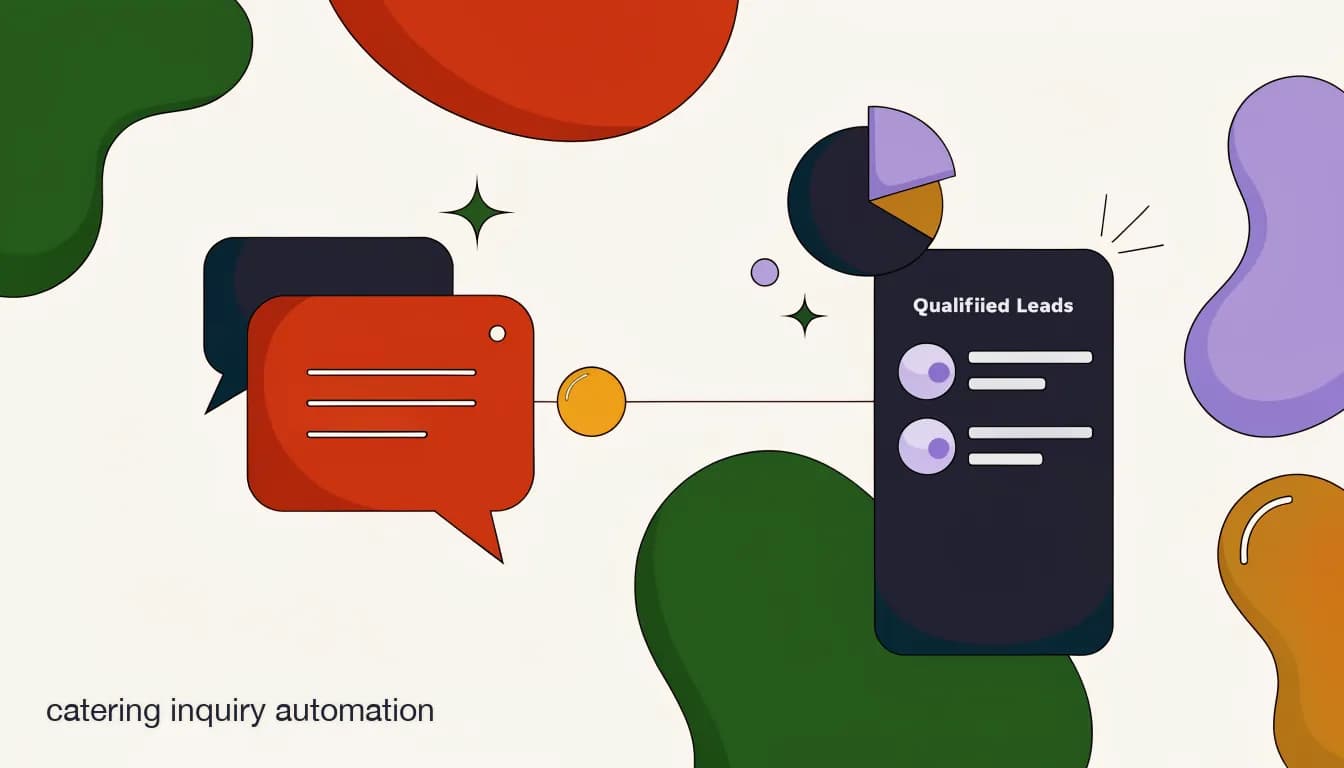
Catering inquiry automation exists to fix the specific failure mode of high-value, low-volume leads: they don't need speed alone (a form auto-reply doesn't book an event), they need fast qualification — someone or something capturing headcount, date, budget range, and dietary needs immediately, so that whoever follows up isn't starting from zero. This guide covers what a working catering automation flow looks like, why response speed matters even more here than for reservations, and where the line sits between what a bot should handle and what needs a human with pricing authority.
Why do catering leads need different handling than table reservations?
A table reservation is a binary yes-or-no against a fixed inventory: is this slot open, yes or no. A catering inquiry is closer to a sales conversation — the guest doesn't know exactly what they want yet, the price depends on choices that haven't been made, and the decision often involves more than one person on the buyer's side (an office manager checking with a boss, a bride checking with a partner). That means the automation job isn't 'confirm or deny' — it's 'gather enough to make the next human reply useful.'
This distinction matters because restaurants that treat catering DMs like reservation DMs — a quick 'thanks, someone will be in touch!' — routinely lose leads to whoever replies with an actual number first. Catering has real cross-shop comparison behavior: a corporate event planner sourcing lunch for a team offsite is very likely messaging three or four places in the same afternoon. The business that responds with a specific, qualified follow-up first tends to win the booking, independent of who has the better food.
Speed still matters — but qualified speed wins
Businesses that respond quickly to inquiries convert meaningfully more leads than slow responders across service industries broadly. For catering specifically, a fast reply that asks the right two or three questions outperforms an instant reply with no substance, because it moves the conversation forward instead of just acknowledging it.
What should a catering inquiry automation flow collect?
The goal of the automated portion of a catering flow isn't to close the sale — it's to arrive at a qualified handoff with everything your events coordinator needs to send a real quote on the first human reply, rather than a round of 'can you tell me more about your event?' that costs a day each way.
Four fields do most of the work: event date, headcount, event type (corporate lunch, wedding, private party, drop-off vs. full service), and a rough budget range or per-person target. A fifth — dietary restrictions or allergies — matters enough to ask early rather than discover during final planning, when substitutions get harder.
- Acknowledge immediatelyConfirm receipt within seconds — 'Thanks for reaching out about catering! A few quick questions so we can get you an accurate quote fast.'
- Collect event basicsAsk date, headcount, and event type in one or two exchanges, accepting free-form answers rather than forcing rigid menus.
- Ask budget and service styleGet a rough per-person budget or total budget range, and whether they need drop-off, buffet, or full-service staffing.
- Flag dietary needsAsk about allergies or dietary restrictions early so they're part of the quote, not a late surprise that changes pricing.
- Hand off with full contextRoute the qualified lead to your events coordinator with all collected details attached, so their first reply is a real quote, not another question.
Two versions of the same catering DM
- Unqualified handoff
- "Hi, interested in catering for our office, can you help?" → coordinator replies asking 5 follow-up questions, loses a day
- Qualified handoff
- "40 people, Fri June 12, corporate lunch, ~$18/person, one vegetarian + one gluten-free" → coordinator sends a real quote same hour
How do you follow up on catering leads that go quiet?
Catering inquiries have a well-documented high abandonment rate — someone messages to check pricing, gets a reply, and then goes quiet while they compare options or wait on approval from someone else. This is normal buyer behavior, not disinterest, and it's exactly where automated follow-up earns its keep: the platform that follows up consistently without manual effort tends to win the repeat and delayed bookings that a one-and-done reply loses.
A reasonable follow-up cadence for a sent quote that hasn't gotten a response is a check-in at roughly 2-3 days ('Just following up on the quote for your June 12 event — happy to answer any questions or adjust the menu') and a second, lighter touch at 7-10 days if the event date is still far enough out to matter. After that, a longer-interval nurture touch (a seasonal catering menu update, a holiday reminder) keeps the door open without being pushy.
| Follow-up | Timing | Message intent |
|---|---|---|
| Quote sent | Immediately | Deliver pricing with all details from the qualification flow |
| First check-in | 2-3 days later | Offer to answer questions or adjust the menu — low pressure |
| Second check-in | 7-10 days later | Light touch, only if the event date is still relevant |
| Seasonal nurture | Ongoing, low frequency | Menu updates or holiday catering reminders to stay top of mind |
Automate the check-in, not the close
Automated follow-up should nudge and offer to help — never pressure a lead into a decision or auto-send a 'final notice.' The tone that converts catering leads is helpful persistence, not urgency tactics, especially for corporate and event-planner buyers who are comparing several vendors respectfully.
Which catering inquiries should stay with a human from the start?
Some catering conversations are complex enough, or high-value enough, that routing them straight to a human — with the automated qualification data attached, not instead of it — produces a better outcome than letting the bot try to carry the whole conversation.
Weddings and large private events almost always need a human early, because the decision involves taste, emotion, and multiple stakeholders in a way a chat flow can't navigate. Any inquiry above a threshold headcount or budget that you set (say, 100+ guests or $5,000+) deserves the same treatment. Repeat corporate clients — the office that orders lunch every Thursday — should go straight to whoever owns that relationship rather than through a generic qualification flow each time.
- Weddings and large private events: route to a human immediately with context attached.
- Inquiries above your set headcount or budget threshold: treat as high-touch from the first reply.
- Repeat/recurring corporate clients: skip the standard flow, route directly to their usual contact.
- Complex dietary or venue logistics (off-site delivery, equipment rental): flag for a human to confirm feasibility before quoting.
Should pricing be shared automatically, or only by a human?
This is a judgment call that depends on how standardized your catering menu is. If you run a small number of fixed packages (a per-person buffet tier, a drop-off box lunch price), sharing a starting range automatically is reasonable and actually speeds up qualification — a lead who sees '$16-22/person depending on menu' can self-select before investing more time.
If your catering is more bespoke — custom menus, event-specific staffing, rental logistics — automating a firm number is a mistake; you'll either underquote and eat the difference or overquote and lose the lead. In that case, automate the qualification and let the human deliver the actual number, but be transparent in the flow that 'a member of our events team will follow up with pricing based on your details' so the guest isn't left wondering if they've been ignored.
Never auto-quote a price you can't honor
An automated flow that quotes a number the kitchen can't actually deliver at that price creates a worse experience than no quote at all — the guest anchors on it and feels misled when the real number is higher. If your pricing has real variability, say so plainly and set a human follow-up expectation instead of guessing.
Once the qualification and follow-up mechanics are in place, the remaining question most restaurants ask is where these leads should actually surface — how a comment on a food photo, a DM on Instagram, and a message on your website all end up in the same place with the same handling, instead of three different processes nobody remembers to check.
How do catering leads reach you in the first place?
Catering inquiries don't arrive through one clean channel — they show up as comments on a photo of a past event ('can you cater something like this?'), as DMs after someone sees your food at a friend's party, through a website contact form, and occasionally as a straightforward phone call. Each of those needs to funnel into the same qualification flow rather than living in separate, uncoordinated processes with different response times.
Comment-to-DM automation is particularly relevant here: a comment asking about catering under an event recap post is exactly the kind of high-intent signal that should trigger an automatic DM offering to help, rather than sitting as a public comment a staffer notices two days later. Routing all of these entry points into one qualification flow and one shared inbox means nothing falls through a channel-specific crack.
| Entry point | Typical intent | Recommended handling |
|---|---|---|
| Comment on an event photo | Curiosity + high intent | Trigger a DM automatically with catering info and the qualification flow |
| Direct DM | High intent, ready to inquire | Immediate qualification flow, then human handoff |
| Website contact form | Medium-high intent, planned ahead | Same qualification data captured, routed into the same inbox |
| Phone call | Highest intent, often time-pressured | Human answers directly; log details into the same system for consistency |
How KlyoChat handles catering inquiry automation
KlyoChat's AI agents can run a catering-specific qualification flow trained on your knowledge base — your menu packages, minimum headcounts, lead-time requirements, and pricing ranges — across Instagram, Facebook, WhatsApp, Telegram, TikTok, and X, so a catering question gets the same quality of first response no matter which channel it arrives on. Comment-to-DM automation catches catering-intent comments on event photos and opens a DM automatically, and the agent collects date, headcount, budget, and dietary needs before anything reaches a person.
Qualified leads land in KlyoChat's shared team inbox with the full conversation and collected details attached, where they can be assigned to whoever owns events, tagged, and followed up with internal notes visible to the rest of the team. Automated follow-up sequences handle the 2-3 day and 7-10 day check-ins on quotes that have gone quiet, without anyone having to remember to send them manually — and any inquiry that crosses your defined threshold for size or complexity can be flagged to route straight to a human from the first message.
- AI agent qualifies date, headcount, budget, and dietary needs before a human ever replies.
- Comment-to-DM automation catches catering-intent comments and opens a qualified conversation automatically.
- Automated follow-up sequences chase quiet quotes at 2-3 and 7-10 day intervals without manual tracking.
- Shared inbox with assignment and internal notes keeps events leads visible to the whole team, not one inbox.
- Threshold-based escalation routes large or complex inquiries straight to a human with context attached.
A catering comment on an event recap post
- No automation
- Comment sits unanswered; the lead messages a competitor who replied first
- KlyoChat comment-to-DM + AI agent
- Comment triggers a DM, qualification flow runs automatically, coordinator gets a ready-to-quote lead within minutes
How do you measure whether catering automation is working?
Three numbers matter more than raw inquiry volume. First, qualified-lead response time — not first reply time, but time to a response that actually contains a real quote or next step, since that's what buyer comparison behavior rewards. Second, quote-to-book conversion rate, tracked separately from inquiry-to-quote conversion, so you can tell whether the bottleneck is qualification (too many unqualified inquiries wasting coordinator time) or closing (quotes going out but not converting).
Third, and easy to overlook: repeat booking rate among past catering clients. Automated follow-up and a consistent qualification process tend to show up here first, because clients who had an easy, responsive experience the first time are the ones most likely to message again for their next event without needing to be re-sold.