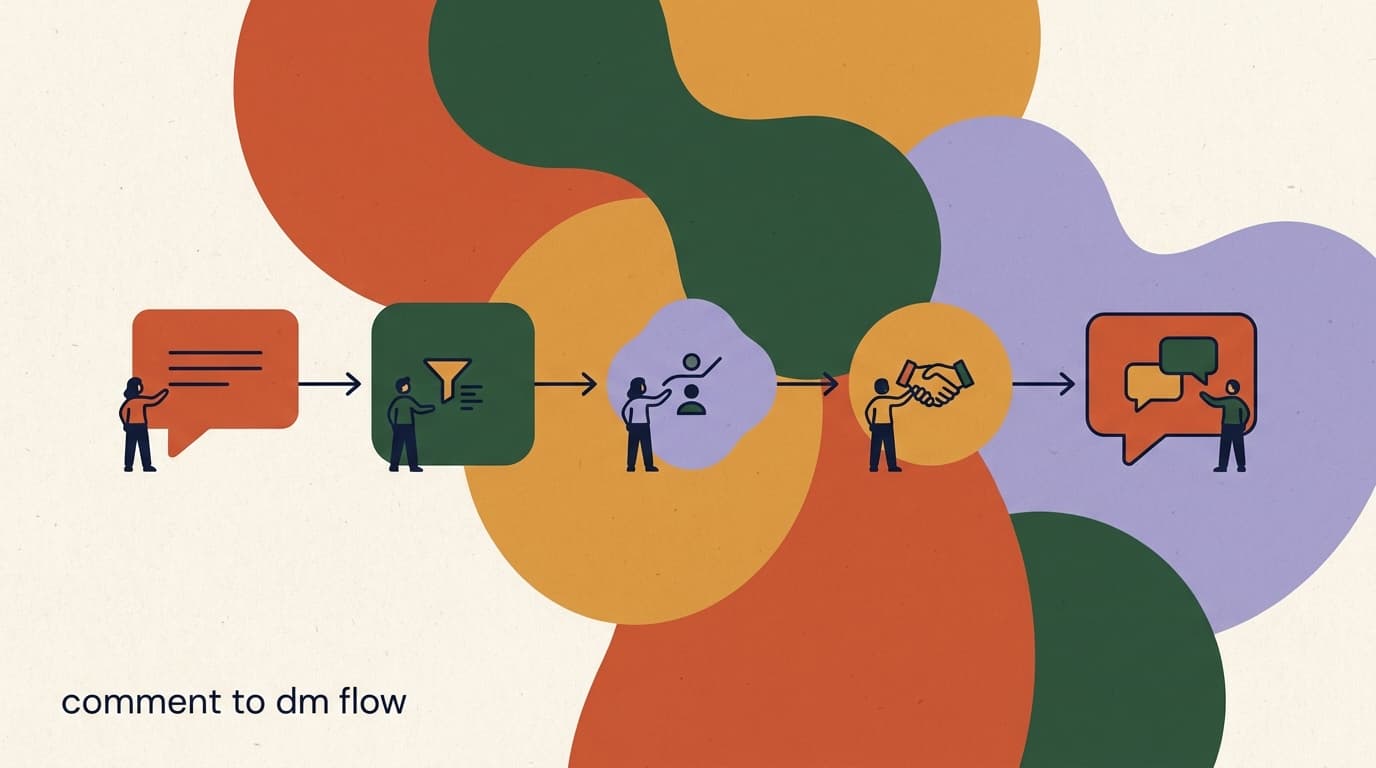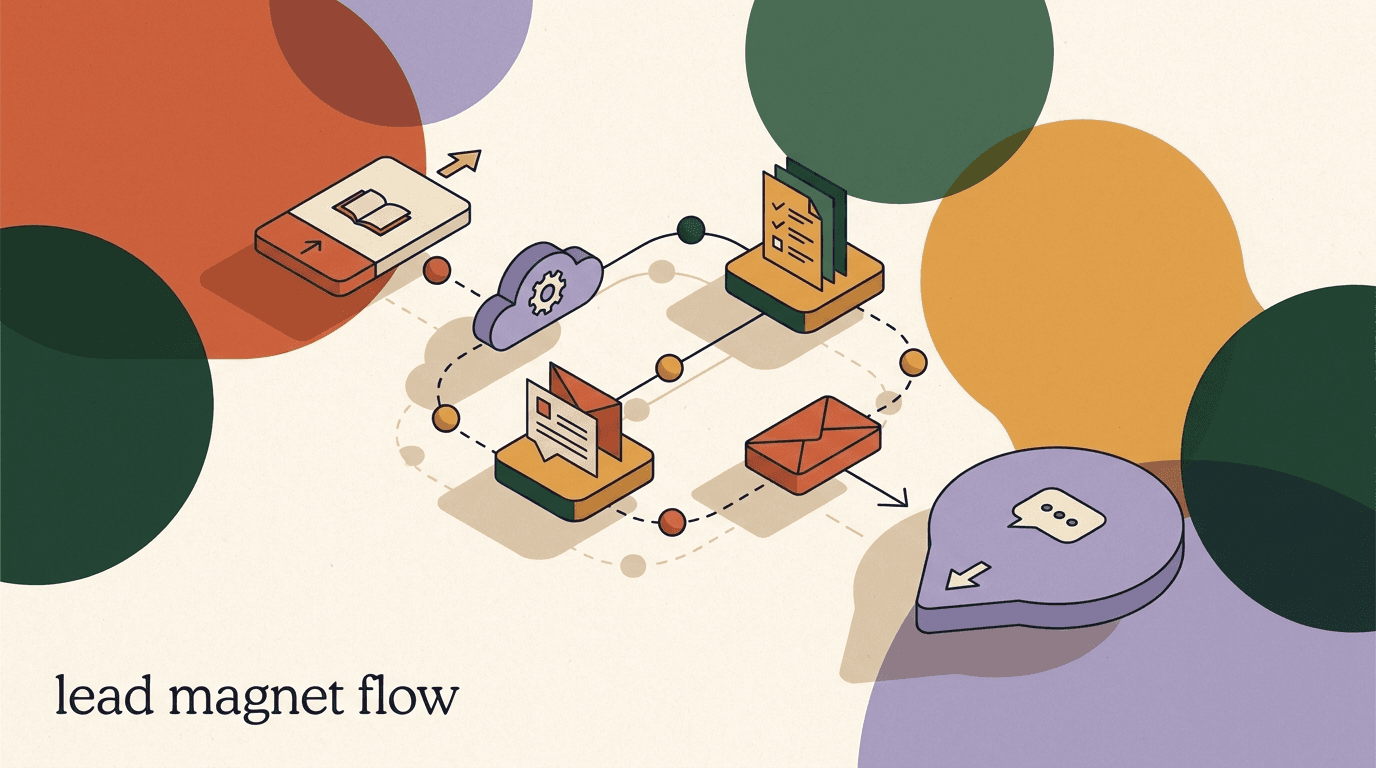
A lead magnet delivery flow is the automated path that runs from the moment someone asks for your freebie to the moment it lands in their hands — and then a little further, to the moment they take a next step. You promise a checklist, a template, a guide, or a discount code; someone comments or sends a keyword; and the flow handles the rest: it greets them, captures an email if you want one, delivers the asset, confirms it arrived, and follows up with something useful. Done well, the whole thing feels like a quick, helpful exchange. Done badly, it feels like a vending machine that ate someone's request.
This is a build tutorial, not a strategy essay. We are going to construct the flow block by block, in the order a subscriber experiences it, with sample messages you can paste and adapt. By the end you will have a working freebie delivery automation that you can point a campaign at the same day. If you want the upstream thinking — which lead magnet to offer, how to write the post that drives the request — that lives in our companion piece on the Instagram lead-magnet DM. This article is the machine that runs underneath it.
Full disclosure before we start: we build KlyoChat, a tool for exactly this kind of flow. We have written the steps so they apply to any capable DM automation platform, and we have flagged the honest limits — including ours — where they matter. The goal is a flow that works, not a sales pitch dressed as a tutorial.
What is a lead-magnet delivery flow, and what are its parts?
Before you build anything, it helps to see the whole machine laid out. A lead-magnet delivery flow is not one message — it is a short sequence of distinct jobs, each of which can succeed or fail on its own. When you treat it as five separate blocks rather than one big blob of copy, it becomes far easier to write, test, and fix.
Here is the anatomy. Every solid lead magnet funnel has these five parts in roughly this order. You can add to them, but you should not skip them.
- Each part is a separate block in your flow builder, so you can edit one without breaking the others.
- The trigger and delivery are mandatory. The opt-in, confirmation, and follow-up are where most flows are won or lost.
- The whole path should feel like a two-minute conversation, not a form submission.
| Part | Job | What can go wrong |
|---|---|---|
| Trigger | Detect the request (keyword or comment) | Misspellings and variants slip through |
| Opt-in | Capture consent and, optionally, an email | Too many questions, people drop off |
| Delivery | Hand over the actual asset | Broken link, wrong file, no link at all |
| Confirmation | Reassure that it arrived | Silence — the person wonders if it worked |
| Follow-up | Point to the next step | Either nothing, or an instant hard sell |
Build in the order people experience it
Resist the urge to start with the clever follow-up. Build the trigger first, then the delivery, then test that the freebie actually arrives. Only once the core path works should you add the opt-in capture and the follow-up. A flow that delivers reliably with a plain message beats a fancy one that drops the asset.
What do you need before you start building?
You can build the flow in well under an hour, but only if you have a few things ready first. Trying to write delivery copy while you are still deciding what the lead magnet is will stall you halfway through. Get these in order and the build is mechanical.
Treat this as a pre-flight checklist. Most of it is decisions, not technical setup — and the decisions are the part people skip, then regret when the flow goes live with a placeholder link still in it.
- Finalise the asset and its linkUpload the PDF, template, or file somewhere with a stable public link — a cloud drive, a hosting page, or a landing page. Test the link in an incognito window. A delivery flow is only as good as the URL it sends.
- Decide your trigger word and the variantsPick one short, memorable keyword (for example GUIDE or CHECKLIST). List the obvious misspellings and lowercase versions you will also accept.
- Decide whether you are capturing an emailIf the point is list building, plan to ask for an email. If the point is speed and goodwill, skip it and deliver instantly. Both are valid; pick on purpose.
- Connect your channel and confirm permissionsMake sure the Instagram, Facebook, or WhatsApp account you are automating is connected and authorised in your tool, and that you understand the messaging-window rules covered later in this article.
Never launch with a placeholder link
The single most common failure in a freebie delivery automation is a real campaign pointing at a test link, a 404, or a Google Doc set to private. Before you promote anything, send yourself through the whole flow from a second account and actually open the asset. If you cannot open it, neither can your audience.
How do you set up the trigger?
The trigger is what wakes the flow up. For a lead magnet, you have two common options, and many flows use both: a keyword sent in the DM, and a comment on a post that you convert to a DM. The keyword trigger fires when someone messages your account with your chosen word. The comment-to-DM trigger fires when someone comments on a specific post, then moves the conversation into the DMs where you can actually deliver.
The comment route is usually the stronger one for reach, because the comment itself is public and nudges other people to join in. But the mechanics of delivery are identical once the conversation is in the DM, so you build the delivery once and feed it from either trigger.
- Create a keyword triggerIn your flow builder, add a trigger that listens for your keyword. Add the variants and lowercase forms you listed earlier so a stray capital letter does not lock someone out.
- Add a comment-to-DM trigger on the relevant postPoint a comment trigger at the specific post or Reel that promotes the lead magnet. When someone comments with your keyword, the flow opens a DM with them.
- Send a public reply to the comment (optional but recommended)Auto-reply to the comment with a short line like Check your DMs! This closes the loop publicly and signals to onlookers that the offer is real.
- Route both triggers into the same delivery blockConnect the keyword trigger and the comment trigger to one shared opt-in and delivery sequence, so you only maintain the message copy in one place.
| Trigger type | Best for | Trade-off |
|---|---|---|
| Keyword in DM | Stories, bio links, direct calls to action | Less public visibility, relies on people remembering the word |
| Comment-to-DM | Feed posts and Reels with reach | Requires the post to perform; comment must match your keyword |
Accept more than one keyword
People do not read carefully. If your magnet is a checklist, accept CHECKLIST, LIST, and even GUIDE, plus the lowercase forms. A trigger that only matches one exact word silently loses everyone who typed something close. Casting a slightly wider net costs nothing and recovers real requests.
How do you write the opt-in step?
The opt-in is the bridge between the trigger firing and the asset arriving. At minimum it acknowledges the request so the person knows the flow heard them. If you are building a list, this is also where you ask for the email — and where you get explicit consent to keep messaging them, which matters both for goodwill and for platform rules.
The mistake here is asking for too much. Every extra question is a place to drop off. You are not running a survey; you are handing someone a freebie. Ask for the one thing you genuinely need, frame it as the reason they get the asset, and move on.
- If you capture an email, ask for exactly that — not name, company, and role as well.
- Say what they are signing up for. A one-line expectation reduces unsubscribes and complaints.
- Keep the tone the same as your posts. The flow should sound like you, not like a form.
Consent is part of the opt-in, not an afterthought
When you ask for an email, you are asking for permission to contact someone. Make that plain in the message and honour it. A flow that quietly harvests addresses and then blasts them is the fastest way to burn trust and trip platform spam protections. Clear consent is both the right thing and the durable thing.
Sample opt-in message (email capture)
- Greeting
- Hey! Thanks for grabbing the [Asset Name] — happy to send it over.
- The ask
- What is the best email to send it to? I will fire it across right away.
- Reassurance
- Just the freebie and the occasional useful note. Unsubscribe any time.
If speed and goodwill matter more than list building, the opt-in step can be a single acknowledgement that sets the expectation and moves straight to delivery. The version below skips the email entirely and tells the person the link is one message away — which keeps the exchange fast and removes the only point of friction in the path.
Sample opt-in message (no email, instant delivery)
- Greeting
- Hey! Great choice — the [Asset Name] is on its way.
- Set expectation
- Sending the link in the next message. Give me one sec.
How do you deliver the asset itself?
This is the moment the whole flow exists for. Everything upstream is setup; this is the payoff. The delivery block hands over the actual thing — a link to the file, the discount code, or the resource. The two rules are simple: make the link impossible to miss, and make it work.
Whether or not you captured an email changes the shape slightly. If you collected an email, you can say the asset is also on its way to their inbox and still drop the link in the DM for immediacy. If you skipped the email, the DM link is the entire delivery, so it has to be right.
- Add the delivery message blockPlace it immediately after the opt-in. Insert the live link to your asset, not a placeholder.
- Include a one-line how-to-useA single sentence on how to open or use the asset reduces confused replies and increases the chance they actually use it.
- Offer a fallbackInvite them to reply if the link fails. This catches the few broken cases and turns a bad experience into a save.
Send the link, not a promise of the link
A surprising number of flows end with We will email you shortly and never actually deliver anything in the DM. People expect the thing they asked for to appear in the conversation they are already in. Put the link in the message. Email delivery, if you use it, is a backup — not the main event.
Sample delivery message (DM link)
- Deliver
- Here it is — your [Asset Name]: [link]
- How to use it
- Open it on desktop for the editable version. Takes about five minutes to fill in.
- Lower the barrier
- Reply here if the link does not open and I will sort it out.
When you did capture an email, the delivery message can do double duty: confirm the email send and still drop the link in the DM so nobody has to switch apps or wait. The version below sends to the inbox, gives the immediate backup link, and pre-empts the spam-folder problem in one move.
Sample delivery message (email plus DM)
- Confirm the send
- Done! I have sent the [Asset Name] to [email].
- Backup link
- And here is the direct link too, so you do not have to wait: [link]
- Spam check
- If it is not in your inbox in a few minutes, check promotions or spam.
Why does the confirmation step matter?
The confirmation step is the one almost everyone skips, and it is the cheapest trust you will ever buy. After you deliver, send one short message that confirms the asset is theirs and the exchange is complete. Without it, the conversation just stops, and a small but real fraction of people are left wondering whether the link they got was the whole thing or whether something else is coming.
Confirmation also does quiet work for you: it is a natural place to invite a reply, which warms the conversation and, on platforms with a messaging window, can extend how long you are allowed to keep talking. A flow that ends on a question stays open; a flow that ends on a link goes cold.
- Keep it to two or three lines — this is a full stop, not a new chapter.
- End on a question or an invitation to reply, not a flat statement.
- Tease the follow-up so the next message is expected rather than a surprise.
A reply is worth more than a read
If your confirmation prompts even a one-word reply, you have a live, two-way conversation instead of a one-shot delivery. That single reply tells the platform the person wants to hear from you, and it tells you which leads are actually engaged. Always give people an easy reason to respond.
Sample confirmation message
- Confirm
- That is everything — the [Asset Name] is all yours.
- Open a door
- Give it a try and let me know what you think, or if anything is unclear.
- Set the tone
- I will check back in a couple of days with one thing that makes it work even better.
How do you build the value follow-up?
The follow-up is what separates a delivery flow from a lead magnet funnel. Delivering the asset earns goodwill; the follow-up turns that goodwill into a next step. The discipline here is patience: the follow-up leads with value, not with an ask. You spend the first message — sometimes the first two — helping them get a result from the thing you just gave them. Only then do you point to whatever is next.
Time the follow-up so it lands after they have had a chance to use the asset, typically a day or two later. The message should reference the magnet directly so it feels connected, add a tip or a quick win that builds on it, and then offer one clear, low-pressure next step — a related resource, a call, a trial, a reply-to-learn-more. One next step, not a menu.
- Add a delay after deliveryWait one to two days so the follow-up arrives after they have used the asset, not while they are still opening it.
- Lead with a quick winOpen with one practical tip that makes the lead magnet work better. This proves the follow-up is for them, not for you.
- Make one clear offerPoint to a single next step and explain why it follows naturally from the freebie. Resist stacking three options.
- Give an easy outA soft line like No worries if now is not the time keeps the relationship warm even when the answer is not yet.
Earn the ask before you make it
The fastest way to waste a lead magnet is to pivot to a hard sell the second the asset lands. The follow-up exists to deliver a second hit of value first. By the time you make an offer, the person should already feel they got more than they paid for — which was nothing. That is what makes the next step feel reasonable.
Sample value follow-up (sent 2 days later)
- Reconnect
- Hey — how did you get on with the [Asset Name]?
- Quick win
- One tip most people miss: [specific tip that makes the asset work better].
- Next step
- If you want help putting it into practice, [next step] is the natural next move. Want the details?
- Easy out
- And if now is not the time, totally fine — the freebie is yours regardless.
How do you handle people who do not give an email?
If your opt-in asks for an email, some people will ignore the question and just say give me the link. How you handle that fork says a lot about whether you are building a flow for them or for you. The friendly, durable answer is to deliver anyway. Withholding the freebie someone publicly asked for, over an email they declined to give, creates a bad experience that other people can sometimes see.
Build a branch for it. If the flow does not detect a valid email after a prompt or two, deliver the asset with a light touch and leave the door open. You can still try to capture the email later, after you have earned it with a good experience — which tends to work better than holding the asset hostage anyway.
- Set a limit of one, maybe two, polite asks for the email — then stop asking.
- If no email arrives, deliver the asset with the DM link and a friendly note.
- Re-offer the email exchange later, in the follow-up, tied to something extra.
- Never trap the asset behind an email the person has clearly chosen not to give.
Goodwill compounds; friction does not
A person who got the freebie with zero hassle is far more likely to give you their email in the follow-up than one who felt squeezed at the door. Deliver first, ask second. The list you build on goodwill is healthier than the one you build on friction.
Sample no-email branch
- Acknowledge
- No problem at all — here is the [Asset Name] directly: [link]
- Soft re-offer
- If you want me to email a copy too so it is easy to find later, just drop your address.
How do you respect the messaging window and opt-in rules?
Every DM platform has rules, and a lead magnet flow lives right at the edge of them. The most important one to understand is the messaging window. On Meta's platforms, once someone messages you, you generally have a 24-hour window in which you can reply freely. After that window closes, your ability to message proactively is limited to specific approved message types. Your whole delivery and confirmation sequence should comfortably fit inside that window — which it does, since it runs in seconds.
The follow-up is where you have to be careful, because a one-to-two-day delay can push you past the window. The clean way to handle this is to keep the person engaged inside the window — that confirmation reply matters here — or to use whatever approved message format your platform provides for messages sent after the window. The rule of thumb is simple: do not assume you can message anyone, any time, forever. Build inside the window, get consent, and respect it.
| Concept | What it means | How to build for it |
|---|---|---|
| 24-hour window | Free-form replies allowed for 24h after their last message | Deliver and confirm instantly; keep them replying |
| Opt-in / consent | Permission to keep contacting someone | Ask plainly when you capture the email; honour it |
| Post-window messaging | Restricted to approved message types | Use your platform's approved format for the delayed follow-up |
The window protects the inbox — work with it
The messaging window exists to stop DMs from becoming a spam channel, which is the same thing that keeps your messages welcome. Treat it as a design constraint, not an obstacle. A flow that delivers fast, earns a reply, and follows up within the rules will outlast any clever workaround that fights them.
How do you test the flow before you promote it?
A lead magnet flow is the kind of thing that works perfectly in the builder and falls apart the first time a real person hits it. The only way to know it works is to walk through it yourself, as a stranger would, on a real device. Testing takes five minutes and saves you from promoting a broken flow to your whole audience.
Use a second account — a personal one, or a teammate's — that has never interacted with your business. That fresh state matters, because returning contacts can behave differently and hide the bugs a brand-new lead would hit.
- Trigger it the way a real lead wouldComment or DM the exact keyword from the second account. Then try a misspelling and a lowercase version to confirm your variants catch them.
- Walk the full pathGo through the opt-in, give an email, and confirm the delivery message arrives with a working link. Then run it again declining the email to test the branch.
- Open the assetActually click the link and open the file from the test account. Confirm it is the right asset and it is publicly accessible.
- Wait for the follow-upLet the delay run and confirm the value follow-up actually fires, with the right copy, inside the rules.
- Check your analyticsConfirm the test run shows up in your tool's reporting so you know your numbers will be trustworthy once real traffic arrives.
Test from a clean account, not your own
Testing from the same account that owns the automation often skips steps or behaves oddly because the system recognises you. A genuinely fresh account is the only honest test of what a new lead experiences. If you do not have one, ask a friend to run through it and tell you exactly what they saw.
What should you measure once it is live?
Once the flow is running, a handful of numbers tell you whether it is working and where it leaks. You do not need a dashboard with forty metrics; you need to watch the steps where people fall out and fix the worst one. A delivery flow is a funnel, and every funnel has a weakest stage.
Track these from the start so you can compare like with like as you tweak. The point is not vanity numbers — it is finding the single biggest drop-off and addressing it before anything else.
- Find the biggest single drop-off and fix only that before touching anything else.
- Change one thing at a time so you can tell what actually moved the number.
- Watch your reply rate, not just delivery — replies are the signal of a real relationship.
| Metric | What it tells you | If it is low |
|---|---|---|
| Trigger-to-opt-in rate | Whether your opt-in message keeps people in | Simplify the ask; reduce friction |
| Opt-in-to-delivery rate | Whether people complete the email step | Make the email optional or deliver first |
| Delivery-to-reply rate | Whether your confirmation earns engagement | End on a clearer question or invitation |
| Follow-up-to-next-step rate | Whether the follow-up converts | Lead with more value before the ask |
Fix the leak, not the whole pipe
It is tempting to rewrite the entire flow when results disappoint. Resist. Find the one step where the most people drop, change one element of it, and measure again. Funnels improve fastest when you treat each stage as a separate experiment instead of rebuilding the machine every week.
A few variations worth building
Once your core flow is solid, a few variations let you reuse the same machine for different goals. Each one is a small change to a single block, not a new build from scratch — which is the whole point of treating the flow as discrete parts.
Pick the variation that matches what you are actually trying to do this month. You do not need all of them, and running too many at once makes your numbers hard to read.
- Discount-code delivery: swap the asset link for a code, and make the follow-up about using it before it expires.
- Multi-asset menu: when the magnet is a bundle, let the opt-in ask which piece they want most, then deliver that one first.
- Webinar or event reminder: deliver the registration link, then use the follow-up sequence as the reminder before the event.
- Qualification branch: add one question in the opt-in to route different leads to different follow-ups.
Start with one, then branch
Every variation above starts from the same five-part skeleton. Get one clean lead magnet delivery flow working and measured before you clone it into variations. A single reliable flow beats four half-built ones that each leak somewhere you have not noticed yet.
What copy mistakes break a delivery flow?
Most flows that underperform are not broken technically — they are broken in the writing. The mechanics fire correctly, the link works, and yet people drop off, because the words do something subtly wrong at one of the five steps. The good news is that the common copy mistakes are predictable, which means you can check for them before you launch and fix them in minutes.
Read your own flow out loud as if you were the person receiving it. Most of these mistakes are obvious the moment you stop reading as the author and start reading as the recipient. The flow is a conversation, and a conversation that sounds like a form, a robot, or a sales script will lose people no matter how cleanly it runs.
- Robotic acknowledgement: a stiff Thank you for your submission tells people they hit a machine. Greet them the way you would in a real reply.
- Burying the link: if the delivery message is three paragraphs and the link is at the bottom, people miss it. Lead with the link.
- Over-asking at opt-in: every extra field — name, company, phone — costs you completions. Ask for the one thing you need.
- Premature selling: an offer in the confirmation, before any second hit of value, reads as a bait-and-switch. Hold it for the follow-up.
- No personality: copy that could belong to any brand belongs to none. The flow should sound like your posts, because that is who they followed.
Write it as a text to a friend
The fastest fix for stiff flow copy is to imagine you are texting one specific person who asked you for the thing. You would not say Your request has been received. You would say Hey, here you go. Write that, then tidy it slightly. The warmth is the conversion lever most people leave switched off.
Same step, two ways to write it
- Weak (robotic)
- Your request has been received. Please provide your email address to proceed.
- Strong (human)
- Hey! Happy to send the [Asset Name] over — what is the best email for it?
How do you keep the flow working over time?
A lead magnet delivery flow is not a set-and-forget object. Links rot, assets get updated, offers change, and the post that drives the trigger eventually stops performing. A flow that delivered flawlessly in March can be quietly handing out a dead link by June, with nobody noticing until a frustrated reply arrives — or worse, until they do not bother to reply at all. Maintenance is the unglamorous part that keeps the whole thing trustworthy.
Build a light routine around it. You do not need to audit the flow weekly, but a periodic check of the few things that decay will catch problems before your audience does. Treat the flow like a small piece of infrastructure, because that is what it is once a campaign is pointed at it.
- Re-test the link monthlyOpen the asset from a clean account once a month. Links break, files get moved, and sharing permissions revert more often than you would think.
- Refresh the asset when it agesIf the guide references last year's numbers or an old screenshot, update it. The delivery flow is only as current as what it delivers.
- Watch the trigger sourceWhen the post or Reel driving the comment trigger stops getting reach, the flow goes quiet. Point a fresh piece of content at it.
- Review the follow-up offerMake sure the next step the follow-up points to still exists and still makes sense. Offers expire; flows do not notice on their own.
A dead link is worse than no flow
Someone who asks for your freebie and receives a broken link does not just miss the asset — they conclude you are careless, and that impression sticks. The whole point of the flow is to build trust at scale, so a single rotted link works against you at scale too. A two-minute monthly check is cheap insurance.
How KlyoChat builds this flow
We build KlyoChat, so here is how this exact flow comes together in our tool — with the honest limits stated plainly. KlyoChat is an AI-native unified inbox with no-code flows and a template library, so the five-part structure in this article maps directly onto blocks you drag into place. Keyword triggers and comment-to-DM triggers are built in, which covers the front of the flow without extra tooling, and the built-in analytics give you the trigger-to-opt-in and follow-up rates we described above.
The honest part: KlyoChat does not send native SMS or email. For a list-building lead magnet, you capture the email inside the DM and hand it to your existing email tool — KlyoChat delivers the asset in the conversation and stores the address; your email platform does the inbox delivery. We are also a newer, smaller community than the long-established players, so the template marketplace is younger. If you want the breadth of a huge ecosystem, weigh that. If you want a clean, AI-native inbox where this flow is quick to build and quick to read, that is what we are good at.
- No-code blocks map onto the five parts, so the build is mostly dragging and writing copy.
- Comment-to-DM and keyword triggers are included — no add-on to turn them on.
- Every plan starts with a 7-day free trial, no credit card.
- Honest limit: capture emails in the DM and pass them to your own email platform; KlyoChat does not send email or SMS.
| Flow part | In KlyoChat | Honest note |
|---|---|---|
| Trigger | Keyword + comment-to-DM, built in | Covered natively |
| Opt-in / email capture | Capture in the DM, store the address | Hand off to your email tool — no native email |
| Delivery | Link or asset in the conversation | Covered natively |
| Confirmation | A flow block like any other | Covered natively |
| Follow-up | Delayed message inside the rules | Respect the 24-hour window and opt-in |
Build it free, then decide
You can build and test this whole lead magnet delivery flow during the 7-day trial without entering a card. If it fits how you work, keep it; if not, you have lost nothing but an hour. We would rather you build the flow and judge it than take our word for it.
KlyoChat plans at a glance
- Basic
- $19/mo — for getting one or two flows live on a couple of channels
- Pro
- $49/mo ($39 billed yearly) — all channels, custom AI agents, room to run several flows
- Business
- $129/mo — more seats, higher volume, integrations
That is the whole machine. A lead magnet delivery flow is five parts — trigger, opt-in, delivery, confirmation, follow-up — each a discrete block you can write, test, and fix on its own. Build in the order people experience it, lead the follow-up with value before any ask, respect the messaging window, and test from a clean account before you promote it to anyone.
If you have not yet decided what to offer or how to write the post that drives the request, start with our piece on the Instagram lead-magnet DM, then come back here to build the flow underneath it. For the message that greets a new contact, see our welcome DM sequence, and for the comment trigger specifically, the comment-to-DM flow tutorial walks through that piece in detail.