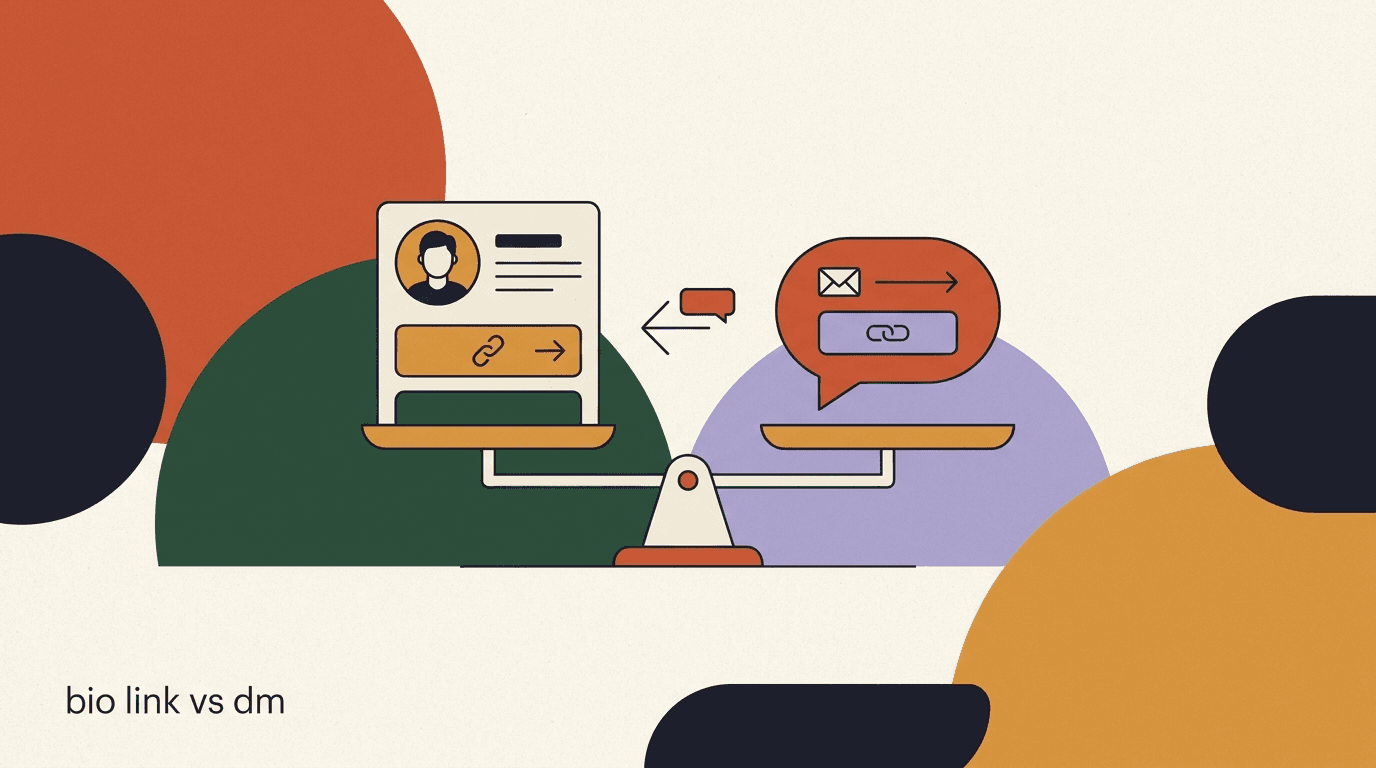
The Instagram bio link vs DM question comes up the moment you try to turn attention into traffic. You have a post that lands, a Reel that travels, an audience that clearly wants what you are offering — and then you hit the wall Instagram built on purpose: you cannot put a clickable link in a caption. So you are left with two real routes to send someone somewhere. You point them at the single link in your bio, or you deliver the link straight into a direct message. Both work. Both fail in different ways. And the choice you make quietly decides how much of that attention ever becomes a click, a lead, or a sale.
This is a head-to-head breakdown of the two approaches, written for people who actually have to ship the funnel rather than theorize about it. We will look at friction — how many taps and decisions stand between interest and action. We will look at attribution — whether you can tell what worked. We will look at conversion context, the offers that suit each channel, the mistakes that quietly leak traffic, and the honest rules you have to respect so you do not get your account limited. Then we will show how to combine the two so you are not forced into a false either-or.
We build KlyoChat, so we have a stake in the DM side of this. We have tried to keep the argument fair: the link in bio is not dead, it is not lazy, and for a lot of accounts it is the right default. The goal here is to help you match the tool to the moment, not to talk you into one habit for every post.
What is the real difference between a bio link and DM delivery?
On the surface the difference looks like location. A bio link sits on your profile; a DM link lands in someone's inbox. But the meaningful difference is timing and intent. A bio link is passive infrastructure. It is always there, waiting, and it does the same thing for every visitor regardless of what brought them. DM delivery is an active response. It fires because someone did something — commented a keyword, replied to a story, tapped a button — and it hands them the exact thing that moment called for.
That distinction changes everything downstream. Because the bio link is generic, it has to serve every possible visitor at once, which usually means it becomes a menu of options rather than a single clear next step. Because the DM is triggered by a specific action, it can be ruthlessly specific: one person asked about the discount code, so the DM contains the discount code and nothing else. The link in bio is a lobby. The DM is a concierge who already knows why you walked in.
There is also a difference in who controls the moment. With a bio link, the user has to remember to leave the content, navigate to your profile, find the link, open it, and choose. Every one of those steps is a place to lose them. With DM delivery, the response comes to them inside the app they are already using, in the surface where they already read and reply. You are not asking them to go somewhere. You are meeting them where they are.
Neither is universally better
The honest answer to the bio link vs DM question is that it depends on the post, the offer, and the audience's intent at that moment. Treat this as a toolkit, not a verdict. The rest of this guide is about knowing which tool the moment calls for.
Why does friction decide what converts on Instagram?
Conversion on social is mostly a story about friction. Every extra tap, every extra decision, every context switch sheds a slice of the audience that was, a second ago, interested. This is the core idea behind conversion rate optimization: you do not usually win by persuading harder, you win by removing the small frictions that quietly send people away. On Instagram, where attention is fast and thumbs are impatient, that principle is amplified.
Map the two paths as a sequence of steps and the difference is obvious. The bio link path asks a lot of a casual viewer. They see your post, decide they are interested, then have to consciously break out of the feed, go to your profile, locate the link, tap it, and — because most bio links lead to a page of several options — make yet another choice about which one they wanted. That is five or six discrete actions, each with its own drop-off.
The DM path collapses that. Someone comments a word or taps a story reply, and the link arrives in their inbox. From their point of view it is one action that produces the thing they wanted. The content did not send them on an errand; it answered them. Fewer steps between intent and payoff is, more often than not, more conversions — not because DMs are magic, but because friction is the tax and DMs pay less of it.
None of this means the bio link is doomed. It means you should be honest about the cost of each tap you are asking for, and reserve the low-friction path for the moments where intent is hot and you cannot afford to lose people on the walk to your profile.
Counting the taps from interest to link
- Bio link path
- See post, leave feed, open profile, find link, tap, choose from menu = 5-6 actions
- DM delivery path
- Comment a keyword or tap a reply, link arrives in inbox = 1 action
How does attribution differ between bio links and DMs?
If friction is where the bio link tends to lose, attribution is where it really struggles. A plain bio link is a black box. You can see how many people landed on the destination, but you usually cannot tell which post, which Reel, or which story drove them, because the link is a single fixed doorway that every visitor walks through regardless of origin. You know traffic arrived. You rarely know why.
You can improve this with UTM parameters and by swapping the bio link to match your latest campaign, and disciplined creators do exactly that. But it is manual, it is fragile, and it only ever tells you about the aggregate. It cannot tell you that the person who clicked was the same person who watched your tutorial three times, because a bio link has no memory of the individual.
DM delivery flips this. Because the DM is triggered by a specific action on a specific piece of content, the attribution is built in. You know this person commented on that Reel with that keyword, so you know precisely which content earned the click. And because it happened inside a conversation, you now have a thread — a persistent, identifiable relationship you can follow up in, segment, and measure over time. The link click is not an anonymous hit; it is a named event attached to a named person.
That difference compounds. A bio link gives you a number. A DM gives you a person, a source, and a channel you can use again. For anyone trying to actually learn what their content is doing, that is a large gap. We go deeper on the measurement side in our guide to Instagram DM open rates and what they really tell you, because open and click behavior in the inbox is where a lot of the useful signal lives.
Tag the trigger, not just the click
When you deliver links by DM, record which post and which keyword fired each one. That single habit turns your DMs into a live map of which content converts, something a bare bio link can never give you.
When does the link in bio actually win?
It would be easy to spend a whole article burying the bio link, but that would be dishonest, because there are clear situations where it is the right and even the better choice. The bio link wins whenever the value of being always-on and low-effort outweighs the friction cost.
The first case is discovery traffic. Plenty of people find your profile without ever engaging with a specific post — a share, a mention, a search, a tap on your name. Those people never triggered anything, so there is no DM to receive. The bio link is the only thing catching them, and it needs to be good, because for that whole segment it is the entire funnel.
The second case is the evergreen hub. If you sell several things, run a podcast, publish a newsletter, and host a shop, no single DM can represent all of that at once, and it should not try to. A well-built link-in-bio page acts as a permanent directory of everything you offer, which is genuinely useful for the visitor who is browsing rather than responding to one specific call to action.
The third case is simple bandwidth. Not every account has the appetite or the setup to run DM automation, and a static bio link requires nothing but a link. For a creator posting a few times a week with a single offer, the bio link is entirely adequate, and adding automation on top would be effort spent where it does not move the needle. Sometimes the boring option is the correct one.
- Discovery traffic that never engaged with a post has no DM to receive, so the bio link catches it.
- Multi-offer brands need an evergreen hub that a single DM cannot represent.
- Low-volume or low-bandwidth accounts get most of the value from a clean static link with none of the setup.
- Cold audiences who are not yet ready to talk may prefer to browse a page over starting a conversation.
When does DM delivery convert better?
DM delivery earns its keep in the opposite conditions: when intent is high, the moment is specific, and you can afford to lose almost no one on the way to the click. These are the situations where the extra friction of the bio link is most expensive, and where meeting the person inside the inbox pays off most.
The clearest case is the call-to-action post. You publish a Reel that ends with comment a word to get the guide, or a story with a reply prompt, and now you have people actively raising their hands. They have expressed intent in the most literal way possible. Making those people leave, hunt for your profile, and dig through a link menu would waste the exact eagerness you just created. The DM delivers the payoff at the peak of intent, while it is still hot.
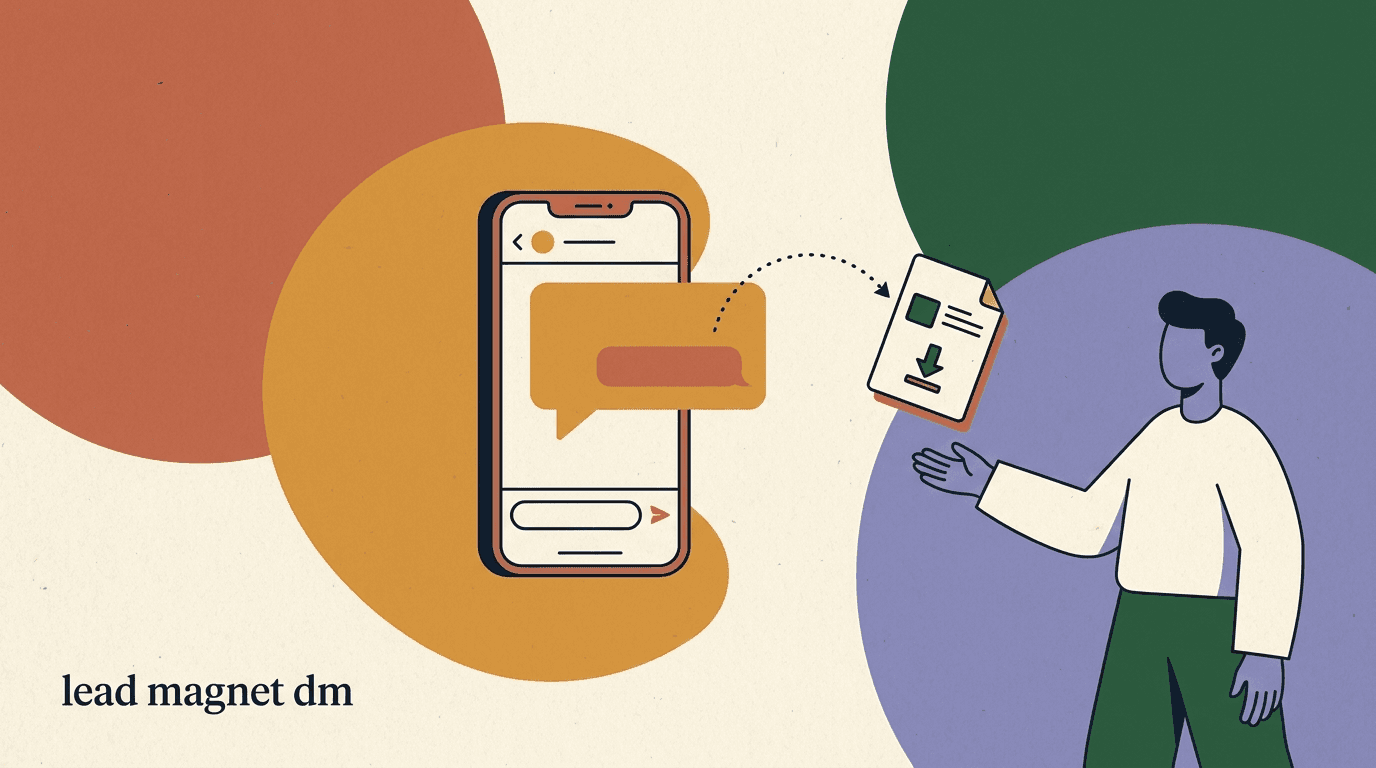
The second case is anything with a single, specific payoff — a lead magnet, a discount code, an event registration, a waitlist. When there is one obvious next step, a menu of options is noise. The DM can carry that one thing cleanly, wrapped in a sentence of context, and it can do it for thousands of people at once without you touching a keyboard. Our walkthrough on building an Instagram lead magnet DM funnel covers how to structure that single-offer flow so it feels like a helpful reply rather than a dispenser.
The third case is relationship building. A bio link click is the end of the interaction; the person leaves and you may never know them. A DM is the start of one. You now have a thread you can nurture, qualify, answer questions in, and reactivate later. For anyone whose business depends on conversation — coaching, services, considered purchases — the DM is not just a delivery mechanism, it is the front door to the actual relationship.
A comment-to-DM moment, step by step
- The post
- Reel ends with comment GUIDE and I will send you the checklist
- The trigger
- Viewer comments GUIDE, at peak intent
- The DM
- One warm sentence plus the link, delivered in-thread
- The result
- Click and a named, followable conversation, not an anonymous hit
What does a bio link vs DM comparison look like side by side?
It helps to put the two approaches next to each other across the dimensions that actually decide outcomes. The table below is qualitative on purpose — we are not going to invent conversion percentages, because your numbers depend on your audience, offer, and content far more than on the mechanism. What is stable is the shape of the trade-offs.
| Dimension | Link in bio | DM delivery |
|---|---|---|
| Friction | Higher: several taps and a menu choice | Lower: link arrives in the inbox |
| Attribution | Weak: hard to know which post drove it | Strong: tied to a specific post and trigger |
| Intent captured | Mixed: serves everyone the same way | High: fires on a deliberate action |
| Relationship | Ends at the click | Starts a followable conversation |
| Reach | Catches all profile visitors, including passersby | Only reaches people who engage |
| Setup effort | Minimal: one page or link | More: triggers, flows, and rules to respect |
| Always-on | Yes: works with zero engagement | No: needs an action to fire |
What kinds of offers suit each channel?
Beyond friction and attribution, the offer itself should steer your choice. Some things belong on a page and some things belong in a conversation, and forcing them into the wrong container is a quiet source of lost conversions.
Offers with a single, urgent, specific payoff want the DM. A limited discount code, a downloadable checklist tied to a particular Reel, a webinar link that only matters if you register before it starts — these are moments where speed and specificity win, and where the context of we were just talking about this makes the click feel natural. The DM wraps the link in relevance.
Offers that are a permanent menu want the bio link. Your full product catalog, your links to every platform, your standing invitation to book a call or subscribe — these do not have a moment, they have a shelf life of forever, and they suit a page a visitor can scan at their own pace. Trying to cram all of that into a DM makes the reply feel like spam and buries the one thing the person actually wanted.
| Offer type | Better channel | Why |
|---|---|---|
| Lead magnet tied to a post | DM delivery | Specific, timely, high-intent moment |
| Discount or promo code | DM delivery | Urgency and one clear action |
| Event or webinar signup | DM delivery | Deadline-driven, needs low friction |
| Full product catalog | Link in bio | Evergreen menu, browsed not answered |
| All my platforms and links | Link in bio | Permanent directory for any visitor |
| Book a call or subscribe | Either | Depends on whether a moment triggered it |
How do you set up a link-in-bio page that converts?
If the bio link is going to carry your discovery traffic and your evergreen offers, it deserves more thought than most accounts give it. A link that dumps people onto a wall of ten equally weighted buttons is a link that converts to nothing in particular. Treat the page as a landing page, not a filing cabinet.
- Lead with one primary actionPut your single most important offer at the top, visually dominant. Give the visitor an obvious first choice before you show them the rest.
- Keep the list short and orderedEvery extra button dilutes the ones above it. Rank by business value and cut anything that is not earning its place.
- Match the page to your current contentIf your recent posts push one campaign, make sure the top of the bio page reflects it. A stale link is a leak.
- Add tracking to every linkUse UTM parameters so you can at least see which destinations get traffic, even if you cannot see the source post.
- Make it fast and thumb-friendlyBig tap targets, quick load, no clutter. This page is viewed almost entirely on phones under impatient thumbs.
You do not need a heavy tool for this
A clean landing page or a simple hosted profile page works. If you are shopping for a linktree alternative, prioritize speed, link tracking, and the ability to reorder quickly over decorative extras you will never use.
How do you deliver a link inside the DM without breaking rules?
DM delivery is powerful precisely because it is close to the user, which is exactly why Instagram and Meta put guardrails around it. Done well, automated DM delivery feels like a helpful, prompt reply. Done carelessly, it looks like spam and puts your account at risk. The difference is in respecting the rules and the tone.
- Trigger on a genuine actionFire the DM off a real signal — a comment keyword, a story reply, a button tap — so you are responding to intent, not broadcasting to strangers.
- Respect the 24-hour windowMeta's messaging rules give you a standard 24-hour window to reply after a user interacts. Deliver your link inside it and do not try to route around the policy.
- Lead with context, then the linkOpen with a short human sentence that references what they asked for. The link should feel earned, not dumped.
- Send one clear thingResist stacking three offers into the reply. One trigger, one payoff. Extra links dilute the action and read as spam.
- Leave room for a replyEnd in a way that invites a response. The DM is a conversation starter, so do not close the door the moment the link lands.
The 24-hour window is not optional
Meta enforces a standard window for messaging after a user interacts with you. Trying to circumvent it, or blasting links to people who never engaged, is the fastest way to get your automation limited. Build inside the rules, not around them.
What are the most common mistakes with each approach?
Most of the traffic these two methods lose is lost to avoidable mistakes rather than to the mechanism itself. Knowing the usual failure modes is often more valuable than any tactic, because fixing a leak is cheaper than adding pressure at the top.
On the bio link side, the biggest mistake is the overloaded menu: a page of a dozen equally weighted links where the visitor cannot tell what they were supposed to do, so they do nothing. Close behind is the stale link — pointing to last month's campaign while your posts push this month's — and the missing tracking, which leaves you blind to what any of it is doing.
On the DM side, the classic mistake is treating delivery as a dispenser instead of a conversation. Cold, link-only replies with no context read as automated and get ignored or reported. The other frequent error is ignoring the rules: firing at people who never engaged, or pushing past the messaging window, which trades a short-term click for a long-term account risk. And plenty of accounts under-use the thread itself, dropping the link and never following up, which throws away the very relationship that made the DM worth using.
- Bio link: an overloaded menu with no clear primary action.
- Bio link: pointing to a stale campaign that no longer matches your content.
- Bio link: no UTM tracking, so you cannot see what works.
- DM: cold, context-free, link-only replies that read as spam.
- DM: ignoring the 24-hour window or messaging people who never engaged.
- DM: dropping the link and never continuing the conversation.
Does relying on the bio link hurt your reach?
There is a persistent worry that funneling everything through comments and DMs somehow games the algorithm, or that leaning on the bio link is safer for reach. The honest answer is more mundane than either fear. Instagram's own guidance, which you can read on its help center for creators and businesses, rewards content that generates genuine interaction and time spent. It does not publish a simple lever you can pull, and anyone claiming a guaranteed trick is guessing.
What is defensible is the behavioral logic. A call-to-action post that invites comments and replies tends to generate exactly the kind of engagement signals that platforms treat as evidence the content is worth showing. Asking people to comment a keyword is, at minimum, not harmful to that, and it produces real interaction rather than empty vanity taps. A bio link, by contrast, sends people off-platform, which is neutral at best from a reach standpoint.
The practical takeaway is not to chase an algorithmic hack. It is that the DM approach happens to align with content that invites participation, and participation is broadly good for distribution. Do not build your whole strategy on that assumption, but do not ignore that a comment prompt tends to be a healthier engagement pattern than a silent redirect to a link. For a deeper look at structuring those prompts, our link-in-DM strategy guide breaks down the mechanics.
No one has a reach cheat code
Be skeptical of anyone promising the algorithm loves this one trick. What holds up is that content inviting real interaction tends to travel further than content that silently points off-platform. Build for genuine engagement, not for a rumored lever.
How does the right choice change as your account grows?
The bio-link-versus-DM balance is not fixed across the life of an account. What is correct for a brand-new profile is often wrong for one with a large, active audience, and the transition catches people out because they keep running the setup that worked a year ago long after it stopped being the right one.
Early on, a static bio link is usually enough, and reaching for DM automation is premature. When you post twice a week to a small following, the volume of intent is low, the offers are few, and the return on building triggers and flows is thin. A clean bio link with one clear action does the job, and your energy is better spent on the content that grows the audience in the first place. Do not automate a funnel that does not yet have traffic flowing through it.
As the account grows, two things shift. The volume of high-intent moments rises to the point where handling them by hand, or losing them to friction, becomes a real cost — and the attribution problem gets more expensive because you now have enough content that you genuinely need to know which pieces convert. This is the stage where layering DM delivery on top of the bio link starts to pay for itself, because the traffic finally justifies the setup and the measurement finally matters.
At scale, the DM layer often becomes the workhorse and the bio link settles into a supporting role, though it never disappears. High-volume accounts lean on comment-to-DM for the bulk of their conversion because it captures intent at the moment and keeps it measurable, while the bio link quietly does its always-on job for the long tail of discovery traffic. The mistake at every stage is inertia — running the small-account setup on a large-account audience, or over-building automation before the traffic exists to feed it.
- New or low-volume account: a clean static bio link is usually enough; do not over-build.
- Growing account: intent volume and the need for attribution both rise, so layer DM delivery on top.
- At scale: DM delivery often carries the bulk of conversion while the bio link handles the long tail.
- The recurring error is inertia — running last year's setup on this year's audience.
Match the setup to the stage, then revisit it
There is no single correct answer for all time. Re-examine the balance whenever your posting volume or audience jumps. The bio-link-only setup that was right at the start is rarely the right one once real intent starts flowing.
How do you combine bio link and DM delivery?
The framing of bio link vs DM as a fight is mostly a mistake. The strongest accounts run both, deliberately, with each doing the job it is best at. The DM handles the hot, specific, high-intent moments; the bio link handles the always-on discovery traffic and the evergreen menu. Neither has to win, because they cover different ground.
In practice, a layered setup looks like this. Your call-to-action posts drive comment-to-DM delivery, capturing intent at its peak and starting conversations you can measure and follow up. Your bio link stays sharp and current as the catch-all for everyone who arrives without engaging — the searchers, the sharers, the browsers — and as the home for offers that have no single moment. The DM is your response; the bio link is your reception desk.
There is a useful redundancy here too. Some people will see comment a word to get it and, instead of commenting, go straight to your profile and look for the link out of habit. If your bio link points to the same offer, you catch them there instead of losing them. The two paths back each other up. You are not choosing one funnel; you are building a net with two overlapping layers so fewer people fall through.
The one discipline this requires is coordination. When you run a campaign, the DM trigger and the bio link should point at the same destination, so whichever route a person takes, they land in the right place. Misaligned layers — a DM promoting the checklist while the bio link still shows last quarter's webinar — is where combined setups leak. Keep the two in sync and they compound instead of competing.
A two-layer setup for one campaign
- Layer 1 (DM)
- Reel prompt fires a comment-to-DM with the offer link, at peak intent
- Layer 2 (bio link)
- Same offer sits at the top of the bio page for anyone who skips the comment
- The point
- Whichever route they take, they land on the same destination
How do you measure which one is working?
You cannot improve what you cannot see, and the two channels give you very different visibility. Measuring them well means using each one's native signal rather than forcing them into the same report.
For the bio link, your instruments are UTM parameters and destination analytics. Tag every link on the page so your analytics tool can separate bio-link traffic from everything else, and watch which destinations earn clicks over time. The limit, as covered earlier, is that you are measuring the aggregate — you see that the page drove traffic, not which post sent it. Accept that ceiling and get what value you can from the trend line.
For DM delivery, the signal is richer because it is per-person and per-trigger. You can track how many people fired each trigger, how many opened the DM, how many clicked the link inside it, and how many replied. Because each event ties back to a specific post and keyword, you can rank your content by which pieces actually produce conversations, not just impressions. That is a level of feedback the bio link structurally cannot give you.
The practical move is to measure them separately and then read them together. Bio link analytics tell you how your always-on layer is doing; DM analytics tell you which specific content and offers are converting in the moment. Put side by side, they tell you where your traffic really comes from and which posts to make more of. Meta's own reporting for professional accounts, described on its business resources, covers the content-level view; your DM tool should cover the conversation-level view underneath it.
Two dashboards, one question
Do not try to force bio link and DM data into one number. Read the bio link for always-on traffic health and the DM for which posts convert. Together they answer the only question that matters: what should I make more of?
What Meta rules do you actually need to respect?
Because DM delivery touches Instagram's messaging system directly, it lives under rules you have to work with rather than around. Ignoring them does not just risk a warning; it risks your ability to message at all, which would take the whole DM strategy offline. Fortunately the rules are reasonable and mostly about not being a spammer.
The central one is the messaging window. After a user interacts with you — comments, replies, messages — you generally have a standard 24-hour window to respond with regular messages. Deliver your link inside that window and you are on solid ground. Trying to reach people who never engaged, or reopening cold conversations with promotional blasts, is where accounts get into trouble. Automation should always be a response to a real action, never an unsolicited broadcast.
The second theme is quality and consent. Instagram treats reports and negative signals seriously, so the surest protection is to only message people who clearly asked, to keep replies genuinely useful, and to make it easy for someone to stop. A DM that reads like a helpful answer to a question the user posed is both more effective and far safer than one that reads like an ad they never requested. Build for the version of DM automation you would be happy to receive, and the rules mostly take care of themselves.
Compliance is a feature, not a tax
Staying inside Meta's messaging window and only replying to people who engaged is not just about avoiding penalties. It is the same behavior that makes DMs convert: timely, wanted, and relevant. The compliant version and the effective version are the same version.
How does KlyoChat handle bio link vs DM delivery?
This is where our own tool fits, and we will keep it honest about what it does and does not do. KlyoChat is an AI-native unified inbox that pulls Instagram together with your other channels, and its comment-to-DM feature is built specifically for the DM-delivery side of this comparison. When someone comments your keyword, KlyoChat delivers the link or asset in-thread, inside the messaging window, so the payoff reaches them at the moment of intent without you touching anything.
Because delivery runs through automated flows you can build without code, you can wrap the link in a real sentence of context, branch based on what the person replies, and follow up rather than dropping a bare URL. And because everything happens in a tracked inbox, you get the per-trigger analytics that a bare bio link cannot give you — which post fired the DM, whether it was opened, and whether the link was clicked. That closes the attribution gap that makes bio links so hard to learn from.
It is worth being clear about the limits, because a MOF comparison should not oversell. KlyoChat is a DM and inbox tool; it does not replace your link-in-bio page, and we would not pretend it should — the bio link still does the always-on discovery job we described above, and you should keep one. KlyoChat also has no native SMS or email, so if your funnel depends on those channels you will need something alongside it. It respects Meta's 24-hour window by design, which means it will not let you do the non-compliant things that put accounts at risk, even when you might want the shortcut. And we are a newer, smaller community than the incumbents, so the template library and forum answers are still growing.
On price, KlyoChat is flat rather than metered on contacts: Basic is $19/month, Pro is $49/month ($39 billed yearly), and Business is $129/month, each with a 7-day free trial and no credit card required. If you want to see how the tiers line up against your volume, the full pricing breakdown lays it out. The short version: if the DM side of your funnel matters and you want it tracked and compliant without stitching tools together, this is what KlyoChat is for — used alongside, not instead of, a clean bio link.
Where each tool sits in the funnel
- Bio link
- Always-on reception for discovery traffic and evergreen offers — keep it
- KlyoChat comment-to-DM
- Tracked, in-window delivery at peak intent, with follow-up
- Honest limit
- No native SMS or email; a newer, smaller community
The bottom line on Instagram bio link vs DM delivery is that the question is framed wrong when it is framed as a winner-take-all. The bio link is passive, always-on, low-effort, and weak on attribution — the right default for discovery traffic and evergreen menus. DM delivery is contextual, low-friction, high-intent, and richly measurable — the right choice for the hot moments where you cannot afford to lose people on the walk to your profile. Their weaknesses are opposite, which is exactly why they combine so well.
So do not pick one and defend it. Keep a sharp bio link for everyone who arrives without engaging, and layer comment-to-DM on top for the moments where intent spikes, making sure both point at the same destination. Measure them separately, respect Meta's rules, and let each do the job it is built for. If you want the DM layer done in a tracked, compliant inbox, that is the part KlyoChat handles — and our guides on the link-in-DM strategy and the lead magnet DM funnel go deeper on building it well.