A DM script that converts buyers is not a magic paragraph you paste at strangers until one of them pays you. It is a repeatable shape for a real conversation — an opener that earns a reply, a question that surfaces the need, a piece of value that builds trust, a soft offer, honest objection handling, and a close that makes saying yes easy. The script is the skeleton. The personalization is the muscle. Without both, you have spam.
This guide gives you that skeleton, beat by beat, with fill-in-the-blank templates and side-by-side good versus bad examples so you can see exactly where most DM copy goes wrong. It is built for creators, coaches, and small brands who already have an audience that messages them — people in the middle of the funnel who are interested but not yet committed. The goal is to turn that warm attention into a clear, respectful path to a purchase.
One honest note up front: we build KlyoChat, an AI-native inbox and automation tool for social DMs, so we have a stake in this. We have written this to be useful even if you never touch our product — the framework works in any inbox. Where KlyoChat helps, we will say so plainly, and we will be equally clear about what a tool cannot do for you. No script converts a stranger you have annoyed. Personalization, timing, and respect do the heavy lifting; the framework just keeps you from fumbling the parts you can control.
Why do most DM scripts fail to convert?
Most DM scripts fail for a single reason: they are written to be sent, not to be read. The person writing them is thinking about their own goal — book the call, make the sale — and not about the human on the other end who has seen a hundred copy-paste pitches this month. The moment a message smells like a template, trust collapses, and trust is the entire currency of a direct message.
The second failure is sequencing. A lot of creators try to close on the first line. They lead with the offer, the price, and a calendar link before they have earned a single reply. That is like proposing marriage on a first date. The DM is a relationship in miniature, and relationships have an order: attention, then interest, then trust, then commitment. Skip a step and the whole thing feels off, even if the reader cannot articulate why.
The third failure is the absence of a real question. Pitches talk; conversations ask. A script that never asks the reader anything is a monologue, and monologues do not convert because they give the reader nothing to respond to and no sense of being understood. The best DM copy is mostly the reader talking, with you guiding.
- It reads like a template, so it triggers the spam reflex instantly.
- It pitches before it has earned a reply or built any trust.
- It never asks a genuine question, so it is a monologue, not a conversation.
- It ignores what the reader actually said and barrels toward the close.
If your script could be sent to anyone, it converts no one
The fastest test for bad DM copy: could you paste this exact message to a thousand people without changing a word? If yes, it is spam, and your reply rate will show it. A converting DM always contains at least one detail that only fits the person you are writing to.
What is the six-beat DM script framework?
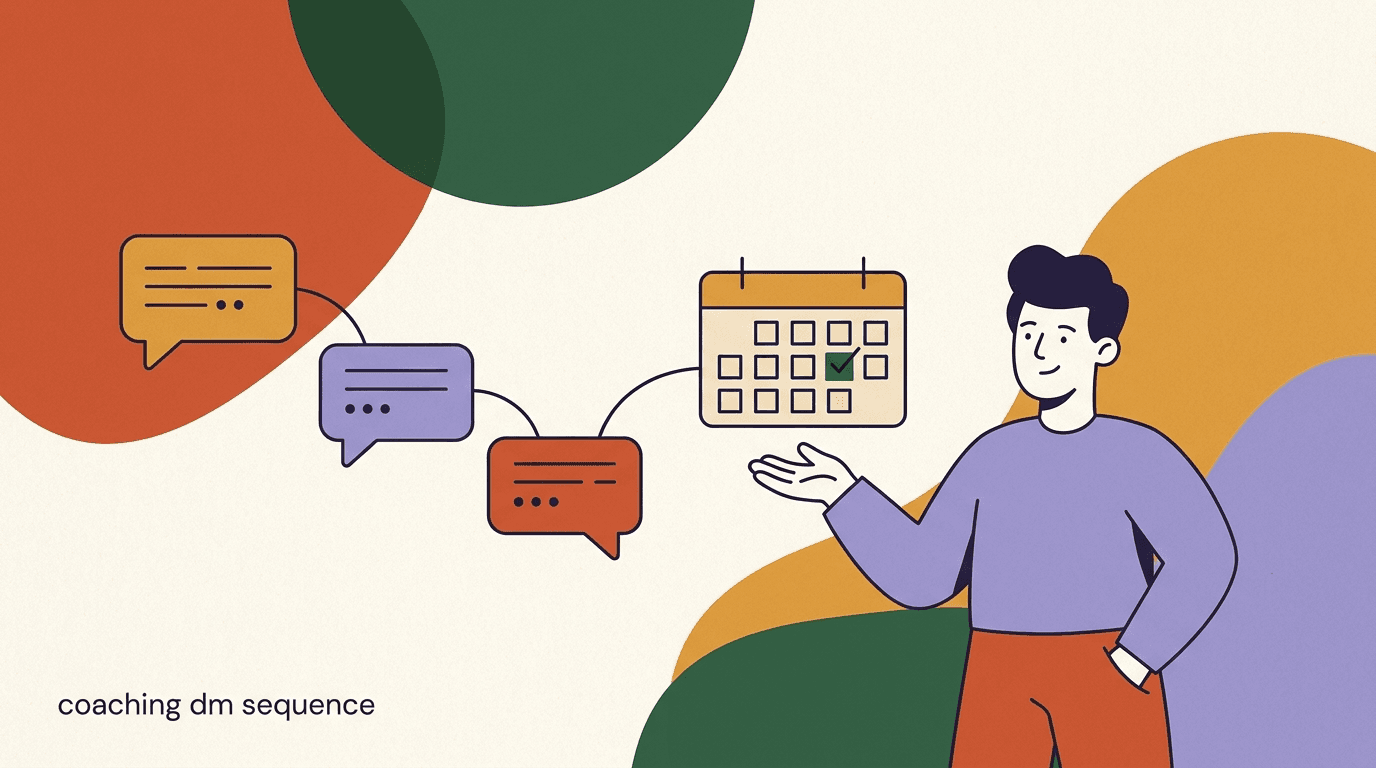
The framework is six beats that mirror how a good salesperson actually talks — except compressed into a chat thread and stripped of pressure. Each beat has one job, and you do not move to the next until the current one has landed. Rushing is the most common mistake; the reader sets the pace, not your sales target.
Think of it less as a script to recite and more as a map. You will not use every beat in every conversation. A warm lead who already knows your offer might skip straight from opener to close. A cold-ish lead might need two rounds of value before they trust you. The beats tell you what move is available next, not what you are forced to say.
- Each beat has exactly one job — do not stack them.
- You only advance when the current beat has landed.
- The reader controls the pace; your target does not.
- Skipping beats is fine for warm leads, but never skip backward into a hard pitch.
| Beat | Its one job | What success looks like |
|---|---|---|
| 1. Opener | Earn a reply | They respond at all |
| 2. Question | Surface the real need | They tell you their problem |
| 3. Value | Build trust by helping first | They feel understood and helped |
| 4. Soft offer | Introduce the paid solution gently | They ask to know more |
| 5. Objections | Remove the real blocker calmly | Their hesitation has a name |
| 6. Close | Make saying yes easy | They take the next step |
Beat 1: How do you write an opener that earns a reply?
The opener has one job and one job only: get a reply. Not a sale, not a click — a reply. Everything else in the framework depends on the conversation actually starting, and it only starts if your first message gives the reader an easy, low-pressure reason to type something back. The mistake is treating the opener as your pitch. It is not your pitch. It is the handshake.
The strongest openers reference something specific and recent — a comment they left, a post they liked, the freebie they just opted into, a reply they sent to your story. Specificity is the entire game here, because it proves you are a person paying attention and not a bot blasting a list. Generic praise ("love your content!") reads as a warm-up to a pitch, which it usually is, and people have learned to ignore it.
Keep it short. One or two sentences. A wall of text in the first message signals effort in the wrong direction — it feels like you are about to ask for something big. The opener should feel like the start of a chat between two people, not the cover letter for a proposal.
Reference the trigger, then ask one easy thing
The best opener names the exact reason you are reaching out (their comment, their opt-in, their reply) and ends with one low-effort question they can answer in a few words. Low effort to reply means high likelihood of a reply, and a reply is the only thing the opener needs to win.
Opener: bad vs good
- Bad (generic)
- Hey! Love your page. I help people like you grow. Want to hop on a call?
- Bad (instant pitch)
- Hi! I have a program that gets results fast. DM me BACK for details and pricing!
- Good (specific)
- Hey Sam — saw your comment on the post about consistency. That stuck with me. How long have you been at it?
Beat 1, continued: Fill-in-the-blank opener templates
Here are opener templates you can adapt. The brackets are not optional — they are where your personalization lives. If you send these with the brackets unfilled or filled with generic filler, you are back to spam. Read the trigger, find the specific detail, and use it.
- The comment opener"Hey [name] — saw your comment about [specific thing they said] on [post]. [One genuine reaction]. Quick question: [easy question about their situation]?"
- The opt-in opener"Hi [name], thanks for grabbing [the freebie]. Curious what made you download it — what are you trying to [outcome the freebie promises] right now?"
- The story-reply opener"Love that you replied to the [topic] story. You mentioned [thing they said]. How's that going for you at the moment?"
The opener is the easiest beat to automate badly
Automation can fire an opener the second someone comments or opts in, which is genuinely useful for timing. But an automated opener with no real personalization is the most obvious spam there is. If you automate the trigger, still make the message reference something true about that person — a tool can insert their name and the post they engaged with, but the reaction should sound like you.
Beat 2: What question surfaces the buyer's real need?
Once they reply, you ask. This is the beat almost everyone skips, and skipping it is why so many DMs stall right after the opener. The question's job is to get the reader to describe their problem in their own words, because a problem they have named out loud is one they are far more ready to solve — and one you can now solve precisely instead of generically.
Good discovery questions are open, specific, and about them. Avoid yes-or-no questions, which end conversations, and avoid questions that are really pitches in disguise ("Have you ever wished you could double your income?"). Ask about their actual situation: what they have tried, what is frustrating them, what they want that they do not have yet. The more concretely they answer, the more obviously your offer will fit later.
Listen to the answer. This sounds obvious, but the entire framework breaks if you ask a great question and then ignore the reply to deliver your pre-written value paragraph. The whole point of the question is that it tells you which value to give and how to frame the offer. Read what they wrote and respond to that specifically.
- Ask open questions, never yes-or-no — yes/no ends the thread.
- Make it about their situation, not your solution.
- Offer two concrete options if they freeze; it makes replying easier.
- Actually read the answer and respond to it, not to your script.
Discovery question: bad vs good
- Bad (yes/no)
- Do you want to grow your business?
- Bad (pitch in disguise)
- Have you ever wished you had a proven system that just works?
- Good (open, specific)
- What's the part of [their goal] that feels stuck right now — is it [option A] or more like [option B]?
Beat 3: How do you give value before you ask for anything?
Now that you know their real problem, you help — for free, with no strings, before any offer. This is the trust beat, and it is the difference between a salesperson and a stranger with a link. When you give someone a genuinely useful insight tailored to what they just told you, two things happen: they trust you, and they get a small taste of what working with you would feel like. Both move them toward buying.
The value should be specific and immediately usable. Not "you should work on your mindset" but "based on what you said about posting inconsistently, the single thing I'd change first is batching three posts every Sunday so a bad week doesn't break your streak." Specific value proves competence in a way that no testimonial can. It also respects the reader's time, which respects the reader.
Resist the urge to attach the offer to the value. The value is a gift. If you say "here's a tip... and by the way here's my program," you have turned the gift into bait, and the reader feels it. Give the value cleanly, let it land, and let them respond. Often they will ask what else you can help with — and that is your invitation to the soft offer.
One specific tip beats five generic ones
The temptation is to dump everything you know to seem valuable. Resist it. One tip that obviously fits their exact situation builds more trust than a list of generic advice they could have Googled. Specificity is the proof you actually listened.
Giving value: bad vs good
- Bad (generic)
- You just need to stay consistent and believe in yourself! Consistency is key.
- Bad (value as bait)
- Here's a tip — and honestly my $2k program covers all of this if you want the full thing.
- Good (specific, clean)
- Given you said Sundays are your only free time, try batching three posts in one sitting. One good session covers a whole week, so an off day doesn't break the streak.
Beat 4: What does a soft offer actually sound like?
The soft offer is where you finally mention that you can help further — for money — but you do it as a natural next step, not a pivot. By now you have earned a reply, learned their problem, and helped them for free. The offer should feel like the obvious continuation of a conversation that is already going well, because it is.
A soft offer names the gap between where they are and where they want to be, then positions your paid solution as the bridge. It is permission-based: you ask if they would like to hear about it rather than dumping the full pitch unprompted. "Would it be helpful if I walked you through how I help people with exactly this?" gives them a choice, and a yes here is a real yes — engaged, not cornered.
Crucially, the soft offer is not the close. It is the door opening. You are checking interest, not asking for the sale. If they say yes, you describe the offer in a sentence or two and let them react. If they hesitate, you have surfaced an objection, which is the next beat and a gift, not a rejection.
Ask permission before you pitch
A single permission question — "want me to share how I help with this?" — changes the dynamic entirely. A yes means they opted into the pitch, so they listen instead of bracing. It also makes a no graceful, which keeps the relationship intact for later.
Soft offer: bad vs good
- Bad (hard pivot)
- Anyway, my program is $1,500 and we start Monday. Here's the payment link!
- Bad (pressure)
- I only have 2 spots left and they're going fast — you in or out?
- Good (permission-based)
- Sounds like the batching idea could help, but you'd move faster with a system around it. Want me to share how I help people set that up? No pressure either way.
Beat 5: How do you handle objections without pressure?
Objections are not the enemy of a sale; they are the sale. When someone says "it's too expensive" or "I'm not sure I have the time," they are telling you exactly what stands between them and yes. An objection is engagement. The reader who objects is still in the conversation, still considering. The reader who vanishes is the one you lost.
The move is to name and validate the objection before you answer it. "Totally fair, price matters — let me address that" lowers the reader's guard far more than jumping straight to a counter. People dig in when they feel argued with and relax when they feel heard. Validate first, then respond with something true. Never invent urgency or guilt; pressure closes a few deals today and burns the trust that would have closed many more.
Match your answer to the real objection, which is not always the stated one. "It's too expensive" sometimes means "I'm not convinced it'll work for me." A gentle clarifying question — "is it the price itself, or whether it'll pay off for your situation?" — often reveals the actual blocker, and the actual blocker is the only one worth answering.
| Objection | What it often really means | Calm response |
|---|---|---|
| Too expensive | Not yet convinced it will work for me | "Fair — is it the number itself, or whether it'll pay off for you? Happy to walk through that." |
| No time | Not sure it's worth the time | "Makes sense. It's built for busy weeks — most people spend under an hour. Want to see how?" |
| Need to think about it | Has an unspoken doubt | "Of course. What's the main thing you'd want to feel sure about before deciding?" |
| Tried something like it before | Burned, scared of repeating it | "I get that. What didn't work last time? I'd rather be honest about fit than oversell." |
Fake urgency is a short-term trick with a long-term cost
"Only 2 spots left" and "price goes up at midnight" can squeeze a few sales, but savvy buyers recognize the play and it cuts trust. Real deadlines are fine to state plainly. Invented ones turn a relationship-building channel into a pressure channel, which is exactly the wrong use of a DM.
Beat 6: What does a clean closing script look like?
The close is not a big ask — if you have done the previous five beats well, it is a small one. By now the reader trusts you, has had their problem understood, received real help, heard a relevant offer, and had their hesitation addressed. The close simply makes the next step concrete and easy. The mistake is treating the close as the hard part; if it feels hard, an earlier beat was rushed.
A good close is specific and singular. Give one clear next step, not three options that create decision paralysis. "Want me to send the link to get started?" or "I can hold a spot for you — shall I?" One yes, one action. Ambiguity at the close ("let me know if you're interested whenever!") kills momentum, because "whenever" means never and "if you're interested" reopens a decision they had nearly made.
Then make the mechanics frictionless. Send the link, the next message, the calendar slot immediately, so the gap between yes and done is as small as possible. Every extra step between decision and action is a chance for second-guessing. And whatever the answer, stay gracious — a respectful no today is a warm lead in three months, and DMs are a long game.
- Give one next step, not a menu of options.
- Make the mechanics instant — send the link in the same breath as the yes.
- State real deadlines plainly; never invent fake ones.
- Treat a no as a pause, not an ending. Stay gracious.
The close: bad vs good
- Bad (vague)
- Anyway, let me know if you're ever interested! No rush at all, whenever works.
- Bad (too many asks)
- You can book a call, or join now, or I can send info, or we can chat more — up to you!
- Good (one clear step)
- Great — I'll send you the link to get started and I'm here if anything comes up as you go. Sound good?
Can you see the full script run end to end?
It helps to see all six beats in one continuous conversation rather than as isolated parts. Here is a compressed example for a fitness coach whose follower opted into a free meal-prep guide. Notice how each message does one job, how the coach reads and responds to what the reader actually says, and how the offer arrives only after trust is built.
This is illustrative, not a transcript to copy word for word. Your wording, your voice, and the reader's actual replies will reshape it every time. The shape stays; the words change.
Notice how short each message is
No single message in that run is more than a couple of sentences. DMs reward brevity. Long paragraphs feel like effort aimed at extracting something, while short messages feel like a real conversation. When in doubt, cut your message in half.
Full six-beat run (fitness coach)
- Opener
- "Hey Mia, thanks for grabbing the meal-prep guide. What's the meal that usually trips you up — breakfast or dinner?"
- Reply
- "Honestly dinner, I'm too tired to cook by then."
- Question
- "That's so common. Is it the cooking itself or the deciding-what-to-make part that drains you?"
- Reply
- "The deciding, for sure."
- Value
- "Then skip deciding entirely — pick three dinners and rotate them for a month. Boring on paper, but it removes the exact friction you described."
- Soft offer
- "That alone helps a lot. If you want, I help people build a full no-decisions plan around their week. Want to hear how it works?"
- Objection
- Reader: "Maybe, but I've tried plans before and quit." Coach: "Totally fair. What made you quit last time? I'd rather check it's a fit than talk you into it."
- Close
- "Got it — that's exactly what we'd design around. Want me to send the link to start? You can keep using the rotation idea either way."
How do you personalize a script so it doesn't read like one?
The whole framework lives or dies on personalization, so it deserves its own beat of attention. The principle is simple: every message should contain at least one detail that is true only for the person you are writing to. Their name is the bare minimum and barely counts. The detail that matters is what they said, what they engaged with, what they want — the things a bot cannot fake.
Practically, this means reading before you write. Skim their last message, their profile, the post they engaged with. Find the hook — the frustration they named, the goal they mentioned, the phrase they used — and mirror it back. Mirroring their own words ("you said dinner drains you") is the strongest personalization there is, because it proves you listened and it makes them feel understood without you having to say "I understand you."
Personalization is also about restraint. A personalized message often says less, not more, because you have cut everything that does not fit this specific person. The generic lines you delete are exactly the lines that made it feel like a script. What remains is lean, relevant, and human.
- Read before you writeSkim their last reply, profile, and the content they engaged with. Find one specific, true detail before typing anything.
- Mirror their wordsUse their own phrasing back to them. "You said X" is more convincing than any clever line you could write.
- Cut anything genericDelete every sentence that could be sent to anyone. What survives is the personalized message.
- Match their energy and lengthIf they write short and casual, do the same. If they write thoughtfully, match it. Mismatched tone reads as scripted.
When should you automate, and when should you type by hand?
Automation and DM selling are not opposites, but they have a clear division of labor. Automation is excellent for timing and triggers — firing a relevant opener the instant someone comments your keyword, opts into a freebie, or replies to a story. That speed matters; a reply that arrives in seconds while interest is hot converts far better than one sent hours later. Automation is also good for routing, sorting, and making sure no message slips through.
Where automation should stop is the moment the conversation gets real. Once someone replies with their actual problem, a human (or a carefully reviewed draft) should take over, because the value, the offer, and the objection handling all depend on what this specific person said. An automated sequence that keeps marching through pre-written messages regardless of the reply is the robotic experience everyone resents. The reader can tell, and they leave.
The healthiest setup is automation for the predictable opening moves and human judgment for everything that requires reading the room. You get speed where speed helps and authenticity where authenticity is non-negotiable. The line is roughly: automate getting the conversation started; personalize everything after the first genuine reply.
| Stage | Good to automate? | Why |
|---|---|---|
| Trigger + opener | Yes | Speed matters; a templated-but-true opener fired instantly beats a late manual one |
| Discovery question | Partly | A first question can be automated; the follow-up must respond to their answer |
| Value | No | It has to fit what they specifically said — generic value erodes trust |
| Soft offer | No | Timing and framing depend on the live conversation |
| Objections | No | Requires reading the real, often unstated, blocker |
| Close | Partly | The ask can be templated; the timing must be human |
Respect platform rules and never mass-DM cold
Meta's platforms restrict unsolicited bulk messaging, and blasting cold DMs is both against the rules and terrible for conversion. Automate within the rules — respond to people who engaged with you, honor opt-ins, and keep volume sane. Getting your account limited costs far more than any script could earn.
How do you measure whether your DM script is working?
A script is a hypothesis, and the only way to improve it is to watch where conversations die. Track the conversation by beat, not just by final sales, because the beat where people drop off tells you exactly what to fix. If openers rarely get replies, your opener is the problem. If replies come but the conversation stalls after your value, your soft offer or its timing is off. Diagnosing by beat turns vague "it's not working" frustration into a specific fix.
Watch reply rate at the opener, the percentage who answer your discovery question, how many reach the soft offer, and how many close. You do not need fancy analytics — a simple note of where each conversation ended is enough to spot the leaky beat. Then change one thing at a time. If you rewrite the opener and the question and the offer all at once, you will not know which change helped.
Be patient with the numbers. DM selling is high-trust and lower-volume than email blasts, so individual conversations matter more and small samples mislead. Give a change enough conversations to mean something before you judge it. And remember the honest truth: no script guarantees a result. The framework improves your odds; it does not promise income, and anyone who promises you a conversion rate is selling you something.
- Track drop-off by beat, not just total sales.
- Change one beat at a time so you know what moved the needle.
- Use a simple log of where each conversation ended — no special tools needed.
- Judge changes over enough conversations to be meaningful, not after three.
We make no income claims
There is no honest universal conversion rate for DMs — it depends on your audience, offer, price, and relationship. This framework is designed to help you have better conversations, not to promise a number. Be wary of anyone who guarantees a specific result from a script.
How does KlyoChat help you run this without losing the human touch?
If you are running this framework across more than a handful of conversations, the operational problem shows up fast: messages scattered across Instagram, Facebook, WhatsApp, Telegram, TikTok, and X, openers that need to fire the moment someone engages, and replies that pile up faster than you can read them. KlyoChat exists to make the framework manageable at volume without turning it into spam. We built it because we kept seeing good DM strategies collapse under their own admin.
Concretely: KlyoChat is an AI-native unified inbox, so every channel lands in one place and you handle a conversation without tab-switching or losing context. No-code flows fire the opener and first question on the right trigger — a comment keyword, an opt-in, a story reply — so beat one happens instantly while interest is hot. That is the part automation is genuinely good at, and it is the part this framework says to automate.
For the human beats, KlyoChat's AI agents can draft replies in your brand voice using a knowledge base you provide — but you review before anything sends. That distinction is the whole point. The AI can save you the blank-page time of writing the value or the objection response, drawing on what the reader actually said, and then you read it, fix what is off, and send. It is a drafting assistant for the parts that need to sound like you, not an autopilot that pretends to be you. A team inbox means several people can work the same conversations without stepping on each other.
- Unified inbox: Instagram, Facebook, WhatsApp, Telegram, TikTok, and X in one place.
- No-code flows fire beat-one openers and questions on the right trigger, instantly.
- AI agents draft value and objection replies in your voice — you review before sending.
- Team inbox so multiple people can run conversations without collisions.
| KlyoChat plan | Price | Who it fits |
|---|---|---|
| Basic | $19/mo | Solo creators starting structured DM selling |
| Pro | $49/mo ($39 yearly) | Creators and small teams at real volume across channels |
| Business | $129/mo | Larger teams needing more seats and contacts |
Let AI draft the beat, but keep your eyes on send
The right use of AI here is removing the blank-page cost of writing the value or the objection response, then reviewing it. An AI draft you read and edit still sounds like you. An AI message sent unread is exactly the robotic experience this whole framework warns against. Review is not optional.
What are the honest limits of any DM script — including ours?
Let's be straight about what a script and a tool cannot do. A script cannot make a bad offer good. If your product does not solve the reader's problem, no sequence of well-crafted messages will fix that, and trying just wastes everyone's time. The framework assumes you have something genuinely worth buying; it is a way to communicate value, not to manufacture it.
A script also cannot rescue a relationship you have damaged. If you mass-DM cold strangers, ignore replies, or pressure people, the framework will not save you — it will just be a nicer-looking version of spam. The whole approach depends on warmth you have already earned through your content and your conduct. Personalization is the rule, not the garnish; the moment you stop personalizing, you are spamming, regardless of how good the template was.
And honestly about KlyoChat specifically: we do not offer native SMS or email, so if those channels are central to your strategy, we are not your only tool. We are a newer, smaller platform with a smaller community than the incumbents, which means fewer third-party templates and tutorials floating around. We think the product earns its place, but we would rather you know the trade-offs than be surprised. Whatever tool you use, you must still respect Meta's rules, and no software — ours included — can promise you sales. The conversations are still yours to have well.
- A script cannot fix a weak offer — it only communicates a real one.
- Personalization is mandatory; the moment you stop, it is spam.
- KlyoChat has no native SMS or email, and a smaller community than incumbents.
- Respect Meta's messaging rules. No tool can promise sales or guarantee income.
The bottom line: a DM script that converts buyers is a six-beat shape — opener, question, value, soft offer, objection handling, close — that you personalize relentlessly and run at the reader's pace, not yours. The templates here are a starting point, not a finish line. The reply rate, the trust, and ultimately the sale come from the parts that cannot be templated: reading carefully, helping genuinely, and asking permission before you pitch.
Start with the opener. Get good at earning replies before you worry about closing, because a conversation that starts is a conversation you can win. Layer in the rest as you go, watch where your conversations stall, and fix one beat at a time. If you want help running this across channels without losing the human touch — automating the openers and drafting the human beats for your review — that is exactly what we built KlyoChat to do. Either way, go have better conversations.