For twenty-five years the contact form has been the default way a website says get in touch. You know the shape by heart: a name field, an email field, a message box, and a submit button that fires your note into a quiet space marked we will get back to you. It worked because there was nothing better. That is no longer true. The search for a contact form alternative — something faster, more human, and far more likely to actually convert — has moved from a fringe experiment to the obvious default. This is an opinion piece, and the opinion is simple: the static contact form is on its way out, and something better is taking its place.
We should say what we mean by dying. Forms are not vanishing tomorrow, and plenty of them will still be collecting job applications and support tickets a decade from now. What is dying is the form as the primary way a stranger reaches a business with a question that has money attached to it. That job is being handed to chat and to direct messages, because a real conversation that starts in seconds beats a submission that waits in an inbox. The rest of this piece explains why, where the shift is real, and where a form still earns its keep.
Full disclosure before we go further: we build KlyoChat, and our product lives on the conversational side of this argument, so we have a point of view. We have tried to be fair rather than triumphant. Forms are not villains. They are a tool that fit the web we had, and they are being outcompeted by tools that fit the web we have now. Where a form is still the right call, we will say so plainly.
Why is the contact form dying?
The contact form is dying for three reasons that compound each other: it is slow, it is impersonal, and it converts poorly. None of these is fatal on its own. Together they describe an experience that feels worse every year, precisely because everything around it has gotten faster and more conversational.
Start with slow. A form is a one-way message with a built-in delay. The person submits, then waits — for a confirmation email, for a reply, for any sign that a human read what they wrote. That waiting used to be normal. Today the same person can message a friend, order a car, and get a chatbot to answer a billing question in the time your form promises a reply within one to two business days. The bar for a response moved, and the form did not move with it.
Then impersonal. A form flattens a human being into fields. It cannot ask a follow-up question, cannot acknowledge what was said, cannot adapt when the message does not fit the boxes. Every field you add to qualify the lead makes the experience colder and the abandonment worse. The form treats a first contact — often the warmest moment a stranger will ever have with your brand — as a data-entry chore.
Finally, it converts poorly, and this is the part that reaches the finance meeting. Forms leak interest at every step: the field that asks too much, the phone-number requirement that scares people off, the submit that returns a bare thank-you page, the silence that follows. Each leak is a person who was ready to talk and is now gone. When you compare contact form conversion against a conversation that answers the first question immediately, the form is usually the weaker performer by a wide margin. Slow plus impersonal plus leaky is not a product that ages well.
Dying, not dead
We are not claiming forms are worthless or that yours should come down today. We are claiming the form is losing its default status as the way strangers reach a business with a buying question. That is a narrower and more defensible claim, and it is the one this article defends.
What made the contact form the default in the first place?
To argue that the form is dying fairly, you have to respect why it won. The contact form was not a mistake. It was a genuinely good answer to the constraints of the early web, and understanding those constraints explains why the answer is now expiring.
In the beginning the alternative to a form was a raw mailto link or a phone number, and both had real problems. A mailto link opened whatever mail client the visitor happened to have configured, which was often nothing, and it exposed your address to an internet full of scrapers and spam. A form solved that: it kept your address private, it validated input, it let you require the fields you needed, and it dropped everything into a database or an inbox in a tidy, structured shape. As a piece of engineering it is elegant and durable, which is why the HTML form element) remains one of the most-used building blocks on the web.
The form also fit the tempo of the era it was born into. Nobody expected an instant reply from a website in 2004. Email was asynchronous by nature, staff worked business hours, and a next-day response felt prompt. The form matched a world where waiting was the default and speed was a luxury. That world is gone. Messaging apps trained an entire generation to expect a reply in minutes, and the form is now judged against that expectation rather than the one it was designed for.
So the form is not dying because it was ever bad. It is dying because the conditions that made it the best available option — no good alternative, a tolerance for delay, a need for structured private capture — have mostly dissolved. When the ground shifts under a tool that was well suited to the old ground, the tool does not become wrong. It becomes legacy.
Why do static contact forms convert so poorly?
Conversion is where the argument stops being philosophical and starts being financial, so it is worth being specific about why a form leaks. The form does not fail at one big step. It fails at a series of small ones, and the losses stack.
The first loss is friction of entry. Every field is a small ask, and every small ask sheds a fraction of your visitors. A form with name, email, phone, company, and a required drop-down is a wall of obligations presented to someone who just wanted to ask one question. The person weighs the effort against the payoff — an uncertain reply at an uncertain time — and a meaningful share of them close the tab. You engineered the form to qualify leads and, in doing so, disqualified the ones who would not fill it out.
The second loss is the confidence gap. A form asks people to commit their information before they get anything back. There is no dialogue, no reassurance, no chance to ask am I even in the right place before handing over a phone number. Humans are reasonably cautious about that, especially with a brand they do not yet trust. The form asks for trust up front and offers proof of value only later, which is exactly backwards from how trust is usually built.
The third loss is the silence after submit. This is the quiet killer. The person hits submit, sees a generic thank-you, and then nothing happens for hours or days. In that gap, motivation decays. The problem gets solved elsewhere, a competitor who replied in ten minutes wins the deal, or the urgency simply passes. The form technically captured the lead, but it captured them at the exact moment their intent was highest and then let that intent cool. High intent is perishable, and the form has no mechanism to act on it while it is fresh.
- Field friction: each required field sheds a share of visitors before they ever submit.
- Confidence gap: forms demand information before offering any value or reassurance in return.
- Post-submit silence: the reply arrives after intent has already decayed, if it arrives at all.
- No recovery: a form cannot re-engage someone who half-filled it and left — the moment is simply lost.
The most expensive field is the one you almost did not need
Teams add fields to make sales easier and quietly make conversion harder. Before you require a field, ask whether a two-message conversation could gather the same detail after the person is already engaged. Usually it can, and usually it converts far better.
What does response time have to do with any of this?
If you want a single lever that explains why chat beats a form, it is response time. The value of a first contact is not fixed. It decays, and it decays fast. A lead who gets an answer in the first few minutes is in a completely different state of mind than the same lead an hour later, and a form is structurally incapable of answering in minutes.
Think about what actually happens in a buyer's head. They have a question right now, while they are on your page, while the intent is hot. If they get an answer while that window is open, the conversation continues and often converts. If they have to wait, the window closes. They move on to the next tab, the next vendor, the next task. By the time your form reply lands, you are not answering a hot lead — you are trying to reheat a cold one, and reheating is much harder than serving fresh.
This is the whole ballgame, and it is why we keep returning to speed. A form's promise of a reply within one business day is not a small inconvenience. It is a decision to answer people at the moment their interest is lowest instead of the moment it is highest. Chat and DM invert that: they answer while the person is still there. We go deep on the economics of this in our piece on why first response time is the metric that moves revenue, and it is the strongest single argument in the whole case against the form.
None of this requires humans to be awake around the clock, which used to be the counterargument. The old objection was that instant response is only possible with a large team on shift. That is no longer true. An automated first response — even a simple one that acknowledges the message, answers the obvious question, and holds attention until a person is free — closes the gap the form cannot. The technology to reply in seconds is now cheap and ordinary, which removes the last practical excuse for making people wait.
Same lead, two response times
- Form path
- Submits at 2:14 PM, gets an auto-confirmation, real reply arrives next morning — lead has already booked a competitor
- Chat path
- Sends a message at 2:14 PM, gets a useful answer at 2:14 PM, books a call before leaving the page
Form vs chat: how do they actually compare?
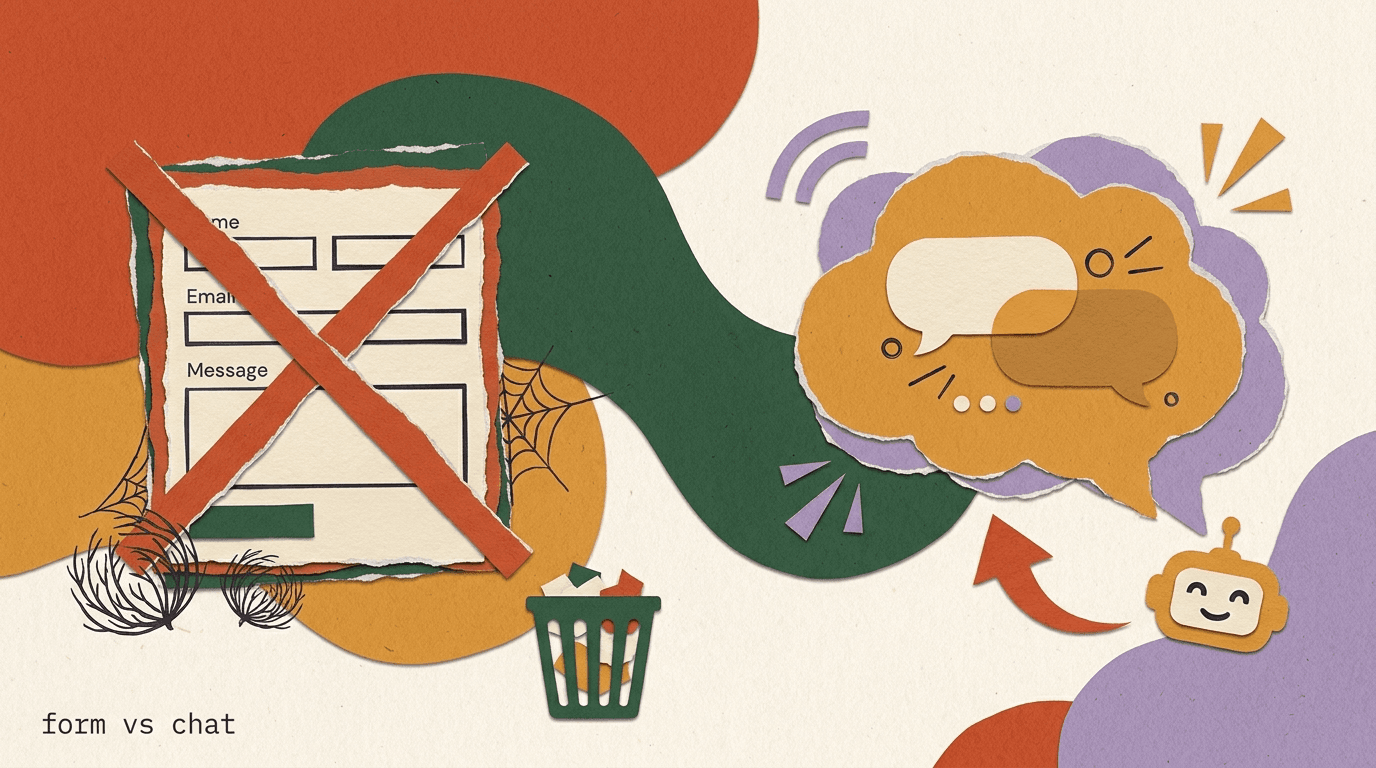
It helps to put the two side by side on the dimensions that matter, because the form vs chat comparison is not close on the things buyers care about. A form wins on a couple of narrow attributes — it is structured and it is quiet — and loses on nearly everything about the human experience.
The table below is deliberately blunt. It is not that a form does everything badly; it is that the things a form does well are increasingly the things that matter least for a first sales contact, and the things chat does well are the things that decide whether a stranger becomes a customer.
| Dimension | Static contact form | Chat / DM |
|---|---|---|
| Speed to first reply | Hours to days | Seconds to minutes |
| Feels like | Filling out paperwork | Talking to a person |
| Follow-up questions | Impossible in the moment | Natural and immediate |
| Qualification | Front-loaded, adds friction | Gathered mid-conversation, low friction |
| Recovering a drop-off | No mechanism | Can re-engage in-thread |
| Structured data capture | Strong | Weaker without extra tooling |
| Spam resistance | Good with basic protection | Varies by channel |
| Best for | Records, applications, structured intake | First contact, sales questions, support |
Read the table as a job-fit map
The point is not that chat wins every row. It is that chat wins the rows that decide a sale and the form wins the rows that suit a filing cabinet. Match the tool to the job and most first-contact use cases point at conversation.
What is actually replacing the contact form?
If the form is dying, something is inheriting its job, and it is not one single thing. The replacement is a family of conversational surfaces that all share one trait: a message goes out and a response comes back quickly, in a thread, like a conversation between people. In practice that means three overlapping options.
The first is website chat — a widget in the corner of the page that opens a thread instead of a form. This is the most direct substitute because it lives exactly where the form lived and answers the same visitors, only faster. The second is social direct messages — Instagram, Facebook Messenger, TikTok, and X — where the customer reaches you on a platform they already live in, and the whole exchange feels native to how they already talk to everyone else. The third is WhatsApp and similar messaging apps, which combine the reach of social with the intimacy of a private thread and, in many markets, are simply where business conversations now happen.
What ties these together is not the channel but the shape of the interaction. In every case the person sends a message and gets a reply in the same place, in the same session, without the ceremony of a submit-and-wait. The reply might come from a human, from automation, or from a handoff between the two, and the customer largely does not care which as long as it is fast and useful. That is the contact form alternative in one sentence: a two-way thread that answers now instead of a one-way form that promises later.
It is worth being clear-eyed about which of these is our lane, because it shapes the advice honestly. KlyoChat is built for social DM and WhatsApp — the second and third options above — rather than being primarily a website chat widget. So when we talk about the shift from form to conversation, the version we are best at is moving first contact off your site and onto the messaging channels your audience already uses. A website widget is a valid contact form alternative too; it is simply not the part of the map we occupy, and we would rather say that than pretend otherwise.
- Website chat: a widget that replaces the form in place, answering the same page visitors faster.
- Social DM: Instagram, Messenger, TikTok, and X threads where customers already spend their attention.
- WhatsApp and messaging apps: private, high-trust threads that in many regions are the default for business.
- Common thread: a two-way conversation that answers now, not a one-way submission that answers later.
Why does an instant reply beat we will get back to you?
The phrase we will get back to you is the epitaph of the contact form, and it is worth dwelling on why it fails so badly. It fails because it moves the burden of patience onto the person with the least reason to be patient: a stranger who is not yet committed to you and has other options one tab away.
An instant reply does the opposite. It rewards the person for reaching out at the exact moment they reached out. That reward can be small — an acknowledgment, an answer to the obvious question, a next step — but its timing is everything. It keeps the conversation alive while the intent is hot, and a live conversation is a thing you can actually work with. You can answer, clarify, reassure, and guide. A form submission sitting in a queue is a thing you can only react to later, when the moment has passed.
There is also a trust effect that is easy to underrate. When a business answers immediately, it signals competence and respect before a single claim is made about the product. Speed is a proxy for care. A stranger who gets a fast, useful reply infers, reasonably, that this is a business that will also be fast and useful after the sale. A form that answers tomorrow signals the reverse, no matter how good the eventual reply is. The medium delivers a message about your business before the content does.
This is why we frame chat as a better default rather than a fancier form. The value is not the widget or the app. The value is closing the gap between when a person wants an answer and when they get one. Every hour you can shave off that gap is worth more than almost any copy tweak or design polish you could make to a form that still, at the end of the day, tells people to wait.
Instant with nothing behind it is worse than slow
A fast auto-reply that cannot actually help, and then a long silence, is more frustrating than an honest form. If you promise instant, deliver something useful instantly — an answer, a next step, or a clear handoff. Speed without substance breaks trust faster than the form ever did.
When do contact forms still make sense?
An honest opinion piece has to draw the line where its own argument stops. Forms are not dying everywhere, and there are jobs where a form is still the right tool — sometimes clearly better than chat. Pretending otherwise would make the whole case weaker, not stronger.
Forms win when the interaction is inherently structured and asynchronous. A job application is a form because it needs specific fields in a specific shape for later comparison, and nobody expects a live conversation to fill a role. A detailed support intake that needs an order number, a device model, and a screenshot is often better as a form, because the structure is the point. A booking that requires a date, a party size, and dietary notes is a form because those are discrete data, not a discussion. Any time you genuinely need clean, comparable, structured records more than you need a fast reply, the form is doing real work.
Forms also make sense when speed is not the bottleneck. Some inquiries are genuinely not urgent — a partnership proposal, a press request, a careers question. The person sending them does not expect an instant answer and would not benefit from one. Forcing those into a chat window can even feel odd, like being pounced on for something you meant to leave and forget. And forms remain useful as a fallback for after-hours or overflow, a quiet channel for people who would rather not chat at all. Some visitors simply prefer a form, and respecting that preference is part of good service.
The mistake is not keeping forms. The mistake is keeping them as the default for the one job they are worst at — first contact with a warm lead who has a buying question and expects an answer now. Move that job to conversation, and leave the form to the structured, patient, records-keeping work it was always good at.
| Situation | Better tool | Why |
|---|---|---|
| Warm lead with a sales question | Chat / DM | Intent is hot and perishable; speed wins the deal |
| Job application | Form | Needs structured, comparable fields for later review |
| Detailed technical support intake | Form | Order numbers, models, and screenshots are structured data |
| Reservation or booking with fixed fields | Form | Discrete data, not a discussion |
| Non-urgent partnership or press request | Form | No speed advantage; asynchronous is fine |
| Simple pre-sale question | Chat / DM | One fast answer converts; a form adds needless delay |
How do you transition from a form to chat without breaking things?
Killing the form is not a switch you flip. Done carelessly, it trades a slow-but-reliable channel for a fast-but-unstaffed one, and that can be worse. Done in steps, it is low-risk and reversible at every stage. Here is a sequence that lets you test the change before you commit to it.
The goal of this sequence is to prove that conversation outperforms the form for your audience before you remove the safety net. You are not making a leap of faith; you are running a comparison and letting the results decide. If chat wins, you shrink the form. If it does not, you have lost nothing and learned something.
- Add a conversational option beside the form, not instead of itPut a chat or DM path next to your existing form on the same page. Change nothing else yet. You want a clean A-versus-B where visitors can choose, so you can watch which they actually pick.
- Make sure the fast path is genuinely fastBefore you promote chat, make certain a message gets a useful reply in seconds — via a person on shift, an automated first response, or a handoff between them. An unstaffed chat widget is worse than an honest form, so earn the speed before you advertise it.
- Route the conversations into one placeDo not scatter DMs across five apps and a widget. Pull every channel into a single inbox so nothing is missed and response time stays low. Fragmentation is the quiet way conversational contact fails.
- Measure the two paths honestlyCompare completion and outcomes: how many people start each path, how many get a reply, how many convert. Give it enough volume to be real. Let the numbers, not the theory, tell you whether chat is winning.
- Shrink the form to the jobs it still deservesOnce chat clearly wins for first contact, demote the form to the structured, patient tasks from the previous section. You are not deleting it — you are retiring it from a job it was losing.
Never remove the safety net before the replacement is proven
The one way this goes wrong is deleting the form on day one and hoping chat picks up the slack. Run them side by side, prove the fast path works and is staffed, and only then narrow the form. Reversible beats bold here.
What about spam, qualification, and the data the form used to capture?
The honest objections to dropping a form are not about speed. They are about the three quiet jobs a form did well: it kept out spam, it qualified leads with required fields, and it captured clean structured data. Any serious move to chat has to answer for all three, or it is just trading one set of problems for another.
On spam, the picture is genuinely mixed and worth stating plainly. A well-protected form with basic bot defenses is quite good at filtering junk. Chat channels vary — a public website widget can attract noise, while an authenticated social DM or a WhatsApp thread tends to come from a real account with a real profile attached, which raises the cost of spamming. So chat is not automatically better or worse on spam; it depends on the channel. Native platform tools help here, and the platforms themselves publish guidance on managing unwanted contact and blocking abusive accounts. It is a solvable problem, not a reason to keep the form by default.
On qualification, chat is usually better once you stop thinking of qualification as a wall and start thinking of it as a conversation. A form qualifies by demanding answers before it gives anything, which sheds people. Chat qualifies by asking the same questions after the person is already engaged, when they are far more willing to answer. You still learn the budget, the timeline, and the use case — you just learn them in a thread that feels like help rather than an interrogation that feels like a gate. The information is the same; the friction is lower.
On structured data, the form has a real edge, and this is where it keeps a permanent role. If your workflow depends on clean, comparable fields — a CRM that needs a company size, a support system that needs a category — a free-form chat is messier to file. The pragmatic answer is not to choose one forever. It is to open with conversation, capture the structured pieces mid-thread or with a light in-chat form when you truly need them, and reserve the full field-heavy form for the structured jobs where it belongs. You get the speed of chat and the structure of a form, applied where each actually helps.
If you are worried about losing the clean data the form gave you, here is a short sequence that keeps it without reintroducing the friction. The idea is to gather the same fields, just later in the conversation and only when they earn their place.
- List the fields you actually useWrite down every field your form collects, then cross off the ones no one has looked at in six months. Most forms carry dead fields nobody misses. Keep only what a real workflow consumes.
- Ask for each surviving field mid-conversationFold the remaining questions into the thread after the person is engaged — budget, timeline, use case — one at a time, as a natural part of helping. Answered willingly beats required and abandoned.
- Push the structured pieces into your systemTag or route the captured details into your CRM or support tool from the inbox, so the data lands as clean as a form submission without the front-loaded friction that cost you the lead.
Qualifying a lead: form vs chat
- Form
- Six required fields up front; a third of visitors abandon before submitting anything
- Chat
- One question answered fast, then budget and timeline gathered naturally two messages in — with the lead already warm
How do social DMs and WhatsApp change the picture?
So far the argument has treated all conversation as roughly equal, but there is a meaningful split between a website chat widget and a social or WhatsApp thread, and it matters for where you focus. This is also where we are honest about our own lane.
A website widget answers people who are already on your site. That is valuable, but it is a narrow window — it only works while the visitor is on the page, and the conversation lives in your tool rather than in a place the customer will return to. Social DMs and WhatsApp are different. They meet the customer where they already spend hours a day, in an app they already trust, and the thread persists. When the customer thinks of you again next week, the conversation is right there in their message list, not gone with a closed browser tab. That persistence turns a single contact into an ongoing relationship, which a form never could and a website widget only partly can.
There is also a reach argument. A large share of your potential customers discover you not on your website at all, but on a social feed, a Reel, an ad, or a shared post. Making them click through to a site and find a form or a widget adds a step and loses people. Letting them reply where they already are — a comment that becomes a DM, a message on Instagram or WhatsApp — removes that step entirely. The platforms are built for exactly this kind of business messaging, and their own Messenger platform documentation describes how business DMs are meant to be used for customer conversations at scale.
This is the honest framing of where KlyoChat sits. We are not primarily a website chat widget, and we would rather tell you that than oversell. We are built for the social DM and WhatsApp side of the contact form alternative — the version where first contact happens on the channels your audience already uses, not on a widget bolted to your homepage. If your entire audience lives on your website and never touches social, a widget-first tool may fit you better, and that is fine. If your audience is on Instagram, WhatsApp, TikTok, and Messenger, that is the shift we are built for.
Where we fit, stated plainly
KlyoChat focuses on social DM and WhatsApp, not website widgets, and it does not do native SMS or email. If your first contact happens on social and messaging apps, that is our lane. If it happens purely on your own site, a dedicated widget tool may serve you better. We would rather you pick the right tool than the flattering one.
What mistakes do teams make when they kill the form?
Plenty of teams reach the same conclusion this article does — the form has to go — and then botch the execution. The idea is right and the rollout is wrong, which discredits the whole change. A few failure modes show up again and again, and they are all avoidable.
The first and biggest is going fast without being staffed. A chat widget or a DM channel that promises a quick reply and then leaves people waiting is worse than the form it replaced, because it raised the expectation and then failed it. Speed is a promise. If you cannot keep it with people, automation, or a handoff between them, do not make it yet. The fix is to earn the response time before you advertise it, not after.
The second is fragmentation. Teams switch on Instagram DMs, then Messenger, then WhatsApp, then a website widget, and suddenly conversations are scattered across four apps and three team members, with no one sure who owns what. Response times climb, messages get missed, and the fast channel becomes the slow one. The whole advantage of conversation collapses if the conversations are not in one place. This is exactly the problem a unified inbox exists to solve — one queue for every channel so nothing slips and speed holds.
The third is losing the structured data without a plan to replace it, then discovering the sales team has no idea which leads are which. If your process depended on form fields, decide up front how you will capture the equivalents in a conversation before you turn the form off. The fourth is treating automation as a wall instead of a bridge — bots that trap people in loops with no way to reach a human. Automation should answer the easy questions and then hand off cleanly, which is the whole point of good AI agents: fast first response, honest handoff, no dead ends.
- Promising speed you cannot staff — the fastest way to make chat worse than a form.
- Scattering channels across apps until response time quietly climbs back up.
- Dropping structured capture with no plan for the data the form used to collect.
- Building automation that traps people instead of answering and handing off.
How does KlyoChat fit into the shift away from forms?
We have kept our own product to the margins on purpose, because this is an argument about forms and conversation, not a pitch. But since the whole piece points toward moving first contact into messaging, it is fair to say plainly where KlyoChat fits and, just as important, where it does not.
KlyoChat is an AI-native unified inbox for social DM and WhatsApp. It pulls Instagram, Facebook Messenger, WhatsApp, TikTok, Telegram, and X into one queue, so the fragmentation failure mode above does not happen — every conversation lands in one place with one response-time clock. On top of that inbox, AI agents can deliver an instant first response, which is the exact thing a form cannot do: answer the obvious question in seconds, gather qualification in the flow of a conversation, and hand off to a person when the question needs one. That is the shift from we will get back to you to here is your answer, applied to the channels your audience already lives on.
The honest limits matter as much as the features. KlyoChat is not primarily a website chat widget — if your entire strategy is a corner-of-the-page widget on your own domain, we are not the closest fit. It does not do native SMS or email, so if those are core to how you reach people, factor that in. And we are a newer, smaller community than the incumbents, which is a real trade-off in templates and third-party integrations even as it means a more focused product. We would rather you weigh those honestly than discover them later.
On pricing, so the soft mention is concrete and not vague: KlyoChat Pro is $49 per month, or $39 per month billed yearly, and every plan starts with a 7-day free trial that does not ask for a credit card. That is enough to test the whole idea — move first contact off a form and onto a fast conversation — without committing anything. If you want the wider strategic context for this shift, our piece on conversational marketing in 2026 covers the demand side, and our take on conversational support and CX covers what happens after the first reply.
First contact, two worlds
- Form world
- Visitor fills six fields, waits a day, gets a templated reply, has already moved on
- KlyoChat world
- Customer DMs on Instagram or WhatsApp, an AI agent answers in seconds, a person takes over to close — all in one inbox
What is the bigger shift the dying form is part of?
The contact form is not dying in isolation. It is one visible casualty of a broader change in how people expect to interact with businesses, and seeing the form as part of that larger pattern makes the decision to move easier to reason about.
For most of the web's history, the relationship between a business and a stranger was transactional and one-directional: you broadcast, they submitted, you replied on your schedule. The form is the perfect artifact of that era — a controlled intake on the business's terms. What is replacing it is a conversational model where the relationship is two-way and continuous, conducted in the channels people already use to talk to everyone else in their lives. The form did not lose to a better form. It lost to conversation itself becoming the interface.
That is why the fixes people reach for first — a shorter form, a nicer thank-you page, a faster auto-responder — feel like polishing something that is fundamentally the wrong shape. They treat a structural change as a cosmetic one. You can make a form less bad, and you probably should while you still run one, but you cannot make a one-way submission feel like a two-way conversation, because it is not one. The ceiling on a form is set by its shape, and its shape is the problem.
So the practical takeaway is not fix your form. It is decide, job by job, whether the job wants a conversation or a record. First contact with a warm lead wants a conversation, and the sooner you route that job to chat and DM, the sooner you stop losing perishable intent to a channel that answers tomorrow. The form keeps the structured, patient work it was always good at. Everything else is moving to the thread, and it is moving whether or not any single business moves with it. The only real choice is whether you lead the shift or arrive late to it.
Stop asking how to fix the form
The better question is which jobs deserve a conversation and which deserve a record. Sort your contact points that way, route the conversational ones to chat and DM, and let the form keep only the structured, unhurried work. That single reframing settles most of the decision.
The case against the contact form is not that it was ever bad. It is that it was built for a slower, more patient web, and it is now judged against an expectation of instant, conversational replies that it cannot meet. Slow, impersonal, and leaky at every step, the static form is losing its default status as the way strangers reach a business with a buying question — and the contact form alternative that is winning is simply a fast, two-way conversation on the channels people already use.
Be pragmatic about it. Keep forms for the structured, patient, records-keeping jobs they still do best — applications, detailed intake, bookings, non-urgent requests. Move first contact with warm leads to chat and DM, prove the fast path works before you remove the safety net, and keep every channel in one place so speed holds. If your audience lives on social and messaging apps, that is the version of this shift we build for. Start with the conversations that are perishable, and let the numbers, not the nostalgia for the form, decide the rest.