Conversational support is the practice of helping customers through real-time, back-and-forth messaging — on WhatsApp, Instagram, Messenger, Telegram, or live chat — instead of through ticket forms and slow email queues. For years this was treated purely as a cost center: a thing you funded to stop customers from leaving, measured by how cheaply you could close tickets. That framing is incomplete. The same conversation that resolves a problem is also the single highest-intent moment a customer will ever give you, and most companies waste it.
This article makes the case that conversational support, done with discipline, is one of the most underrated growth channels a business has. Not because you turn every chat into a sales pitch — that is the fastest way to destroy trust — but because faster resolution drives retention, because context-rich threads make the rare upsell feel like help, and because the same inbox that answers questions can also reach out before a problem starts. We will walk through the strategy, the practical moves, the metrics, and the honest limits.
Full disclosure up front: we build KlyoChat, an AI-native unified inbox that combines support and marketing. So we have a point of view, and we are not neutral about whether these two functions belong in one place. We have kept the advice tool-agnostic until the end, where we describe how KlyoChat approaches the problem and where it falls short. Everything before that section applies whether you use our product or someone else's.
What is conversational support, and how is it different from a ticket queue?
A traditional ticket queue is asynchronous and transactional. A customer fills out a form or sends an email, it lands in a system, an agent picks it up hours or days later, replies, and the thread is marked resolved. Each touch is a discrete transaction. The customer waits, the context is thin, and the relationship is essentially adversarial: the company wants to close the ticket, the customer wants their problem gone.
Conversational support is synchronous, or close to it, and it is continuous. The customer messages on a channel they already use to talk to friends. The reply comes in seconds or minutes, not days. The whole history lives in one thread, so nobody asks the customer to repeat their order number for the third time. And because the channel is the same one where the customer first discovered, browsed, or bought, the conversation is not isolated from the rest of the relationship — it is part of it.
That continuity is the whole point. When support lives in the same place as discovery and purchase, you stop treating a question as an interruption and start treating it as a touchpoint in an ongoing relationship. The difference is not cosmetic. It changes what is possible.
It also changes who in the company can act on what the customer says. In a ticket queue, the customer's words are trapped in a closed ticket that nobody reopens. In a conversational thread, the same insight — they wanted a size you do not stock, they were confused by a step, they almost bought but hesitated — is sitting in plain view, ready to inform the next reply, the next product decision, or the next proactive message. The conversation becomes a source of intelligence, not just a task to clear.
| Dimension | Ticket queue | Conversational support |
|---|---|---|
| Timing | Asynchronous, hours to days | Real-time or near-real-time |
| Channel | Email, web form | WhatsApp, Instagram, Messenger, chat |
| Context | Reset each ticket | One continuous thread |
| Customer effort | High — repeat details | Low — history is there |
| Relationship | Transactional, close-the-ticket | Continuous, ongoing |
| Growth potential | Largely untapped | High — intent and context align |
Conversational does not mean instant for everything
Conversational support is real-time when it can be and respectfully asynchronous when it cannot. The customer messages whenever they like; you reply fast for simple things and set clear expectations for the rest. The unifying trait is the continuous thread, not a promise of zero wait.
Why should support be treated as a growth channel at all?
The instinct to keep support and growth separate is understandable. Support is judged on cost and resolution; growth is judged on revenue. Putting them together feels like mixing concerns. But the separation is an artifact of old tooling, not a law of customer behavior. From the customer's side there is only one relationship with your brand, and they do not experience your org chart.
Consider where growth actually comes from. New revenue is a slice of it, but the larger, cheaper, more durable slice is retention and expansion: customers who stay, who buy again, who upgrade, who tell other people. Every one of those outcomes is shaped by how the customer feels about you, and nothing shapes that feeling more directly than what happens the moment they need help. A great support interaction is a retention event. A bad one is a churn event. Support is already moving your growth numbers — the only question is in which direction.
So treating support as a growth channel is not about bolting sales onto service. It is about recognizing that service already determines whether customers stay and spend, and then being deliberate about it: resolving faster so they stay, capturing the context that makes the next purchase relevant, and reaching out proactively so small problems do not become cancellations. The revenue follows the trust, never the other way around.
Two ways to handle the same return request
- Cost-center mindset
- Process the return, close the ticket, move on. Customer leaves satisfied but neutral.
- Growth mindset
- Process the return fast, ask why, learn the size ran small, note it on the profile, suggest the size that fits. Customer reorders.
How does faster resolution actually drive retention and revenue?
The link between resolution speed and retention is one of the most consistent findings in customer experience research, and it matches intuition. When a customer hits a problem, they are in a moment of doubt about your brand. The longer that doubt sits unresolved, the more it hardens into a decision to leave. Speed does not just fix the problem — it shortens the window in which the customer is reconsidering you.
Conversational channels compress that window dramatically. An email round-trip that used to take a day collapses into a two-minute exchange. A question that would have generated a support ticket gets answered before the customer even thinks of it as a complaint. And critically, the customer never has to leave the place they were already in — no portal login, no ticket number, no waiting for an autoresponder. Lower effort and higher speed compound.
There is a revenue mechanism hiding inside the retention number. A customer who gets a fast, clean answer to a pre-purchase question buys at a higher rate than one who is left guessing. A customer whose post-purchase issue is handled well returns at a higher rate than one who is left frustrated. You do not have to sell anything in either conversation for the revenue to move — you just have to remove the friction that was suppressing it.
- Speed shortens the reconsideration window, so fewer doubts harden into churn.
- Lower customer effort (no portal, no ticket number) raises satisfaction independent of speed.
- Fast pre-purchase answers lift conversion without any explicit selling.
- Clean post-purchase handling lifts repeat-purchase rate.
- Each well-handled issue compounds into reputation, reviews, and referrals.
Measure first response and full resolution separately
A fast first reply that does not resolve anything is theater. Track first response time and time to resolution as distinct numbers. The retention gains come from resolution speed; the trust gains come from quick acknowledgment. You want both, and conflating them hides which one is failing.
What does upsell-in-context look like without being pushy?
This is the part most teams get wrong, so it deserves care. Upsell-in-context means making a relevant suggestion at a moment when it genuinely helps the customer, inside a conversation that is already solving their problem. It is the difference between a waiter who notices your glass is empty and offers a refill, and a waiter who interrupts every bite to push the dessert menu. The first is service. The second is selling. Customers can tell the difference instantly.
The mechanics are simple but the judgment is everything. The suggestion has to be relevant to what the customer is actually doing, it has to come after their original problem is resolved, and it has to be easy to decline without friction or follow-up pressure. If any of those three conditions is missing, you are not doing upsell-in-context, you are doing a pitch, and you should not do it.
When the conditions are met, the suggestion does not feel like a sale because it is solving a real need the customer just revealed. A customer asking whether a product is compatible with their setup is telling you they are trying to make something work — recommending the part that completes it is help. A customer asking how to get more out of a feature they already use is telling you they want more capability — pointing them to the plan that includes it is help. The intent came from them. You are just responding to it.
The original problem comes first, always
Never lead with a suggestion while the customer's issue is still open. Resolve the thing they came for, confirm they are satisfied, and only then — if it is genuinely relevant — offer the next step. Selling on top of an unresolved problem reads as exploitation, and it is.
Upsell-in-context vs a pitch, same scenario
- Pitch (do not)
- Customer asks about shipping. Agent replies with shipping info plus 'By the way, have you seen our premium bundle? 20% off this week!'
- In-context (do)
- Customer asks if the starter kit includes the carrying case. Agent: 'It does not, but the travel bundle includes the same kit plus the case for a few dollars more — want that instead?'
When is the right moment to make a suggestion in a support chat?
Timing is the variable that separates helpful from annoying, and it is more teachable than people assume. There are a handful of moments where a suggestion lands as service, and a much larger number where it lands as an interruption. Train your team and your automations to recognize the good moments and to stay silent everywhere else.
The reliable green-light moments share a trait: the customer has just expressed a need, a goal, or a constraint that your suggestion directly addresses, and their original reason for messaging is already handled. The reliable red-light moments also share a trait: the customer is frustrated, mid-problem, or has given no signal of wanting more. When in doubt, say nothing. A missed upsell costs you a few dollars; a mistimed one costs you the relationship.
| Moment | Green or red light | Why |
|---|---|---|
| Issue just resolved, customer happy | Green | Goodwill is high, problem is closed |
| Customer asks about a related capability | Green | Intent came from them |
| Customer hits a limit on their current plan | Green | The need is concrete and current |
| Customer is mid-complaint | Red | Selling now reads as tone-deaf |
| No signal of wanting more | Red | Unprompted pitch erodes trust |
| Refund or cancellation in progress | Red | Wrong moment; save the relationship first |
Build the timing into your playbook, not just your hopes
Write down the green-light moments as explicit triggers — 'after resolution and a positive reply,' 'when the customer names a goal we have a fit for.' Then make 'no suggestion' the default everywhere else. Discipline here is what keeps the channel trusted enough to be worth anything.
What is proactive support, and how does it prevent churn?
Most support is reactive: the customer has a problem, they reach out, you respond. Proactive support flips the order. You reach out before the customer has to, because you can see a problem forming — a payment about to fail, an order delayed, a feature being used in a way that suggests confusion, a renewal approaching for an account that has gone quiet. The message arrives as a courtesy, not a complaint, and that changes the entire emotional tenor of the interaction.
Proactive support is the most direct churn-prevention tool conversational channels offer, because so much churn is silent. Customers rarely send an angry message before they leave — they just stop. A failed payment they did not notice, an onboarding step they got stuck on, a question they never bothered to ask: these become quiet cancellations. A timely, well-judged proactive message intercepts the problem while it is still fixable and while the customer still feels good about you.
The same caution applies as with upselling, maybe more so. Proactive does not mean constant. A proactive message has to be genuinely useful to the customer, not a thinly disguised marketing blast. 'Your order shipped and here is the tracking' is proactive support. 'Have you seen our new collection' sent to everyone is marketing, and dressing it up as support is exactly the kind of thing that gets a channel muted or blocked.
- Order and delivery updates before the customer wonders where their thing is.
- Payment-failure notices with a one-tap fix, before the account lapses.
- Onboarding nudges when usage data shows someone is stuck.
- Renewal check-ins for quiet accounts, framed as a question, not a sale.
- Outage or delay heads-up, owning the problem before they discover it.
Respect consent and channel rules on proactive outreach
Proactive messaging on channels like WhatsApp runs under platform rules and opt-in requirements, and metered conversation fees may apply. Get clear consent, keep proactive messages genuinely useful, and honor opt-outs immediately. A proactive program that ignores consent is not support — it is spam with extra steps, and it will be treated as such.
Why does unifying support and marketing in one inbox matter?
Here is the structural problem with treating support and marketing as separate systems: the customer is one person, but you see them as two unrelated records. Your support tool knows they had a shipping issue last week. Your marketing tool knows nothing about it and cheerfully sends them a promotion the next day. The customer experiences this as a company that does not pay attention, because it is one.
A unified inbox — where support conversations and marketing outreach share the same customer record, the same channel connections, and the same history — fixes this at the root. The agent answering a question can see the customer is a long-time subscriber. The proactive message about a renewal can be suppressed if the customer is mid-complaint. The upsell suggestion can be informed by what the customer actually owns. Context that was trapped in separate systems becomes available where decisions get made.
Unification also fixes a quieter problem: handoffs. When support and marketing live apart, moving a customer from one to the other means losing context, re-explaining, and friction. When they share an inbox, a conversation can move from an AI agent to a human, or from a service question to a relevant offer, without anyone starting over. The customer never feels the seam because there is not one.
| Capability | Separate systems | Unified inbox |
|---|---|---|
| Customer record | Split across tools | One shared profile |
| Context at point of contact | Partial, siloed | Full history visible |
| Avoiding tone-deaf outreach | Hard to coordinate | Suppress based on live status |
| AI-to-human handoff | Lossy, re-explain | Smooth, full context carries |
| Reporting | Two dashboards | One view of the relationship |
What unification prevents
- Siloed systems
- Customer complains about a late order Monday; gets a cheerful 'shop our sale!' blast Tuesday.
- Unified inbox
- Marketing outreach is automatically held while the complaint is open, then resumes once resolved.
Where do AI agents fit in conversational support?
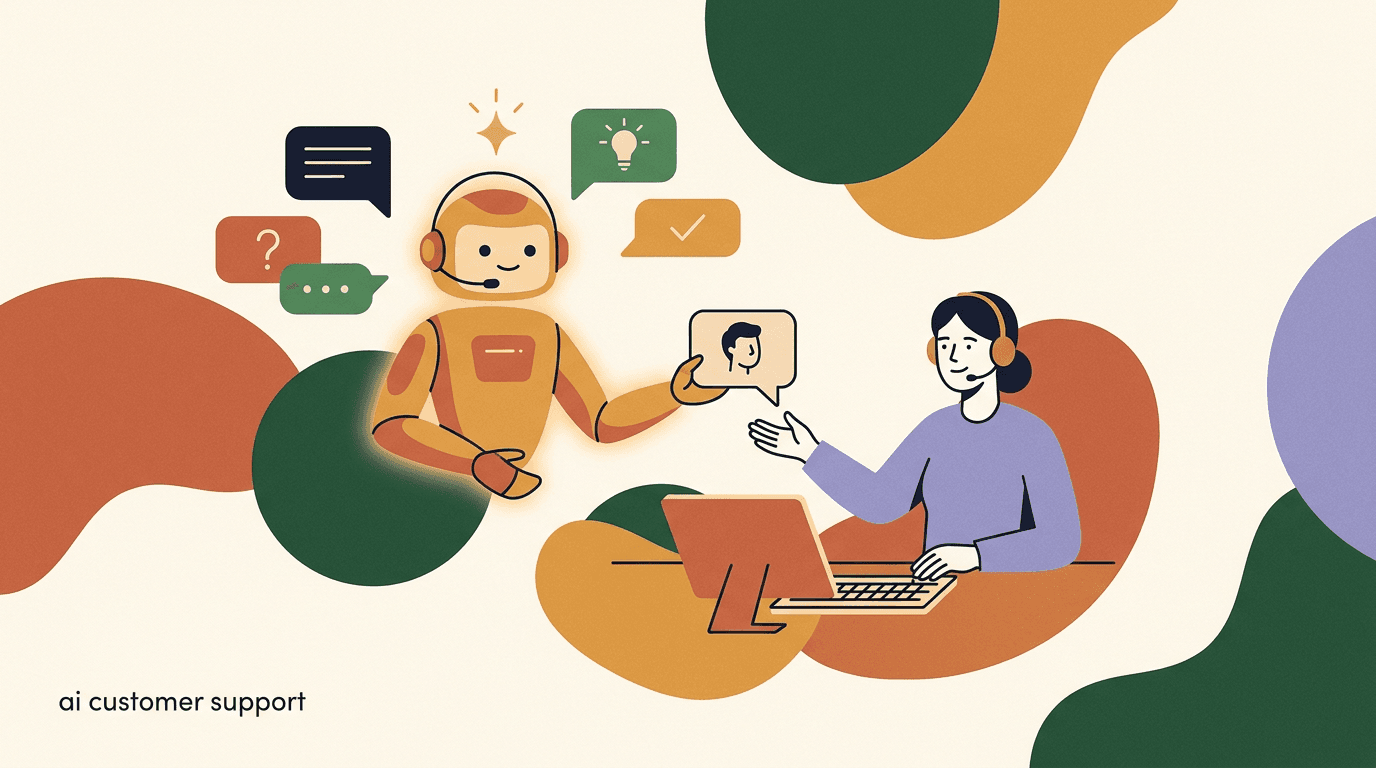
AI agents are what make conversational support viable at scale without ballooning headcount. The reason is simple: a large share of support volume is repetitive. Where is my order, how do I reset my password, what is your return policy, is this in stock. These questions do not need a human; they need a fast, accurate answer, and an AI agent trained on your knowledge base can give one instantly, around the clock, in the customer's language.
The value is not just deflection. When an AI agent handles the routine volume, your human team is freed for the conversations that actually require judgment — the upset customer, the complex edge case, the high-value account, the moment where a real person's empathy changes the outcome. The AI does not replace the team; it removes the drudgery that was burning the team out and making them too rushed to do the high-value work well.
The non-negotiable design principle is clean handoff. An AI agent that cannot tell when it is out of its depth, or that traps a frustrated customer in a loop, does more damage than no AI at all. The agent should resolve what it can confidently resolve, recognize when it cannot, and hand off to a human with the full conversation intact — so the customer never repeats themselves and the human picks up exactly where the AI left off.
- Let AI take first responseRoute every incoming message to an AI agent trained on your knowledge base so customers get an instant, accurate first reply at any hour.
- Resolve the routine, confidentlyThe agent handles the high-frequency, low-ambiguity questions — order status, policies, stock, basic troubleshooting — end to end.
- Detect the limitWhen confidence drops, the topic is sensitive, or the customer is frustrated, the agent recognizes it should not push further.
- Hand off with full contextPass the conversation to a human with the entire thread and customer history attached, so nobody starts from zero.
- Learn from the gapsFeed the questions the AI could not answer back into the knowledge base so the deflection rate rises over time without sacrificing quality.
A bad AI agent is worse than none
If your AI cannot escalate cleanly, you have built a wall between customers and help. Make 'talk to a human' always reachable, never bury it, and judge the AI on resolved-and-satisfied outcomes, not raw deflection. Deflection that creates frustration is churn dressed up as efficiency.
How do you measure conversational support as a growth channel?
If you want support to be taken seriously as a growth channel, you have to measure it like one — which means going beyond the classic service metrics. Resolution time, first response time, and customer satisfaction still matter; they are the foundation. But on their own they keep support in the cost-center frame. To show growth contribution, you need to connect support activity to retention and revenue outcomes.
The metrics that reframe support as growth are the ones that tie a conversation to what happened next. Did customers who got a fast resolution renew at a higher rate than those who did not? Did in-context suggestions convert, and at what rate without harming satisfaction? Did proactive outreach reduce churn in the segments that received it? These are harder to measure than ticket counts, but they are the numbers that justify investment.
A word of caution on the revenue metrics: watch satisfaction alongside conversion, never in isolation. If your in-context suggestion conversion rate climbs while satisfaction drops, you are over-selling and borrowing against future retention to hit a short-term number. The whole strategy depends on trust, so trust has to stay in the dashboard next to the dollars.
| Metric | What it tells you | Frame |
|---|---|---|
| First response time | Speed of acknowledgment | Service foundation |
| Time to resolution | Speed of actually fixing it | Service foundation |
| CSAT / satisfaction | How the interaction felt | Trust guardrail |
| AI resolution rate | Volume handled without humans | Efficiency |
| Post-resolution retention | Do helped customers stay | Growth |
| In-context conversion | Do relevant suggestions land | Growth |
| Proactive churn reduction | Does outreach prevent leaving | Growth |
Attribution will be imperfect — that is fine
You will not get a clean, marketing-grade attribution line from 'fast resolution' to 'renewal.' Use cohort comparisons instead: customers who experienced X versus those who did not. Directional evidence across cohorts is enough to justify investment, and chasing false precision wastes the effort better spent improving the experience.
How do you build a service-to-sales motion without breaking trust?
Service-to-sales is the discipline of letting genuine help create commercial outcomes, in that order, never reversed. It is not a sales tactic wearing a support costume. The entire thing rests on a single rule that every agent and every automation has to internalize: the customer's problem is the priority, and any commercial moment is secondary and conditional. Get that order wrong and you do not have a growth channel, you have a leak in your reputation.
Building the motion is less about scripts and more about defaults and permissions. The default for any support conversation is: resolve, confirm, and stop. The permission to go further is granted only by the customer's own signals — a stated goal, a question about more, a clearly relevant gap. You are not training people to find excuses to sell. You are training them to recognize the rare moments when a suggestion is genuinely the most helpful next thing, and to ignore the temptation everywhere else.
The teams that pull this off tend to share a cultural trait: they would rather miss a sale than make a customer feel handled. That sounds like it would cost revenue. In practice it is what makes the revenue durable, because a channel customers trust is one they keep using, keep responding to, and keep buying through. Trust is the asset; sales are the yield. Spend the asset and the yield stops.
It helps to think of the conversation as a bank account of goodwill. Every fast, honest, no-strings resolution makes a deposit. Every mistimed pitch, every proactive message that was really an ad, every AI loop with no way out is a withdrawal. A suggestion offered at the right moment, after a genuine resolution, is a small withdrawal the customer is happy to allow because the balance is high. Make withdrawals before you have made deposits, or make them faster than you replenish, and the account goes empty — at which point the channel stops working entirely, no matter how good your offers are. The discipline is just keeping the balance positive.
- Set the default to resolve-and-stopMake the standard close of any support chat the resolution of the original issue and a check that the customer is satisfied — nothing more.
- Define explicit permission signalsList the specific customer signals that permit a suggestion: a stated goal you fit, a question about more, a hit limit. Without one of these, no suggestion.
- Make declining frictionlessAny suggestion must be one-tap to ignore, with zero follow-up pressure. A 'no thanks' should cost the customer nothing and trigger nothing.
- Equip agents with context, not quotasGive agents the customer history that makes good suggestions possible, but do not put a sales quota on a support role — that is what corrupts the motion.
- Audit for tone driftPeriodically review transcripts for creeping pushiness. If suggestions are showing up in red-light moments, retrain before the channel loses trust.
Never put a sales quota on a support seat
The moment a support agent is measured on sales, every conversation tilts toward the pitch and the customer feels it. Keep service roles measured on service-and-satisfaction outcomes; let the commercial lift be a tracked byproduct, not a target. The structure protects the trust.
What channels should conversational support live on?
The honest answer is: wherever your customers already are, not wherever is most convenient for you. The premise of conversational support is meeting customers in the channels they use daily, which means the right mix depends on your audience and geography. For many consumer brands that is WhatsApp and Instagram; for others it is Messenger, Telegram, or a live chat widget on the site. The point is to remove the friction of switching contexts, so picking a channel your customers do not use defeats the purpose.
Channel choice also affects what is possible. Some channels are excellent for proactive outreach but governed by strict templating and consent rules. Others are great for reactive chat but weaker for outbound. Mapping each channel's strengths and constraints before you build keeps you from designing a proactive program on a channel that does not support it well, or promising real-time chat on a channel your team cannot staff.
Whatever the mix, the goal is one consolidated view across all of them. A customer who asks on Instagram today and WhatsApp next week is the same person, and your team should see one conversation history, not two disconnected ones. Fragmentation across channels recreates the exact silo problem that conversational support is supposed to solve, just along a different axis.
- Pick channels by where your customers already spend time, not internal convenience.
- Map each channel's strengths: some excel at proactive, some at reactive.
- Account for platform rules — consent, templating, and metered fees vary.
- Consolidate all channels into one history so the customer is never split.
- Staff realistically: do not promise real-time on a channel you cannot cover.
What are the most common mistakes teams make with this?
The failure modes are predictable, which is good news — predictable mistakes are avoidable ones. Almost every team that turns conversational support into a liability instead of an asset does it in one of a few recognizable ways, and most of them come down to putting the commercial goal ahead of the customer's actual need.
The cardinal sin is treating every support conversation as a sales opportunity. It poisons the channel: customers learn that reaching out invites a pitch, so they stop reaching out, or they brace for the upsell and resent it. A close second is deploying an AI agent with no clean path to a human, which traps frustrated customers and converts a fixable problem into a cancellation. The rest follow a similar logic — optimizing a number at the expense of the trust the whole strategy depends on.
- Pitching in every thread, so customers stop trusting the channel.
- AI with no human escape hatch, trapping the people who most need help.
- Proactive messaging that is really marketing in disguise, earning mutes and blocks.
- Measuring deflection instead of resolved-and-satisfied, hiding the frustration.
- Putting sales quotas on support seats, corrupting every conversation.
- Splitting the customer across channels and tools, recreating the silo problem.
The fastest way to ruin the channel is to over-monetize it
Every one of these mistakes shares a root cause: prioritizing a short-term commercial number over the customer's experience. The channel only produces growth because customers trust it. Over-monetize it and the trust evaporates, taking the growth with it. Restraint is not a soft value here — it is the mechanism.
How does KlyoChat approach support as a growth channel?
Everything above is true regardless of tooling, but the strategy is much easier to run when support and marketing genuinely share one system — which is the problem we built KlyoChat to solve. KlyoChat is an AI-native unified inbox that combines support and marketing in one place, so the context that makes in-context suggestions and well-timed proactive outreach possible is actually available where your team works.
In practice that means a few things line up. Customer conversations across your connected channels land in one team inbox with full history, so nobody re-asks for an order number. AI agents take first response and resolve the routine volume, then hand off to a human with the thread intact when judgment is needed — the clean escalation that keeps AI from becoming a wall. Broadcasts let you run proactive outreach, and analytics let you watch satisfaction next to the commercial numbers so you can tell help from over-selling. It is the unification this whole article argues for, in one product.
We want to be straight about the limits, because the strategy depends on honesty and so should we. KlyoChat does not offer native SMS or email — if those channels are central to your support mix, that is a real gap you should weigh. And we are a newer product with a smaller community than the incumbents, so you will find fewer third-party templates and tutorials. If your priority is the largest possible ecosystem rather than a unified support-plus-marketing inbox, a more established tool may fit better. We would rather you choose well than choose us.
- Support and marketing share one inbox, so outreach is never tone-deaf to an open issue.
- AI agents plus human handoff keep speed up without trapping frustrated customers.
- Every plan starts with a 7-day free trial — no credit card.
- Honest limits: no native SMS or email, and a newer, smaller community than incumbents.
| What the strategy needs | How KlyoChat does it |
|---|---|
| Support and marketing in one place | AI-native unified inbox combining both |
| Context at the point of contact | Team inbox with full conversation history |
| Routine volume handled fast | AI agents take first response |
| Clean escalation to humans | AI-to-human handoff with thread intact |
| Proactive outreach | Broadcasts to connected channels |
| Trust-aware measurement | Analytics across the relationship |
Lead with help, whatever tool you use
The product matters less than the discipline. Whether you run KlyoChat or anything else, the rule is the same: resolve first, suggest only when it genuinely helps, and treat proactive outreach as a courtesy. The tooling makes it easier; the discipline makes it work.
KlyoChat plans at a glance
- Basic
- $19/mo — small teams getting started with a unified inbox
- Pro
- $49/mo ($39 billed yearly) — AI agents, all channels, the full growth motion
- Business
- $129/mo — larger teams, higher volume, more seats
Conversational support earns its place as a growth channel not by being a clever way to sell, but by being a genuinely better way to help — fast, contextual, continuous, and present in the channels customers already use. The growth is a consequence of the trust: customers who get helped well stay longer, buy again, and respond to the rare suggestion because they know it is offered in good faith. Reverse that order, treat the channel as a sales surface, and the whole thing collapses.
If you take one thing from this, take the rule: help first, and let the commercial outcomes follow the trust rather than chasing them ahead of it. Resolve fast to keep customers. Suggest only when the customer's own signals make it relevant and the original problem is solved. Reach out proactively only when the message is a real courtesy. Do that consistently, in one inbox where support and marketing actually share context, and service quietly becomes one of the most durable growth channels you have. To go deeper, see our companion pieces on AI customer support automation, conversational marketing, and conversational commerce.