Most coaching businesses do not stall because the coaching is weak. They stall because one person can only run so many conversations in a day. You build an audience, the DMs start coming in, and within a few months the bottleneck is not lead generation — it is your calendar and your thumbs. Every interested person needs a reply, a few qualifying questions, and a booked call before they ever become a client, and all of that lands on you.
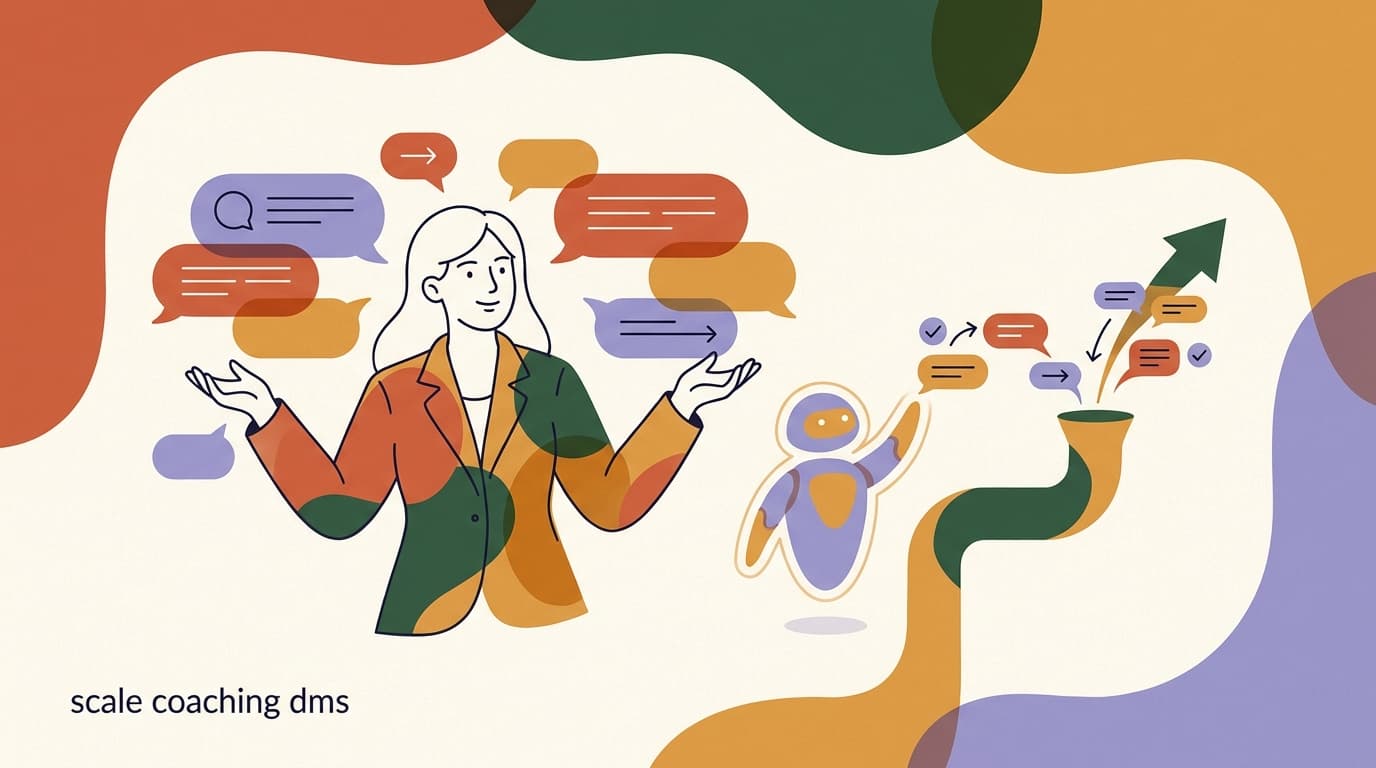
Coaching DM automation is the practice of handing the repeatable front end of that process — the first reply, the qualifying questions, the scheduling, the gentle follow-up — to an AI-assisted system, so your human hours go to the conversations that actually need a human. Done well, it raises the number of leads you can serve without raising the number of hours you work. Done badly, it spams people with a robot and burns the trust your content earned.
This guide is about doing it well. We will map the real bottleneck, show the capacity math, walk through what an AI agent should and should not handle, and be honest about the limits. One thing up front, stated plainly and repeated throughout: automation expands your capacity and consistency. It does not guarantee revenue, a client count, or an income figure. We are not going to promise you a number. We build KlyoChat, so we have a point of view, and we will tell you where the tool fits and where it does not.
Why does a coaching business hit a ceiling so fast?
The math is unforgiving. Imagine each interested DM takes you a few minutes to read, a few back-and-forth messages to qualify, and a scheduling exchange to book. Call it ten minutes of attention per genuine lead, spread across a day of interruptions. Thirty leads is five hours of DM work. That is before a single discovery call, before you deliver any coaching, and before you create the content that brought the leads in the first place.
So the ceiling is not your skill or your offer. It is the fixed number of conversations a single person can hold in a week. Coaches feel this as a specific kind of exhaustion: the inbox is full, the opportunity is real, and you are the constraint. You start replying slower. Leads who messaged at 11pm get an answer two days later, by which point their motivation has cooled. The funnel leaks at exactly the point where you are most personally involved.
The instinct is to hire — a setter, a VA, an assistant to triage DMs. That works, but it adds cost, management overhead, and the risk of an off-brand voice representing you. Before adding people, it is worth asking which parts of the conversation genuinely require you, and which parts are the same five questions answered the same five ways every single day.
There is also a compounding cost most coaches underrate: the mental load. Even when you are not actively replying, an inbox you are behind on sits in the back of your mind. You think about it during calls, you check it on weekends, you feel the low-grade guilt of leads waiting. That ambient drag quietly lowers the quality of the work you do everywhere else. A bottleneck is not only the hours it consumes; it is the attention it occupies even when you are doing something else. Solving the front end is as much about reclaiming that headspace as it is about reclaiming clock time.
Where a coach's week actually goes
- Reading and triaging DMs
- Hours, fragmented across the day, easy to fall behind on
- Asking the same qualifying questions
- Repetitive, identical for most leads, low-judgment
- Scheduling back-and-forth
- Tedious timezone and slot juggling
- The discovery call and the coaching
- High-judgment, relationship-driven, genuinely you
What exactly is coaching DM automation?
Coaching DM automation is not a single feature. It is a system that sits across your social channels and handles the predictable, repeatable steps of turning an interested stranger into a booked, qualified call. The point is not to remove the human. The point is to remove the human from the parts that do not need one, so the human shows up where they matter most.
A useful way to think about it: every inbound conversation has a front end and a back end. The front end is reception and triage — greeting, answering common questions, finding out whether this person is a fit, and getting a fit-looking person onto your calendar. The back end is the relationship — the discovery call, the diagnosis, the offer, the close, and the coaching itself. Automation belongs on the front end. You belong on the back end.
- First response: a fast, on-brand reply to every DM, comment-to-DM, or story reply, day or night.
- Qualification: a short set of questions that surface budget fit, goal, timeline, and readiness.
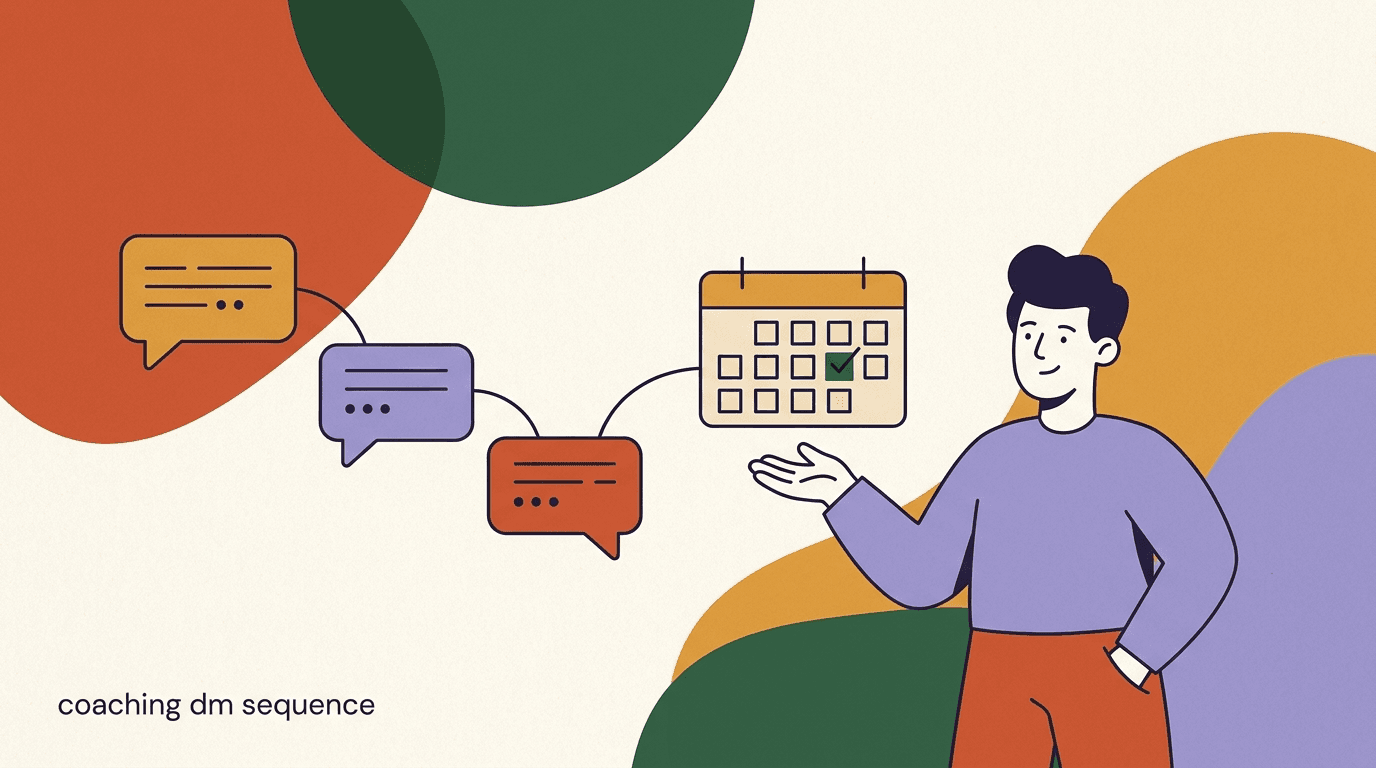
- Booking: handing a qualified lead a scheduling link or capturing a time without manual back-and-forth.
- Nurture: gentle, spaced follow-up for people who went quiet but never said no.
- Handoff: routing the genuinely human moments to you, with the context already gathered.
Automation is the front desk, not the coach
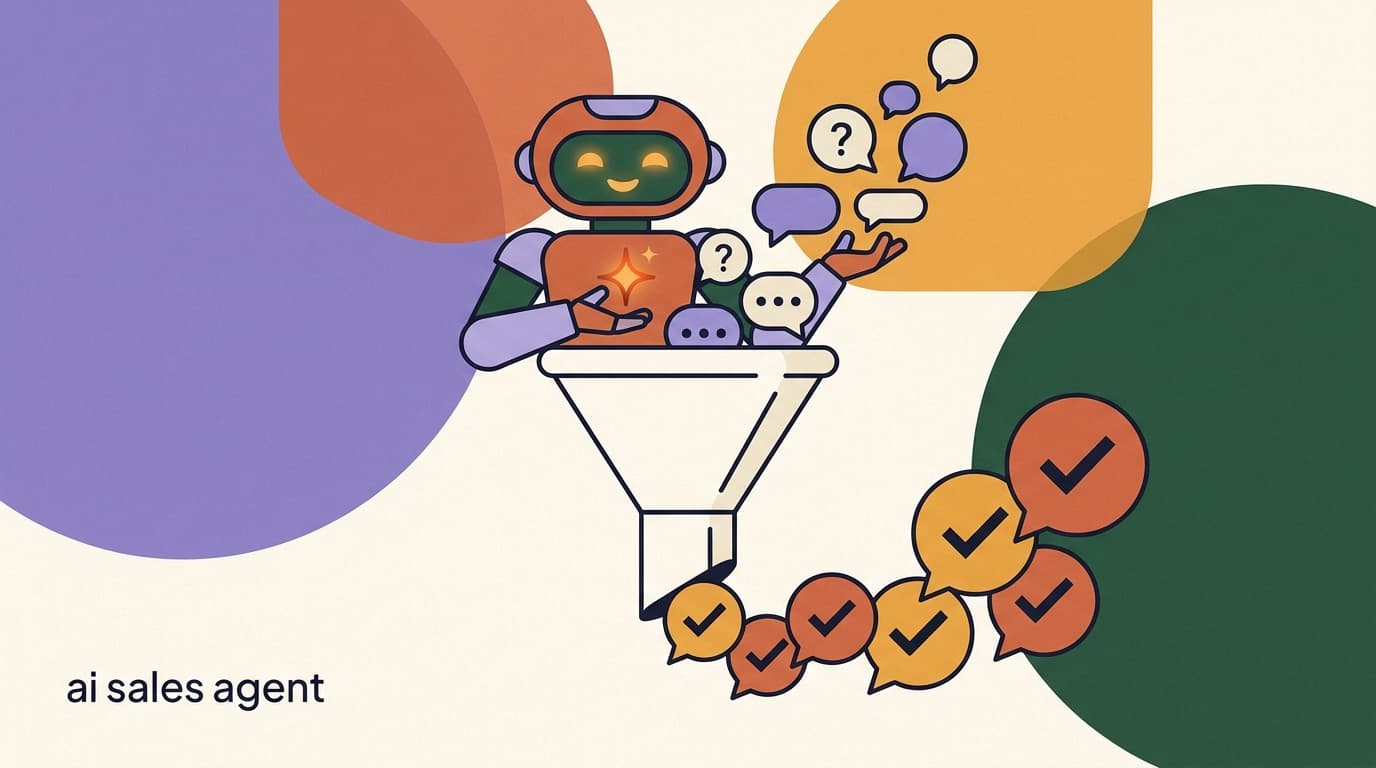
Think of the AI as a great front-desk team: it greets everyone instantly, asks the right intake questions, books the appointment, and hands you a prepared file. It does not diagnose, sell, or coach. That line is the whole strategy.
How does an AI agent qualify a coaching lead?
Qualification is the highest-leverage thing to automate, because it is where you waste the most time on people who were never going to be a fit — and where you lose good-fit people to slow replies. A well-configured AI agent runs a short, natural conversation that surfaces the few facts you need to decide whether a call is worth booking.
The agent is not guessing. You give it a knowledge base — your offer, your ideal client, your price band, your common objections, your FAQ — and a set of qualifying criteria. It conducts a conversation, not an interrogation, and scores or tags the lead based on the answers. People who clearly fit get routed to booking. People who clearly do not get a kind, honest reply and a useful resource. People in the middle get flagged for you.
Crucially, a good agent qualifies in a way that respects the person. It does not pretend to be human if asked directly, it does not hard-sell, and it knows when to stop and bring you in. The goal is a warm, accurate triage — not a high-pressure filter that alienates the audience your content worked to build.
- Define your fit criteriaWrite down the three or four things that actually predict a good client — goal, timeline, budget band, readiness to start. Vague criteria produce vague qualification.
- Load the knowledge baseGive the agent your offer details, pricing approach, FAQ, and common objections so its answers are accurate and on-brand rather than generic.
- Script the qualifying conversationTurn your criteria into a few conversational questions the agent asks naturally across a short exchange, not a form dump.
- Set the routing rulesDecide what happens at each outcome: fit goes to booking, no-fit gets a graceful exit and a resource, unsure gets handed to you.
- Review and refine weeklyRead real transcripts for the first few weeks. Tighten questions, fix any answer that felt off, and adjust thresholds based on who actually showed up to calls.
Qualify for fit, not just for a yes
An agent that books everyone is not helping you. The win is more qualified calls, which means fewer wasted hours on calls that were never going to convert. Tune your criteria so the calendar fills with people you can genuinely help.
How does automated booking actually save time?
Booking is deceptively expensive. The qualifying conversation can go perfectly, and then you lose the lead to three days of timezone ping-pong about which slot works. Every hour of delay between interest and a confirmed call lowers the odds the call happens at all. Momentum is perishable.
When the AI agent hands a qualified lead straight to a scheduling step — a link, available slots, or a captured preferred time — the gap between intent and commitment collapses from days to minutes. The lead books while they are still motivated, gets a confirmation, and you wake up to a calendar that filled itself overnight with people who already match your criteria.
There is a quieter benefit too: it removes the booking task from your plate entirely. You are no longer the scheduling assistant. That reclaimed attention goes back into content, into the calls themselves, and into the clients you already have — the work that compounds.
The booking gap, before and after
- Manual booking
- Interest at 11pm, your reply at noon, back-and-forth on slots, booked two days later if at all
- Automated booking
- Interest at 11pm, qualified and offered slots in minutes, confirmed call before you wake up
What does the capacity math look like?
This is the heart of it, so let us be careful and honest. We are talking about capacity — how many leads you can move through the front of your funnel — not income. The figures below are illustrative to show the shape of the leverage. They are not a promise about your business, your conversion rate, or your revenue.
Suppose you have a fixed amount of weekly time for DM work. Manually, every lead consumes your minutes, so your capacity is hard-capped by your hours. With the front end automated, the per-lead cost of your time drops sharply, because the agent handles reception, qualification, and booking. Your hours now concentrate on calls and coaching — the part that needs you.
| Funnel stage | Manual (your time per lead) | AI-assisted (your time per lead) |
|---|---|---|
| First response to every DM | A few minutes each, if you keep up | ~0 — agent replies instantly |
| Qualifying questions | Several minutes of back-and-forth | ~0 — agent runs the conversation |
| Scheduling the call | Tedious slot juggling | ~0 — handled at handoff |
| Discovery call + coaching | Fully yours | Fully yours |
Capacity is not revenue
Handling more leads does not mean earning more. If your offer, your calls, or your fit criteria are weak, automation just helps you reach more of the wrong people faster. Automation multiplies whatever your funnel already does — good or bad. Fix the funnel first, then scale it.
Does more capacity actually mean more clients?
Not automatically, and it is important to say so. Capacity is the number of conversations you can hold. Conversion is the rate at which those conversations become clients. Automation works directly on the first and only indirectly on the second.
Where it helps conversion is real but bounded: faster first responses tend to keep leads warm, consistent qualification means your calls are with better-fit people, and reliable follow-up recovers leads who would otherwise have slipped through silence. None of that changes the quality of your offer or how well you run a discovery call. Those remain entirely your job, and they are usually the bigger lever.
So the honest framing is this: automation removes the capacity ceiling and tightens consistency, which gives your existing conversion rate more shots on goal. If your offer converts, more qualified calls can mean more clients. If it does not, you will find that out faster. Either way, there is no income guarantee here — just a more efficient front end.
It is worth dwelling on the second-order effect, because it is the one people miss. A front end that is fast, consistent, and never overwhelmed produces a steadier flow of qualified calls — and a steadier flow is easier to improve. When your calls trickle in unpredictably and you are exhausted from inbox work before each one, you cannot tell whether a bad week was your pitch or just a quiet stretch. When the front end is reliable, you get a clean signal on the back end. You can actually see whether a change to your offer or your call script moved the needle, because the input is no longer noisy. Automation does not raise your conversion rate, but it makes your conversion rate legible enough to work on. That clarity is its own quiet form of leverage.
Two different numbers
Keep capacity and conversion separate in your head. Automation raises capacity and protects consistency. Your offer, your pricing, and your discovery call drive conversion. Confusing the two is how people end up disappointed by a tool that did exactly what it was supposed to.
What should the AI never handle in a coaching funnel?
The fastest way to damage a coaching brand with automation is to point it at the wrong part of the funnel. Some moments are the relationship, and the relationship is the product. Hand those to a bot and you erode the trust that makes coaching work at all.
Draw a hard line. The AI handles reception and logistics. You handle diagnosis, the offer, the close, and the coaching. When in doubt, the conversation goes to you.
- The discovery call: this is where you understand the person and they decide to trust you. Never automate it.
- The actual close: pricing decisions and the moment of commitment deserve a human who can read the room.
- Sensitive or emotional disclosures: if a lead opens up about something hard, the agent should hand off immediately, not respond with a script.
- Complex or unusual questions: anything outside the knowledge base should escalate to you rather than risk a wrong answer.
- The coaching itself: the delivery is the relationship. Automation supports it; it never replaces it.
Build the escape hatch first
Before you turn anything on, set the handoff rule: any signal of confusion, emotion, or genuine buying intent routes the conversation to you with the context attached. A clean handoff is what separates a helpful front desk from an annoying robot.
How do you keep automated DMs from feeling robotic?
The reason people distrust DM automation is that they have all received the bad version — the instant, irrelevant, hard-selling reply that screams bot. You avoid that not by hiding the automation but by making it genuinely useful and honest. People do not mind talking to an assistant; they mind talking to a useless or pushy one.
Tone is most of the battle. The agent should sound like your brand: same warmth, same vocabulary, same pace. It should answer the actual question asked, not deflect to a sales pitch. It should be brief, it should be helpful, and it should know its limits and say so. An agent that says, plainly, that it will bring in the coach for a specific question builds more trust than one that bluffs.
- Write the agent in your voiceFeed it real examples of how you talk in DMs. Match your warmth and phrasing so replies feel like your account, not a generic helpdesk.
- Lead with help, not the pitchThe first job of every reply is to answer the question or move the person forward. Selling comes only after genuine value and only for qualified fits.
- Keep it short and human-pacedAvoid walls of text and instant essay-length replies. Conversational, concise messages read as natural.
- Be honest about what it isIf asked, the agent should not pretend to be you. An honest assistant that books a real call with a real coach is trustworthy; a bot caught lying is not.
- Read transcripts and fix what gratesNothing reveals robotic moments like reading real conversations. Edit the responses that made you wince and the voice tightens fast.
How do you build the system step by step?
You do not need to automate everything on day one. The reliable path is to start with the single highest-volume, lowest-judgment task, get it right, and expand. Trying to build the whole funnel at once is how people end up with a brittle system they do not trust and quietly switch off.
- Start with first responseAutomate only the instant greeting and the most common FAQ answers. This alone removes a huge amount of repetitive load and earns you faster reply times.
- Add qualificationOnce first response feels right, layer in the few qualifying questions and the routing rules for fit, no-fit, and unsure.
- Connect bookingHand qualified leads straight to scheduling so the interest-to-booked gap closes. Confirm and remind automatically.
- Layer in nurtureFor leads who went quiet, add a small number of spaced, helpful follow-ups — not a barrage. Stop the moment they reply or book.
- Tighten the handoffMake sure every human-needed moment reaches you with context. This is the last piece and the most important one for trust.
Do not automate a broken funnel
If your offer is unclear or your qualifying criteria are wrong, automating it scales the problem. Get one manual conversation working end to end first, then teach the system to repeat the good version.
How should you measure whether it is working?
The wrong metric is total messages sent. The right metrics tie to capacity, consistency, and fit — and, eventually, to whether your calls and clients improved. Measure what the system is actually responsible for, and keep your conversion metrics separate so you can see what the automation did versus what your offer did.
Track the front-end numbers the automation controls, and watch them against the back-end numbers only you control. If qualified calls rise but conversion on those calls is flat, the system is doing its job and the next lever is your call or offer — not more automation.
| Metric | What it tells you | Who owns it |
|---|---|---|
| First-response time | Whether leads get answered before they cool off | Automation |
| Qualified calls booked | Front-end capacity and fit | Automation |
| No-show rate | Whether confirmations and reminders are working | Mostly automation |
| Call-to-client conversion | Whether your offer and discovery call land | You |
Watch the gap between booked and showed
A rising number of booked calls with a rising no-show rate means you are booking the wrong people or your reminders are weak. Capacity without fit is just busier disappointment. Tune qualification, not volume.
How does nurture work without becoming spam?
Most leads do not say yes on the first exchange, and they do not say no either. They go quiet. They got busy, they got distracted, the timing was not right, or they wanted to think. In a manual workflow these people simply vanish, because you do not have the hours to chase everyone who went silent. This is one of the largest, quietest leaks in a coaching funnel: warm interest that cooled only because nobody followed up.
Automated nurture closes that leak, but the line between helpful follow-up and spam is real and easy to cross. The difference is intent. Spam is a sequence that keeps poking a person to buy regardless of their signals. Good nurture is a small number of genuinely useful touches — a relevant resource, a check-in, a gentle reminder that the offer is open — spaced out and built to stop the instant the person responds or books. The follow-up should add something each time, not just repeat the ask.
The other rule is restraint. A good nurture sequence for coaching is short. Two or three thoughtful messages over a couple of weeks recover far more goodwill than a daily barrage ever will. The aim is to be the coach who stayed helpfully in touch, not the account that would not stop messaging. When in doubt, send fewer, better messages, and always honor a no the moment you get one.
- Lead with value: each follow-up should offer something, not just repeat the pitch.
- Keep it short: a few spaced touches over a couple of weeks, not a daily stream.
- Stop on signal: the sequence ends the moment the lead replies, books, or asks you to.
- Respect a no: if someone declines, thank them and leave the door open — do not keep pushing.
- Stay on-brand: nurture messages should sound like the same helpful coach the lead first met.
Spam versus nurture
- Spam
- Daily 'just checking in' and 'ready to buy yet?' messages that ignore silence
- Nurture
- A useful resource, then a check-in, then a gentle open-door note — spaced, and stopped on any reply
How do you handle multiple channels without losing your mind?
Coaching audiences rarely live on one platform. Some people find you on Instagram, some on TikTok, some message your Facebook page, and the most engaged ones drift to WhatsApp or Telegram. Each platform has its own app, its own inbox, and its own notification stream. Run them separately and you spend your day app-switching, missing messages on the channel you checked least, and giving wildly inconsistent response times depending on where someone happened to reach you.
Multi-channel reality is one of the strongest arguments for automation, because the front-end work — first response, qualification, booking — is identical no matter which platform the lead arrived on. A single AI agent applying the same logic across every channel means a person who DMs you on TikTok gets the same fast, on-brand, qualifying conversation as someone who messages your Facebook page. Consistency across channels is something a human juggling five apps almost never achieves.
A unified inbox is the practical backbone here. When every channel lands in one place, the automation can run uniformly, your follow-up does not depend on remembering which app a conversation started in, and a human takeover is one tap away regardless of source. The alternative — separate tools and separate logic per channel — multiplies both the work and the chances of dropping a lead.
- Consolidate your channelsBring every platform your audience uses into one inbox so conversations stop hiding in apps you rarely open.
- Apply one agent everywhereRun the same qualifying logic across all channels so response quality does not depend on where a lead found you.
- Standardize the handoffMake takeover identical across channels, so stepping in is the same simple action whether the lead came from TikTok or WhatsApp.
- Review channel performance togetherLook at which channels produce qualified calls so you invest your content effort where the fit leads actually come from.
One inbox beats five apps
The hidden cost of multi-channel coaching is not the messages — it is the context-switching and the leads that slip through on the app you checked last. Consolidating channels is often the single biggest quality-of-life win before you automate anything.
What are the real risks, and how do you avoid them?
Automation is not free of downside, and a guide that pretended otherwise would not be worth reading. The risks are real, but each one has a clear mitigation, and most failures come from skipping the mitigation rather than from the automation itself. Knowing the failure modes in advance is most of the protection.
The biggest risk is automating the wrong thing — pointing the AI at the relationship instead of the reception. The second is a tone that does not match your brand, which makes the whole account feel cheaper. The third is over-aggression: too many follow-ups, too hard a sell, a filter that alienates good-fit people. The fourth is neglect — building the system, walking away, and never reading what it actually says to your audience. The table below names each risk and the practical guard against it.
| Risk | What it looks like | How to avoid it |
|---|---|---|
| Automating the relationship | A bot tries to coach, diagnose, or close | Restrict the agent to reception, qualification, and booking only |
| Off-brand tone | Replies feel generic or robotic | Train the agent on your real voice and read transcripts weekly |
| Over-aggressive follow-up | Too many messages, hard selling, ignored signals | Short nurture sequences that stop on any reply |
| Neglect after setup | The system drifts and nobody notices | Schedule a recurring transcript review and metric check |
The set-and-forget trap
The most common failure is not a dramatic one — it is quietly never reading what your agent says after launch. An unchecked system slowly drifts off-brand and you only find out when a lead complains. Read real conversations on a schedule.
Should you automate before or after hiring a team?
Many growing coaches reach a fork: do you hire a setter or a virtual assistant to handle DMs, or do you automate the front end first? Both can work, and they are not mutually exclusive, but the order matters and the trade-offs are worth being clear about.
Hiring a person brings judgment, empathy, and the ability to handle the unexpected, but it also brings cost, recruiting and training time, management overhead, and the risk of an off-brand voice representing you before they learn your style. Automation brings instant, consistent, around-the-clock front-end coverage at a fixed software cost, but it cannot exercise judgment beyond its instructions and it needs a human for anything genuinely human. The strongest setups usually combine the two: automation handles reception and triage at scale, and a human steps in for the nuanced conversations and the takeovers.
A sensible sequence for most coaches is to automate the repetitive front end first, see how much human time that frees up, and only then decide whether you still need to hire — and if so, for what. Often the automation reduces the role you would have hired for to a part-time takeover-and-relationship job rather than a full-time DM-triage grind. You hire for judgment, not for volume, because the volume is handled.
Let automation define the role
Automate the front end before you write a job description. You will usually find you need a part-time human for takeovers and relationships, not a full-time person to copy-paste the same answers all day.
Two ways to add front-end capacity
- Hire first
- Adds judgment, but also cost, training time, management, and voice-consistency risk
- Automate first, then hire for judgment
- Fixed-cost, consistent triage at scale; humans added only where nuance is needed
What does a day look like once the front end runs itself?
It helps to picture the change concretely, because the benefit of automation is less about any single feature and more about how your day reshapes. The work that used to fragment your attention all day collapses into a few focused windows, and the leads keep moving even when you are not at your phone.
Overnight, while you sleep, the agent greets the people who messaged after a late-night content binge, answers their questions, qualifies them, and books the fits onto your calendar. In the morning, instead of an inbox of unanswered DMs and a guilty backlog, you have a short list of prepared, qualified calls and a handful of conversations the agent flagged for your judgment. You spend twenty focused minutes on the flagged ones and the takeovers, then go run the calls that are actually on the calendar.
Across the day, new DMs get instant, on-brand responses without interrupting your coaching. Quiet leads from last week get a gentle, useful follow-up without you remembering to send it. The repetitive scheduling exchange simply does not happen anymore. None of this guarantees the calls convert — that is still your craft — but the shape of the day changes from reactive triage to focused, high-value work. That shift in attention is the real product of coaching DM automation.
The benefit is reclaimed attention
The point is not that a machine does your job. The point is that the repetitive front-end work stops fragmenting your day, so your best attention goes to calls, clients, and content — the things that actually compound.
So far this has been platform-agnostic, because the strategy matters more than any tool. The principles — automate the front end, protect the relationship, separate capacity from conversion — hold no matter what software you run. With that said, here is honestly how KlyoChat fits, including where it does not.
How does KlyoChat support coaching DM automation?
We built KlyoChat as an AI-native, mobile-first platform for exactly this kind of work: turning social DMs into booked, qualified conversations without adding hours. It unifies Facebook, Instagram, Telegram, WhatsApp, TikTok, and X into one inbox, so every channel your audience uses lands in a single place rather than five apps you check at different times.
On top of that inbox, you build custom AI agents — included in the plan, not a separate add-on — that you point at a knowledge base of your offer, FAQ, and fit criteria. Those agents handle first response, run the qualifying conversation, and book calls, while sequences cover spaced follow-up and a team inbox lets a setter or VA step in when you add one. Analytics show you the front-end numbers so you can tell capacity from conversion. Because it is mobile-first, you can review transcripts and take over a conversation from your phone between calls.
- AI agents are included on the plan, not billed as a separate AI add-on.
- Mobile-first, so you manage and take over conversations from your phone.
- Honest limit: KlyoChat has no native SMS or email — if those channels are core to your funnel, factor that in.
- Honest limit: we are a newer, smaller platform with a smaller community than the oldest incumbents.
- Honest limit: the tool expands capacity; it does not guarantee revenue. You still run the call and do the coaching.
| Coaching need | How KlyoChat handles it |
|---|---|
| Replies across many channels | Unified inbox for FB, IG, Telegram, WhatsApp, TikTok, and X |
| Qualify leads automatically | Custom AI agents trained on your offer and fit criteria, included |
| Book calls without back-and-forth | Agents qualify then route straight to booking |
| Follow up with quiet leads | Sequences for spaced, helpful nurture |
| Step in when it needs a human | Mobile team inbox with clean handoff and context |
What the tool does and does not promise
KlyoChat can give every lead a fast, on-brand, qualifying first conversation and a booked call. It cannot make your offer convert, run your discovery call, or guarantee any income. Those stay with you — which is exactly where they should be.
KlyoChat plans at a glance
- Basic
- $19/mo — entry tier for a single coach getting started
- Pro
- $49/mo ($39 billed yearly) — all channels, 10,000 contacts, custom AI agents
- Business
- $129/mo — higher limits and more seats for a growing team
- Free trial
- 7 days, no credit card — test the full product before paying
Is coaching DM automation right for your stage?
It is not for everyone, and pretending otherwise would be dishonest. The clearest fit is a coach who is already getting more inbound DMs than they can answer well, has a defined offer and ideal client, and is losing leads to slow replies. For that person, automating the front end is a direct fix for a real bottleneck.
If you are earlier — still finding your offer, with low DM volume — your time is better spent in conversations, learning what your audience actually needs. Automation at that stage hides the very signal you need. The system works best once you know what a good conversation sounds like and simply cannot have enough of them.
- Good fit: steady inbound DMs, a clear offer, and a calendar you cannot keep up with.
- Good fit: a coach who wants to add leads without immediately adding staff.
- Poor fit: pre-offer or very low volume, where every conversation is still research.
- Poor fit: anyone expecting the tool to sell, coach, or guarantee income for them.
Automate the bottleneck you actually have
If your bottleneck is too few leads, automation is not your answer yet — content and offer are. If your bottleneck is too many leads to handle well, that is exactly what this solves.
The bottom line: a coaching business hits a ceiling because one person can only hold so many conversations. Coaching DM automation lifts that ceiling by handing reception, qualification, booking, and follow-up to an AI-assisted system, so your hours concentrate on the discovery call and the coaching — the parts that are genuinely you.
Treat it as a front desk, not a coach. Separate capacity from conversion, protect the relationship moments, build it one step at a time, and read real transcripts. And hold onto the honest frame throughout: this expands your capacity and consistency. It does not guarantee revenue or a client count. You still close, and you still do the work. To go deeper, see our tactical five-day coaching DM sequence, our guide to building an AI qualifying agent, and our walkthrough of an end-to-end Instagram revenue system.