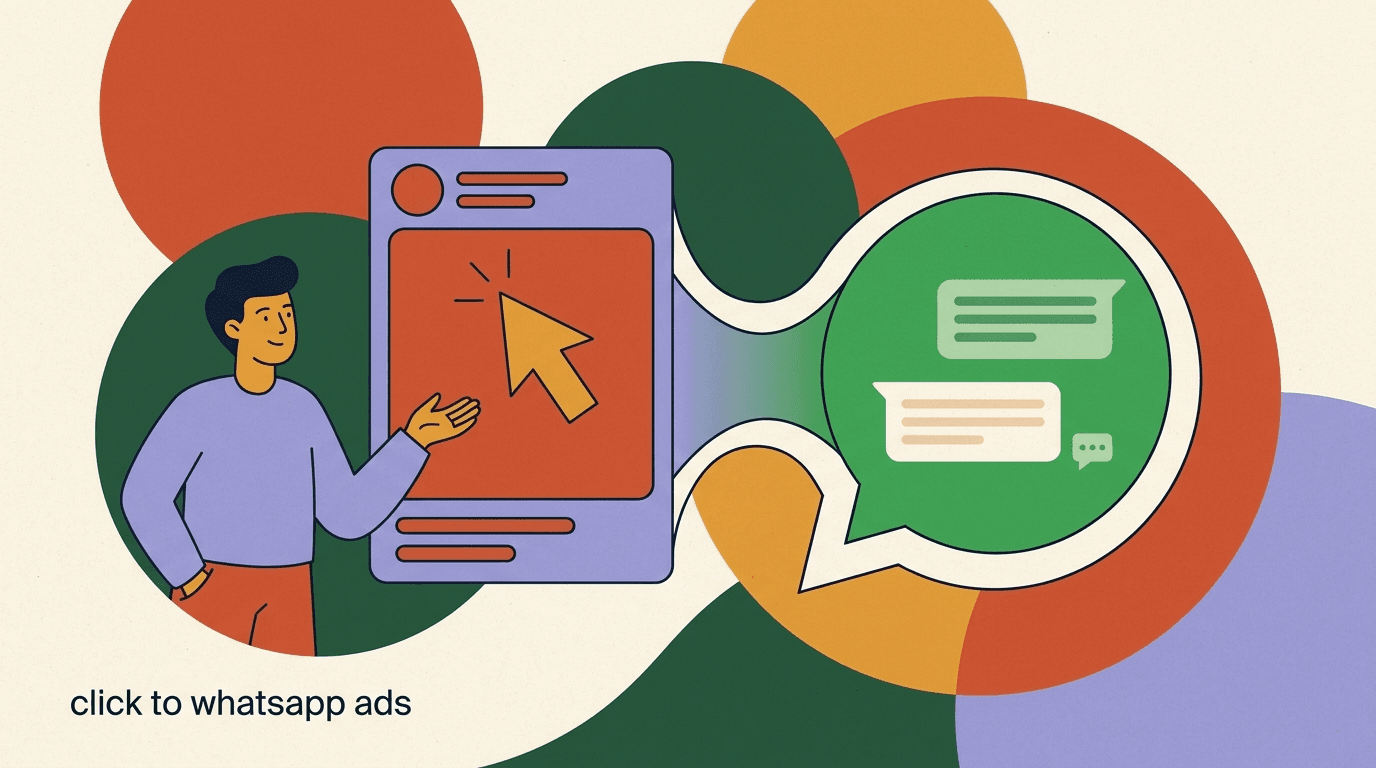
Click to WhatsApp ads are Meta ads that open a WhatsApp conversation instead of sending people to a landing page. Someone scrolling Instagram or Facebook taps your ad, and rather than loading a website they land inside a chat with your business — message pre-filled, ready to ask a question. The friction of a form, a page load, and a follow-up email simply is not there. For direct-to-consumer brands, that shift from page to conversation is the whole point.
This guide covers the format end to end: how click to WhatsApp ads (often shortened to CTWA ads) actually work inside Meta's system, why they convert for D2C, how to build the ad and the welcome conversation behind it, how to use an AI agent as your instant first responder, and how to measure cost per lead and cost per conversation honestly — including the per-conversation fees Meta charges that never show up in your ad dashboard.
Full disclosure: we build KlyoChat, a tool that handles the WhatsApp side of CTWA — the inbox, the AI first response, the automation. So we have a point of view. We have kept the platform mechanics vendor-neutral, flagged every cost you will actually pay, and pointed you to verify Meta's current ad and WhatsApp pricing yourself rather than quoting a number that will be stale by the time you read this.
A word on what this guide deliberately does not do. It does not promise a magic cost per lead, because that number does not exist as a constant — it moves with your market, your offer, your creative, and Meta's auction on any given week. Instead, it gives you the mechanics, the levers, and the math so you can produce your own honest number and decide whether the channel earns its place in your mix. If you have run any Meta campaign before, none of the ad-side setup will surprise you; the new muscle is the conversation that opens after the click, and that is where most of this guide lives.
What are click to WhatsApp ads, exactly?
A click to WhatsApp ad is a standard Meta ad — image, video, carousel — with one difference in the destination. Instead of a link to your site, the call to action opens WhatsApp and starts a chat with your business number. The user does not leave the messaging environment they are comfortable in, and you get a real conversation rather than an anonymous click.
These ads run across Facebook, Instagram, and Messenger placements, and they are built in Meta Ads Manager like any other campaign. The key choice is the conversion location: you tell Meta you want conversations on WhatsApp, and the platform optimizes delivery toward people likely to message you, not just people likely to click.
There are two broad ways the conversation opens. The most common is a direct deep link into a one-to-one chat. The other, sometimes called a WhatsApp lead ad flow, uses a guided form or pre-set questions inside the chat to qualify the person before a human or AI takes over. Both end in the same place: a thread in your WhatsApp inbox that you own.
That last point — ownership — is worth dwelling on, because it is the structural advantage of the format. When someone fills a form on your site, you get a row in a spreadsheet and a single permission to email them, often filtered into a promotions tab. When someone messages you from a CTWA ad, you get an ongoing, two-way thread on a phone they carry everywhere. You can follow up, answer the next question, send an order update, or re-engage them later within the rules Meta sets. The ad bought you a click; the conversation bought you a relationship, and the relationship is the asset.
It is also worth being clear about what CTWA is not. It is not a way to dodge Meta's fees — you still pay for the ad. It is not a guaranteed cheaper lead — a badly run CTWA campaign can cost more than a good landing-page campaign. And it is not hands-off; a conversation channel needs someone, or something, ready to converse. Treat it as a different shape of funnel rather than a shortcut, and the rest of this guide will make sense.
| Element | Standard link ad | Click to WhatsApp ad |
|---|---|---|
| Destination | Website or landing page | WhatsApp chat with your business |
| First touch | Page view, often anonymous | A message you can reply to |
| Optimization | Link clicks or site conversions | Conversations started |
| Follow-up channel | Email or retargeting pixel | Same WhatsApp thread, owned by you |
| Extra cost beyond ad spend | None directly | Meta per-conversation WhatsApp fee |
CTWA is a destination, not a campaign objective
You still pick a Meta objective — usually Engagement or Sales — and then set WhatsApp as the conversion location. The format is about where the click lands, not a separate ad type you buy. Names and menu paths in Ads Manager change, so confirm the current setup flow in Meta's own help docs.
Why do click to WhatsApp ads convert for D2C brands?
The honest reason CTWA works is psychological, not technical. A landing page asks a stranger to trust you enough to fill a form. A WhatsApp chat asks them only to send a message — a thing they do hundreds of times a day. The commitment is smaller, so more people take the step. And once they have sent that first message, you have permission to keep talking inside a channel they check constantly.
For D2C specifically, the format lines up with how people actually buy lower-consideration products. Someone sees a skincare ad, has one question about their skin type, and would never email customer service to ask it — but they will tap a WhatsApp button and type one line. You answer, recommend, and close, all in the same thread. The conversation does the job a product page and three retargeting ads would otherwise try to do.
There is also a deliverability advantage. An email sits in a promotions tab; a WhatsApp message lands with a notification on the lock screen. We will not quote open-rate statistics here because they vary wildly by market and are easy to misrepresent — but qualitatively, a message that arrives where people already pay attention gets seen, and seen is the prerequisite for everything else.
Geography matters too. In markets where WhatsApp is the default way people talk to businesses — much of Latin America, the Middle East, South and Southeast Asia, and parts of Europe — sending an ad into WhatsApp meets buyers exactly where they already transact. A landing page in those markets can feel like an extra, foreign step. In markets where email and web checkout are the norm, CTWA still works, but you are introducing a behavior rather than matching one, so the lift may be smaller. Knowing which world your audience lives in tells you how aggressively to lean on the format.
Finally, the conversation surfaces objections you would otherwise never hear. A landing page that does not convert tells you nothing about why. A WhatsApp thread where ten people in a row ask the same question about shipping to their country is a free, continuous focus group. You learn what blocks the sale in the customer's own words, then fix the ad, the product page, or the agent's script accordingly. That feedback loop is one of the quieter reasons the format compounds in value over time.
CTWA suits considered impulse buys best
The format shines when there is one small objection between interest and purchase — sizing, ingredients, shipping, fit. If your product genuinely needs a long landing page to explain, run both and let cost per qualified conversation decide.
Same ad budget, two destinations
- Ad to landing page
- Click → page load → form → maybe an email later → cold follow-up
- Ad to WhatsApp
- Click → live chat → question answered → warm thread you own
What audience and creative work best for CTWA ads?
The creative for a click to WhatsApp ad has a different job than a creative pointing to a landing page. A landing-page ad sells the click; a CTWA ad sells the conversation. The most effective creatives make it obvious that messaging is the next step and that a real exchange is waiting — a question to ask, an offer to claim, a problem to describe. The call to action should invite a chat, not a purchase, because the purchase happens later, inside the thread.
On audience, resist the urge to over-narrow at the start. CTWA optimizes toward people likely to message, and that optimization needs room to learn. A reasonably broad audience with strong creative usually beats a tightly stacked interest audience, because the conversation objective is good at finding the right people once it has signal. Layer your targeting back in only when the data tells you a segment converses and converts better.
- Lead the creative with a question or an offer the viewer can only resolve by messaging.
- Make the CTA verb conversational — ask, chat, message — not buy or shop.
- Use the pre-filled message to set the conversation's first move, so the thread opens with intent.
- Start broad and let conversation optimization find your messagers before you narrow.
- Test creatives in pairs that change one variable — hook, format, or offer — so you learn what moved the result.
- Show the product in use, not just on white, so the question the viewer forms is specific enough to answer in chat.
Your pre-filled message is creative, not a formality
The text that appears pre-typed when the chat opens sets the tone of the entire conversation. A specific opener — Hi, I want help choosing a serum for oily skin — qualifies the lead before your agent even replies. Treat it as the last line of your ad copy.
Creative angle: link-ad thinking versus CTWA thinking
- Link-ad creative
- Shop the bestselling serum — 20% off today (drives a click to a page)
- CTWA creative
- Not sure which serum suits your skin? Message us and we will tell you
Knowing why the format works and what creative suits it is the strategy. The other half is execution, and most of the wins or losses happen in two places: the campaign build itself, and the conversation that opens behind it. Get either wrong and the format underperforms a plain link ad. Let's build both, starting with the campaign.
How do you set up a click to WhatsApp campaign in Meta?
Before you open Ads Manager, you need three things connected: a WhatsApp Business account (via the WhatsApp Business app or the API through a provider), that account linked to your Meta Business Manager, and a Facebook Page with permission to advertise. With those in place, the campaign build itself is short — the work that takes time is the preparation around it, not the clicks inside Ads Manager.
Plan the prerequisites a day or two ahead. Connecting WhatsApp to Business Manager, getting a number verified, and (if you are on the API) having message templates reviewed by Meta can each take time you do not want to discover on launch day. Treat the setup below as the fast part that follows the slower groundwork.
- Connect WhatsApp to Meta BusinessLink your WhatsApp Business number to Business Manager so Ads Manager can use it as a conversion location. If you use the API through a platform, this connection is part of onboarding.
- Create the campaign with a conversation objectiveIn Ads Manager choose an objective that supports messaging (commonly Engagement or Sales), then set WhatsApp as the conversion location at the ad set level.
- Define audience and budgetTarget as you would any Meta campaign. Start with a broad-ish audience and let optimization for conversations do the work; CTWA delivery learns who actually messages.
- Build the creative and the pre-filled messageUpload your image or video, write the ad copy, and set the message the user sees pre-typed when the chat opens. The pre-filled text is a quiet conversion lever — make it specific.
- Set the welcome message and routingDecide what happens the instant they hit send: an automated greeting, a qualifying question, and who or what responds first. This is the conversation layer, covered next.
- Publish, then watch conversations not clicksOnce live, judge the ad on conversations started and cost per conversation, then on qualified leads — not on raw click metrics, which mislead for this format.
A CTWA ad with no one ready to reply is wasted spend
The biggest setup mistake is launching the ad before the conversation behind it is built. Every message that arrives to silence is paid demand you cannot recover. Have your welcome flow and first responder live before the campaign goes active.
What should the welcome and qualification conversation look like?
The moment someone messages, two things must happen fast: they get acknowledged, and you start learning whether they are a real lead. A good welcome conversation does both without feeling like an interrogation. It greets, sets expectations, and asks one or two questions that sort buyers from browsers.
Keep it short. The reason this person chose WhatsApp over a form is that forms feel like work — so do not rebuild a form in chat. Two well-chosen questions usually qualify better than ten. Lead with the one that most predicts intent for your business: budget, use case, timeline, or product category.
Think of the welcome conversation as three quick stages: acknowledge, qualify, and direct. Acknowledge means a near-instant reply that proves a human or capable agent is on the other side. Qualify means one or two questions that route the person down the right branch. Direct means giving them a clear next action — a product, a link, a booking, or a handoff — so the thread always moves forward and never stalls on the customer's side waiting for permission to continue.
Design the branches before you design the words. Sketch the two or three paths a typical lead can take — ready to buy, comparing options, just curious — and write the qualifying question whose answers cleanly sort people into those paths. When the structure is right, the copy is easy. When the structure is muddled, no amount of friendly wording rescues it.
- Greet and confirm you received them within seconds, not minutes.
- Ask one qualifying question that maps to how you actually segment leads.
- Offer quick-reply buttons so people tap instead of type where possible.
- Set a clear next step — a recommendation, a link, or a handoff to a human.
- Never leave the thread silent after a question; an unanswered reply kills the warm start.
Match the conversation to the ad's promise
If the ad offered 10% off, the first message should reference that offer. A disconnect between ad and chat — a discount ad that opens with a generic hello — breaks trust and tanks conversion.
A lean qualification flow for a D2C skincare brand
- Auto-greeting
- Hi! Thanks for messaging — happy to help you find the right routine.
- Qualifier
- Quick one: is your main concern dryness, breakouts, or anti-aging?
- Branch
- Based on the answer, recommend 1–2 products with a checkout link
- Handoff
- Offer to connect a human if they have a question the agent cannot answer
How does an AI agent work as your CTWA first responder?
Speed is the hidden variable in CTWA performance. People click an ad on impulse, and that impulse cools by the minute. If your first reply comes an hour later because a human was offline, the warm thread you paid for has gone cold. An AI agent solves the timing problem: it answers instantly, every hour, in every thread, so no paid conversation ever waits.
A well-configured AI first responder does more than say hello. Trained on your product catalog, FAQs, and policies, it can answer the sizing or ingredient question that was the whole reason someone messaged, run the qualifying questions, recommend a product, and share a checkout link — then hand off to a human the moment the conversation needs one. The human's time goes to the conversations that are actually close to converting.
The honest framing: AI does not replace your sales judgment, it removes the wait. It handles the repetitive opening of every conversation so a person never burns time greeting tire-kickers, and it makes sure the lead you paid Meta for gets a reply while they are still holding the phone.
There is a coverage dimension too. CTWA ads run around the clock, and impulse does not respect your office hours — a large share of clicks arrive in the evening, on weekends, and across time zones your team does not staff. An AI first responder turns 24/7 ad delivery into 24/7 conversation, so the budget you spend at 11pm does not sit in an unanswered queue until morning. By the time a human logs in, the easy questions are resolved and the high-intent threads are flagged and waiting.
It also keeps quality consistent. A tired human at the end of a shift answers differently than a fresh one at the start; an agent trained on your content answers the hundredth sizing question exactly as well as the first. Consistency is not glamorous, but at volume it is what protects the conversion rate you worked to earn. The right division of labor is simple: AI for instant, accurate, repeatable opening moves, humans for judgment, negotiation, and the conversations where empathy closes the sale.
- Train the agent on your real contentFeed it your product details, shipping and returns policy, and common questions so its answers are accurate, not generic.
- Set it as the instant first replyThe agent responds the second a CTWA message arrives, acknowledging the person and starting qualification before any human is involved.
- Let it qualify and recommendIt runs your two qualifying questions, suggests products, and shares links — resolving the simple conversations entirely.
- Hand off cleanly to a humanWhen intent is high or the question is out of scope, it routes the thread to a person with the full context attached, so nothing is repeated.
AI first response is about timing, not deflection
The goal is not to keep humans out of conversations — it is to make sure the paid lead gets an answer immediately and a person spends their time where it matters. Set clear handoff rules so high-intent buyers reach a human fast.
How do you measure cost per lead and cost per conversation?
CTWA breaks the metrics most advertisers default to. Cost per click is nearly meaningless here, because a click that does not turn into a message is worthless and a message that turns into a sale is worth a great deal. The metrics that matter are cost per conversation started, cost per qualified conversation, and cost per acquired customer — in that order of usefulness.
Here is the part most guides skip: your true cost has two stacked layers. First, the Meta ad spend you see in Ads Manager. Second, the per-conversation fee Meta charges for WhatsApp messaging, which is billed separately and never appears in your ad dashboard. To know your real cost per lead, you have to add both.
Attribution is the other thing CTWA changes. A standard sales campaign reports purchases back through the pixel because the conversion happens on your site. A CTWA conversion happens inside WhatsApp, which means Meta sees the conversation start but often cannot see the sale unless you feed it back. To close the loop, you connect the outcome — a purchase, a booking, a qualified lead — back to Meta through the conversions API or your platform's integration, so optimization learns from sales rather than from chats alone. Without that, you are optimizing for conversations and hoping they convert; with it, you are optimizing for the result you actually care about.
Keep a single source of truth for the math. Because the two bills live in different places and the sale may live in a third (your store or CRM), it is easy to report a flattering number by quietly leaving one out. Decide once how you calculate cost per qualified conversation and cost per customer, write the formula down, and apply it the same way every week. A consistent honest number beats a precise number you compute differently each month.
| Metric | What it tells you | Watch out for |
|---|---|---|
| Cost per link click | Almost nothing for CTWA | Vanity metric — ignore in isolation |
| Cost per conversation started | Ad spend ÷ conversations | Excludes the Meta WhatsApp fee |
| Cost per qualified conversation | Spend ÷ leads that pass qualification | Your real top-of-funnel number |
| Cost per customer (CAC) | Total cost ÷ paying customers | The number that decides if CTWA scales |
Two bills, one cost-per-lead
Meta charges you for the ad and, separately, for WhatsApp conversations. Reporting cost per lead from ad spend alone understates your real number. Always combine ad spend and conversation fees before you judge whether the channel pays.
Building a real cost-per-lead figure (illustrative method)
- Step 1
- Take Meta ad spend for the campaign from Ads Manager
- Step 2
- Add Meta's per-conversation WhatsApp fees for the same period
- Step 3
- Divide the combined total by qualified conversations
- Note
- Verify Meta's current per-conversation rates for your country and category
How much do click to WhatsApp ads cost in 2026?
There is no single price, and anyone who gives you a flat cost-per-lead figure for CTWA is guessing. Your cost is the sum of three moving parts, each of which varies by market, industry, and time. We will name the parts honestly and tell you to confirm the live numbers rather than invent them.
The first part is auction-based ad spend, set by competition for your audience — the same dynamics as any Meta campaign. The second is Meta's per-conversation WhatsApp fee, which differs by country and by message category, with marketing-initiated conversations generally costing more than utility ones. The third is the software you use to run the WhatsApp side — your inbox, automation, and AI.
- Ad spend is auction-driven — there is no fixed CPL to quote.
- Meta's WhatsApp fees change and vary by country and category; verify the current rates.
- Marketing-category conversations typically cost more than utility ones.
- Software cost is the only flat, predictable part of the three — and the one you control.
| Cost component | Who charges it | What drives it |
|---|---|---|
| Ad delivery | Meta (Ads Manager) | Auction competition, audience, creative quality |
| WhatsApp conversation fee | Meta (billed separately) | Country and message category |
| Inbox, automation & AI | Your platform vendor | Plan tier and feature set |
Verify Meta's pricing at the source
Meta updates both ad auction dynamics and WhatsApp conversation pricing regularly, and rates differ by region. Before you budget, check Meta's current advertising and WhatsApp Business pricing pages for your market. We deliberately avoid quoting figures that would be wrong by the time you read this.
How do you budget for Meta ad spend plus WhatsApp fees?
Because CTWA has two cost layers from Meta plus your software, a sane budget separates the controllable from the variable. Your software cost is fixed and known. Your ad spend is a dial you set. Meta's per-conversation WhatsApp fee is the variable rider that scales with how many conversations your spend produces — so the more efficiently your ads start conversations, the more of that fee you incur, which is a good problem but a real line item.
Build the budget bottom-up from a result, not top-down from a vanity number. Start with what a customer is worth to you and the margin you can spend to acquire one. Work back through your expected conversation-to-customer rate to a target cost per qualified conversation, then set ad spend at a level where you can gather enough conversations to judge that rate honestly before you scale. A test that produces only a handful of conversations cannot tell you anything reliable.
- Fix the knownsLock your software cost and decide the maximum you can pay to acquire one customer based on margin and lifetime value.
- Set a test ad budget that buys enough conversationsSpend enough to generate a meaningful sample of conversations — too small a test gives you noise, not a read.
- Reserve a line for Meta's WhatsApp feesEstimate conversation volume and multiply by Meta's current per-conversation rate for your country and category, then add it to the budget.
- Judge on combined cost per qualified conversationAdd ad spend and conversation fees, divide by qualified conversations, and compare to your target before scaling.
- Scale the dial, re-check the riderAs you raise ad spend, conversation fees rise with it; re-confirm the economics still hold at the new volume.
Budget for utility versus marketing conversations separately
Meta prices conversation categories differently, and an order confirmation (utility) typically costs less than a promotional outreach (marketing). If you mix both, estimate them as separate lines rather than one blended guess. Confirm the current category rates on Meta's pricing page.
What does a click to WhatsApp campaign look like end to end?
To make the moving parts concrete, here is an illustrative walk-through for a small D2C skincare brand running its first CTWA campaign. The numbers and ratios below are made up for illustration — they are not benchmarks, and you should expect your own to differ. The point is the shape of the process, not the figures.
The brand connects its WhatsApp Business number to Business Manager through a platform, sets up an AI agent trained on its product range and shipping policy, and builds a three-branch welcome flow. It then launches one ad set with two creatives — both asking viewers to message for a routine recommendation — to a broad audience, with a modest test budget and WhatsApp as the conversion location.
- Launch and acknowledgeThe ad goes live; every message that arrives gets an instant AI greeting referencing the ad's offer, so no paid lead waits.
- Qualify in one questionThe agent asks the single qualifying question — dryness, breakouts, or anti-aging — and branches the conversation accordingly.
- Recommend and linkIt suggests one or two products with a checkout link, resolving the straightforward buyers entirely on its own.
- Hand off the close callsThreads with hesitation, custom questions, or high order value route to a human with full context attached.
- Measure the real costThe brand adds ad spend and Meta's conversation fees, divides by qualified conversations, and compares to its target.
- Re-engage and iterateIt broadcasts a follow-up to non-buyers within Meta's rules, kills the weaker creative, and reinvests in the winner.
Treat the first campaign as a learning buy
Your first CTWA campaign's real product is data: which creative starts conversations, which question qualifies, where buyers hesitate. Budget it as tuition, read the conversations closely, and let what you learn shape the second campaign. The numbers above are illustrative — generate your own.
Where this brand's effort and cost actually went
- Meta ad spend
- The dial they set — buys the conversations
- Meta WhatsApp fees
- The variable rider — scales with conversations started
- AI first response
- Handled the repetitive openers around the clock, included in their plan
- Human time
- Spent only on the high-intent and high-value threads
What are the most common click to WhatsApp ad mistakes?
Most CTWA campaigns that disappoint fail for the same handful of reasons, and almost none of them are about the ad creative. They are about the conversation, the timing, and the measurement. Here are the ones we see again and again.
The unifying theme is that advertisers carry landing-page habits into a conversation channel. They optimize for clicks, they front-load qualification like a form, they go silent after the first reply the way a static page does, and they forget that a second Meta bill exists because a landing page never had one. Every mistake below is a version of treating CTWA like a link ad. Fix the mindset and the specific errors mostly fix themselves.
- Launching with no first responder, so paid messages arrive to silence and go cold.
- Treating the chat like a form — ten questions where two would qualify better.
- A disconnect between the ad's promise and the welcome message that follows.
- Judging the campaign on cost per click instead of cost per qualified conversation.
- Forgetting the Meta per-conversation fee, so the real cost per lead is understated.
- No clear handoff rule, so high-intent buyers wait while an agent loops on the wrong path.
- Letting threads die after the first reply instead of following up inside the window.
Slow first reply is the silent killer
The single most expensive mistake is a delayed first response. You paid Meta to put a warm lead in your inbox; every minute of silence cools them. If you cannot guarantee an instant human reply, an AI first responder is not optional.
Do you need the WhatsApp Business API for CTWA ads?
For a very small operation, the free WhatsApp Business app can technically receive CTWA conversations — one person, one phone, replying by hand. That works until volume arrives, at which point it breaks: no shared inbox, no automation, no AI, no analytics, and a single device as a bottleneck.
For anything beyond a tiny test, you want the WhatsApp Business API through a platform. The API is what unlocks a team inbox, automated welcome flows, AI first response, broadcasts, and reporting — the entire apparatus that makes CTWA scale. Note that the API also requires message templates to be approved by Meta for certain message types, which is part of the setup either way.
There is a timing rule worth understanding because it shapes how you follow up. Within a customer-care window that opens when someone messages you, you can reply freely. Outside that window, re-engaging requires a pre-approved template message, which is also where Meta's marketing-conversation fees come in. This is not a reason to avoid the API — it is a reason to design your flow so the most valuable exchanges happen while the window is open, and your later re-engagement uses templates deliberately rather than by accident.
Start API-ready if you plan to scale
If your CTWA test goes well you will outgrow the free app fast. Setting up on the API from the start saves a disruptive migration later, and most platforms make API onboarding a guided process rather than a developer project.
App versus API for running CTWA
- WhatsApp Business app
- One device, manual replies — fine for a tiny pilot
- WhatsApp Business API
- Team inbox, automation, AI, broadcasts, analytics
How does KlyoChat run the WhatsApp side of CTWA?
KlyoChat handles everything that happens after the click — the part Meta does not. When a click to WhatsApp ad sends someone into a chat, KlyoChat is the inbox that receives it, the AI agent that replies instantly, the automation that qualifies, and the analytics that tell you what the conversation cost. Meta drives the demand; KlyoChat works the conversation.
It is AI-native and mobile-first, with a unified inbox that pulls WhatsApp together with Facebook, Instagram, Telegram, TikTok, and X — so a CTWA lead and a comment-to-DM lead sit in the same place. Custom AI agents are included on the paid plans, not a separate add-on, which is what lets you give every paid conversation an instant first response trained on your own catalog and policies. No-code automation builds the welcome and qualification flow, broadcasts re-engage past conversations, and analytics show conversation volume so you can pair it with your Meta spend.
- Custom AI agents are included on paid plans — your instant CTWA first responder, not an add-on.
- Every plan starts with a 7-day free trial, no credit card.
- Honest cost reminder: you still pay Meta for ad spend and for WhatsApp per-conversation fees on top of any platform — that applies to everyone, KlyoChat included.
- Honest limit: KlyoChat does not offer native SMS or email, and it is a newer, smaller community than the largest incumbents. If SMS or email is core to you, factor that in.
| CTWA need | What KlyoChat provides |
|---|---|
| Instant first reply to paid leads | Custom AI agents, included on paid plans |
| Welcome & qualification flow | No-code automation builder |
| One place for every channel's leads | Unified inbox: WhatsApp, FB, IG, Telegram, TikTok, X |
| Re-engage past conversations | Broadcasts |
| Understand conversation volume | Built-in analytics |
What KlyoChat does and does not change about CTWA cost
KlyoChat cannot lower Meta's ad auction or WhatsApp conversation fees — no tool can; those are Meta's. What it changes is the conversation work around them: an instant AI first reply so paid leads do not go cold, and one flat, predictable software cost. Verify Meta's current rates separately.
KlyoChat plans at a glance
- Basic
- $19/mo — entry plan with AI agents
- Pro
- $49/mo ($39 billed yearly) — all channels, 10,000 contacts, custom AI agents
- Business
- $129/mo — higher limits and advanced needs
- Enterprise
- Custom — for larger teams and specific requirements
How do you scale a click to WhatsApp campaign that works?
Once a CTWA campaign is profitable on cost per qualified conversation and CAC, scaling is less about the ad and more about the conversation holding up under volume. The constraint is rarely creative — it is whether your first response stays instant and your qualification stays sharp as the message count climbs.
Scale the creative the way you would any Meta campaign: test new hooks and formats, widen audiences gradually, and let conversation optimization find more of the right people. But before you push budget, make sure the conversation layer can absorb it — that the AI handles the new volume instantly and humans are routed only the threads worth their time.
Watch for two scaling traps specific to CTWA. The first is response decay: at low volume a small team can keep up by hand, but the moment you triple spend, manual coverage cracks and reply times slip — which is exactly when an AI first responder stops being a nice-to-have. The second is fee drift: as conversation volume climbs, Meta's per-conversation charges climb with it, so an efficiency that looked great at test scale can compress your margin at full scale. Re-run the full math, including the conversation fee, at every meaningful step up rather than assuming the test economics hold.
- Confirm unit economics first: profitable on CAC including the WhatsApp fee.
- Scale creative and audiences gradually so optimization keeps learning.
- Stress-test the conversation: can your first response stay instant at 5x volume?
- Use broadcasts to re-engage past CTWA threads instead of only paying for new ones.
- Re-check cost per qualified conversation as you scale — it often drifts up before it settles.
The cheapest lead is the one you already talked to
Before scaling spend, re-engage the threads you already paid for. A broadcast to past CTWA conversations costs a fraction of a new click and reaches people who already raised their hand.
The bottom line on click to WhatsApp ads: the format converts for D2C because it swaps a cold landing page for a warm conversation, but it only pays off if the conversation behind the ad is ready before you spend. Build the welcome flow, put an instant first responder on every thread, and measure cost per qualified conversation with the Meta WhatsApp fee included — not cost per click.
If you want help on the parts around CTWA, see our companion guides on WhatsApp Business API cost for the full fee breakdown, the WhatsApp AI chatbot guide for designing the first-response agent, and Shopify WhatsApp integration if you are selling D2C. And whatever tool you choose, verify Meta's current ad and WhatsApp conversation pricing on Meta's own pages before you set a budget.