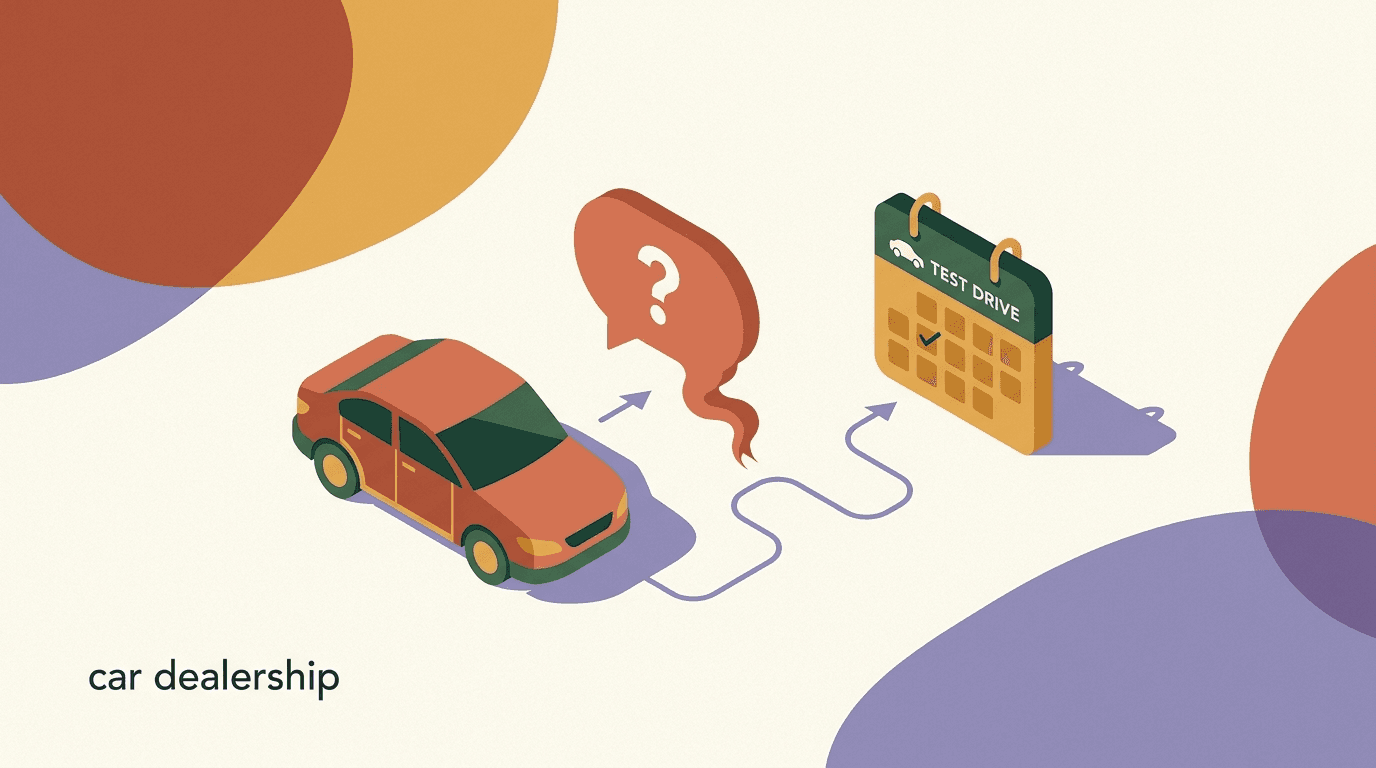
A car dealership chatbot is the difference between catching a buyer at the moment of interest and losing them to the dealer who answered first. Most car shopping now starts on a phone — someone sees a Reel of a used SUV, taps the comment, and asks a simple question: is it still available, and what is the payment. If that message sits unread for three hours, the lead is usually gone. Automating the first response across Instagram and WhatsApp lets you reply in seconds, qualify the buyer, and offer a test-drive slot before they have closed the app. This playbook walks through exactly how to build that, with the flows and sample copy you can adapt for your store.
We are going to be specific, not theoretical. You will see how to capture inquiries from social and messaging, how to qualify on the things that actually matter — model, budget, trade-in, and finance interest — how to book test drives without phone tag, and how to follow up on the people who go quiet. We will also be honest about the limits. A chatbot should never quote a final out-the-door price or pretend to be a finance manager. Its job is to capture, qualify, and book, then hand a warm, organized lead to a human. That line matters, and we will keep returning to it.
Full disclosure: we build KlyoChat, an AI-native inbox and automation tool for social and messaging channels, so we have a point of view. We will show how the pieces map to our product near the end, but most of this playbook is tool-agnostic. The flows, the qualifying questions, and the handoff logic apply whether you build them in KlyoChat or somewhere else. Where we mention pricing or specific capabilities, we keep it honest and flag what a chatbot genuinely cannot do.
Why do car dealerships need a chatbot in the first place?
The buying journey moved to the phone, but most dealership response times did not follow it. A shopper does their research online, narrows to two or three vehicles, and reaches out on whatever channel is easiest — usually Instagram DM, a Facebook message, or WhatsApp. They are not filling out a form on your website and waiting for a callback. They are sending a one-line message and expecting an answer the way they would from a friend.
Speed is the whole game here. The first dealer to respond with a useful answer wins the conversation, and often the sale. When a buyer messages five dealers about the same model, the one who replies in two minutes with availability and a test-drive offer is in a completely different position than the one who replies the next morning. Manual response simply cannot cover evenings, weekends, and the gaps when your sales floor is busy with walk-ins — which is exactly when a lot of social inquiries land.
A chatbot closes that gap. It acknowledges every message instantly, answers the predictable questions, collects the details a salesperson needs, and either books a test drive or flags a hot lead for a human to take over. It does not replace your salespeople. It makes sure they spend their time on qualified buyers instead of typing the same three answers fifty times a day.
The chatbot is a triage layer, not a closer
Think of automation as the front desk, not the sales desk. It greets, qualifies, and books. The actual selling — negotiating price, structuring finance, building trust on a big purchase — stays with your people. Every flow in this guide is designed to hand off cleanly the moment a human adds more value than a script.
Which channels matter most for automotive lead capture?
Not every channel pulls the same weight for a dealership. Where you focus depends on where your buyers already are, but a few patterns hold across most stores. Instagram and Facebook drive discovery — this is where someone first sees the vehicle. WhatsApp is where serious conversations continue, especially in markets where it is the default messaging app. The right setup connects all of them into one place so a buyer who starts on Instagram and follows up on WhatsApp is the same conversation, not two strangers.
Here is how the main channels tend to behave for automotive, and what to automate on each.
- Discovery channels (Instagram, Facebook) need fast first response and comment-to-DM capture.
- WhatsApp carries the heavier conversations — qualification, booking, and reminders.
- Unify channels so one buyer is one conversation, regardless of where they started.
- Do not spread thin. Automate the two or three channels your leads actually use before adding more.
| Channel | Best for | What to automate |
|---|---|---|
| Discovery from Reels and posts | Comment-to-DM, availability checks, qualify and book | |
| Marketplace and local reach | First response, model questions, route to test drive | |
| Serious back-and-forth, reminders | Qualification, test-drive booking, follow-up, service reminders | |
| Telegram | Niche and enthusiast communities | First response, availability, handoff to sales |
Comment-to-DM is the highest-leverage automotive trigger
When you post a vehicle and ask people to comment a keyword like PRICE or DRIVE, a comment-to-DM flow turns every public comment into a private qualified conversation. It is the single best way to convert social attention into bookable leads, because it captures buyers at the exact moment of interest.
What should the first-response flow actually say?
The opening message sets the tone for the whole conversation. It needs to do three things at once: acknowledge the buyer instantly so they know they are not being ignored, answer or address what they asked, and move toward the next step without being pushy. Get this wrong and the buyer feels processed. Get it right and they feel helped.
The most common opening inquiry is some version of is this still available. Your flow should confirm availability, then immediately offer value — a quick spec, a photo, or the natural next question. Avoid dumping a wall of text or asking for a phone number before you have given the buyer anything. Earn the details by being useful first.
Lead with availability, then offer a test drive
The fastest path from inquiry to showroom is: confirm it exists, show it, offer to book a drive. Resist the urge to qualify hard before you have given the buyer a reason to stay in the chat. A test-drive offer in the first or second message converts far better than a form.
First-response flow on Instagram DM
- Buyer
- Is the 2021 RAV4 still available?
- Bot (instant)
- Yes, it is still here and ready to view. Want a few quick photos and the key specs?
- Buyer
- Yeah please
- Bot
- Sending those now. Are you looking to drive it this week? I can hold a test-drive slot for you.
How do you qualify a car buyer without an interrogation?
Qualification is where a lot of dealership chatbots go wrong. They fire off five questions in a row and the buyer ghosts. The fix is to qualify conversationally, one question at a time, woven into a helpful exchange rather than stacked like a form. You want four things eventually — which vehicle or type, budget or payment range, whether there is a trade-in, and whether they are interested in financing — but you gather them across the conversation, not all at once.
The order matters. Start with the vehicle, because that is what they care about and it feels like help. Move to budget or payment next, framed as making sure you show the right options. Trade-in and finance interest come later, once the buyer is invested. Each answer also routes the conversation — a cash buyer with no trade-in is a simpler, faster handoff than someone who needs financing and wants their current car appraised.
Tag every answer as you go. The point of qualifying is not just to filter; it is to hand the salesperson a complete picture so the first human message can be relevant instead of starting from zero. A salesperson who opens with the right vehicle, the right budget, and a note that there is a trade-in is already ahead.
- Ask one qualifier per message, not a stacked questionnaire.
- Frame each question as helping the buyer get the right options.
- Tag answers automatically so the salesperson inherits a full profile.
- Use answers to route: cash vs finance, trade-in vs not, new vs used.
| Qualifier | Why it matters | Sample question |
|---|---|---|
| Vehicle / type | Routes to the right inventory and salesperson | Which model caught your eye, or what type are you after? |
| Budget / payment | Filters realistic options, sets expectations | Are you thinking monthly payment or total price? |
| Trade-in | Changes the deal structure and appraisal need | Do you have a vehicle to trade in? |
| Finance interest | Routes to finance team early if needed | Would you want to explore financing, or paying outright? |
Never quote a payment or finance term in the bot
It is fine for a chatbot to ask whether someone is interested in financing. It is not fine for it to quote a monthly payment, an APR, or an out-the-door price. Those depend on credit, incentives, and terms that only a person can responsibly handle. Capture the interest, then hand off — promising numbers a bot cannot stand behind erodes trust fast.
How does test-drive booking work end to end?
Booking is where automation earns its keep, because phone tag is the silent killer of test drives. A buyer says they want to come in, the salesperson is with someone else, they trade voicemails, and by the time they connect the buyer has cooled off. A chatbot that offers real time slots and confirms instantly removes every step of that friction.
The flow is straightforward once qualification is done. Offer a few concrete windows rather than asking open-ended when works for you, because choices are easier to answer than blanks. Confirm the slot, capture a name and the best contact number, and send a confirmation with the address and what to bring. Then set a reminder so the booking actually shows up.
- Confirm intent and vehicleReconfirm which vehicle they want to drive so the right car is ready and the right salesperson is assigned.
- Offer concrete time slotsPresent two or three specific windows (for example, today at 4pm, tomorrow at 11am, Saturday at 1pm) instead of an open question.
- Capture name and contactCollect a name and the best phone number so a human can reach them and the booking is attached to a real person.
- Send confirmation with detailsConfirm the slot, share the dealership address, parking notes, and what to bring (license, and for a trade-in, the keys and any paperwork).
- Hand off to the assigned salespersonNotify the salesperson with the full qualified profile so they can prep the vehicle and greet the buyer by name.
Offer slots, do not ask for availability
When you ask when are you free, you create work for the buyer and invite a vague answer. When you offer three specific windows, you get a clean yes. This one change measurably lifts booking completion, especially on mobile where typing a full answer is annoying.
Test-drive booking on WhatsApp
- Bot
- Great. I can get you behind the wheel of the RAV4. Which works: today 4pm, tomorrow 11am, or Saturday 1pm?
- Buyer
- Tomorrow 11 works
- Bot
- Booked for 11am tomorrow. What name should I put it under, and the best number to reach you?
- Buyer
- Sam, 555-0148
- Bot
- Thanks Sam. You are set for 11am tomorrow at 120 Main St. Bring your license. Marco from our team will have the RAV4 ready.
What happens when a lead goes quiet?
Most leads do not book on the first exchange. They get pulled away, they want to think, they are comparing dealers. The teams that win are the ones that follow up — consistently, helpfully, and without nagging. A chatbot is ideal for this because it never forgets and never feels awkward sending a second message.
The structure that works is a short, spaced sequence. A gentle nudge a few hours later, a value-add the next day, and a final check-in after that. Each message should give the buyer a reason to re-engage — a reminder the vehicle is still available, an offer to answer a question, a heads-up if interest in that model is high. Stop after a few touches; chasing past that annoys more than it converts.
- Same-day nudgeA few hours after the chat goes quiet: Still thinking it over? Happy to hold a test-drive slot whenever you are ready.
- Next-day valueThe following day, add something useful: a photo, a spec they cared about, or a note that the vehicle is still available.
- Final check-inA day or two later, a soft close: Want me to keep this one on your radar, or are you all set? Then stop.
Follow-up is where most dealership revenue leaks
The inquiry that did not book today is not lost — it is un-followed-up. A simple three-touch sequence recovers a meaningful share of quiet leads with zero extra staff time. The honest caveat: respect opt-outs and message frequency rules, especially on WhatsApp, where Meta enforces its own policies.
Can the chatbot handle service reminders too?
Lead capture gets the attention, but service is where dealerships keep customers for years, and it is badly underserved by manual outreach. The same automation that books test drives can remind existing customers when a service is due, offer a booking slot, and answer the routine questions service advisors field all day — hours, whether a loaner is available, roughly how long an oil change takes.
Service reminders work because they are timely and genuinely useful, not promotional. A message that says your vehicle is due for its scheduled service, want me to book you in this week lands as a courtesy, not a pitch. It also reopens a conversation channel with a past buyer, which is exactly when many of them start thinking about their next vehicle.
- Trigger reminders on mileage or time intervals from your records, then offer a bookable slot.
- Answer routine service questions automatically — hours, loaners, typical wait times.
- Use service contact as a soft re-engagement channel for the next purchase.
- Keep it useful, not salesy. A reminder is a service; a sales pitch in disguise is not.
Service reminders are retention disguised as convenience
A customer who books service through a quick chat is a customer who stays in your orbit. The reminder does the practical job, and the open channel quietly keeps you top of mind for their next car. It is the cheapest loyalty program you are probably not running.
How do you build these flows without code?
You do not need a developer to ship any of this. Modern automation tools let you build these flows visually — drag a trigger, add a message, branch on the buyer's answer, attach a tag, set a reminder. The skill is not technical; it is thinking through the conversation the way a good salesperson would, then mapping the branches.
Start with one flow, not ten. The comment-to-DM-to-test-drive path is the highest return, so build that first, run it on a few posts, and refine the copy based on real replies. Once it is working, layer on qualification branches, the follow-up sequence, and service reminders. Trying to build the whole system at once is how projects stall.
- Map the conversation on paper firstWrite the ideal exchange as if you were the best salesperson: greeting, availability, qualify, book, confirm. The flow is just this, formalized.
- Build the first-response and booking pathCreate the trigger (comment keyword or new DM), the opening message, the test-drive offer, and the booking capture. Keep branches minimal at first.
- Add qualification branchesInsert one-question-at-a-time qualifiers (vehicle, budget, trade-in, finance) and tag each answer for the handoff.
- Set the handoff triggerDefine exactly when a human takes over — a finance question, a price ask, or a confirmed booking — and route to the right salesperson.
- Test with real messages, then refineRun it live on a few posts, read the actual replies, and fix the spots where buyers drop off or get confused.
AI agents reduce the branch-building burden
Rigid if-this-then-that flows handle predictable paths well but break on phrasing they did not expect. An AI agent trained on your inventory and FAQs can handle the messy middle — odd questions, typos, multi-part asks — and still follow your rules on what it must not do (no prices, no finance terms). The best setups combine flows for the structured steps with an AI agent for the conversation.
Where must a human always take over?
This is the part too many automation pitches skip, so we will be blunt about it. A car is one of the largest purchases most people make, and trust is the entire transaction. There are clear points where a script stops adding value and a person must step in. Knowing these lines is what separates a chatbot that helps from one that annoys.
The bot should hand off the instant the conversation touches real money or real commitment. Final pricing, finance and lease terms, trade-in valuations beyond a rough acknowledgment, and any negotiation all belong to a human. So does a buyer who is clearly ready and just wants to talk to someone. The chatbot's job is to recognize these moments and route them fast, with the full context attached, not to fumble through them.
- Final or out-the-door pricing — never quoted by the bot.
- Finance, lease, and APR terms — routed to the finance team.
- Trade-in valuation — the bot captures the vehicle, a person appraises it.
- Negotiation of any kind — always human.
- An emotional or high-stakes moment — when the buyer needs reassurance, send a person.
A chatbot is not a DMS, CRM, or finance system
Be clear-eyed about scope. A chatbot captures, qualifies, books, and reminds. It does not replace your dealer management system, your CRM, or your finance and insurance tools. It feeds them. Treat it as the top-of-funnel layer that hands clean leads to the systems and people that close, not as a substitute for them.
What does a complete dealership automation stack look like?
Putting it together, the full picture is a layered system where each part does one job well. Discovery happens on social, capture and qualification happen in chat, booking happens automatically, and closing happens with a human inside your existing systems. The chatbot is the connective tissue between attention and the sales floor.
The table below shows how the layers fit, what is automated, and where the human line sits. The point is not to automate everything — it is to automate the repetitive, time-sensitive front end so your team spends its hours on the work that actually needs a person.
- Automate the front end: capture, qualify, book, remind.
- Keep the back end human: price, finance, negotiate, sign.
- Let the chatbot feed your CRM and DMS, not replace them.
- Measure on booked test drives and shows, not just messages sent.
| Layer | What it does | Automated or human |
|---|---|---|
| Discovery | Reels, posts, Marketplace generate interest | Human content, automated comment-to-DM |
| Capture | First response, availability, photos | Automated |
| Qualification | Vehicle, budget, trade-in, finance interest | Automated, tagged |
| Booking | Test-drive slot, confirmation, reminder | Automated |
| Closing | Price, finance, negotiation, signing | Human, in your DMS/CRM |
| Retention | Service reminders, re-engagement | Automated nudges, human service |
How do you handle new versus used inquiries differently?
New and used buyers ask different questions and need different routing, so a one-size-fits-all flow leaves value on the table. A new-vehicle shopper is usually comparing trims, colors, and current incentives, and is often more payment-focused. A used-vehicle shopper cares about condition, history, mileage, and whether the specific car they saw is still on the lot. Branching early on which one they are lets the rest of the conversation feel tailored rather than generic.
The branch is simple to build. Your opening can ask, or you can infer it from which vehicle they messaged about. From there, a used inquiry leads with availability and condition reassurance and routes toward a quick test-drive booking, because used cars are one-of-one and urgency is real — once it sells, it is gone. A new inquiry can take a slightly longer qualification path around trim and options, since you usually have more than one in stock and the buyer is configuring rather than racing.
Routing to the right salesperson matters here too. Many stores have people who specialize in new versus used, or in particular brands. Tagging the inquiry by type and vehicle lets the handoff land with the person best equipped to close it, instead of whoever happens to be free.
- Used inquiries: lead with availability and condition, push urgency, book fast.
- New inquiries: qualify on trim, options, and payment preference before booking.
- Branch early — ask or infer new versus used from the first message.
- Tag by type and route to the salesperson who specializes in it.
Used-car urgency is real and worth signaling
Because a used vehicle is unique, an honest nudge like this is the only one at this price and it has had interest works without feeling manufactured. It is true, it is useful, and it moves a serious buyer to book before someone else does. Do not fake scarcity on new vehicles where you have several in stock.
What mistakes do dealerships make with chat automation?
The flows are easy; the judgment is where stores trip. A handful of mistakes show up again and again, and every one of them is avoidable once you know to watch for it. Most of them come from treating automation as a way to do less for the buyer rather than to respond faster and better.
The first and most common is over-automating — building a maze of branches that traps a buyer who just wants a person. The second is the opposite of the first impression you want: a robotic, corporate tone that makes the buyer feel processed. The third is hiding the human option, so a frustrated buyer cannot escape the bot. The fourth is forgetting follow-up entirely, which is where most of the recoverable revenue lives. And the fifth is measuring the wrong thing and declaring victory on message volume while bookings stay flat.
The fix for all of them is the same principle: the bot exists to help the buyer reach a person or a booking faster, never to keep them away from one. Write copy the way your best salesperson talks. Always offer an obvious path to a human. Build the follow-up sequence on day one. And judge the system on booked, shown test drives, not on activity.
| Mistake | What it costs | The fix |
|---|---|---|
| Over-automating the flow | Frustrated buyers drop off | Keep branches shallow; offer a human early |
| Robotic, corporate tone | Buyers feel processed, not helped | Write copy like your best salesperson speaks |
| Hiding the human option | Trapped buyers leave for a competitor | Always show a clear talk to a person path |
| No follow-up sequence | Quiet leads quietly disappear | Build the three-touch follow-up from the start |
| Measuring message volume | False confidence, flat sales | Track bookings and shows, not messages |
If the bot cannot help, get out of the way fast
Nothing burns a hot lead faster than a chatbot that loops or stonewalls a buyer who clearly wants a person. Build an explicit escape hatch — a keyword, a button, or intent detection — that drops them into a human conversation immediately. The cost of a missed handoff is a lost sale; the cost of an easy one is nothing.
How do you write chatbot copy that sounds like your store?
The flows are scaffolding; the copy is what the buyer actually experiences, and it is where most dealership bots feel cheap. A buyer can tell within two messages whether they are talking to something that was written carefully or something assembled from a generic template. The goal is for the automation to sound like the friendliest, most helpful person on your floor — warm, brief, and genuinely trying to move things forward.
A few principles carry most of the weight. Keep messages short, because long blocks of text read as canned. Use the buyer's words back to them — if they said the blue one, say the blue one, not the vehicle you inquired about. Lead every message toward a clear next step, whether that is a photo, a question, or a booking offer. And cut every word that sounds like a corporation rather than a person. Plain, direct language wins.
Tone should also match your brand and your market. A high-line luxury store and a high-volume used lot do not talk the same way, and the copy should reflect that. Read your messages out loud. If they sound like something a good salesperson would actually say to a customer standing in front of them, you are close. If they sound like a terms-and-conditions page, rewrite them.
- Short messages beat long ones — long text reads as canned.
- Mirror the buyer's own words back to them.
- End every message with a clear, single next step.
- Match tone to your store and market; read it out loud to test it.
Generic copy versus store-voice copy
- Generic
- Thank you for your inquiry. A representative will assist you with your vehicle selection shortly.
- Store voice
- Good news, the blue RAV4 is still here. Want a couple of photos, or should I just grab you a test-drive slot?
How does KlyoChat fit a dealership setup?
Here is where our product fits, kept honest. KlyoChat is an AI-native unified inbox that connects Facebook, Instagram, Telegram, WhatsApp, TikTok, and X into one place, so a buyer who starts on Instagram and continues on WhatsApp stays a single conversation. On top of the inbox, you build the flows from this guide: comment-to-DM capture, no-code qualification, and test-drive booking. Custom AI agents handle the conversational middle — answering inventory and FAQ questions, qualifying, and following your rules on what not to say — then hand off to the right salesperson with the full tagged profile when a person is needed.
The AI agents qualify, book, send reminders, and hand off; the team inbox lets your salespeople take over a conversation smoothly when the bot routes it to them. Service reminders and follow-up sequences run on the same system. Pricing is flat: Basic is $19/month, Pro is $49/month ($39 billed yearly), and Business is $129/month, with a 7-day free trial and no credit card required to start. You can stand up the comment-to-DM-to-test-drive flow and try it on a few posts inside the trial.
Now the limits, plainly. KlyoChat is not a dealer management system, an automotive CRM, or a finance and insurance platform. It captures, qualifies, books, and reminds, then hands the lead to the people and systems that close — that handoff is the design, not a gap. It has no native SMS or email, so if those are core to your outreach you will need them elsewhere. WhatsApp carries Meta's per-conversation fees, which apply on any platform, not just ours. And we are a newer tool with a smaller community than the incumbents, so if you want a vast template marketplace on day one, that is a fair thing to weigh.
Try the highest-leverage flow inside the trial
You do not have to commit to a full rollout to see if this works. In the 7-day trial, build just the comment-to-DM-to-test-drive flow, run it on two or three vehicle posts, and read the real replies. That single flow is usually enough to tell you whether automated capture fits your store.
KlyoChat for a dealership, at a glance
- Channels
- Facebook, Instagram, Telegram, WhatsApp, TikTok, X in one inbox
- Automation
- Comment-to-DM, no-code flows, custom AI agents that qualify and book
- Handoff
- Team inbox; bot routes hot leads to the assigned salesperson with full context
- Pricing
- Basic $19, Pro $49 ($39 yearly), Business $129; 7-day trial, no card
What results should a dealership actually expect?
Set expectations honestly, because automation is not magic. What a chatbot reliably improves is response time and capture rate — you stop losing the after-hours and busy-floor inquiries that used to go unanswered. You will see more conversations started, more leads qualified without staff time, and more test drives booked from the same social traffic you already generate.
What it does not do is sell cars on its own or fix a weak inventory, a slow sales floor, or pricing that is not competitive. It is a force multiplier on a process that works, not a substitute for one. Measure it on the metrics it actually moves: speed to first response, percentage of inquiries qualified, test drives booked, and ultimately shows on the lot. Vanity metrics like total messages sent will flatter you without telling you anything.
- Realistic wins: faster first response, more captured inquiries, more booked drives.
- Not realistic: replacing salespeople, fixing inventory or pricing problems.
- Track speed-to-response, qualification rate, bookings, and shows — not message volume.
- Treat the first month as tuning. Read real replies and refine the copy.
The metric that matters is booked-to-show, not messages
It is easy to celebrate a high message count and miss that few of those people showed up. The honest scoreboard runs from inquiry to qualified lead to booked test drive to actual show on the lot. Optimize the flow for that last number and the rest takes care of itself.
The takeaway is simple: a car dealership chatbot wins by being fast, helpful, and honest about its job. It catches the buyer at the moment of interest, confirms the vehicle is available, qualifies them on the things that matter, and books a test drive before they move on — across Instagram, WhatsApp, and the other channels where car shopping actually happens now. Then it gets out of the way, handing a warm, fully tagged lead to a salesperson the instant real money or real reassurance enters the conversation.
Build the comment-to-DM-to-test-drive flow first, run it on a few posts, and let the real replies guide your refinements. Keep the human line bright — no prices, no finance terms, no negotiation in the bot — and let the automation do the repetitive, time-sensitive work it is good at. If you want to see the full stack in one place, our solutions overview, AI agents, and flows pages walk through how the pieces connect, and you can build the first flow inside a free trial.