A tourist in Seoul finds your day-tour listing on Instagram and sends a DM in Korean asking about availability next week. If nobody on your team reads Korean, that message sits until someone can translate it, gets a generic reply that misses the actual question, or goes unanswered entirely. Multiply that across every language your international audience speaks — French, Portuguese, Japanese, Arabic, German — and you have a quiet, ongoing leak in your booking funnel that has nothing to do with your tours and everything to do with language.
This is one of the most under-discussed problems in travel sales. Agencies obsess over ad targeting, itinerary pricing, and review scores while losing real, ready-to-book leads to a translation gap that a decent workflow closes in seconds. This guide covers why the gap opens, how to close it with staff and tools, and what a real-time translated inbox looks like for a travel business handling inquiries in a dozen languages a week.
Why do multilingual inquiries fall through the cracks?
Most travel businesses are small teams — a few agents, maybe a bilingual owner, covering a handful of languages fluently between them. International demand does not respect that limit. A single popular listing, a mention in a foreign-language travel blog, or a well-targeted ad can pull inquiries in ten or more languages within a single season, and the team simply cannot staff for all of them around the clock.
The usual workaround — pasting a message into a separate translate app, reading the result, typing a reply, then pasting that back — works occasionally but breaks down completely under volume. It happens outside the conversation thread, so context and history get lost between tabs. It is also the first task that gets skipped when an agent is juggling five other conversations, and a skipped message is a lead who quietly books somewhere else.
| Approach | Speed | Scales with inquiry volume? |
|---|---|---|
| Hire staff per language | Fast once staffed | No — expensive and impossible to cover every language |
| Manual copy-paste into a translate app | Slow, error-prone | No — the first step skipped under load |
| Auto-translate inside the shared inbox | Instant, in-thread | Yes — same effort regardless of language mix |
What does it actually cost a travel business to lose a lead over language?
The cost is not just one missed booking. A tourist who messages in their own language and gets no reply, or a reply that clearly misunderstood the question, does not usually try again — they assume the operator does not serve their market and move to a competitor who replied cleanly. Because travel decisions are high-consideration and researched across multiple options, that first impression is often the whole decision.
There is a second, quieter cost: word of mouth inside language communities. Travelers from the same country or region frequently ask each other for recommendations before booking. One international guest who had a smooth, well-translated experience becomes a source of referrals from people who speak that language; one who gave up on a confusing exchange becomes the opposite.
There is also a straightforward math version of this cost that is worth running for your own business: take your average booking value, multiply it by the number of inquiries you estimate went unanswered or poorly answered last month because of language, and compare that figure to the cost of a translation-enabled inbox. For almost every operator that runs this calculation honestly, the gap closes the case on its own.
How many languages should a travel business realistically expect to see?
It depends on your destination and your marketing reach, but the number surprises most operators the first time they actually look at their inbox language breakdown. A tour based in a popular international destination with any organic reach or ad spend commonly sees inquiries in six to twelve languages during peak season — English as a baseline, plus a mix that might include Spanish, Mandarin, Korean, German, French, Portuguese, Italian, and Arabic depending on the region.
The distribution is usually a long tail: two or three languages account for most of the volume, and the rest trickle in one or two messages at a time. That long tail is exactly the part a small team cannot justify hiring for, and exactly the part a translation-enabled inbox handles without any extra headcount.
What happens when a lead switches languages mid-conversation?
International leads often switch languages mid-thread — opening in English because it feels safer for a first message, then dropping into their native language for a detailed question about a refund policy or a dietary restriction, then back to English to confirm. A manual translation workflow cannot keep up with that pattern because it requires the agent to notice the switch and re-translate; an automatic one does not need to notice it is happening at all.
A wrong translation costs more than a slow reply
A mistranslated date, group size, or dietary requirement can turn into a wrong booking that costs you a refund and a bad review. Translation quality matters as much as translation speed — always double-check numbers, dates, and medical or dietary details before confirming, translated or not.
Should you hire multilingual staff or use a translation tool?
For a handful of high-volume languages tied to your core markets, bilingual staff are genuinely worth the investment — they catch nuance a machine translation can miss, understand regional slang, and build trust with repeat visitors from that market who prefer to deal with a native speaker. For the long tail of languages that show up occasionally, real-time translation inside the inbox is the more realistic answer, because you cannot hire for every language a curious tourist might use.
Most agencies land on a mix rather than an either-or choice: dedicated staff for one or two primary markets by booking volume, and auto-translation covering everything else — plus acting as a speed layer even on the languages staff already speak, since typing a reply in your own language and letting it translate is faster than composing directly in a second language.
- Dedicated bilingual staff for your top one or two international markets by booking volume.
- Auto-translation for every other language, so no inquiry gets ignored for lack of a speaker on shift.
- Auto-translation as a speed layer even on languages staff cover, cutting average reply time.
- A record of the original message kept alongside the translation, in case nuance needs a human check.
Is machine translation accurate enough for booking details?
For everyday inquiry translation — availability, pricing, meeting points, general questions about an itinerary — modern translation is reliable enough to run a conversation end to end without a native speaker involved. Where it gets riskier is anything with legal, medical, or financial weight: cancellation terms, allergy and dietary information, age or mobility restrictions, or anything tied to a refund.
Flag high-stakes fields for a human read
Set an internal habit — or an automation rule — that any message mentioning allergies, medical needs, refunds, or legal terms gets a second look from a team member who can read the original, not just the translation, before you confirm.
How does real-time DM translation work in practice?
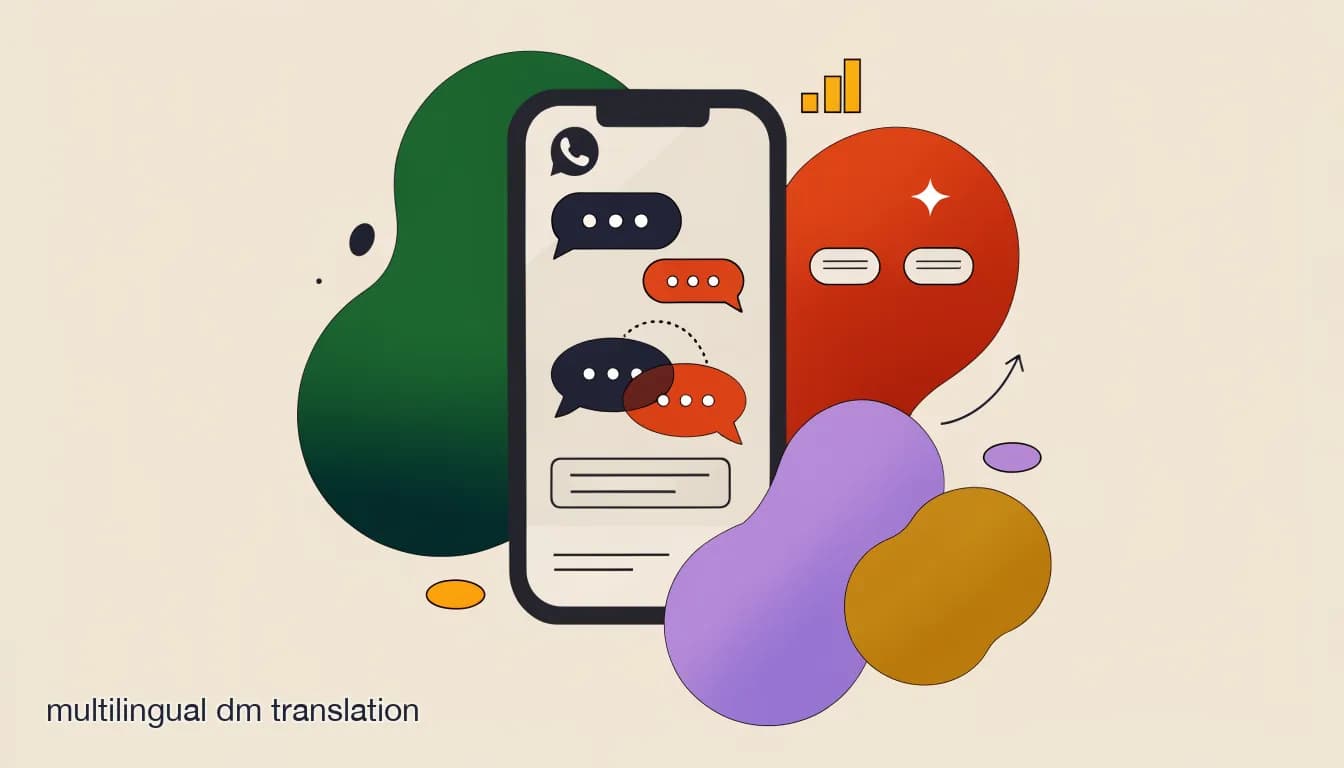
The mechanics matter less than what the agent actually experiences during a shift: a message arrives in Spanish, the inbox displays it already translated into English right inside the thread, the agent types a reply in English, and the guest receives it auto-translated back into Spanish. No app-switching, no copy-paste, no separate translation log sitting outside the conversation history.
A WhatsApp inquiry in French, handled entirely in English
- Guest sends
- "Bonjour, avez-vous une place pour 4 personnes le 12 juillet ?"
- Agent sees
- "Hi, do you have space for 4 people on July 12th?" — translated inline
- Agent replies
- Types the answer in English; the guest receives it auto-translated into French
Which channels need translation coverage — WhatsApp, Instagram, or Facebook?
All three, if that is where your inquiries land, because travelers do not pick a channel based on which one your team translates best — they use whichever app they already have open. A guest who found you on Instagram will DM you there; a guest who got your WhatsApp number from a hotel concierge will message there instead. Splitting translation coverage across only one channel just moves the leak rather than closing it.
| Channel | Typical use by international travelers | Needs translation? |
|---|---|---|
| Direct booking questions, often shared by hotels/partners | Yes — highest inquiry volume for most operators | |
| Instagram DM | First contact after finding a tour post or reel | Yes — first impression channel |
| Facebook Messenger | Older demographics, group-trip organizers | Yes — still active for family and group bookings |
How do you train an AI agent to qualify leads across languages?
An AI agent trained on your tour catalog, pricing, and policies can handle first-response qualification in any language the translation layer supports, so a human only steps in once a lead is warm and ready to book. Setting it up is mostly about giving it the same information you would give a new hire.
- Upload your knowledge baseTour descriptions, pricing, availability rules, cancellation policy, and common FAQ answers in your working language.
- Define qualification questionsDates, group size, budget range, and any must-ask details like accessibility needs or dietary restrictions.
- Turn on translation for all connected channelsSo the agent's questions and the guest's answers translate automatically, regardless of the inbound language.
- Set the handoff ruleOnce a lead answers the qualification questions, route the thread to a human agent to close the booking.
- Review transcripts weeklyEspecially in languages your team does not speak natively, to catch anything that reads oddly and adjust the knowledge base.
What translation mistakes actually cost bookings?
Most translation failures are not dramatic mistranslations — they are small omissions that compound. A currency symbol that does not get converted, a date format read the wrong way round (day/month versus month/day), or a tone that reads as curt in the target language even though it was friendly in the original.
- Assuming a translated price is understood in the guest's local currency without stating the currency explicitly.
- Sending dates in a format that is ambiguous once translated (spell out the month to avoid day/month confusion).
- Letting a short, efficient reply translate into something that reads as abrupt or rude in the target language.
- Skipping a human check on messages that mention medical, dietary, or legal details.
Write dates and currency unambiguously in the source message
Spell out the month ("July 12" not "12/7") and always name the currency ("$120 USD") before translation happens. This removes the two most common translation-adjacent booking errors regardless of which language the message ends up in.
How do you roll out multilingual support without disrupting your team?
Switching to a translated inbox is a smaller change than it sounds, because the agent's workflow stays the same — read a message, type a reply — the only difference is what appears on screen. A staged rollout keeps the team comfortable and gives you a chance to catch edge cases before peak season.
- Connect your channelsLink WhatsApp, Instagram, and Facebook to a shared inbox with translation built in.
- Pilot with one high-volume languageTurn on translation for your second-most-common language first and watch reply quality for a week.
- Expand to all languagesOnce the team is comfortable, enable translation across every inbound language automatically.
- Set the original-message-visible ruleKeep the untranslated original one click away so any team member who happens to read that language can double-check.
How does KlyoChat handle multilingual travel DMs?
KlyoChat's shared inbox translates inbound WhatsApp, Instagram, and Facebook messages in real time, so your team reads and replies in the language they work in while the guest reads their own — inline, in the same thread, with no separate app. Combined with an AI agent trained on your tour catalog and policies, first-response qualification questions can go out and come back translated automatically, even outside business hours, so a lead that arrives at 2am in Japanese is qualified before your team logs on.
It is not a replacement for a bilingual specialist on your single biggest market, where nuance and trust matter most. It is coverage for every other market you would otherwise be unable to serve at all, running inside the same inbox your team already uses for the languages they do speak.
A qualification exchange handled entirely by translation + AI agent
- Guest (Portuguese)
- Asks about a group tour for 6 people in August
- AI agent
- Replies in Portuguese, asks dates, budget, and any dietary needs — translated automatically
- Human agent
- Steps in once qualified, sees the full thread and original messages, confirms the booking
Does closing the language gap change reviews and referrals too?
Reviews from international guests carry outsized weight because they signal to future travelers from that same country that the operator can actually handle their language, not just their money. A guest who booked, communicated, and resolved a last-minute question smoothly in their own language is far more likely to leave a detailed, positive review — and to recommend the operator inside language-specific travel forums and group chats that never show up in your analytics.
The reverse is also true: a guest who struggled through a garbled exchange, even if the tour itself went well, often mentions the communication friction in their review. That single line can cost future bookings from the same language community for months, long after the original conversation is forgotten by everyone except the review page.
- International reviews often mention communication quality explicitly, separate from the tour experience itself.
- A smooth translated booking exchange tends to produce more detailed, specific reviews.
- Language-community referrals (forums, group chats, family networks) rarely show up in standard attribution tracking.
- Fixing the language gap compounds — each good multilingual experience makes the next inquiry in that language easier to close.
Is multilingual DM translation worth it for a small tour operator?
If any meaningful share of your inquiries come from outside your primary language market — and for most destinations with international visitors, that share is larger than operators expect once they actually check — the answer is yes. The cost of a translation-enabled inbox is a fraction of the value of even one recovered booking, and it requires no new hire, no new workflow to learn, and no separate tool to maintain outside the inbox your team already lives in.
Check your own numbers before deciding
Look back at your last month of inquiries and count how many arrived in a language other than your team's primary one. That number, multiplied by your average booking value, is usually a bigger figure than operators expect — and it is the real ROI case for translation.
Language should never be the reason a ready-to-book traveler goes to a competitor instead. Whether you handle translation with dedicated staff, a standalone tool, or a shared inbox that translates inline and pairs it with an AI agent for first response, the goal is the same: reply fast, reply accurately, and never let a message sit untranslated while the booking window closes.
Start by auditing a month of your own inbox to see how many languages are actually showing up, then decide whether staff, a tool, or a mix of both closes the gap fastest. The audit alone usually settles the debate — most operators are surprised by how much international demand they were already receiving, and quietly losing, before they ever looked.