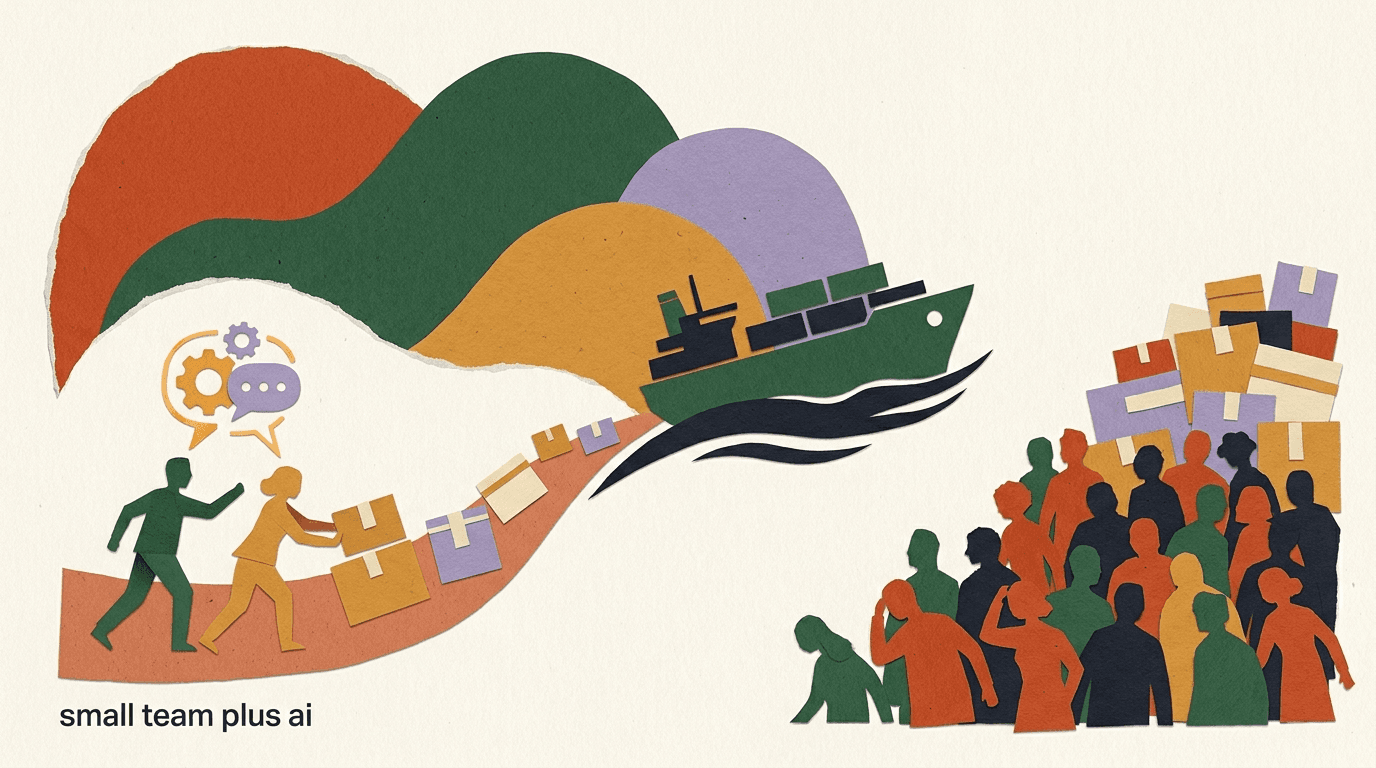
The small teams AI advantage is the quiet story of the last two years: two people with good tools now ship things that used to take twenty. A solo founder answers support across five channels overnight. A three-person agency runs campaigns that would have needed a department. None of this is because small teams suddenly got smarter. It is because AI closed the gap between what a lean team can imagine and what it can actually execute, and because small teams can move without asking anyone for permission.
This is an opinion piece with a practical spine. We think the advantage is real, but we also think it is easy to overplay. AI does not replace judgment, it does not build relationships, and leaning on it too hard produces work that looks finished and is quietly wrong. So this article does two things at once: it argues why small teams now punch above their weight, and it stays honest about where that leverage runs out.
Full disclosure — we build KlyoChat, an AI-native tool made for small teams, so we have a stake in this. We have kept the argument general and useful whether or not you ever touch our product. Most of what follows is about how to think and what to do, not what to buy.
What does the small teams AI advantage actually mean?
The phrase gets thrown around loosely, so let us pin it down. The small teams AI advantage is not the claim that small is always better. It is the observation that the historical penalty for being small has shrunk. For most of business history, scale bought capability: more people meant more things you could do at once, more specialists, more coverage, more output. Being small meant choosing what to skip.
AI changes the arithmetic. A single person can now hold a first draft of nearly any function — support, research, copy, code, analysis — at a quality that used to require hiring for it. The output is not always as good as a specialist's, but it is good enough often enough that the small team no longer has to leave whole functions empty. That is the shift. Not that small beats big, but that small no longer means absent.
There is a useful way to see it. Big organizations convert money into capability through headcount. Small teams now convert time and taste into capability through tools. The second path is faster to start, cheaper to run, and much easier to change your mind about. It is also thinner — one person plus AI is not the same as a real team — and pretending otherwise is where people get hurt.
This is leverage, not magic
AI gives a small team leverage on the work it already understands. It does not give you understanding you do not have. A founder who knows their customers gets far more from AI than one who is guessing, because they can tell when the output is wrong. Judgment is the multiplier.
Why can small teams now out-ship big ones?
Shipping is the thing that matters, so start there. To out-ship a bigger competitor, you do not need to be better at everything. You need to get more useful work in front of customers, faster, and to keep doing it. Small teams have three structural things going for them here, and AI amplifies all three.
The first is speed of decision. A small team decides in a conversation what a large one decides in a meeting series. There is no committee, no sign-off chain, no cross-department alignment. When you have an idea on Monday, you can have it live on Wednesday. AI compresses the execution step even further, so the bottleneck that used to be capacity — we cannot build that this quarter — often disappears.
The second is proximity to the customer. In a two-person company, the person who talks to customers is the person who builds the product and the person who decides what to do next. There is no translation loss. The signal arrives raw. AI helps you process more of that signal — summarizing conversations, spotting patterns across hundreds of messages — without adding the layers that usually dull it.
The third is the absence of things to protect. Big companies move slowly in part because they have a lot to lose: brand risk, existing revenue, internal politics, careful reputations. A small team has less to defend and so can take shots a larger one would veto. When AI lowers the cost of taking a shot, small teams take more of them, and shipping more shots is how you win a category before the incumbent notices.
Put these together and the pattern becomes clear. Out-shipping is not about being faster on any single task — a large company with a big budget can often build one thing faster than you can. It is about the cadence across many small bets. A small team that ships something small every few days, learns from it, and adjusts will, over a quarter, cover more ground than a large team shipping one polished release. AI does not change the direction of that math, it steepens it, because the execution cost of each small bet drops toward zero while the learning value of each one stays the same.
The trap is mistaking motion for progress. Shipping fast only wins if you are shipping things customers want, and speed makes it easier to ship the wrong things faster. The small teams that actually out-ship do two things at once: they move quickly, and they stay honest about what is working. The second discipline is what turns raw speed into a durable lead rather than a busy quarter with nothing to show for it.
Same idea, two org sizes
- Large company
- Idea → brief → prioritization → sprint planning → build → review → legal → launch (6-10 weeks)
- Small team + AI
- Idea → rough draft with AI → test with a few customers → ship → iterate (2-4 days)
What structural advantages does a lean team really have?
It is worth separating the advantages that are real and durable from the ones that sound good on a conference stage. Speed and proximity, above, are real. A few others get overstated, and being clear-eyed about them keeps you from believing your own marketing.
The durable advantages are mostly about coordination cost. Every person you add to a team adds communication overhead — more people to inform, align, and wait for. A famous rule of thumb holds that adding people to a late project makes it later, because the coordination cost outruns the extra hands. Small teams pay almost none of this tax. Two people share context by osmosis. Ten people need a system to share context, and that system is itself work.
AI is unusual because it adds capability without adding coordination cost. An AI agent does not need to be brought up to speed in a standup, does not have competing priorities, and does not need its work politically managed. So a small team using AI gets some of the capability of a larger team without paying the overhead that makes larger teams slow. That is the core mechanism behind the whole advantage, and it is worth understanding rather than just feeling.
| Dimension | Big team | Small team + AI |
|---|---|---|
| Decision speed | Slow — many stakeholders | Fast — one conversation |
| Coordination cost | High and rising | Low and flat |
| Customer signal | Filtered through layers | Raw and direct |
| Risk appetite | Low — much to protect | High — little to lose |
| Depth of expertise | Deep specialists | Broad but shallower |
| Resilience | Redundant, survives churn | Fragile — few points of failure |
The last two rows are the honest cost
Depth and resilience are where big teams still win. A small team plus AI is broad but shallow, and if one person burns out or leaves, a large share of the knowledge goes with them. Do not let the speed advantages blind you to the fragility you are carrying.
How does AI cover the gaps a small team cannot staff?
The most practical part of the advantage is gap coverage. Every small team has functions it cannot afford to fill: a dedicated support person, a researcher, a copywriter, an analyst, a first-line salesperson. Traditionally you either did these jobs badly in your spare time or did not do them at all. AI lets you do them adequately without hiring, which changes what a small team can credibly offer.
Think of AI here as a competent junior who never sleeps and never complains, but who also needs checking. It can draft the support reply, summarize the research, write the first version of the landing page, pull the numbers into a table, and answer the customer's first question at 2 a.m. None of these outputs are final. All of them save the hours that a lean team does not have. The gap does not vanish, but it shrinks from a chasm to a manageable step.
The teams that get the most from this treat AI as coverage for the boring 80 percent so their scarce human hours go to the valuable 20 percent. A founder who no longer writes every support reply from scratch spends that time on the three conversations that actually decide whether a big customer stays. That reallocation — not the raw automation — is where the leverage compounds. We wrote more about how this reshapes roles in our piece on AI agents and the future of work.
It helps to be precise about what gap coverage is not. It is not a replacement for the specialist you would eventually hire; it is a bridge that keeps the function alive until you can. A small team that would otherwise ship a product with no help documentation, no first-line support, and no analysis at all can now ship with adequate versions of each. Adequate is not excellent, but adequate beats absent every time, and absent was the honest baseline for most lean teams before these tools existed. The advantage is measured against that baseline, not against a well-staffed competitor's best work.
- Support: AI handles first response and routine questions; humans take the hard, emotional, or high-value ones.
- Research: AI gathers and summarizes; humans decide what it means and what to do.
- Content: AI drafts; humans edit for voice, accuracy, and judgment.
- Operations: AI handles repetitive data entry, tagging, and routing; humans handle exceptions.
- Sales: AI qualifies and answers early questions; humans build the relationship and close.
Cover gaps, do not fake expertise
AI covering a gap means getting adequate work where you had none. It does not mean claiming expertise you lack. If you use AI to answer legal, medical, or financial questions for customers, you have not filled a gap — you have created a liability. Know the difference.
What should a small team automate first?
The instinct when you get a capable tool is to automate everything, which is how people waste the first month building clever systems for problems they do not have. The better approach is to automate in order of pain and safety: start where the work is most repetitive and the cost of a small mistake is lowest, then move up.
A simple filter helps. For any task, ask two questions: how often do I do this, and how bad is it if the AI gets it slightly wrong? High-frequency, low-stakes tasks are the sweet spot — they save real time and a mistake is cheap to catch. Low-frequency, high-stakes tasks are the worst place to start, because you save little and risk a lot. Automate the first, keep the second human until you deeply trust the system.
Here is the order most small teams should actually follow. It front-loads the tasks that free the most hours with the least risk, and it defers the judgment-heavy work until you have built the habit of checking AI output well.
One more filter is worth applying before you build anything: is this a task you understand well enough to check? Automating a task you do not truly understand is how errors compound silently, because you cannot tell a good output from a bad one. The tasks you have done a hundred times by hand are the safest to hand off, precisely because your gut instantly flags when the AI drifts. Save the unfamiliar work for later, when you have either learned it yourself or added a person who has.
- Start with repetitive customer questionsThe same ten questions arrive daily. Let AI handle first response with a reviewed knowledge base. High frequency, low stakes, immediate time savings.
- Add drafting for content you already editAI writes first drafts of replies, posts, and pages. You were going to edit anyway, so a rough draft only saves the blank-page tax.
- Automate routing, tagging, and summariesLet AI sort incoming messages, tag them, and summarize long threads. Invisible work that quietly eats hours.
- Layer in research and first-pass analysisAI gathers and structures information. You keep the judgment about what it means. Useful, but check the facts.
- Only then touch judgment-adjacent workPricing, hiring, strategy, sensitive customer situations. Keep these human-led with AI as a sounding board, not a decider.
The first win should be boring
If your first automation is exciting, you probably picked something too risky. The best first project is a boring one that saves an hour a day and would embarrass no one if it failed. Boring wins build the trust and the habits you need for the harder stuff.
Where does the small team advantage break down?
An honest opinion piece has to spend real time on the failure modes, because the advantage is genuine and the risks are equally genuine. Ignoring either half gives you a bad decision. Here is where the small-team-plus-AI model breaks, in roughly the order it tends to bite.
The first break is over-reliance. When AI is good enough often enough, it is tempting to stop checking. This works until the day it does not, and because AI fails confidently — producing wrong answers in the same fluent tone as right ones — you often do not notice until a customer does. A small team has no second pair of eyes by default, so the errors that a larger team would catch in review slip straight through to production.
The second break is thin oversight. In a big company, work passes through several people, and each catches a fraction of the mistakes. A solo founder plus AI has removed all of those checkpoints. The speed you gained by cutting the review chain is exactly the speed at which errors now reach customers. Speed without oversight is not an advantage, it is just faster failure.
The third break is sameness. If every small team uses the same AI tools with the same default prompts, the output converges. AI is trained on the average of what exists, so unguided it produces the average. The teams that stand out are the ones that use AI for the draft and then add the specific taste, voice, and point of view that AI cannot originate. Lean on the defaults and you will sound like everyone else, which is its own kind of losing.
- Over-reliance: you stop checking, and confident errors reach customers.
- Thin oversight: no second reviewer, so the safety net a big team has is gone.
- Sameness: default prompts produce average output that blends into the crowd.
- Fragility: knowledge lives in one head plus some tools, and both can disappear.
- Skill atrophy: if AI always drafts, your own craft can quietly rust.
Confident wrongness is the signature risk
The specific danger of AI is not that it fails, but that it fails in a fluent, plausible voice. A wrong answer looks exactly like a right one. On a small team with no reviewer, that is the error most likely to reach a customer. Build a checking habit before you build a scaling habit.
How do you keep the human in the loop without losing speed?
The obvious response to those risks is oversight, and the obvious objection is that oversight is slow — the very thing you were trying to escape. The resolution is that not all oversight costs the same, and a small team should spend its limited checking budget where mistakes are expensive, not spread it evenly across everything.
Think in tiers. Some AI output can ship with no human check because a mistake is trivial and reversible: an internal summary, a draft you will edit anyway, a tag on a message. Some output needs a glance before it goes out: a customer reply on a sensitive account, a public post, anything with your name on it. And some output should never ship without a human deciding: pricing, promises, legal or financial statements, anything hard to walk back. The skill is putting each task in the right tier and not treating them all the same.
This is how you keep speed and safety at once. You are not reviewing everything, which would kill the advantage. You are reviewing the small fraction where review actually pays for itself. Done well, a small team spends most of its human attention on the 10 percent of decisions that matter and lets AI run free on the 90 percent that do not. Automation, at its best, is about choosing what deserves a human rather than removing humans entirely.
| Tier | Human involvement | Example |
|---|---|---|
| Ship freely | None — reversible, low stakes | Internal summaries, message tags, first drafts |
| Glance first | Quick review before it leaves | Customer replies, social posts, public copy |
| Human decides | AI advises, human commits | Pricing, refunds, legal claims, hiring |
Set the tiers once, then trust them
Decide which tasks live in which tier before you are busy, not in the moment. When the pressure is on, you will default to whatever is fastest, and without a rule that means shipping unchecked. A written tier list is a five-minute investment that prevents your worst mistakes.
How do you build an AI-augmented workflow that keeps quality high?
Beyond the tier system, a few working habits separate the small teams that use AI well from the ones that produce fast, forgettable output. These are not tools, they are practices, and they cost nothing but discipline.
The first habit is to treat AI as a first drafter, never a final author. The blank page is the expensive part of most work; AI removes it. But the value you add — your judgment, your specific knowledge of your customer, your voice — goes in the editing, not the generating. Teams that ship the raw draft are trading their one advantage, taste, for a little more speed they did not need.
The second habit is to feed AI your specifics. Generic input produces generic output. If you give an AI agent your real knowledge base, your actual customer questions, your genuine voice and constraints, it produces work that sounds like you. If you give it nothing, it produces the average of the internet. The difference between a small team that stands out and one that blends in is often just how much specific context they bother to provide.
The third habit is to keep a human close to anything a customer feels. People can tell when they are talking to something that does not care, and no amount of fluent text hides an absence of genuine attention on the things that matter to them. Use AI to handle the volume so your humans have time for the moments — and be deliberate about which moments those are. We go deeper on this balance in our note on why we built KlyoChat the way we did.
AI raises the floor, taste raises the ceiling
AI reliably lifts the quality of your worst output — the rushed reply, the draft you would have skipped. It does not lift your best. The ceiling is still set by human taste and judgment. Small teams win by keeping their taste sharp and letting AI handle the floor.
Generic prompt vs specific context
- Generic
- Write a reply to a customer asking about refunds → bland, could be any company
- With your context
- AI trained on your refund policy, past replies, and tone → sounds like you wrote it
What are the risks of over-relying on AI as a solopreneur?
Solopreneurs feel every one of these risks more sharply than teams, because there is no one else at all. If you are a company of one, AI is not covering a gap between specialists — it is the entire rest of your organization. That makes the leverage bigger and the failure modes more dangerous, and it is worth naming them plainly.
The first risk is that you lose the ability to tell good from bad. Skill comes from doing, and if AI does all the doing, your own judgment stops improving and eventually starts to fade. The founder who has written a thousand support replies can instantly spot when an AI reply is off. The one who has never written any cannot. Keep your hand in the work enough to stay a good judge of it, even when you no longer need to do all of it.
The second risk is a false sense of coverage. Because AI produces a full, confident answer to almost anything, a solopreneur can feel covered in areas where they are actually exposed — legal, tax, security, compliance. The output looks authoritative. That is precisely why it is dangerous. In domains where being wrong is expensive, AI output is a starting point for a real expert, not a substitute for one.
The third risk is quiet fragility. A solo operation running on AI has an enormous amount of leverage sitting on a very thin base: one person's attention, one set of accounts, a handful of tools. It works beautifully right up until the person gets sick, the tool changes its pricing, or an account gets locked. Big companies are slow partly because they are built to survive these shocks. A solopreneur trades that resilience for speed, which is often the right trade — as long as you know you made it.
Speed is borrowed against resilience
Every layer a small team removes to move faster is also a layer of protection removed. That is a reasonable trade when you are small and need to move. It stops being reasonable the moment real revenue or real customers depend on you. Add resilience back deliberately as you grow, before something forces you to.
How do you stay human when AI does more of the work?
This is the part that gets treated as soft and is actually the hardest. The whole advantage of a small team is that it is close to its customers and has a point of view. AI, used carelessly, erodes both — it puts distance between you and the people you serve, and it nudges your voice toward the average. Staying human is not sentiment. It is protecting the exact thing that lets a small team win.
Concretely, staying human means a few things. It means letting AI handle volume so that when a customer reaches a person, that person has the time to actually pay attention. It means writing in your own voice and using AI to help, not the reverse. It means being honest with customers about where they are talking to automation and where they are talking to you — people forgive a bot answering a simple question and resent being tricked into thinking one was a person. And it means keeping the relationships, the judgment calls, and the genuine care as human work, because those are not gaps AI can fill.
There is a version of the small-team future that is grim: a flood of AI-generated sameness, companies of one that feel like companies of none, customers talking to systems that do not care. There is also a better version, where AI absorbs the drudgery and frees small teams to be more human with the people who matter, not less. Which version you get is not decided by the tools. It is decided by how you choose to use them.
In practice, the choice shows up in small, repeated decisions rather than one grand stance. It is whether you take the extra minute to rewrite the AI draft in your own words, whether you route the frustrated customer to a person or let a bot keep trying, whether you tell someone plainly that they are talking to automation. None of these decisions is dramatic. Made consistently, they are the difference between a small team that uses AI to stay close to its customers and one that quietly uses it to drift away from them.
- Use AI for volume so humans have time for the moments that matter.
- Keep your own voice; use AI to help write it, not to replace it.
- Be honest about where customers are talking to automation.
- Keep relationships, hard judgment calls, and genuine care human.
- Stay close enough to the work that you remain a good judge of it.
The competitive moat is care
As AI makes competent output cheap and common, the scarce thing becomes genuine attention. A small team that uses AI to buy back time and spends it caring about customers will beat one that uses the same time to churn out more average content. Care does not scale cheaply, which is exactly why it is worth so much.
What does a day in an AI-augmented small team look like?
Abstract principles are easy to nod along to and hard to act on, so here is a concrete picture. Imagine a three-person business — a founder, a maker, and a person who handles customers — selling something online across a few channels. Here is how AI reshapes an ordinary day without replacing any of them.
Overnight, an AI agent answered the routine customer questions across every channel: where is my order, how does the return work, does it fit this use case. It handled the first response, resolved the simple ones, and flagged the four that needed a human. In the morning, the customer person opens a summarized queue instead of a chaotic inbox — the AI has tagged, sorted, and drafted replies for the four flagged conversations. They spend thirty minutes editing and sending, then an hour on the one genuinely upset customer who needs real attention. Before AI, that morning was three hours of triage and the upset customer got a rushed reply.
The founder, meanwhile, asked AI to summarize the week's conversations and spot patterns. It surfaces that a dozen customers asked about a feature the product does not have. That is a real signal that used to drown in the noise. The maker uses AI to draft the first version of a help doc and a landing page section, then rewrites both in the company's voice. By afternoon, the team has shipped a fix, published a page, and had a real conversation with a customer who mattered — the kind of day that used to require twice the people.
The important thing about that day is what it did to the shape of the work, not just the volume. Before AI, the team spent most of its energy on maintenance — keeping up with the inbox, not falling behind — and had little left for the work that moves a business forward. The drudgery set the ceiling. After AI, maintenance shrinks to a manageable slice of the morning and the rest of the day is available for the things only humans can do: deciding what to build, talking to the customer who is upset, spotting the pattern that becomes next quarter's roadmap. The team did not become superhuman. It stopped drowning, and a team that is not drowning makes far better decisions than one that is.
Notice what did not change
In that day, no human was replaced. The upset customer still reached a person. The voice was still the team's own. AI changed the ratio of drudgery to meaningful work, not the presence of humans. That is the version of the advantage worth building toward.
The customer person's morning, before and after AI
- Before AI
- 3 hours of inbox triage, every reply from scratch, upset customer gets a rushed answer
- After AI
- 30 min editing drafted replies, 1 hour on the customer who matters, patterns already surfaced
How do you measure whether AI is actually helping?
It is easy to feel productive with AI and hard to know if you actually are. New tools produce a burst of novelty that feels like progress, and some of it is theater — clever automations that save less time than they took to build. A small team cannot afford that self-deception, so it helps to measure the advantage rather than assume it.
The measures that matter are boring and concrete. How many hours a week did you get back, and what did you spend them on? Did response times to customers improve? Did the quality of what you ship hold or slip? Are you shipping more of the things that move the business, or just more things? A small team that tracks these honestly will quickly see which automations earn their keep and which were fun to build and worthless to run.
Watch for the warning signs too. If your output volume went up but customer satisfaction went down, you automated the wrong thing or removed a human where one was needed. If you are spending more time managing AI than you saved, the automation is a net loss. If your work is faster but blander, you traded taste for speed. Measuring keeps you honest, and honesty is what turns a shiny tool into a durable advantage.
| Metric | Good sign | Warning sign |
|---|---|---|
| Hours reclaimed | Spent on high-value work | Spent managing the AI |
| Response time | Faster to customers | Faster but lower quality |
| Output quality | Held or improved | Blander, more generic |
| What you ship | More of what matters | More of everything |
| Customer sentiment | Steady or up | Down as volume rose |
Reclaimed hours are the real number
The single most useful metric is honest: how many hours did AI actually give back this week, and where did they go? If the answer is a lot and they went to work that matters, you have the advantage. If the answer is unclear, you probably have novelty dressed up as progress.
When does a big company's size still beat a small team's speed?
A balanced piece has to admit the other side, because size still wins in several situations and pretending otherwise sets small teams up to pick fights they cannot win. Knowing where the advantage runs out is as valuable as knowing where it holds.
Big beats small when the work requires deep, specialized expertise that AI can assist but not replace — advanced engineering, regulated domains, anything where being slightly wrong is catastrophic. It beats small when trust and scale are the product: enterprise buyers often need the assurance that a vendor will still exist and support them in five years, and a company of three struggles to offer that. It beats small when the job genuinely requires many hands at once — physical operations, large-scale logistics, round-the-clock human coverage that AI cannot yet provide. And it beats small on resilience: a large organization survives the loss of any one person, while a small team often does not.
The strategic lesson is not to avoid competing with big companies, but to compete where your advantages apply. Small teams win on speed, focus, customer intimacy, and the willingness to serve niches too small for a large company to bother with. They lose on depth, scale, resilience, and trust-at-size. Pick the fights that reward the first list and avoid the ones that punish you on the second. The artificial intelligence that makes small teams faster does not change these fundamentals — it just widens the range of fights a small team can pick.
There is also a timing dimension worth naming. The small-team advantage is strongest early, when a market is new and the winning move is to learn fast and serve a niche well. As a market matures and buyers start to prize stability, breadth, and guarantees, the balance tips back toward scale. Many of the best outcomes for small teams come from moving quickly while the advantage is with them — establishing a loyal base, a clear point of view, and a reputation for care — so that by the time larger competitors arrive, there is something real to defend. AI does not remove that clock. It just lets you do more before it runs out.
Where each size wins
- Small team + AI wins
- Speed, niche focus, customer intimacy, rapid iteration, underserved segments
- Big company wins
- Deep expertise, scale, resilience, enterprise trust, regulated or high-stakes work
How does a tool like KlyoChat fit a small team?
Everything above is true regardless of what tools you use, and you can build most of it with pieces you assemble yourself. We mention KlyoChat here because it is a concrete example of the pattern, and because we built it specifically for the small-team case rather than adapting an enterprise product downward.
The idea is simple. Small teams that talk to customers usually do it across several channels — Facebook, Instagram, WhatsApp, Telegram, TikTok, X — and juggling six inboxes is exactly the kind of drudgery that eats a lean team's hours. KlyoChat pulls those into one place and adds AI agents that handle first response and routine questions, so a two- or three-person team can cover conversations at a scale that would otherwise need more people. It is AI-native and mobile-first, which matters when the whole team is often away from a desk. You can see how the AI side works on our AI agents page, and more about who we are on our about page.
We are deliberately honest about the limits, because the whole argument of this article is that honesty beats hype. AI agents augment a small team; they do not replace the judgment, relationships, and care we spent this whole piece defending. KlyoChat does not do native SMS or email, so if those are core to you, factor it in. And we are a newer, smaller product with a smaller community than the incumbents — which is its own trade-off. The reason to consider a tool like this is not that it is magic. It is that it does the specific, boring, high-volume work that lets your scarce human hours go where they count.
| Small-team need | The drudgery version | The AI-augmented version |
|---|---|---|
| Multi-channel messages | Six inboxes, constant switching | One unified inbox |
| First response | Founder answers everything | AI handles routine, flags the rest |
| Working on the go | Tied to a desktop | Mobile-first, answer anywhere |
| Scaling conversations | Hire more people | AI covers volume, humans cover moments |
A tool is the how, not the why
Whether you use KlyoChat or assemble your own stack, the principle is the same: let AI absorb the repetitive volume so your small team spends its human attention where it matters. The tool is interchangeable. The discipline of using it well is not.
How do you get started this week without overreaching?
The failure mode of pieces like this is that they inspire a grand plan that never ships. So end small and concrete. You do not need an AI strategy. You need one boring automation that saves an hour, and the habit of checking its output well. Everything else builds from there.
Pick the single most repetitive, lowest-stakes task you do — almost certainly answering the same handful of customer questions — and let AI handle the first response while you keep a hand on the review. Give it your real context: your actual answers, your real voice, your genuine policies. Watch it for a week. Measure the hours you got back and where they went. If it works, add the next boring task. If it does not, you learned that cheaply and lost nothing.
That is the entire method. Start where mistakes are cheap, feed it your specifics, keep a human close to anything a customer feels, and measure honestly. The small teams that out-ship big ones are not the ones with the most ambitious AI plans. They are the ones who quietly automated the drudgery, kept their taste sharp, and spent the reclaimed time being more useful to the customers who matter. The advantage is real. Using it well is a choice you make every day.
- Pick one boring, low-stakes taskThe most repetitive thing you do where a small mistake is cheap to catch. Usually routine customer questions.
- Feed the AI your real contextYour actual answers, voice, and policies — not generic prompts. Specific input is what makes output sound like you.
- Keep a human on review for a weekCheck the output before it ships. You are building trust in the system and a habit of catching confident errors.
- Measure hours reclaimed and where they wentIf the time went to work that matters, it is working. If it is unclear, adjust before you scale.
- Add the next task only when the last one is trustedGrow the system one boring win at a time. Speed comes from compounding small automations, not one big leap.
Ship one thing, then compound
The teams that win with AI are not the ones who planned the most. They are the ones who shipped one small automation, measured it, trusted it, and added the next. Start this week with something boring, and let the advantage compound from there.
The small teams AI advantage comes down to a simple exchange: AI absorbs the repetitive volume that used to require headcount, and small teams convert the reclaimed time into speed, focus, and genuine attention on the customers who matter. That is a real edge over larger, slower competitors — but only if you keep the judgment human, check the confident errors, and refuse to trade your taste for a little more output.
The advantage is not that small beats big. It is that small no longer means absent, and that the historical penalty for being lean has shrunk to something a good tool and a clear head can overcome. For more on how AI is reshaping who does what, read our take on AI agents and the future of work, and on why working from your phone matters more than ever for lean teams, see our thoughts on mobile-first SaaS in 2026. Start small, stay human, and measure honestly — that is the whole playbook.