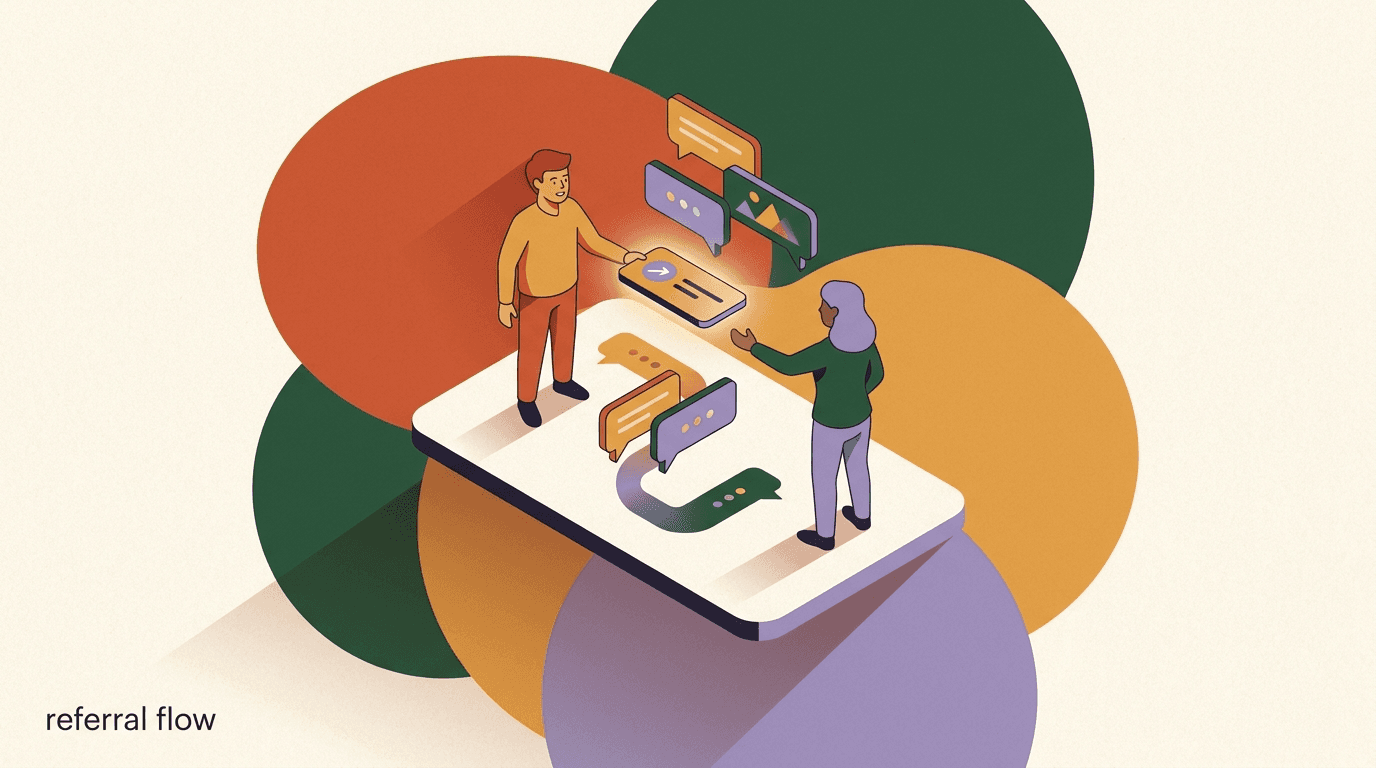
A referral flow is the automated conversation that asks a happy customer to recommend you, hands them a personal referral link or code, and thanks them when someone they sent actually buys. Built inside chat — Instagram DMs, WhatsApp, Messenger, or Telegram — it lives where your best customers already talk to you, which is why it tends to convert better than the email version most brands default to. This guide walks through building one end to end: who to invite, what to say, how to deliver the link, how tracking really works, and how to reward both sides without turning your program into a discount leak.
We will be direct about one thing from the start, because it changes how you should read everything below. A chat tool automates the messaging side of a referral flow — the invite, the delivery, the follow-up, the thank-you. It does not, on its own, track who referred whom or attribute a sale to a referrer. That tracking comes from your store or a dedicated referral app that issues unique links and codes. The pattern that works is to let your store handle the accounting and let your chat automation handle the human conversation around it. Keep that division of labor in mind and the rest of this becomes a build tutorial rather than a wish list.
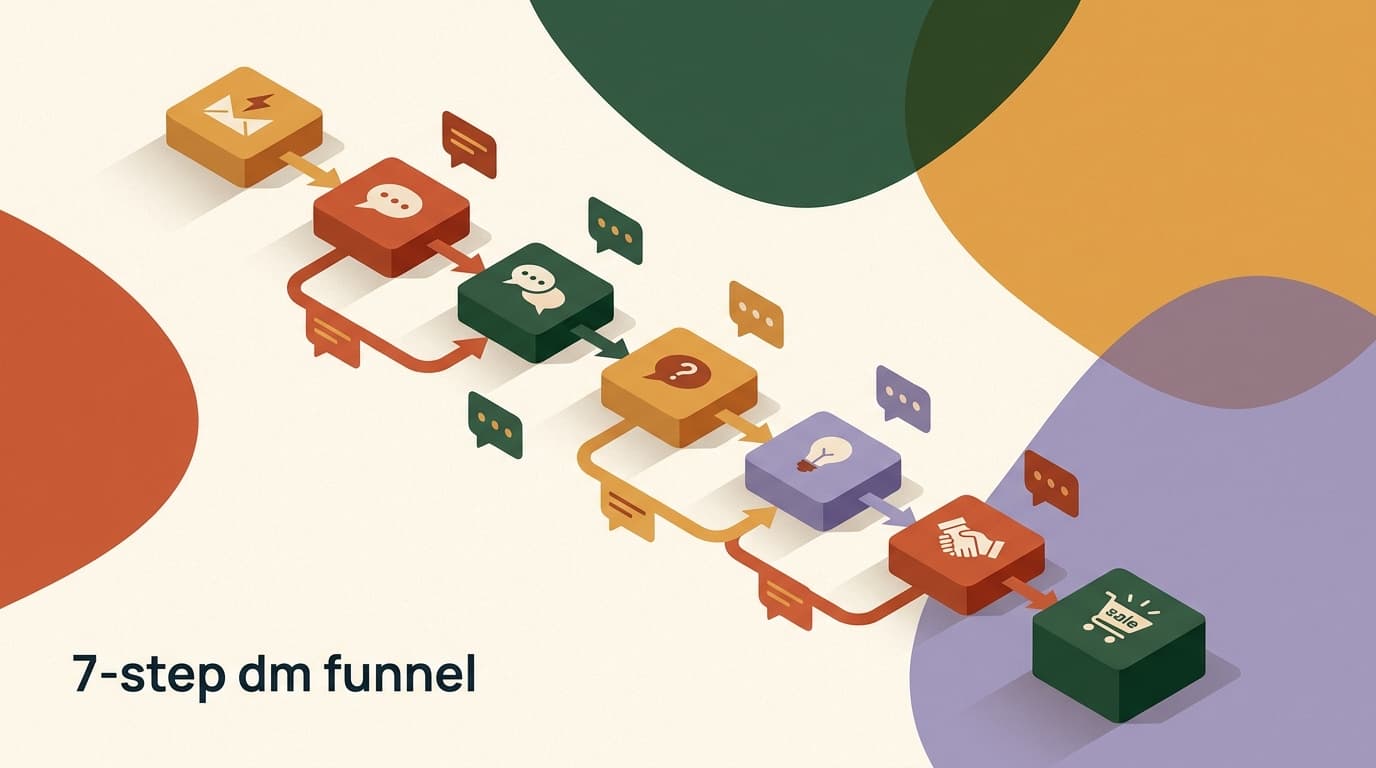
This post is written for creators, small brands, and anyone running direct-to-customer sales who already has a handful of people who love the product and just needs a repeatable way to ask. We include sample copy you can adapt, tables you can use as planning templates, and honest notes about where the automation ends and your other tools begin. If you have already built a DM funnel or a welcome sequence, a referral flow slots in alongside them as another automated conversation you run inside the no-code flow builder. For the theory behind why word-of-mouth converts, referral marketing has a solid overview.
What is a referral flow, and why build it in chat?
A referral flow is a structured, mostly automated sequence that moves a satisfied customer through five stages: invite, deliver, track, reward, and follow up. The invite asks them to refer a friend. The delivery hands over the thing they will actually share — a link or a code. Tracking records the referral when it converts. The reward pays out to one or both parties. The follow-up keeps the loop alive so a single customer refers more than once. Each stage is a small piece of messaging, and messaging is exactly what chat automation is built to run. Referrals also pair naturally with the wider work of turning DMs into revenue — your happiest buyers become a distribution channel, and you can see the whole program in pricing terms of what a new referred customer costs you versus a paid one.
Building it in chat rather than email is a deliberate choice, not a fashion. Referrals are a personal act — you are asking someone to put their own reputation on the line by recommending you to a friend. That ask feels more natural in a one-to-one conversation than in a broadcast email that clearly went to ten thousand people. In a DM, you can reference the specific thing they bought, thank them by name, and answer a question in real time if they have one. The medium matches the message.
There is also a practical open-rate argument. Direct messages on platforms like Instagram and WhatsApp are read far more reliably than marketing email, and the reply is a tap away rather than a compose-a-new-message chore. When the entire flow — ask, receive link, share, get rewarded — happens inside a single thread, friction drops at every step. Fewer steps means more referrers actually complete the loop, which is the only number that matters.
- Invite: ask a happy customer to refer, at a moment when they feel good about you.
- Deliver: hand over a unique referral link or code they can share.
- Track: record which referrals convert — handled by your store or referral app, not the chat tool.
- Reward: pay out to the referrer, the friend, or both.
- Follow up: thank, remind, and re-invite so one customer refers repeatedly.
The honest scope of this guide
Everything here is about automating the conversation. The unique link or code, and the attribution of a sale to a referrer, come from your store platform or a referral app. We will show you exactly where that hand-off sits so you build the flow on solid ground rather than assuming your chat tool does the accounting.
Why does word of mouth work better inside DMs?
Word-of-mouth marketing is old, well studied, and reliably effective because it borrows trust. A friend's recommendation carries weight that no ad can buy, since the person making it has nothing obvious to gain and a relationship to protect. The academic and practitioner literature on referral marketing keeps landing on the same conclusion: referred customers tend to convert at higher rates, stick around longer, and refer others themselves. You can read a general overview of the mechanism in the reference on referral marketing linked in our sources. The strategic question is never whether word of mouth works — it is how to make it easy to start and easy to repeat.
That is where DMs earn their place. Most referral programs fail not because the incentive is wrong but because the ask is buried. It lives on a page in the account settings nobody visits, or in an email that arrives three weeks after the customer stopped thinking about you. A chat-based referral flow puts the ask inside a live conversation at the moment the customer is most receptive — right after they praised you, right after a repeat purchase, right after they hit a milestone with your product. Context and timing do most of the work.
DMs also compress the share itself. In a chat thread, the customer receives their link, and sharing it is a forward or a copy-paste to another chat — the same muscle they use a hundred times a day. There is no jumping to a separate portal, logging in, or hunting for a share button. The lower the effort between wanting to refer and actually referring, the more referrals you get. That compression is the quiet advantage of running the whole thing in chat.
Ask when the feeling is fresh
The single biggest lever in a referral flow is timing. A customer who just told you they love the product is worth ten who bought six months ago and went quiet. Trigger the invite off a positive signal — a five-star reply, a repeat order, a milestone — not off a fixed calendar date.
What do you need before you build a referral flow?
Before you open a flow builder, get three things in place. Skipping any of them produces a flow that sends messages but cannot actually reward anyone, which is worse than no program at all because it burns goodwill. The good news is that none of these takes long, and most brands already have two of the three.
First, you need a source of unique referral links or codes. This is the piece your chat tool does not provide. It comes from your e-commerce platform's built-in referral feature, a dedicated referral or affiliate app, or — for a small program — a spreadsheet of pre-generated single-use codes you paste in manually. Second, you need a clear reward structure decided in advance: what the referrer gets, what the friend gets, and when each pays out. Third, you need a chat automation tool that can trigger a flow off a signal, send messages across your channel, tag contacts, and branch based on replies.
With those three in hand, the build is mostly copywriting and wiring. Without them, you will get halfway through and discover you have no way to tell a real referral from a friend who typed the code themselves. Settle the tracking and reward questions first — they are the hard part — and the messaging falls into place quickly.
| Requirement | Where it comes from | Why it matters |
|---|---|---|
| Unique referral links or codes | Store platform, referral/affiliate app, or a pre-generated code list | This is the tracking backbone; the chat tool does not create it |
| Reward structure | Your decision, set before you launch | Defines what each side gets and when it pays out |
| Chat automation tool | A flow builder that triggers, messages, tags, and branches | Runs the invite, delivery, and follow-up conversation |
Do not launch without a tracking source
A referral flow that sends invites but cannot attribute a sale to a referrer will generate promises you cannot keep. Confirm your store or referral app issues unique links or codes and reports conversions before you send a single invite. Messaging is easy to fix later; a broken reward promise is not.
How do you map the referral funnel before automating?
A referral funnel is just the customer's journey from happy to referring to being rewarded, drawn as steps so you can see where people drop off. Sketch it on paper before you build anything. Most referral funnels have four visible stages and one invisible one, and each stage has a job and a failure point you should design against.
The four visible stages are: the customer receives the invite, the customer accepts and gets their link, the friend clicks and buys, and the reward is issued. The invisible stage sits between the second and third — the customer actually sharing the link with someone. You cannot automate that share; it happens off your platform, in the customer's own conversations. What you can do is make the two stages around it so smooth that sharing is the only thing left to do.
Mapping the funnel first tells you where your messaging needs to reduce friction and where your other tools need to do the accounting. It also stops you from over-building. A common mistake is automating ten messages when the funnel only needs four. Draw the minimum path from happy to rewarded, automate exactly that, and add branches only where real behavior demands them.
| Funnel stage | Who does the work | Design goal |
|---|---|---|
| Invite received | Your chat flow | Land at a high-emotion moment; make the ask feel personal |
| Link delivered | Chat flow + store/app | Hand over the unique link fast, with clear instructions |
| Friend shares | The customer, off-platform | Make the link frictionless to forward; give a ready message |
| Friend converts | Store / referral app | Attribute the sale to the right referrer |
| Reward issued | Store / referral app + chat follow-up | Pay out promptly and confirm it in chat |
Step 1: How do you invite happy customers to refer?
The invite is the make-or-break message. Get the targeting and the timing right and a plain-text ask will outperform a beautifully designed campaign sent to the wrong people. The core principle is simple: only invite customers who have shown a positive signal, and invite them close to that signal.
Decide what counts as a positive signal in your business, then use it as the trigger. A five-star review, a reply that says thank you, a second or third purchase, a completed onboarding milestone, or a customer who reached a usage goal all qualify. Tag those contacts as you identify them so your flow has a clean audience to fire against. If you are building the invite as part of a larger DM funnel, our guide on how to set up a DM funnel covers the tagging and triggering mechanics in more depth.
- Define the positive signal that triggers the invitePick a concrete trigger — a five-star reply, a repeat order, an onboarding milestone. This becomes the entry condition so only genuinely happy customers get asked.
- Tag the qualifying contactsApply a tag such as happy-customer or referral-eligible when the signal fires, so your flow has a clean, intentional audience rather than your whole list.
- Write a short, personal inviteOpen by referencing what they did — the review, the reorder — then make one clear ask. Keep it to a few sentences; a wall of text kills reply rates.
- Ask a yes/no question to gate the linkEnd with something like Want your referral link? so the customer opts in with a tap. Only send the link to people who say yes; it keeps the flow consensual and your codes clean.
One ask per message
Do not combine the referral invite with an upsell, a review request, and a newsletter signup in the same message. Each competing ask lowers the chance any of them get done. The invite has one job: get a yes so you can send the link.
Referral invite copy — after a five-star reply
- Opening
- That made our day, thank you. Since you love it, can I ask a small favor?
- The ask
- We give friends of happy customers 15% off their first order — and you get a reward when they buy.
- The gate
- Want me to send your personal referral link? Just reply YES.
Step 2: How do you deliver the referral link or code?
Once the customer says yes, deliver fast and deliver clearly. This is the moment the chat tool hands off to your tracking source. The unique link or code was generated by your store or referral app; your flow's job is to place it in front of the customer with instructions clean enough that a distracted person can act on them in ten seconds.
There are two common delivery models, and the right one depends on how your tracking works. A unique link is best when your store attributes conversions automatically through that link — the friend clicks, buys, and the sale is credited without anyone typing anything. A code is best when you want the friend to enter something at checkout and you are comfortable that the code identifies the referrer. Links reduce friction; codes give the friend a discount they can see. Many programs use both — a link that pre-applies a code — which is the smoothest option when your platform supports it.
Whichever you use, send the exact message the customer should forward, not just the raw link. People freeze when asked to write their own recommendation. If you hand them a ready-to-send line with the link already in it, sharing becomes a copy-and-forward rather than a writing task. That single courtesy lifts share rates more than any incentive tweak.
- Insert the unique link or codePull the customer's personal link or code from your store or referral app and place it in the message. If your tool supports custom fields, store it per contact so it stays consistent across follow-ups.
- Include a ready-to-forward messageGive the customer a complete line they can send to a friend, link included, so sharing is a forward rather than a writing exercise.
- State the reward plainlyRemind them what they get and what the friend gets, in one sentence, so the value is fresh at the moment of sharing.
The link comes from your store, not the chat tool
To be clear about the hand-off: example.com/r/ANNA15 is issued by your store or referral app, which is also what records the conversion. The chat flow simply delivers it and talks about it. If you need the messaging engine, that is exactly what a no-code flow builder handles.
Referral link delivery copy
- The link
- Here is your personal link: example.com/r/ANNA15
- Ready to forward
- Copy this to a friend: I have been loving this — here is 15% off your first order: example.com/r/ANNA15
- The reward reminder
- When they buy, you get a $10 credit. Share it with as many friends as you like.
How do you track referrals when your chat tool doesn't?
This is the question that trips up most first-time builders, so we will spend real time on it. A chat automation platform sends and receives messages. It does not know that a stranger who bought yesterday came from a link your customer forwarded last week. Attribution — connecting a sale back to a referrer — lives in the system that owns the checkout. That means your store platform or a purpose-built referral app, never the DM tool alone.
There are three practical ways to track, in rough order of reliability. The strongest is unique referral links that your store attributes automatically: the friend clicks, and the platform credits the referrer at checkout with no manual step. The second is unique discount codes, one per referrer, where the code entered at checkout tells you who referred. The third, for small or early programs, is manual tracking in a spreadsheet — you issue codes by hand and reconcile conversions yourself. Manual works at low volume and breaks the moment the program grows, so treat it as a starting point, not a destination.
Whatever method you choose, the chat flow's role is to deliver the identifier and then, later, to react to the outcome your tracking system reports. When your store tells you a referral converted, that is your cue to trigger the reward and the thank-you message. The two systems talk through you, or through an integration if your platform supports one. Design the flow so the tracking source is the source of truth and the chat is the voice around it.
| Tracking method | Best for | Trade-off |
|---|---|---|
| Unique links (auto-attributed) | Stores with built-in referral link support | Lowest friction, but depends on your platform's features |
| Unique discount codes | Programs that want a visible discount at checkout | Friend must enter the code; codes can leak to coupon sites |
| Manual spreadsheet | Very small or pilot programs | Simple to start, but does not scale and invites errors |
Codes leak — plan for it
Public discount codes end up on coupon aggregators, which lets non-referred shoppers claim the friend reward and quietly inflates your costs. Use single-use or account-tied codes where you can, keep the discount modest, and watch redemption against genuine referral activity. Unique links are harder to abuse than shared codes.
Step 3: How do you reward both sides fairly?
A two-sided reward — something for the referrer and something for the friend — outperforms a one-sided reward in most programs because it removes the awkwardness of the ask. When the friend also gets a benefit, the referrer is not begging a favor; they are passing along a genuine deal. That reframing matters more than the exact dollar amounts. Design the reward so the customer feels generous, not salesy, when they share.
Match the reward to your margins and your product. A discount on the next order suits repeat-purchase businesses; store credit keeps the value inside your ecosystem; a free add-on or upgrade works when a discount would cheapen the brand. Cash and gift cards convert well but cost you the most and attract the least loyal referrers. Whatever you choose, decide the trigger for payout in advance: does the referrer get rewarded when the friend clicks, when the friend buys, or when the friend's order clears the return window? Rewarding only on a completed, kept purchase protects you from gaming, but it lengthens the loop, so communicate the timing honestly.
Keep the structure simple enough to explain in one sentence. If your reward has tiers, caps, exclusions, and expiry dates that need a paragraph to explain, customers will not bother. A clean give-15-get-10 beats a clever scheme nobody understands. Complexity is where referral programs go to die.
- Two-sided beats one-sided: give the friend a reason and the referrer stops feeling like they are asking for a favor.
- Match the reward to margin: store credit and add-ons cost less than cash and build loyalty.
- Reward on a kept purchase, not just a click, to prevent gaming — and say so up front.
- Keep it explainable in one sentence; complexity kills participation.
Two-sided reward, stated simply
- Friend gets
- 15% off their first order
- Referrer gets
- $10 store credit per friend who buys
- Payout timing
- Credit lands 14 days after the friend's order, once the return window closes
How do you follow up without nagging?
The follow-up is where good referral flows separate from forgettable ones. Most customers who accept a link never share it — not because they changed their mind, but because life moved on. A light, well-timed reminder recovers a meaningful share of those. The skill is reminding without becoming the pushy brand that gets muted.
Space your follow-ups and give each one a distinct reason to exist. A first nudge a few days after delivery can simply check whether they had a friend in mind. A second, a week or two later, can share a small proof point — a number of members, a testimonial — that makes sharing feel more worthwhile. Cap the sequence; two or three touches is plenty, and every one should be skippable with a single reply that tags the contact as done so the flow stops. Respect the mute button before your customer reaches for it.
The best follow-up is not a reminder at all — it is a celebration. When a referral converts, thank the customer immediately and tell them the reward is on the way. That moment is your best opportunity to ask for the next referral, because it just worked. A customer who has been rewarded once is your warmest possible audience for referral number two. If you already run a welcome DM sequence, model the referral follow-up on the same principles: spaced, valuable, and easy to opt out of.
- Send a gentle reminder if no share happensA few days after delivery, ask if they had someone in mind. Keep it curious, not demanding, and make it easy to say not right now.
- Add a proof point on the second touchA week or two later, share a small piece of social proof that makes referring feel worthwhile. Then stop — do not send a third generic nudge.
- Celebrate every conversion, then re-inviteWhen a referral buys, thank the customer, confirm the reward, and invite the next referral while the win is fresh. This is your highest-converting ask.
Make every follow-up escapable
Include a clear way out in each reminder — a reply that tags the contact as opted-out and halts the sequence. A referral program that respects a no keeps the relationship intact for the next campaign. One that ignores it earns a mute, and a muted customer refers no one.
What copy works for a refer-a-friend DM?
Copy carries the whole flow, so it is worth getting the voice right. A refer-a-friend DM should sound like a message from a person, not a coupon from a brand. Short sentences, one idea per line, and a single clear action. Reference something specific about the customer whenever you can — the product they bought, the review they left, the milestone they hit — because specificity is what makes an automated message feel personal.
Lead with gratitude or context, then make the ask, then gate the link behind a simple yes. Avoid stacking hype words; a plain description of the reward beats adjectives. If you want deeper patterns for turning conversations into revenue, our piece on how to monetise your Instagram DMs covers adjacent copy techniques you can reuse here. Below are two complete examples for different triggers you can adapt to your own voice.
Refer-a-friend DM — after a repeat purchase
- Opening
- Order number three — you clearly know the good stuff. Quick idea for you.
- The ask
- Send a friend 15% off and you earn $10 credit every time one of them orders.
- The gate
- Want your link? Reply YES and it is yours in a second.
What does a full referral DM script look like end to end?
It helps to see the whole conversation in one place rather than as isolated messages. Here is a complete script for a link-based, two-sided program triggered by a positive reply. Read it as a template: swap the reward, the product reference, and the link format for your own, and adjust the tone to sound like you.
Notice how each message does one job and hands off cleanly to the next. The invite gets a yes. The delivery gives the link and a ready-to-forward line. The reminder recovers non-sharers. The celebration rewards and re-invites. That structure is the entire flow; everything else is decoration.
Adapt, do not copy verbatim
Scripts are scaffolding. The examples here work, but a message that sounds like your brand will always outperform a generic one. Rewrite these lines in your own voice, keep the one-job-per-message structure, and test the invite wording first since it gates everything downstream.
Full referral flow script
- 1. Invite
- So glad you love it. Friends of happy customers get 15% off — want to share it and earn credit?
- 2. Gate
- Reply YES and I will send your personal link.
- 3. Deliver
- Here you go: example.com/r/YOURCODE. Forward this: Loving this, here is 15% off — example.com/r/YOURCODE
- 4. Reminder (day 4)
- No rush — had anyone in mind for that 15% link? Happy to resend it.
- 5. Celebrate
- Your friend just ordered — $10 credit is on the way. Want to send another link?
How do you time and trigger the referral ask?
Timing is a lever most brands never pull, and it is the difference between a referral flow that hums and one that gets ignored. The wrong time is a fixed schedule with no regard for how the customer feels. The right time is a behavioral trigger tied to a moment of genuine satisfaction. Build your flow to fire off signals, not dates.
The strongest triggers are moments of delivered value or expressed happiness. Right after a customer leaves a positive review. A few days after a repeat purchase, once they have used the reorder. When they hit a usage milestone that proves the product is working for them. Immediately after a support interaction that ended well, because a problem solved graciously often produces more loyalty than a problem that never occurred. Each of these is a spike in goodwill, and goodwill is the fuel a referral ask runs on.
Avoid the anti-patterns just as deliberately. Do not ask before the customer has experienced value — a referral request bundled into the order confirmation asks someone to vouch for a product they have not tried. Do not ask during or right after a complaint. And do not ask everyone on the same day of the month regardless of their state. Behavioral triggering means your flow only ever reaches people who are ready to hear it, which is why chat automation that can branch on tags and signals is the right engine for the job.
- Trigger on a positive review or a thank-you reply.
- Trigger a few days after a repeat purchase, once value has landed.
- Trigger on a usage milestone that proves the product works.
- Trigger after a support win, when goodwill spikes.
- Do not trigger before value, during a complaint, or on a blind calendar date.
Let the signal choose the audience
Instead of asking who should I invite this month, let the trigger answer it. Tag customers when a positive signal fires and let the flow invite them automatically. You end up asking exactly the right people at exactly the right time without maintaining a list by hand.
Which channels suit a referral flow best?
A referral flow can run on any messaging channel you already use, but the channels differ in reach, rules, and how naturally sharing fits. Match the flow to where your happy customers actually are, and respect each platform's messaging policies, which exist precisely to prevent the kind of unsolicited blasting that a poorly built referral program can drift into.
Instagram DMs suit creators and lifestyle brands whose customers live on the platform and share visually. Sharing a link there is native, but Instagram's rules limit unprompted messaging, so your flow should respond to opt-ins rather than cold-message people — the platform's own messaging guidelines are the reference to check before you scale. WhatsApp reaches broadly and is excellent for regions where it is the default chat app; it carries per-conversation fees charged by Meta and has stricter template rules, which the WhatsApp Business Platform documentation lays out. Messenger and Telegram each fit their own audiences. The table below is a starting map, not a rule.
| Channel | Referral flow fits when | Watch out for |
|---|---|---|
| Instagram DMs | Creators and visual brands with an engaged following | Unprompted messaging limits; keep it opt-in |
| Broad reach, regions where it is the default chat app | Meta per-conversation fees and template approval rules | |
| Messenger | Facebook-centric audiences and existing page conversations | Messaging window rules for non-promotional replies |
| Telegram | Community-driven and tech-forward audiences | Smaller reach for some demographics |
Respect platform messaging rules
Referral flows can slide into spam if you cold-message people who never opted in. Every channel has policies about who you may message and when. Build your flow to invite customers who have engaged with you and to honor opt-outs immediately. Compliance is not just ethics — it is what keeps your account alive.
What metrics tell you the referral flow is working?
Measure the flow at each stage so you know which part to fix rather than guessing. A referral program can fail at the invite, the share, or the conversion, and the remedy differs completely depending on where the drop is. Track the funnel, not just the final sales number, because the final number alone never tells you why.
Watch four rates in particular. Invite acceptance — the share of invited customers who say yes to a link — tests your targeting and your ask. Share rate — how many who accept actually send the link — tests your delivery copy and friction. Referral conversion — how many shared links produce a purchase — tests your offer and your friend-side experience. And repeat-referral rate — how many rewarded customers refer again — tests your follow-up and reward. A weak number at any stage points to a specific fix.
Set a modest baseline and improve one stage at a time. If acceptance is low, rework the invite trigger and copy. If acceptance is high but sharing is low, your delivery is too much work — add the ready-to-forward line. If sharing is healthy but conversion is low, look at the friend's offer and landing experience. Changing one thing at a time is the only way to learn what actually moved the needle.
- Track the funnel stage by stage, not just total referred sales.
- Change one variable at a time so you learn what moved the result.
- Watch reward redemption against real referral activity to catch code leaks.
| Metric | What it measures | If it is low, fix |
|---|---|---|
| Invite acceptance rate | Yes-responses to the invite | Targeting and invite copy |
| Share rate | Accepters who actually send the link | Delivery friction and forward copy |
| Referral conversion rate | Shared links that produce a sale | The offer and the friend's experience |
| Repeat-referral rate | Rewarded customers who refer again | Follow-up and reward structure |
What are the common mistakes that kill a referral flow?
Most failed referral programs fail for the same handful of reasons, and all of them are avoidable once you know to look. Read this list as a pre-launch checklist. If your flow trips any of these, fix it before you send invites rather than after.
The first and most common is asking at the wrong time — before value, during frustration, or on a blind schedule. The second is making the customer write their own recommendation instead of handing them a ready line. The third is a reward so small, so complex, or so slow to pay that nobody bothers. The fourth is launching with no reliable tracking, so referrals happen but cannot be credited. The fifth is nagging — too many reminders with no easy exit — which mutes the very customers you most wanted to keep. And the sixth is treating the referral as a one-time event rather than a loop, so a customer refers once and is never invited again.
Notice that only one of these — tracking — is a tooling problem. The rest are design and copy problems, which means they are cheap to fix and entirely within your control. A referral flow is mostly a series of good decisions about timing, wording, and reward, wired together by automation. Get those decisions right and the technology is the easy part.
- Asking before the customer has experienced value, or during a complaint.
- Forcing the customer to write their own recommendation.
- A reward that is too small, too complex, or too slow to pay.
- Launching with no reliable way to attribute referrals.
- Over-reminding with no easy opt-out.
- Treating the referral as one-and-done instead of a repeating loop.
Fix the design before blaming the incentive
When a referral flow underperforms, brands instinctively raise the reward. More often the problem is timing, friction, or a missing forward-ready message. Increasing the payout on a badly designed flow just makes a leaky program more expensive. Fix the funnel first, then tune the incentive.
How does KlyoChat handle the messaging side of referrals?
Here is where KlyoChat fits, and we will keep it honest about scope. KlyoChat is an AI-native unified inbox with a no-code flow builder. It is very good at the messaging side of a referral flow — triggering the invite off a tag or signal, sending the delivery message with the customer's link, tagging contacts by stage, branching on their replies, and running the spaced follow-up. It is not a referral-tracking platform. It does not generate unique referral links, and it does not attribute a sale back to a referrer. That accounting belongs to your store or a dedicated referral app.
In practice that division works well. Your store or referral app issues the unique links or codes and reports conversions. KlyoChat runs the conversation around them: it invites the right customers at the right moment, delivers their link with a forward-ready message, segments and tags people as they move through the funnel, and sends the thank-you when a conversion comes back. You wire the two together — manually at small scale, or through an integration on plans that support it — with your tracking source as the source of truth. If you want to see the messaging engine itself, the no-code flow builder is the piece that runs all of this.
KlyoChat unifies Facebook, Instagram, Telegram, WhatsApp, TikTok, and X into one inbox, so a referral flow you build once can run across the channels your customers actually use, with broadcasts available when you want to announce the program to a whole segment. AI agents can handle first-line questions about the program — how the reward works, when it pays out — so the flow does not stall while a human catches up. That is the honest boundary: KlyoChat automates and staffs the conversation; your store handles the tracking and the payout.
- KlyoChat automates the invite, delivery, tagging, branching, and follow-up messaging.
- It does not create referral links or attribute sales — use your store or a referral app for that.
- One flow can run across Instagram, WhatsApp, Messenger, Telegram, TikTok, and X from a single inbox.
- AI agents answer program questions so the flow does not stall.
- Honest limits: no native referral tracking, no native SMS or email, and a newer, smaller community than the incumbents.
Where KlyoChat ends and your store begins
Think of KlyoChat as the voice of your referral program and your store or referral app as the ledger. KlyoChat asks, delivers, and thanks; your store issues the links and counts the sales. Keeping that boundary clear is what makes the flow reliable. You can see plan details on the pricing page.
KlyoChat plans at a glance
- Basic
- $19/mo — unified inbox, no-code flows, tags and segments for a small referral program
- Pro
- $49/mo ($39 billed yearly) — all channels, custom AI agents, broadcasts, room to scale the flow
- Business
- $129/mo — higher limits and integrations for larger referral operations
- Trial
- 7-day free trial, no credit card — build and test the whole flow before you pay
How do you launch and improve a referral flow over time?
Launch small and deliberately. Resist the urge to build a ten-message masterpiece before you have a single referral. Ship the minimum loop — invite, deliver, one follow-up, celebrate — to a small segment of your happiest customers, watch what happens, and let real behavior tell you what to add. A modest flow live this week beats a perfect flow live next quarter.
Once it is running, improve one stage at a time using the metrics from earlier. Rework the invite if acceptance is low. Tighten the delivery if sharing is low. Revisit the offer if conversion is low. Add re-invitation if repeat referrals are low. Each cycle teaches you one thing about your customers, and those lessons compound. A referral flow is never finished; it is tuned. The brands that win at word-of-mouth automation are not the ones with the cleverest initial build — they are the ones who kept adjusting.
Finally, keep the human in the loop. Automation runs the flow, but a real thank-you, a reply to a question, or a small surprise for a customer who referred five friends is what turns a mechanical program into a relationship. Let the automation carry the volume and reserve your attention for the moments that deserve it. That balance — automated at scale, human at the edges — is the whole point of building a referral flow in chat.
- Ship the minimum loop to your best customersInvite, deliver, one follow-up, celebrate — sent to a small happy segment. Learn before you expand.
- Improve one stage per cycleUse the four funnel metrics to find the weakest stage and fix only that. Change one thing so you know what worked.
- Reserve human attention for the edgesLet automation carry volume; step in personally for standout referrers and real questions. That is what keeps the program warm.
The takeaway on building a referral flow: the hard parts are timing, copy, and reward design, not technology. Ask happy customers at a moment of real goodwill, hand them a link with a ready-to-forward message, reward both sides simply, and follow up without nagging. Let your store or a referral app own the tracking and the payout, and let your chat automation own the conversation around them. That clean division is what makes the whole thing reliable.
If you are assembling the wider picture, our guides on how to set up a DM funnel, building a welcome DM sequence, and monetising your Instagram DMs cover the adjacent flows that a referral program plugs into. Build the loop small, measure each stage, and tune it over time. Word of mouth has always been the best marketing there is — a referral flow just makes it repeatable.