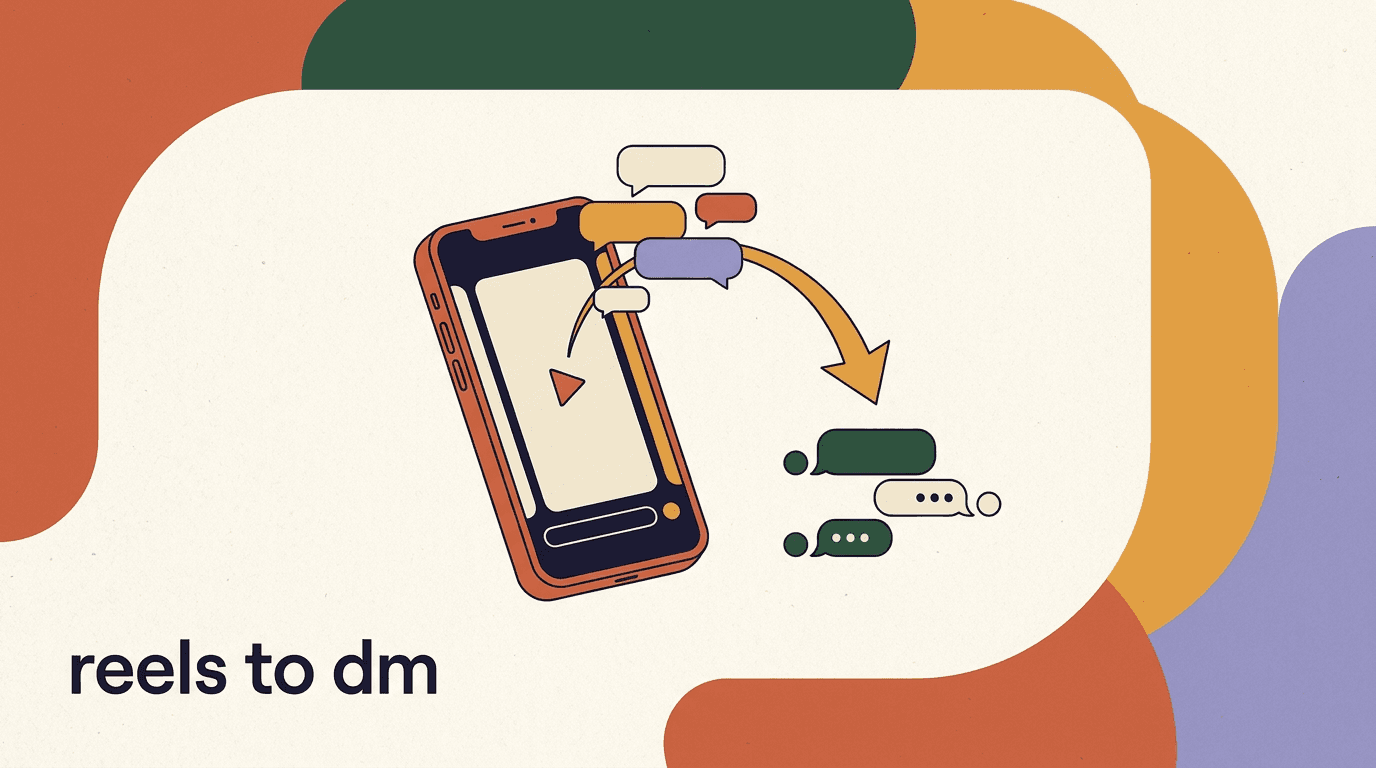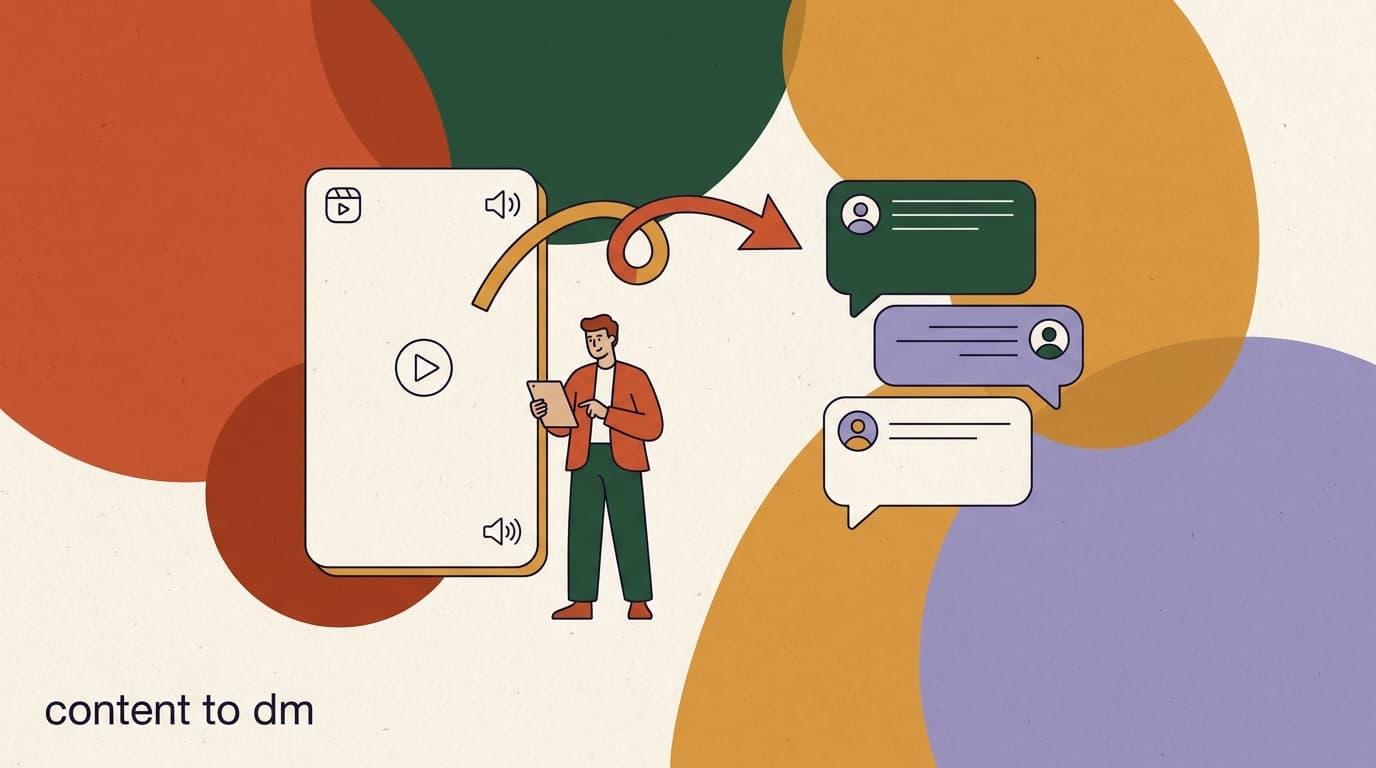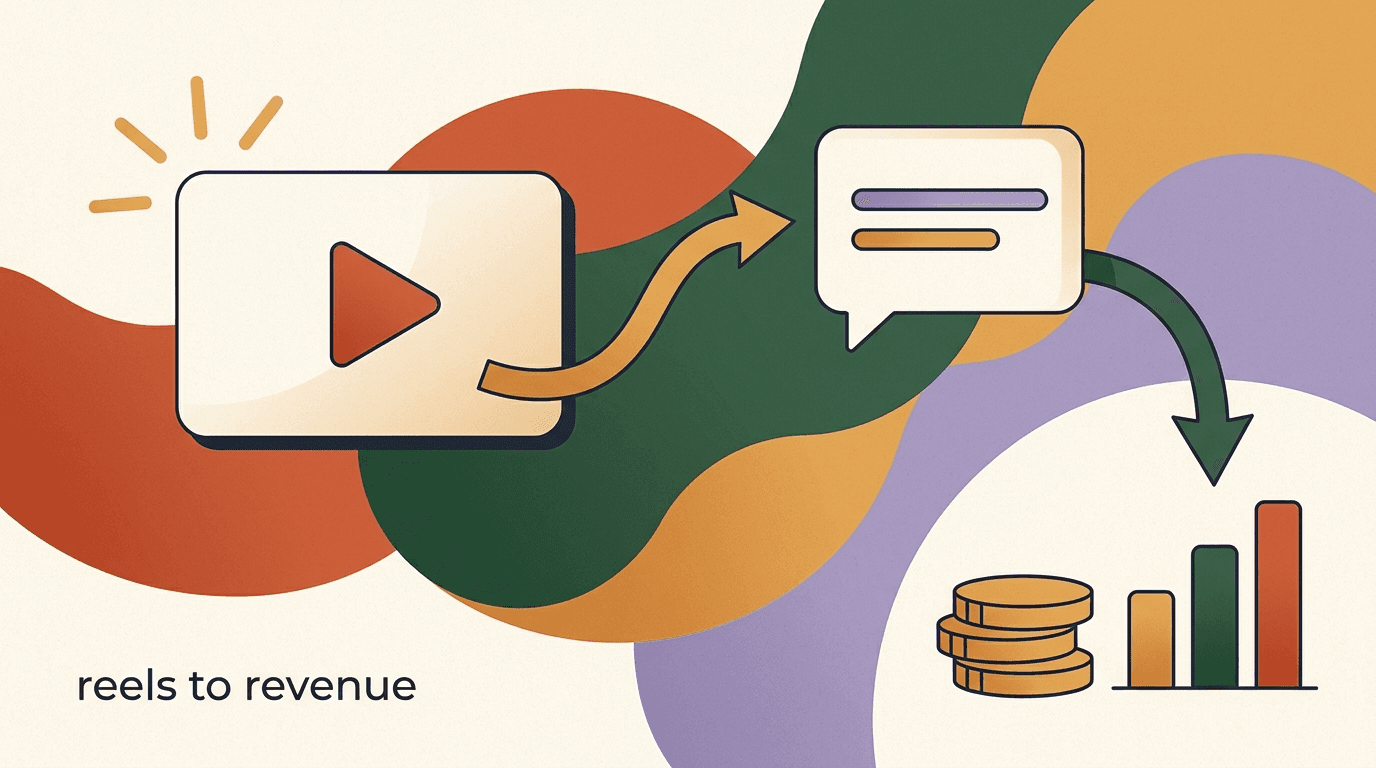
Reels dm revenue is what happens when you stop treating a viral Reel as the finish line and start treating it as the opening move. A Reel earns reach. Reach is not revenue. The gap between the two is a conversation, and the fastest, most repeatable way to start that conversation at scale is DM automation. This guide is about closing that gap on purpose: designing the Reel so it invites a DM, capturing the people who respond, and running an offer path that turns interest into a sale without you typing every reply by hand.
Most creators get one half of this right. Either they make Reels that travel but have no mechanism to monetize the attention, or they build elaborate DM funnels that never get fed because their content does not prompt anyone to message. The revenue lives in the pairing. A good Reel with a clear call-to-action and an automated capture behind it can convert a fraction of viewers into conversations, and a fraction of those conversations into customers — predictably enough that you can plan around it.
We build KlyoChat, an AI-native tool for exactly this kind of comment-to-DM and offer automation, so we have a point of view and we will say where it fits. But most of this guide is platform-agnostic strategy you can run anywhere. There are no income guarantees here and no fabricated numbers — outcomes depend on your offer, your audience, and your content. What we can give you is a system that makes the most of whatever reach you earn, plus the honest limits of where automation helps and where it does not.
Why does a viral Reel rarely produce revenue on its own?
A Reel is optimized to be watched, not to be acted on. The platform rewards retention, replays, and shares, which means the format favors content that is satisfying to consume in a loop. Satisfying-to-watch and easy-to-buy-from are not the same thing. A viewer finishes your Reel, feels something, and keeps scrolling — because nothing in that moment told them what to do next or made the next step frictionless.
The second problem is that attention from a Reel is anonymous and fleeting. You get a view count, maybe some likes and comments, but you do not get a relationship. There is no inbox thread, no way to follow up, no second touch. Unless you convert that fleeting attention into an owned conversation, the reach evaporates the moment the viewer scrolls past. Tomorrow the algorithm shows your Reel to new people and the same thing happens again.
DM automation fixes both problems at once. It gives the viewer a single, low-effort action — comment a word, and you will send something — and it converts the anonymous view into a named conversation in your inbox. That conversation is the asset. It is where the offer gets made, the objection gets answered, and the sale gets closed. The Reel's only job is to generate enough of the right attention to feed that conversation.
It is worth being precise about why a comment is such a useful action to ask for. A comment is public, so it lifts the Reel's engagement signals and can extend its reach, and it is also the trigger that opens a private channel to that exact person. One action does two jobs: it helps the content travel further and it captures the viewer. A link in bio, by contrast, asks the viewer to leave the app, find your profile, tap through, and then act — every one of those steps sheds people. The comment keeps the entire motion inside the feed where the attention already is.
Reach is rented, conversations are owned
Algorithmic reach belongs to the platform and can disappear with one ranking change. A DM thread belongs to you. The whole point of pairing Reels with DM automation is to convert rented attention into owned conversations you can follow up with on your terms.
What does a Reels to DM revenue funnel actually look like?
Before getting into tactics, it helps to see the whole shape. A reels dm funnel has four stages, and revenue leaks at every transition between them. Your job is to design each handoff so the maximum number of people move to the next stage. Think of it as a sequence of conversions, not a single magic moment.
Most creators only ever optimize the first stage — they obsess over making the Reel perform — and ignore the three transitions where the money is actually won or lost. The Reel is the cheapest stage to improve once you understand the rest of the chain.
- Stage 1 is a content problem — hook, payoff, and a clear ask.
- Stage 2 is a mechanics problem — comment-to-DM and keyword triggers.
- Stage 3 is a copy and timing problem — the first message has to earn a reply.
- Stage 4 is an offer problem — the right thing at the right price with a clear next step.
| Stage | What happens | The transition to optimize |
|---|---|---|
| 1. Reach | The Reel is shown and watched | Getting watchers to take the call-to-action |
| 2. Capture | Viewer comments or DMs a keyword | Reliably moving them from comment into a DM thread |
| 3. Qualify | Automation opens the conversation | Getting a reply, not just a delivered message |
| 4. Offer | The offer is made and answered | Turning interest into a purchase decision |
Fix the leakiest stage first
If your Reels get views but few comments, fix the call-to-action. If you get comments but few DM replies, fix the first automated message. Diagnose which transition is leaking before you make more content — more reach into a leaky funnel just wastes attention.
How do you design a Reel that invites a DM?
The Reel itself has to do one extra job beyond entertaining or teaching: it has to make the next step obvious and worth taking. That means giving viewers a specific reason to message you and a specific word to use. Vague asks like 'DM me for info' convert poorly because they push the work onto the viewer. A precise ask — 'comment GUIDE and I will send you the full breakdown' — converts because it is concrete, low-effort, and promises something real.
The mechanics of the ask matter as much as the content. The call-to-action should appear in three places: spoken or shown in the video itself, written as on-screen text, and repeated in the caption. People watch with sound off, skim captions, and decide in seconds, so redundancy is not clutter — it is coverage. The keyword should be short, easy to spell, and unambiguous, because a misspelled keyword is a missed capture.
Crucially, the thing you promise in exchange for the comment should be genuinely valuable and directly related to your offer. If the Reel is about a workout method and you promise a free routine, the people who comment are pre-qualified for a fitness product. The lead magnet is a filter as much as an incentive. A mismatched freebie attracts freebie-seekers; a well-matched one attracts buyers.
There is a structural reason the comment ask outperforms most alternatives, and it is worth internalizing rather than treating as a trick. When you ask people to comment a word, you are converting a passive watch into an explicit signal of interest, and you are doing it at the exact moment their interest is highest — right after the payoff, before they scroll. The further you push that decision away from the Reel, the colder the interest gets. The discipline, then, is to make the ask immediate, specific, and small, so the viewer can say yes while the feeling the Reel created is still fresh.
- Lead with a hook that earns the watchThe first two seconds decide whether the Reel travels. Open with a specific promise, a pattern interrupt, or a question your audience already has — earn the view before you ask for anything.
- Deliver one clear payoffGive one useful idea or result, not five. A Reel that tries to teach everything leaves no room for the DM to add value. Hold the deeper material for the conversation.
- Make the call-to-action concreteName the keyword and what they get: 'Comment PLAN and I will DM you the template.' Specific verb, specific word, specific reward.
- Repeat the ask across video, text, and captionSound-off viewers need on-screen text; skimmers need it in the caption. Cover all three so the ask is unmissable.
Weak ask versus strong ask
- Weak
- 'Link in bio for more!' — vague, off-platform, high friction
- Weak
- 'DM me if interested' — no keyword, no incentive, nothing to capture on
- Strong
- 'Comment RECIPE and I will send the full method to your DMs' — concrete word, clear reward, in-app
How does the comment and keyword-to-DM capture work?
This is the mechanical heart of the system and the part automation handles best. When the Reel prompts viewers to comment a specific keyword, an automation watches that Reel's comments for the word and responds in two ways: it can reply publicly to the comment, and it sends the promised content as a direct message to the commenter. The public reply does double duty — it confirms to the commenter that something is coming and it signals to everyone else reading the comments that the offer is real, which lifts participation.
Keyword triggers are what make this scale. Instead of you watching a viral Reel's comments and copy-pasting a reply two hundred times, the trigger fires automatically the moment the word appears, day or night, at whatever volume the Reel produces. A keyword can also live on your account broadly, so anyone who DMs that word — not just on one Reel — enters the same flow. That lets you reuse a single proven flow across many Reels.
There is an important platform rule to respect here, and we are not going to pretend it does not exist. On Instagram and Facebook, you can send a message in response to a user's interaction, but ongoing messaging is governed by Meta's policies and a 24-hour window for standard messages after the user's last interaction. Your capture and your offer conversation need to fit inside how the platform allows you to message, and good automation is built to stay within those rules rather than around them.
Respect Meta's rules and the 24-hour window
Comment-to-DM and keyword triggers work because the user initiated contact. Standard messaging operates inside a 24-hour window after the user's last interaction, and Meta's policies define what you can send. Build your flows to fit those rules — accounts that push against them risk restriction, which is the opposite of a revenue system.
What should the first automated DM say?
The first message is where most reels dm funnels quietly fail. The commenter raised their hand; now you have a few seconds of goodwill before they forget they ever commented. The message has to do three things fast: deliver what you promised, confirm you are a real operation and not a spam bot, and open a door to the next step. Get those three right and you have a conversation; get them wrong and you have a delivered message that goes nowhere.
Deliver first, sell second. If you promised a guide, the first message should contain or link to the guide immediately. Leading with the thing you promised builds trust and honors the deal the viewer made when they commented. Only after delivering should you open the next step — a question, an invitation, or a soft pointer toward your offer. Asking a simple question is the single best way to convert a one-way delivery into a two-way thread, because a reply re-opens your messaging window and tells you the person is engaged.
Keep the tone human. Automated does not have to mean robotic. Short sentences, a real voice, and one clear question outperform a wall of marketing copy. The goal of message one is not to close — it is to earn message two.
This is also the natural place for an AI agent to help, used carefully. A well-configured agent can deliver the promised asset instantly, recognize common follow-up questions, and answer them in your voice without you being awake to do it. The boundary to hold is the same one as everywhere else in this guide: let automation handle delivery and the predictable questions, and make sure the path to a human is short whenever the conversation moves toward a real buying decision. An agent that quietly hands off at the right moment beats one that tries to close a high-consideration sale on its own.
Always end the first message with a question
A question converts a one-way delivery into a conversation and prompts a reply that re-opens your messaging window. 'What are you working on?' or 'Which of these is your situation?' costs nothing and roughly doubles how many threads continue past message one.
First-message structure
- Deliver
- 'Here is the full method I promised in the Reel — [link/asset].'
- Confirm
- 'I make these because I run [thing]; happy you grabbed it.'
- Open
- 'Quick question — are you doing this for [goal A] or [goal B]?'
How do you build the offer path without being pushy?
Once someone has replied, you have earned the right to talk about your offer — but the path from helpful conversation to sale has to feel like a continuation, not a bait-and-switch. The cleanest structure is qualify, then match. Use their reply to understand what they actually want, then point them to the specific thing that fits. A creator selling a course might learn the person is a beginner and recommend the foundational track; one selling a service might learn the budget and route accordingly.
The offer itself should have a single, obvious next step. Confusion kills conversion in DMs even more than price does. Whether the next step is a checkout link, a booking page, a discount code, or simply 'reply YES and I will send the details,' it needs to be one action, clearly stated. Every extra decision you ask the buyer to make is a place they can stall.
Resist the urge to automate the entire close on high-consideration offers. Automation is excellent at delivery, qualification, and answering common questions; it is weaker at handling nuanced objections on a meaningful purchase. A practical split is to automate everything up to the point of genuine buying intent, then let a human — you or your team — step in for the final conversation. For low-priced, simple offers, a fully automated path with a direct link can work end to end.
- Qualify with one or two questions before you pitch anything.
- Match the offer to what they told you — do not pitch everyone the same thing.
- Give exactly one next step, stated plainly.
- Automate delivery and qualification; bring a human in for high-value closes.
- Make the price and what is included unambiguous before asking for the sale.
Two offer paths by price point
- Low-ticket digital product
- Deliver freebie, answer one FAQ, send checkout link — fully automated
- High-ticket coaching or service
- Deliver freebie, qualify, then hand to a human to close
Why does this only work as a system across many Reels?
A single Reel is a lottery ticket. Even with a perfect funnel behind it, one Reel might underperform, hit the wrong audience, or simply not catch the algorithm. The revenue compounds when you run the same proven funnel behind many Reels over time. Each Reel is a fresh top-of-funnel that feeds the same capture-and-offer machine, and the more shots you take, the more the variance smooths out into something you can forecast.
There is a powerful reuse effect here. Once you have a keyword flow that converts — the capture, the first message, the offer path — you do not rebuild it for every Reel. You point new Reels at the same flow, or clone it and swap the lead magnet. Your content production stays creative and varied while your funnel stays consistent and improving. The flow gets better with every iteration; the Reels just keep feeding it.
This separation of concerns is what keeps the workload sane as you scale. Making good Reels is the hard, creative, time-consuming part, and it never gets easier — it just gets better. The funnel, by contrast, is build-once infrastructure. By keeping them decoupled, you avoid the trap of treating every campaign as a fresh build, which is how creators burn out and end up with a graveyard of half-finished flows. The creator who ships their hundredth Reel into the same battle-tested funnel is in a far stronger position than the one who built a hundred funnels and optimized none.
This is also why analytics matter. When you run the same funnel across dozens of Reels, you can see which content drives the most comments, which keywords convert best, where threads stall, and which offers close. That feedback loop is impossible to build from one viral hit. The system is what lets you learn, and learning is what turns occasional luck into a repeatable revenue process.
There is a portfolio mindset that helps here. Treat your Reels the way an investor treats positions: you do not need every one to win, you need the winners to be big enough and the funnel behind them efficient enough that the average is positive. That reframing takes the pressure off any single post and puts it where it belongs — on the consistency of your output and the quality of the funnel. It also makes the inevitable quiet Reels feel like data rather than failure, because each one still teaches you something about what your audience responds to.
Volume plus a fixed funnel equals predictability
One viral Reel is a story. Twenty Reels feeding one well-tuned funnel is a system. The funnel is the part you perfect once and reuse; the Reels are the part you keep making. Predictable revenue comes from the combination, not from any single post going big.
How do you map your content to your offers?
Not every Reel should sell the same thing, and not every offer suits every Reel. The strongest reels dm revenue setups map content themes to specific offers and keywords so the lead magnet always matches the intent of the people who watched. A viewer who watched a Reel about meal prep and commented for a meal-prep template is a different lead from someone who watched a mindset Reel — and they should not land in the same offer path.
A simple way to organize this is a content-to-offer grid. List your offers down one side and your recurring content themes across the top, then assign each theme a keyword and a matching lead magnet. This keeps your funnels clean: each Reel knows which keyword to promote, each keyword knows which flow it triggers, and each flow knows which offer it is warming up. It also stops you from cross-wiring leads into offers they never signaled interest in.
The grid has a second benefit beyond organization: it forces you to confront whether you have too many offers. Many creators dilute their results by trying to sell five things at once, which fractures their content and confuses their audience. If you cannot map a clean keyword and lead magnet to an offer, that is often a sign the offer is not distinct enough to deserve its own funnel yet. Starting with one or two well-defined offers, each with a dedicated theme, almost always outperforms a sprawling catalog promoted at random.
- One keyword per theme keeps captures clean and reporting clear.
- The lead magnet should preview the paid offer, not replace it.
- Reuse the same grid across months so flows mature instead of multiplying.
| Content theme | Keyword | Lead magnet | Offer it warms |
|---|---|---|---|
| How-to / tutorial | GUIDE | Step-by-step PDF | Paid course |
| Quick win / hack | TEMPLATE | Reusable template | Template pack or membership |
| Transformation / result | PLAN | Starter plan | Coaching or program |
| Behind-the-scenes / tools | STACK | Tool list | Affiliate or service |
What are realistic expectations and the honest limits?
We will not put a revenue number on this, because anyone who does is guessing about your offer, your price, your audience, and your content quality. What we can say honestly is how the math behaves. Only a fraction of viewers comment, only a fraction of commenters reply in DMs, and only a fraction of repliers buy. Each stage is a percentage of the one before, so the inputs that move revenue most are reach (more qualified views), capture rate (a better call-to-action), and close rate (a better offer and conversation).
Automation does not create demand. If the offer is weak or mispriced, a flawless funnel will efficiently route uninterested people to a thing they do not want. The funnel multiplies whatever is already true about your offer — it does not fix a fundamentally wrong one. Spend at least as much energy on the offer and the lead-magnet match as on the mechanics.
There are platform limits too. Messaging operates inside Meta's rules and the 24-hour window, so you cannot endlessly follow up. Aggressive automation that ignores these rules risks account restrictions. The durable approach is to design flows that work within the window and treat the platform's policies as constraints to design around, not obstacles to beat.
One more honest caveat: this strategy rewards patience, and patience is the part most people skip. The first version of your funnel will leak somewhere, your first lead magnet may attract the wrong people, and your earliest Reels may not catch. That is normal and it is not a sign the approach is broken. The creators who make this work are the ones who keep the same funnel running long enough to gather signal, then improve it deliberately. The mechanics can be set up in an afternoon; the results come from the weeks of iteration that follow.
No income guarantees — automation multiplies, it does not create
A DM funnel makes the most of the reach and offer you already have. It will not turn a weak offer into a strong one or manufacture demand that is not there. Treat any creator who promises specific income from Reels automation with skepticism; the honest promise is leverage, not a guaranteed outcome.
How do you measure and improve a reels dm funnel?
You cannot improve what you do not watch, and the four-stage funnel gives you four numbers to track. At the top, look at views and the comment-to-view rate, which tells you whether your call-to-action is working. In the middle, watch the DM reply rate, which tells you whether your first message earns a conversation. At the bottom, track how many qualified threads convert to a sale. Each number points to a different fix.
The discipline is to change one thing at a time. If you rewrite the Reel's hook, the keyword, and the first DM all at once, a change in results tells you nothing about which edit caused it. Run a single variable, give it enough Reels to gather signal, then keep or discard it. Over a few cycles you converge on a hook style, a call-to-action format, a first message, and an offer path that reliably outperform — and that combination becomes your template.
- Track the four-stage numbersViews, comment rate, DM reply rate, and close rate. Each one isolates a different stage of the funnel so you know where to look.
- Find the leakiest transitionThe stage with the steepest drop-off is your highest-leverage fix. Low comment rate means fix the ask; low reply rate means fix message one.
- Change one variable and run itTest a single edit across several Reels. One change at a time keeps cause and effect legible.
- Promote winners into your templateWhen a hook, keyword, or message proves out, fold it into your standard flow and reuse it. Retire what loses.
Let one flow mature instead of building ten
Resist creating a brand-new flow for every campaign. A single flow that you refine across dozens of Reels will outperform a pile of one-off funnels you never optimized. Depth beats breadth in DM automation.
A worked example: turning one theme into a repeatable funnel
Imagine a creator who teaches home cooking and sells a paid recipe membership. Their content theme is quick weeknight meals, and they decide to run that theme through a single reels dm funnel for a month. Every Reel in the theme ends with the same ask: 'Comment DINNER and I will send you this week's full recipe card.' The keyword DINNER triggers one flow, no matter which Reel produced the comment.
When someone comments, the automation replies publicly — 'Sent! check your DMs' — and messages the recipe card immediately. The first DM delivers the card, mentions that it comes from a larger weekly collection, and ends with a question: 'Are you cooking mostly for one, or feeding a family?' The answer routes the conversation: solo cooks get pointed to the lighter plan, families to the batch-cooking plan, and both paths end with a single link to start a trial of the membership. Higher-intent repliers who ask detailed questions get a human reply.
Across the month, the creator runs eight Reels through this one flow. Some travel further than others, but every one feeds the same machine. By the end they can see which Reel hooks drove the most DINNER comments, where replies stalled, and which plan converted best — and they fold those lessons into the next month's content. No single Reel carried the result; the system did.
The one-theme funnel in numbers (illustrative shape, not a promise)
- Input
- 8 Reels on one theme, all using keyword DINNER
- Capture
- Comments funnel into one flow that delivers the recipe card
- Conversation
- First DM ends in a question that routes to the right plan
- Outcome
- Qualified trial sign-ups plus a feedback loop for next month
How does KlyoChat fit into a Reels DM revenue system?
Everything above is strategy you can run on a range of tools. Here is honestly where our product fits. We build KlyoChat as an AI-native, mobile-first tool for exactly this loop: comment-to-DM and keyword triggers feed a unified inbox, AI agents can handle first response and qualification, and analytics show you where the funnel leaks. Because the creator's whole workflow — checking comments, sending DMs, adjusting flows — happens on a phone, a mobile-first inbox matches how Reels creators actually work.
The piece most relevant to reels dm revenue is pricing. Many automation tools bill by contacts, which means a Reel that goes viral and floods you with new conversations also spikes your software bill — your success is taxed. KlyoChat uses flat pricing, so a viral month that brings in thousands of new DMs does not change your plan cost. For a strategy built on occasional viral spikes feeding a fixed funnel, a bill that does not jump with reach is the point.
We will also be straight about the limits. KlyoChat does not offer native SMS or email, so if your funnel depends on those channels you will need something else for that part. We are a newer, smaller-community product than the largest incumbents, so the template marketplace and third-party ecosystem are leaner. And like every tool, we operate inside Meta's rules and the 24-hour window — we build flows to respect them, not to evade them. If your needs are Instagram and the other social channels plus AI on a flat bill, that is the fit; if you need SMS and email in the same tool, factor that in.
- Basic is $19/mo, Pro is $49/mo ($39 billed yearly), Business is $129/mo.
- Every plan starts with a 7-day free trial — no credit card required.
- AI agents are included, not a separate add-on.
- Honest limit: no native SMS or email, and a smaller community than the biggest incumbents.
| What the funnel needs | How KlyoChat handles it |
|---|---|
| Capture commenters from Reels | Comment-to-DM and keyword triggers |
| Open and qualify conversations | AI agents for first response, included |
| See where the funnel leaks | Built-in analytics across the four stages |
| Survive a viral spike | Flat pricing — the bill does not jump with reach |
| Work from a phone | Mobile-first unified inbox |
Flat pricing matters most when content is spiky
Reels revenue is lumpy by nature — most posts are quiet, a few go big. On contact-based pricing the big ones raise your bill exactly when they should be paying off. Flat pricing keeps the cost steady so a viral Reel is pure upside. Verify current pricing on our pricing page before you budget.
What is the simplest way to start this week?
You do not need a perfect system to begin — you need one Reel, one keyword, and one flow. Starting small lets you learn the mechanics on a real conversation before you scale the content. The fastest path is to pick your single best offer, build one lead magnet that previews it, choose one memorable keyword, and ship one Reel that asks for that keyword. Then watch what happens and fix the leakiest stage.
From there, the work is repetition and refinement, not reinvention. Keep the flow, vary the Reels, change one variable at a time, and let the funnel mature. Within a few weeks you will know your hook style, your best keyword format, and a first message that earns replies — the building blocks of a system you can run indefinitely.
- Pick one offer and one matching lead magnetChoose the offer you most want to sell and build a small free asset that previews it. Match matters more than polish.
- Choose one short, clear keywordPick a word that is easy to spell and obviously tied to the reward. This is what your automation listens for.
- Build one flow: capture, deliver, qualify, offerSet the keyword trigger, write a first message that delivers and asks a question, and define the single next step to the offer.
- Ship one Reel with the ask in three placesPut the call-to-action in the video, the on-screen text, and the caption. Then let the flow run and read the results.
- Fix the leakiest stage, then repeatDiagnose where people drop off, change one thing, and run the same flow behind your next Reels. Repeat until it converts.
The bottom line on reels dm revenue: a Reel earns attention, but a DM earns the sale, and the two only work together. Design the Reel to invite a specific, low-friction action; capture commenters automatically with comment-to-DM and keyword triggers; open a real conversation with a first message that delivers and asks; then route qualified interest to one clear offer. Do it across many Reels behind one maturing funnel and occasional reach turns into a process you can plan around.
Keep the honest limits in view. There are no income guarantees, automation multiplies an offer rather than creating demand, and everything operates inside Meta's rules and the 24-hour window. Build for those constraints and the system is durable. For the capture mechanics in depth see our guide on Reels comment automation, for the wider strategy see content-to-DM strategy, and for the full picture see our Instagram revenue system breakdown.