RAG is one of those three-letter terms that gets dropped into AI sales decks with no explanation, as if everyone already knows it. You do not need a technical background to understand it, and as a marketer you genuinely should, because RAG is the difference between an AI that confidently invents your refund policy and one that quotes it correctly. RAG stands for retrieval-augmented generation. In plain English, it means the AI looks something up in your own materials before it writes an answer, instead of replying purely from memory and hoping it gets the details right.
This guide explains RAG without jargon dumps. We will define every term in everyday language, show why grounding an AI in your own knowledge beats relying on a generic model, walk through how RAG reduces (but does not eliminate) the wrong answers people call hallucinations, compare RAG to the other popular approach called fine-tuning, and translate all of it into what it actually means for the chatbots and AI agents you might put on your website or social channels.
Full disclosure before we start: we build KlyoChat, a tool whose AI agents use this approach, so we have a point of view. We have kept this explainer vendor-neutral and educational. The concepts here apply no matter which platform you eventually use, and we will keep the single mention of our own product to one clearly-labeled section near the end.
What is RAG, in one plain-English sentence?
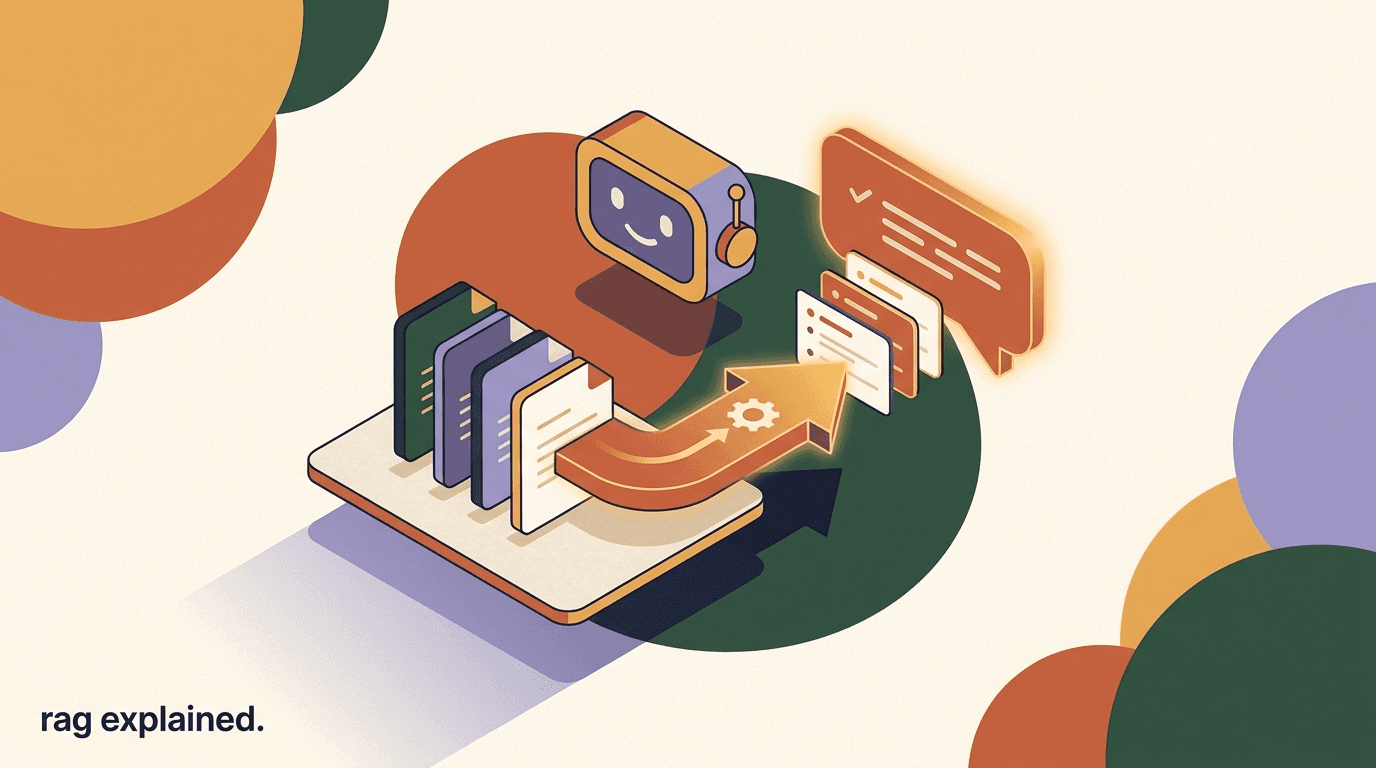
RAG is a method that lets an AI answer your question by first retrieving relevant information from a specific set of documents you control, and then generating a reply based on what it found. That is the whole idea. Retrieval means looking it up. Generation means writing the answer. Augmented just means the writing step is helped by the looking-up step.
Here is an everyday comparison. Imagine you ask a knowledgeable colleague a question about your company's return policy. There are two ways they could answer. One: they reply instantly from memory, which is fast but risky, because they might be remembering an old policy or confusing it with another company. Two: they open the actual policy document, read the relevant section, and then answer based on what it says. The second person is doing RAG. They retrieve first, then respond.
A standard AI model, on its own, behaves like the first colleague. It has read enormous amounts of text during training and answers from that general memory. It does not know your specific prices, your hours, your shipping rules, or yesterday's product launch, because none of that was in its training. RAG gives it the second behavior: before answering, it consults your specific, current materials.
The two words that matter
Retrieval = look it up in your documents. Generation = write the answer in natural language. RAG simply puts the look-up step before the writing step, so the answer is anchored to your real information instead of the model's general training.
Why can't a regular AI model just know my business?
It is reasonable to assume that a powerful AI already knows everything, so why would it need to look anything up? The answer comes down to two limits that are easy to picture once you see them.
The first limit is timing. An AI model is trained on a snapshot of text up to a certain date, and then that training is frozen. Anything that happened after that cutoff, or anything that simply was not on the public internet, is invisible to it. Your internal pricing sheet, your current promotion, the policy you updated last week, the SKU you launched this morning: none of it is in the model's memory. The model is not being lazy. It genuinely never saw the information.
The second limit is specificity. Even for things that are public, a general model knows the average version of the world, not your version. Ask it about shipping times and it will give you a plausible-sounding industry-standard answer, which may be completely wrong for your warehouse. It is built to sound right, and sounding right is not the same as being right about your particular business.
RAG closes both gaps. By retrieving from documents you provide, the AI can answer with information that is both current (you can update the documents any time) and specific (the documents are yours). The model supplies the language skills; your knowledge supplies the facts.
Same question, two kinds of answer
- Generic model (from memory)
- Standard shipping usually takes 5 to 7 business days. — plausible, but not actually your policy
- RAG-grounded answer (from your docs)
- Standard shipping is 2 to 3 business days within the US, free over $50. — pulled from your real shipping page
What does 'grounded AI' actually mean?
You will hear the word grounded a lot in this space, and it is worth defining because it is the whole point. A grounded answer is one that is tied to a real, specific source rather than floating free in the model's general knowledge. When an AI is grounded in your knowledge base, it is answering from your material, not from a vague averaged memory of the internet.
Think of grounding as the difference between a student answering an open-book exam versus a closed-book one. Closed-book, they answer from whatever they happen to remember, and confident wrong answers are common. Open-book, they can check the source before they commit. RAG turns every customer question into an open-book exam where the book is your documentation.
Grounding is what makes AI usable for customer-facing work. A marketing team cannot put an ungrounded model in front of customers, because it will eventually state a price or a policy that is simply not true. A grounded model, working from your real documents, keeps its answers anchored to facts you can stand behind.
A quick test for whether an answer is grounded
Ask the AI a question whose answer only exists in your documents, like an unusual policy detail or a specific product spec. If it answers correctly, it is genuinely retrieving from your knowledge. If it gives a generic, hedge-y answer, it is guessing from training, not grounded.
How does RAG actually work, step by step?
You do not need to understand the engineering to use RAG, but a simple mental model helps you set it up well and spot problems. Here is the whole process in five plain steps, with no math.
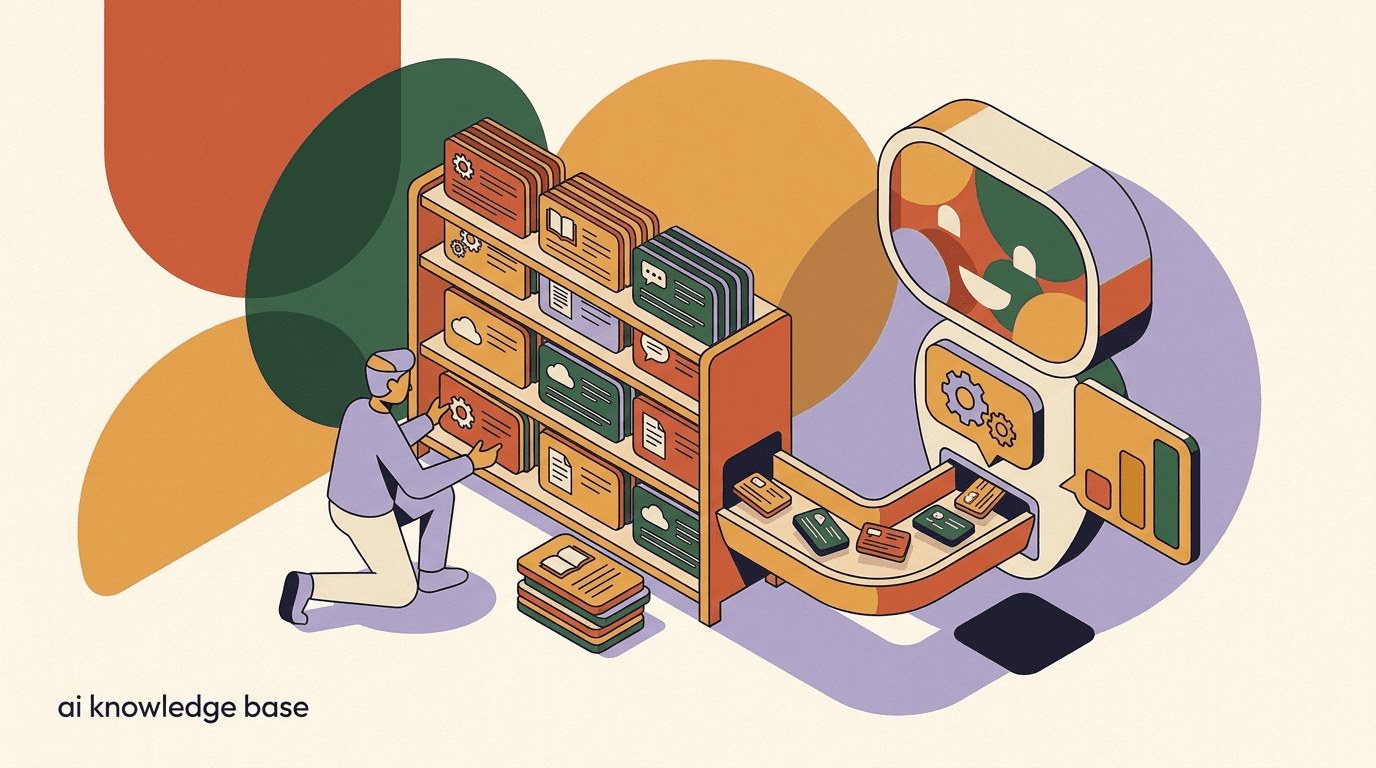
- You give it your knowledgeYou upload or connect documents — help articles, FAQs, product pages, policies, past support answers. This collection is your knowledge base. It is the book the AI gets to open.
- The system indexes itBehind the scenes, the tool breaks your documents into small chunks and organizes them so they can be searched by meaning, not just exact keywords. You do not do this manually; the platform handles it.
- A question comes inA customer asks something — by chat, DM, or comment. The system reads the question and searches your indexed knowledge for the chunks most relevant to it.
- It retrieves the relevant piecesThe most relevant snippets from your documents are pulled out — the return window paragraph, the right pricing line, the matching FAQ. These become the source material for the answer.
- It writes a grounded answerThe AI combines the retrieved snippets with its language ability and writes a natural reply based on what it found. The fluency comes from the model; the facts come from your documents.
You manage the knowledge, not the plumbing
On a good platform, the only step you touch is the first one — giving it your documents and keeping them current. Indexing, searching, and retrieving happen automatically. Your job is curating accurate source material, which is a marketing and operations job, not an engineering one.
What exactly is a 'hallucination,' and how does RAG help?
A hallucination is when an AI states something that is false but sounds completely confident. It is not lying in any human sense; it is filling a gap with the most plausible-sounding text it can produce. The danger is that hallucinations are fluent and assured, so they are hard to catch. An AI that says your warranty is two years when it is actually one will say it just as smoothly as it says anything true.
Hallucinations happen most when the model is answering from memory about something it does not actually know — exactly the situation a generic model is in when asked about your specific business. With nothing solid to anchor on, it improvises, and improvised facts are often wrong.
RAG reduces this by giving the model something real to anchor on. When the right answer is sitting in a retrieved snippet from your documents, the model does not need to improvise; it can base its reply on the source. Fewer gaps to fill means fewer confident inventions. This is the single biggest reason RAG matters for any customer-facing use.
RAG reduces hallucination — it does not eliminate it
This is the honest limit. RAG makes wrong answers far less common, but it cannot guarantee zero. If your documents are outdated, contradictory, or missing a topic, the AI can still answer poorly or fall back on guessing. Review AI answers, especially for anything involving money, legal terms, or promises to customers.
Why is a clean knowledge base the real secret?
Here is the part most vendors gloss over: RAG is only as good as the documents it retrieves from. The technology can find and quote your material perfectly, but if that material is wrong, stale, or contradictory, the AI will faithfully repeat the problem. Garbage in, confident garbage out.
This is actually good news for marketers, because it puts the quality lever in your hands rather than in an engineer's. You do not need to tune a model. You need to write clear, accurate, current documentation — which is work you already understand. A well-maintained knowledge base does more for answer quality than any clever technical setting.
Practically, a few habits make a large difference. Keep one source of truth per topic so the AI is not torn between two versions of your refund policy. Write in plain, direct language, because answers are easier to retrieve and quote when the source is clear. And prune anything outdated, because an old promotion left in your documents is a wrong answer waiting to happen.
- One source of truth per topic — avoid two documents that disagree about the same policy.
- Plain, direct writing retrieves and quotes more cleanly than dense, jargon-heavy text.
- Cover the questions people actually ask, not just the ones you wish they asked.
- Date-sensitive content (promos, seasonal hours) needs a review schedule or it becomes a hallucination source.
- When you change a policy in real life, change it in the knowledge base the same day.
How source quality shapes the answer
- Outdated doc retrieved
- AI quotes last year's 30-day return window — confidently wrong
- Conflicting docs retrieved
- AI picks one of two contradictory policies — unpredictable
- Single, current doc retrieved
- AI quotes today's 14-day window correctly — reliable
RAG vs fine-tuning: which one do I actually need?
When people talk about customizing AI, two methods come up: RAG and fine-tuning. They are often presented as rivals, but they solve different problems, and for most marketing use cases the choice is clearer than the debate suggests.
Fine-tuning means further training the model on examples so it adjusts its behavior — its tone, its format, the style of its responses. It is good at teaching the AI how to sound. It is poor at teaching the AI what is currently true, because the facts get baked in at training time and go stale, and updating them means training again.
RAG, by contrast, is about facts and freshness. It does not change the model's behavior; it changes what information the model has access to at the moment it answers. Need to update a price? Edit a document. The change is live immediately, with no retraining. For knowledge that changes — which is most business knowledge — RAG is the natural fit.
| Question | RAG (retrieval) | Fine-tuning (training) |
|---|---|---|
| What it changes | What the AI knows at answer time | How the AI behaves and sounds |
| Best for | Facts, policies, prices, docs that change | Consistent tone, style, response format |
| Updating info | Edit a document — live instantly | Retrain the model — slower, repeated |
| Risk if neglected | Stale docs cause wrong answers | Stale training cannot be quickly fixed |
| Who manages it | Marketing / ops (write the docs) | Technical team (prepare training data) |
| Effort to start | Lower — upload your knowledge | Higher — assemble and run training |
They are not mutually exclusive
The two can work together: fine-tuning (or simpler tone settings) shapes how the AI sounds, while RAG controls what it knows. For most marketers, getting RAG right matters far more day to day, because your facts change constantly and your tone does not.
Why does RAG beat a generic model for marketing work?
Put plainly: a generic model is a brilliant generalist with no idea who you are. It writes fluently, reasons well, and knows a great deal about the world in general. What it does not know is the one thing your customers are asking about — your business. For marketing, where every answer is about your product, your price, your policy, that gap is the whole ballgame.
RAG turns the generalist into a specialist about you, without rebuilding the model. You keep all the fluency and reasoning, and you add accurate, current, business-specific knowledge on top. The result is an AI that can answer real customer questions correctly, in your context, rather than offering polished generalities.
There is also a trust dimension that matters more in marketing than people admit. A grounded answer can often point to where it came from, which means a human can verify it. An ungrounded answer is a black box — you cannot tell whether it is true without already knowing the answer. For anything customer-facing, verifiability is not a luxury.
- Accuracy: answers come from your real documents, not averaged-out internet knowledge.
- Freshness: update a document and the AI's answers update with it, no retraining.
- Control: you decide what goes in the knowledge base, so you shape what the AI can say.
- Verifiability: grounded answers can be traced back to a source a human can check.
- Lower technical lift: maintaining documents is a job marketers already know how to do.
What does RAG mean for chatbots and AI agents?
This is where RAG stops being abstract. The chatbots and AI agents you might add to your website, your Instagram DMs, or your support inbox are exactly where RAG earns its keep, because those tools answer real customer questions in real time, unsupervised, at scale.
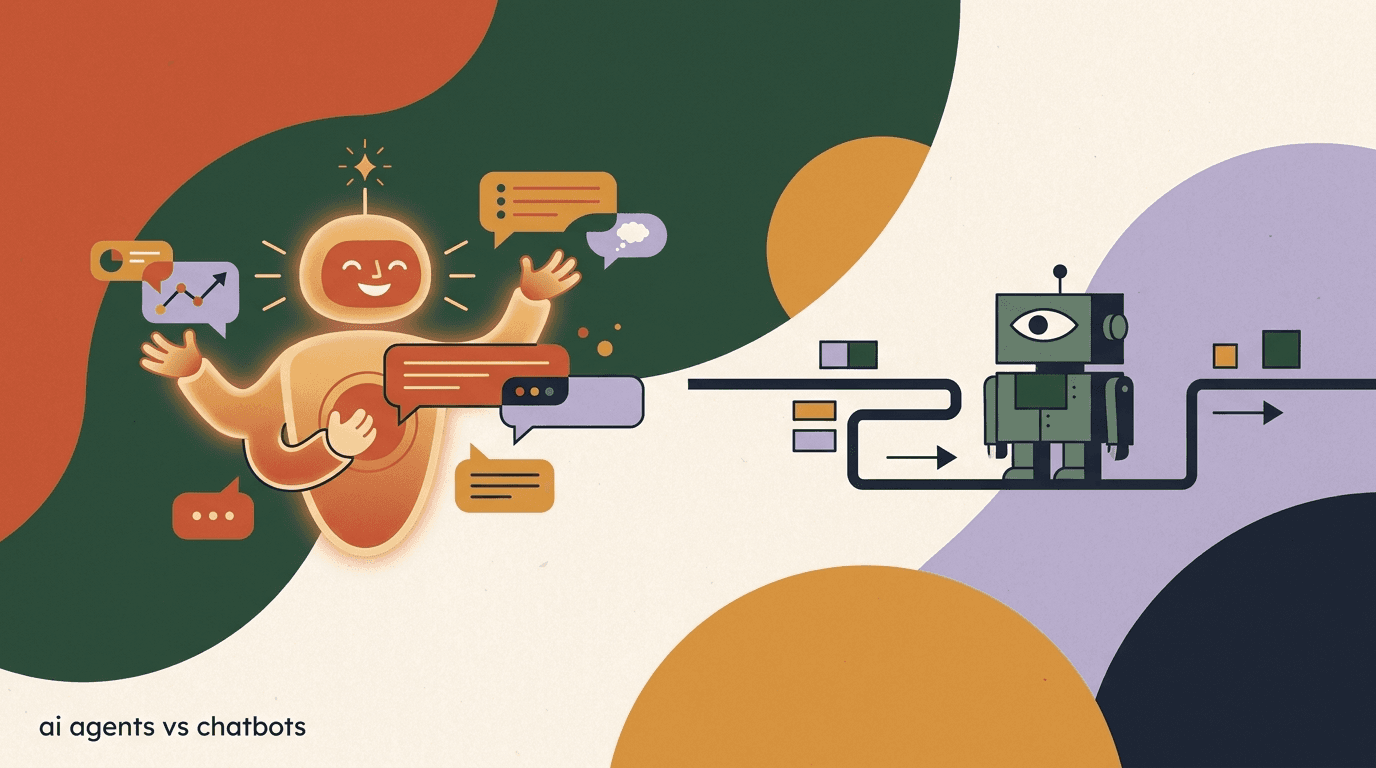
An old-style chatbot followed a rigid script: press 1 for billing, type a keyword to trigger a canned reply. It could not handle a question phrased in an unexpected way, and it never actually understood anything. A modern AI agent built on RAG is different. It understands the question in natural language, retrieves the relevant facts from your knowledge base, and writes a tailored answer — even for a question you never explicitly scripted.
The practical effect is an assistant that can field the long tail of real customer questions correctly. Not just the ten FAQs you anticipated, but the oddly-worded, half-specific, real-human questions that scripts always failed. And because it is grounded, it answers them from your real information rather than improvising.
| Capability | Scripted chatbot | RAG-powered agent |
|---|---|---|
| Understands natural language | No — keyword or menu only | Yes — reads the question as written |
| Handles unscripted questions | No — fails or loops | Yes — retrieves and answers |
| Source of its answers | Hard-coded canned replies | Your live knowledge base |
| Updating answers | Edit each script by hand | Edit a document — answers follow |
| When it does not know | Dead end or wrong menu | Can say so and hand off to a human |
RAG is the engine, not the whole car
RAG handles the knowledge part. A good customer-facing agent also needs guardrails (what it should not answer), a way to hand off to a human, and a defined tone. RAG makes the answers accurate; those other pieces make the experience safe and on-brand.
Scripted bot vs RAG-powered agent
- Scripted chatbot
- Sorry, I didn't understand. Please choose from the menu. — fails on anything off-script
- RAG-powered agent
- Understands a unique question, retrieves the right policy, and answers in context
How should a marketer evaluate a RAG-powered tool?
If you are shopping for a chatbot or AI agent, the marketing copy will all promise smart, accurate AI. RAG gives you a concrete lens to cut through that. Instead of asking is the AI good, ask how it is grounded and how easy it is to keep the knowledge correct.
A few questions separate a serious tool from a demo. They are not technical questions; they are practical ones any marketer can ask on a sales call.
- Ask how I add and update knowledgeCan you upload documents, paste content, or connect existing pages? How fast does an update take effect? If updating knowledge is hard, your answers will go stale.
- Test it on a question only your docs can answerDuring a trial, ask something specific to your business. A grounded tool answers correctly; an ungrounded one gives a generic non-answer.
- Check what happens when it does not knowA good agent says it is not sure or hands off to a human. A weak one invents an answer. Deliberately ask something outside the knowledge base and watch.
- Look for human handoff and reviewYou want to be able to review answers and step in. RAG reduces wrong answers; oversight catches the ones that slip through.
- Confirm it fits your channelsAn agent is only useful where your customers are. Check it covers the channels you actually use, whether that is your site, social DMs, or messaging apps.
What are the honest limits of RAG?
An explainer that only lists benefits is a sales pitch, not an education. RAG is genuinely useful, but it has real limits worth knowing before you build expectations around it.
The biggest is the one we have already flagged: RAG reduces hallucination but does not eliminate it. If your documents are incomplete or contradictory, or if a question falls in a gap your knowledge base does not cover, the AI can still produce a wrong or vague answer. The technology is only as trustworthy as the material behind it and the oversight around it.
There are quieter limits too. Retrieval can occasionally surface the wrong snippet — close in wording but not in meaning — and the answer inherits that mistake. Very nuanced or judgment-heavy questions, the kind that need real human discretion, are still better routed to a person. And RAG handles knowledge, not actions; if a customer needs something done rather than answered, you need workflows and handoffs around the AI, not just a smarter answer.
- It reduces but never fully removes confident wrong answers — review matters.
- Quality is capped by your documents: stale or contradictory sources produce bad answers.
- Retrieval can occasionally fetch a near-miss snippet and answer from it.
- Judgment-heavy or sensitive questions still belong with a human.
- RAG answers questions; it does not take actions — wrap it in proper handoffs.
Treat AI answers as drafts for high-stakes topics
For anything involving money, contracts, legal terms, medical or safety information, or firm promises to a customer, keep a human in the loop. RAG makes the AI a strong first-draft assistant for those topics, not a final authority.
How does KlyoChat use RAG in its AI agents?
Since we have spent this whole piece on the concept, here is the one place we connect it to what we build — clearly labeled so you can take it or skip it. KlyoChat is an AI-native unified inbox that brings social and messaging channels into one place, and its custom AI agents use the grounded approach described above: you give each agent a knowledge base, and it answers from your real documents rather than from generic training.
Knowledge bases and grounded AI agents are included rather than sold as a separate add-on, which fits our bias toward grounded, controllable AI over a generic model left to improvise. You upload or connect your material, the agent retrieves from it to answer customer questions across your channels, and you stay in control of what it can say by controlling what is in the knowledge base.
We will also keep our own honest limits in view, the same way we asked you to judge any vendor. KlyoChat does not offer native SMS or email, so if those are core channels for you, factor that in. We are a newer product with a smaller community than the long-established players. And the universal caveat applies to us as much as anyone: RAG reduces wrong answers but does not eliminate them, so review your agent's responses, especially early on.
- Custom AI agents with knowledge bases are included, so agents answer from your real material.
- Grounded, controllable answers by design — you shape replies by curating the knowledge base.
- One unified inbox so a grounded agent can work across your connected channels.
- Honest limits: no native SMS or email, a newer and smaller community, and review is still required.
Try it on your own knowledge before you trust it
Whatever tool you consider, the real test is your content. KlyoChat offers a 7-day free trial with no credit card, and Pro is $49/month ($39 billed yearly). Upload a few of your real documents, ask the questions your customers actually ask, and judge the grounding for yourself.
What kinds of marketing questions does RAG handle well?
It helps to get concrete about where this pays off, because RAG is not equally useful for every kind of question. Its sweet spot is factual, repetitive questions whose answers live somewhere in your documents. These are exactly the questions that flood a support inbox and a brand's social DMs, and they are exactly the questions that a generic model gets wrong because it does not know your specifics.
Think about the questions you answer over and over. What is your return window? Do you ship to my country, and how long does it take? Is this product in stock in my size? What is the difference between your two plans? Where is my order? How do I cancel? Every one of these has a single correct answer that already exists in your policies, product pages, or order system, and every one is a strong candidate for a grounded AI agent.
RAG is weaker for questions that are not really about facts at all. Open-ended advice, subjective judgment calls, emotionally sensitive complaints, and anything requiring negotiation or discretion are better handled by, or escalated to, a human. The skill in deploying RAG well is partly knowing which questions to point it at and which to route to a person. A tool that tries to answer everything will eventually answer something it should have passed along.
- Strong fit: policy questions — returns, shipping, warranty, cancellation, hours.
- Strong fit: product questions — specs, availability, plan differences, compatibility.
- Strong fit: how-to and onboarding questions answered in your help docs.
- Weak fit: subjective advice, sensitive complaints, negotiation, and judgment calls.
- Weak fit: anything requiring an action the AI cannot take — route it to a person or a workflow.
Which questions to ground vs escalate
- What is your return policy?
- Ground it — the answer is in your docs
- Is this gift appropriate for my situation?
- Escalate it — subjective judgment
- I am furious about a late order — fix it
- Escalate it — sensitive, needs a human
How does retrieval search by meaning, not just keywords?
One detail worth understanding, because it explains why modern RAG feels smarter than old search, is how the retrieval step actually finds the right document. Old-fashioned search matched keywords: if the customer's words did not appear in your document, the search missed it. That is why traditional FAQ search was so frustrating — ask in your own words and it found nothing.
RAG-based retrieval searches by meaning instead. Without getting into the math, the system converts both your documents and the incoming question into a form that captures what they mean, then finds the documents whose meaning is closest to the question. So a customer who asks can I send this back? will be matched to your returns policy even though they never used the word return. This is why a RAG agent can handle the messy, varied ways real people phrase things.
The practical upshot for you is freeing. You do not need to stuff every possible phrasing of a question into your documents to be found, the way you might have with keyword search. You need clear, accurate content about each topic, and the retrieval step handles the matching. That said, clarity still helps: a document that plainly states the policy is easier to match and quote than one that buries it in dense paragraphs.
Why this matters for your writing
Because retrieval works by meaning, you do not have to anticipate every synonym a customer might use. Write one clear, complete explanation of each topic. The system finds it whether the customer says refund, return, send back, or money back.
What is the cost and effort of getting started with RAG?
Marketers reasonably worry that anything with a technical name will be expensive and slow to set up. With RAG delivered through a modern tool, the heavy engineering is already done for you, so the real cost is mostly your time spent preparing knowledge, plus a software subscription. You are not hiring a data science team to build this from scratch.
The effort breaks into a one-time setup and an ongoing habit. The one-time setup is gathering your documents, connecting or uploading them, and testing the agent on real questions. The ongoing habit is keeping that knowledge current — updating a document when a policy changes, adding answers for new questions you start seeing, and pruning anything stale. The ongoing habit is small but it is not optional; a neglected knowledge base quietly decays into a source of wrong answers.
There is also a softer cost worth naming: the discipline of writing things down clearly. Many businesses discover, while setting up a knowledge base, that their policies were never actually documented in one place, only known informally. That work is genuinely useful beyond the AI — it gives your human team a single source of truth too. In that sense, the setup pays a dividend even apart from the agent.
- Gather what you already havePull together existing help articles, FAQs, product pages, and policy documents. Most businesses have more written down than they think, just scattered.
- Fill the obvious gapsWrite short, plain answers for the common questions you currently handle informally or repeatedly by hand. These gaps are where hallucinations hide.
- Connect and testUpload or connect the knowledge to your tool, then ask it your real customer questions and check the answers against the truth.
- Set a review rhythmPut a recurring reminder to review the knowledge base — monthly is a reasonable start — and to update it immediately whenever something changes in real life.
Does RAG keep my information private and current?
Two practical questions come up constantly once marketers understand the basics: is my information safe, and does the AI actually use my latest version? Both are fair, and both have clear answers that are worth separating from the hype.
On currency, this is one of RAG's core strengths. Because the AI retrieves from your documents at the moment it answers, rather than from frozen training, your latest version is what gets used — provided you have actually updated the document. There is no retraining lag. Change the shipping policy this morning, and afternoon questions get the new answer. The flip side is that the AI is only as current as you keep your documents, so freshness is your responsibility, not the technology's gift.
On privacy, the honest answer is that it depends on the specific vendor's data handling, not on RAG as a concept. RAG itself is just a method; what matters is how a given platform stores your documents, who can access them, and what it does with the conversations. This is a question to ask any vendor directly, and to weigh against your own requirements. Do not assume an answer either way — ask how your knowledge and your customer conversations are stored and used, and get it in writing if it matters to your business.
Ask every vendor the same data questions
RAG does not, by itself, tell you how your data is handled. Before you upload customer information or sensitive documents, ask each vendor where your knowledge base and conversations are stored, who can access them, and whether they are used for anything beyond answering your customers. Treat vague answers as a red flag.
What does a good RAG answer look like in practice?
It helps to see the texture of a strong grounded answer versus a weak one, because the difference is not always loud. Both can sound fluent. The difference is whether the answer is specific, correct, and honest about its limits — qualities that come directly from good retrieval and good source material.
A strong grounded answer states your actual specifics rather than industry generalities. It does not hedge with maybe or usually when your documents contain a definite answer, and it does not over-claim certainty when the knowledge base does not cover the question. Crucially, a well-built agent will say it is not sure, or offer to connect the customer to a person, rather than invent something. That willingness to say I do not know is a feature, not a failure — it is what keeps the wrong answers down.
A weak answer, by contrast, is confident and generic. It sounds helpful and says nothing specific to you, which is the signature of a model answering from training rather than retrieval. If you see a lot of plausible-but-vague answers in testing, that is a sign the agent is not actually grounded in your knowledge, and it is exactly the moment to dig into your documents or your tool before going live.
Weak vs strong grounded answer
- Weak (sounds grounded, is not)
- We typically offer returns within a reasonable window — please check our policy. — generic, unhelpful
- Strong (genuinely grounded)
- You can return unworn items within 14 days for a full refund; here is how to start it. — specific and correct
- Strong (honest about a gap)
- I am not certain about that one — let me connect you with a teammate who can confirm. — safe
Where should a marketer start with RAG?
You do not need to become technical to put RAG to work. The starting point is not a tool at all; it is your knowledge. Before you evaluate any AI agent, spend an hour gathering and tidying the documents that answer your most common customer questions. That material is the fuel, and the better it is, the better any RAG system will perform.
From there, the path is simple: pick a tool that makes grounding and updates easy, test it on questions only your documents can answer, confirm it hands off gracefully when it does not know, and keep a human reviewing answers while you build trust. Start narrow — point it at your clearest, highest-volume questions first — and expand the knowledge base as you see it work.
The headline to carry away is this: RAG is not magic and it is not just hype. It is a sensible, understandable method for making AI answer from your real, current information instead of guessing. Get your knowledge base right, keep a human in the loop, and a grounded AI agent can handle a large share of routine customer questions accurately. To go deeper, our companion pieces compare AI agents with old-style chatbots, walk through setting up a knowledge base, and cover keeping an agent on brand.