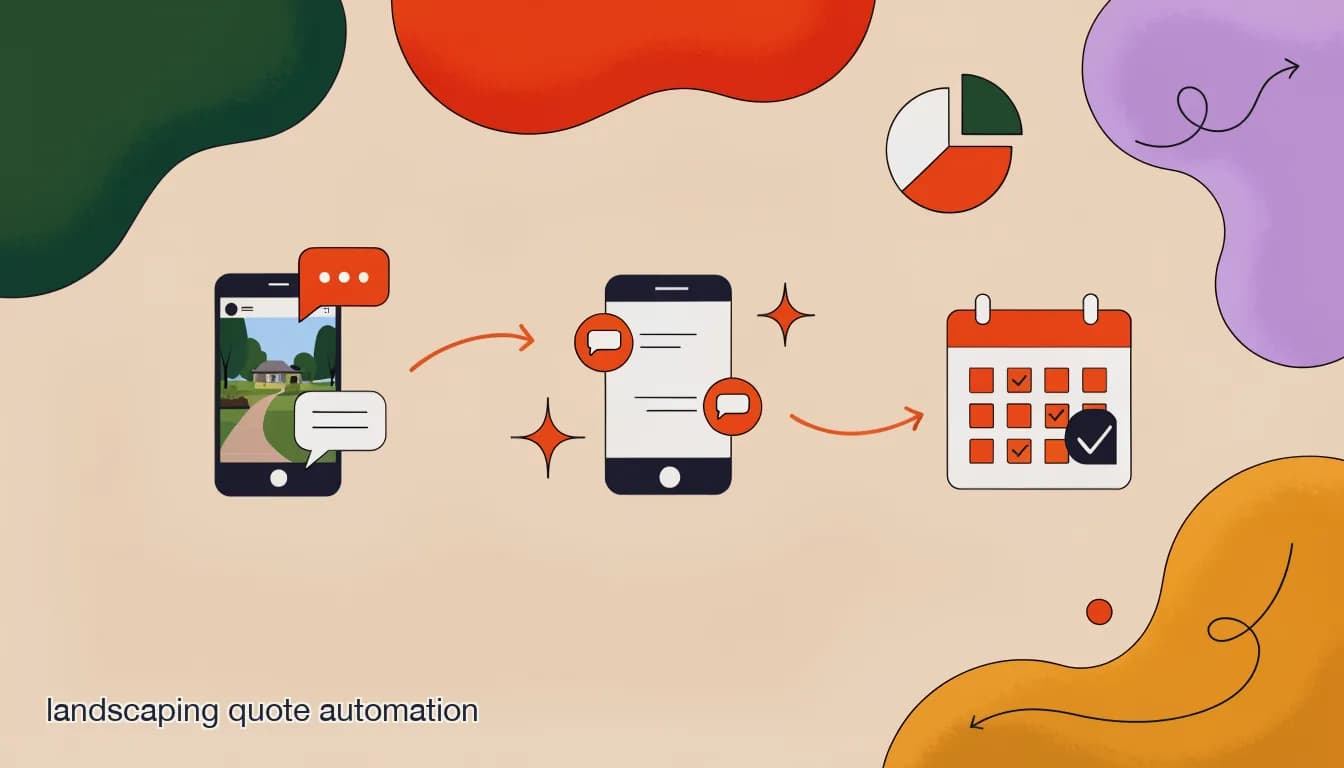
Landscaping quote automation solves a very specific leak in the sales funnel: the gap between someone commenting 'DM for a quote' on your Instagram post and that conversation actually turning into a booked estimate visit. Most landscaping companies already generate this kind of interest — a before-and-after post gets a dozen comments, a Facebook ad drives DMs, a referral texts a photo of their yard. The problem is what happens next, which for a lot of crews is: someone eventually replies, asks a few questions manually, maybe gets an address, and then the thread goes quiet because nobody circled back with a firm time.
That gap is where landscaping leads actually die — not at the ad, not at the comment, but in the unstructured back-and-forth that happens after someone shows interest and before an estimate gets booked on the calendar. Automating that specific stretch of the conversation, from first DM to confirmed visit, is what turns a comment into revenue instead of a comment that sits unanswered for two days.
Why does 'DM for a free quote' generate leads that never book?
'DM for a free quote' is one of the most common calls-to-action in landscaping marketing, and for good reason — it's low-friction for the prospect and it works on the platforms landscaping companies already post on. The problem isn't the CTA. It's that once someone actually DMs, most companies handle the reply the same way they'd handle a phone call: whenever someone gets around to it, manually, with no consistent set of questions.
That inconsistency creates two failure points. First, response time: a comment-to-DM lead who doesn't hear back within a few hours often forgets they asked, or messages a competitor instead. Second, incomplete information: a manual reply that just says 'thanks for reaching out, what's your address?' starts a slow back-and-forth that can take five or six messages spread across two days to gather what a structured flow could capture in one exchange — property size or lot type, which service they actually want (mowing, install, hardscape, cleanup), and when they'd like it done.
| Stage | Manual handling | What typically goes wrong |
|---|---|---|
| Comment lands | Seen whenever someone checks notifications | Delay of hours to days before first reply |
| First DM reply | Generic 'thanks, what do you need?' | Starts a slow back-and-forth instead of qualifying in one pass |
| Gathering details | Asked one question per message over multiple days | Prospect loses momentum or gets quoted by a competitor first |
| Booking the estimate | Requires a phone call to finally pin a time | Thread goes quiet before a visit ever gets on the calendar |
The CTA isn't the leak — the follow-through is
If your posts are generating comments and DMs but your estimate calendar doesn't reflect that volume, the marketing is working. The conversation after the DM is where the leads are actually being lost, and that's the part worth fixing first.
What does a landscaping quote automation flow actually qualify?
A useful quote-automation flow asks a small, consistent set of questions that give a crew lead enough to either quote on the spot for simple jobs or schedule an in-person estimate for anything that needs eyes on the property. The goal isn't to replace judgment — it's to make sure every lead arrives at that judgment with the same baseline information, instead of some leads getting a thorough intake and others getting nothing.
- Service type: mowing/maintenance, one-time cleanup, landscape design or install, hardscape (patio, retaining wall), irrigation, or tree/shrub work.
- Property basics: rough lot size or square footage, residential vs. commercial, and whether it's a recurring service or a one-time project.
- Timeline: is this urgent (overgrown lot, event coming up) or flexible planning for next season.
- Location: service address or at least zip code, to confirm it's inside your service area before anyone's time is spent.
- Budget signal (optional but useful): a rough range question can pre-qualify serious inquiries from price-shoppers without being pushy about it.
A qualifying exchange, compressed into one flow
- Prospect comments
- "DM for a free quote" reply on a backyard patio post
- Agent DM (automated)
- "Happy to help — are you looking at a new patio, or refreshing an existing one? And roughly what size area?"
- Agent follow-up
- "Got it. What's the property address or zip, and is there a timeline you're working toward?"
How do you go from qualified lead to a booked estimate visit, not just a quote request?
For most landscaping work beyond basic recurring mowing, you can't give a real number without seeing the property — soil, slope, existing plantings, and access all affect the estimate. That means the automation's real job usually isn't to quote a price, it's to get a qualified lead onto the calendar for an in-person estimate as fast and as frictionlessly as possible, while simple recurring-service requests can sometimes be quoted directly if your pricing is standardized enough.
- Trigger on the commentA keyword trigger ("quote", "DM", "price") on your posts automatically opens a DM to anyone who comments, instead of waiting for a manual reply.
- Qualify in one flowThe AI agent asks service type, rough property size, timeline, and location in a natural back-and-forth, not a rigid form.
- Route by job typeStandardized recurring services (weekly mowing at a known rate) can get an instant price range; design, install, and hardscape jobs route to an estimate booking.
- Offer real estimate slotsThe agent offers the next available estimate windows directly in the conversation, so booking happens without a phone call.
- Confirm and remindA confirmation message locks the appointment, and a reminder goes out closer to the date so no-shows drop.
Let simple jobs skip the estimate visit entirely
If your recurring mowing pricing is standardized by lot size, there's no reason those leads need an in-person visit before booking. Reserve the estimate-visit step for design, install, and hardscape work where price genuinely depends on seeing the property — it keeps your crew's calendar focused on jobs that actually need it.
Is landscaping quote automation just estimating software with extra steps?
Not quite — and the distinction matters. Estimating software (the LMN, Aspire, Jobber, Arborgold, and similar category of tools) is built to price a job accurately once you already have the details: materials, labor rates, equipment, sometimes aerial-imagery property measurement. It's excellent at the pricing math. What it generally isn't built to do is have the initial conversation that gets those details out of a cold Instagram comment in the first place.
Quote automation, as covered in this post, sits upstream of that: it's the conversational layer that takes an unqualified 'DM for a quote' and turns it into a structured lead with the service type, rough scope, and a booked estimate slot — which then feeds into whatever estimating tool your team uses to actually price the job. The two aren't competitors; a lot of landscaping companies get the best result running both, with the conversational intake automated and the pricing math handled by dedicated estimating software.
| Tool category | What it's built for | What it doesn't do well |
|---|---|---|
| Estimating software (LMN, Aspire, Jobber, etc.) | Accurate pricing from known job details, materials, labor rates | Doesn't capture the initial DM conversation or qualify a cold lead |
| Quote automation (comment-to-DM + AI agent) | Turns an unqualified comment into a structured, booked lead | Doesn't replace detailed pricing math for complex install/hardscape jobs |
These are complementary, not competing
If your estimates are inconsistently priced, the fix is estimating software. If your leads are inconsistently captured before they ever reach pricing, the fix is quote automation. Most landscaping companies losing revenue are actually further upstream than they think — the comment sat unanswered, not the estimate was priced wrong.
Where estimating software and quote automation both matter less than you'd expect is the channel itself. A lot of landscaping companies still treat Instagram and Facebook comments as marketing exhaust rather than a real sales channel — worth engaging with for likes, not worth building a real intake process around. That instinct is outdated for a category where 'DM for a free quote' is now one of the single most common calls-to-action in the industry.
How much does Instagram/Facebook DM volume actually matter for landscaping leads?
DM-originated conversations tend to run higher engagement than a standard contact form for one structural reason: the prospect is already in the app where they discovered you, mid-scroll, reacting to a specific photo or post rather than navigating away to fill out a form. That immediacy is an asset if you respond fast and a liability if you don't — the same momentum that makes someone comment 'DM for a quote' on impulse is the momentum that evaporates if the reply takes two days.
For a landscaping company, that means the DM channel deserves the same seriousness as the phone line, not a lower tier of attention. A missed call gets a voicemail and sometimes a callback. A missed DM, more often, just gets forgotten by the prospect — or answered by whichever competitor's post they scroll to next.
Directional, not a guaranteed number
Industry sources describe DM-originated conversations converting to engagement at a meaningfully higher rate than off-platform forms, since the prospect stays where they discovered you instead of navigating away. Treat that as a directional pattern worth acting on, not a precise statistic for your specific audience or region.
What should you do about leads who ghost after the first message?
Not every qualified lead books on the first exchange — some get partway through qualification and go quiet, often because they got distracted, not because they lost interest. A single, well-timed follow-up recovers a meaningful share of these without being pushy, especially if it's specific rather than a generic "just checking in."
- Follow up once, 24–48 hours after the thread goes cold — referencing what they asked about, not a generic nudge.
- If they were mid-qualification (gave service type but not location/timeline), the follow-up should pick up exactly where they left off, not restart the questions.
- Two follow-ups is usually the ceiling — beyond that, move on rather than risk feeling like spam to someone who's browsing multiple companies.
- Segment cold leads from booked ones so your follow-up sequence doesn't accidentally message someone who already has an estimate on the calendar.
A recovered lead, not a generic nudge
- Generic follow-up
- "Hey, still interested?" — easy to ignore, no new information
- Specific follow-up
- "Following up on the backyard patio project — still want to grab an estimate slot this week?"
How do you handle price-shoppers who just want a number and won't book?
Every landscaping company that runs comment-to-DM at any volume eventually runs into the prospect who wants a ballpark number before committing to anything — no interest in an estimate visit, no interest in giving an address, just "how much for a patio" with zero details. These leads are real, but they're a different category than someone ready to book, and treating them the same way wastes calendar slots on people who were never going to convert this week.
The fix isn't to refuse a ballpark — refusing tends to read as evasive and can cost you a lead who would have booked with more information. It's to give a range conditioned on the variables that actually drive price ("patio installs in our area typically run $X–$Y depending on size and material, and we'd need to see the space to get more specific") and then offer the estimate visit as the natural next step rather than a demand. That framing satisfies the price-shopper's actual question while still routing anyone genuinely interested toward booking.
- Give a conditioned range, not a refusal — "depends on size and material, typically $X–$Y" moves the conversation forward instead of stalling it.
- Always pair a ballpark with the next step: "want to grab a quick estimate visit to get you an exact number?"
- Track which price-shopper leads convert later in the season — some come back once they've compared a few ranges and yours looked reasonable.
- Don't over-invest human time in a lead that's explicitly said they're just comparing numbers; let the automation handle that tier so your crew's time goes to leads ready to book.
How do you know if landscaping quote automation is actually working?
Automating the intake is only useful if it moves a real number: the share of DM/comment leads that turn into a booked estimate visit. Response time and message volume are easy to track but are inputs, not outcomes — a fast reply that never leads to a booking hasn't actually fixed anything. The metric that matters is comment-or-DM-to-booked-estimate conversion rate, tracked over a full month so seasonal noise doesn't skew a single week's read.
A second worthwhile metric is the completion rate through the qualifying flow itself — what share of people who start the conversation actually answer all the qualifying questions versus dropping off partway. A low completion rate usually means the flow is asking too much, asking it too rigidly, or asking questions that feel like a form rather than a conversation, and is worth revisiting before you assume the channel itself is underperforming.
| Metric | What it tells you | How to improve it |
|---|---|---|
| Comment/DM-to-booked-estimate rate | Whether qualified interest is actually converting to a calendar slot | Tighten the qualifying flow; add a follow-up for stalled threads |
| Qualifying-flow completion rate | Whether the conversation itself is too long or too form-like | Cut to the essential questions; keep the tone conversational |
| Time-to-first-reply on comments | How much momentum you're losing before the conversation even starts | Automate the first reply so it fires within seconds, not hours |
Don't optimize for reply speed alone
A fast automated reply that then asks five separate questions in five separate messages can still lose leads to impatience, even though the first-response metric looks great. Track the full funnel through to a booked estimate, not just how quickly the first message goes out.
How does KlyoChat handle landscaping quote automation?
KlyoChat is built by Pointerflow LLC as a unified inbox and no-code automation platform across Facebook, Instagram, Telegram, and WhatsApp (rolling out), with comment-to-DM automation as a core feature rather than a workaround. For a landscaping company, that means the exact 'DM for a free quote' pattern this post is built around — someone comments, an automated DM opens instantly, and an AI agent trained on your service list and pricing structure runs the qualifying conversation without a person needing to be watching the post in real time.
The AI agent (included from the Pro plan, not sold as a separate add-on) can be trained on your actual service menu and standard pricing tiers, so it can quote simple recurring services directly and route anything needing an in-person look — design, install, hardscape — to a booked estimate slot pulled from your real availability. Because the shared team inbox keeps every conversation in one place regardless of channel, a crew lead can see the full qualifying thread before ever driving out to the property, instead of walking in blind.
For the follow-up problem, KlyoChat's automation can trigger a single, context-aware nudge to leads who stalled mid-qualification, and broadcasts let you segment your contact list — booked customers, past customers due for spring cleanup, cold leads from last season — so re-engagement messages go to the right group instead of everyone at once.
None of this requires your crew to learn a new tool mid-season. The flow builder is no-code, so a crew lead or office manager can adjust the qualifying questions or the service menu directly from a phone between jobs, without waiting on a developer or filing a support ticket to change a single question in the intake flow.
Train the agent on your actual service list first
The single biggest factor in how well this works is how specific your AI agent's knowledge base is — your real service categories, rough pricing tiers, and service-area boundaries. A generic agent asking generic questions converts worse than one that sounds like it actually knows your business.
A comment-to-DM flow on KlyoChat
- Comment
- "DM for a quote 🌿" on a before/after landscaping post
- Automated DM
- AI agent opens the conversation within seconds, asks service type and rough size
- Booked
- Agent offers next estimate slot; confirmation and reminder sent automatically
Landscaping quote automation isn't about replacing the conversation with a form — it's about making sure the conversation that already happens in your DMs every week actually reaches a calendar slot instead of stalling out in a half-finished thread. The comment-to-DM moment is where the interest already exists; automation's job is just to make sure it doesn't leak out before it becomes a booked estimate.