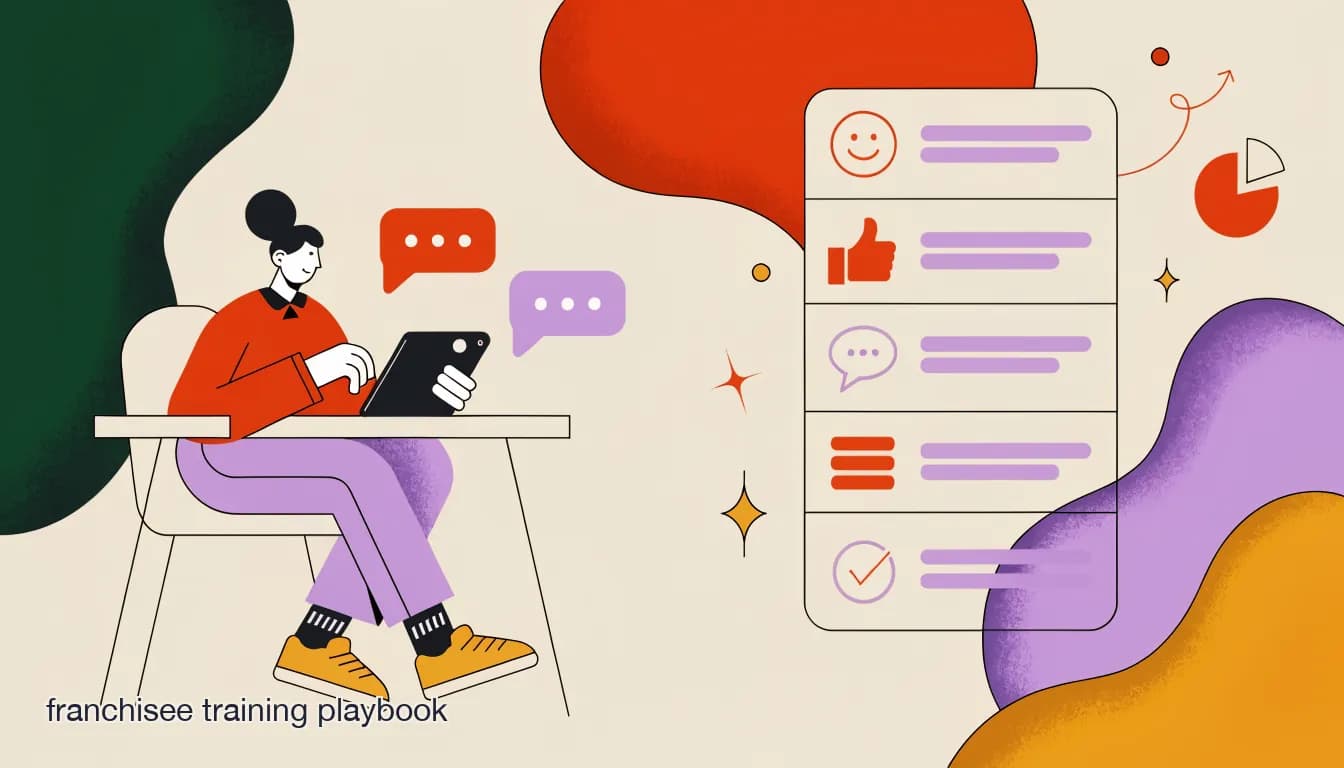
A franchisee training playbook for messaging is the piece franchise groups most often skip, and it's not the technical setup — connecting channels, creating a tenant, configuring the AI agent's local fields is a checklist any operations team can execute in a day. What gets skipped is training the actual human being who's about to represent the brand in every customer DM: a new franchisee, and often two or three staff members, who have never seen the brand's tone guidelines, never practiced an escalation, and have no instinct yet for where the AI agent's boundaries are.
The gap shows up fast and predictably. A new location goes live with a perfectly configured inbox and an owner who's never actually typed a reply in the system before a real customer is on the other end. This post is the training side of onboarding a new franchisee — separate from and complementary to the technical location setup — covering what to teach, how long it should take, how to certify someone as ready, and how to keep training current as brand standards evolve.
Why does franchisee training on messaging matter as much as location setup?
Technical setup determines whether the system works. Training determines whether the person using it represents the brand well. Both matter, but franchise groups consistently over-invest in the first and under-invest in the second — probably because setup has a visible checklist and training doesn't, until a franchisee's first off-script reply becomes a screenshot circulating among customers.
The stakes are higher than they look. A new franchisee's first few weeks of customer messaging set the tone for how that location's DM presence is perceived long-term, and mistakes made before training — an overpromised policy, an off-brand tone, a mishandled complaint — are harder to walk back than mistakes that never happen because the franchisee was trained first.
- Technical setup is a one-time configuration task; training is a skill the franchisee and their staff carry into every future conversation.
- A poorly trained franchisee can misuse a perfectly configured system just as easily as a well-trained one can compensate for a rough setup.
- First-month mistakes are disproportionately visible — new locations get more scrutiny from curious local customers than an established one would for the same error.
What does a new franchisee actually need to learn before answering customer DMs?
Training should cover four areas, roughly in this order: what they're allowed to say, what they're allowed to change, what to do when something's outside their authority, and how the tools actually work day to day. Most franchise training programs jump straight to the fourth item — 'here's how to use the inbox' — and skip the first three, which is backwards. A franchisee who deeply understands the boundaries can figure out the interface in twenty minutes. A franchisee who's fluent in the interface but unclear on the boundaries will eventually say something the brand regrets.
| Training area | What it covers | Why it comes first |
|---|---|---|
| Brand voice and policy | Tone, standard answers, refund/return language, disclosures | This is what customers actually experience in every reply |
| Local override authority | What the franchisee can edit themselves — hours, local promos, address | Defines their day-to-day autonomy without needing HQ approval |
| Escalation boundaries | When to hand off to a regional manager or HQ, and how | Protects the franchisee and the brand when something's outside scope |
| Tool mechanics | How to use the inbox, assign, note, and read AI agent suggestions | Fastest part to learn once the first three are clear |
How long should franchisee messaging training take?
Long enough to build real fluency, short enough that it doesn't become a barrier franchisees resent before they've even opened. In practice, three to five hours of structured training — spread across brand voice review, a walkthrough of the tools, and a graded practice run — covers the ground without turning onboarding into a multi-day event a busy new owner has to carve out of an already packed pre-opening schedule.
That time splits roughly into thirds: about ninety minutes reviewing brand voice and policy material (ideally with real example conversations, not just a written style guide), ninety minutes on tool mechanics and local override configuration, and a final block for a graded practice run — responding to a set of realistic sample conversations before touching a live customer.
Compress it, don't skip it
The pressure before a grand opening is real, and training is often the first thing cut when the schedule gets tight. Resist that instinct — three to five hours spread over a week is far cheaper than the reputational cost of an untrained franchisee's first month of replies, and it's a fraction of the time the technical setup checklist already takes.
What does a certification checkpoint look like before a franchisee goes live?
A certification step turns training from 'we covered the material' into 'we verified they can apply it' — the difference between a franchisee who sat through a presentation and one who's actually demonstrated they'll handle a real conversation well. It doesn't need to be elaborate, but it does need to be a genuine checkpoint, not a formality everyone passes automatically.
- Review the brand voice guide togetherWalk through the core knowledge base and policy language with the franchisee, using real past conversations from other locations as examples of good and bad replies.
- Run a practice set of sample conversationsGive the franchisee five to eight realistic scenarios — a routine question, a complaint, an edge case outside their authority — and have them draft replies.
- Review the practice replies against the brand standardA regional manager or trainer scores each reply for tone, accuracy, and correct escalation judgment, and flags anything that would have needed a correction.
- Confirm escalation reflexes specificallyMake sure the franchisee correctly identified which practice scenarios needed to be escalated rather than answered directly — this is the single highest-risk skill to get wrong.
- Sign off and grant live accessOnce the practice set is reviewed and any gaps addressed, grant the franchisee and their trained staff live inbox access for real customer conversations.
Score the escalation judgment, not just the writing
A franchisee can write a warm, on-brand reply and still fail the practice run if they answer something that should have been escalated — a refund promise, a legal question, a safety concern. Escalation judgment is the specific skill most likely to cause real damage if it's wrong, so weight it accordingly when reviewing practice conversations.
Certification confirms a franchisee can apply the rules correctly in a controlled setting. The harder, ongoing question is how to teach brand voice in the first place without producing a franchisee who sounds like they're reading from a script — because customers notice that too, and it undercuts the local, personal feel that makes DM engagement work.
How do you teach brand voice without turning every franchisee into a robot?
The instinct is to hand new franchisees a long style guide full of approved phrases. It produces exactly the stiff, corporate-sounding replies that make a DM conversation feel like talking to a form letter instead of a person — which defeats the point of a local, human-feeling messaging channel. Better training teaches the underlying principles — warmth, directness, what never to promise — and lets the franchisee's own voice fill in the rest, the same way a well-run brand lets regional accents and personalities show through in person.
The practical version of this: instead of scripting exact sentences, train on a small number of hard boundaries (what can never be said or promised) and a handful of tone examples showing the range of acceptable replies to the same question. A franchisee who understands 'warm and direct, never promise a refund without checking policy' will handle a novel question well. A franchisee handed only exact scripts will freeze or improvise badly the moment a real conversation goes off-script.
- Teach hard boundaries explicitly — refund policy, legal disclosures, safety statements — these should never vary by franchisee.
- Teach tone as a range, with two or three example replies to the same question showing acceptable variation, not one 'correct' script.
- Let the AI agent's co-pilot suggestions model good tone in real time, so franchisees learn by seeing suggested replies during actual early conversations, not just in training.
What materials should a franchisee training kit actually include?
Training only stays consistent across a growing franchise group if it doesn't depend on whoever happens to be running the session that week improvising the content from memory. A written training kit — reused for every new franchisee, updated centrally when policy changes — is what makes the three-to-five-hour session repeatable at location fifty the same way it worked at location five.
The kit doesn't need to be a lengthy manual. It needs to be a small set of purpose-built materials that map directly onto the four training areas covered earlier, so a regional manager running the session has everything on hand without assembling it from scratch each time.
- A one-page brand voice cheat sheet: the hard boundaries that never change, plus two or three example replies showing acceptable tone range for common questions.
- A copy of the current AI agent knowledge base, so the franchisee sees exactly what the AI is already saying to customers and where their own replies need to stay consistent with it.
- A written escalation flowchart: which situations route to a regional manager, which go straight to HQ, and what the expected response time is at each level.
- The five-to-eight scenario practice set used for certification, kept current so it reflects real recent conversations rather than a static set written once and never refreshed.
- A one-page local override guide showing exactly which fields (hours, address, current promotion) the franchisee can edit themselves without approval.
Update the kit before you update the training
When brand policy changes, update the training kit's cheat sheet and knowledge-base excerpt first, then run the next new-franchisee session from the updated version. Franchise groups that update training verbally, location by location, end up with different franchisees trained on different versions of the same policy without realizing it.
What common mistakes do new franchisees make in their first month of messaging?
A handful of mistakes show up so consistently across franchise groups that it's worth training against them directly, rather than waiting for each new franchisee to make and learn from them individually.
| Common mistake | Why it happens | How training prevents it |
|---|---|---|
| Answering outside their authority | Wanting to be helpful and resolve things fast | Explicit escalation-boundary training and practice-run scoring |
| Inconsistent tone across staff | Multiple people replying with no shared reference | Shared tone examples and AI co-pilot suggestions as a baseline |
| Slow response outside business hours | Not realizing the AI agent needs to be configured for after-hours coverage | Tool-mechanics training covering AI agent handoff hours |
| Ignoring the local override fields | Not knowing they can update hours/promos themselves | Explicit walkthrough of what they're empowered to edit |
The 'wanting to help' mistake is the hardest to train away
The most common escalation failure isn't laziness — it's a well-meaning franchisee trying to fully resolve a customer's problem themselves rather than routing a complex issue up. Frame escalation training as 'this gets the customer a better, faster answer,' not as a limitation on their authority, or the instinct to over-help will keep winning.
Who should run the training — HQ, a regional manager, or a peer franchisee?
All three have a role, and the mix matters more than picking just one. HQ should own the brand-voice and policy content itself — the boundaries shouldn't drift based on who happens to be delivering the training that week. A regional manager is usually the right person to actually run the session and score the certification practice run, since they have local market context and an ongoing relationship with the franchisee after go-live.
A peer franchisee — someone who's been running their location on the same system for six months or more — adds something neither HQ nor a regional manager can: credibility about what the day-to-day actually feels like, and practical tips that never make it into an official training document. Pairing a new franchisee with an experienced peer for even one informal conversation alongside the formal training consistently gets flagged as one of the most useful parts of onboarding.
How do you keep training current as brand policy changes?
Training isn't a one-time event for a franchisee's first week — brand policy changes, new products launch, and the AI agent's knowledge base gets updated, all of which can make a franchisee's original training stale within months. Franchise groups that treat training as a single onboarding milestone end up with locations quietly operating on outdated information a year later.
- Tie training updates to knowledge-base changesWhenever HQ updates the core AI agent knowledge base or policy language, push a short update summary to every location, not just a silent backend change.
- Run a brief quarterly refreshA thirty-minute session covering what's changed since the last quarter keeps franchisees current without repeating the full onboarding training.
- Use audit review to catch drift earlyIf a sampled conversation review shows a franchisee using outdated policy language, that's a signal to refresh their training specifically, not just flag the individual conversation.
How does KlyoChat support franchisee training?
KlyoChat doesn't replace a franchise group's training program, but the product is built to make training and certification easier to run and easier to verify. The AI agent's knowledge base gives HQ a single, versioned source of brand voice and policy content to train against, and the same override-field structure used in day-to-day operation doubles as the training map — a new franchisee learns exactly what they can edit locally, because that's the same permission set they'll actually operate under.
The AI co-pilot's suggested replies, visible inside the inbox during real early conversations, function as ongoing on-the-job coaching — a new franchisee sees a suggested on-brand reply alongside the customer's message and starts absorbing the tone by working, not just by reading a guide beforehand. Sampled audit review across locations gives HQ and regional managers the data to spot a franchisee whose replies are drifting from training and schedule a refresh before it becomes a pattern.
- AI agent knowledge base functions as the single source of truth for what franchisee training should teach.
- AI co-pilot suggested replies act as real-time coaching during a new franchisee's first live conversations.
- Conversation audit logs, scoped per location, let HQ verify training stuck without reading every message.
Training support across KlyoChat's plans
- Pro ($49/mo, $39 yearly)
- Shared AI agent knowledge base, co-pilot reply suggestions, per-location override fields for role-based training
- Business ($129/mo, $109 yearly)
- Adds a higher contact ceiling and API access for groups building custom LMS integrations around training data
Franchise groups spend real budget getting a new location's technical setup right on day one — and they should. The training side deserves the same discipline, not because it's harder, but because it's easier to skip and the cost of skipping it is slower to show up. A franchisee who's genuinely fluent in brand voice, local authority, and escalation before their first real conversation is the difference between a location that feels like part of the brand from week one and one that spends its first year quietly correcting avoidable mistakes.