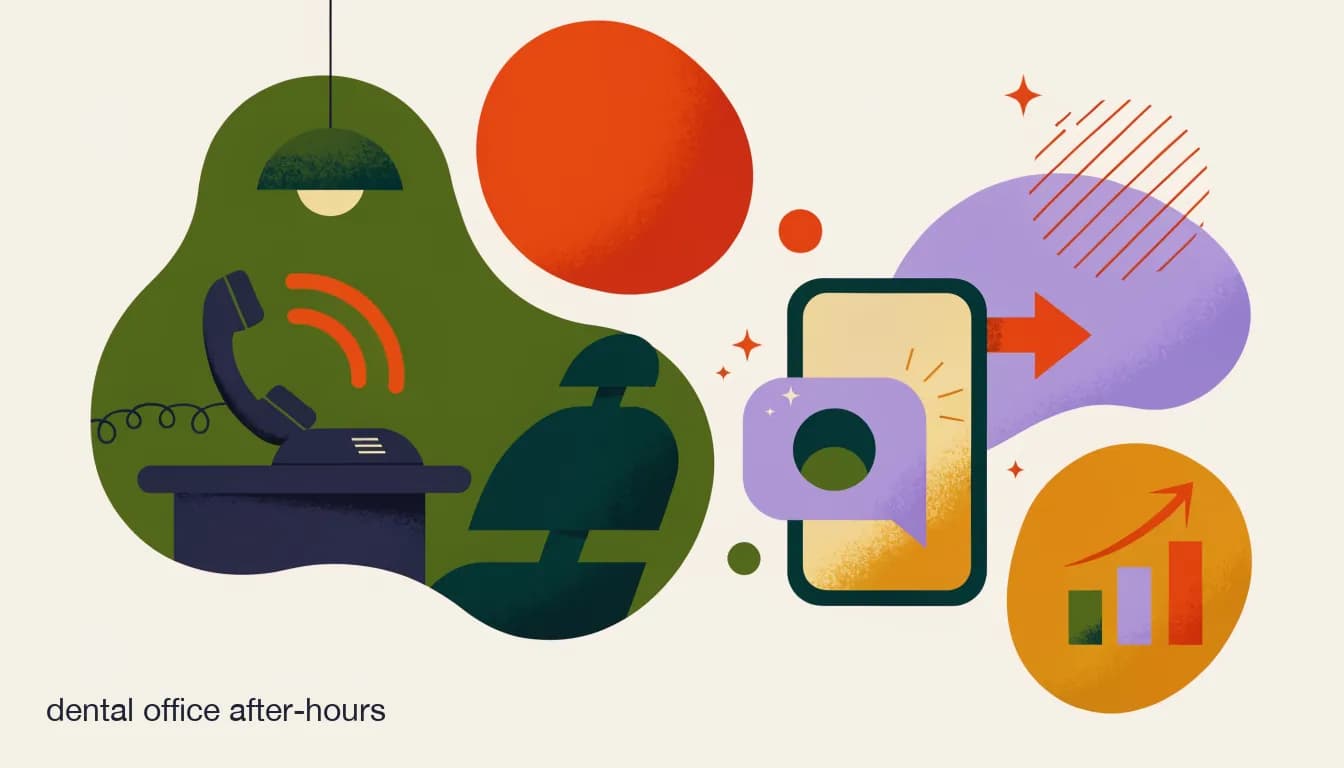
Dental office after-hours messaging sounds like a minor operational detail until you look at when patients actually reach out. A parent researching braces for their kid browses Instagram after dinner. Someone self-conscious about a chipped front tooth finally works up the nerve to ask about veneers at 9pm, alone, on their phone. A new-to-town professional googles "dentist near me" on a Sunday because Monday's toothache reminded them they still need to find one. None of this happens on a tidy 9-to-5 schedule, but most dental front desks are only staffed to answer during exactly those hours.
The result is a gap that's easy to miss because it never shows up as a complaint. Nobody calls to tell you they called once, got no answer, and booked with the practice three exits down instead. They just don't show up in your schedule. Industry reports on dental call handling suggest this gap is bigger than most practices assume — and it isn't only a phone problem. The same silence happens on Instagram DMs, Facebook Messenger, and website chat widgets the moment the last hygienist locks the door.
This is a problem-framing piece, not a how-to. The goal here is to make the size and shape of the after-hours leak visible, because most practices only fix problems they can actually see.
How many calls does a dental office actually miss?
Ask most office managers how many calls go unanswered and you'll get a confident "not many" — usually because nobody has actually measured it. Industry sources tracking dental call volume suggest that roughly a third of calls to a typical practice go unanswered, and that figure includes calls during normal business hours, when the front desk is simply mid-checkout with another patient, on hold with an insurer, or juggling three lines at once.
That's the daytime number. After the office closes, the unanswered rate for anyone dialing your listed number is effectively total, unless you've set something up to catch it. The same is true for anyone messaging your Instagram or Facebook page after your last staff member logs off for the day.
These are directional estimates, not audited numbers
Figures like "about a third of calls go unanswered" come from industry reporting on dental call-handling patterns, not a controlled study of your specific practice. Treat them as a reason to check your own numbers, not as a hard statistic to quote to your team.
What actually happens when a call goes unanswered?
The instinct is to assume a patient who doesn't get through will simply call back later, or leave a voicemail and wait patiently. Some do. But dental treatment is rarely an emergency in the medical sense — it's a want, or a slow-building discomfort, not a 911 call — which means the person on the other end has options and very little reason to wait around for you specifically.
Industry sources on lead response describe a pattern that shows up across service businesses generally, and dentistry is no exception: a caller who doesn't get through tends to move to the next name on their shortlist, not to a patient hold pattern. For a practice that spent real marketing dollars getting that person to pick up the phone in the first place, that's the most expensive kind of loss — the lead was already earned, and it disappeared at the last step.
- A caller with a real toothache rarely waits quietly for a callback — they try the next practice.
- A first-time inquiry ("do you take my insurance," "how much is a cleaning") has even less reason to wait; there's no existing relationship pulling them back.
- Voicemail is a weak substitute for a live answer — many callers simply hang up rather than leave one.
- The same pattern applies to DMs and web chat: a message that sits unread for hours reads as "they're not interested" to the person who sent it.
Why does response speed matter so much for dental leads?
Speed isn't just a nice-to-have on top of good service — for a new-patient inquiry, it's often the single biggest factor in whether that person ever becomes a patient at all. The research on lead response time across service industries is consistent on the shape of the curve, even where exact numbers vary by source: replying within the first few minutes converts dramatically better than replying thirty minutes or more later, and the drop-off accelerates the longer the gap runs.
For a dental practice, this plays out in a very specific way. Someone comparing two or three local practices is often doing that comparison in a single sitting — a few tabs open, a couple of DMs sent, a couple of numbers dialed. Whoever replies first, with something specific rather than a placeholder, effectively wins that comparison before the slower practice even sees the message.
| Response window | What industry sources suggest happens | What it means for a dental practice |
|---|---|---|
| Under 5 minutes | Reported to convert far better than any slower window | Patient is still in "comparing" mode; you can close the loop first |
| 5–30 minutes | Conversion drops noticeably as the gap widens | Patient may have already messaged another practice as a backup |
| 1–6 hours | Interest cools; competing options often win by default | Reply reads as an afterthought even if the content is good |
| Next business day | Treated by many prospects as effectively "no answer" | Lead is frequently already booked elsewhere |
Speed beats polish for the first reply
The first response doesn't need to be a perfect, fully personalized message. A quick, specific acknowledgment — hours, a price range, a next step — that arrives in minutes will usually outperform an eloquent reply that arrives the next morning.
Is this only a phone problem, or does it happen on DMs too?
It's tempting to treat missed calls as the whole story, since a phone is the most obvious channel and the easiest to audit — you can literally see the call log. But for a practice actively posting before/after photos, procedure explainers, or Invisalign content on Instagram, DMs and comments carry just as much after-hours risk as the phone line, and they're easier to overlook because there's no ringing to notice.
A comment on a smile-transformation post at 9pm, or a DM asking "do you take my insurance," sits in exactly the same limbo as an unanswered call — except there's no missed-call notification forcing anyone to notice it happened. By the time someone checks the inbox the next morning, the moment that made that person comment has usually already passed.
Two after-hours inquiries, same night
- 8:45pm phone call, no answer
- Goes to voicemail; caller doesn't leave one and tries another practice
- 9:10pm Instagram DM, unread until morning
- Prospect has already messaged two other local accounts by 9:30pm
What time of day are dental practices actually losing leads?
The after-hours window is wider than the phrase suggests. It's not just late night — it includes the early evening hours right after most practices close, which is also, not coincidentally, when a lot of people finally have time to sit down and think about a dental decision they've been putting off all day.
Industry reporting on this pattern points to a heavy concentration of missed inquiries landing between roughly 6pm and 9pm, well before anyone would call it "the middle of the night." A practice that closes at 5pm and reopens at 8am the next morning has a fifteen-hour window sitting open every single weekday, plus the entire weekend for practices closed Saturday and Sunday.
| Time window | Why it matters | Typical coverage |
|---|---|---|
| 5pm–6pm | Front desk winding down, last patients checking out | Often already unmanned or distracted |
| 6pm–9pm | Peak personal browsing/decision time for many prospects | Fully unmanned at most practices |
| 9pm–8am | Late browsers, insomniac scrollers, early risers | Fully unmanned |
| Weekends | Prospects have unstructured time to research and decide | Often fully unmanned unless staffed specifically for it |
How much does a single missed after-hours lead actually cost?
It's easy to wave off one missed message as a rounding error. The math looks different once you multiply it out across a month, especially for a practice running Invisalign, veneers, or implant content where a single booked patient can be worth thousands of dollars in treatment value.
Industry estimates on missed-lead volume suggest a typical practice can lose somewhere in the range of a dozen or more real inquiries a month specifically to after-hours silence — not tire-kickers, but people who took the time to call or message and simply never heard back in time to matter. Even a conservative estimate of the value per lost lead adds up fast for anything beyond routine cleanings.
Don't anchor on someone else's number — measure your own
The exact dozen-plus figure will vary a lot by location, specialty, and how much marketing you're running. Treat published estimates as a reason to check your own missed-call log and after-hours message timestamps for a month, not as your practice's actual number.
A rough monthly estimate (illustrative, not a guarantee)
- Estimated after-hours inquiries lost per month
- A dozen or more, per industry reporting on missed-call patterns
- Share that would have converted with a fast reply
- Unknown for your practice — worth measuring directly
- Value of even 2–3 recovered leads a month
- Often exceeds the cost of any tool that closes the gap
How do you find out how big your own after-hours gap actually is?
Before deciding whether this is worth fixing, it's worth spending twenty minutes with your own numbers rather than borrowing someone else's estimate. Most practices can pull this together from records they already have, without any new software.
- Pull your call log for two weeksMost phone systems and practice management tools log call times — note how many arrived after your posted closing hours.
- Check your Instagram and Facebook message timestampsLook at when DMs and comments actually arrived versus when someone on your team replied.
- Tag anything that reads like a new-patient inquirySeparate genuine "how much/do you take my insurance/can I book" messages from spam or existing-patient chatter.
- Compare timestamps to your booked-consult listSee how many after-hours inquiries actually turned into an appointment, and how long each one waited for a reply.
Two weeks is enough to see the shape of the problem
You don't need a full quarter of data to know whether this is worth addressing. Two weeks of call and message timestamps is usually enough to show whether after-hours silence is costing you a handful of leads or a genuinely significant number.
Why can't the front desk just fix this by working later?
The obvious fix — keep someone on the phones and DMs until 9pm — runs into the same wall every small practice runs into: staffing cost, burnout, and the fact that after-hours volume, while real, is usually too thin and unpredictable to justify a dedicated evening shift for one or two people to sit and wait for messages that may or may not arrive.
It's also not really a front-desk problem in the way it first appears. Front-desk staff are already fully occupied during business hours checking patients in, verifying insurance, and answering the phone that is ringing. Asking the same team to also cover evenings and weekends isn't a scheduling tweak — it's a second shift, with its own cost and its own turnover risk.
- Hiring evening coverage is expensive relative to the thin, unpredictable volume it would catch.
- Existing staff are already at capacity during business hours; extending their day risks burnout.
- Voicemail and "we'll call you back" don't solve the speed problem — they just move the wait.
- A generic autoresponder ("we're closed, call back tomorrow") stops the bleeding a little but doesn't actually capture the lead.
The goal isn't to eliminate the gap — it's to catch what falls into it
No practice is realistically going to staff 24/7. The more useful framing is: what's the fastest, cheapest way to give an after-hours inquiry something better than silence, even if a human doesn't pick it up for real until the next morning?
That reframing — catch the lead, don't necessarily staff the hours — is where most practices land once they've actually measured the size of the gap. The question becomes what a decent catch-and-hold response looks like, and how it avoids sounding like a dead end.
What does a good after-hours message actually need to say?
The bar here is lower than it sounds. An after-hours reply doesn't need to close the sale on its own — it needs to do two things: acknowledge the person quickly, and give them a clear, specific reason to believe someone will follow up soon. Vague or purely apologetic replies do neither well.
- Acknowledge immediatelyConfirm the message was received the moment it arrives — silence, even for ten minutes, reads as "ignored" to someone actively comparing options.
- Set a specific expectation"We'll follow up first thing tomorrow by 9am" beats "we'll get back to you soon" — specificity reduces the urge to try elsewhere.
- Answer what can be answered safelyHours, whether you accept their insurance, a general price range, and how to book — logistics only, never a clinical assessment.
- Offer a next step, not just a promiseA booking link or a request for the best callback time gives the person something to do right now instead of just waiting.
- Route anything clinical to the morningSymptom descriptions, pain questions, or "is this an emergency" belong with a human during business hours or an emergency line — never guessed at overnight.
Keep after-hours automation to logistics, not health information
An automated after-hours reply should stick to scheduling, hours, insurance, and general pricing — never clinical advice, and never a channel for someone to describe symptoms or share health details. Keep protected health information off of DM and chat channels entirely, and make sure genuine dental emergencies are pointed to a phone line or an emergency protocol, not a chatbot.
Does an automated after-hours reply feel impersonal to patients?
This is the objection every office manager raises first, and it's a fair one — nobody wants their practice's first impression to feel like talking to a wall. But the actual comparison patients are making isn't "automated message vs. a human right now." It's "automated message vs. total silence until tomorrow," because a human right now usually isn't available at 9pm regardless.
Framed that way, a quick, honest, well-written automated reply almost always beats silence, and it doesn't have to sound robotic. "Thanks for reaching out! Our office is closed right now, but we typically see patients starting at $X for a cleaning and we'll follow up first thing tomorrow — want to leave us the best time to reach you?" reads as attentive, not automated, even though it fired in under a second.
How do you know if after-hours coverage is actually working?
Once something is catching after-hours inquiries, the honest way to know whether it's helping is to track a small set of numbers over a month or two, rather than assuming it's working because it exists.
| Metric | What it tells you | If it's weak |
|---|---|---|
| After-hours inquiries logged per week | Whether you're even seeing the volume that used to be invisible | You likely still have channels going unmonitored |
| Time to first response, after hours | Whether the catch is actually fast or just eventually happens | Automate the first reply rather than relying on morning check-ins |
| After-hours reply to booked-consult rate | Whether the acknowledgment is converting, not just logging | Tighten the message; add a clearer next step |
| Complaints about being "ignored" after hours | A blunt signal something in the loop is broken | Audit response timestamps directly rather than guessing |
What mistakes do practices make with after-hours lead handling?
Most of the recurring mistakes aren't about lacking the right tool — they're about assuming the gap doesn't exist, or fixing it halfway and stopping there.
- Assuming after-hours volume is too small to matter without ever actually checking a call log or DM inbox.
- Covering the phone with voicemail but leaving Instagram and Facebook DMs completely unmonitored overnight.
- Sending a generic "we're closed" autoreply with no price, no timeline, and no next step — technically an answer, functionally a dead end.
- Letting a well-meaning after-hours message drift into clinical territory ("describe your pain and we'll see if it's urgent") instead of staying strictly logistical.
- Treating the fix as a one-time setup rather than checking response-time numbers periodically as volume changes.
The leak is quiet, which is exactly why it's dangerous
A broken checkout process or a bad review shows up loudly. A missed after-hours DM doesn't — the prospect just never appears in your schedule, and there's nothing in your usual reporting that flags why. That quietness is precisely why most practices underestimate how much this is actually costing them.
How does KlyoChat help catch after-hours dental leads?
KlyoChat brings Facebook, Instagram, Telegram, and WhatsApp into one inbox, so an evening comment, a DM, or a message doesn't sit unseen just because it landed after your front desk went home. A custom AI agent — trained on your practice's own hours, general pricing ranges, and insurance information — can send an immediate, specific reply the moment a message comes in, well past what a generic autoresponder does, without anyone needing to be watching a screen at 9pm.
That agent is deliberately scoped to logistics: confirming hours, giving a price range, checking whether you generally accept a given insurance plan, and offering to book or collect a callback time. Anything that reads as symptoms, pain, or a clinical question gets flagged and routed to your team the next morning rather than answered by the bot — the same guardrail described earlier in this piece, not a KlyoChat-specific limitation. It's a starting point for closing the after-hours gap, not a full clinical answering service, and it isn't a replacement for a signed HIPAA Business Associate Agreement if your practice needs to move protected health information anywhere near a messaging channel.
- Unified inbox across Facebook, Instagram, Telegram, and WhatsApp catches messages the front desk would otherwise never see until morning.
- AI agents are included from the Pro plan, not sold as a separate after-hours add-on.
- Configurable handoff keeps clinical-sounding questions with your human team, never guessed at overnight.
- A 7-day free trial with no credit card is enough time to measure your own after-hours volume before deciding.
Start by measuring, not by buying
If you're not sure how big your after-hours gap actually is, the first useful step is simply watching your call log and DM inbox timestamps for two weeks. Whatever tool you eventually pick — KlyoChat or otherwise — that baseline will tell you whether the fix is worth it for your specific practice.
Dental office after-hours messaging isn't about running a 24-hour front desk. It's about recognizing that a meaningful share of the patients your marketing already earns are reaching out after 5pm, and that silence in that window quietly hands them to whichever practice answers first — sometimes one that isn't even as good clinically, just faster to reply.
The simplest next step is also the cheapest: pull your call log and your Instagram/Facebook message timestamps for the last two weeks and see how many inquiries landed after your closing time, and how long each one actually waited for a reply. That number, once you see it, is usually the thing that makes the case for fixing this on its own.