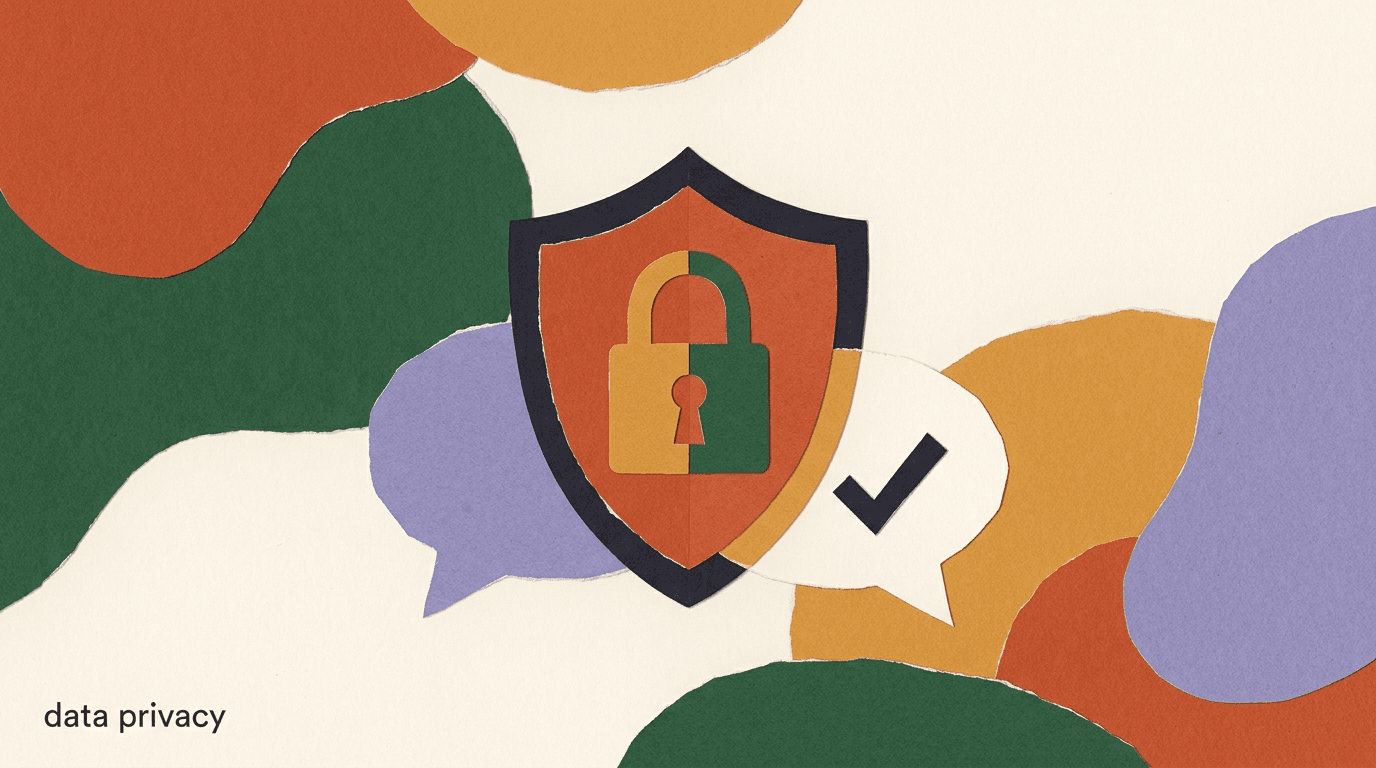
Chat marketing data privacy is the difference between a channel people trust and a channel people block. When someone messages your brand on Instagram, WhatsApp, or Telegram, they are handing you something intimate — a direct line into the same inbox where they talk to friends and family. That access is a privilege, and the moment it feels abused, it is gone. The unsubscribe in chat is silent: they stop replying, they mute, they report, and the algorithm quietly stops delivering. So privacy here is not only a legal box to tick. It is the operating system of the channel.
This guide is a point of view and a practical playbook in one. We will work through consent and opt-in, the idea of a lawful basis for processing, data minimization, storage and retention, the platform rules that govern Meta and other messaging services, and the trust practices that turn a compliant program into a respected one. We will give you checklists, tables, and examples you can act on this week.
One thing up front, stated plainly: this is general guidance, not legal advice. We are a software company, not your lawyers. Privacy law — GDPR in Europe, CCPA and its successors in California, and a long list of national and sectoral rules — is specific, fact-dependent, and always moving. Treat everything here as a starting point for a conversation with your own qualified counsel, who can map it to your business, your markets, and your data. We build KlyoChat, an AI-native unified inbox, so we have a stake in this. We will be honest about that and about what we do and do not handle.
Why does data privacy matter so much in chat marketing specifically?
Every marketing channel touches personal data, but chat is unusual in three ways that raise the stakes. First, it is bidirectional and personal — you are not broadcasting into a feed, you are sitting inside someone's private conversations. Second, the data is rich. A single chat thread can reveal what someone wants to buy, what they are worried about, their location, their language, their schedule, sometimes their health or finances. Third, the channel runs on platform permission. Meta, WhatsApp, Telegram, and the rest set rules about who you can message and when, and they enforce them with deliverability penalties that no opt-out list can appeal.
Put those together and you get a channel where a privacy mistake is not a slow leak — it is an immediate loss of access and trust. A broadcast to people who never opted in does not just risk a complaint to a regulator; it gets your number rate-limited or your account flagged the same day. The economics of chat reward restraint. The brands that win treat every message as something the recipient actively wanted.
There is also a quieter reason. Chat is where zero-party data lives — the preferences and intentions people tell you directly, freely, because they are in a conversation. That data is enormously valuable and only stays available if people feel safe sharing it. Privacy is what keeps the well from running dry.
General guidance, not legal advice
Nothing in this article is legal advice and reading it does not create any professional relationship. Privacy obligations depend on your jurisdiction, your industry, and the specifics of your data. Always confirm GDPR, CCPA, and local requirements with your own qualified counsel before you rely on any practice described here.
What does consent actually mean in DM marketing?
Consent is the heart of chat marketing, and it is widely misunderstood. In the privacy world, valid consent generally has to be freely given, specific, informed, and unambiguous — and, increasingly, it has to be demonstrable, meaning you can show when and how you got it. A pre-ticked box is not consent. Burying agreement in a wall of terms is not consent. A like on a post is not consent to be messaged. Someone replying once to a comment is a weaker signal than many marketers assume.
In chat specifically, consent has layers. There is consent to be contacted at all on a channel. There is consent to receive marketing as opposed to transactional or support messages. There is consent to specific topics or frequencies. And on regulated platforms there is the platform's own definition of opt-in, which can be stricter than the law. The safest mental model is that consent is not a single yes — it is a scope. The person agreed to something specific, and your job is to stay inside that scope.
The practical upshot is that you should capture consent explicitly, record it, and respect its boundaries. If someone opted in for order updates, that is not a green light for weekly promotions. If they opted in for one campaign, that is not a standing subscription. When in doubt, ask again — re-permission is cheap, and a re-confirmed audience is worth more than a large unconsented one.
| Consent type | What it covers | Common mistake |
|---|---|---|
| Channel consent | Permission to message on this platform at all | Assuming a reply equals broad permission |
| Marketing consent | Promotional messages, not just service updates | Sending promos under a transactional opt-in |
| Topic / frequency consent | Specific subjects or cadence the person agreed to | Treating one campaign opt-in as a lifetime subscription |
| Platform opt-in | The messaging platform's own opt-in standard | Meeting the law but breaking platform policy |
Consent is a scope, not a switch
Before any broadcast, ask one question: does the scope of what this person agreed to actually include this message? If you cannot answer yes with a record to back it up, do not send it. Re-permission is far cheaper than a report or a regulator complaint.
How do you collect opt-in the right way?
Good opt-in is deliberate. It tells the person who you are, what they will get, how often, and how to stop — before they say yes. It uses an affirmative action they take on purpose, and it leaves a record you can produce later. The goal is not to make opt-in hard; it is to make it honest, so that the people who join genuinely want to be there.
Here is a reliable pattern for capturing opt-in in a chat funnel, whether it starts from an ad, a comment-to-DM, a website widget, or a QR code.
- State who you are and what they getOpen with your brand name and a plain description of the messages they are signing up for — for example, restock alerts and occasional offers, roughly twice a month.
- Ask for an affirmative actionHave them reply with a keyword, tap a clearly labeled button, or check an unticked box. Silence, a like, or a vague reply is not opt-in.
- Link your privacy noticePoint to where you explain what data you collect, why, how long you keep it, and their rights. Informed consent requires the information to be available.
- Confirm and set expectationsSend a confirmation message that restates the cadence and shows how to opt out. This doubles as your proof that consent was given.
- Log the consent recordStore the timestamp, the channel, the exact wording shown, and the action taken. If you ever need to demonstrate consent, this is what you produce.
Buying or scraping contacts is the fastest way to lose the channel
Lists you did not build with consent are toxic in chat. Messaging people who never opted in violates platform policy and very likely the law, and it triggers reports that damage deliverability for your real audience. There is no list big enough to be worth that. Confirm the rules with your counsel, but the practical answer is simple: do not do it.
What is a lawful basis, and why can't you skip it?
Under frameworks like the GDPR, you generally cannot process personal data just because you find it useful. You need a lawful basis — a specific, documented reason that the law recognizes. Consent is one basis, and in marketing it is often the cleanest, but it is not the only one. Performing a contract (sending an order confirmation to a customer who bought something) and legitimate interests (a carefully balanced business need that does not override the person's rights) are others that can apply. Which basis fits which message is a legal judgment, and it is exactly the kind of thing to confirm with counsel.
The reason you cannot skip this is that the lawful basis shapes everything downstream. It determines what rights the person has, what you must tell them, and what you are allowed to do with their data later. Build your program by reaching for consent for marketing and a defensible basis for service messages, and document the reasoning. The documentation is not bureaucracy for its own sake — it is what lets you answer a regulator, a platform, or a customer with a straight, evidenced answer instead of a guess.
A useful discipline: write down, in one line per use, why you are allowed to process each category of data and for what purpose. If you cannot write that line, you have found a gap to close before you send.
Message type and a plausible basis (confirm with counsel)
- Order shipped update
- Often contract / legitimate interest — the customer is expecting it
- Weekly promotional broadcast
- Usually consent — explicit marketing opt-in required
- Abandoned-cart reminder
- Context-dependent — legitimate interest or consent; get advice
- Re-engagement to dormant contacts
- Risky without fresh consent — confirm before sending
What is data minimization and how do you practice it in chat?
Data minimization is the principle that you should collect and keep only the personal data you actually need for a clear purpose — no more, just in case. It is one of the most powerful privacy practices because it shrinks your risk at the source. Data you never collected cannot leak, cannot be misused, and does not have to be protected, retained, or deleted on request. The cheapest data to secure is the data you do not hold.
In chat, minimization is easy to neglect because the channel is conversational and information flows naturally. People mention things. Your AI or your agents capture context. Before long you have stored phone numbers, locations, health hints, and purchase histories that you never needed for the task at hand. Minimization means designing your flows and your storage so you keep what serves a stated purpose and let the rest go.
Practically, that means resisting the urge to log everything, tagging contacts with purpose rather than with everything you happen to learn, and being especially careful with special categories of data — health, financial, political, religious, biometric — which carry heavier obligations almost everywhere. If a flow does not need someone's date of birth, do not ask for it. If a tag does not drive a decision, do not store it.
- Collect data tied to a specific, stated purpose — not data you might use someday.
- Avoid capturing special-category data (health, finances, beliefs) unless you truly need it and have a basis for it.
- Prefer purposeful tags over raw transcripts when a tag is enough to act on.
- Separate what you need to operate from what is merely interesting; delete the merely interesting.
- Review your fields and tags periodically and prune any that no longer drive a decision.
Treat sensitive data as a liability, not an asset
Every extra field you store is something you must secure, justify, retain, and be able to delete on request. Special-category data multiplies that burden and the consequences of a breach. When a piece of data does not earn its place by serving a clear purpose, the privacy-positive move is to not collect it at all.
How long should you store customer chat data?
Retention is the question most chat programs never answer until something forces them to. The privacy principle is storage limitation: keep personal data only as long as it is necessary for the purpose you collected it for, then delete or anonymize it. Indefinite retention is not a strategy; it is a growing liability that sits quietly until a breach, an access request, or an audit turns it into a problem.
The hard part is that there is no universal number. Retention periods depend on the purpose, your sector, and the law — a tax-relevant transaction record may need to be kept for years, while a marketing conversation that led nowhere may have no reason to live past a few months. The right move is to set a retention schedule per data type, document the reasoning, and automate the cleanup so it actually happens. A schedule on paper that nobody enforces is worse than none, because it creates a false sense of control.
A simple framework: for each category of chat data, decide the purpose, the period that purpose justifies, and what happens at the end (delete, or anonymize so it is no longer personal). Then build the deletion into your tooling. Confirm the specific periods with counsel, because the gap between a defensible schedule and a guess is exactly where regulators and plaintiffs look.
| Data category | Typical purpose | Retention question to settle |
|---|---|---|
| Active conversation threads | Support and continuity | How long after last contact is it still useful? |
| Consent records | Proof of opt-in | Keep as long as you message them, plus a defensible buffer |
| Marketing engagement data | Targeting and analytics | Anonymize once individual-level detail is unnecessary |
| Transaction-linked messages | Legal and financial records | Often a statutory minimum — confirm with counsel |
Automate deletion, do not rely on memory
A retention policy only protects you if it runs. Set retention periods per data type, then automate the purge or anonymization so it happens without anyone remembering to do it. Manual cleanup always slips, and the data you forgot to delete is exactly the data that hurts in a breach.
Where does that data live, and who can see it?
Storage is not only about how long — it is about where and who. Two questions decide most of your exposure: is the data encrypted, and is access scoped to the people who genuinely need it? Encryption protects data if your systems are compromised; access control protects it from misuse on the inside, which is the more common failure. A breach is often not a hacker but an account that had more access than it ever needed.
Role-scoped access is the practical answer. A support agent might see the conversations assigned to them but not the entire customer database. A marketer might run broadcasts to consented segments without browsing individual threads. An admin can configure the system without that meaning they should be reading everyone's DMs. The goal is least privilege: each person and each integration gets exactly the access their job requires and nothing more.
Data location matters too. Some regulations care about where personal data is stored and transferred, and some customers and contracts require specific residency. You do not need to solve cross-border transfer law yourself, but you do need to know where your chat data lives and be able to answer when someone asks. That answer should be in your privacy notice, not improvised under pressure.
- Encrypt data in transit and at rest so a compromise does not hand over readable data.
- Scope access by role — least privilege for every person and integration.
- Know where your data is stored and whether it crosses borders.
- Audit who has access periodically and remove access that is no longer needed.
- Treat third-party integrations as access too — they see your data, so vet them.
Most leaks come from too much access, not too little encryption
Encryption is necessary, but the everyday risk is over-broad access — the agent, the integration, or the export that could see far more than the job required. Default to least privilege and review it. The strongest lock in the world does not help if everyone has a key.
What platform rules govern chat marketing, and how strict are they?
On top of the law sits a second rulebook: the platforms. Meta (which runs WhatsApp, Instagram, and Messenger), Telegram, TikTok, and X each set their own policies for business messaging, and they are often stricter and faster-acting than any regulator. They control your access, and they can withdraw it without a hearing. For most chat marketers, platform policy is the rule you will brush against first and most often.
WhatsApp is the clearest example. It requires opt-in before you message people, it distinguishes message categories (utility, authentication, marketing) with different rules and Meta-charged fees, and it gates promotional messaging behind template approval and quality ratings. Send unwanted messages and your quality rating drops, your sending limits shrink, and your number can be restricted. The platform is, in effect, enforcing consent on your behalf — and punishing you for ignoring it faster than any court would.
Instagram and Messenger have their own windows and rules about when you can message someone after they engage, and about what counts as permission. The details change, so the durable practice is not to memorize today's exact windows but to internalize the spirit: message people who clearly want it, in the categories they agreed to, and stay well inside the platform's stated boundaries. Read the current policy on the platform's own developer and business pages before you build, because these terms move.
| Platform area | Typical requirement | What breaking it costs |
|---|---|---|
| WhatsApp opt-in | Explicit opt-in before messaging | Quality rating drop, lower limits, number restriction |
| WhatsApp templates | Pre-approval for promotional templates | Rejected sends, blocked campaigns |
| Instagram / Messenger windows | Messaging only within allowed windows | Undelivered messages, policy strikes |
| General policy | No spam, no unconsented contact | Account flags, suspension, loss of access |
Platform rules can be stricter than the law — and faster
You can be technically compliant with privacy law and still get your WhatsApp number throttled for poor quality or unwanted messages. Platforms act on their own terms, on their own timeline, with no appeal you can count on. Read each platform's current policy directly, because these terms change and the cost of guessing is your access to the channel.
How do you handle data subject rights and opt-out in chat?
Privacy law gives people rights over their data — commonly the right to access what you hold, to correct it, to delete it, to object to processing, and to withdraw consent. In chat, these rights are not abstract. Someone can ask, mid-conversation, what you know about them or to be forgotten, and you need a real answer and a real process, not a shrug. The ability to honor these requests is part of the product, not a legal afterthought.
Opt-out deserves special attention because in chat it is constant and informal. People say stop, they say leave me alone, they mute, they go quiet. A compliant program makes opting out genuinely easy — a clear keyword, a respected request, an immediate effect — and treats ambiguous signals conservatively. If someone's behavior says they no longer want your messages, the privacy-positive and deliverability-positive move is the same: stop.
Operationally, you need to be able to find a person's data across your channels, export it, correct it, and delete it on request, and to do all of that within the timelines the law sets. Withdrawing consent has to be as easy as giving it. Build these capabilities before you need them, because the first time you discover you cannot honor a deletion request is the worst possible time to find out.
- Make opt-out easy and honor it immediately — a clear keyword and an instant effect.
- Be able to locate, export, correct, and delete a person's data across channels.
- Treat ambiguous opt-out signals conservatively — when in doubt, stop messaging.
- Make withdrawing consent as easy as giving it.
- Know and meet the response timelines your jurisdiction sets for rights requests.
An easy opt-out is a feature, not a leak in the funnel
Marketers sometimes hide the exit to protect list size. In chat that backfires: a frustrated person who cannot leave cleanly reports you instead, and a report hurts deliverability for everyone. A respected, frictionless opt-out keeps your remaining audience engaged and your sender reputation intact.
How do you turn compliance into actual trust?
Compliance is the floor, not the goal. You can meet every requirement and still feel creepy to your customers if your practices are technically legal but obviously extractive. Trust is what you earn when people sense that you collect less than you could, explain more than you have to, and treat their attention as borrowed rather than owned. That feeling is a competitive advantage, and it compounds.
The trust-building moves are mostly about transparency and restraint. Tell people plainly what you do with their data, in language a human can read, not a wall of legalese. Send less than you are allowed to — frequency restraint is the most underrated trust lever in chat. Give people control they can actually use: easy preferences, easy opt-out, honest answers when they ask. And when you make a mistake, say so quickly and fix it, because how you handle a slip tells people more than your privacy notice ever will.
There is a strategic payoff beyond goodwill. Trusted brands get more zero-party data, because people share willingly when they feel safe. They get better deliverability, because engaged audiences signal quality to the platforms. And they get resilience, because a brand that has earned trust survives the occasional error that would sink a brand that never had any. Privacy done well is not a cost center — it is how the channel keeps working.
Two brands, same channel, different outcome
- Extractive brand
- Hidden opt-in, daily promos, buried opt-out — reports rise, reach falls
- Trusted brand
- Clear opt-in, restrained cadence, easy controls — replies rise, reach holds
What does a privacy notice for chat need to cover?
Your privacy notice is where transparency becomes concrete. For a chat program it should answer, in plain language, the questions a reasonable person would ask: what data you collect through messaging, why, what your lawful basis is, who you share it with (including the platforms and any processors), how long you keep it, where it is stored, and how someone exercises their rights. If a customer reads it and still does not understand what happens to their messages, it has failed at its only job.
The notice is also your reference point in a dispute. When a regulator, a platform, or a customer asks how you handle data, a clear and accurate notice is the document that answers for you. That only works if the notice matches reality — a notice that promises practices you do not follow is worse than a vague one, because it documents the gap. Keep it current, keep it specific to how you actually use chat, and have your counsel review it.
A short, honest, accurate notice beats a long, impressive, aspirational one. Write what you do, do what you write, and make it easy to find from your opt-in flows.
- What data you collect through chat and from which platforms.
- Why you collect it and your lawful basis for each purpose.
- Who you share it with — platforms, processors, integrations.
- How long you keep it and where it is stored.
- How people exercise access, correction, deletion, and consent withdrawal.
- How to contact you with a privacy question, and a real address that is monitored.
Write what you do, do what you write
A privacy notice that overpromises is a liability, because it documents the difference between your claims and your practice. Keep the notice accurate to how you actually handle chat data, review it with counsel, and update it when your practices change. Honesty is easier to maintain than a story.
A practical chat privacy checklist you can run this week
Principles are only useful if they turn into action. Here is a checklist that takes a typical chat program from vague to defensible. None of it requires a legal degree to start, though several items are worth confirming with counsel before you finalize them.
- Audit what you collect and whyList every field, tag, and data point your chat flows capture, and write one line per item on why you need it. Delete what fails the test.
- Fix your opt-inMake every entry point state who you are, what they get, and how to stop, with an affirmative action and a logged consent record.
- Set a retention scheduleDecide how long each data category lives and what happens at the end, then automate the deletion or anonymization.
- Tighten accessApply least privilege — scope access by role, review who can see what, and remove access nobody needs.
- Make opt-out and rights realConfirm you can honor stop, access, and deletion requests across every channel, quickly and reliably.
- Update your privacy notice and check platform policyAlign your notice with what you actually do, then re-read each platform's current rules before your next campaign.
Confirm the legal specifics before you finalize
This checklist gets you organized, but retention periods, lawful bases, and cross-border questions are jurisdiction-specific. Run your finished policies past your own counsel. The goal of this guide is to make that conversation short and productive, not to replace it.
How does KlyoChat approach data privacy?
Since we have spent this whole article on principles, it is only fair to be specific about how we apply them — and honest about where the responsibility stays with you. KlyoChat is an AI-native unified inbox that brings your messaging channels into one place. We built it so that the privacy-positive choice is also the default choice, but no tool makes you compliant on its own, and we will not pretend otherwise.
On the things a platform can control, here is what we do. Your data is encrypted. Access is role-scoped, so your team members see what their role requires rather than everything by default. You control your data — it is yours, and the product is designed around you being able to manage, export, and delete it. And because consent is the foundation of the channel, KlyoChat includes consent and opt-in features so that capturing and respecting permission is part of the workflow, not a bolt-on.
Now the honest limits. You are the data controller for your contacts — you decide what to collect and why, and the legal responsibility for that sits with you, not with us. We are general guidance, not legal advice, and we cannot tell you whether your specific program satisfies GDPR, CCPA, or your local law; confirm that with your counsel. KlyoChat does not offer native SMS or email, so if those channels are central to your privacy program, factor that in. And we are a newer, smaller community than the long-established incumbents — a real consideration if ecosystem size matters to you. We would rather you know all of that going in than discover it later.
- Encrypted data and role-scoped access by default — least privilege built in.
- You control your data: manage, export, and delete it as the controller.
- Consent and opt-in features so permission is part of the workflow.
- Honest limit: you are the data controller — the legal responsibility for your contacts is yours.
- Honest limit: no native SMS or email, and a newer, smaller community than the incumbents.
We disclose our stake, and our limits
We build KlyoChat, so we are not neutral about it. We have tried to keep this guide useful regardless of which tool you pick, and to be straight about what KlyoChat does and does not do. The privacy practices here matter on any platform — apply them wherever your conversations live.
What are the most common chat privacy mistakes to avoid?
It helps to know where programs go wrong, because the same handful of mistakes recur across almost every team. Avoiding them puts you ahead of most of the field, and none of them require special tooling — just discipline.
The throughline is that each mistake trades a short-term gain (a bigger list, a logged data point, an extra send) for a long-term cost (a report, a breach, a lost channel). Privacy-positive choices are usually the long-term-smart choices, which is why restraint pays.
- Messaging people who never clearly opted in — the cardinal sin of chat.
- Treating a single reply or campaign opt-in as a standing subscription.
- Collecting and keeping data with no purpose and no end date.
- Over-broad access — too many people and integrations seeing too much.
- Hiding or slow-walking opt-out, which converts annoyance into reports.
- Ignoring platform policy because the law technically allows the message.
- A privacy notice that describes an aspirational program rather than the real one.
When unsure, choose less
Faced with a privacy judgment call, the lower-risk answer is almost always to collect less, keep it for less time, share it with fewer people, and send fewer messages. Restraint rarely gets a brand into trouble. Excess almost always does, eventually.
The bottom line on chat marketing data privacy is that it is not a separate compliance chore bolted onto your marketing — it is the marketing. Get consent honestly, collect the minimum, keep it only as long as it serves a purpose, lock down who can see it, respect the platforms, and be transparent about all of it. Do that and you do not just avoid penalties; you build the trust that keeps the channel delivering.
Start with the audit and the opt-in fix this week, set a retention schedule, and put your finished policies in front of your own counsel — because this is general guidance, not legal advice, and the specifics of GDPR, CCPA, and your local rules are theirs to confirm. For more on the data side of conversational marketing, see our pieces on zero-party data in chat, on transparent SaaS pricing, and on the state of conversational AI. Privacy done well is how you keep the privilege of being in someone's inbox.