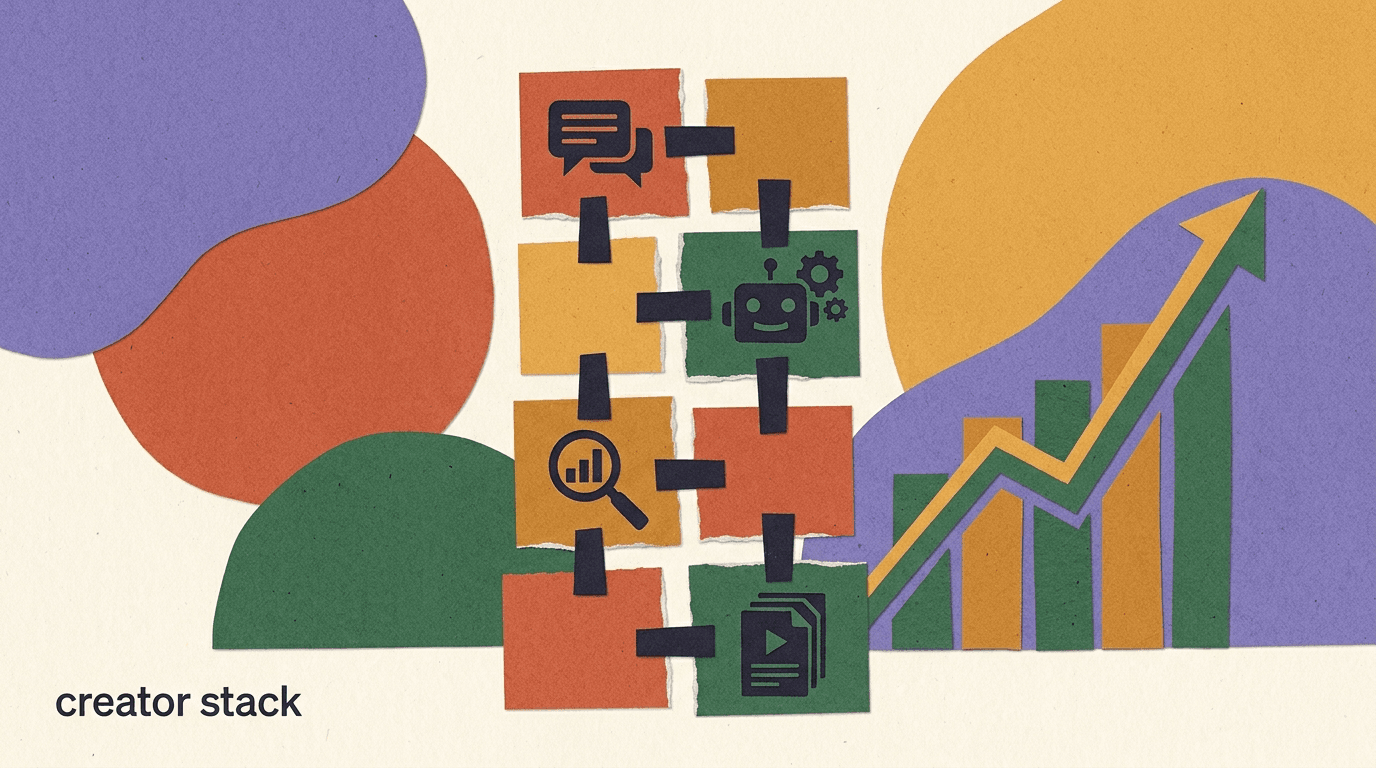
Building a creator automation stack is the quiet difference between the accounts that stall at 10K and the ones that keep climbing toward 100K without the creator quietly burning out behind the scenes. At 10K followers, you can answer most of your DMs by hand, post when you feel inspired, and keep the whole operation in your head. Somewhere past that, the math stops working. A single Reel that pops can bury your inbox in hundreds of comments and DMs overnight, and the hours you spend copy-pasting the same link are hours you are not spending making the content that grew the account in the first place.
This guide is the honest version of how to build that stack — the systems, in the order you actually need them, with the human kept exactly where a human belongs. We will walk through the content workflow that keeps you posting, the comment-to-DM capture that turns engagement into a contact, the AI agent that handles first response so nobody waits hours, the nurture and broadcast layer that turns one-off conversations into a relationship, and the analytics that tell you what is working. We will also be clear about the limits, because automation that is oversold is automation that gets abandoned.
Full disclosure up front: we build KlyoChat, which is one layer of this stack — the conversation and DM layer. We are not going to pretend it is the whole thing. A real creator stack pairs a conversation tool like ours with the content and email tools you already use, and none of it replaces good content and a clear offer. There are no growth guarantees here, from us or anyone. What there is, is a structure that stops the busywork from eating the creative work.
What is a creator automation stack, and why do you need one?
A creator automation stack is the set of tools and workflows that handle the repetitive, predictable parts of running an audience so you can spend your finite energy on the parts only you can do. Think of it as plumbing. Nobody follows you for your plumbing. But when the plumbing fails — a DM goes unanswered for two days, a comment-to-DM link never fires, a launch email never goes out — you lose trust, momentum, and money, all of which are far harder to win back than they were to lose.
The reason you need one is not that automation is fashionable. It is that the work scales faster than you do. Your follower count can double in a month; your hours in a day cannot. Every new follower is a potential comment, DM, question, and customer, and at 10K those interactions are a trickle you can manage personally. At 50K the trickle is a stream, and at 100K it is a firehose. The stack is what lets a stream-sized team handle firehose-sized volume without dropping the people who reached out.
It helps to separate the two things a stack buys you. The first is time — hours reclaimed from copy-pasting, sorting, and chasing. The second, and the one creators underrate, is consistency. A human gets tired, distracted, and inconsistent; they answer brilliantly on Monday and forget to reply at all on Friday. A well-built system answers the same way every time, at any hour, in any volume. Consistency is what turns a following into a business, because people buy from accounts that feel reliable.
Automation augments; it does not replace
The stack does not make bad content go viral or turn a weak offer into a strong one. It removes the friction between good content and the people who respond to it. If the content and the offer are not there, automating around them just makes the silence faster. Build the stack on top of something worth automating.
Why does the stack change as you grow from 10K to 100K?
The mistake most creators make is trying to build the whole stack at 10K, before they have the volume that justifies it. You spend a weekend wiring up nurture sequences for an audience that does not yet generate enough conversations to nurture, and the tools sit idle while you lose interest. The opposite mistake is just as common and more painful: you wait until 80K, drowning, and try to build five systems at once while your inbox is on fire. Neither works.
The stack should grow the way a body grows — adding what the current size demands, when it demands it. Each layer solves a specific failure that appears at a specific scale. Comment-to-DM capture matters once a single post can generate more comments than you can personally reply to. An AI agent for first response matters once DMs arrive faster than you can read them. A broadcast and nurture system matters once you have enough contacts that a one-to-many message is worth sending. Build each layer when the problem it solves actually hurts, not before.
There is a rough progression that holds for most accounts, and we will use it as the spine of this guide. The numbers are not laws — a creator selling a high-ticket offer might need the nurture layer at 8K, while a meme account might coast to 50K on capture alone — but they are a useful map. The point of the map is not to follow it precisely; it is to recognize the symptom that signals each transition. When you feel a specific kind of pain, you know which layer is next.
It is also worth saying that the layers do not retire as you add new ones. Comment-to-DM capture still runs at 100K exactly as it did at 15K; you simply have an AI agent and a nurture system working on the contacts it produces. The stack accumulates. Each layer you add increases the value of the layers below it, which is why the order matters and why building out of sequence wastes effort — a nurture system with nothing feeding it contacts is a machine with no fuel.
| Stage | What breaks | What you add |
|---|---|---|
| 10K–25K | Comments outpace manual replies after a good post | Comment-to-DM capture |
| 25K–50K | DMs arrive faster than you can read them | AI agent for first response |
| 50K–75K | Contacts pile up with no way to re-engage them | Broadcasts and nurture sequences |
| 75K–100K | You are guessing what works instead of knowing | Analytics and a light human review layer |
Add the layer that hurts, not the layer that is impressive
It is tempting to build the sophisticated AI-and-nurture machine first because it feels like a real business. Resist it. The cheapest, highest-return move is almost always the next layer up from where you are now. Solve today's bottleneck; tomorrow's will announce itself loudly.
Layer one: how should a content workflow fit into the stack?
Content is the engine; the rest of the stack is the transmission. If you are not posting consistently, no amount of DM automation matters, because there is nothing driving people to your account in the first place. So the first layer is not a clever tool — it is a workflow that makes posting sustainable when inspiration does not show up on schedule.
The core idea is to separate the four jobs that get tangled together when you wing it: capturing ideas, producing content, scheduling it, and tracking what worked. When those happen in one frantic session the night before, quality drops and you burn out. When they are separate, batched steps, you can produce a week of content in a focused block and let a scheduler handle the rest. The tools here are the ones you almost certainly already use — a notes app or content calendar for ideas, your camera and editing app for production, and a scheduler for distribution.
Automation's job in this layer is narrow and worth being honest about: it handles distribution and reminders, not creation. A scheduler posts at the right time so you do not have to be on your phone at 6pm. A content calendar reminds you what is due. But the idea, the hook, the actual making — that stays human, because that is the part audiences are responding to. This is the first place where the rule holds: keep the human where the human matters.
- Capture ideas continuouslyKeep a running list of hooks and topics in one place. The best ideas arrive at random; a system that catches them beats a brainstorm under deadline pressure.
- Batch productionFilm or write several pieces in one focused block. Batching protects the deep-work state that good content needs and stops daily context-switching.
- Schedule distributionLoad the batch into a scheduler so posts go out at consistent times without you being present. Consistency of cadence compounds.
- Tag the call to actionDecide, before scheduling, what each post asks people to do — comment a keyword, click a link, ask a question. The CTA is what connects content to the next layer.
The content layer is mostly tools you already have
You do not need to buy anything new to build this layer well. A calendar, a scheduler, and a habit of batching cover it. The expensive layers come later, when conversation volume — not content production — becomes the bottleneck.
Layer two: how does comment-to-DM capture work, and when do you add it?
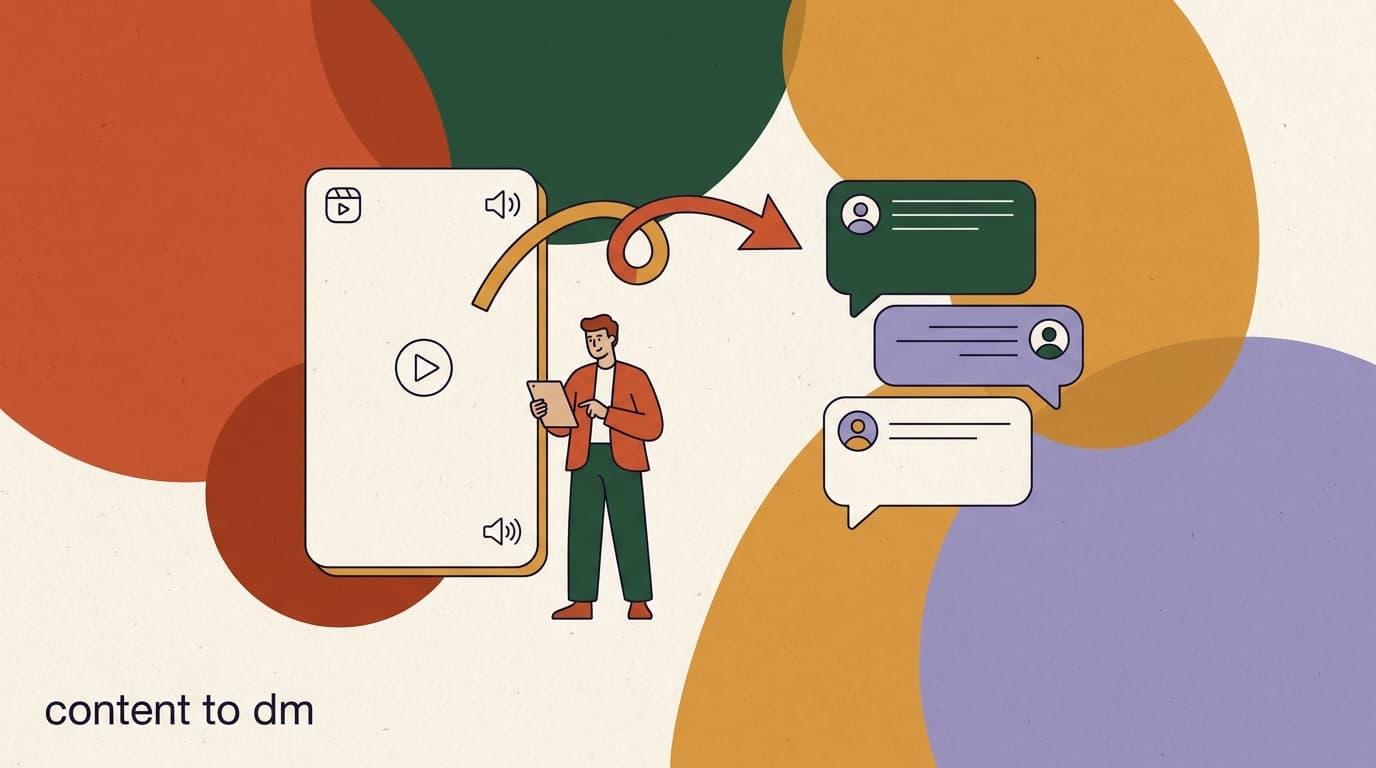
Here is the first layer where a dedicated tool earns its place. Comment-to-DM is the mechanic where someone comments a keyword on your post — say, GUIDE — and an automation sends them the thing they asked for in a private DM. It is the single highest-leverage automation a creator can run, because it converts public engagement, which the algorithm rewards, into a private contact you actually own.
The timing is clear: add it the moment a single post can generate more comments than you can personally reply to. Below that threshold, replying by hand is fine and arguably better. Above it, manual replies become a bottleneck that costs you contacts, because the person who commented at 2am and got no link by 9am has already moved on. The automation closes that gap to seconds, at any hour and any volume.
Why does this matter so much for the 10K-to-100K journey specifically? Because comments are the currency of reach. A post that drives a flood of keyword comments signals engagement to the platform, which shows the post to more people, which drives more comments. The automation lets you encourage that loop without drowning in it. And every keyword comment becomes a DM contact — the beginning of a relationship, not just a vanity metric. That contact is the raw material the rest of your stack works on.
- It converts public engagement into owned contacts — the foundation everything downstream is built on.
- It responds in seconds at any hour, so you never lose the people who engaged while you slept.
- It scales with the post, not with your time — a 50-comment post and a 5,000-comment post take the same zero effort.
- It feeds clean, intent-tagged contacts into your nurture layer instead of a random pile of DMs.
Keep the keyword and the promise simple
One post, one keyword, one clear deliverable. The friction that kills comment-to-DM is confusion — vague CTAs, multiple keywords, or a promised resource that does not match what gets delivered. Make the ask obvious and keep the promise exactly.
Comment-to-DM in action
- Post CTA
- Comment GUIDE and I'll send you the free checklist
- Manual reality
- 200 comments, you reply to 40 before giving up, 160 people get nothing
- Automated
- All 200 get the DM in seconds, every one becomes a contact you can follow up with
Layer three: where does an AI agent fit, and what should it actually do?
Once capture is working, you have a new and better problem: more conversations than you can keep up with. People reply to the DM, ask a follow-up question, want to know if the thing is right for them, ask about price. At 25K to 50K, those threads arrive faster than you can read them, and the speed of your first response is now the thing that wins or loses trust. This is where an AI agent earns its place in the stack.
Be precise about the job. The AI agent handles first response and the predictable middle — the questions you have answered a hundred times. What is included? Is this for beginners? How do I get the link? When does the next cohort start? An agent trained on your own knowledge base answers these instantly, in your voice, at 3am, across every conversation at once. It does not pretend to be you, and it does not try to handle the conversations that need you. It clears the 80% that is routine so the 20% that matters reaches you uncluttered.
The trap to avoid is letting the agent do too much. An AI that tries to close high-ticket sales, handle a complaint, or improvise on a sensitive question will eventually say something off, and the cost of that is trust you cannot easily rebuild. The right design hands off cleanly: the agent answers what it knows, recognizes what it does not, and routes the rest to a human — you or a teammate — with the context attached. Speed from the machine, judgment from the person.
There is a second, less obvious benefit to the AI layer that creators discover only after they build it: it changes which conversations reach you and in what order. Without an agent, your inbox is a flat, undifferentiated pile, and the message that matters most sits next to a hundred that ask the same routine question. With an agent doing triage, the routine is handled and tagged, and what surfaces to you is the qualified, high-intent thread — the person genuinely deciding whether to buy. You are not just answering faster; you are spending your attention on the conversations that move the business, instead of rationing it across all of them equally.
- Train it on your real answersFeed the agent your actual FAQs, your offer details, your tone. A generic bot sounds generic; an agent grounded in your knowledge base sounds like your account.
- Define the handoff lineDecide which topics the agent answers and which it must pass to a human — pricing edge cases, complaints, anything emotional or high-stakes.
- Let it triage, not just replyUse the agent to tag and sort conversations by intent so that when a human steps in, they see the qualified, ready-to-talk threads first.
- Review and refine weeklyRead a sample of the agent's conversations each week. Where it stumbled is your next training input. The agent gets better only if you teach it.
Do not let the agent fake being human
Audiences forgive a fast, helpful AI first response. They do not forgive being deceived into thinking a bot was the creator. Let the agent be useful and clearly a helper; reserve the personal, named conversations for the moments a human actually shows up. Honesty here protects the trust the whole account runs on.
Layer four: how do nurture and broadcasts turn contacts into a business?
By 50K, the comment-to-DM layer has built you something valuable that most creators waste: a list of contacts who raised their hand. The problem is that a one-time DM is a one-time event. The person who got your free guide in March has no reason to think of you in June unless you give them one. The nurture and broadcast layer is how you stay present in that relationship without manually messaging thousands of people.
There are two distinct tools here, and it helps to keep them separate in your head. Broadcasts are one-to-many: a single message sent to a segment of your contacts at a moment you choose — a launch, a live, a new drop. Sequences are automated and triggered: a contact does something (subscribes, asks about an offer, goes quiet) and a pre-built series of messages follows, spaced over days, with no further effort from you. Broadcasts are for moments; sequences are for journeys.
This is also the layer where the honest limit of any single tool shows up most clearly, and we are going to be direct about it. The conversation layer — DMs across Instagram, WhatsApp, and the rest — is where KlyoChat lives, and broadcasts and DM sequences run well there. But email is its own channel with its own economics, and a serious creator business runs email too. We do not do native email or SMS. So the realistic stack pairs a conversation tool for DM nurture with a dedicated email tool for the email side. Use each for what it does best rather than forcing one tool to do both badly.
| Mechanism | Best for | Lives in |
|---|---|---|
| Broadcast | Time-bound moments: launches, lives, drops | Conversation tool (DM) + email tool |
| Triggered sequence | Onboarding, re-engagement, offer follow-up | Conversation tool (DM) + email tool |
| One-to-one reply | High-intent, high-value, sensitive threads | A human |
Pair the conversation layer with an email tool
DM nurture and email nurture are complementary, not interchangeable. DMs are immediate and high-open; email is durable and ownable independent of any platform. The strong stack runs both — a conversation tool for the DM side, a dedicated email platform for the email side. Do not try to make one cover both.
A nurture journey from one keyword
- Trigger
- Contact comments GUIDE, receives the checklist via DM
- DM sequence
- Day 2 a tip, day 4 a related resource, day 6 a soft offer
- Email handoff
- If they share email, the deeper sequence runs in your email tool
- Broadcast
- When you launch, the whole segment hears about it in one send
Layer five: what should you measure, and how do analytics close the loop?
By the time you are pushing toward 100K, the biggest risk is no longer volume — it is flying blind. You have content going out, comments converting, an agent replying, sequences running, and broadcasts landing, and somewhere in all that motion you stop knowing which parts are actually driving growth. Analytics is the layer that turns a busy stack into a learning one. Without it, you are optimizing on vibes.
Focus on a small number of metrics that map to the layers you built, rather than a dashboard of everything. From the content layer: which posts drive the most keyword comments. From the capture layer: comment-to-DM conversion rate. From the AI layer: how many conversations the agent resolved without a human, and where it handed off. From the nurture layer: broadcast and sequence engagement, and how many contacts move from free resource to offer. Each metric tells you which layer to tune next.
The point of measuring is to change what you do. If one post format drives five times the keyword comments of another, make more of that format. If the AI agent hands off the same question every week, add that answer to its training. If a sequence loses people at message three, rewrite message three. Analytics without action is just anxiety with charts. The loop is: measure, find the weakest link, fix it, measure again.
- Content: which formats and hooks drive the most keyword comments.
- Capture: comment-to-DM conversion rate per post and per keyword.
- AI: resolution rate, handoff rate, and the questions that trigger handoffs.
- Nurture: broadcast open and reply rates, sequence drop-off points, free-to-offer conversion.
Pick one weak link per week
Do not try to optimize everything at once — you will spread thin and learn nothing. Each week, read your numbers, choose the single weakest link, and fix only that. Slow, compounding improvement beats a frantic overhaul that you cannot attribute.
Where exactly should you keep a human in the stack?
The whole philosophy of a good creator stack is not maximum automation — it is automating the parts that are repetitive and predictable while keeping a human on the parts that are personal and high-stakes. Get this line wrong in either direction and the stack fails. Automate too little and you burn out; automate too much and the account loses the human texture that made people follow in the first place.
Some things should always stay human, and it is worth naming them plainly. The creative work — ideas, hooks, the actual content — is human, always. High-value and high-intent conversations, where someone is close to buying or asking something nuanced, deserve a real person. Anything emotional or sensitive — a complaint, a vulnerable message, a difficult situation — needs human judgment and care. And the strategic decisions about what to build and offer next are yours; no tool makes those.
Everything else is fair game for automation, and the categories are clear. Routine first responses and repeated FAQs are perfect for an AI agent. Distribution and scheduling belong to tools. Capturing contacts from comments should be automatic. Sending the same nurture messages to many people is exactly what sequences are for. The skill is not choosing automation or humans — it is drawing the line between them deliberately, and moving it as your team and tools mature.
| Task | Keep human | Automate |
|---|---|---|
| Content ideas and hooks | Yes | No |
| Posting and scheduling | No | Yes |
| Capturing comment contacts | No | Yes |
| First response to common questions | No | Yes |
| High-intent or sensitive conversations | Yes | No |
| Bulk nurture messages | No | Yes |
| Strategy and offer decisions | Yes | No |
Over-automation has a cost
An account that automates the human moments away feels hollow, and audiences sense it. The goal is to use automation to create more space for the human moments, not to eliminate them. If your stack makes you less present with the people who matter most, it is tuned wrong.
How do you build the stack without burning out?
The irony of an automation stack is that building it badly can burn you out faster than having no stack at all. Creators read a guide like this, get excited, and try to wire up all five layers in a weekend — and then spend the next month maintaining a sprawling system instead of making content. The system was supposed to give you time and it took it. Avoiding that is mostly about sequencing and restraint.
Build one layer at a time, and only when the problem it solves is actively hurting. Get content consistency solid before you touch capture. Get capture humming before you add an AI agent. Let the agent run for a few weeks before you build nurture. Each layer should be boring and reliable before the next one goes on top of it. A stable foundation makes the next layer easy; an unstable one makes it a nightmare.
The second protection is to treat the stack as something you maintain lightly, not babysit. A well-built layer runs on its own for weeks at a time. Schedule a short weekly review — read some agent conversations, glance at the numbers, fix one thing — and otherwise leave it alone. If a layer needs constant attention, it is not built right yet, and the fix is to simplify it, not to spend more time on it. The stack exists to give you hours back, and you should be able to feel that it does.
- Stabilize the layer below firstNever stack a new layer on a shaky one. Capture should be reliable before AI; AI before nurture. Boring and stable, then build up.
- Add only when it hurtsWait until the current bottleneck is genuinely costing you before adding the layer that fixes it. Premature layers sit idle and sap motivation.
- Keep a weekly review ritualThirty minutes a week to read conversations, check numbers, and fix one weak link. Light maintenance beats constant firefighting.
- Simplify anything that needs babysittingIf a layer demands daily attention, it is over-built. Strip it back until it runs on its own. Complexity you cannot maintain is worse than a gap.
Does a stack guarantee you'll reach 100K?
No, and anyone who tells you otherwise is selling something. This is the most important section in the guide, so we are going to be blunt. A creator automation stack removes friction, buys back time, and keeps you consistent. It does not create demand, write good hooks, or make a mediocre offer compelling. If the content does not resonate and the offer does not solve a real problem, the most elegant stack in the world will just deliver your lack of traction more efficiently.
Growth from 10K to 100K is driven by two things the stack cannot manufacture: an audience that genuinely wants what you make, and an offer that genuinely serves them. Those are creative and strategic problems, and they live on the human side of the line. The stack is a multiplier on whatever is already working — and a multiplier on zero is still zero. We say this not to discourage you but because pretending otherwise leads creators to blame their tools when the real gap is upstream.
What the stack does change is the ceiling on what your existing traction can become. If your content is landing and your offer is solid, the difference between handling that well and handling it badly is enormous at scale — the difference between every engaged follower becoming a contact you nurture and most of them slipping away unanswered. The stack is how you stop leaking the growth you have earned. Earn the growth with content and offer; keep it with the stack.
No growth guarantees — from us or anyone
We will not promise you 100K followers or any specific result, because no honest tool can. What we can say is that the structure above is how serious creators stop losing the people who already engage. The creative work is still yours. The stack just makes sure it is not wasted.
What does a realistic full stack look like at each stage?
To make this concrete, here is how the stack typically assembles itself across the journey, with the tools kept generic so you can map your own. Notice that you are never buying everything at once — you are adding the next layer as the previous one matures and the volume demands it.
Early on, the stack is almost all tools you already own. The paid, dedicated layers come in precisely when conversation volume — not content production — becomes the thing that breaks. That ordering keeps your costs aligned with your scale and your attention aligned with your real bottleneck.
- The content layer is mostly tools you already have — do not over-invest here.
- Comment-to-DM is the first dedicated tool worth paying for, because it owns your contacts.
- The AI agent and nurture layers are where a conversation platform pays for itself.
- Email is a separate channel — pair a dedicated email tool with your conversation layer.
The stack, assembled by stage
- 10K–25K
- Content calendar + scheduler + comment-to-DM capture
- 25K–50K
- Add an AI agent for first response and triage
- 50K–75K
- Add DM broadcasts and sequences, plus an email tool
- 75K–100K
- Add analytics review and a light human handoff layer
How does KlyoChat fit into the creator automation stack?
We built KlyoChat to be one specific layer of this stack — the conversation and DM layer — and we think the honest way to talk about it is to tell you exactly what it does and does not cover. It is an AI-native, mobile-first unified inbox that brings Facebook, Instagram, WhatsApp, Telegram, TikTok, and X into one place, so the conversations the rest of your stack generates do not scatter across six apps. That is the problem it exists to solve.
On top of that inbox, it runs the layers we have been describing. Comment-to-DM capture turns keyword comments into owned contacts. AI agents are included — not a separate add-on — so first response and triage run across every channel at once, trained on your knowledge base and in your voice. Broadcasts handle your one-to-many moments, and analytics tell you what is working. Because the pricing is flat, a viral month that floods your inbox does not spike your bill — the cost stays predictable exactly when your volume is least predictable, which is the moment most tools punish you.
Now the limits, plainly stated, because a guide about an honest stack has to be honest about its own tool. KlyoChat does not do native SMS or email — for the email side of your nurture, pair it with a dedicated email tool, as we recommended in the nurture layer. We are also a newer, smaller community than the largest incumbents, so if a vast template marketplace is decisive for you, weigh that. And nothing here is a growth guarantee: KlyoChat handles the conversation layer well, but your content and your offer still do the actual growing. Pair it with your content tools and an email platform, keep the human where the human belongs, and it does its part of the job.
| Stack layer | Covered by KlyoChat | Pair with |
|---|---|---|
| Content creation and scheduling | No | Your content calendar and scheduler |
| Comment-to-DM capture | Yes | — |
| AI first response and triage | Yes (included) | — |
| DM broadcasts and sequences | Yes | — |
| Email nurture | No (no native email) | A dedicated email tool |
| Analytics for the conversation layer | Yes | — |
KlyoChat is the conversation layer, not the whole stack
Use KlyoChat for capture, AI first response, DM nurture, and conversation analytics. Keep your content tools for creation and add a dedicated email tool for email. A stack of focused tools, each doing its job well, beats one tool stretched to do everything.
KlyoChat plans at a glance
- Basic
- $19/mo — for creators getting their first capture and AI layer live
- Pro
- $49/mo ($39 billed yearly) — all channels, custom AI agents, the full conversation stack
- Business
- $129/mo — for larger creator teams with more seats and higher volume
- Trial
- 7-day free trial, no credit card — test the full product, not a limited slice
The honest summary is this: a creator automation stack is what lets the work scale when you cannot. From 10K to 100K, add the layers in order — content workflow, comment-to-DM capture, an AI agent for first response, broadcasts and nurture, then analytics — and add each one only when the problem it solves starts to hurt. Keep the human on the creative, the high-value, and the sensitive; automate the repetitive and predictable. Build one stable layer at a time so the stack gives you hours back instead of taking them.
And keep the perspective straight. Tools remove friction and protect your consistency, but your audience and your offer are what actually grow the account. There are no guarantees — only a structure that stops you leaking the growth you have earned. If you want help with the conversation layer specifically, that is the part we build, and you can pair it with the content and email tools you already trust. For more on the pieces around it, see our guides on building an Instagram revenue system, monetizing your DMs, and turning content into DMs.