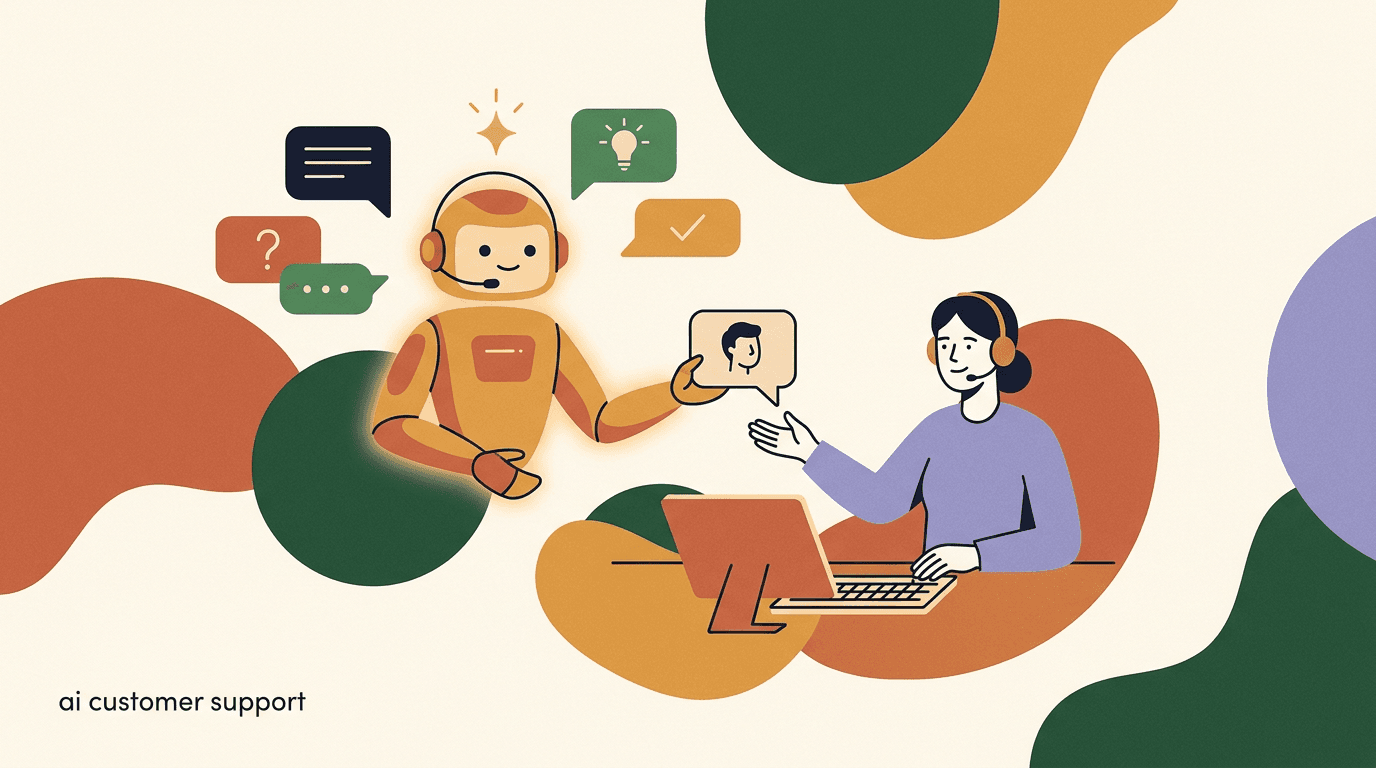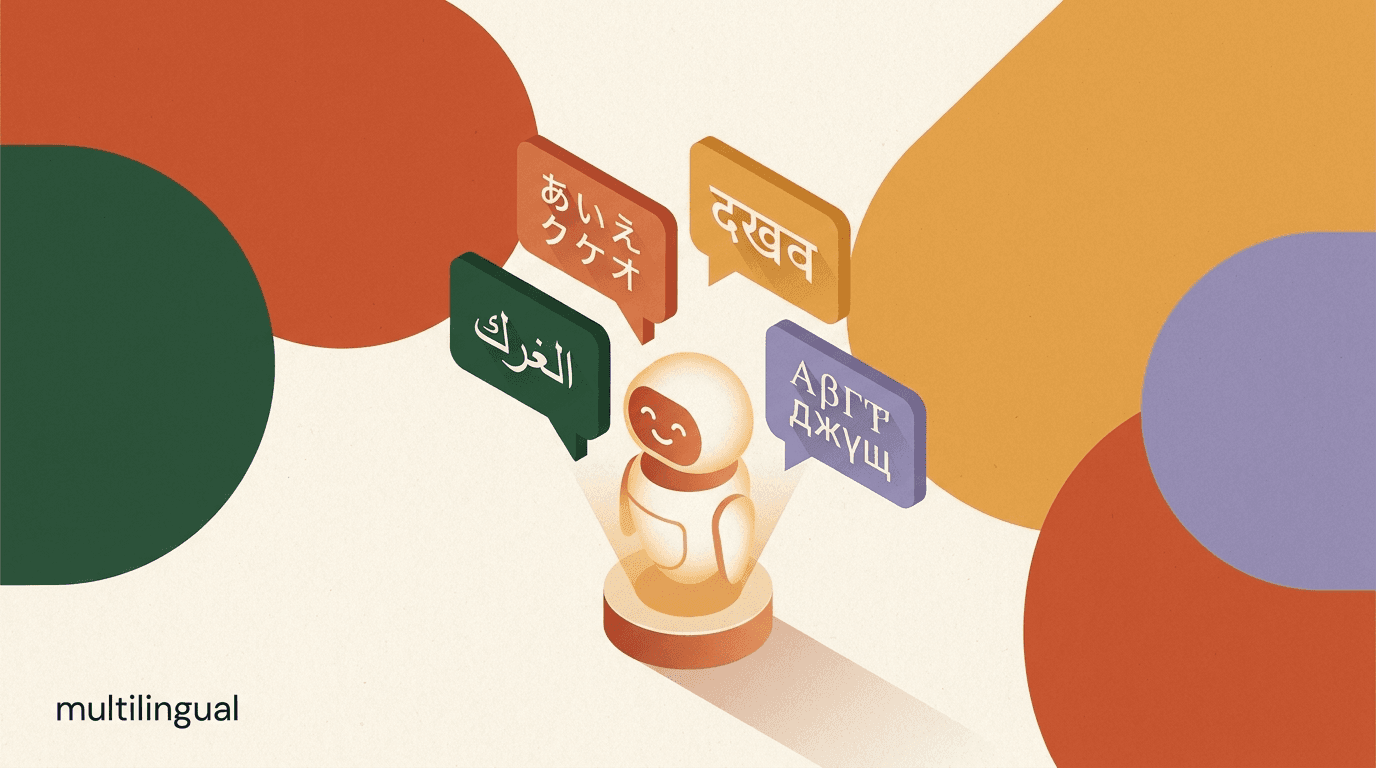
Multilingual AI support is the practice of letting an AI agent read a customer's message in whatever language they wrote it, understand the intent, and reply in that same language — without a human translating in the middle. For a global or regional team, this is the difference between answering a Portuguese buyer at 2 a.m. and losing them to a competitor who happened to have someone awake. It is also, done carelessly, the difference between a helpful answer and a confidently wrong one that nobody on your team can even read to catch.
This guide is for teams that already serve customers in more than one language, or are about to. We will cover how language detection actually works, how an AI agent replies in the customer's language while keeping your brand voice and your facts straight, how to localize a knowledge base, and how to hand off to a human who speaks the right language. We will be honest about the pitfalls: idiom that does not translate, right-to-left scripts that break layouts, compliance language that must be exact, and the simple fact that AI translation can err in nuance even when it reads fluently.
Full disclosure: we build KlyoChat, an AI-native unified inbox whose agents understand and reply in many languages. So we have a point of view, and we will get to where KlyoChat fits near the end. The bulk of this is vendor-neutral advice you can apply with any tool — including the parts where we tell you to slow down and review.
What does multilingual AI support actually mean?
There is a meaningful difference between a tool that can be configured in several languages and a tool that handles a single conversation in whatever language shows up. Plenty of platforms offer the first: you pick German, and your canned replies are in German. That is localization of your interface, not multilingual support of your customers.
True multilingual AI support is dynamic. One inbox, one agent, and a French message gets a French reply while the next message in Arabic gets an Arabic reply — automatically, without you pre-assigning anyone or building a separate bot per language. The agent detects, understands, and responds inline. That is the capability worth paying for, because it scales to languages you never explicitly planned for.
It helps to separate three layers that often get blurred together. Understanding the incoming message is one job. Generating a correct, on-brand reply is a second. Keeping your facts and policies accurate across every language is a third — and it is the one that breaks most often, because fluent output hides factual drift.
- Interface localization: your menus and canned replies are translated. Static, set once.
- Reactive translation: a human or tool translates each message on demand. Slow, costly, error-prone at volume.
- Multilingual AI support: the agent detects the language, understands intent, and replies natively in that language, per conversation.
Localization and multilingual support are not the same thing
If a vendor says they 'support 50 languages,' ask whether that means the dashboard is translated or the AI can actually hold a conversation in those languages. Those are very different claims, and only the second one helps your customers.
Why does language coverage matter for a support team?
The business case is rarely about a headline language count. It is about the long tail. Most teams can staff their top one or two languages with native speakers. The trouble is the third, fourth, and tenth language — the Vietnamese customer, the Polish customer, the one message a week in Greek. You cannot justify a full-time hire for a trickle, but every one of those customers is real revenue and a real review waiting to be written.
Multilingual AI support changes the math. The agent handles the long tail at zero marginal cost per language, so a customer who writes in a language you do not staff still gets a competent first response instead of silence or a clumsy machine-translated apology. For regional businesses — say a brand selling across Southeast Asia or the Gulf — this is not a nice-to-have. It is table stakes, because customers in those markets switch languages mid-conversation without thinking about it.
There is also a coverage-hours dimension that compounds the language one. A small team is awake for one timezone. AI is awake for all of them. Combine round-the-clock availability with any-language coverage and you have effectively bought a global support desk for the price of software — with the honest caveat that you still need humans for the hard cases, in the right language.
The long-tail problem, two ways
- Human-only team
- Staffs English and Spanish. The weekly message in Thai waits 18 hours for someone to machine-translate it badly.
- AI-first team
- Agent answers the Thai message in Thai immediately; a human follows up only if it escalates.
How does language detection work in a chatbot?
Before an agent can reply in the right language, it has to figure out what language the customer used. Modern language models do this well in most cases by reading the message itself — the vocabulary, the script, the grammar — and inferring the language with high confidence. For a clear sentence in a common language, detection is close to a solved problem.
The edge cases are where it gets interesting, and where you should set expectations. Very short messages give the model little to work with: a lone 'ok' or 'si' could be several languages. Mixed-language messages — common among bilingual customers who code-switch — can confuse a naive detector. And languages that share a script or borrow heavily from each other can be misread, especially in one-word replies.
A good system uses signals beyond the message text. The customer's previous messages in the thread, their profile or locale if available, and the channel's regional context all help disambiguate. The practical rule: detect from the message first, but lean on conversation history so the agent does not flip languages mid-thread just because someone typed a short reply.
| Detection scenario | Difficulty | What helps |
|---|---|---|
| Full sentence, common language | Easy | The message text alone is enough |
| Very short reply ('ok', 'gracias') | Hard | Conversation history, prior turns |
| Code-switching (two languages mixed) | Hard | Pick the dominant language; let the customer steer |
| Similar scripts or shared loanwords | Medium | Locale signals, longer context window |
Anchor to the thread, not just the last message
Configure your agent to stay in the established language of a conversation unless the customer clearly switches. This prevents the jarring experience of a one-word reply flipping the whole conversation into the wrong language.
How does an AI agent reply in the customer's language?
Once the language is known, replying in it is mostly a matter of instruction and capability. A capable model does not translate an English answer into French as a separate step — it composes the answer in French directly, which produces far more natural output than translate-after-the-fact pipelines. This is why model-native multilingual generation reads better than bolt-on translation layers.
The quality you get depends heavily on how much support the underlying model has for a given language. High-resource languages — the ones with enormous amounts of text on the internet — get fluent, idiomatic output. Lower-resource languages get output that is usually understandable but can be stiffer or occasionally wrong in ways that are hard for you to spot. This unevenness is real and worth planning around rather than pretending it does not exist.
The honest framing for your team: treat every language as fluent-until-proven-otherwise for your top markets, where you can verify, and as competent-but-verify for the long tail. The agent will sound confident in all of them. Confidence is not accuracy, and in a language nobody on your team reads, you have no native check unless you build one.
Native generation vs. translate-after
- Translate-after pipeline
- Drafts in English, machine-translates to German. Output is literal, sometimes awkward, loses idiom.
- Model-native generation
- Composes the answer in German from the start. Reads like a German speaker wrote it.
How do you keep brand voice consistent across languages?
Brand voice is hard enough in one language. Across many, it is a genuine challenge, because tone does not translate one-to-one. A breezy, first-name-basis American tone can read as unprofessional in German business contexts, where formal address is expected. The Japanese politeness register has levels that English simply does not encode. So 'keep our voice' cannot mean 'say the same words' — it has to mean 'carry the same intent, adapted to local norms.'
The way to operationalize this is to give your agent voice guidance that travels: not a script, but principles. 'Warm but concise. Never blame the customer. Offer a next step in every reply.' Those hold across languages. Then layer language-specific notes where the norms diverge — for instance, default to the formal register in German and Japanese unless the customer is clearly casual.
The trade-off to accept: the more rigidly you script exact phrasing, the worse your multilingual output gets, because rigid phrasing fights the natural grammar of other languages. The more you specify intent and let the model phrase it natively, the better it reads — at the cost of less word-for-word control. For most teams, leaning toward intent is the right call, with review on the languages that matter most. Our companion piece on keeping an AI agent on brand voice goes deeper on this trade-off.
- Write voice guidance as principles, not scripts — principles survive translation, scripts do not.
- Add per-language register notes where formality norms differ (formal default for German, Japanese).
- Avoid brand slang and puns in your instructions; they rarely have equivalents and produce nonsense when forced.
- Decide your control vs. fluency trade-off deliberately: tighter scripts mean stiffer non-English output.
A voice that works in English can offend elsewhere
Casual, jokey tone is a brand asset in some markets and a liability in others. Do not assume your home-market voice ports cleanly. Have a native speaker sanity-check the tone in each top market at least once.
How do you keep answers accurate across languages?
This is the part that keeps careful support leaders up at night, and rightly so. An AI agent can produce a reply that is grammatically perfect and factually wrong, and in a language you cannot read, you have no way to catch it by glancing at the inbox. Fluency masks error. That is the central risk of multilingual AI support, and any vendor who tells you otherwise is selling.
The defense is grounding. Instead of letting the model answer from its general knowledge, you anchor it to your own knowledge base — your real policies, prices, hours, and procedures — and instruct it to answer from that source. When the agent pulls the return window from your documented policy rather than inventing a plausible-sounding number, accuracy holds across languages because the facts come from one controlled place, not from the model's guesswork.
But grounding only solves the facts, not the rendering. The agent still has to express your documented policy in the target language, and that expression can introduce subtle errors — a negation dropped, a condition softened, a 'within 14 days' that becomes 'after 14 days.' For low-stakes answers this is tolerable. For anything involving money, legal terms, medical guidance, or safety, it is not. Treat those categories as review-required or handoff-required, not as fully automated.
| Answer type | Automation risk | Recommended handling |
|---|---|---|
| Hours, shipping, general FAQ | Low | Fully automate, spot-check periodically |
| Pricing, discounts, order status | Medium | Ground in live data; review the top languages |
| Refunds, contracts, legal terms | High | Require review or route to a human |
| Medical, financial, safety guidance | Very high | Do not fully automate; human in the loop |
Fluent does not mean correct
The single most dangerous failure mode in multilingual support is a confident, well-written answer that is factually wrong in a language your team cannot read. Ground answers in your knowledge base and gate high-stakes categories behind human review.
How do you localize a knowledge base for many languages?
You do not necessarily have to translate your entire knowledge base into every language to get multilingual answers. A capable agent can read a knowledge base written in one language — say English — and answer questions about it in another. That gets you surprisingly far and is the pragmatic starting point for most teams: one source of truth, many output languages.
The case for actually localizing the knowledge base is precision in your priority markets. When the source content is already in the target language, the agent has less translation work to do at answer time, and the chance of a subtle mistranslation drops. So the sensible pattern is tiered: keep one canonical knowledge base, and localize the highest-stakes, highest-volume content into your top markets' languages.
Whatever you do, designate one language as the source of truth and keep it authoritative. The failure mode to avoid is parallel knowledge bases that drift apart — the English version says 14 days, the Spanish version still says 30 because nobody updated it after the policy changed. Drift across language versions is worse than no translation at all, because it produces confidently inconsistent answers.
- Pick a source-of-truth languageChoose one canonical knowledge base. Every policy change lands here first. Other languages derive from it.
- Let the agent translate the long tail at answer timeFor lower-volume languages, rely on the agent to answer from the source base. Good enough for most FAQ.
- Localize high-stakes, high-volume contentTranslate refund policy, legal terms, and your busiest articles into your top markets' languages for precision.
- Version and review the localized copiesWhen the source changes, flag the translations for update. Have a native speaker review the high-stakes ones.
One source of truth, derived translations
Never let translated knowledge-base articles become independent originals. Tie them to the source language so a policy change propagates instead of leaving stale, contradictory versions in different languages.
How does human handoff work in a multilingual setup?
AI handles the first response and the routine cases. The hard, sensitive, or angry conversations should reach a human — and in a multilingual setup, the right human. Handing a furious Turkish customer to an agent who only reads English just moves the language problem one desk over and adds a delay. The routing has to be language-aware.
The mechanics are straightforward in a good unified inbox. The AI detects the language during the conversation, so when it escalates, that language metadata travels with the handoff. You route to the team member who covers that language, or — if nobody on your team does — to your best available agent with the full conversation and an AI-generated summary in their language, so they at least know what is going on before they reply.
The summary-in-handoff detail matters more than it sounds. Your English-speaking lead can manage a German escalation far better with an English summary of what the customer wants and what the AI already tried, even if the customer's own messages are in German. The AI bridges the gap: it can translate the thread for the agent and translate the agent's reply back for the customer, keeping a human in control without requiring that human to be fluent.
- Detect and tag the languageThe agent records the conversation language so it can travel with any escalation.
- Route to a matching-language human firstIf someone on the team covers the language, the conversation lands with them directly.
- Fall back with a translated summaryNo native speaker available? Route to your best agent with an AI summary and thread translation in their language.
- Let AI bridge the live replyThe human writes in their language; the agent translates to the customer's, keeping a person in control.
Language-aware handoff in practice
- Customer (Turkish)
- Escalates an angry refund dispute. Language tagged as Turkish on the thread.
- Routing
- No Turkish speaker on shift. Routes to senior agent with an English summary plus translated thread.
- Resolution
- Agent decides in English; AI delivers the reply in Turkish. Customer never feels the language gap.
What are the real pitfalls of multilingual AI support?
We have flagged the big one — fluent-but-wrong answers — throughout. There are several more that bite teams in production, and knowing them in advance is most of the battle. None of these are reasons to avoid multilingual AI support; they are reasons to deploy it with eyes open.
Idiom and cultural nuance top the list. Idioms rarely translate, and an AI that takes one literally produces something between confusing and comical. Marketing copy and brand humor are especially fragile here. The safe move is to keep customer-facing AI text plain and literal, and reserve clever wordplay for human-written, human-reviewed content in each market.
Then there is the mechanical layer that has nothing to do with the AI's intelligence. Right-to-left languages like Arabic and Hebrew can break interfaces that assume left-to-right text, mangling alignment and punctuation. Some scripts render with mixed direction when numbers or Latin brand names appear in the sentence. And compliance language — disclaimers, consent text, regulated-industry phrasing — often must be exact and pre-approved, not freely generated, in every jurisdiction you operate in.
- Idiom and humor: keep AI replies plain; never trust literal translation of a joke or saying.
- Right-to-left scripts: test Arabic and Hebrew rendering in your actual interface, not just in theory.
- Mixed-direction text: numbers, dates, and Latin brand names inside RTL sentences can render oddly.
- Compliance and legal phrasing: use pre-approved, locale-specific text — do not let the AI improvise it.
- Names, dates, currencies, and units: formats differ by locale and are easy to get subtly wrong.
- Per-language quality is uneven: high-resource languages read better than low-resource ones, full stop.
Compliance text is not a place for improvisation
In regulated industries, the exact wording of consent, disclaimers, and disclosures is often legally mandated per market. Pin that text as fixed, approved snippets the agent inserts verbatim — never as something it generates on the fly in a language you cannot vet.
How do you review quality in languages your team doesn't speak?
This is the operational problem that separates teams who succeed at multilingual AI support from those who get burned. You cannot improve what you cannot evaluate, and you cannot evaluate a Korean reply if nobody on your team reads Korean. Pretending the problem away — assuming fluent output means correct output — is how confident mistakes ship for months.
The realistic playbook is a mix of tactics, none of which require you to hire a native speaker for every language on day one. Start by ranking your languages by volume and stakes, and concentrate review effort on the top of that list, where most of your customers and most of your risk live. The long tail can run with lighter oversight precisely because it is low volume.
For the languages you cannot staff, use the tools available: periodic spot-checks with a trusted reviewer or a freelance native speaker, customer feedback signals (a spike in reopened tickets or low CSAT in one language is a red flag), and back-translation as a rough sanity check on critical replies. The goal is not perfection in every language from the start. It is a system that surfaces problems before they compound.
- Rank languages by volume and stakesMost of your risk concentrates in a few languages. Put review effort there first.
- Native-review your top marketsFor your highest-volume languages, have a native speaker review a sample of AI replies regularly.
- Spot-check the long tailFor low-volume languages, use periodic freelance review and watch satisfaction and reopen metrics for warning signs.
- Watch the signalsA jump in reopened tickets, escalations, or low ratings in one language is your smoke detector. Investigate it.
Be honest about per-language quality
We will say it plainly because it is true of every multilingual AI, ours included: quality is not uniform across languages, and AI translation can miss nuance even when it reads fluently. Review the languages that matter most to you, and treat the long tail as competent-but-verify.
What does a sensible multilingual rollout look like?
You do not flip a switch and serve forty languages perfectly on Monday. A measured rollout earns trust and surfaces the pitfalls above while the stakes are low. The shape that works for most teams is to start narrow, prove quality where you can verify it, then widen.
Begin with the languages you can actually review — usually your top markets where you have native speakers or reliable reviewers. Run the AI agent on first responses there, watch the quality, tune the voice guidance and knowledge grounding, and build your handoff routing. Once that is solid, turn on the long tail, since the agent can already handle those languages; you are mostly deciding how much oversight each gets.
Throughout, keep humans in the loop for the categories that warrant it — money, legal, regulated content, and anything emotionally charged. The endgame is not full automation of every conversation in every language. It is AI covering the high-volume, low-risk majority across all your languages and timezones, with humans focused on the cases that genuinely need judgment, routed to the right language.
- Phase 1: AI first-response in your top, reviewable languages; tune voice and grounding.
- Phase 2: build language-aware handoff and routing before you scale languages.
- Phase 3: enable the long tail with appropriate oversight per language.
- Always: keep high-stakes categories human-reviewed regardless of language.
How do channels change your multilingual strategy?
The channel a customer reaches you on shapes how multilingual support behaves, and teams that ignore this end up surprised. WhatsApp, Instagram DMs, Telegram, Facebook Messenger, TikTok, and X each carry different language expectations, message lengths, and cultural norms — and customers do not adjust their language to suit your staffing on any of them.
WhatsApp is the clearest example. In large parts of Latin America, the Middle East, South Asia, and Africa, WhatsApp is the default channel for talking to a business, and the language mix on it skews heavily toward local languages rather than English. If your WhatsApp presence only answers in English, you are effectively closed for business to a big share of the people most likely to message you there. Multilingual AI on WhatsApp is not an enhancement in those markets; it is the baseline expectation.
Instagram and TikTok skew younger and more informal, with heavy use of slang, emoji, and abbreviations that vary by language and region. The same casual register that reads as friendly on Instagram can read as sloppy in a more formal channel or market. The practical takeaway is that channel and language interact: your voice guidance should account for both, and your review effort should follow the channels where most of your volume and risk actually land.
- WhatsApp: local-language-first in many regions; English-only answers lose customers.
- Instagram and TikTok: younger, informal, slang-heavy — register matters per language and region.
- Telegram and X: vary widely by community; lean on conversation context to set the language.
- Match review effort to your highest-volume channel-and-language combinations, not just languages alone.
Think in channel-language pairs
Your busiest combination might be WhatsApp in Spanish or Instagram in Arabic, not just 'Spanish' or 'Arabic' in the abstract. Prioritize quality review on the specific pairs where your customers actually are.
How do you measure whether multilingual AI support is working?
You cannot manage multilingual support on vibes, especially across languages you do not read. The metrics that matter are mostly the standard support metrics, sliced by language — and that per-language slice is the part most teams forget to set up, then wonder why a problem festered unseen.
Track first-response time, resolution rate, escalation rate, reopened-ticket rate, and customer satisfaction, broken out by language. The point of the breakdown is comparison: if your Spanish CSAT tracks your English CSAT but your German numbers are noticeably worse, that gap is a signal pointing you exactly where to focus a native review. Aggregate metrics hide exactly the per-language problems you most need to find.
Pay special attention to the escalation and reopen rates by language, because they are leading indicators of quality problems before customers bother to leave a rating. A rising reopen rate in one language usually means the AI's answers there are subtly off — understood well enough to send, wrong enough to come back. That is the smoke before the fire, and it is visible in the data long before it shows up as churn.
One more measurement habit pays off disproportionately: keep a small, fixed set of test questions in each of your top languages and run them through the agent on a schedule — after every knowledge-base change, after any model update, and on a regular cadence regardless. Because the questions are fixed, you can compare answers over time and catch regressions that would otherwise hide in the noise of live traffic. It is a few minutes of work that turns 'I think the German answers got worse' into something you can actually see and prove.
| Metric (sliced by language) | What a bad number tells you |
|---|---|
| First-response time | Coverage gap — a language is waiting on humans it should not |
| Reopened-ticket rate | Answers are subtly wrong; the AI is confident but off |
| Escalation rate | The AI cannot handle that language's cases well yet |
| CSAT vs. your best language | The gap points to where native review pays off most |
Always slice by language
An aggregate satisfaction score that looks healthy can hide one language quietly underperforming. The per-language breakdown is what turns 'the AI seems fine' into 'fix German first.' Set it up before you scale.
How does KlyoChat handle multilingual support?
Here is where we fit. KlyoChat is an AI-native unified inbox that brings Facebook, Instagram, Telegram, WhatsApp, TikTok, and X into one place, and its AI agents understand and reply in many languages out of the box. A French message gets a French reply, an Arabic message gets an Arabic reply, in the same inbox, without you building a separate bot per language. That is the dynamic, per-conversation multilingual support we described at the top, not just a translated dashboard.
The agents ground their answers in a knowledge base you control, so facts come from your documented policies rather than the model's guesswork — the accuracy defense we walked through. When a conversation needs a person, KlyoChat hands it to your team inbox with the context intact, so a human can step in and take over. That covers the human-in-the-loop and handoff patterns that make multilingual support safe rather than reckless.
We are going to be straight about the limits, because that is the whole point of this article. KlyoChat does not do native SMS or email — it is built around social and messaging channels. As with any multilingual AI, you should review reply quality per language; nuance and idiom can slip, and quality is not perfectly uniform across languages. And we are a newer platform with a smaller community than the incumbents, which is a real consideration if you lean heavily on third-party templates and forums. If your core need is multilingual support across social and chat channels, that trade is usually worth it; if you need SMS and email in the same tool, factor that in.
| Capability | KlyoChat |
|---|---|
| Per-conversation language detection and reply | Yes, across supported channels |
| Channels | Facebook, Instagram, Telegram, WhatsApp, TikTok, X |
| Knowledge-base grounding for accuracy | Yes, agents answer from your sources |
| Human handoff with context | Yes, into a shared team inbox |
| Native SMS / email | No — social and messaging only |
Test it in the languages you actually serve
Start the free trial and run real questions through the agent in your top markets' languages. Quality is uneven across languages everywhere, so the only honest test is your languages, your questions, reviewed by someone who reads them.
KlyoChat plans at a glance
- Basic
- $19/mo — entry plan for small teams getting started
- Pro
- $49/mo ($39 billed yearly) — all channels and custom AI agents for growing teams
- Business
- $129/mo — higher limits and team scale
- Trial
- 7-day free trial, no credit card required
When should you not rely on AI for a language?
Honest advice cuts both ways, so here is the case against. There are situations where multilingual AI support is the wrong tool, or at least not the whole answer, and recognizing them protects your customers and your brand.
If a language is central to a high-stakes, regulated business and you have no way to review it, do not run it unattended. A clinic, a bank, or a legal service operating in a language nobody on staff reads is one confident mistranslation away from real harm. In those cases, AI can draft and triage, but a qualified human must approve before anything goes out.
Likewise, if a language carries strong cultural expectations of human contact — markets where customers expect to reach a person and read automation as disrespect — lead with humans and use AI in the background. The technology is a tool for coverage and speed, not a mandate to remove people from every interaction. Match the deployment to the market, not the other way around.
- Regulated, high-stakes services in a language you cannot review: human approval required.
- Markets that culturally expect human contact: lead with people, support with AI.
- Crisis or safety-critical conversations: AI triages, humans decide.
- Brand-defining first impressions in a flagship market: have a native speaker in the loop.
Multilingual AI support, done with care, lets a small team serve customers in languages it could never staff and hours it could never cover. The agent detects the language, replies natively, grounds its facts in your knowledge base, and hands the hard cases to the right-language human. The risk is real and specific — fluent answers can be wrong in languages you cannot read — and the defense is equally specific: ground your facts, localize the high-stakes content, review the languages that matter most, and keep humans in the loop where the stakes demand it.
If you want to see how this works across social and messaging channels, KlyoChat's AI agents reply in many languages from one inbox, with knowledge-base grounding and handoff to your team. For the related pieces, see our guide to AI customer support automation for the broader playbook, keeping an AI agent on brand voice for the tone trade-offs across languages, and the travel chatbot on WhatsApp piece for a concrete multilingual, multi-channel example. Test it in your own languages before you trust it — that is the one rule that holds no matter which tool you pick.