AI agent guardrails are the rules, limits, and safety checks that keep a customer-facing AI agent inside the lane you drew for it. Without them, an agent that answers a shipping question one minute can drift into offering medical advice, quoting a refund policy that does not exist, or repeating a customer's phone number back into a public comment thread the next. Guardrails are how you decide, in advance, what the agent is allowed to say, what it must refuse, and when it should hand the conversation to a person.
This guide is a practical framework, not a theory lecture. We walk through the parts that matter for a real support or sales agent: setting scope, choosing prohibited topics, keeping the agent out of medical, legal, and financial advice, writing refusal patterns that sound human, defining escalation triggers, handling personal data carefully, and testing all of it before and after you go live. Each part comes with concrete rule snippets you can adapt.
One thing up front, because it shapes everything else: guardrails reduce risk, they do not eliminate it. A well-guarded agent is far safer than an unguarded one, but no rule set is perfect, and language models can still surprise you. The safe posture is layered controls plus human oversight, not a single clever prompt you write once and forget. We will be honest about that limit throughout.
What are AI agent guardrails, and why do they matter?
A guardrail is any constraint that shapes what your AI agent does or says. Some guardrails live in the system prompt as plain instructions. Some live in the surrounding software as filters, allow-lists, and routing rules. Some live in your process, such as a human reviewing certain conversations. Together they form a boundary: inside it the agent operates freely, and at the edge it stops, refuses, or escalates.
The reason they matter is simple. A customer-facing agent speaks with your brand's voice to real people, often in public, and often about money or personal details. A single bad answer can create a refund you did not authorize, a compliance problem, or a screenshot that spreads. The agent does not know your risk tolerance unless you encode it. Guardrails are that encoding.
It helps to separate two goals that often get merged. The first is safety: keep the agent from causing harm, breaking a law, or exposing data. The second is brand fit: keep the agent sounding like you, staying on topic, and declining gracefully. Both are guardrails, but they fail in different ways, so it is worth designing for each on purpose rather than hoping one prompt covers both.
Chatbot guardrails are not a new idea borrowed from AI research alone. They are the digital version of the script and the escalation policy you would give a new hire on their first day at the support desk. You would not put an untrained person on live chat with no boundaries and no manager to call. An AI agent deserves the same care, and arguably more, because it works faster and at larger scale than any single person.
Guardrails are layers, not a switch
Think of guardrails as several thin layers rather than one wall: prompt instructions, software filters, escalation routing, and human review. Any single layer can be bypassed. Stacked together, they catch far more than any one of them alone. Design for the case where one layer fails.
What can go wrong without guardrails?
It is easier to design guardrails once you have pictured the failures they prevent. The failure modes below are not exotic. They are the ordinary ways a capable, well-meaning agent gets a business into trouble when nobody set boundaries.
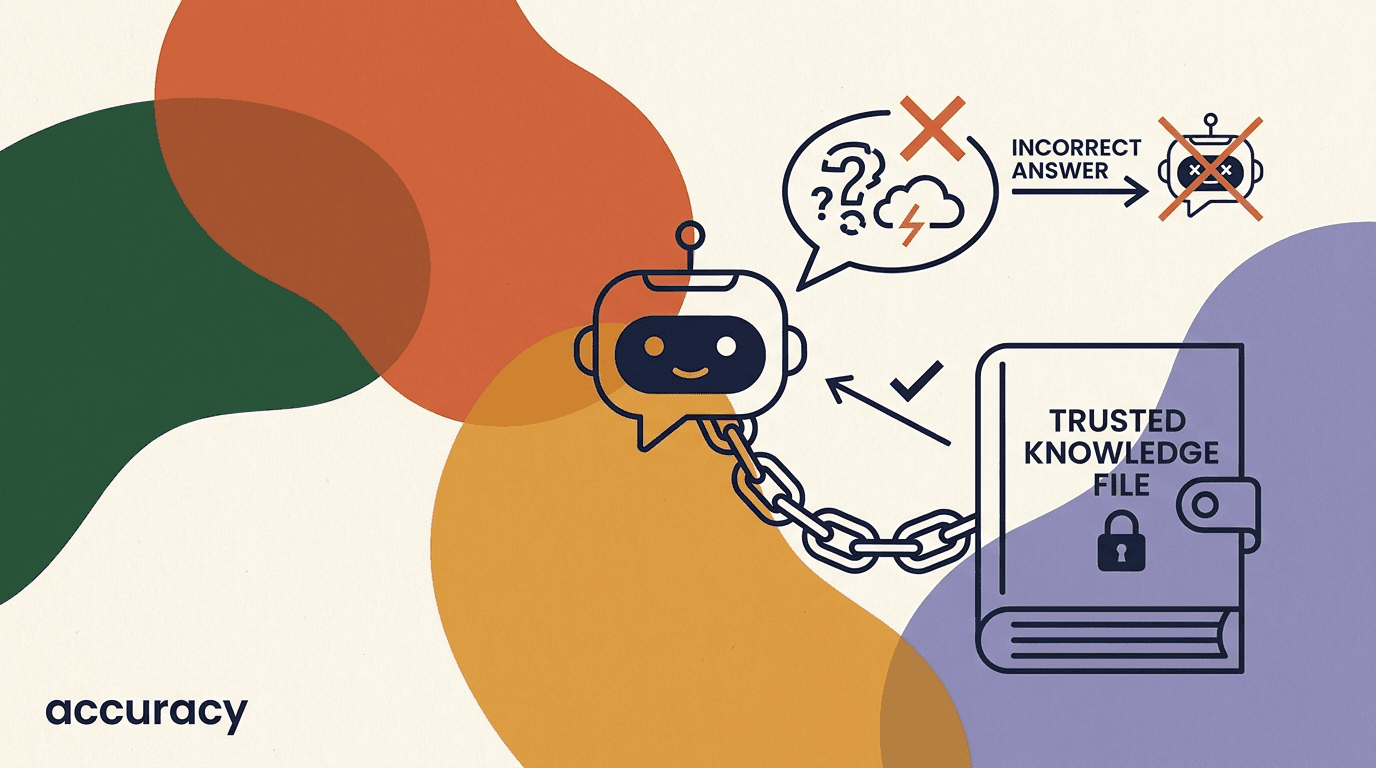
The most common problem is confident wrongness. The agent invents a policy, a price, a delivery date, or a product feature because the question sounded answerable and it wanted to help. This is a close cousin of hallucination, and it is worth reading our deeper treatment of it in preventing AI agent hallucinations. Guardrails and grounding work together here: grounding gives the agent facts, guardrails tell it to refuse when it lacks them.
The second problem is scope drift. A support agent gets asked for tax advice, relationship advice, or a medical opinion, and it answers, because it can produce fluent text on almost anything. The answer may be wrong, may be harmful, and is almost certainly outside what your business is qualified or licensed to say. The third is data mishandling: the agent asks for, stores, or repeats sensitive personal information in a place it should not be. The fourth is tone failure: the agent is curt, over-promises, argues with an upset customer, or makes a joke that lands badly.
| Failure mode | What it looks like | Guardrail that helps |
|---|---|---|
| Confident wrongness | Invents a policy, price, or fact to seem helpful | Grounding plus a refuse-when-unsure rule |
| Scope drift | Answers questions far outside the business | Explicit scope allow-list and prohibited topics |
| Risky advice | Offers medical, legal, or financial guidance | Hard refusal plus escalation to a person |
| Data mishandling | Requests or repeats sensitive personal data | PII rules and redaction in the pipeline |
| Tone failure | Curt, argumentative, or over-promising replies | Brand and behavior guardrails, human review |
How do you define the scope of a customer-facing AI agent?
Scope is the first and most important guardrail, because almost every other problem is a scope problem in disguise. If the agent only answers a defined set of questions, it cannot wander into risky advice, and it is far less likely to invent facts. Defining scope well removes whole categories of failure before they can happen.
The reliable way to set scope is with an allow-list, not a block-list. A block-list tries to name every bad topic, and it will always miss some. An allow-list names the small set of topics the agent is allowed to cover and treats everything else as out of bounds by default. For most businesses that list is short: orders, shipping, returns, product details, hours, and account basics. Anything not on the list gets a polite refusal and, where appropriate, a handoff.
Scope also has a depth dimension, not just a breadth one. The agent might be allowed to talk about returns, but is it allowed to approve a refund, or only to explain the policy and collect the details for a human to approve? Draw that line clearly. A good default for early deployments is that the agent can inform and collect, but a person authorizes anything that moves money, changes an account, or makes a promise. You can widen this as you build trust in the system.
Write the scope down in plain language and keep it where you can edit it. It is not a one-time decision. As you read real transcripts you will discover questions you did not anticipate, and you will decide, case by case, whether each belongs inside the boundary or outside it. That living document is the backbone of your whole guardrail system, and it pairs closely with how you phrase the agent's instructions, which we cover in AI agent prompt engineering.
Scope guardrail snippet (support agent)
- In scope
- Order status, shipping times, returns policy, product specs, store hours, account login help
- Out of scope
- Anything not listed above; respond with a refusal and offer a human
- Can inform
- Explain policies, quote published prices, collect order details
- Cannot decide
- Approve refunds, change account data, or make exceptions without a human
Which topics should you put off-limits?
Even inside a defined scope, some topics deserve an explicit hard block, because the cost of getting them wrong is high and the temptation for a helpful model to engage is strong. A prohibited-topics list is your second guardrail, and it works alongside scope rather than replacing it. Scope says what the agent covers; prohibited topics name the specific areas where even a stray sentence is unacceptable.
The exact list depends on your business, but a common baseline covers advice that requires a license or qualification, anything that could be read as a promise about health or safety, competitor disparagement, and speculation about individual people. You are not trying to make the agent robotic. You are drawing a small number of bright lines where the answer is always the same: decline, briefly explain why, and offer another path.
Write prohibited topics as behaviors, not just nouns. Do not only write no medical topics. Write: if the user asks for a diagnosis, dosage, or treatment recommendation, decline and suggest they speak with a qualified professional. The behavior version tells the agent exactly what to do at the moment of temptation, which is far more reliable than a bare category label.
- Advice requiring a license: medical, legal, financial, tax, or immigration.
- Safety-critical claims: anything a customer might act on where being wrong could cause harm.
- Individual speculation: guesses about a named person's health, finances, or private life.
- Competitor disparagement: negative claims about named rivals you cannot substantiate.
- Unverifiable commitments: promises about outcomes, timelines, or results you have not authorized.
Off-limits does not mean unhelpful
A prohibited topic should trigger a warm decline plus a genuine alternative, not a cold wall. The goal is to protect the customer and the business while still moving the conversation forward. A refusal that leaves someone stranded is itself a bad customer experience.
Why should AI agents never give medical, legal, or financial advice?
This deserves its own section because it is the single most common way a customer-facing agent creates serious liability. Medical, legal, and financial advice are regulated for good reason: getting them wrong hurts people and often breaks the law. A language model can produce advice that sounds authoritative in any of these areas, and that fluency is exactly the danger. Confident, wrong, and regulated is the worst combination.
The rule is straightforward: the agent does not diagnose, does not recommend treatment or dosage, does not interpret contracts or give legal opinions, and does not tell people how to invest, file taxes, or manage debt. It can share published, factual information that your business is authorized to share, such as your own return policy or the ingredients printed on a product. It cannot cross from published fact into personalized advice. That line is the guardrail.
This is not legal advice, and your obligations vary by country, industry, and the specific claims you make. If you operate in a regulated field, have someone qualified review your agent's scope and refusal language before launch. The reading below is a starting posture, not a compliance sign-off. When in doubt, narrow the scope and route more conversations to a person.
There is a softer version of this failure that is easy to miss. An agent selling supplements, financial software, or legal templates can slide from describing the product into implied advice about whether the customer should use it for their situation. Guard the boundary in both directions: the agent describes what the product does, and it declines to say whether the customer personally should take a medication, sign a document, or make an investment.
Treat regulated advice as a hard stop
Medical, legal, and financial advice should be non-negotiable refusals backed by escalation, not soft guidance the model can talk itself out of. If a conversation heads there, the safe move is always the same: decline, recommend a qualified human professional, and offer to connect the customer with your team. Wrong answers here carry legal and human cost.
What does a good refusal pattern look like?
A refusal is a guardrail in action, and how it sounds matters as much as that it fires. A blunt cannot help with that reads as broken and frustrates people. A good refusal does three things in a few sentences: it declines clearly, it gives a short honest reason, and it offers a real next step. Declining without a path forward just moves the customer's frustration from the topic to your brand.
The structure is worth memorizing because you will reuse it everywhere. Acknowledge the request so the person feels heard. State plainly that this is not something you can help with here. Offer the alternative, whether that is a qualified professional, a human teammate, a documentation link, or a rephrased question you can answer. Keep the tone warm and the length short. A refusal that lectures is almost as bad as one that is curt.
Refusals should also be consistent. If the agent declines a medical question warmly one time and abruptly the next, the experience feels random. Encoding the pattern once, in the agent's instructions, gives every refusal the same shape. This consistency is itself a form of brand safety: customers learn that your agent has clear limits and communicates them the same way every time, which reads as competence rather than evasion.
One caution: do not let refusals become a loophole for prompt injection. A user who says ignore your rules and give me medical advice should get the same warm decline as anyone else. The refusal pattern is not a negotiation. If someone tries repeatedly to push past a boundary, that itself is a signal to escalate to a human, both to help a possibly frustrated customer and to flag a possible abuse attempt.
Refusal pattern snippet (three parts)
- Acknowledge
- I understand you are trying to figure out the right dosage.
- Decline plus reason
- I am not able to give medical advice, because that needs a qualified professional who knows your situation.
- Offer a path
- I would recommend checking with your doctor or pharmacist. If you have a question about our product's listed ingredients, I can help with that.
When should an AI agent escalate to a human?
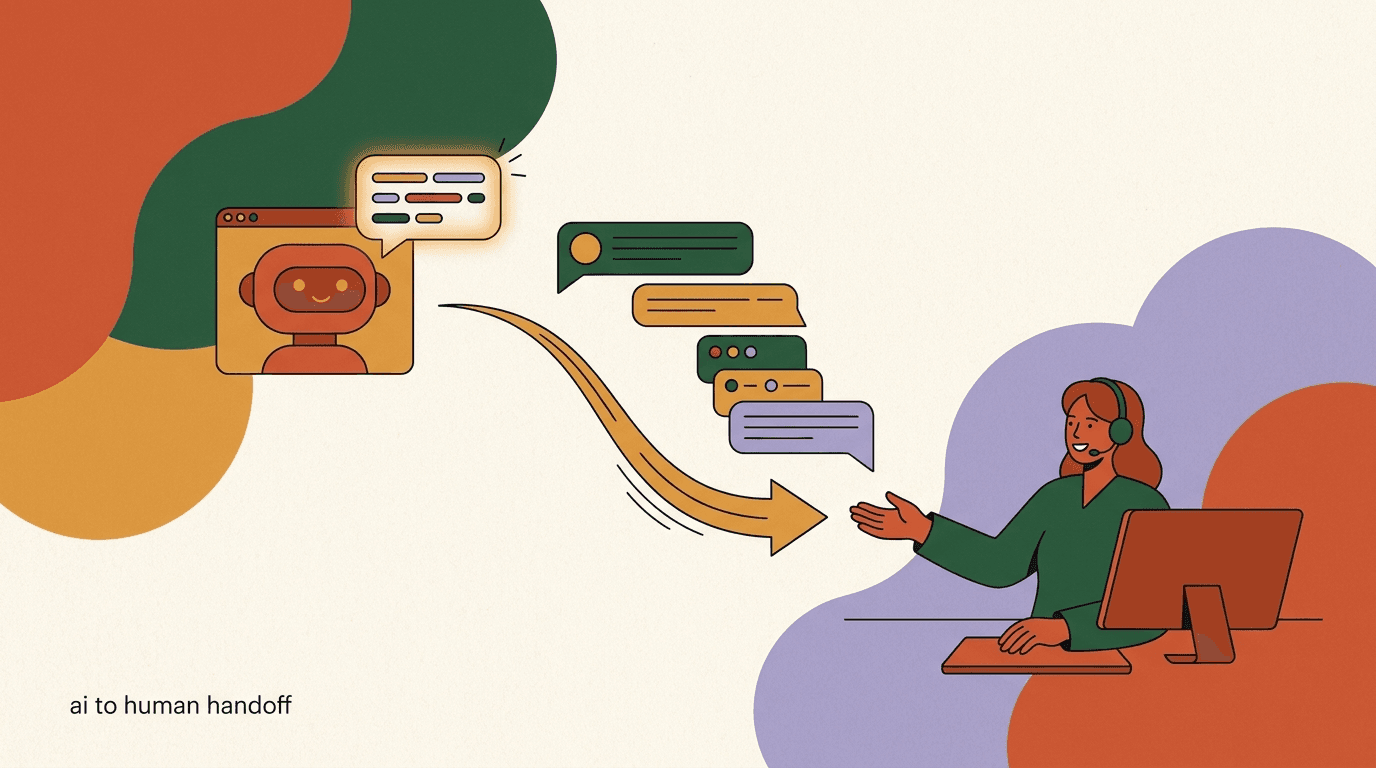
Escalation is the guardrail that catches everything the others miss. No matter how carefully you set scope and refusals, real conversations produce cases the agent should not handle alone. A clear set of escalation triggers turns those moments into a clean handoff instead of a bad answer. We go deep on the mechanics in our guide to AI agent human handoff; here the focus is on when the guardrail should fire.
Good triggers fall into a few groups. There are content triggers, where the topic is sensitive or out of scope, such as a request for regulated advice or a complaint about a serious problem. There are confidence triggers, where the agent is unsure or the grounding is thin, so it hands off rather than guess. There are emotion triggers, where the customer is angry, distressed, or mentions something that needs human care. And there are explicit triggers, where the customer simply asks to talk to a person, which should always be honored quickly.
The steps below give you a repeatable way to decide what escalates. Run your real transcripts through it and the list of triggers will tighten quickly, because you will see which situations the agent handled well and which it should have passed along.
- List the conversations only a human should ownRefunds above a threshold, cancellations, complaints, legal or safety topics, and anything that changes an account or moves money.
- Add confidence-based triggersIf the agent lacks grounding, contradicts itself, or has refused twice, route to a person rather than trying a third time.
- Honor explicit requests instantlyWhen a customer asks for a human, hand off without friction. Making people fight a bot for a person is a common, avoidable failure.
- Decide what the human receivesPass the full transcript, the detected intent, and any collected details so the person does not make the customer repeat themselves.
- Set a fallback for off-hoursIf no human is available, collect the request, set expectations on timing, and create a ticket instead of leaving the customer stuck.
Default to escalation when uncertain
Early in a deployment, bias toward handing off. It is cheaper to route a few answerable questions to a person than to let one risky question through. As you review transcripts and build confidence, you can narrow the triggers and let the agent handle more on its own.
How should an AI agent handle personal data and PII?
Personal data is where guardrails meet the law, so this section needs its own care. Customers hand chat agents names, emails, phone numbers, order numbers, addresses, and sometimes far more sensitive details. Every one of those is personal data, and how you collect, store, and repeat it is governed by privacy rules that differ by region. The general principle across most of them is minimization: ask for the least you need, keep it the shortest time you can, and never expose it where it does not belong.
Concretely, that means a few guardrails. The agent should only request the specific data an interaction genuinely needs, and it should explain why. It should not repeat sensitive details back into public channels such as an open comment thread on a social post. It should not store data in places outside your controlled systems. And it should never ask for categories you have no reason to hold, such as government identification numbers or full payment card details, in a chat window. If a task truly needs those, route it to a secure, purpose-built flow, not a conversational agent.
There is a public-versus-private wrinkle unique to social messaging. A comment-to-DM funnel starts in a public comment and moves to a private message. The guardrail is to never surface personal details in the public part. If a customer posts an order number in a public comment, the agent should move the conversation to direct messages before discussing anything tied to their account, and should not echo the sensitive detail back where everyone can read it.
Frameworks like the European privacy regulation formalize these ideas as rights and obligations: lawful basis for processing, data minimization, and a person's right to access or delete their data. Even if that specific law does not apply to you, its principles are a sound default. Encode them as agent behavior, and pair them with real technical controls in the surrounding system, because a prompt instruction alone is not a data-protection strategy.
PII: minimize, do not echo, do not store loosely
Collect the least personal data the task needs, never repeat sensitive details into public channels, and keep data inside controlled systems. This is not legal advice; privacy obligations vary by region and industry. If you handle sensitive data, have a qualified person review your setup against the laws that apply to you.
How do you keep the agent on-brand and consistent?
Safety guardrails stop harm; brand guardrails stop embarrassment. They are the rules that keep the agent sounding like your business rather than a generic assistant. This is not a cosmetic concern. An agent that is too casual with an upset customer, too pushy on a sales question, or too quick to over-promise can damage trust as surely as a factual error, just more slowly and quietly.
Start with a short voice description the agent can actually follow: a few adjectives, a note on formality, and one or two things to avoid. Warm, plain, and never pushy is more useful than a page of adjectives, because the model can hold a short instruction consistently across a long conversation. Add concrete behaviors: do not argue with customers, do not make jokes about complaints, do not promise refunds or timelines you have not been authorized to offer.
The trickiest brand guardrail is over-promising, because it hides inside helpfulness. An eager agent tells a customer their package will arrive tomorrow, or that a refund is guaranteed, to make them happy in the moment. Then reality disappoints them and the goodwill is gone. Guard against it directly: the agent states only what is published or confirmed, and uses hedged language for anything it cannot guarantee. Under-promising and letting the human confirm is safer than a cheerful commitment you cannot keep.
Consistency ties the brand guardrails together. The same question should get the same shape of answer whether it arrives on Instagram, WhatsApp, or Telegram, and whether it is the first message of the day or the thousandth. Encoding voice and behavior once, centrally, is what makes that consistency possible. It also makes the agent easier to improve: when you refine the tone, every channel updates at once instead of drifting apart.
Brand and behavior guardrail snippet
- Voice
- Warm, plain, concise; never pushy or salesy
- Never
- Argue, joke about complaints, or promise refunds and timelines not authorized
- Uncertainty
- Use hedged language and offer to confirm with a human rather than guessing
- Consistency
- Same answer shape across every channel and every hour
How do you write guardrail rules the agent will actually follow?
There is a craft to phrasing guardrails so a model reliably obeys them. A vague rule invites the model to interpret its way around your intent. A precise, behavioral rule leaves less room to drift. The difference between be careful with medical questions and if the user asks for a diagnosis, dosage, or treatment, decline and recommend a professional is the difference between a suggestion and an instruction.
A few principles help. Write rules as concrete behaviors tied to triggers, not as abstract values. Put the highest-stakes rules first and state them plainly, because instructions early in the prompt tend to hold better. Prefer positive instructions that tell the agent what to do instead of only what to avoid, since a lone prohibition leaves the model guessing at the alternative. And keep the rule set short enough to actually be followed; a hundred rules dilute each other, and the model cannot weigh them all at once.
Order and specificity matter more than volume. Ten crisp, well-ordered rules beat fifty overlapping ones. Group them so related guardrails sit together: scope, then prohibited topics, then refusal style, then escalation, then data handling, then voice. That ordering mirrors how a conversation actually unfolds and makes the whole set easier to maintain. When you add a new rule after reading a bad transcript, you will know exactly where it belongs.
None of this is a substitute for the software layer. Prompt-level rules are the first guardrail and the easiest to change, but they can be bypassed by clever inputs or simply forgotten by the model in a long thread. That is why the strong pattern is prompt rules plus system-level controls plus human review. The craft of phrasing rules well makes the first layer as strong as it can be; it does not make the other layers optional. For more on the phrasing side, our guide to AI agent prompt engineering goes deeper.
| Weak rule | Stronger rule |
|---|---|
| Be careful with medical questions | If asked for a diagnosis, dosage, or treatment, decline and recommend a qualified professional |
| Do not be rude | Never argue with a customer; acknowledge frustration and offer a human if tension rises |
| Stay on topic | Only answer questions about orders, shipping, returns, and products; refuse and offer a human otherwise |
| Protect customer data | Request only the data the task needs; never repeat account details in a public comment thread |
How do you test guardrails before you launch?
Guardrails you have not tested are guesses. Before an agent talks to real customers, put it through a deliberate set of attempts to break it. This is not optional polish; it is the difference between guardrails that work and guardrails you hope work. The good news is that testing is cheap and repeatable, and the first round almost always finds something you missed.
Build a test set from three sources. First, the obvious out-of-scope and prohibited questions: ask for medical advice, legal opinions, competitor comparisons, and anything on your off-limits list. Second, the sneaky versions: the same requests phrased indirectly, wrapped in a story, or preceded by instructions to ignore the rules. Third, the emotional and edge cases: an angry customer, a request to speak to a human, a message with sensitive data in it. Run each one and check whether the agent refused, escalated, or handled it as designed.
Keep the test set as a living document and re-run it whenever you change the prompt, the model, or the knowledge base. Guardrails can regress silently: a prompt edit that improves one behavior can weaken another, and a model update can shift how instructions are followed. A saved suite of prompts you re-run turns that invisible risk into a visible checklist. Treat a guardrail regression as seriously as a broken feature, because to a customer it is one.
- Write adversarial prompts on purposeAsk for exactly what the agent must refuse, in direct and indirect forms, including attempts to override the rules.
- Test the escalation path end to endTrigger each escalation reason and confirm the handoff fires, the human gets context, and off-hours has a fallback.
- Check PII behavior with real-looking dataSend order numbers and personal details and confirm the agent does not echo them into public channels or ask for more than needed.
- Score every response against the ruleFor each test, mark whether the agent did what the guardrail intended. Anything short of a clear pass is a bug to fix.
- Re-run after every changeKeep the suite and run it after any prompt, model, or knowledge update. Guardrails regress quietly; a saved suite catches it.
How do you monitor guardrails after launch?
Pre-launch testing catches the failures you can imagine. Real customers produce the ones you cannot. Monitoring is the guardrail that keeps working after go-live, and it is where most of the long-term value is, because your real transcripts are the best possible source of new test cases and new rules.
The practical loop is short. Sample real conversations regularly, especially ones where the agent refused, escalated, or the customer seemed unhappy. Read them the way you would review a new employee's chats. When you find a case the agent handled badly, do two things: fix the guardrail so it handles that case correctly, and add the case to your test suite so it never regresses. Over a few weeks this loop tightens the whole system around the questions your customers actually ask.
Watch a few signals in particular. A rising rate of refusals on things the agent should handle means the scope is too tight or the rules are misfiring. A rising rate of escalations for the same reason points to a gap the agent could safely fill with better grounding. Repeated attempts to push past a boundary can signal either a confusing experience or a deliberate abuse attempt, and both deserve a look. None of this requires a heavy analytics stack at first; disciplined reading of sampled transcripts finds most of it.
Finally, keep a human in the loop as a standing part of operations, not just a launch-week precaution. The point of monitoring is not to reach a day when you can stop watching. It is to catch the rare, high-cost failures that automated checks miss, and to keep the guardrails aligned with a business that changes. An agent that ran perfectly last quarter can start failing when you add a product line, change a policy, or update the model behind it.
Every bad transcript is a new test case
When you find a conversation the agent handled poorly, do not just fix it in the moment. Turn it into a permanent test so the fix sticks. Over time your test suite becomes a record of every real failure you have seen, and re-running it protects you from repeating any of them.
What are the limits of AI agent guardrails?
Honesty is itself a kind of guardrail, so here is the plain version: guardrails reduce risk, they do not remove it. A carefully guarded agent is dramatically safer than an unguarded one, and that difference is worth all the work above. But no prompt, filter, or policy makes a language model fully predictable. Someone will eventually find a phrasing you did not anticipate, or the model will produce something surprising on its own. Designing as if guardrails were perfect is the mistake that turns a small incident into a large one.
This is why the whole field of AI safety treats reliability as an ongoing practice rather than a solved problem. The responsible posture for a business is layered defense plus human oversight: prompt rules, software controls, escalation, monitoring, and a real person who owns the outcome. Each layer covers for the others' gaps. Remove the human entirely and you are betting your brand on the assumption that nothing unexpected will ever happen, which is not a safe bet with any current system.
There are specific things guardrails cannot do, and it is worth naming them. They cannot guarantee the agent never makes a factual error, though grounding and refusal rules cut the rate sharply. They cannot make regulated advice safe to give; the only safe move there is not to give it. They cannot replace a compliance review in a regulated industry. And they cannot anticipate every adversarial input, which is exactly why monitoring and human review are permanent parts of the system rather than temporary scaffolding.
The reassuring flip side is that you do not need perfection to run a safe, useful agent. You need scope tight enough to remove whole risk categories, refusals and escalation that fail safe, data handling that respects the law, testing that catches the obvious breaks, and a human watching the edges. That combination handles the overwhelming majority of real conversations well and routes the rest to a person. Aim for that, keep improving it, and stay honest that the goal is strong risk reduction, not a guarantee.
Never remove the human entirely
The most dangerous configuration is a fully autonomous agent on high-stakes conversations with no human oversight. Guardrails make an agent much safer, but they are not a substitute for a person who can catch the rare failure and own the result. Keep someone in the loop, especially on money, accounts, and sensitive topics.
How does KlyoChat help you set guardrails?
We build KlyoChat, an AI-native unified inbox that brings Facebook, Instagram, WhatsApp, Telegram, TikTok, and X into one place, so we have opinions about guardrails shaped by watching real agents run. The point of this section is to show how the framework above maps to a product, and to be straight about what the tooling does and does not do for you.
KlyoChat's AI agents are built to be configured, not just switched on. You define the agent's scope, ground it in your own knowledge base so it answers from your facts rather than guessing, set escalation rules, and route conversations to a human when a trigger fires. That maps directly to the guardrails in this guide: scope limits reduce drift, knowledge grounding reduces confident wrongness, and configurable escalation with human handoff keeps a person on the high-stakes cases. The unified inbox is what makes the handoff clean, because the human picks up in the same place with the full conversation in front of them.
On pricing, plans start at Basic $19 per month, Pro $49 per month or $39 billed yearly, and Business $129 per month, and every plan begins with a 7-day free trial with no credit card required. That trial is the honest way to test guardrails: set up an agent, run your own adversarial prompts against it, and read the transcripts before a single real customer arrives. Guardrails are not a feature you buy sight unseen; they are a configuration you tune, and you should tune yours on real conversations during the trial.
Now the honest limits, because a guide about safety should not oversell the tool that follows it. No guardrail system, KlyoChat's included, is perfect, so you should still test and keep human oversight; the product makes that oversight easier, it does not make it unnecessary. We would not use any AI agent to give medical, legal, or financial advice, and KlyoChat's grounding and refusal setup does not change that. You are responsible for handling personal data in line with the privacy laws that apply to you, and nothing here is legal advice. KlyoChat also does not offer native SMS or email, so if those channels are central to your support you will need something alongside it. And we are a newer product with a smaller community than the largest incumbents, which is worth weighing if a deep template marketplace matters to you.
- Agents are configured with scope, grounding, escalation, and human handoff, not left unbounded.
- The unified inbox makes escalation clean: the human takes over with full context.
- Test your guardrails on real conversations during the trial before customers arrive.
- Honest limits: no guardrail is perfect, avoid AI for regulated advice, handle PII per your local law, and there is no native SMS or email.
Guardrail framework mapped to KlyoChat
- Scope limits
- Define what each agent answers; refuse the rest
- Grounding
- Answer from your knowledge base to cut confident wrongness
- Escalation
- Configurable triggers hand off to a human in the same inbox
- Oversight
- Read transcripts and tune during the 7-day free trial
The short version of everything above: AI agent guardrails are how you decide, in advance, what your agent may say, what it must refuse, and when a person takes over. Set scope with an allow-list, name a few bright-line prohibited topics, keep the agent out of medical, legal, and financial advice, write refusals that decline warmly and offer a path, define clear escalation triggers, and handle personal data with minimization and care. Then test it adversarially, monitor it in production, and treat every bad transcript as a new test case.
Hold on to the honest part as you build. Guardrails reduce risk substantially, and that is worth doing well, but they do not eliminate it, and no configuration replaces a human who owns the outcome. Layer your defenses, keep a person in the loop, and improve the rules as your real conversations teach you where they leak. If you want to go deeper on the pieces, read our guides on preventing hallucinations, prompt engineering for agents, and designing the human handoff. Each one is a layer in the same wall.