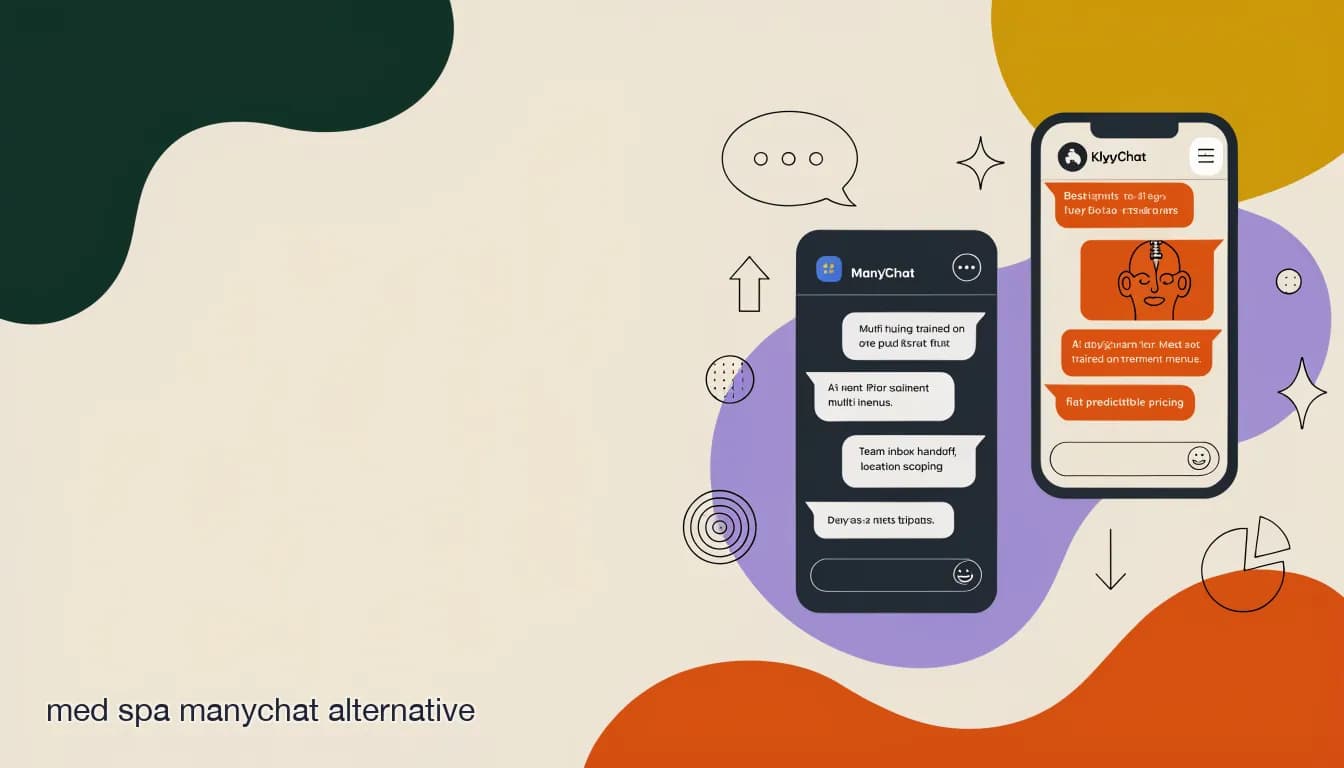
Med spa owners and front-desk managers searching for a med spa ManyChat alternative in 2026 are asking a specific question that generic tool-comparison roundups don't answer: which platform was actually designed for the way an aesthetic practice works? Not a D2C retailer. Not a creator with a course. A practice where the front desk fields forty identical 'how much does Botox cost?' DMs per week, where a filler special on Instagram sends comment volume through the roof, and where the team needs to hand a consultation inquiry from one staff member to another without losing context mid-thread.
The existing comparison content out there — Chatimize, Respond.io, Tidio, G2 roundups — isn't written with the aesthetic medicine vertical in mind. This post is. We build KlyoChat, so we have a side in this comparison, and we'll say so plainly throughout. We have worked to keep the analysis honest: ManyChat's real wins are stated clearly, KlyoChat's real limits are on the page, and we haven't invented a single competitor figure. Where ManyChat pricing scales above published tiers or a number is an estimate, we say so and point you to manychat.com to verify. The goal is a comparison you can trust regardless of which tool you end up choosing.
We go deeper on the general head-to-head in our full ManyChat vs KlyoChat comparison. This post focuses on the parts that matter specifically to a med spa: comment-to-DM for Botox and filler promotions, AI that can answer from your treatment menu, team inbox handoff for front-desk staff, multi-location coordination, and the privacy considerations that sit adjacent to clinical practice.
Why are med spas looking for a ManyChat alternative?
ManyChat is not a bad tool, and a number of aesthetic practices use it. The complaints that drive med spa teams to look elsewhere cluster around a few specific friction points — not a broad dissatisfaction with chat automation, but gaps between what a general-purpose platform offers and what an aesthetic practice's front desk actually needs day to day.
The most common issue is AI that doesn't fit the workflow. ManyChat's AI capability is its AI Step add-on — roughly +$29/month on top of whichever plan you're on — which places AI blocks inside a pre-built flow. That works for handling a discrete, predictable part of a conversation you've already mapped out. It doesn't work well when a prospect asks something like: 'I've been thinking about filler for my nasolabial folds, but I'm not sure if I'm a good candidate — what do you think?' That question requires contextual knowledge about your treatments and your practice's approach, not a branch in a decision tree. When a prospect falls outside the path the flow anticipated, ManyChat's AI either doesn't fire or delivers a catch-all response, and the inquiry sits waiting for a human who was supposed to have been replaced by the automation.
The second friction point is inbox management for a team. Med spas typically have two to five front-desk staff handling consultations, bookings, and follow-ups across multiple channels. When a Botox inquiry arrives on Instagram at 9 PM and is picked up by a different staff member at 9 AM the next morning, context needs to travel with that conversation — which location it's for, what pricing was mentioned, what the client said they were considering. Without internal notes and clear assignment, the next reply often starts from scratch, and sometimes contradicts what was already said. For a client who's deciding between your practice and the one three blocks away, that inconsistency can be the deciding factor.
A third pattern: comment-to-DM is either not set up at all, or it is capturing DMs but the follow-up automation doesn't qualify well enough to convert. A practice can receive 200 DMs from a Botox special post and book almost none of them if the flow sends a pricing guide and then goes quiet. The practices that see results have automation that qualifies, answers a follow-up question, and routes to a booking link — and that requires more AI flexibility than a keyword-triggered decision tree reliably offers.
If your current setup is working, this post won't tell you to switch
ManyChat is a mature, widely-used platform with a large community. If you have a working automation build and your front desk is satisfied with the inbox experience, the case for switching is weaker than for a practice that hasn't found a tool that fits its workflow. Read for the axes that matter to your specific situation — not for an overall verdict.
What does a med spa actually need from a chat automation tool?
Before comparing platforms, it helps to be precise about what the job is for a med spa. The requirements differ enough from an e-commerce store or a content creator that 'best automation tool' answers from generic comparison content don't translate cleanly. A practice running Instagram promotions with a front-desk team of three has genuinely different needs from a DTC brand with a product catalog and a solo marketing manager.
The table below lists the core requirements we hear from med spa teams evaluating automation tools, and why each one matters operationally. Use it as a checklist when comparing any two platforms: if a tool doesn't cover your top four or five requirements, no feature elsewhere compensates.
- Most med spas handle 20–100 DMs per day depending on how actively they post promotions — even modest AI that answers pricing questions reduces front-desk workload noticeably.
- Instagram comment-to-DM is the highest-leverage automation for most practices: Botox, filler, and laser content drives organic engagement, and every non-automated comment is a potential consult that may book elsewhere.
- Aftercare questions happen outside business hours by definition — a client who had a chemical peel doesn't schedule their post-procedure concerns for 9 AM on a Monday.
- The team inbox is the daily-use surface for most front-desk staff, which makes it the real decision driver when evaluating tools — not the flow builder or the AI settings page.
| Requirement | Why it matters for a med spa |
|---|---|
| AI trained on your treatment menu and pricing ranges | Answers 'how much is 20 units of Botox?' without a human typing the same reply 40 times a day |
| Comment-to-DM for Instagram promotions | Converts engagement on a Botox or filler special post into a private conversation and, ultimately, a booked consult |
| Consultation qualification flow | Screens leads before a front-desk call or booking link is shared, so staff spend time on ready-to-book prospects |
| Aftercare Q&A from your own protocols | Lets a client who had a peel last week ask if their reaction is normal at 11 PM — and get an accurate answer from your own protocols |
| Team inbox with handoff and internal notes | Multiple staff; a conversation started by one team member needs full context when another picks it up |
| Multi-location role scoping | Separate inbox access per location; location A staff should not see conversations belonging to location B |
| Data handling consistent with a clinical setting | Encrypted messages, no training on your client data, audit logs for access |
| Booking software link-out | Automation routes qualified leads to Mindbody, Jane App, or your scheduling tool — it doesn't replace it |
How do the AI capabilities compare for a med spa's use case?
This is the capability that most often drives the evaluation, and it is worth being precise about how each platform actually does AI — not which marketing page mentions 'AI' more often, but how the AI actually works when a prospect sends a DM at 9 PM asking about lip filler.
ManyChat's AI is the AI Step add-on, priced at approximately +$29/month added to whichever plan you are on. It places AI blocks inside a flow, which means the AI fires when a conversation reaches a step you have already designed. For handling a defined, predictable part of a conversation — detecting intent, drafting a closing message, answering a narrow FAQ within a path — it works. The limitation for a med spa is that clients rarely stay on the path you drew. A prospect who DMs 'I'm on Ozempic, does that affect filler placement?' is not on any flow you pre-built. Without a route to reach the AI Step, the conversation either delivers a generic response or sits waiting for a human who was supposed to have been replaced by the automation.
KlyoChat's AI is a standalone agent. You build the agent, attach a knowledge base — your treatment menu, pricing ranges in the phrasing your front desk would use, FAQs, aftercare instructions, escalation signals for clinical language — and it answers inbound conversations across your connected channels as a first responder. It doesn't wait for a specific flow state; it handles the conversation from the opening message and hands off to your team inbox when it encounters something outside its knowledge or flags a concern that needs human judgment. AI agents are included in KlyoChat Pro and Business plans. They are not a separate add-on charge.
Priya, the office manager at Glow & Co Aesthetics in Chicago, described the practical difference clearly: 'We had ManyChat set up for about six months. It caught the obvious stuff — people typing exactly the keyword we expected. Anything that needed actual judgment, like someone asking whether their medication would interact with treatment, just fell out of the flow and ended up in my inbox anyway. The whole point was to reduce that pile, not just catch the easy ones.'
Price your knowledge base in ranges, not fixed numbers
Train your AI agent with statements like 'Botox typically runs $12–$16 per unit depending on treatment area and provider; your exact quote comes from a consultation.' Fixed prices create problems when you run a promotion, change providers, or adjust your menu — and they create risk if a client holds you to a number that changes. Ranges are honest, they give the front desk room to have the real pricing conversation, and they set accurate expectations before the consult.
Answering a filler pricing question at 9 PM — same scenario, two tools
- ManyChat AI Step
- Fires only if the conversation reaches the pricing step you designed; outside that path, the message waits for a human or gets a keyword catch-all
- KlyoChat AI agent
- Reads your pricing ranges and treatment descriptions from the knowledge base, answers directly on any connected channel, and offers a booking link or escalates if the question needs clinical judgment
How does comment-to-DM work for Botox and filler promotions?
Comment-to-DM is arguably the single highest-ROI automation a med spa can run on Instagram. When you post a Botox special, a new lip filler service, or a before-and-after Reel, some percentage of the engagement comes from people who are actively interested in booking. Converting that public engagement into a private conversation — and from there into a booked consultation — is a step most practices either skip entirely or handle manually. Both ManyChat and KlyoChat support comment-to-DM. The difference is in how far the automation can carry the conversation once the DM starts.
The following setup sequence is for a comment-to-DM funnel targeting a Botox promotion. The trigger and first DM work similarly on either platform; where KlyoChat's AI agent makes the difference is in steps three through five, where the conversation gets specific and requires real knowledge of your practice and treatments.
- Post your promotion with a comment triggerPublish the Instagram post or Reel promoting your special and include a clear call-to-action in the caption: 'Comment BOTOX below and we'll send you our spring pricing guide directly.' The trigger word needs to be in the caption so followers know what to type. Keep it short and treatment-specific — 'BOTOX,' 'FILLER,' 'LASER,' or the treatment name — rather than a generic word that will fire on unrelated comments.
- Configure the keyword trigger in your automation toolIn KlyoChat (or ManyChat), set the comment keyword trigger to match the word in your caption. Both platforms support exact-match and partial-match triggers; for Botox, partial match is usually right so that 'botox,' 'Botox,' and 'BOTOX' all fire the same flow. Add a short delay of 30–60 seconds so the DM doesn't arrive before the commenter finishes scrolling. Configure a polite like or emoji reaction to the original comment as a confirmation signal — it feels personal and reassures the commenter something is happening.
- Deliver the DM and ask one qualifying questionThe opening DM delivers the promised content — pricing guide, treatment overview, or a short FAQ — and then asks exactly one qualifying question: 'What area are you thinking about treating?' or 'Have you had Botox before, or would this be your first time?' One question is enough. Two or more in the first message feels like an intake form, and drop-off increases sharply. Keep the first message under 150 words and make it read like your front desk wrote it, not like a chatbot.
- Route qualified leads to the booking linkBased on the qualifying answer, the next message includes your booking link — Mindbody, Jane App, Acuity, or your scheduling tool — with a specific, low-friction CTA: 'It sounds like you'd be a great fit for a Botox consultation. Here's how to book a 30-minute slot with our team.' KlyoChat's AI agent handles this routing from your knowledge base without requiring explicit branches for every possible qualifying answer. It reads the intent and responds accordingly, so you're not building a separate path for every variation of 'yes, I'm interested.'
- Escalate clinical or sensitive questions to a human immediatelyAny conversation that mentions clinical language — 'I had a reaction,' 'I'm on medication,' 'I had a bad experience,' 'I'm pregnant' — should route directly to your team inbox for a human reply, not an automated response. Set keyword escalation triggers for phrases like 'reaction,' 'allergy,' 'medication,' 'pregnant,' and 'side effect.' In KlyoChat, the AI agent is trained to recognize escalation signals and hand off to the assigned team member in the inbox with a clear notification, rather than attempting an autonomous answer for anything clinically adjacent.
Which is better for a multi-location med spa chain?
Multi-location management is where inbox architecture becomes operational rather than theoretical, and where the differences between platforms show up in daily practice rather than on a feature-comparison page. A single-location practice and a five-location aesthetics group have genuinely different coordination problems, and most general-purpose comparison content doesn't distinguish between them.
A two-to-five-location group has a problem a solo practice doesn't: which location does this inquiry belong to, who is the right person to respond, and how do you prevent client conversations from crossing between locations in ways that expose information a staff member at location A shouldn't be handling for location B? An inquiry that comes through the main Instagram account might be for any of three locations. The person who picks it up needs to know which one before they reply with location-specific pricing, provider availability, or parking directions.
KlyoChat's team inbox is built for this coordination. Conversations are assigned to specific team members, role permissions are scoped so location A staff see only location A conversations, and internal notes carry context through the thread — which location, what the client mentioned, what pricing was quoted — for whoever picks it up next. The @mention feature lets a manager or senior nurse be looped into a complex clinical question without exposing the full thread to the rest of the team. Per-agent knowledge bases mean you can configure a separate AI agent for each location, trained on that location's specific providers, pricing, and availability, so the automated answers are actually correct for the location the client is asking about.
ManyChat handles multi-location through its account structure and integration ecosystem, and for a single-location practice it is perfectly capable. For a multi-location group, ManyChat's team collaboration features — internal notes, @mentions, and granular role scoping per location — are lighter than KlyoChat's native capability. This is a practical distinction that matters daily at scale, not a marketing-page talking point.
| Capability | ManyChat | KlyoChat |
|---|---|---|
| Assign conversation to a specific staff member | Yes | Yes |
| Internal notes visible only to your team | Limited | Yes |
| @mention a colleague within a thread | Limited | Yes |
| Role-scoped inbox access by location | Via account structure | Native permission layer |
| Snooze a thread for scheduled follow-up | Limited | Yes |
| Per-location AI agent with a separate knowledge base | Requires separate account or flow configuration | Native per-agent knowledge base |
Before we get to pricing, a brief note on SMS — because it comes up in almost every med spa evaluation. Many practices already use their booking software (Mindbody, Jane App, or similar) to send SMS appointment reminders and confirmations. If that is true for your practice, the question is not really 'do I need SMS in my chat automation tool?' — it is 'do I need a second SMS system on top of the one my booking software already runs?' For most practices, the honest answer is no. ManyChat's SMS capability is a genuine advantage for practices that don't have a booking system handling reminders, or that want to run SMS marketing broadcasts through the same tool as their DM automation. But it is worth being clear about whether that actually describes your situation before letting SMS become the deciding factor in a comparison where everything else points the other direction.
Is KlyoChat cheaper for a typical med spa's contact volume?
A mid-size med spa might have 2,000 active client contacts and 300–500 new inbound inquiries a month. A growing practice or small chain might run 5,000–15,000 contacts with significantly higher DM volume. Pricing at those levels looks meaningfully different depending on whether the model charges per contact or per flat tier.
ManyChat publishes the following tiers: Free at 25 contacts, Essential at roughly $14/month for 250 contacts, Pro at roughly $29/month for 2,500, and Business at roughly $69/month for 7,500 — then a sliding scale above that. Always verify current numbers on manychat.com before budgeting; tiers and pricing change, and any figure here may already be out of date. The AI Step add-on is approximately +$29/month on top of your plan. WhatsApp requires at least the Pro tier, plus Meta's per-conversation fees charged by Meta separately. A practice running AI and WhatsApp at 5,000 contacts is looking at an estimated $87–120+/month in platform subscription alone — we flag this as directional and you should verify it on manychat.com before you build a budget around it.
KlyoChat uses flat bundled plans: Basic at $19/month ($15 billed yearly). Pro at $49/month ($39 yearly) with all supported channels, 10,000 contacts, custom AI agents with a knowledge base, and 5,000 AI replies per month included. Business at $129/month ($109 yearly) with 50,000 contacts, 25,000 AI replies, API access, and e-commerce integrations. Growing from 5,000 to 9,000 contacts does not change your Pro bill. The AI agent is included — there is no separate AI charge layered on top. WhatsApp incurs Meta's per-conversation fees on either platform; those are a Meta charge, not a platform subscription cost.
| Practice size / setup | ManyChat (effective) | KlyoChat |
|---|---|---|
| Entry point | Free (25 contacts) / ~$14/mo Essential | $19/mo Basic; 7-day trial, no card required |
| ~2,500 contacts, no AI | ~$29/mo Pro (verify on manychat.com) | $19/mo Basic |
| ~5,000 contacts + AI agent | ~$87–120+/mo estimate (Pro + AI Step; verify on manychat.com) | $49/mo Pro, AI agent included |
| ~10,000 contacts + AI + WhatsApp | $150+/mo estimate (verify on manychat.com) + Meta fees | $49/mo Pro + Meta fees |
| AI knowledge base included in plan | No — AI Step is a separate add-on (~+$29/mo) | Yes — included in Pro and Business |
Compare fully-loaded setups, not just the base tier sticker price
The only fair comparison is the total monthly cost at your projected contact count with the features you will actually use — AI and WhatsApp included. ManyChat's entry tier and KlyoChat's entry tier are not measuring the same capability set once you layer in AI and WhatsApp. Verify both vendors' current pricing on their own pages before making a budget decision. ManyChat's pricing in particular scales in ways that any third-party estimate can quickly understate above 7,500 contacts.
What about privacy and HIPAA-adjacent concerns for a med spa?
This section requires a direct statement up front: we are not lawyers, this is not legal advice, and nothing here constitutes a HIPAA compliance determination for your practice. Whether HIPAA applies to your specific services, in your jurisdiction, is a question for your healthcare attorney or compliance officer. Med spas sit in a legal gray area — some services and some communications may be covered; others may not be. Get that determination before you decide how to configure any messaging tool that touches client conversations.
With that clear, here is what you can evaluate about each platform's data handling. KlyoChat encrypts messages in transit and at rest, applies role-scoped permissions by default so staff access only what they are assigned, maintains audit logs of conversation access, and does not train its AI models on your client conversations or your knowledge base content. That last point matters specifically for a med spa: if your knowledge base includes clinical protocols, aftercare instructions, or practitioner-specific FAQs, that content is yours and is not used to improve a shared model or a shared dataset.
ManyChat is a mature platform with standard enterprise data security practices. If HIPAA applies to your practice, you would need to evaluate whether a Business Associate Agreement is available and whether ManyChat's data processing practices are compatible with your compliance obligations. This is a standard due-diligence step for any SaaS tool used in a healthcare-adjacent context, not a criticism specific to ManyChat.
The cleaner practical boundary to draw — regardless of which tool you choose — is in what the automation actually handles. DM automation is the right place for marketing qualification, pricing questions, promotion responses, and booking link delivery. It is not the right place for clinical intake, medical history collection, medication disclosures, or anything that would constitute protected health information. That data belongs in your electronic health record system or booking software — Mindbody, Jane App, Cerbo, or similar — which are purpose-built and, where applicable, certified for medical data handling. Set this boundary clearly in your automation design and document it in your internal policy before you build.
Do not collect clinical intake data through DM automation
DM channels are appropriate for marketing, lead qualification, pricing Q&A, and booking link delivery. Medical history, allergy disclosures, consent forms, and intake questionnaires belong in your EMR or booking software — not in a chat thread on Instagram or Facebook. This boundary protects your clients and your practice. Train your AI agent to recognize clinical intake questions and direct the prospect to your intake form, rather than attempting to collect that information in the conversation.
How do the support and community resources compare?
ManyChat's community is its most underrated non-channel advantage, and it matters more for a med spa than the section heading implies. ManyChat has the largest user base in this category by a wide margin. That translates into a large template marketplace — and while not all templates are written specifically for aesthetics, med-spa-adjacent flows for lead capture, FAQ automation, and consultation booking exist and are findable. It also means an active community forum, a large catalog of third-party tutorials and courses (many free), and an agency and partner ecosystem that includes people who specialize in healthcare and aesthetic marketing. If you want to hire a certified ManyChat expert who has already built Botox comment-to-DM funnels for aesthetics clinics and can implement yours in a week, that person exists — and there are several.
KlyoChat is newer. The community is smaller, the template library is shorter, and there are fewer third-party resources specifically for med spas. That is the honest reality of being the newer product, and we are not going to paper over it. What KlyoChat offers instead is direct support: guided onboarding, help building your first flows, and a team you can contact that will walk you through setting up your treatment-menu knowledge base, not point you to a search bar and a forum thread. Whether that is better depends on how you prefer to get unstuck. A large self-serve ecosystem and direct human support are both legitimate; they are not the same thing, and which fits better depends on how your team works.
- ManyChat win: the largest community in the category, with documented agency partners in the healthcare and aesthetic vertical.
- ManyChat win: a template marketplace with ready-to-use flows for lead capture and consultation booking, reducing the time to your first working automation.
- ManyChat win: an extensive library of third-party tutorials, YouTube walkthroughs, and certified experts available to hire.
- KlyoChat win: direct onboarding and migration support — a team that helps you build, not a search bar.
- KlyoChat win: knowledge base builder purpose-built for AI agents, with hands-on guidance for structuring treatment-menu content correctly.
- KlyoChat limit: a smaller community with fewer existing med-spa-specific templates and third-party resources. More flows will start from scratch or from KlyoChat's own template library than on ManyChat.
Who should choose ManyChat, and who should choose KlyoChat, for a med spa?
Here is the honest two-way recommendation. Neither answer is 'always us.' The right tool depends on which two or three capabilities your practice actually uses every day — not on which platform has the longer feature list or the most recent product update.
Choose ManyChat if your practice already runs SMS appointment reminders or email sequences through the same tool as your DM automation, or if you plan to. This is the decisive channel advantage and KlyoChat cannot serve it natively — we are not going to spin that. Choose ManyChat if your team relies heavily on a template marketplace and community resources. A solo nurse practitioner without a dedicated marketing person who needs a pre-built consultation flow up and running this week benefits meaningfully from ManyChat's ecosystem. Choose ManyChat if your current ManyChat build is working, your front desk is comfortable with it, and the ceiling you're hitting is not specifically an AI-depth or team-inbox problem.
Choose KlyoChat if your core need is an AI agent that answers pricing questions, consult inquiries, and aftercare questions from your own treatment menu — and you want that included in the plan rather than billed as a +$29/month add-on. Choose KlyoChat if you run a multi-location practice and need a real team inbox: assign, @mention, internal notes, and role-scoped access per location. Choose KlyoChat if you or your front-desk manager build and edit automation from a phone — KlyoChat supports full mobile flow editing; ManyChat's mobile app is inbox-only. Choose KlyoChat if flat, predictable monthly pricing matters for a practice that is actively growing its DM volume and does not want the bill to scale unpredictably as your contact list grows.
- Choose ManyChat: you need SMS reminders or email marketing in the same platform as your DM automation.
- Choose ManyChat: you rely on templates and a large community, especially without a dedicated marketing person on staff.
- Choose ManyChat: your current ManyChat build is working and you are not hitting a specific AI or team-inbox ceiling.
- Choose KlyoChat: you want an AI agent trained on your treatment menu and included in the plan, not a per-month add-on.
- Choose KlyoChat: you run multiple locations and need real team inbox handoff — notes, assignment, role scoping per site.
- Choose KlyoChat: you edit automation from your phone and need more than an inbox-only mobile app.
- Choose KlyoChat: flat, predictable monthly pricing matters as your contact volume grows.
Two med-spa scenarios, two different answers
- A solo aesthetics nurse whose booking software handles SMS, wanting a comment-to-DM funnel for Instagram specials
- ManyChat — SMS already handled elsewhere; template marketplace helps a solo operator get a flow live fast without building from scratch
- A three-location aesthetics group needing AI to answer pricing DMs, team handoff between front-desk staff, and per-location inbox access
- KlyoChat — AI agent from the knowledge base, team inbox with notes and @mention, and role-scoped access per location are the right fit for this workflow
What does KlyoChat offer a med spa, in one place?
Since we have been pulling the comparison apart section by section, here is what KlyoChat offers a med spa gathered in one view — not as a feature list, but as an operational picture of how the tool fits into a practice's actual workflow.
KlyoChat is a unified inbox that today covers Facebook, Instagram, and Telegram, with WhatsApp rolling out and TikTok and X to follow. A med spa connecting its Instagram and Facebook accounts has two of the highest-volume DM channels for aesthetic practices covered from day one. No-code automation handles comment-to-DM funnels for Botox and filler promotions, and broadcasts let you message segmented contact lists — a re-engagement campaign for clients who haven't visited in six months, or a seasonal promotion to your filler-interested segment. The team inbox handles assign, @mention, internal notes, snooze, and an AI co-pilot that drafts replies for your front desk to review and send. Custom AI agents, included in the Pro plan, answer inbound questions from a knowledge base you build and maintain — your treatment menu, pricing ranges, aftercare instructions, escalation signals. The whole platform runs on a 7-day free trial with no credit card required.
- Connect your Instagram and Facebook channelsStart with the two highest-volume DM channels for most aesthetic practices. Connection is OAuth — a few clicks per channel. Leave your existing tools running in parallel during the evaluation so there's no gap in coverage. If you also use Telegram for client follow-up, add that in the same session. WhatsApp can be connected when it becomes available on your account.
- Build your AI agent knowledge baseCreate a new AI agent and load your treatment content: service names, descriptions, pricing ranges (stated as ranges, not fixed prices), candidacy notes for each treatment, your standard FAQ answers — the fifteen questions your front desk answers every day. Add aftercare protocols for the treatments you perform most often. Add escalation instructions: if the client mentions a clinical concern, reaction, or medical history question, the agent hands off to your team inbox immediately rather than attempting an autonomous answer.
- Set up your first comment-to-DM funnelBuild the funnel for your next Instagram promotion: keyword trigger, opening DM with pricing or the promotion content, one qualifying question, and a routing step that delivers the booking link to ready-to-book leads and escalates clinical questions to your team inbox. Test it with a private post before you go live publicly. This is the highest-return first flow for most med spas — it converts existing Instagram engagement that is currently going unaddressed.
- Configure your team inbox for your front-desk teamAdd team members, assign roles, and establish your handoff protocol: who receives new unassigned conversations, who handles the AI agent's escalations, and who covers after-hours clinical questions. If you run multiple locations, set role permissions so each location's staff access only their location's conversations. Write a brief internal protocol note — three to five lines — and leave it pinned for each team member. It prevents a significant amount of first-week confusion.
- Start the 7-day free trial and run it on real trafficNo credit card required. Use your real Instagram account, build the flows your practice actually needs, and have your front-desk team use the inbox for a full week of live conversations. One week of real use tells you more than any feature comparison. If KlyoChat fits your practice, you'll know. If something doesn't work for your workflow, you'll know that too — and the team will help you figure out whether it's a configuration issue or a genuine mismatch. Start at https://app.klyochat.com/signup.
KlyoChat does not have native SMS or email — stated plainly
We will say this here rather than let it get lost in a footnote: KlyoChat has no native SMS or email channel. If your practice needs to run SMS appointment reminders or email marketing sequences through the same platform as your DM automation, ManyChat is the better fit on channels alone. If your booking software already handles SMS reminders and you primarily need DM automation with an AI agent and a capable team inbox, that limit may not affect your actual daily workflow at all. Be honest with yourself about which situation describes your practice.
The choice between ManyChat and KlyoChat for a med spa comes down to which two or three capabilities your front desk uses every day. If SMS reminders or email sequences need to live in the same platform as your Instagram DMs, ManyChat is the tool — that is the channel advantage, and KlyoChat cannot match it natively. If your priority is an AI agent that answers Botox and filler pricing questions from your own treatment menu without a per-month add-on, a team inbox your staff can actually use across locations, and predictable pricing as your contact volume grows, KlyoChat was built for exactly those jobs.
For the full head-to-head across every dimension — not just the med-spa lens — read our full ManyChat vs KlyoChat comparison. For a deeper look at managing multiple locations in one shared inbox, see our guide to multi-location shared inboxes for med spas. And for the privacy and compliance questions specific to aesthetic practices, our post on HIPAA-adjacent chatbot considerations for med spas covers what to evaluate and what boundaries to draw before you build.